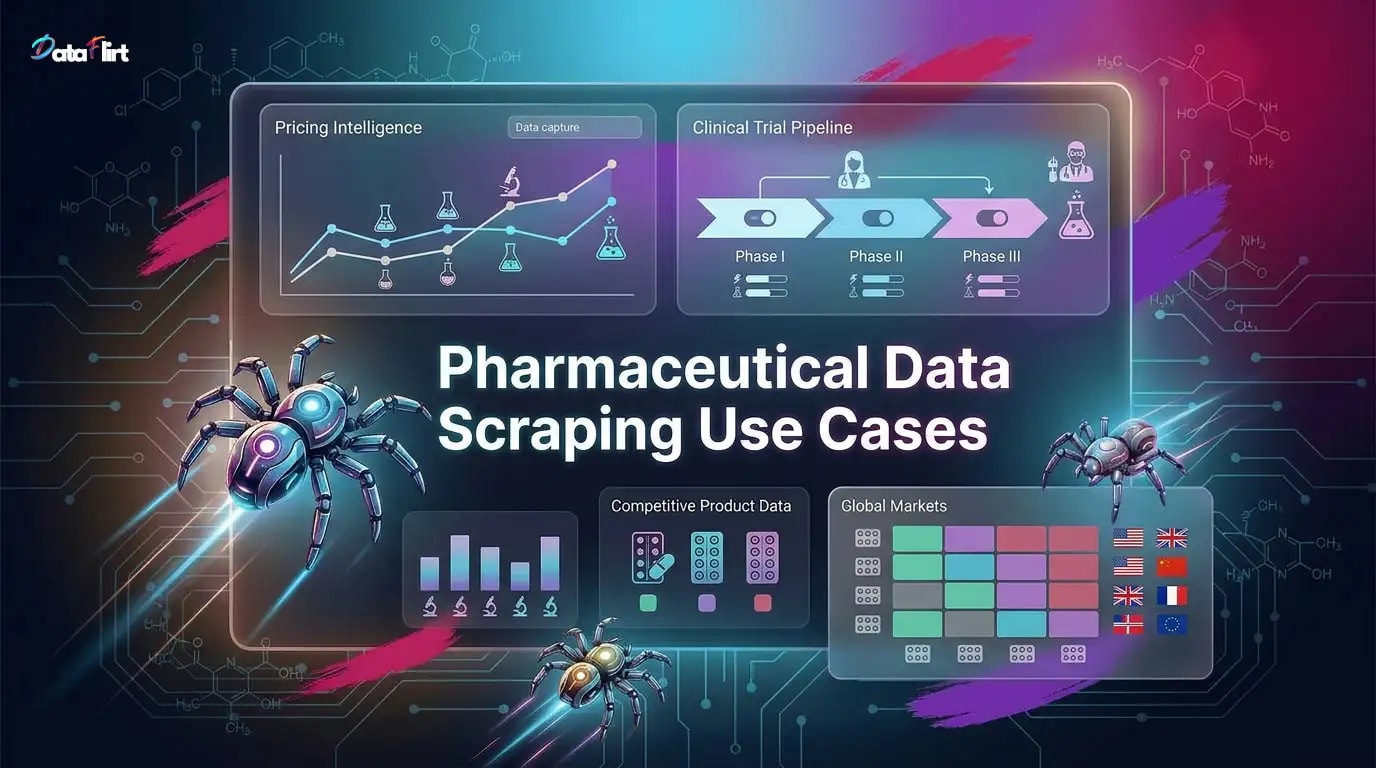

The $1.5 Trillion Transparency Problem: Why Pharmaceutical Data Scraping Is Now a Strategic Imperative
The global pharmaceutical market reached approximately $1.5 trillion in revenue in 2025, with prescription drug spending alone accounting for over $600 billion in the United States. Yet despite operating at this scale, the data infrastructure that most pharmaceutical companies, biotech startups, healthcare analytics firms, and payer organizations rely on for competitive intelligence, pricing strategy, and market analysis remains surprisingly opaque, fragmented, and expensive.
Licensed pharmaceutical databases provide structured drug information, but they operate on quarterly update cycles, exclude critical data categories like real-time pharmacy pricing and cross-border price variations, impose strict redistribution limits, and cover only a subset of global markets. Clinical trial registries like ClinicalTrials.gov are comprehensive but require manual extraction for competitive pipeline analysis. Regulatory databases publish FDA approvals and patent filings, but accessing this data at scale for trend analysis requires systematic collection that no commercial vendor currently offers in a usable format.
Prescription drug pricing in the United States varies by as much as 300% across pharmacy chains and geographic markets for identical formulations. Generic drug entry reduces brand prices by an average of 40-60% within six months of launch, but predicting the exact timing and competitive response requires patent expiry intelligence and regulatory filing tracking that standard databases do not deliver in real time. Biosimilar penetration rates, orphan drug pricing strategies, and specialty pharmacy formulary positioning are all data points that exist in fragmented, publicly accessible sources but are not aggregated, normalized, or delivered in decision-ready formats.
This is the transparency gap that pharmaceutical data scraping directly addresses.
“The pharmaceutical industry generates more publicly accessible regulatory, clinical, pricing, and product data than almost any other sector, but most of that intelligence sits in siloed databases, regional pharmacy portals, and regulatory filing systems. The competitive advantage belongs to the organizations that can systematically extract, normalize, and operationalize that data faster than their competitors.”
The scale of publicly available pharmaceutical data on the web is genuinely extraordinary. The FDA publishes over 1,500 new drug approvals, labeling updates, and safety communications annually. ClinicalTrials.gov hosts more than 450,000 registered studies across 220 countries. Online pharmacy platforms in the United States alone list pricing and availability data for over 20,000 prescription medications across thousands of retail locations. European Medicines Agency databases publish regulatory decisions, orphan drug designations, and pediatric investigation plans covering the entire EU market. Patent databases maintained by the USPTO, EPO, and WIPO contain filing records, prosecution histories, and expiry timelines for millions of pharmaceutical patents.
Pharmaceutical data scraping is the systematic, programmatic extraction of this intelligence at scale. When executed with proper data quality controls, therapeutic classification mapping, and delivery formats that integrate cleanly into existing pharmaceutical analytical workflows, it becomes a foundational capability for any organization competing on drug market knowledge.
The global pharmaceutical data analytics market itself, valued at approximately $5.2 billion in 2024, is projected to exceed $12.8 billion by 2032, growing at a compound annual rate of over 12%. A substantial portion of that growth is being driven by real-world evidence platforms, drug pricing transparency tools, competitive intelligence dashboards, and clinical development analytics products, nearly all of which rely on pharmaceutical data scraping as a core data acquisition method.
Who should read this pharmaceutical intelligence guide?
Read this if you are:
- a market intelligence analyst at a pharmaceutical company trying to understand how drug pricing intelligence and competitive pipeline data can sharpen your forecasts and strategic recommendations
- a pricing strategist at a pharma or biotech company wondering what scraped pharmacy pricing data can tell you about elasticity, competitive positioning, and optimal launch pricing
- a regulatory affairs specialist needing to systematically track competitor patent filings, clinical trial progress, and FDA approval timelines to inform your company’s IP strategy
- a product manager at a digital health platform, pharmacy benefit manager, or healthcare analytics company looking to integrate pharmaceutical product data into your platform
- a data scientist building predictive models for drug demand forecasting, adverse event detection, or patient adherence and you need training datasets with the breadth and temporal granularity that licensed databases do not provide
This guide will not walk you through building a Python scraper. It will walk you through understanding what pharmaceutical data scraping actually delivers, how to think about data quality and normalization for pharmaceutical datasets, how different roles inside your organization can extract value from the same underlying data, and how to make an informed decision between a one-time pharmaceutical data extraction exercise and a continuous pharmaceutical intelligence feed.
For context on how data-driven competitive intelligence is reshaping pharmaceutical strategy, see DataFlirt’s perspective on data for business intelligence and the broader landscape of datasets for competitive intelligence.
The Personas Who Benefit Most from Pharmaceutical Data Scraping
Before discussing what pharmaceutical data scraping delivers, it is essential to establish who is actually consuming the output. The same underlying dataset, say, a daily feed of prescription drug prices across 5,000 pharmacy locations, will be analyzed through five or six entirely different business lenses depending on the role of the person accessing it.
Understanding this role-based consumption model is critical for designing a pharmaceutical data acquisition program that delivers value across an organization, rather than serving a single team’s workflow in isolation.
The Market Intelligence Analyst
Market intelligence analysts at pharmaceutical companies, biotech firms, and healthcare consulting practices are the most data-intensive consumers of pharmaceutical intelligence. They need granular, high-frequency pharmaceutical market data to model drug launch trajectories, forecast competitive responses, identify therapeutic category trends, track biosimilar penetration rates, and benchmark portfolio performance against live market dynamics.
For a market intelligence analyst, pharmaceutical data scraping is not a research enhancement; it is a competitive requirement. The difference between acting on a competitor’s patent filing 30 days before your peers and acting 30 days after can represent the difference between preemptive strategic response and reactive damage control.
What they need from pharmaceutical data scraping:
- Drug pricing trends across pharmacy chains and geographic markets, segmented by therapeutic class and formulation type
- Clinical trial pipeline data for competing molecules, including phase progression timelines and enrollment velocity
- Regulatory filing status updates from FDA, EMA, and regional agencies
- Patent expiry calendars with exclusivity period tracking
- Product launch intelligence: new SKU introductions, formulation changes, dosage strength expansions
- Generic and biosimilar entry timelines based on ANDA filings and regulatory approval patterns
The Pricing and Market Access Strategist
Pricing strategists at pharmaceutical manufacturers and market access teams responsible for payer negotiation strategies live and die by pharmaceutical pricing intelligence. They need to understand what competing therapies are priced at in real time, how those prices vary across payer channels and geographic markets, and how pricing elasticity models should inform their own launch pricing and discounting decisions.
Pharmaceutical data extraction for pricing strategists is less about clinical data and more about commercial market signals: what are competitors charging, where are they discounting aggressively, what formulary positioning are they achieving, and how are patient out-of-pocket costs trending in response to payer benefit design changes?
This is a genuinely high-stakes use case for pharmaceutical data scraping. A mispricing decision on a specialty drug can represent hundreds of millions of dollars in foregone revenue or market share loss over the product lifecycle.
The Regulatory Affairs and IP Specialist
Regulatory affairs teams and intellectual property strategists at pharmaceutical companies use scraped pharmaceutical data to map competitive patent landscapes, track competitor regulatory filings, monitor clinical trial outcomes that may impact their own development strategies, and predict generic or biosimilar entry timelines based on patent expiry and exclusivity data.
For regulatory affairs teams, the primary value of pharmaceutical data scraping is systematic intelligence gathering across multiple regulatory jurisdictions: tracking FDA approval timelines, monitoring EMA orphan drug designations, following Health Canada regulatory decisions, and mapping NMPA approvals in China. These are discrete data sources that require manual monitoring in most organizations, but they can be systematically scraped, normalized, and delivered as a unified regulatory intelligence feed.
The Product Manager at a Digital Health or Healthcare Analytics Company
Product managers building drug pricing transparency tools, formulary optimization platforms, patient adherence apps, or physician prescribing decision support systems rely on pharmaceutical data extraction as a core product input. They need comprehensive pharmaceutical product catalogs with structured attributes, real-time pricing data across pharmacy channels, and drug interaction databases to power their product features.
The specific ways digital health product managers use pharmaceutical data scraping in their product pipelines:
i. Drug catalog enrichment: Augmenting internal drug databases with additional attributes scraped from pharmacy portals and manufacturer websites to create more complete product records for patient-facing tools. ii. Pricing transparency features: Powering consumer-facing drug pricing comparison tools with daily-refreshed scraped pricing data across retail and mail-order pharmacy channels. iii. Formulary intelligence: Tracking which drugs are preferred or excluded on major payer formularies by scraping publicly available formulary documents and payer transparency portals. iv. Clinical decision support: Surfacing drug interaction warnings, dosing guidelines, and contraindication data scraped from FDA labeling databases to power EHR-integrated clinical tools.
The Data Scientist and Analytics Lead
Data scientists and analytics leads at pharmaceutical companies, payer organizations, and healthcare research institutions are the architects of the predictive models that everyone else depends on. Drug demand forecasting models, adverse event detection algorithms, patient adherence prediction engines, and therapeutic substitution recommendation systems all require continuous, high-quality pharmaceutical data inputs.
For data science teams, the primary concern with pharmaceutical data scraping is schema consistency, therapeutic classification standardization, temporal alignment, and field completeness. A machine learning model trained on drug pricing data that is 83% complete in critical fields will perform materially worse than one trained on data that is 95% complete. Product duplication across pharmacy portals (the same drug listed under different trade names or NDC codes) will corrupt a model if those duplicate records are not resolved before model training.
Pharmaceutical data scraping at the scale and quality that data teams require is an engineering challenge, but the procurement decision is a data strategy decision. Data leads need to own that decision.
The Procurement and Supply Chain Strategist
Procurement teams at hospital systems, pharmacy chains, and pharmaceutical wholesalers use pharmaceutical data scraping in ways that are often invisible to the rest of the healthcare ecosystem. They are tracking drug shortage intelligence by scraping FDA drug shortage databases and manufacturer availability portals. They are monitoring contract pricing from group purchasing organizations by scraping publicly disclosed contract terms. They are mapping pharmaceutical distributor inventory levels to inform allocation decisions during supply disruptions.
These are fundamentally operational intelligence use cases, not research use cases, and they require pharmaceutical data delivered on a cadence that matches procurement decision rhythms, typically weekly or even daily in constrained supply environments.
The Anatomy of What Pharmaceutical Data Scraping Actually Delivers
Pharmaceutical data scraping is not a monolithic activity. The data that can be systematically extracted from online pharmacies, regulatory databases, clinical trial registries, patent offices, and pharmaceutical manufacturer portals spans an enormous range of attributes, each with distinct utility for different business functions. Understanding this taxonomy is the first step toward specifying a pharmaceutical data acquisition program that serves your actual needs.
Drug Pricing and Availability Data
This is the most commercially valuable category: real-time prescription drug prices from retail pharmacy chains, mail-order pharmacies, and specialty pharmacy portals, including list price, negotiated price where disclosed, patient copay estimates, insurance coverage status, generic alternatives, and stock availability.
The richness of pharmaceutical pricing data varies enormously by market. United States pharmacy portals surface cash prices, insurance-negotiated rates for specific plans, manufacturer coupon availability, and pharmacy-specific pricing that can vary by 200-400% for the same NDC code. European pharmacy platforms typically surface reimbursement-eligible pricing, over-the-counter versus prescription status, and parallel import pricing from lower-cost EU markets. Canadian pharmacy portals surface both domestic and international mail-order pricing with explicit price comparisons to US retail prices.
For pharmaceutical companies, payer organizations, and healthcare analytics firms, this pricing intelligence is foundational for: launch pricing strategy, competitive pricing benchmarking, price elasticity modeling, patient affordability analysis, and formulary positioning decisions.
Clinical Trial Registry Data
Clinical trial data scraped from ClinicalTrials.gov, EU Clinical Trials Register, WHO ICTRP, and regional trial registries includes study title, sponsor organization, therapeutic area, intervention type, phase designation, enrollment status, primary and secondary endpoints, patient population criteria, trial site locations, and timeline milestones including start date, estimated completion date, and actual completion date.
This data is among the most analytically valuable outputs of pharmaceutical data scraping for competitive intelligence. A competitor’s clinical trial portfolio reveals their development priorities, therapeutic area focus, patient population targeting strategies, endpoint selection (which signals regulatory strategy), and timeline expectations. Changes in trial status, enrollment delays, or early terminations are all leading indicators of pipeline risk that can be captured through systematic pharmaceutical data extraction.
Regulatory Approval and Filing Data
Regulatory data scraped from FDA approval databases, EMA decision registers, Health Canada drug product database, and NMPA approval listings includes approval date, application type (NDA, ANDA, BLA), approved indication, dosage forms and strengths, manufacturer information, exclusivity periods, patent linkage data, and post-marketing requirements.
For regulatory affairs teams and market intelligence analysts, this data enables: competitive approval timeline benchmarking, generic entry prediction based on ANDA filing patterns, orphan drug designation tracking, pediatric exclusivity monitoring, and regulatory pathway analysis to inform development strategy.
The specific regulatory intelligence extracted through pharmaceutical data scraping varies by jurisdiction. In the United States, FDA approval letters, labeling updates, and safety communications are all publicly accessible and scrapable. In Europe, EMA publishes European Public Assessment Reports (EPARs) with detailed review findings, safety evaluations, and benefit-risk analyses for every approved product. In emerging markets, regulatory approval announcements are often published only on agency websites with no structured data feed, making scraping the only scalable method for systematic monitoring.
Patent and Intellectual Property Data
Patent data extracted from USPTO, EPO, WIPO, and national patent offices includes patent number, filing date, priority date, grant date, expiry date, patent claims, cited references, inventor names, assignee organization, prosecution history, and legal status updates including oppositions, invalidations, and extensions.
This data is critical for pharmaceutical IP strategists conducting freedom-to-operate analyses, patent landscape mapping, competitive IP portfolio assessment, and generic entry risk modeling. The timing of pharmaceutical patent expiry directly determines when generic competition can legally enter the market, and exclusivity extensions through regulatory pathways like pediatric exclusivity or orphan drug status can shift those timelines by years.
Pharmaceutical Product Catalog Data
Product catalog data scraped from pharmaceutical distributor portals, pharmacy inventory systems, and manufacturer product pages includes trade name, generic name, active pharmaceutical ingredient, dosage form, strength, route of administration, package size, NDC code, manufacturer, distributor, therapeutic class (ATC code), controlled substance schedule, and storage requirements.
For digital health product managers, this catalog data is the foundational reference dataset for building drug databases that power patient-facing applications, prescriber decision support tools, and pharmacy inventory management systems.
Adverse Event and Safety Signal Data
Safety data scraped from FDA FAERS database, EMA EudraVigilance, and WHO VigiBase includes reported adverse events, drug-event associations, patient demographics, reporter type (healthcare professional versus consumer), event severity, and outcome classification.
For pharmaceutical safety surveillance teams and data scientists building pharmacovigilance algorithms, this data enables: signal detection for emerging safety concerns, comparative safety profiling across therapeutic classes, and post-market safety trend monitoring. While FAERS data is available through FDA’s public dashboard, systematic extraction at scale for longitudinal analysis requires pharmaceutical data scraping infrastructure.
For context on how large-scale pharmaceutical data collection challenges are managed in production environments, see DataFlirt’s overview of large-scale web scraping data extraction challenges.
Role-Based Pharmaceutical Data Utility in Depth
This is the section that matters most for your organization’s decision-making. The same underlying pharmaceutical data scraping infrastructure can serve radically different business functions depending on how data is processed, normalized, and delivered to each team. Here is a detailed breakdown of how each persona actually uses pharmaceutical data in practice.
Market Intelligence Analysts and Competitive Strategists
Primary use cases: Competitive landscape mapping, drug launch forecasting, therapeutic area trend analysis, biosimilar penetration tracking, portfolio benchmarking, market share estimation.
Market intelligence analysts working with pharmaceutical data scraping operate at the intersection of data science and strategic judgment. The raw data they receive from a well-executed pharmaceutical data extraction program is typically far richer than anything available through a standard licensed database, but it requires analytical processing before it becomes actionable intelligence.
Competitive Pipeline Analysis: Pharmaceutical data scraping enables market analysts to build dynamic competitive pipeline dashboards that update continuously with clinical trial progress, regulatory filing status, and patent expiry timelines. A pipeline assessment built from daily-refreshed scraped data will capture trial status changes, enrollment milestones, and regulatory decision timelines within 24-48 hours of their publication, giving an analyst a genuinely current picture of where competitive molecules are in the development lifecycle.
Therapeutic Category Intelligence: Analysts can define therapeutic category criteria (ATC codes, mechanism of action, approved indications) and have those criteria applied programmatically against a continuously refreshed pharmaceutical dataset to identify emerging trends: new molecular entities entering the pipeline, novel delivery mechanisms, pediatric formulation expansions, and orphan drug designations in specific disease areas.
Biosimilar and Generic Entry Modeling: Patent expiry dates, exclusivity periods, ANDA filing counts, and historical generic entry patterns are all signals that can be captured through pharmaceutical data scraping and used to build predictive models for generic and biosimilar penetration. A brand drug facing three ANDA filers in the 180-day exclusivity window behaves materially differently in pricing and volume than one facing ten ANDA filers, and that intelligence is available months before generic launch through systematic regulatory data monitoring.
Launch Performance Tracking: Market intelligence teams tracking a competitor’s product launch can use pharmaceutical data scraping to monitor: pricing trajectory across pharmacy channels in the first 90 days post-launch, geographic rollout velocity based on pharmacy availability data, formulary positioning through payer transparency portal scraping, and promotional intensity proxies through physician detailing data where publicly disclosed.
DataFlirt Insight: Market intelligence teams that integrate pharmaceutical data scraping into their competitive monitoring workflows consistently report a 20-30% improvement in forecast accuracy for competitive product launches and a 3-6 month advantage in identifying pipeline risks before they become consensus market knowledge.
Recommended data cadence for market intelligence analysts: Weekly refresh for pipeline monitoring and therapeutic category trend analysis; monthly refresh for patent landscape updates; daily refresh for launch performance tracking in critical therapeutic areas.
Pricing and Market Access Strategists
Primary use cases: Launch pricing strategy, price elasticity modeling, competitive pricing benchmarking, formulary positioning intelligence, patient affordability analysis, value-based contracting support.
Pricing strategists represent one of the most analytically sophisticated consumers of pharmaceutical data scraping, and one of the most sensitive to data quality issues. A pricing decision based on stale or incomplete competitive pricing intelligence can result in hundreds of millions of dollars in foregone revenue or accelerated market share erosion.
Competitive Pricing Intelligence: Pharmaceutical data extraction from retail pharmacy portals, specialty pharmacy pricing tools, and payer formulary documents enables pricing strategists to systematically assess: list pricing for competing therapies in the same therapeutic class, net pricing proxies through disclosed rebate percentages and manufacturer coupon programs, geographic price variation across US states and international markets, and time-series pricing trends to model competitor pricing strategy evolution.
Price Elasticity and Demand Modeling: Data science teams supporting pricing strategy use scraped pharmaceutical pricing data paired with prescription volume proxies (where available through aggregated claims data or pharmacy fill counts) to estimate price elasticity by therapeutic class, payer channel, and patient demographic. This analysis is foundational for optimal pricing decisions that balance revenue maximization against volume risk.
Formulary Positioning Analysis: Payer formulary documents, when scraped systematically across major commercial and government payers, reveal: tier placement for competing products (preferred, non-preferred, specialty tier), utilization management requirements (prior authorization, step therapy, quantity limits), and excluded drug lists. This intelligence informs market access strategy and contracting priorities.
Patient Affordability Assessment: Consumer-facing pharmacy pricing tools and manufacturer patient assistance program portals, when scraped at scale, enable pricing teams to model: out-of-pocket cost distributions by insurance type and income level, manufacturer copay card uptake rates, and charity care program eligibility thresholds. This analysis is increasingly important as payer benefit designs shift more cost burden to patients through high-deductible plans and specialty pharmacy tiers.
Regulatory Affairs and IP Teams
Primary use cases: Patent landscape mapping, freedom-to-operate analysis, regulatory filing intelligence, clinical trial endpoint analysis, orphan drug strategy, pediatric exclusivity tracking.
Regulatory affairs teams and IP strategists use pharmaceutical data scraping to build systematic intelligence capabilities around competitive filings, patent prosecution, and regulatory pathway selection that would otherwise require dozens of hours of manual research per competitor molecule.
Patent Landscape Mapping: Systematic scraping of USPTO, EPO, and WIPO patent databases enables IP teams to build: comprehensive patent family trees for competing molecules, prosecution history analysis to identify potential invalidity arguments, citation network mapping to understand prior art landscapes, and patent expiry calendars with exclusivity period overlays to predict generic entry windows with precision.
Regulatory Pathway Intelligence: Tracking competitor regulatory filings across FDA, EMA, Health Canada, and NMPA reveals: pathway selection strategies (505(b)(2) versus full NDA, biosimilar versus interchangeable biosimilar), endpoint choices in clinical development programs, pediatric investigation plan commitments, and orphan drug designation applications. This intelligence informs your own regulatory strategy decisions by revealing what pathways competitors are successfully navigating.
Clinical Endpoint Analysis: Clinical trial data scraped from trial registries, when analyzed at scale across therapeutic areas, reveals: consensus endpoint selections for specific indications, evolving regulatory expectations based on what endpoints are being approved, patient population definitions that balance trial feasibility against regulatory relevance, and adaptive trial design patterns.
Orphan Drug and Exclusivity Monitoring: FDA orphan drug designation database, pediatric exclusivity grants, and breakthrough therapy designations are all publicly disclosed regulatory decisions that, when tracked systematically through pharmaceutical data scraping, enable regulatory teams to: benchmark their own designation strategy against competitor success rates, identify therapeutic areas with high orphan designation approval rates, and model exclusivity period extensions for lifecycle management planning.
Product Managers at Digital Health and Healthcare Analytics Platforms
Primary use cases: Drug database enrichment, pricing transparency tools, formulary optimization, clinical decision support, patient adherence tools, prescriber analytics.
Product managers building healthcare software products rely on pharmaceutical data extraction as a core product infrastructure layer, not just an analytical resource. For them, pharmaceutical data scraping is the raw material from which product value is manufactured.
Drug Database Completeness: Digital health platforms maintain internal drug databases that power features ranging from medication lists in patient portals to clinical interaction checking in prescriber tools. Pharmaceutical data scraping from FDA labeling databases, manufacturer product pages, and pharmacy product catalogs enables product teams to: fill gaps in trade name and generic name mappings, enrich dosage form and strength coverage, add therapeutic class and mechanism of action attributes, and maintain current NDC code assignments as manufacturers update packaging.
Pricing Transparency Features: Consumer-facing drug pricing tools rely on pharmaceutical data scraping to power: real-time price comparison across retail pharmacy chains and mail-order services, generic alternative recommendations with cost savings estimates, manufacturer coupon and patient assistance program discovery, and insurance coverage prediction based on formulary scraping.
Formulary Intelligence Products: Payer formulary optimization tools and pharmacy benefit design platforms use scraped formulary data to: benchmark formulary structures across competing payers, model therapeutic interchange opportunities, assess biosimilar substitution potential, and project cost impact of formulary tier changes.
Clinical Decision Support Integration: EHR-integrated clinical decision support tools use pharmaceutical data scraped from FDA labeling databases to surface: drug-drug interaction warnings at the point of prescribing, dosing guidance for special populations (renal impairment, pediatric, geriatric), contraindication alerts based on patient problem lists, and black box warning disclosures.
Data Scientists and Predictive Analytics Teams
Primary use cases: Drug demand forecasting, adverse event prediction, patient adherence modeling, therapeutic substitution algorithms, supply shortage prediction.
Data science teams building predictive models on pharmaceutical data require inputs with higher quality standards than almost any other analytical consumer. Model performance is directly constrained by training data quality, and pharmaceutical data scraping at production scale must meet those standards.
Demand Forecasting Models: Pharmaceutical demand forecasting models require: historical prescription volume data (where available through aggregated claims or retail fill data), pricing time series across therapeutic classes, new product launch indicators from regulatory approval feeds, generic entry event markers, and seasonal trend signals. Pharmaceutical data scraping provides several of these inputs at scale, and when combined with proprietary sales data, enables demand models with 10-15% lower mean absolute percentage error than models built on internal data alone.
Adverse Event Detection Algorithms: Machine learning models for pharmacovigilance signal detection are trained on FAERS data, which is publicly available but requires systematic extraction and normalization. Pharmaceutical data scraping enables data science teams to: build longitudinal adverse event datasets spanning 10+ years for time-series modeling, link adverse events to drug exposure timelines, normalize drug names across reporter types (physicians versus consumers), and create comparative safety profiles across therapeutic classes.
Patient Adherence Prediction: Patient adherence models benefit from scraped pharmaceutical data that proxies for barriers to adherence: out-of-pocket cost estimates from pharmacy pricing data, dosing complexity indicators from drug labeling, refill convenience signals from mail-order pharmacy availability, and manufacturer support program eligibility from patient assistance portal scraping.
Therapeutic Substitution Recommendation Engines: Payer and PBM platforms building therapeutic substitution algorithms use pharmaceutical data scraping to: map therapeutic equivalence across molecules within ATC subgroups, identify biosimilar and interchangeable biologic opportunities, model cost-effectiveness of switches using scraped pricing data, and assess formulary impact through payer formulary document analysis.
For data teams, the most critical decision in a pharmaceutical data scraping program is not which portals to scrape but how the data normalization pipeline is designed. A raw scrape of pharmacy pricing data contains inconsistent drug name formats, incomplete NDC mappings, and formulation descriptions that vary by pharmacy chain. This data will corrupt a model if not normalized to a canonical drug ontology (RxNorm, ATC codes, or an internal master data reference) before it reaches the analytics layer.
For detailed context on data quality requirements for analytical datasets, see DataFlirt’s guide on assessing data quality for scraped datasets.
One-Off vs Periodic Pharmaceutical Data Scraping: Strategic Modes
One of the most important decisions a business team makes when commissioning a pharmaceutical data scraping program is choosing between a one-time data acquisition exercise and an ongoing, periodic data feed. These are not variations on the same product; they are fundamentally different strategic tools that serve different pharmaceutical intelligence needs.
When One-Off Pharmaceutical Data Scraping Is the Right Choice
One-off pharmaceutical data scraping is appropriate when your business question has a defined answer that does not require continuous updating. The intelligence value of a one-time pharmaceutical dataset decays at a rate proportional to the velocity of the market segment you are studying, but for certain use cases, a point-in-time dataset is exactly what is needed.
Competitive Landscape Assessment for Product Launch: If your organization is preparing to launch a new molecular entity into a therapeutic category, a comprehensive one-time snapshot of that category’s competitive landscape provides everything needed to inform positioning strategy: current branded and generic products by mechanism of action, pricing distribution across formulations, clinical trial pipeline for competing late-stage molecules, patent expiry timelines for branded products, and payer formulary positioning for existing therapies. The market will continue evolving after your snapshot, but the structural characteristics of the therapeutic landscape change slowly enough that a one-time dataset remains analytically valid for 4-6 months.
Patent Expiry Impact Analysis: IP teams evaluating the revenue impact of an upcoming patent expiry need a comprehensive, high-quality snapshot of: ANDA filing counts and filer identity, historical generic entry patterns for molecules in the same therapeutic class, pricing erosion trajectories post-generic entry, and exclusivity period analysis to model first-filer advantage scenarios. This is a classic one-off use case: deep, accurate, well-documented, and time-stamped.
Market Entry Feasibility Study: A pharmaceutical company evaluating entry into a new geographic market (e.g., a US-focused company assessing European expansion) needs a systematic, comprehensive snapshot of: regulatory approval pathways by country, pricing and reimbursement structures, local competitor presence, pharmacy distribution channels, and prescription volume estimates where available. This is an analytical exercise that requires completeness and accuracy at a single point in time, not continuous refreshment.
Acquisition Due Diligence: Investment teams conducting due diligence on a pharmaceutical or biotech acquisition target need a well-documented dataset of: target company’s approved product portfolio with pricing and market share estimates, clinical pipeline with probability-adjusted valuations, patent landscape with freedom-to-operate assessment, and competitive positioning analysis. One-off pharmaceutical data scraping, with explicit timestamp documentation and data provenance records, serves this need precisely.
Characteristic data requirements for one-off pharmaceutical scraping:
| Dimension | Requirement |
|---|---|
| Coverage | Maximum breadth across all relevant therapeutic classes, regulatory jurisdictions, and pharmacy channels |
| Depth | Maximum field completeness per drug record, including NDC codes, ATC classification, patent linkage, and pricing across channels |
| Accuracy | Verified against authoritative sources (FDA Orange Book, RxNorm) where feasible |
| Documentation | Full data provenance including source portal URLs, scrape timestamps, schema mappings, and normalization logic |
| Delivery | Structured CSV or database export with data dictionary, delivered within a defined SLA |
When Periodic Pharmaceutical Data Scraping Is Non-Negotiable
Periodic pharmaceutical data scraping is the right architectural choice whenever your business decision is a function of how the pharmaceutical market is moving rather than where it is at a single point in time. If your use case requires trend data, velocity signals, or the ability to react to market changes as they occur, periodic scraping is not optional; it is the only data architecture that serves the need.
Drug Pricing Surveillance: A pharmaceutical manufacturer that needs to track competitor pricing on a continuous basis cannot operate on quarterly snapshots. Drug prices, particularly for specialty medications and generics in competitive categories, can move 20-40% within a month in response to payer contract negotiations, generic entry, or supply constraints. Weekly or even daily pharmaceutical data scraping of pharmacy pricing portals is the operational data infrastructure that enables real-time competitive pricing intelligence.
Clinical Trial Pipeline Monitoring: Market intelligence teams who want to maintain a continuously current picture of competitive clinical development need a data feed that refreshes at least monthly. Clinical trials change status frequently: enrollments accelerate or stall, trials are suspended or terminated early, phase transitions occur, and primary completion dates are revised. Monthly pharmaceutical data extraction from trial registries is the minimum cadence for capturing these dynamics.
Regulatory Approval Tracking: Regulatory affairs teams monitoring FDA approval decisions, EMA regulatory opinions, and competitor ANDA filings need weekly or bi-weekly data refreshes. Regulatory decisions can shift competitive dynamics overnight: an unexpected approval acceleration, a Complete Response Letter requiring additional trials, or a first-filer ANDA approval can all materially change market forecasts, and those events are only visible through systematic pharmaceutical data scraping.
Patent and Exclusivity Calendar Maintenance: IP teams maintaining patent expiry calendars need quarterly updates to capture: patent term extensions granted through regulatory pathways, patent invalidation decisions from litigation, exclusivity period revisions, and new patent grants that extend protection periods. These events are published sporadically across multiple databases, and systematic pharmaceutical data scraping is the only scalable method for maintaining accurate, comprehensive patent intelligence.
Recommended cadence by pharmaceutical use case:
| Use Case | Recommended Cadence | Rationale |
|---|---|---|
| Drug pricing surveillance | Daily to weekly | Prices move rapidly in competitive markets |
| Clinical trial pipeline monitoring | Monthly | Trial status changes occur continuously |
| Regulatory approval tracking | Weekly to bi-weekly | Approval decisions are time-sensitive |
| Patent landscape monitoring | Quarterly | Patent status changes are less frequent |
| Competitive landscape assessment | One-off | Strategic decision with defined timeline |
| Adverse event signal detection | Weekly | Safety signals require timely detection |
| Formulary positioning intelligence | Monthly | Formularies update on quarterly cycles |
| Generic entry modeling | Quarterly | ANDA filing patterns evolve gradually |
For tactical context on data delivery infrastructure for ongoing pharmaceutical feeds, see DataFlirt’s overview of best real-time web scraping APIs for live data feeds.
Industry-Specific Pharmaceutical Use Cases in Depth
Pharmaceutical data scraping serves a remarkably diverse set of healthcare industry segments, and the specific data requirements, quality standards, and delivery formats differ significantly across them. Here is a detailed breakdown of the highest-value applications by industry vertical.
Brand Pharmaceutical Manufacturers
Brand pharmaceutical companies are the most analytically sophisticated consumers of pharmaceutical data scraping. Their data requirements span competitive intelligence, pricing strategy, regulatory monitoring, and market access optimization, and their decision cycles are where data quality failures have the most material financial consequences.
The core use case for brand pharma is comprehensive pharmaceutical market intelligence: understanding, on a continuous basis, how competitors are positioning and pricing their products, where clinical pipeline threats are emerging, when patent expiries will trigger generic erosion, and what payer formulary dynamics are affecting market access.
What brand pharmaceutical companies need that traditional data vendors do not provide: real-time pricing intelligence across retail and specialty pharmacy channels, cross-border pricing data to inform international launch strategies, generic ANDA filing counts and filer identity to model generic entry scenarios, biosimilar pipeline visibility to inform lifecycle management decisions, and payer formulary positioning across commercial and government payers.
A well-designed pharmaceutical data scraping program for a brand manufacturer typically covers: top 50 retail pharmacy chains and mail-order services for pricing data, ClinicalTrials.gov and EU CTR for competitive pipeline intelligence, FDA databases for regulatory approval and safety surveillance, USPTO and EPO for patent landscape monitoring, and major payer formulary portals for market access intelligence.
Generic and Biosimilar Manufacturers
Generic pharmaceutical companies and biosimilar developers use pharmaceutical data scraping with a fundamentally different strategic lens than brand manufacturers. Their intelligence needs center on: patent expiry calendars to identify upcoming generic opportunities, branded product pricing to model generic pricing strategy, ANDA filing counts by molecule to assess competitive intensity, and regulatory pathway precedents for complex generics and biosimilars.
Specific pharmaceutical data scraping applications for generic manufacturers:
i. Patent expiry intelligence: Systematic scraping of FDA Orange Book patent linkage data, USPTO patent records, and litigation tracking databases to build comprehensive patent expiry calendars with exclusivity period overlays. ii. Branded pricing baselines: Scraping branded product pricing across pharmacy channels to establish baseline pricing for generic launch modeling and margin analysis. iii. Competitive filer tracking: Monitoring ANDA approval counts and filer identity through FDA databases to assess how many competitors are likely to enter simultaneously with generic launch. iv. Regulatory pathway analysis: Extracting FDA approval letters and labeling for complex generics (modified-release, combination products, topicals) to understand regulatory expectations and bioequivalence study requirements.
Pharmacy Benefit Managers and Payers
Pharmacy benefit managers and health insurance payers use pharmaceutical data scraping to inform: formulary design decisions, rebate negotiation strategy, therapeutic interchange program development, specialty pharmacy network optimization, and member cost-sharing tier placement.
The specific pharmaceutical data they need from scraping:
- Competitive formulary structures from other payers to benchmark tier placement and utilization management strategies
- Drug pricing across pharmacy channels to validate contract pricing and identify cost-saving opportunities
- Biosimilar and generic availability to inform therapeutic substitution programs
- Specialty pharmacy pricing to optimize specialty drug cost management
- Manufacturer patient assistance programs to model patient out-of-pocket cost impact
Digital Health and Healthcare Technology Companies
Digital health companies building drug pricing transparency tools, medication adherence platforms, EHR-integrated clinical decision support, or pharmacy marketplace applications rely on pharmaceutical data extraction as a foundational product capability.
Drug Pricing Transparency Platforms: Consumer-facing drug pricing comparison tools (e.g., GoodRx competitors) are entirely powered by pharmaceutical data scraping from retail pharmacy websites, mail-order services, and discount card programs. These platforms scrape pricing data daily across thousands of pharmacy locations to surface real-time cost comparisons and savings opportunities.
Medication Adherence Solutions: Digital therapeutics and medication adherence platforms use scraped pharmaceutical data to: identify high out-of-pocket cost medications that are adherence barriers, surface manufacturer copay assistance programs to reduce patient cost, recommend therapeutic alternatives when cost is prohibitive, and provide refill convenience intelligence through pharmacy availability scraping.
Clinical Decision Support Systems: EHR-integrated prescribing tools use pharmaceutical data scraped from FDA labeling databases to power: drug interaction checking at the point of prescribing, dosing guidance for special populations, formulary compliance checking to promote preferred alternatives, and safety alert generation for black box warnings and contraindications.
Healthcare Consulting and Market Research Firms
Pharmaceutical consulting firms, investment banks covering healthcare, and market research companies use pharmaceutical data scraping to deliver: competitive landscape reports for pharma clients, market sizing and forecasting studies, regulatory pathway assessments, and patent expiry impact analyses.
For these organizations, the key requirements from pharmaceutical data scraping are: archival depth (historical data for trend analysis and forecasting), methodological documentation (complete provenance for every data point to support client reports), and geographic coverage breadth to support multinational pharmaceutical companies.
Academic and Clinical Research Institutions
Academic medical centers, clinical trial networks, and health services researchers use pharmaceutical data scraping to build: real-world evidence datasets for comparative effectiveness research, post-market safety surveillance databases, drug utilization pattern analysis, and health economics modeling inputs.
The most common academic use cases:
- Scraping FAERS adverse event data for pharmacovigilance research and signal detection algorithm development
- Extracting clinical trial registry data to analyze trial design trends, endpoint selection patterns, and sponsor publication behavior
- Scraping FDA approval letters and regulatory review documents to study drug development timelines and approval success factors
- Collecting pharmacy pricing data to model patient financial burden and medication access disparities
For context on how healthcare data specifically is used to drive organizational decisions, see DataFlirt’s analysis on advantages of web scraping for healthcare companies and data use cases in the healthcare industry.
Data Quality, Normalization, and Delivery Frameworks for Pharmaceutical Data
This is the section that separates pharmaceutical data scraping programs that deliver analytical value from ones that generate data warehousing problems. Raw scraped pharmaceutical data from pharmacy portals, clinical trial registries, and regulatory databases is not a finished product. It is a collection of semi-structured records with inconsistent drug naming conventions, duplicate product representations across source platforms, dosage form variations that prevent reliable matching, and temporal metadata that requires explicit management to remain analytically useful.
A professional pharmaceutical data scraping engagement includes four mandatory quality layers between raw collection and data delivery.
Layer 1: Drug Identifier Standardization and Deduplication
A single prescription medication may appear across multiple pharmacy portals under different trade names, with slight variations in generic name formatting, different NDC codes reflecting different package sizes, and inconsistent manufacturer attribution. Without systematic deduplication and identifier standardization, that single drug generates dozens of records in your dataset, each with potentially conflicting pricing, availability status, and attribute data.
What rigorous pharmaceutical deduplication requires:
- NDC code normalization to 11-digit format with package size and manufacturer disambiguation
- RxNorm Concept Unique Identifier (RxCUI) mapping to create a canonical drug identifier across sources
- Trade name and generic name fuzzy matching to resolve naming variations
- Therapeutic class mapping to ATC codes for consistent classification
- Manufacturer normalization to resolve subsidiary and parent company relationships
- Dosage strength and form standardization (e.g., “500mg tablet” versus “0.5g tab” as equivalent representations)
Industry benchmark: A well-executed pharmaceutical deduplication layer should resolve drug product records with greater than 96% accuracy. Deduplication accuracy below 92% meaningfully degrades downstream pricing analysis, therapeutic class comparisons, and market share calculations.
Layer 2: Therapeutic Classification and Ontology Mapping
Pharmaceutical products in scraped datasets arrive with inconsistent therapeutic class labels: some sources use proprietary classification schemes, others use outdated WHO ATC hierarchies, and many use free-text descriptions with no structured taxonomy. Analytical utility requires mapping all products to a standardized therapeutic ontology.
Pharmaceutical ontology mapping requirements:
- ATC classification to fifth level (chemical substance level) for precise therapeutic grouping
- FDA therapeutic equivalence code mapping for generic substitutability analysis
- Controlled substance schedule assignment for regulatory compliance tracking
- Biologic versus small molecule classification for appropriate comparisons
- Orphan drug and breakthrough therapy designation flagging
Without therapeutic class normalization, any comparative analysis across competitive products produces flawed results, and any attempt to benchmark pricing or market dynamics within a therapeutic area fails at the classification level.
Layer 3: Pricing and Temporal Data Consistency
Pharmaceutical pricing data scraped from multiple pharmacy sources at different timestamps requires careful temporal alignment and price type disambiguation before it becomes analytically reliable.
Pharmaceutical pricing data normalization requirements:
- Price type classification: list price versus discounted price versus copay estimate versus out-of-pocket cost
- Temporal alignment: ensuring all pricing records within a delivery batch reflect the same snapshot date
- Quantity normalization: standardizing pricing to per-unit costs (cost per tablet, per milliliter, per dose)
- Insurance coverage attribution: flagging which prices reflect specific insurance plan negotiations
- Manufacturer discount and rebate attribution where disclosed
- Geographic location tagging for regional price variation analysis
DataFlirt’s recommended pricing data completeness thresholds:
| Use Case | Price Record Completeness | Temporal Consistency | Geographic Coverage |
|---|---|---|---|
| Launch pricing strategy | 95%+ | Same-day snapshot | National coverage required |
| Competitive benchmarking | 92%+ | Weekly alignment acceptable | Top 20 markets minimum |
| Elasticity modeling | 97%+ | Exact timestamp matching | National or multi-market |
| Patient affordability analysis | 88%+ | Monthly alignment acceptable | Target patient geography |
Layer 4: Schema Standardization Across Sources
A pharmaceutical data scraping program sourcing data from 15 different portals and databases will encounter 15 different data schemas for essentially the same underlying drug attributes. One source might express dosage strength as a structured field with separate value and unit columns; another as a free-text string; a third as part of the product name itself.
Schema standardization translates all of these source-specific formats into a single canonical output schema that downstream pharmaceutical analytics systems can consume without transformation logic. This is an engineering investment that pays dividends across every use case the dataset serves.
Canonical pharmaceutical data schema should include:
- Standardized drug identifiers: NDC-11, RxCUI, ATC code
- Product descriptors: trade name, generic name, dosage form, strength, route of administration
- Classification fields: therapeutic class, controlled substance schedule, biologic flag
- Manufacturer and distributor attribution
- Regulatory fields: FDA approval date, exclusivity periods, patent expiry dates
- Pricing fields: list price, discounted price, price per unit, insurance coverage indicator
- Availability fields: in-stock status, backorder indicator, alternative availability
- Temporal metadata: data collection timestamp, last update timestamp, validity period
Delivery Formats and Integration Patterns for Pharmaceutical Data
The right delivery format is entirely a function of the downstream pharmaceutical analytics workflow, not a universal recommendation. DataFlirt delivers pharmaceutical datasets in the following formats depending on team requirements:
For market intelligence and pricing teams: Structured CSV or Excel files with explicit field documentation, NDC and RxCUI mappings, ATC classification, pricing time series, and competitive product groupings, delivered to cloud storage or shared drives with each scheduled refresh.
For data science and analytics teams: Direct database load to PostgreSQL, BigQuery, Snowflake, or Redshift with defined schema versioning, partitioned by therapeutic class and snapshot date for efficient query performance; or Parquet files delivered to S3/GCS with Hive-compatible directory structures.
For digital health product teams: JSON or XML feeds via internal REST API with defined schema versioning, changelog documentation, and backward compatibility guarantees for integration into product data pipelines.
For regulatory affairs teams: Enriched Excel files with patent expiry calendars, clinical trial status tables, FDA approval timelines, and competitive filing intelligence formatted for executive reporting and strategic planning.
See DataFlirt’s detailed analysis on data normalization best practices for further context on how data quality architecture supports pharmaceutical analytics.
Top Pharmaceutical Data Sources to Scrape by Region
The following table provides a region-organized reference for the highest-value pharmaceutical data sources for systematic collection in 2026. Complexity ratings reflect the technical challenge of sustained, high-quality data extraction and should be factored into pharmaceutical project scoping and timeline estimates.
| Region (Country) | Target Websites | Why Scrape? |
|---|---|---|
| United States | CVS Pharmacy, Walgreens, Walmart Pharmacy, Kroger Pharmacy, Rite Aid, Costco Pharmacy | Real-time retail pharmacy pricing across the largest US chains covering 60%+ of retail prescription volume; pricing variations across geography and payer channels; generic availability and stock status |
| United States | GoodRx, SingleCare, RxSaver, Blink Health | Consumer drug pricing platforms aggregating cash prices and discount card rates across thousands of pharmacies; baseline pricing benchmarks for patient affordability analysis |
| United States | FDA Orange Book, Purple Book, Drug Approvals Database | Regulatory approval data including patent linkage, exclusivity periods, therapeutic equivalence codes, and approval timelines; foundational reference for generic entry modeling and IP strategy |
| United States | ClinicalTrials.gov | Comprehensive global clinical trial registry with sponsor details, phase status, enrollment timelines, study endpoints, and site locations; primary source for competitive pipeline intelligence |
| United States | FDA FAERS Database | Adverse event reports for post-market safety surveillance; enables pharmacovigilance signal detection and comparative safety profiling |
| United States | USPTO Patent Database | Pharmaceutical patent filings, prosecution histories, expiry dates, and legal status; critical for patent landscape mapping and freedom-to-operate analysis |
| United States | Medicare Part D Formulary Finder, Medicaid Formulary Databases | Government payer formulary structures showing tier placement, utilization management, and coverage restrictions for Medicare and Medicaid programs |
| United States | Express Scripts, CVS Caremark, OptumRx Formularies | Major PBM formulary documents (where publicly disclosed) revealing commercial payer coverage policies and preferred product lists |
| Europe | EMA Medicines Database, EudraPharm | European regulatory approval data, orphan drug designations, pediatric investigation plans, and European Public Assessment Reports (EPARs) with detailed review findings |
| Europe (UK) | NHS Electronic Drug Tariff, NHS Business Services Authority Drug Database | UK public payer pricing and reimbursement data; formulary status and prescribing guidance from NICE |
| Europe (Germany) | ABDATA Pharma Database, Gelbe Liste (where publicly accessible) | German pharmaceutical product information, pricing, and reimbursement status; critical for largest EU pharmaceutical market |
| Europe (France) | Base de Données Publique des Médicaments, ANSM Database | French pharmaceutical product registry with pricing, reimbursement rates, and regulatory status |
| Europe | EU Clinical Trials Register | European clinical trial registry complementing ClinicalTrials.gov with EU-specific trials and regulatory timelines |
| Canada | Health Canada Drug Product Database | Canadian approved drug products with regulatory status, DIN numbers, and manufacturer information |
| Canada | Ontario Drug Benefit Formulary, BC PharmaCare Formulary | Provincial formulary data showing coverage policies and reimbursement rates for public drug programs |
| Canada | Canadian Agency for Drugs and Technologies in Health (CADTH) | Health technology assessments and reimbursement recommendations that influence provincial formulary decisions |
| Asia (Japan) | PMDA Drugs Database, NHI Drug Price List | Japanese regulatory approvals and national health insurance pricing; essential for world’s third-largest pharma market |
| Asia (China) | NMPA Drug Database, National Reimbursement Drug List (NRDL) | Chinese regulatory approvals and government reimbursement status; critical for accessing fastest-growing pharmaceutical market |
| Asia (India) | CDSCO Drug Database, National Pharmaceutical Pricing Authority (NPPA) | Indian regulatory approvals and government-mandated drug pricing; relevant for generic manufacturing intelligence |
| Australia | TGA Australian Register of Therapeutic Goods, PBS Schedule | Australian regulatory approvals and Pharmaceutical Benefits Scheme reimbursement data with pricing |
| Global | WHO INN Database, WHO ICTRP | International nonproprietary names for pharmaceutical substances and global clinical trial registry portal aggregating national registries |
| Global | WIPO Patent Database, EPO Patent Register | International patent filings and European patent data complementing USPTO for comprehensive IP landscape analysis |
Regional Data Quality and Collection Notes:
-
United States: Offers the richest pharmaceutical data ecosystem globally with pricing transparency, comprehensive regulatory databases, and public payer formulary disclosure, but also the most aggressive anti-scraping protections on commercial pharmacy portals.
-
Europe: Provides excellent regulatory transparency through EMA and national agencies, strong pharmacovigilance data through EudraVigilance, but more limited public pricing disclosure compared to the US, with pricing data often requiring national-level database access.
-
Canada: Balances accessibility and data richness well, with good regulatory database access and provincial formulary transparency, but lower pharmacy pricing transparency than the US market.
-
Asia-Pacific: Data availability varies enormously: Japan and Australia offer structured, accessible regulatory and pricing databases; China and India provide growing regulatory transparency but limited pricing data; Southeast Asian markets generally have fragmented data sources requiring multi-country scraping strategies.
Pharmaceutical Data Scraping Complexity Factors:
The technical complexity of pharmaceutical data scraping varies by source type:
-
Regulatory databases (FDA, EMA, Health Canada): Generally low to medium complexity due to structured data formats, often with API access or bulk download options, but requiring careful parsing of PDF documents and XML schemas.
-
Retail pharmacy portals: Medium to high complexity due to JavaScript rendering requirements, session management, CAPTCHA challenges on high-volume scraping, and frequent schema changes requiring ongoing maintenance.
-
Clinical trial registries: Low to medium complexity with relatively stable schemas and bulk download options, but requiring careful handling of trial status updates and nested data structures.
-
Patent databases: Medium complexity due to complex search interfaces, pagination handling across large result sets, and PDF parsing for patent claim text and prosecution histories.
For comprehensive context on technical approaches to scraping complex pharmaceutical portals, see DataFlirt’s guide on best approaches to scraping dynamic JavaScript sites without getting blocked.
Legal and Regulatory Guardrails for Pharmaceutical Data Scraping
Every pharmaceutical data scraping program, regardless of business purpose, must operate within clearly understood legal and regulatory frameworks. This is not an area where ambiguity is acceptable, and it is one where the standards are actively evolving, particularly given healthcare data’s sensitivity.
Terms of Service and Computer Fraud Considerations
Most pharmaceutical portals and pharmacy websites include Terms of Service provisions restricting automated data collection. The legal enforceability of these provisions varies significantly by jurisdiction, the nature of the restriction, and whether the data being accessed is publicly available or requires authentication.
The general principle: scraping publicly accessible pharmaceutical data from regulatory databases, clinical trial registries, and public pricing portals that do not require user login carries substantially lower legal risk than scraping behind authentication barriers, accessing proprietary formulary databases, or circumventing technical access controls.
Specific pharmaceutical scraping scenarios and risk levels:
| Data Source Type | Authentication Required | Legal Risk Level | Risk Factors |
|---|---|---|---|
| FDA public databases | No | Low | Public government data, explicit access intended |
| Clinical trial registries | No | Low | Public research disclosure mandate |
| Retail pharmacy cash pricing | No | Low-Medium | Publicly displayed pricing, potential ToS issues |
| PBM formulary portals | Yes (member login) | High | Authentication barrier, contractual restrictions |
| Pharmacy benefit plan pricing | Yes | Very High | Protected health information, HIPAA concerns |
| Prescription claims data | Yes | Prohibited | PHI under HIPAA, regulatory violation |
Any organization commissioning a pharmaceutical data scraping program should conduct legal review of specific platforms targeted, the data fields to be collected, and applicable jurisdictional law before initiating collection, particularly when personal health information or patient-level data might be incidentally captured.
HIPAA and Patient Privacy Protections
When pharmaceutical data scraping collects any data that could be linked to individual patients, including prescription records, patient assistance program applications, or pharmacy transaction data, the collection, storage, and processing falls within the scope of HIPAA in the United States and similar patient privacy regulations globally.
HIPAA compliance requirements for pharmaceutical data scraping:
- De-identification of any patient-level data before storage or analysis, following Safe Harbor or Expert Determination methods
- Business Associate Agreements with any third-party scraping vendors handling potential PHI
- Minimum necessary principle applied to data collection scope, limiting fields to those required for the business purpose
- Access controls and encryption for any datasets containing health information
- Breach notification procedures if patient data is inadvertently collected or exposed
In practice, most pharmaceutical data scraping programs avoid patient-level data entirely by focusing on: aggregate pricing data at the product level, regulatory filings with no patient identifiers, clinical trial records that publish only anonymized results, and patent documents that contain no health information. When patient data is required for research purposes, institutional review board approval and explicit consent mechanisms are non-negotiable.
GDPR and International Data Privacy Compliance
European pharmaceutical data scraping must comply with GDPR when collecting personal data, which includes physician names, contact information for healthcare professionals, and any identifiers that could link to natural persons. The legal basis for processing such data is typically “legitimate interests” for market research and competitive intelligence, but it requires a documented balancing test showing that the controller’s interests outweigh the data subject’s privacy rights.
GDPR compliance measures for pharmaceutical data scraping:
- Privacy impact assessments for programs collecting HCP contact information or physician prescribing data
- Data retention policies limiting storage duration to the minimum required for the business purpose
- Right to erasure procedures allowing data subjects to request removal from scraped datasets
- Transparency disclosures if personal data will be used for direct marketing or profiling
FDA and Regulatory Database Access Policies
FDA, EMA, and other regulatory agencies generally encourage public access to their databases for research, transparency, and competitive intelligence purposes. However, some agencies impose terms of use that restrict: commercial redistribution of bulk data extracts, use of scraped data to generate competing regulatory databases, and high-volume automated access that degrades system performance.
Best practice for regulatory database scraping: review each agency’s API access policies and bulk download options before implementing scrapers, use official APIs where available, implement rate limiting to avoid system impact, and maintain audit logs documenting data provenance for regulatory compliance purposes.
Pharmaceutical Data Scraping and Anti-Competitive Concerns
In highly regulated pharmaceutical markets, systematic collection of competitor pricing data could theoretically raise antitrust concerns if used to facilitate price coordination or anti-competitive information sharing. In practice, pharmaceutical data scraping for internal competitive intelligence and pricing strategy is legally sound, but sharing raw scraped pricing data with competitors or using it to coordinate pricing behavior would cross into illegal territory.
Recommended practices: maintain scraped pharmaceutical data as confidential business information, use aggregated and anonymized data for any external reporting, and avoid any sharing of granular competitor pricing intelligence with other market participants.
For detailed legal context on web scraping practices, see DataFlirt’s comprehensive analysis on is web crawling legal? and data crawling ethics and best practices.
DataFlirt’s Consultative Approach to Pharmaceutical Data Delivery
DataFlirt approaches pharmaceutical data scraping engagements from the business outcome backward, not from the technical architecture forward. The starting question in every pharmaceutical engagement is not “what portals can we scrape?” but “what decision does this pharmaceutical data need to power, who is making that decision, what therapeutic areas or markets are in scope, and how frequently do they need updated intelligence to make it well?”
This consultative orientation fundamentally changes the shape of the pharmaceutical data engagement.
For a one-off competitive landscape project supporting a brand pharmaceutical launch, it means defining the precise therapeutic class scope, competitor molecule identification, geographic market coverage, and pricing data granularity up front, then delivering a single, well-documented pharmaceutical dataset with complete data provenance, ATC classification mappings, NDC standardization, and therapeutic class benchmarking analysis, rather than a raw data dump requiring weeks of normalization before it becomes useful.
For a periodic pharmaceutical pricing surveillance program supporting a pricing strategy team’s market intelligence function, it means designing a delivery architecture that integrates directly with the team’s existing business intelligence tools, with a weekly refresh cadence, schema versioning that prevents breaking changes, NDC and RxCUI mapping for clean joins with internal sales data, and monitoring alerts on data quality metrics including pricing completeness rates and pharmacy coverage at each delivery cycle.
For a digital health company integrating pharmaceutical product catalog data into a consumer-facing drug pricing platform, it means building a data feed that conforms to the product’s existing schema standards, includes explicit field-level null handling for optional attributes, delivers updates in an incremental format with change detection that minimizes downstream reprocessing, and provides SLA guarantees on data freshness and availability that match the product’s user-facing commitments.
The technical infrastructure behind DataFlirt’s pharmaceutical data scraping capability, including therapeutic database integration for classification mapping, NDC normalization pipelines, regulatory database parsing systems, and distributed crawl orchestration for pharmacy portal collection, is the enabler of these outcomes. But it is not the point. The point is the pharmaceutical intelligence: clean, therapeutically classified, temporally consistent, and delivered in a format that reduces friction between collection and strategic decision-making to the minimum achievable level.
Explore DataFlirt’s pharmaceutical data services at the pharma data scraping services page, and learn more about our broader managed scraping services for healthcare organizations that need turnkey pharmaceutical intelligence without internal infrastructure investment.
For teams evaluating an in-house pharmaceutical data scraping program against a managed data delivery solution, see DataFlirt’s detailed comparison on outsourced vs. in-house web scraping services and key considerations when outsourcing your web scraping project.
Building Your Pharmaceutical Intelligence Strategy: A Practical Decision Framework
Before commissioning any pharmaceutical data scraping program, internal or outsourced, pharmaceutical business teams should work through the following decision framework. It takes approximately two to three hours of structured internal discussion to complete and will prevent the most common and expensive mistakes in pharmaceutical data acquisition.
Step 1: Define the Pharmaceutical Business Decision
What specific pharmaceutical business decision will this data enable? Not “we want drug pricing data” but “we need to monitor competitor pricing for our lead product across top 20 retail pharmacy chains on a weekly basis to inform our pricing strategy and competitive response planning.” The specificity of the pharmaceutical decision drives every subsequent data architecture choice.
Step 2: Map Pharmaceutical Data Requirements to the Decision
What specific data fields, therapeutic classes, geographic markets, and temporal granularity does that pharmaceutical decision require? This exercise frequently reveals that teams are requesting far more pharmaceutical data than their actual decision requires, or that critical therapeutic classification mappings, NDC identifiers, or regulatory filing attributes they need are not available from obvious source portals and require supplementary pharmaceutical data sourcing.
Key pharmaceutical data requirement questions:
- Which therapeutic classes (ATC codes) are in scope?
- Do you need branded products, generics, biosimilars, or all three?
- Which geographic markets (US, EU, Canada, APAC)?
- What pricing data granularity (list price only, or channel-specific pricing)?
- Do you need historical time series or current snapshot only?
- What regulatory data fields (approval dates, exclusivity periods, patent linkage)?
- Do you need clinical trial data, and if so, which trial phases?
Step 3: Assess the Pharmaceutical Data Cadence Requirement
Is this a one-off pharmaceutical intelligence exercise or periodic feed? If periodic, what is the minimum refresh cadence that keeps the pharmaceutical data analytically current for the target decision? Overspecifying cadence (requesting daily pharmaceutical data updates when monthly is sufficient) adds cost and complexity without adding analytical value to pharmaceutical decisions.
Step 4: Define Pharmaceutical Data Quality and Normalization Requirements
What are the minimum acceptable completeness rates for critical pharmaceutical fields like NDC codes, ATC classification, dosage strength, and pricing data? What deduplication standard is required across pharmacy portals? What therapeutic classification standard must be used (ATC, FDA therapeutic equivalence, proprietary taxonomy)? Defining these pharmaceutical data quality thresholds explicitly before collection begins prevents the expensive discovery, mid-project, that the pharmaceutical data quality delivered does not meet analytical requirements.
Pharmaceutical data quality checklist:
- NDC standardization to 11-digit format: required or optional?
- RxCUI mapping for canonical drug identification: required or optional?
- ATC classification to which level (therapeutic group, subgroup, chemical substance)?
- Pricing data completeness threshold: 90%, 95%, 98%?
- Deduplication accuracy requirement across pharmacy sources?
- Temporal consistency requirement for pricing snapshots?
- Patent and exclusivity data verification against FDA Orange Book?
Step 5: Specify Pharmaceutical Data Delivery Format and Integration
How does this pharmaceutical data need to arrive for the consuming team to be able to use it without additional transformation? A pharmaceutical dataset delivered in the wrong format to the wrong system is a dataset that will sit in a folder and never get used, regardless of its technical quality. Pharmaceutical data delivery architecture should match downstream pharmaceutical analytics workflows, not generic data formats.
Pharmaceutical data delivery considerations:
- Database direct load (PostgreSQL, Snowflake, BigQuery) versus file delivery (CSV, Parquet, JSON)?
- Schema versioning and backward compatibility requirements?
- Incremental updates versus full snapshot delivery?
- Data dictionary and field documentation requirements?
- Integration with existing pharmaceutical analytics tools (Tableau, PowerBI, custom dashboards)?
Step 6: Assess Legal and Regulatory Boundaries for Pharmaceutical Scraping
Which pharmaceutical portals and databases are in scope? Do any require authentication for the target pharmaceutical data? Does the pharmaceutical data include patient health information or HCP personal data subject to HIPAA or GDPR? What is the applicable jurisdictional legal framework for pharmaceutical data collection? These pharmaceutical legal questions should be answered in consultation with legal counsel before any technical work begins.
Additional Reading from DataFlirt on Healthcare and Pharmaceutical Data
The following DataFlirt resources provide deeper context on specific dimensions of pharmaceutical and healthcare data acquisition:
- Advantages of Web Scraping for Healthcare Companies
- Data Use Cases in Healthcare Industry
- Healthcare Web Scraping Services by DataFlirt
- Pharmaceutical Data Scraping Services
- Data for Business Intelligence: Strategic Frameworks
- Web Scraping Best Practices for Enterprise Programs
- Assessing Data Quality in Scraped Datasets
- Data Normalization Best Practices
- Large-Scale Web Scraping Challenges
- Best Platforms to Deploy and Schedule Scrapers
- Web Scraping Use Cases Across Industries
Frequently Asked Questions
What exactly is pharmaceutical data scraping and how does it differ from licensed pharmaceutical databases?
Pharmaceutical data scraping is the systematic, automated collection of publicly available drug information, including pricing data from online pharmacies, clinical trial records from regulatory databases, patent filings from IP registries, FDA approval documentation, pharmaceutical product catalogs from distributor portals, physician prescription data from public health databases, and competitive intelligence from pharma company disclosures. It is distinct from licensed pharmaceutical databases because it captures real-time market dynamics, cross-border price variations, and emerging competitive signals that subscription services cannot match in timeliness or geographic coverage.
How do different teams inside pharmaceutical and healthcare organizations use scraped pharmaceutical data?
Market intelligence analysts use pharmaceutical data scraping to track drug launch timelines and competitive positioning across geographies. Pricing strategists use scraped pharmacy pricing data to model elasticity and optimize launch pricing decisions. Regulatory affairs teams use patent and clinical trial data to map competitive IP landscapes and predict generic entry timelines. Product managers at digital health companies use pharmaceutical product catalog data to prioritize integration partnerships. Data science teams use scraped datasets to train machine learning models for demand forecasting, adverse event prediction, and patient adherence modeling.
When should an organization invest in one-off pharmaceutical data scraping versus periodic data feeds?
One-off pharmaceutical data scraping is appropriate for competitive landscape assessments before a product launch, patent expiry impact analysis for strategic planning, market entry feasibility studies, and acquisition due diligence on pharma or biotech targets. Periodic scraping, running on weekly or monthly cadences, is required for drug pricing surveillance across markets, clinical trial pipeline monitoring, regulatory filing tracking, supply chain intelligence, and any use case where real-time pharmaceutical market intelligence drives business decisions.
What does data quality mean in the context of scraped pharmaceutical datasets?
Data quality in pharmaceutical data scraping depends on NDC code standardization for drug identification, dosage form normalization across source platforms, therapeutic class mapping to standardized ontologies like ATC codes, deduplication logic for products listed across multiple pharmacy portals, and temporal consistency in pricing and availability records. A high-quality pharmaceutical dataset should have product deduplication rates above 96%, standardized drug identifiers mapped to authoritative references, and completeness rates above 93% for critical fields like active ingredient, dosage strength, formulation type, and manufacturer attribution.
What are the legal considerations for pharmaceutical data scraping in commercial applications?
Pharmaceutical data scraping operates within strict legal boundaries that vary by jurisdiction and data type. Scraping publicly accessible pricing data from online pharmacies, clinical trial records from government databases, and regulatory filings from official portals generally carries low legal risk. However, accessing patient-level prescription data, proprietary formulary information, or data behind authentication barriers raises significant privacy and compliance concerns under HIPAA, GDPR, and regional pharmaceutical data protection laws. Any pharmaceutical data acquisition program must include legal review of source terms of service, applicable healthcare data regulations, and patient privacy protections before collection begins.
In what formats should scraped pharmaceutical data be delivered to different business teams?
Delivery formats are dictated by downstream analytical workflows. Market intelligence teams typically receive pharmaceutical data as structured CSV files with NDC codes, ATC classifications, and pricing trends, delivered to cloud storage or BI tools for visualization. Data science teams consume data via direct database loads to PostgreSQL or Snowflake with defined schema versioning for model retraining pipelines. Regulatory affairs teams often receive enriched Excel files with patent expiry dates, clinical trial status updates, and competitive filing timelines formatted for executive reporting. The delivery architecture should minimize transformation overhead between collection and decision-making.