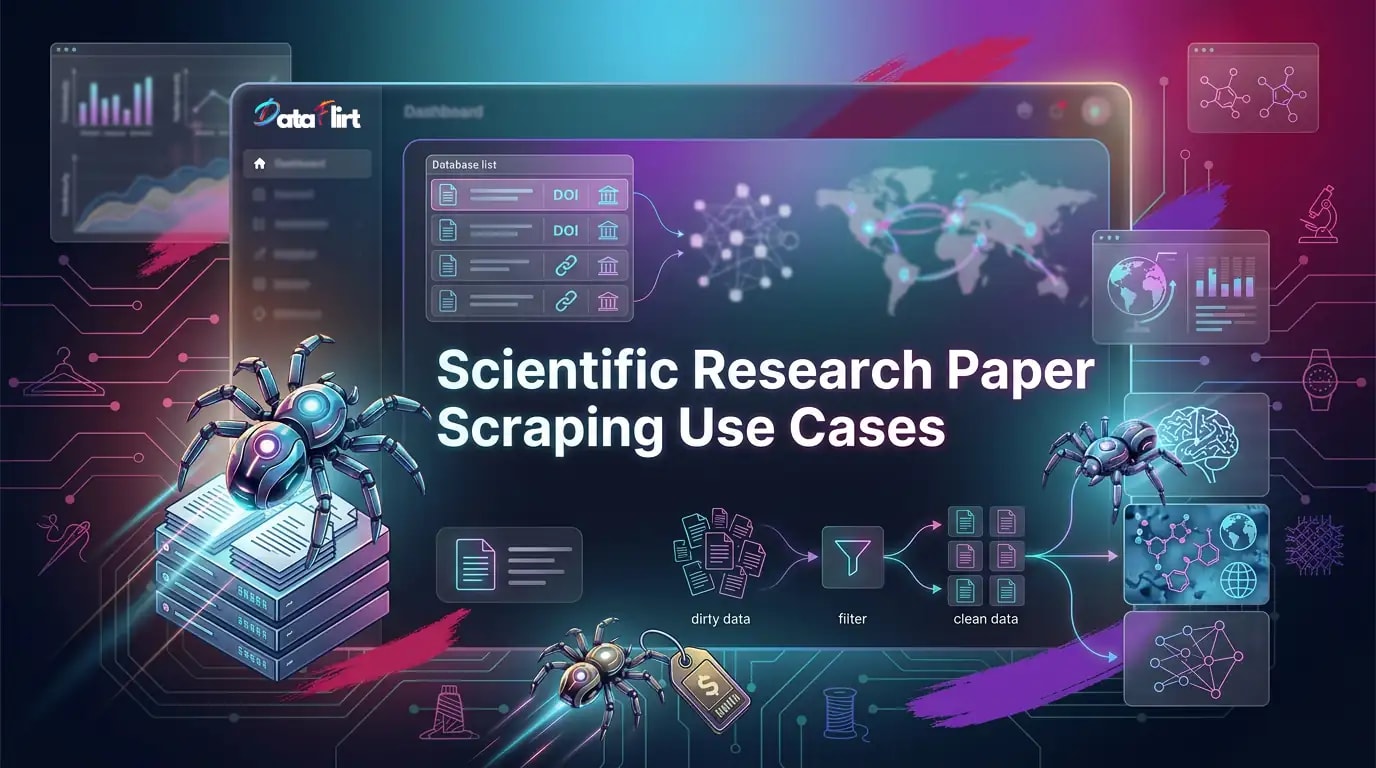

The 220 Million Paper Problem: Why Scientific Research Paper Scraping Is Now a Strategic Imperative
The global corpus of published academic research has crossed an estimated 220 million papers as of 2026, growing at a rate of approximately 4 to 5 million new publications per year across disciplines. That number alone is misleading, because it undercounts the full scope of accessible scholarly content. When you add preprints on arXiv and bioRxiv, institutional repository deposits, working papers on SSRN, conference proceedings, theses, dissertations, and technical reports, the accessible scholarly record is considerably larger, and it is growing faster than any team can monitor manually.
The intelligence gap this creates is significant and widening. AI research teams building domain-specific language models need clean, structured, deduplicated corpora of millions of scientific papers that reflect the actual frontier of research in their target domain. Pharmaceutical companies monitoring competitor pipeline development need real-time signals from oncology, immunology, and genomics literature that surface emerging drug targets months before they appear in any licensed competitive intelligence report. Academic institutions tracking their own research output need bibliometric data at a granularity and freshness that internal systems simply do not provide. Science policy teams at government agencies need publication trend data across funding categories, institutional affiliations, and national research programs that no single data vendor has assembled.
What these teams share is a requirement for scientific literature data at a scale, quality, and freshness that the traditional licensed database model cannot serve. The licensed database model, built around controlled vocabularies, editorial curation, subscription APIs with rate limits, and redistribution restrictions, was designed for individual researcher search workflows, not for bulk machine learning pipelines, competitive intelligence dashboards, or large-scale bibliometric analyses.
“The academic web is the most comprehensive, most frequently updated, and most structurally consistent corpus of human knowledge ever assembled. Every preprint posted, every journal article accepted, every citation added to a reference list is a structured intelligence signal. The teams that build systematic programs to capture that signal at scale will hold research intelligence advantages that no subscription database can replicate.”
Scientific research paper scraping is the programmatic response to this reality. Executed with appropriate data quality controls, proper legal review, and delivery architectures that match the consuming team’s workflow, it becomes a foundational capability for any organization that competes on research knowledge.
The stakes are concrete. The global AI market, now exceeding $200 billion, depends critically on high-quality domain-specific training corpora. The pharmaceutical R&D market, worth over $250 billion annually, runs on competitive intelligence that requires continuous literature monitoring. The academic publishing market itself, valued at over $25 billion, is being restructured by open access mandates that have made billions of previously paywalled papers publicly accessible in the last five years alone.
The Plan S initiative in Europe, along with open access mandates from major funders including the NIH and the Wellcome Trust, has accelerated the transition to open access at a pace that was not anticipated even three years ago. As of 2025, estimates suggest that over 50% of newly published research articles are immediately accessible as open access, up from roughly 28% in 2018. This is not a minor policy change. It represents a structural shift in the accessibility of the world’s scientific knowledge base, and it is the reason that large-scale scientific research paper scraping is both more feasible and more strategically valuable than it has ever been.
For context on how large-scale data acquisition programs create strategic competitive advantages, see DataFlirt’s perspective on data scraping for enterprise growth and the foundational overview on what is web scraping.
Who Actually Reads Scraped Research Paper Data: The Role Map
Before discussing what scientific research paper scraping delivers, it is worth establishing precisely who consumes the output and what they are trying to accomplish. The same underlying dataset, say, a daily feed of new publications across computational biology and structural biology journals, will be consumed through entirely different analytical frameworks depending on the professional reading it. A data delivery program that serves one team’s needs without accounting for the others will be underutilized and underfunded.
The AI and Machine Learning Team
This is currently the fastest-growing and most resource-intensive consumer segment for scientific literature data. AI teams at technology companies, research labs, and startups building domain-specific models have an insatiable appetite for clean, structured, deduplicated text corpora that represent the actual state of knowledge in their target fields.
Their needs are specific and technically demanding. They do not want just abstracts. They want full-text content where it is accessible, structured with clear section delineation (introduction, methods, results, discussion, conclusion), stripped of formatting artifacts, deduplicated at the document level across source repositories, and delivered in formats that integrate directly into their pre-processing pipelines (JSONL, Parquet, or HuggingFace-compatible dataset formats).
For LLM fine-tuning programs, the quality of the scientific research paper scraping program directly determines the quality of the resulting model. A corpus with 15% duplicate records, 20% incomplete full-text fields, and inconsistent tokenization-breaking artifacts will produce a worse model than a corpus with 97% deduplication accuracy and field completeness above 93%, even if the raw record count is identical.
What they need from scraped scientific literature data:
- Full-text content with section-level structural markup preserved
- DOI-normalized deduplication across source repositories
- Accurate publication dates and version history for preprints
- Domain and subject classification labels, both MeSH terms for biomedical content and arXiv categories for quantitative disciplines
- Author affiliation metadata for domain-specific filtering
- License metadata to distinguish CC-BY, CC-BY-SA, and other open access licenses from more restrictive terms
The Pharmaceutical and Biotech Intelligence Team
Competitive intelligence analysts at pharmaceutical companies, biotech firms, and medical device manufacturers are one of the highest-value consumer segments for scientific research paper scraping, and they are consistently underserved by existing licensed intelligence products.
Their core need is not a corpus; it is a signal. They want to know: what is being published about target X, by which institutions, with which funding sources, using which experimental methods, and at what velocity? They want to see the rise of a new therapeutic modality in the preprint record six to twelve months before it enters clinical trial registries. They want to map competitor R&D programs through publication patterns when those programs are not disclosed in investor filings.
For pharma intelligence teams, academic data extraction is fundamentally a competitive monitoring exercise. The bibliometric signals in scientific literature data, specifically publication velocity by research group, citation network clustering around specific targets, co-authorship patterns between academic labs and industry affiliates, and the emergence of preprints from previously quiet research groups, are leading indicators of competitor pipeline development that no other intelligence source provides at comparable lead time.
The Academic Research Office and Library Data Team
Research offices at universities and research institutions use scraped bibliometric data to answer institutional questions: how does our research output compare to peer institutions? which departments are producing high-citation work? which faculty are attracting significant external citation? where are our publication counts growing, and in which disciplines are they declining?
These teams consume scientific literature data through a bibliometric lens. Their primary data requirements are: institutional affiliation normalization (resolving “MIT”, “Massachusetts Institute of Technology”, “M.I.T.”, and “Massachusetts Inst. of Technology” to a single canonical record), author disambiguation (resolving name variants across publications), citation count aggregation by author, department, and discipline, and longitudinal trend analysis of output and impact metrics.
For research offices, a well-executed scientific research paper scraping program that covers the primary open access repositories and indexes delivers data that is materially fresher and more complete than what institutional subscriptions to commercial bibliometric databases provide, at a fraction of the cost.
The Competitive Intelligence Analyst at Technology Companies
Technology companies building products in AI, biomedical software, scientific data infrastructure, and research tooling need to track the state of scientific research in their domains for reasons that go beyond model training. They are monitoring competitor research programs, tracking the emergence of new methodologies that might displace their products, identifying academic groups whose work is most likely to generate license opportunities, and understanding where the research frontier is moving before it becomes product opportunity.
For tech company CI analysts, scientific research paper scraping is a product intelligence and market foresight function. They are asking: what is the research community building right now that will become commercial software in 18 to 36 months? Where is academic funding concentrating? Which preprints are accumulating citations at a velocity that signals they will become foundational references in a new subfield?
The Science Policy and Funding Agency Team
Government funding agencies, science policy institutes, and intergovernmental research organizations use bulk scientific literature data to assess the impact of funding programs, identify geographic and institutional concentration in specific research areas, monitor the balance of research investment across disciplines, and evaluate the open access compliance rates of funded researchers.
Their data requirements emphasize longitudinal consistency, geographic tagging, funding disclosure normalization, and cross-disciplinary topic classification at a granularity that individual database subscriptions do not provide. For science policy teams, a well-structured research paper data pipeline that covers a decade or more of publication history enables the kind of systematic impact analysis that previously required dedicated research consortia to assemble.
The Science Journalist and Media Research Team
Science journalists, editorial data teams at media organizations, and research communication professionals use academic data extraction to track publication trends, identify significant research developments across disciplines, surface preprints that are likely to generate public interest before they appear in the mainstream research press, and build data-driven science journalism projects.
Their needs are more focused on accessibility than depth: they need clean, structured, English-language abstracts with accurate publication dates, credible author affiliation data, and reliable DOI links. They do not need full-text content. They need enough signal to identify stories and enough metadata to source them accurately.
What Scientific Research Paper Scraping Actually Delivers: A Data Taxonomy
Scientific research paper scraping is not a monolithic data acquisition activity. The records accessible from public scholarly repositories span an enormous range of data attributes, each with distinct utility for different professional consumers. Understanding this taxonomy is essential for specifying a data acquisition program that actually serves your organizational needs.
Publication Metadata
The foundational layer of any scientific literature dataset is publication metadata: title, authors, abstract, journal or conference name, publication date, DOI or other persistent identifier, volume, issue, page range, ISSN, and open access status. This is the most universally available data layer across all source repositories and the starting point for any scientific research paper scraping program.
Metadata is also the layer where data quality problems are most consequential. A title that has been truncated, an author list that has been collapsed to “et al.” by the source platform, an abstract that has been partially rendered due to Unicode encoding errors, or a DOI that resolves to a retracted paper without a retraction flag: each of these represents a data quality failure that propagates into every downstream use case that touches that record.
Structured Abstracts and Full Text
For AI training applications and pharmaceutical text mining programs, structured abstract content and full-text extraction are the primary data deliverables. Structured abstracts, common in clinical and biomedical literature, break the abstract into labeled sections: background, objective, methods, results, and conclusions. These sections carry additional signal for downstream natural language processing tasks because they allow training data to be segmented by rhetorical function.
Full-text extraction from open access papers is the most technically demanding element of scientific research paper scraping. HTML-rendered articles from modern journal platforms are generally parseable with appropriate treatment of mathematical notation, figure and table references, and footnote handling. PDF-based full text, which remains the dominant format for preprint archives and older journal content, requires optical character recognition quality assessment and post-processing to handle column layout artifacts, figure boundary detection, and reference list parsing.
The practical implication for data teams: full-text extraction quality varies significantly by source format and publisher. A research paper data pipeline that claims to deliver full text without specifying format handling, quality thresholds, and extraction confidence scoring is making a claim that is difficult to evaluate without examining actual output records.
Citation Networks and Reference Lists
Citation data is one of the most analytically valuable outputs of academic data extraction and one of the most structurally complex to collect and normalize at scale. A citation record connects a citing paper to a cited paper through a reference string that may or may not include a DOI, may contain author name variants, and may reference different editions or versions of the same work.
For AI teams building knowledge graph applications, citation network data is the connective tissue that links individual papers into a navigable research landscape. For pharma intelligence teams, citation velocity data (how quickly a newly published paper is being cited, and by whom) is a leading indicator of the scientific community’s assessment of a result’s significance. For academic institutions building research impact dashboards, citation count and h-index calculation require clean, deduplicated citation records where each citing paper is uniquely identified and each cited paper is resolved to a canonical record.
The OpenAlex database, which succeeded the Microsoft Academic Graph as the most comprehensive open citation graph, now covers over 250 million works with citation linkages. This represents a publicly accessible foundation for citation network research that did not exist at this scale three years ago.
Author and Institutional Affiliation Data
Author records in scientific literature are structurally problematic in ways that are not immediately obvious. The same researcher may appear as “John A. Smith”, “J. Smith”, “John Smith”, and “J.A. Smith” across different publications and different repositories. The same institution may be recorded as “University of California, San Francisco”, “UCSF”, “University of California San Francisco Medical Center”, and “UC San Francisco” in affiliation strings from different journals.
Author disambiguation and institutional affiliation normalization are not preprocessing steps that can be treated as optional. For pharmaceutical intelligence teams trying to map competitor research programs through publication patterns, unresolved author records mean missed connections between publications from the same research group. For academic research offices trying to assess institutional output, unresolved affiliation strings mean publication counts that are systematically incomplete for their institution.
The ROR (Research Organization Registry) identifier system, now adopted by thousands of journals and repositories as a standard affiliation identifier, provides an increasingly reliable anchor for institutional normalization in scientific research paper scraping programs. Programs that incorporate ROR-based affiliation resolution produce materially cleaner institutional attribution than those relying on string matching alone.
Funding Disclosure and Grant Data
Funding acknowledgment data, extracted from the acknowledgment sections and structured funding statement fields that many journals now require, links publications to their funding sources. This data is commercially valuable for grant intelligence, competitive R&D monitoring, and science policy analysis in ways that are rarely surfaced through standard academic database subscriptions.
For pharmaceutical CI teams, funding disclosure data reveals which academic research programs are receiving industry sponsorship from specific companies, which represents a material signal about competitor pipeline interest. For science policy organizations, aggregate funding disclosure data by agency, program, and institution provides a systematic picture of how public research investment is being distributed across disciplines and geographies.
Preprint Version History
Preprint servers, particularly arXiv, bioRxiv, medRxiv, and SSRN, maintain version histories for submitted papers that track how a manuscript evolves from initial deposit through revision cycles and, in many cases, through to the final published version. This version history data is invisible in licensed database subscriptions but is accessible through systematic scientific research paper scraping of preprint server APIs and metadata endpoints.
For AI teams, version history data enables corpus construction that distinguishes initial preprint submissions from revised versions, preventing training data contamination from superseded content. For pharmaceutical intelligence teams, monitoring the revision patterns on preprints from key research groups can surface significant methodological changes or results updates that signal evolving scientific confidence in a finding.
For deeper context on how data quality considerations apply across large-scale data collection programs, see DataFlirt’s analysis on assessing data quality for scraped datasets and the foundational framework on data quality standards for enterprise data programs.
Role-Based Data Utility: What Each Team Actually Does With Scraped Research Data
The same underlying scientific research paper scraping infrastructure, covering the major open access repositories at 100K to 10M+ records, will generate radically different analytical value depending on how each consuming team structures and applies the data. Here is a detailed breakdown of the primary use cases by professional role.
AI and Machine Learning Teams: Corpus Construction at Scale
For AI and ML teams, scientific research paper scraping is primarily a corpus construction exercise. The quality of the training corpus directly determines the quality of domain-specific models, and the requirements are exacting in ways that general-purpose text data pipelines are not designed to handle.
LLM Domain Fine-Tuning: Building a biomedical language model, a chemistry reasoning system, or a materials science literature assistant requires a training corpus that is: deduplicated at the document level across all source repositories so that a paper appearing on PubMed Central, Europe PMC, and an institutional repository is represented exactly once; cleaned of extraction artifacts including OCR errors from PDF processing, HTML rendering noise, and encoding errors in mathematical and chemical notation; filtered by license status to ensure only permissively licensed content is included in training sets intended for commercial model deployment; and structured in a format compatible with the downstream training pipeline.
The practical scale requirements for this use case are demanding. A biomedical domain model of meaningful capability requires a minimum of 10 to 50 million high-quality paper abstracts, and a full-text training set of 1 to 5 million complete papers for models targeting research-level tasks. This is a scale that no commercial academic database API delivers affordably within the rate limits of standard subscription tiers, and it is precisely what a well-designed scientific research paper scraping program is built to provide.
Retrieval-Augmented Generation (RAG) Knowledge Bases: AI teams building RAG systems for scientific question-answering, research assistant tools, and literature review automation need not just a training corpus but a continuously refreshed, queryable knowledge base that reflects the current state of published research. For RAG applications, the freshness requirements are more demanding than for static model training: a RAG knowledge base for a clinical decision support tool that is six months stale on oncology literature is not a knowledge base; it is a liability.
This creates a clear case for a periodic research paper data pipeline with weekly or even daily refresh cadence, delivered in an incremental format that allows new records to be indexed without rebuilding the full knowledge base from scratch.
Embedding Model Training and Semantic Search: Scientific document embedding models, used for semantic search across literature, require balanced training datasets that represent diverse disciplines, methodological approaches, and publication types. The curation of this training data requires a systematic scientific research paper scraping program that can filter, sample, and balance records across taxonomic categories at a scale that manual curation cannot approach.
DataFlirt Insight: AI teams that build their domain model training corpora from well-curated scientific research paper scraping programs, with rigorous deduplication, license filtering, and format normalization, consistently produce models that outperform equivalents trained on uncurated bulk downloads, even when the curated corpus is smaller in raw record count. Quality architecture beats volume architecture in domain model training.
Recommended data cadence for AI and ML teams:
- Initial corpus build: one-off, high completeness, full deduplication
- RAG knowledge base refresh: weekly minimum, daily for high-velocity domains such as machine learning and genomics
- Embedding model retraining: quarterly, triggered by significant corpus expansion
Pharmaceutical and Biotech Intelligence Teams: Research Signal Extraction
For pharma and biotech intelligence analysts, scientific research paper scraping is a competitive signal extraction exercise. The raw publication record is not what they consume; it is what they derive competitive intelligence signals from.
Competitor Pipeline Monitoring Through Publication Patterns: Pharmaceutical companies do not publish press releases when they initiate research programs on new drug targets. They publish scientific papers. A systematic research paper data pipeline that monitors publication output from known competitor institutions, across known competitor therapeutic areas, with author disambiguation that tracks specific research groups across affiliations, is one of the most reliable early warning systems for competitor pipeline activity available.
The analytical workflow looks like this: aggregate all publications from known competitor-affiliated research groups; filter by therapeutic area ontology (MeSH terms for the specific target classes of interest); track publication velocity by research group over rolling 90-day windows; flag velocity increases above statistical thresholds as potential intensification signals; correlate publication author lists with patent filing author lists from patent scraping programs; and surface the combined signal to the CI team as an intelligence dashboard update.
Drug Target Emergence Detection: New drug targets do not emerge fully formed in clinical trial registries. They emerge first in basic science publications, accumulate citations and replication studies, attract systematic review attention, and eventually reach a consensus threshold where clinical translation programs begin. The lag between a target’s emergence in the preprint record and its appearance in clinical trial databases is typically 12 to 36 months.
A scientific research paper scraping program that continuously monitors the preprint record for citation velocity anomalies, specifically papers accumulating citations significantly faster than the baseline for their subfield, is an early detection system for emerging target opportunities. This is a genuine competitive advantage that cannot be replicated through any licensed database subscription because the velocity signal is derived from continuous monitoring of citation accumulation, not from periodic database exports.
Clinical Trial Outcome Intelligence: Publications reporting the results of clinical trials are among the highest-signal records in the biomedical literature. Systematic scientific research paper scraping of trial results publications, linked to clinical trial registry records through NCT number extraction from full text and structured data fields, creates an integrated view of trial outcomes that is more complete and more timely than any commercial clinical intelligence product.
The reason: trial results are often published in journal form before they are fully updated in clinical trial registries, particularly for trials conducted outside the United States where ClinicalTrials.gov reporting requirements are not mandatory. A research paper data pipeline that captures these publications through academic data extraction and links them to registry records through identifier matching fills a genuine intelligence gap.
Funding Intelligence and Partnership Mapping: Extracting and normalizing funding acknowledgment data from the full text and structured funding statement fields of biomedical publications creates a continuously updated map of which academic research programs are receiving industry co-funding. This is a commercially sensitive signal: a previously purely academic research group that begins receiving industry co-funding is potentially entering a translational research phase, and the industry co-funders named in the acknowledgment data are revealing a strategic interest.
For context on how large-scale data acquisition challenges are managed in production pipelines, see DataFlirt’s overview of large-scale web scraping data extraction challenges.
Academic Research Offices and Library Data Teams: Bibliometric Intelligence
For academic research offices, scientific research paper scraping is primarily a benchmarking and institutional intelligence exercise. The data they need is not novel in type but is systematically unavailable at the required quality level from standard institutional database subscriptions.
Institutional Research Output Benchmarking: A university research office that wants to understand how its publication output and citation impact compare to ten peer institutions across fifteen discipline categories needs a dataset that: covers all relevant repositories with consistent coverage across all fifteen institutions; resolves institutional affiliation strings to canonical identifiers for each of the eleven institutions; disambiguates shared surnames across institutional boundaries; and produces longitudinal trend data with sufficient depth to assess trajectory rather than point-in-time snapshots.
This is not a query that any single commercial database supports cleanly. It requires a custom scientific research paper scraping program that covers the relevant repositories, applies ROR-based institutional normalization, and delivers a structured, schema-consistent dataset that the research office’s analytics team can query and visualize.
Faculty Research Impact Dashboards: Many universities are building internal dashboards that provide faculty members and department heads with real-time visibility into their publication output, citation impact, co-authorship network reach, and open access compliance rates. These dashboards require a continuously refreshed research paper data pipeline that resolves each faculty member’s author records across all repositories and aggregates their citation counts on a weekly or monthly cadence.
Open Access Compliance Monitoring: Major research funders, including the NIH, the Wellcome Trust, and the European Research Council, require funded researchers to deposit publications in designated open access repositories within defined timeframes. Monitoring compliance at scale, across hundreds or thousands of funded researchers, requires a systematic academic data extraction program that checks whether each publication from a funded researcher has been deposited in the required repository within the required window.
This is a use case that is increasingly resource-intensive for research offices to manage manually and that a well-designed scientific research paper scraping program can automate at a fraction of the administrative cost.
Competitive Intelligence Analysts at Technology Companies
For technology company CI analysts using scientific literature data, the primary questions are about the research frontier, competitive program visibility, and technology foresight.
Research Frontier Mapping: An AI company building tools for molecular biology researchers needs to continuously understand what the research community is working on, which methodologies are gaining adoption, which computational approaches are being applied to biological problems for the first time, and where the intersection of ML and biology is producing the most active publication clusters. This is not a question that an annual literature review answers adequately. It requires a periodic research paper data pipeline that delivers weekly or monthly updates on publication volumes, citation patterns, and emerging topic clusters in the domains of interest.
Academic-to-Commercial Pipeline Tracking: University research that is in the transition from basic science to commercial application typically becomes visible in the publication record before it becomes visible in patent filings or startup formation. A technology company systematically monitoring scientific literature data from leading research groups in its target domains, tracking the trajectory of publications from fundamental results through proof-of-concept demonstrations and into applied method papers, has a materially earlier view of emerging competitive technology than one relying on patent monitoring alone.
Researcher Recruitment Intelligence: Publication records, including h-index, citation velocity, co-authorship networks, and institutional affiliation trajectories, are among the most reliable signals of a researcher’s scientific productivity and impact. Technology companies using academic data extraction to systematically identify researchers with specific technical profiles, publication momentum in target domains, and institutional contexts suggesting openness to industry transitions have a meaningful advantage in competitive research talent acquisition.
Science Policy and Funding Agency Teams: Systemic Research Intelligence
For government funding agencies and science policy organizations, scientific research paper scraping at scale enables the kind of systemic research intelligence that was previously only available through expensive, manually constructed datasets assembled by specialist bibliometric research organizations.
Cross-Disciplinary Research Portfolio Analysis: Funding agencies with diverse research portfolios need to understand how their investment is distributed across disciplines, geographies, institution types, and career stages of funded researchers. A scientific research paper scraping program covering the full publication record of funded research programs, linked to funding acknowledgment data and researcher affiliation records, creates an integrated portfolio intelligence system that no internal administrative database can replicate.
International Research Collaboration Mapping: Co-authorship network data from large-scale scientific literature datasets enables systematic mapping of international research collaboration patterns. For science policy teams, this intelligence informs decisions about bilateral research agreements, international funding partnership structures, and the identification of collaboration deserts where international research connections are underdeveloped relative to the scientific opportunity.
Citation-Based Impact Assessment: Bibliometric citation analysis, applied to the publication record of funded research programs, provides a systematic basis for impact assessment that complements peer review and case study approaches. A research paper data pipeline that delivers continuous citation count updates for funded publications creates an early warning system for programs producing high-impact research and a signal for programs where funded publications are failing to attract scientific community uptake.
One-Off vs Periodic Scraping: Two Fundamentally Different Strategic Modes
The decision between a one-time scientific research paper scraping exercise and a continuous research paper data pipeline is not a question of scale or budget alone. It is a question of what business or research decision the data needs to serve, and whether that decision changes over time.
When One-Off Scientific Research Paper Scraping Is the Right Choice
One-off scraping is appropriate when your information need has a defined scope that does not require ongoing updating to remain useful. The analytical half-life of a scraped scientific literature dataset varies by domain: a corpus for training a materials science model may remain useful for 12 to 18 months before research field shifts require corpus expansion, while a competitive intelligence dataset covering an oncology subfield may become stale within six to eight weeks.
Corpus Construction for a Specific Training Build: An AI team building a domain-specific language model for a defined commercial application needs a high-quality, comprehensive corpus at a specific point in time. The model will be trained, validated, and deployed; it does not need its training corpus to be continuously updated. A one-off scientific research paper scraping program that delivers a clean, deduplicated, license-filtered corpus covering a defined domain and time range is the right data acquisition mode.
Competitive Landscape Snapshots for Due Diligence: A pharmaceutical company evaluating an acquisition target needs to understand the scientific publication record of the target’s research programs, the citation impact of their key publications, the research group composition and institutional affiliations of their scientific leadership, and the competitive landscape of research activity in their therapeutic area. This is a point-in-time intelligence exercise: comprehensive, well-documented, and timestamped, but not requiring continuous refresh.
Domain Mapping for Strategic Planning: An organization entering a new research domain, whether to launch a product, establish a research program, or evaluate a licensing opportunity, needs a systematic survey of the scientific literature in that domain before committing to a course of action. A one-off academic data extraction program that delivers a structured, topic-classified, bibliometrically annotated dataset covering the domain’s literature provides this strategic map.
Research for Specific Publications or Reports: Science journalists, policy researchers, and academic authors constructing systematic reviews or meta-analyses need structured access to the published literature in a defined scope at a specific point in time. A targeted scientific research paper scraping exercise that delivers a clean, deduplicated dataset for a defined query is the appropriate tool.
Characteristic requirements for one-off scientific research paper scraping:
| Dimension | Requirement |
|---|---|
| Coverage | Maximum breadth across all relevant repositories for the defined domain |
| Depth | Maximum field completeness per record, including full text where available |
| Deduplication | Full DOI-based cross-repository deduplication before delivery |
| Documentation | Complete data provenance including source URL, scrape timestamp, license status per record, and schema map |
| Delivery | Structured flat files (JSONL, Parquet, CSV) or direct data warehouse load with defined schema |
When a Periodic Research Paper Data Pipeline Is Non-Negotiable
A periodic research paper data pipeline is the right architectural choice whenever the value of the data degrades faster than the cadence at which decisions are made using it. For any use case that involves monitoring, trend detection, or real-time intelligence, periodic academic data extraction is not an option; it is a requirement.
LLM Knowledge Base Maintenance: A RAG-based scientific assistant that serves researchers in a fast-moving field like machine learning, genomics, or immunotherapy becomes measurably less useful with each week that its knowledge base is not refreshed. New papers answer questions the system previously could not answer and update answers the system was providing from superseded findings. A weekly or daily incremental update pipeline, delivering new and revised records as structured data to the indexing layer, is the operational infrastructure for a scientifically current AI research assistant.
Pharmaceutical Competitive Intelligence Monitoring: A pharma CI program that monitors competitor publication activity through scientific literature data needs a data cadence that matches the publication rhythm of target research groups. Major research groups in high-priority therapeutic areas publish new work at a rate of 5 to 20 papers per month. A monthly data refresh misses intra-month publication events entirely. A weekly or daily refresh cadence is the minimum for real-time competitive intelligence.
Citation Velocity Tracking: The scientific significance of a newly published paper is often most visible in the first 90 days after publication, as researchers in the field respond with citations, replication attempts, and methodological extensions. A research paper data pipeline that delivers citation count updates on a weekly cadence allows CI and research teams to identify high-velocity papers before they become consensus knowledge, which is where the actionable intelligence value lies.
Open Access Compliance Monitoring: Research offices monitoring compliance with funder open access mandates need to check the deposit status of funded publications continuously, because the compliance window (typically six to twelve months from publication) requires action before the deadline, not after. A weekly academic data extraction pipeline that checks deposit status for all funded publications within their compliance window automates a monitoring function that would otherwise require significant manual effort.
Recommended cadence by use case:
| Use Case | Recommended Cadence | Rationale |
|---|---|---|
| RAG knowledge base refresh | Daily to weekly | Research frontier moves rapidly |
| Pharma competitive intelligence | Weekly | Publication velocity of target groups |
| Citation velocity monitoring | Weekly | Early signal degrades quickly |
| Institutional bibliometric dashboards | Monthly | Trend analysis requires aggregation |
| Domain corpus construction | One-off | Training builds are discrete events |
| Strategic competitive landscape | One-off or quarterly | Decision rhythm is strategic |
| Open access compliance monitoring | Weekly | Deadline-driven monitoring |
| Science policy portfolio analysis | Monthly | Policy cycles operate monthly to quarterly |
| Preprint monitoring (ML, genomics) | Daily | Preprint velocity in these fields is very high |
For context on real-time data delivery infrastructure and scheduling approaches for continuous data pipelines, see DataFlirt’s guide on best platforms to deploy and schedule scrapers automatically.
Where to Scrape: High-Value Sources for Scientific Research Paper Scraping at Scale
The following table maps the highest-value publicly accessible repositories for large-scale scientific research paper scraping by region, platform, and primary data value proposition. Complexity ratings reflect technical collection challenge, including rate limit management, format handling requirements, and infrastructure implications for programs targeting 100K to 10M+ records.
| Region (Country) | Target Websites | Why Scrape? |
|---|---|---|
| Global | PubMed and PubMed Central (pubmed.ncbi.nlm.nih.gov; pmc.ncbi.nlm.nih.gov) | The definitive index for biomedical literature with over 36 million citations on PubMed and over 9 million full-text articles on PubMed Central. Structured XML exports available for bulk access. Essential for any pharma, clinical, or biomedical AI program. Supports both API-based and bulk data download approaches. |
| Global | arXiv (arxiv.org) | The world’s largest preprint server with over 2.4 million papers across physics, mathematics, computer science, quantitative biology, economics, and statistics. Bulk metadata access via OAI-PMH and S3 bulk download. Essential for any AI, ML, or quantitative research corpus program. Source of first publication for most significant machine learning research. |
| Global | OpenAlex (openalex.org) | Open replacement for the Microsoft Academic Graph. Covers over 250 million scholarly works with citation linkages, institutional affiliation data, funding acknowledgments, and topic classifications. Provides bulk data snapshots updated monthly. The highest-coverage open citation graph available for large-scale bibliometric programs. |
| Global | Semantic Scholar (semanticscholar.org) | Covers over 200 million publications with AI-generated structured abstracts, semantic similarity scores, citation influence metrics, and open access PDF links. Particularly strong for citation influence analysis and related paper recommendations. Bulk data access through Open Research Corpus and API. |
| Global | CrossRef (crossref.org) | The authoritative DOI registration agency covering over 145 million works. Essential as a deduplication anchor and metadata enrichment source for any scientific research paper scraping program. API provides structured JSON metadata for any registered DOI. |
| Global | CORE (core.ac.uk) | Aggregates open access research from over 10,000 repositories and journals globally. Over 230 million records with growing full-text coverage. Strong complementary coverage for grey literature, institutional repositories, and regional open access content not well-represented in other indexes. |
| Global | Unpaywall (unpaywall.org) | Database linking DOIs to freely available legal full-text versions of scholarly articles, covering over 50 million papers. Essential for identifying full-text access points for articles where the publisher version is paywalled. API-accessible and bulk data download available. |
| Global | bioRxiv and medRxiv (biorxiv.org; medrxiv.org) | The primary preprint servers for biological sciences and health sciences respectively. bioRxiv alone hosts over 300,000 preprints. Both provide structured XML metadata and full-text access. Essential for any biomedical AI training corpus and for pharma pipeline intelligence programs that need pre-publication signals. |
| Global | SSRN (ssrn.com) | The dominant preprint and working paper repository for social sciences, economics, law, and finance. Over 1.3 million papers. Valuable for economics research corpus programs, financial regulatory intelligence, and social science AI training datasets. |
| Global | Europe PMC (europepmc.org) | European mirror and extension of PubMed with additional coverage of European research, grant-linked publications, and preprints from bioRxiv and medRxiv. Adds grant linkage data and European author affiliation records not consistently present in PubMed. Full-text and metadata bulk download available. |
| United States | ClinicalTrials.gov Results Database | Structured results records for registered clinical trials, including outcome measures, adverse event reporting, and results publication links. Essential for pharmaceutical outcomes intelligence and clinical AI training programs. Full database available for bulk download. |
| United States | NIH Reporter Publications Database (reporter.nih.gov) | Links NIH grant records to resulting publications through the iCite and PubMed infrastructure. Essential for science policy analysis, funding impact assessment, and pharmaceutical competitive intelligence on NIH-funded research programs. API-accessible and bulk download available. |
| United States / Global | ERIC (eric.ed.gov) | The primary index for education research, covering over 1.9 million records. Bulk data download available. Essential for edtech AI training programs and education policy research. |
| United States / Global | JSTOR Open Access (jstor.org/open) | Growing collection of open access content from JSTOR’s archive, covering humanities, social sciences, and sciences. Text Data Mining program provides structured bulk access for qualifying research purposes. Valuable for humanities AI corpus programs. |
| United Kingdom | UKRI Gateway (gtr.ukri.org) | UK Research and Innovation grant database linking funded projects to resulting publications. Essential for UK science policy analysis and for mapping UK academic research programs. API-accessible with structured JSON responses. |
| European Union | OpenDOAR Repositories (v2.sherpa.ac.uk/opendoar) | Directory of open access repositories with over 6,000 institutional and subject-specific repositories. Systematic crawling of OpenDOAR-listed repositories provides coverage of institutional research output not indexed in central aggregators. |
| European Union | Zenodo (zenodo.org) | CERN-hosted open research repository covering over 3 million records across all disciplines including datasets, software, preprints, and conference papers. Particularly strong for physics, computational research, and European research program outputs. REST API provides structured metadata access. |
| European Union | HAL (hal.science) | French national open access archive covering over 1.5 million full-text documents from French research institutions. Essential for programs requiring comprehensive French research output coverage. OAI-PMH bulk access available. |
| Germany | BASE (Bielefeld Academic Search Engine; base-search.net) | Aggregates over 350 million documents from over 10,000 content providers with strong European institutional repository coverage. OAI-PMH access available. Strong complement to CORE for European grey literature coverage. |
| India | INFLIBNET Shodhganga (shodhganga.inflibnet.ac.in) | National repository of Indian doctoral theses covering over 600,000 theses across Indian universities. Essential for programs requiring Indian academic output coverage at the dissertation level. |
| China | CNKI Open Access (cnki.net) | The dominant Chinese academic database with partial open access content. Critical for programs requiring Chinese research literature, particularly in materials science, chemistry, and engineering disciplines where Chinese output is globally significant. |
| Japan | CiNii (cir.nii.ac.jp) | National Institute of Informatics database covering Japanese academic papers, with growing open access full-text coverage. Essential for East Asian research program intelligence. |
| Australia | TROVE (trove.nla.gov.au) | National Library of Australia aggregator with strong coverage of Australian research output across all disciplines including theses, conference papers, and journal articles. OAI-PMH access available. |
| Brazil | SciELO Brazil (scielo.br) | The largest open access repository for Latin American research with over 1.3 million articles from Brazilian journals. Essential for programs requiring comprehensive Latin American biomedical and science coverage. Bulk XML download available. |
| Global Multidisciplinary | DOAJ (doaj.org) | Directory of Open Access Journals indexing over 20,000 fully open access journals. Metadata bulk download available as CSV and JSON. Essential as a quality filter for identifying legitimate open access journals versus predatory publishers when constructing training corpora. |
| Global Preprints | AfricArXiv (africarxiv.org) | Preprint server focused on African research across disciplines. Growing coverage of sub-Saharan African research output not well-represented in other major indexes. Essential for programs requiring geographic diversity in training corpora. |
| Global | Dimensions Open Access (dimensions.ai) | Covers over 140 million publications with strong clinical trials linkage, patent citation linkage, and policy document citation tracking. Free tier available for research purposes. Particularly valuable for translational research intelligence programs tracking publication-to-patent and publication-to-policy pipelines. |
Data Quality, Freshness, and Delivery Frameworks for Scientific Literature Datasets
This section separates scientific research paper scraping programs that deliver analytical value from those that deliver storage problems. Raw scraped records from scholarly repositories are not a finished product. They are semi-structured metadata records with heterogeneous field populations, author name variants that resist simple string matching, institutional affiliation strings that exist in hundreds of normalized and unnormalized forms, DOI records that may reference retracted or corrected papers without flags, and full-text content that may contain OCR artifacts, mathematical notation rendering failures, and figure reference strings that require specialized parsing.
A professional academic data extraction engagement that DataFlirt delivers includes five mandatory quality layers between raw collection and data delivery.
Layer 1: DOI-Based Cross-Repository Deduplication
The same paper will frequently appear in multiple repositories simultaneously. A biomedical paper may be indexed in PubMed, deposited in PubMed Central, linked from Europe PMC, aggregated in OpenAlex, and available as a preprint version on bioRxiv, all with slightly different metadata representations. Without deduplication logic anchored to the DOI (or, for papers without DOIs, a composite key of title hash, first author surname, and publication year), your dataset contains 5 to 6 copies of the same paper, each with slightly different field populations.
What rigorous scientific research paper deduplication requires:
- Primary deduplication on normalized DOI strings, with cleaning for common DOI formatting variants (http vs https, trailing slashes, case variants)
- Secondary deduplication using fuzzy title matching combined with author list matching for records without DOIs, covering conference papers, theses, reports, and preprints that were never formally registered
- Version resolution logic for preprints that have been updated: the canonical record should be the most recent version, with version history preserved as a structured field rather than separate records
- Retraction flagging: a retracted paper should be retained in the dataset but flagged, not silently removed, so downstream models and analyses can exclude or weight it appropriately
Industry benchmark: DOI-based deduplication programs achieve accuracy rates above 99% for DOI-bearing records. Fuzzy matching approaches for non-DOI records should achieve above 92% precision to avoid false positive record merges that delete distinct papers.
Layer 2: Author Disambiguation
Author disambiguation in scientific literature is harder than it appears and more consequential than it is treated. A program that does not resolve author variants will produce citation counts, co-authorship network analyses, and institutional publication tallies that are systematically incorrect.
The core problem dimensions:
- Name variants: “Zhang Wei” is among the most common names in Chinese biomedical research; there are thousands of distinct researchers who publish under this name or its romanization variants
- Institutional transitions: a researcher who moves from Stanford to MIT mid-career will have author records associated with both institutional affiliations; disambiguating these to a single researcher identity requires combining affiliation history with co-authorship network data
- Initials compression: journal formatting practices frequently compress given names to initials, creating systematic ambiguity for any common surname
The practical resolution: disambiguation for scientific research paper scraping programs relies on combining multiple signal sources, including ORCID identifier extraction where present, institutional affiliation sequence analysis, co-authorship network overlap, and email domain extraction from affiliation strings where available. Programs that can anchor disambiguation to ORCID identifiers achieve materially higher accuracy because ORCID provides a researcher-asserted persistent identity that survives name changes, institutional transitions, and romanization variants.
Layer 3: Institutional Affiliation Normalization
Institutional affiliation strings in scholarly metadata are entered by authors and journal systems with minimal standardization. The result is that a single large research institution can appear in hundreds of variant forms across a large scientific literature dataset.
Normalization approach: ROR (Research Organization Registry) identifiers provide the most reliable anchor for institutional normalization in scientific research paper scraping programs. ROR now covers over 100,000 research organizations globally and is being adopted as a standard affiliation identifier by an increasing number of journals, funding agencies, and repositories. A normalization pipeline that resolves affiliation strings to ROR identifiers using a combination of exact string matching, fuzzy matching, and hierarchical disambiguation (matching department-level strings to parent institution identifiers) produces institutional attribution data that is genuinely comparable across publishers and repositories.
Layer 4: Full-Text Quality Scoring and Cleaning
Full-text content extracted from HTML journal pages and PDF documents varies significantly in quality, and delivering raw extraction output to downstream consumers without quality scoring is a disservice. A research paper data pipeline that includes full-text content should include:
- Extraction confidence scores by section, distinguishing high-confidence HTML extraction from lower-confidence PDF OCR output
- Mathematical notation handling: LaTeX rendering artifacts, MathML parsing, and plain-text fallback strategies for equations that cannot be rendered in Unicode
- Table extraction status: whether tables have been extracted as structured data or as raw text, which materially affects downstream analytical use
- Reference list parsing quality: whether the reference section has been parsed into individual citation records or retained as a text block
- Language identification and encoding validation: full-text content from international repositories may contain Unicode encoding errors, mixed-script text, or language switching that requires explicit handling
Layer 5: Schema Standardization and Metadata Enrichment
A scientific research paper scraping program that sources data from 20 different repositories will encounter at minimum 15 different metadata schemas. Dublin Core, JATS XML, DataCite, OpenAlex schema, CrossRef Unified Resource Schema, arXiv metadata format, and institution-specific OAI-PMH implementations each represent the same underlying publication record in a different structural form.
Schema standardization translates all source-specific formats into a single canonical output schema. For scientific literature data, this canonical schema should include, at minimum:
- Persistent identifier (DOI, arXiv ID, PubMed ID, or composite key)
- Canonical title (normalized for case, punctuation, and trailing punctuation artifacts)
- Author list (with ORCID where available, normalized affiliation strings, and ROR identifiers)
- Abstract (full text, section-labeled where structured)
- Publication date (ISO 8601 format, distinguishing preprint date from journal publication date)
- Source repository and journal metadata (ISSN, journal name, publisher)
- License status (Creative Commons license code or rights statement)
- MeSH terms or subject classifications (where applicable)
- Citation count (with source and date of count for temporal analysis)
- Full-text access link and extraction status
Recommended field completeness thresholds by use case:
| Use Case | Critical Field Completeness | Enrichment Field Completeness |
|---|---|---|
| LLM Fine-Tuning Corpus | 98%+ | 85%+ |
| Pharma Competitive Intelligence | 95%+ | 75%+ |
| Bibliometric Research Analysis | 97%+ | 80%+ |
| RAG Knowledge Base | 95%+ | 70%+ |
| Science Policy Portfolio Analysis | 93%+ | 65%+ |
| Competitive Landscape Snapshot | 90%+ | 55%+ |
Delivery Formats and Integration Patterns
The right delivery format for scientific literature data depends entirely on the consuming team’s downstream workflow and infrastructure. DataFlirt delivers academic data extraction outputs in the following formats depending on team requirements:
For AI and ML teams: JSONL files structured for direct ingestion into HuggingFace Datasets or custom training pipelines; Parquet files partitioned by domain, year, and license type for efficient query performance in Spark or BigQuery; or direct delivery to cloud object storage (S3, GCS, Azure Blob) with Hive-partitioned directory structure. For RAG applications: incremental delta files containing only new and updated records since the last delivery, with explicit record-level change type indicators (new, updated, retracted).
For pharmaceutical intelligence teams: Structured CSV or Excel files with topic-classified records, citation count annotations, and flagged high-velocity papers delivered to a shared intelligence workspace on a weekly cadence; or structured JSON feeds via internal API integrated with the CI team’s existing intelligence management platform.
For academic research offices: Direct database load to institutional data warehouses with weekly refresh; or structured spreadsheet delivery with normalized institution-level aggregation tables that plug directly into visualization dashboards.
For science policy teams: Structured datasets delivered to government data platforms (AWS GovCloud, Azure Government) with full data provenance documentation, funding acknowledgment parsed fields, and geographic tagging.
See DataFlirt’s framework for data delivery and pipeline management for enterprise data programs for broader context on data delivery architecture decisions.
Industry-Specific Use Cases: Where Scientific Research Paper Scraping Creates the Most Value
Scientific research paper scraping creates measurably different types of business value across different industry verticals. The data inputs are similar; the analytical applications and decision outcomes are radically different.
Life Sciences and Pharmaceutical Companies
The pharmaceutical industry’s return on investment in R&D has declined steadily over the past 30 years, a phenomenon sometimes called Eroom’s Law (Moore’s Law in reverse). Average costs to bring a new drug to market now exceed $2.6 billion by some estimates, and the failure rate in clinical development remains above 90%. Against this backdrop, any intelligence advantage in the early stages of target identification and validation has material economic value.
Scientific research paper scraping addresses several of the most consequential intelligence gaps in pharmaceutical R&D:
i. Target identification: Systematic monitoring of scientific literature data for emerging drug target publications, with citation velocity analysis to distinguish potentially significant findings from noise, provides a structured approach to target prioritization that supplements and partially replaces the informal “read the journals” approach that many discovery teams rely on ii. Validation signal aggregation: Aggregating all published evidence around a specific target from the full biomedical literature, including replication studies, conflicting findings, and methodological critiques, creates a structured validation evidence base that reduces the risk of advancing poorly validated targets into expensive development programs iii. Competitive program mapping: Publication pattern analysis across known competitor research groups, combined with patent citation cross-referencing and clinical trial registry monitoring, creates a multi-signal competitive intelligence picture that is materially more complete than any single data source provides iv. Biomarker and diagnostic development: The biomarker literature is diffuse, methodologically diverse, and rapidly evolving. Systematic scientific research paper scraping of the biomarker validation literature, structured by target, tissue type, assay methodology, and patient population, creates a searchable evidence base for biomarker development programs
AI and Technology Companies
For AI companies, scientific research paper scraping is increasingly a foundational infrastructure decision rather than a research activity. The quality of domain-specific AI models depends directly on the quality and comprehensiveness of the scientific literature data they were trained on.
The specific competitive advantage at stake: a company that builds a biomedical AI assistant on a carefully curated corpus of 5 million high-quality biomedical papers, with rigorous deduplication, license filtering, and schema standardization, will produce a materially more capable model than a competitor that trains on an uncurated bulk download of the same nominal record count. The difference is not in the training algorithm or the model architecture; it is in the data quality architecture.
Technology companies building scientific AI products are also using scientific literature data for product differentiation in ways that go beyond model training. Literature search tools that surface papers by semantic similarity to a user query require both a clean training corpus and a continuously refreshed indexed knowledge base. Research trend dashboards require a well-structured bibliometric data pipeline. Collaborative research platforms that recommend relevant literature to researchers based on their work history require a comprehensive and current literature dataset with rich semantic annotations.
Insurance and Financial Services
Insurance underwriters and financial analysts consume scientific literature data in ways that are not immediately obvious from the outside but are growing rapidly in sophistication.
For life and health insurance actuaries, the emerging evidence base in genomics, clinical interventions, and preventive medicine directly affects long-term mortality and morbidity assumptions. Systematic monitoring of scientific literature data for publications that change the evidence base on specific health risks (cardiovascular outcomes, cancer incidence, treatment efficacy) is increasingly part of sophisticated actuarial assumption management.
For financial analysts covering pharmaceutical, biotech, and medical device companies, the publication record of a company’s research pipeline, specifically the citation impact and reproducibility of the scientific findings underlying a pipeline program, is a leading indicator of clinical success probability that is not captured in any standard financial disclosure.
Academic Publishers and Scholarly Communication
Academic publishers are themselves significant consumers of scientific research paper scraping for their own business intelligence functions: understanding how citation patterns are evolving across their journal portfolio, monitoring preprint activity in fields covered by their journals, tracking the open access compliance landscape, and benchmarking their journals’ performance metrics against competitor publications.
This represents a genuinely ironic structural reality: the entities that publish the papers are among the most sophisticated consumers of systematically scraped scientific literature data about those papers, because the data their own systems produce is siloed by journal and not aggregated in the cross-publisher, cross-format way that business intelligence requires.
EdTech and Research Training Platforms
EdTech companies building platforms for academic training, research skill development, and graduate-level education use scientific literature data to construct curriculum-relevant reading corpora, power literature discovery features within their platforms, and build automated research methodology assessment tools that score student papers against the methodological standards demonstrated in the published literature.
For these platforms, the specific value of scientific research paper scraping lies in the breadth of domain coverage and the freshness of methodology representation: students learning research methods in 2026 should be learning from methodological standards exemplified in current published research, not from textbook examples that may be 10 to 20 years old.
For context on data collection programs in adjacent domains, see DataFlirt’s guides on web scraping for data scientists and machine learning and web scraping strategies.
Legal and Ethical Guardrails for Scientific Research Paper Scraping
Every scientific research paper scraping program must operate within a clearly understood legal and ethical framework. This is an area where the standards are evolving faster than many practitioners realize, driven by changes in open access policy, court decisions on database rights, and the emergence of AI training data as a specific area of legal scrutiny.
Open Access Licensing and Content Rights
The single most important legal distinction in scientific research paper scraping is between metadata and full-text content, and between openly licensed and rights-restricted content.
Metadata: Publication metadata (title, authors, abstract, DOI, journal information, publication date, and citation records) is generally treated as factual information not subject to copyright protection in most jurisdictions. Systematic collection of metadata from publicly accessible scholarly indexes and repositories operates in a relatively clear legal space for non-personal metadata fields.
Full-text content: The legal status of full-text extraction depends critically on the license under which the paper was published. Content published under Creative Commons Attribution (CC-BY) licenses is explicitly permitted for any use including commercial use, with attribution requirements. CC-BY-NC content is permitted for non-commercial use. All-rights-reserved content, even when publicly accessible through open access mandates, may retain reproduction restrictions that limit full-text extraction for commercial AI training purposes.
The practical implication: any scientific research paper scraping program that intends to use full-text content for commercial AI model training requires explicit license status tracking at the record level, and a content filtering step that removes or quarantines rights-restricted content before the corpus is used for training.
Terms of Service and Access Controls
Most scholarly repositories publish terms of service that address automated access. The spectrum ranges from explicit bulk download programs that are designed for exactly this use case (PubMed Central’s Open Access Subset, OpenAlex bulk data snapshots, arXiv’s S3 bulk access) to platforms that restrict systematic automated access and require individual request patterns that respect rate limits.
Ethical crawl practices for academic repositories:
- Always respect robots.txt directives and crawl delay specifications
- Use documented bulk access endpoints (OAI-PMH, dedicated bulk download APIs) in preference to HTML scraping where they exist
- Implement crawl delays that do not degrade site performance for legitimate users
- Avoid session-based access where login is required and not explicitly authorized for bulk use
- Identify your crawler with an accurate user-agent string and contact information
The AI Training Data Legal Landscape
The use of scraped content for AI model training is currently one of the most actively litigated areas in intellectual property law. While the legal outcomes remain unsettled across jurisdictions, several principles are becoming clearer:
- Open access content under CC-BY licensing represents the safest legal path for AI training corpus construction
- The distinction between training on metadata and abstracts versus training on full-text content matters legally and should be documented in program design
- Geographic jurisdiction affects the legal analysis significantly: the EU AI Act, US copyright law developments, and UK text and data mining exceptions create different legal landscapes for programs operating in different regulatory environments
Practical guidance: Any scientific research paper scraping program intended for commercial AI training use should be designed from the outset to track and filter by license status at the record level, should include a legal review of the specific repositories targeted and the intended use, and should prioritize established bulk access programs that exist for exactly this purpose before resorting to HTML scraping of sites not designed for bulk access.
Author Personal Data Considerations
When scientific research paper scraping collects author email addresses, ORCID profiles, institutional employee directory entries, or any other personally identifiable information about researchers, GDPR, CCPA, and equivalent data protection regulations apply to the collection, storage, and processing of that data.
The key practical considerations:
- Institutional email addresses and professional contact information in published papers are generally treated as professional contact data published for the purpose of enabling scientific communication; their use for research-purpose prospecting carries lower privacy risk than their use for commercial marketing
- Any program that builds researcher prospect databases for commercial outreach purposes should obtain legal review against applicable data protection frameworks in the researcher’s jurisdiction
- Author ORCID identifiers, where researchers have made them public, provide a privacy-preserving anchor for researcher identification that reduces the need to store name variants and affiliation strings as direct personal data
For a detailed analysis of the legal and ethical dimensions of web data collection, see DataFlirt’s guides on data crawling ethics and best practices and is web crawling legal.
Building Your Scientific Research Paper Scraping Strategy: A Decision Framework
Before commissioning any scientific research paper scraping program, whether internal or outsourced, the following decision framework structures the key choices that determine whether the program delivers analytical value or generates a data management problem.
Step 1: Define the Business Question
The starting question is not “how many papers do we need?” It is: what specific decision, product, or research output does this data need to enable? A well-specified business question drives every subsequent architectural choice and prevents the most expensive mistake in large-scale data programs, which is collecting data without a defined downstream use.
- For AI teams: “We are building a biomedical question-answering model. We need a deduplicated, license-filtered corpus of at least 8 million English-language biomedical papers with title, abstract, full text where available, and license status, covering publications from 2000 to present.”
- For pharma CI teams: “We need a continuous weekly feed of all publications from 200 target research groups across oncology, immunology, and gene therapy, with citation velocity tracking and author disambiguation to track group members across institutional transitions.”
- For research offices: “We need a monthly bibliometric dataset covering publications from all faculty across our 12 schools, normalized to ROR institutional identifiers, with citation counts and open access status.”
Step 2: Map Data Requirements to Sources
Given the business question, which sources are required? Not all sources are created equal for all use cases:
- Biomedical AI training: PubMed Central, Europe PMC, bioRxiv, medRxiv (prioritize CC-BY content)
- Broad scientific corpus: OpenAlex, CORE, Semantic Scholar (cross-disciplinary coverage)
- AI and computer science: arXiv (comprehensive coverage of ML, CS, mathematics)
- Citation network analysis: OpenAlex, Semantic Scholar, CrossRef (citation linkage completeness)
- International coverage: BASE, SciELO, DOAJ, CiNii, CNKI open access (geographic diversity)
- Preprint monitoring: arXiv, bioRxiv, medRxiv, SSRN (real-time research signal)
Step 3: Assess Scale and Cadence Requirements
How many records does the program need to seed, and at what refresh cadence? The scale and cadence requirements together determine the infrastructure complexity:
- 100K to 1M records, one-off: manageable with standard crawling infrastructure; deliverable in days to weeks
- 1M to 10M records, one-off: requires distributed crawling infrastructure and careful rate limit management; deliverable in weeks
- 10M+ records, one-off: requires bulk access endpoint strategy (OAI-PMH, bulk download API); deliverable in weeks to months
- Any scale, daily refresh: requires incremental crawling architecture with change detection, delivery pipeline automation, and quality monitoring at each cadence cycle
Step 4: Define Data Quality Requirements
What are the minimum acceptable field completeness rates for critical fields? What deduplication accuracy is required? Does the program require full-text extraction or metadata-only? Does it require author disambiguation? Does it require license status tracking?
Each quality requirement has infrastructure implications. Author disambiguation requires an external service or a custom disambiguation model. License status tracking requires a CrossRef or Unpaywall API integration. Full-text extraction from PDFs requires an OCR pipeline and quality scoring infrastructure. Defining these requirements explicitly before collection begins prevents the expensive mid-program discovery that the quality delivered does not meet the analytical requirements.
Step 5: Specify Delivery Format and Integration
How does the data need to arrive for the consuming team to be able to use it without additional transformation overhead? A biomedical AI team that receives data in raw HTML needs to build a cleaning pipeline before they can use it. A pharma CI team that receives data in a schema different from their intelligence management platform needs to build a transformation layer. Every layer of transformation between delivery and use is a source of processing delay, quality degradation risk, and engineering resource consumption.
Specifying the delivery format, schema, partitioning structure, update mechanism, and SLA at the program design stage produces a scientific research paper scraping program that integrates cleanly into the consuming team’s workflow rather than creating a secondary data engineering problem.
Step 6: Assess Legal and Ethical Scope
Which repositories are in scope? What is the intended use of the data (model training, intelligence analysis, research, product development)? Does the program include full-text content? Does it include author personal data? What are the applicable jurisdictional frameworks?
For any program that includes full-text content for commercial AI training purposes: conduct a license status analysis before scoping, build license filtering into the data quality pipeline, and obtain legal review of the specific repositories and intended use.
DataFlirt’s Approach to Scientific Literature Data Delivery
DataFlirt approaches scientific research paper scraping engagements from the downstream use case backward. The starting conversation is not about crawling infrastructure; it is about what the data needs to enable, who is consuming it, and what quality standards are required before it becomes analytically useful.
For a one-off corpus construction project for an AI team, this means designing the collection scope, license filtering logic, deduplication architecture, and output schema before any collection begins, then delivering a single, well-documented, schema-consistent dataset with full data provenance documentation, field-level completeness statistics, and deduplication accuracy reporting.
For a periodic research paper data pipeline supporting a pharmaceutical intelligence program, this means designing a delivery architecture that integrates directly with the CI team’s existing workflow, with a defined weekly refresh cadence, incremental delta delivery, author disambiguation that persists across refresh cycles, and monitoring and alerting on data quality metrics at each delivery.
For a proptech or edtech company integrating scraped scientific literature data into a product pipeline, this means building a data feed that conforms to the product’s existing schema standards, includes explicit field-level null handling documentation, and delivers updates in an incremental format that minimizes downstream processing overhead.
The technical infrastructure behind DataFlirt’s scientific research paper scraping capability, including distributed crawling orchestration, OAI-PMH and bulk API integration, DOI-based deduplication pipelines, ROR-based institutional normalization, and cloud-native data delivery, is the enabler. The point is the data: clean, complete, timely, and delivered in a format that reduces the distance between collection and decision to the minimum achievable level.
Additional Reading from DataFlirt
The following DataFlirt resources provide deeper context on specific dimensions of large-scale data acquisition, quality management, and delivery architecture:
- Web Scraping for Data Scientists: Methods, Tools, and Best Practices
- Machine Learning and Web Scraping: A Strategic Guide
- Data Quality Frameworks for Enterprise Data Programs
- Assessing Data Quality in Scraped Datasets
- Large-Scale Web Scraping: Data Extraction Challenges at Volume
- Best Scraping Platforms for Building AI Training Datasets
- Data for Business Intelligence: Strategic Frameworks
- Datasets for Competitive Intelligence
- Custom Web Crawler: Extract Data at Scale
- Key Considerations When Outsourcing Your Web Scraping Project
- Outsourced vs In-House Web Scraping Services
- Best Real-Time Web Scraping APIs for Live Data Feeds
- Data Crawling Ethics and Best Practices
- Managed Scraping Services by DataFlirt
- AI Training Data Scraping Services
Frequently Asked Questions
What is scientific research paper scraping and how is it different from subscribing to an academic database API?
Scientific research paper scraping is the programmatic, large-scale extraction of structured metadata, abstracts, full-text content, citation graphs, author affiliation records, funding disclosures, and bibliometric signals from publicly accessible academic repositories, preprint servers, open access journals, and scholarly aggregators. It differs from licensed academic database subscriptions because it captures real-time publication velocity, cross-repository author disambiguation, and citation network evolution at a granularity and freshness that subscription APIs do not provide at any reasonable cost.
Which teams inside a research-intensive organization benefit most from a scientific research paper scraping program?
AI and ML teams use scientific literature data to build LLM fine-tuning corpora, domain-specific embedding models, and retrieval-augmented generation knowledge bases. Pharmaceutical intelligence teams use academic data extraction to monitor competitor research pipelines, emerging drug targets, and clinical trial outcomes. Academic research offices use scraped bibliometric data to benchmark institutional research output and track citation impact. Technology company CI analysts use scientific literature data for research frontier mapping and competitive program monitoring. Each team uses the same raw records through an entirely different analytical and operational lens.
When does a team need one-off scraping versus a continuous research paper data pipeline?
One-off scientific research paper scraping is appropriate for targeted corpus construction, competitive landscape snapshots, due diligence on a research domain, or a defined AI training dataset build. Periodic academic data extraction, running on a daily or weekly cadence, is required for real-time publication monitoring, citation velocity tracking, trend detection in fast-moving fields, and any use case where research signal freshness affects a downstream product or investment decision.
What does data quality actually mean for scraped scientific literature datasets?
Data quality in scientific literature data depends on DOI-based deduplication across repositories, author disambiguation logic that resolves name variants across institutional affiliations, abstract and full-text field completeness rates, accurate publication date timestamping, and schema consistency across heterogeneous source formats. A usable dataset requires deduplication accuracy above 95%, critical field completeness above 90% for fields like title, abstract, DOI, and publication year, and normalized institutional affiliation strings before any downstream model can treat the records as analytically reliable.
What are the most scalable public sources for large-scale scientific research paper scraping?
The most scalable public sources include PubMed and PubMed Central for biomedical literature, arXiv for physics, mathematics, computer science, and quantitative biology preprints, CORE and OpenAlex for cross-disciplinary open access aggregation, Europe PMC for European biomedical research, SSRN for social sciences and economics preprints, Semantic Scholar for citation graph intelligence, and national institutional repositories that expose bulk download endpoints. These sources collectively cover hundreds of millions of records accessible without authentication requirements.
What are the legal and ethical boundaries for scientific research paper scraping at scale?
The primary legal and ethical considerations are: respect for robots.txt directives and crawl delay specifications, compliance with each platform’s terms of service particularly around redistribution and commercial use of extracted content, copyright status of full-text content versus metadata (metadata is generally more permissive than full-text reproduction), and applicable data protection regulations when author contact or affiliation data is collected. Open access content under Creative Commons licensing offers the most legally clear path for corpus construction and downstream model training. Always conduct a legal review of the intended use before initiating large-scale collection programs.