
A competitor drops the price on a bestselling SKU on a Tuesday morning. Your pricing team finds out from a customer complaint on Thursday. By then, the sale is already gone. Most “we need more data” requests are actually a timing problem, not a data problem. Fixing that timing problem is worth real money. The research behind that claim is more specific than most vendor pitches let on.
The Real Bottleneck Isn’t the Data
Most enterprises already have market data. Quarterly research reports. Internal BI dashboards. A pricing team that reviews numbers every Monday. What’s usually missing isn’t information. It’s information young enough to act on before the moment passes. A number that’s a week stale isn’t wrong. It’s just no longer useful for the decision it was meant to inform.
This post looks at two places where that timing gap moves real revenue: pricing and inventory. It then looks at the data-quality problem that quietly derails most in-house attempts at both. Every claim below traces back to what Gartner, McKinsey, and IHL Group actually measured. Not a vendor’s marketing copy, DataFlirt’s included.
| Claim | What the research actually shows |
|---|---|
| ”Dynamic pricing is a marginal tweak.” | McKinsey reports 2 to 5% sales growth and 5 to 10% margin growth from competitor-aware pricing engagements. |
| ”Stockouts are just an inventory problem.” | IHL Group put the global cost of retail inventory distortion at $1.73 trillion in its most recent report, about 6.5% of global retail sales. |
| ”More data fixes bad decisions.” | Gartner estimates poor data quality costs the average organization $12.9 million a year, regardless of how much data feeds into it. |
Competitor Pricing Data Moves Real Revenue
McKinsey’s retail practice tracks real client outcomes from dynamic, competitor-aware pricing. The range: 2 to 5 percent sales growth. 5 to 10 percent margin growth. Some pilots reported up to 3 percent gains in both revenue and margin at once. That range holds because competitor-aware pricing responds to something concrete: what a rival actually charges today, not last quarter.
The mechanism is simple, even when the engineering isn’t. A pricing feed tracks a defined set of competitor SKUs on a schedule. It flags moves worth a same-day reaction. An Amazon price change gets caught the day it happens, not discovered a week later in a spreadsheet nobody updated. The same feed catches MAP violations the moment a reseller drops below an agreed floor. That’s a same-day alert, not a finding from a routine audit weeks after the fact.
Not Every SKU Needs a Daily Price Check
Tracking every SKU on every competitor site daily sounds thorough. It’s usually wasted engineering effort. McKinsey’s own pricing work scores each item by how much it shapes a shopper’s overall sense of a store’s prices. Retailers call that a key value item, or KVI. A handful of well-known, frequently compared products carry most of that perception. The rest of the catalog barely moves it.
| SKU tier | Example | Recommended check cadence |
|---|---|---|
| KVI (key value item) | A bestselling, frequently compared product | Daily |
| Mid-tier | Steady seller, occasional comparison | 2 to 3 times a week |
| Long tail | Low-volume, rarely compared | Weekly or monthly |
A pricing feed built around that distinction checks KVIs daily and the long tail on a slower cycle instead. The engineering cost drops. The signal quality doesn’t. This is also where a pricing analyst earns their keep, deciding which few hundred SKUs deserve daily attention. That’s a judgment call, not something a crawler figures out on its own.
Stockouts Are a Demand Signal, Not Just an Inventory Problem
IHL Group tracks the global cost of retail inventory distortion every year. The most recent figure: $1.73 trillion, combining out-of-stocks and overstocks. That’s roughly 6.5 percent of global retail sales, gone to empty shelves and overordered inventory. A competitor’s out-of-stock page isn’t just their problem. It’s a demand signal sitting in public view.
Tracking when a competitor goes out of stock reveals what’s actually selling. It does that faster than any market report gets published. The same monitoring, applied to bestseller ranks and sold-counts, turns public listing pages into an early demand proxy. That signal often shows up months before a category appears in anyone’s quarterly numbers. Estimating inventory from public listings works the same way in reverse. A competitor’s stock count creeping up, week over week, is a quiet signal too. It usually means demand is softening, well before their own reporting would admit it.
The $12.9 Million Reason Pilots Stall
Gartner estimates poor data quality costs the average organization $12.9 million a year. Most in-house pricing or inventory pilots don’t fail at the scraping step. They fail here: duplicate SKUs, stale snapshots, a price field that silently stops updating after a competitor redesigns their site. The fix isn’t more data. It’s a change-detection layer that only flags what’s actually real.
# Compare two scraped snapshots of the same SKUs and flag
# anything that changed: a price move or a stock-status flip.
def diff_snapshots(previous: dict, current: dict) -> list[dict]:
    """previous/current shape: {sku: {"price": float, "in_stock": bool}}"""
    changes = []
    for sku, now in current.items():
        before = previous.get(sku)
        if before is None:
            continue  # 1. new SKU, not a change worth flagging
        price_moved = before["price"] != now["price"]     # 2. price delta
        stock_flipped = before["in_stock"] != now["in_stock"]  # 3. availability delta
        if price_moved or stock_flipped:
            changes.append({
                "sku": sku,
                "price_before": before["price"],
                "price_after": now["price"],
                "in_stock_before": before["in_stock"],
                "in_stock_after": now["in_stock"],
            })
    return changes  # 4. only the records worth a human's attention

# Sample input: yesterday's snapshot and today's snapshot
previous = {"SKU-1042": {"price": 54.99, "in_stock": True}, "SKU-2078": {"price": 129.00, "in_stock": True}}
current  = {"SKU-1042": {"price": 49.99, "in_stock": True}, "SKU-2078": {"price": 129.00, "in_stock": False}}
[
{"sku": "SKU-1042", "price_before": 54.99, "price_after": 49.99, "in_stock_before": true, "in_stock_after": true},
{"sku": "SKU-2078", "price_before": 129.0, "price_after": 129.0, "in_stock_before": true, "in_stock_after": false}
]A single price or stock field means nothing without something to compare it against. Incremental scraping pulls only what changed since the last run. That keeps the comparison cheap, even at thousands of SKUs a day. This is the same change data capture pattern databases have used for years, just pointed at the open web instead of a database log. Here’s where that $12.9 million actually shows up in practice:
| Quality gap | What it costs downstream |
|---|---|
| Duplicate SKU records | Two prices for one product, and nobody trusts either |
| Stale snapshot, no freshness check | A pricing decision made on last week’s competitor price |
| No stock-status verification | A false “in stock” flag triggers a panic reorder that wasn’t needed |
| No source-page confirmation | A parsing error on a redesigned page ships as a real price move |
Build It, Rent Access, or Buy the Finished Feed
For a growth or pricing lead evaluating this, the real question isn’t whether the data exists. It’s who owns turning raw pages into a change-detection feed a team can actually act on. Building in-house means owning the crawler, the anti-bot fight, and the diff logic above, indefinitely. Renting proxy or API access still leaves parsing, deduplication, and scheduling on your team.
A defined feed, delivered daily and already deduplicated, is what a partner like DataFlirt is built to hand over instead. That’s the difference between a one-time competitive snapshot and an ecommerce pricing feed someone actually checks every morning. It also tends to be faster to a first useful result. Renting API access gets a request through on day one. Usable data still takes weeks of internal parsing work after that. A custom pull, scoped for the fields and cadence a team actually needs, skips that internal build entirely.
Where This Isn’t the Right Tool
Not every pricing or demand question has a public answer. B2B contract pricing, negotiated per account, doesn’t show up on any page to scrape. Hyper-local service pricing, quoted over a phone call, works the same way. A category with only two or three visible competitors doesn’t generate much signal either. That holds no matter how well the crawler is built.
In those cases, the honest answer is that scraping isn’t the tool for the job. A market research firm or a direct competitive survey usually is. Saying so upfront, before a project starts, saves more time than discovering it three weeks into a build.
How Fresh Does This Actually Need to Be
Price changes have gotten more frequent industry-wide. Harvard economist Alberto Cavallo found that multi-channel retailers’ rate of price changes roughly doubled between 2008 and 2017. It went from about 15 percent of prices changing per month to almost 30 percent. That shift was largely a response to Amazon-style dynamic pricing. Amazon itself reprices at a different scale entirely. Profitero has estimated the company adjusts prices on the order of millions of times a day across its catalog.
None of that means a competitor-tracking feed needs to poll every five minutes. Polling that frequently adds cost. It also multiplies the anti-bot risk on the target site, for a freshness gain that mostly goes unused. Most competitive pricing decisions get made once or twice a day, tied to when someone actually looks at the dashboard. Match the crawl cadence to that decision cadence, not to the fastest technically possible interval. A “real-time” label sounds better in a pitch deck than it performs in practice.
What Happens After the Diff
A change record is only useful once it reaches someone who can act on it. Writing every diff to a CSV nobody opens defeats the point. A same-day price drop belongs in a Slack channel, or a webhook straight into the pricing team’s own tool. It shouldn’t sit buried in a file waiting for the weekly review.
Delivery format matters as much as the data itself here. A daily digest email works for a small SKU set. A live API endpoint fits better once volume grows past what one person can scan by eye. A direct write into an existing dashboard works too, for a team that already lives there. The right choice depends on who’s actually making the pricing call. It also depends on how fast they need to see the change to act on it.
What Changes Once This Runs in Production
A pilot tracking 50 SKUs on 3 competitor sites is a manageable side project. The same feed across thousands of SKUs, on 20 or 30 competitors, running daily, is a different kind of commitment. That’s roughly where most in-house efforts stall. Not from lack of will. From lack of dedicated engineering time to keep it running. That gap widens further once a target site starts running its own bot detection against the traffic.
Horizontal scaling across distributed workers keeps a daily crawl of that size fast enough to matter. Residential proxies, rotated per request, keep it running without tripping the target’s own defenses. Data freshness becomes the metric that actually matters at this stage. The question isn’t whether the crawl ran. It’s how many hours old the numbers are when someone opens the dashboard.
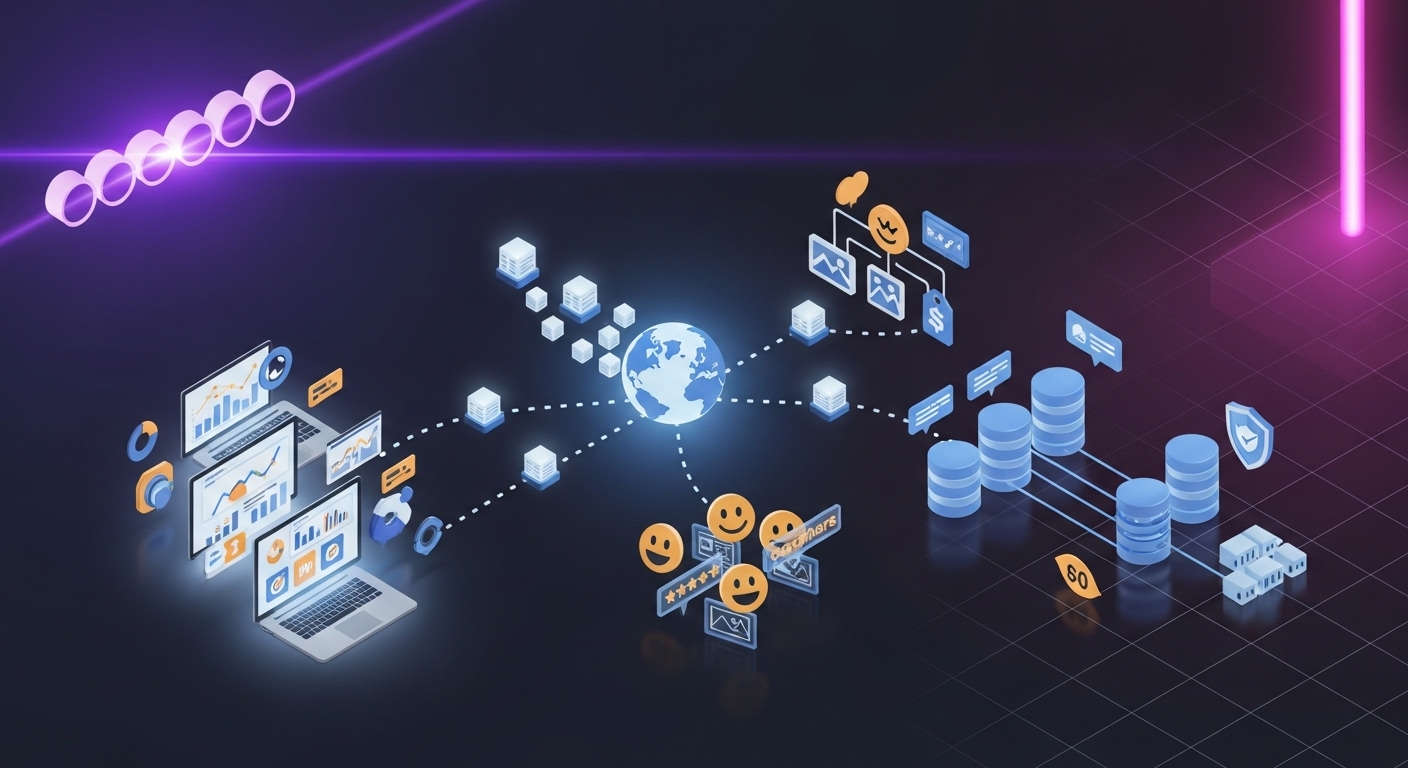
Two scraped snapshots become one change-detection feed: extraction, diffing, and an alert, before the pricing call gets made.
This isn’t legal advice for your specific situation. For how GDPR and CCPA actually apply to scraped data, see DataFlirt’s guide on web scraping and GDPR.
Next Steps
Choose DataFlirt if:
- Daily competitor pricing or stock-status monitoring is the actual need, not a one-off pull.
- There’s no in-house data engineering team to build and maintain the pipeline.
- Structured CSV, JSON, or API delivery matters more than raw HTML access.
- MAP violations or SKU-level pricing accuracy matter as much as raw coverage.
Look elsewhere if:
- DataFlirt runs on cloud infrastructure and third-party proxy vendors rather than owning infrastructure in-house. That’s true of nearly every provider in this space, so it isn’t a differentiator against alternatives. It’s worth knowing if in-house infrastructure ownership is a hard requirement for your team.
Get in touch with the target sites and the fields you need. One-time pricing or inventory pulls are typically scoped and delivered in 3-4 days.