
Key takeaways
- Alternative data markets are exploding as analysts scrape stock availability to predict corporate revenue.
- The shopping cart manipulation technique still works, provided maximum order limits are absent.
- Shopify storefronts frequently expose exact inventory quantities via page source code or the cart API.
- Relying strictly on logged-out, public pages minimizes legal risk during web scraping operations.
- Public estimates become reliable when analysts track depletion velocity rather than point-in-time snapshots.
Investors and enterprise analysts need predictive signals before quarterly earnings drop. Waiting for an official financial report means you are trading on the past. By the time a retailer discloses supply chain friction, the market has already reacted. You need alternative data right now. You need a way to estimate competitor stock levels directly from public listings.
What inventory data from public listings actually delivers
Extracting stock availability provides real-time predictive intelligence regarding product demand and upcoming financial performance. It bridges the gap between public perception and actual warehouse reality.
Inventory distortion is a massive financial drain across global supply chains. The global annual cost to the retail industry caused by out-of-stocks and overstocks reached $1.77 trillion in 2023. That translates to roughly 7.2% of all retail sales vanishing into pure operational friction. Investors tracking this distortion gain a massive analytical edge over the broader market. DataFlirt sees quantitative analysts utilizing this data to adjust quarterly revenue expectations weeks in advance.
Overstocking forces retailers into aggressive markdown cycles. These markdowns destroy profit margins and signal weak consumer demand to the broader market. Conversely, understocking leaves guaranteed revenue on the table. Both scenarios indicate internal operational failures. Tracking these failures in real time provides an undeniable trading advantage.
How stock-outs create alternative data opportunities
Stock-outs specifically bleed revenue at an alarming rate. Global retail revenue lost due to stock-outs hit an estimated $1.2 trillion in 2024. That accounts for roughly 40% of all lost sales opportunities. When a flagship product goes out of stock, competitors immediately absorb that displaced revenue.
Shopper loyalty evaporates instantly when availability drops. When encountering an out-of-stock item, 69% of online shoppers abandon their purchase and shop with a competitor. Tracking stock levels across sites like target and walmart allows analysts to model these massive consumer shifts. DataFlirt clients frequently track these precise migration patterns to predict shifts in market share.
Analysts must capture these events as they happen. If a major electronics retailer runs out of inventory during the holiday rush, the financial damage is already done. Scraping this data daily highlights these operational failures long before the next investor call.
The surge of alternative data in finance
Tracking this information falls under the growing umbrella of alternative data. The estimated global market size for alternative data sits at $18.8 billion in 2025. Projections expect this market to reach $29.6 billion by 2026. Extracting ecommerce stock signals drives a significant portion of this growth. DataFlirt provisions the infrastructure that makes this growth possible.
Fundamental analysis relies heavily on historical data. Alternative data flips this paradigm by focusing on leading indicators. Tracking the availability of high-margin products provides a direct proxy for sales volume. When you know a product is selling out rapidly, you possess a highly lucrative piece of information.
Hedge funds adopted these extraction techniques years ago. By 2022, 78% of hedge funds had integrated alternative data into their investment models. Scraping pricing trends and inventory availability from a bestbuy or homedepot catalog generates alpha that traditional analysis misses. To stay competitive, you must build alternative data for ecommerce into your regular modeling workflow. DataFlirt helps modern funds secure these exact datasets at massive scale.
How to extract stock levels and what to watch for
You extract inventory numbers by probing ecommerce shopping carts, parsing hidden page variables, or intercepting API responses. Each method carries specific technical limits based on the target platform’s underlying architecture.
Analysts use a few well-known techniques to extract exact quantities from public storefronts. You must tailor your data-extraction approach to the specific software running the site. A technique that works perfectly on amazon will fail entirely on a custom-built storefront like wayfair. DataFlirt engineers spend thousands of hours cataloging these platform-specific quirks.
The Amazon 999 cart technique
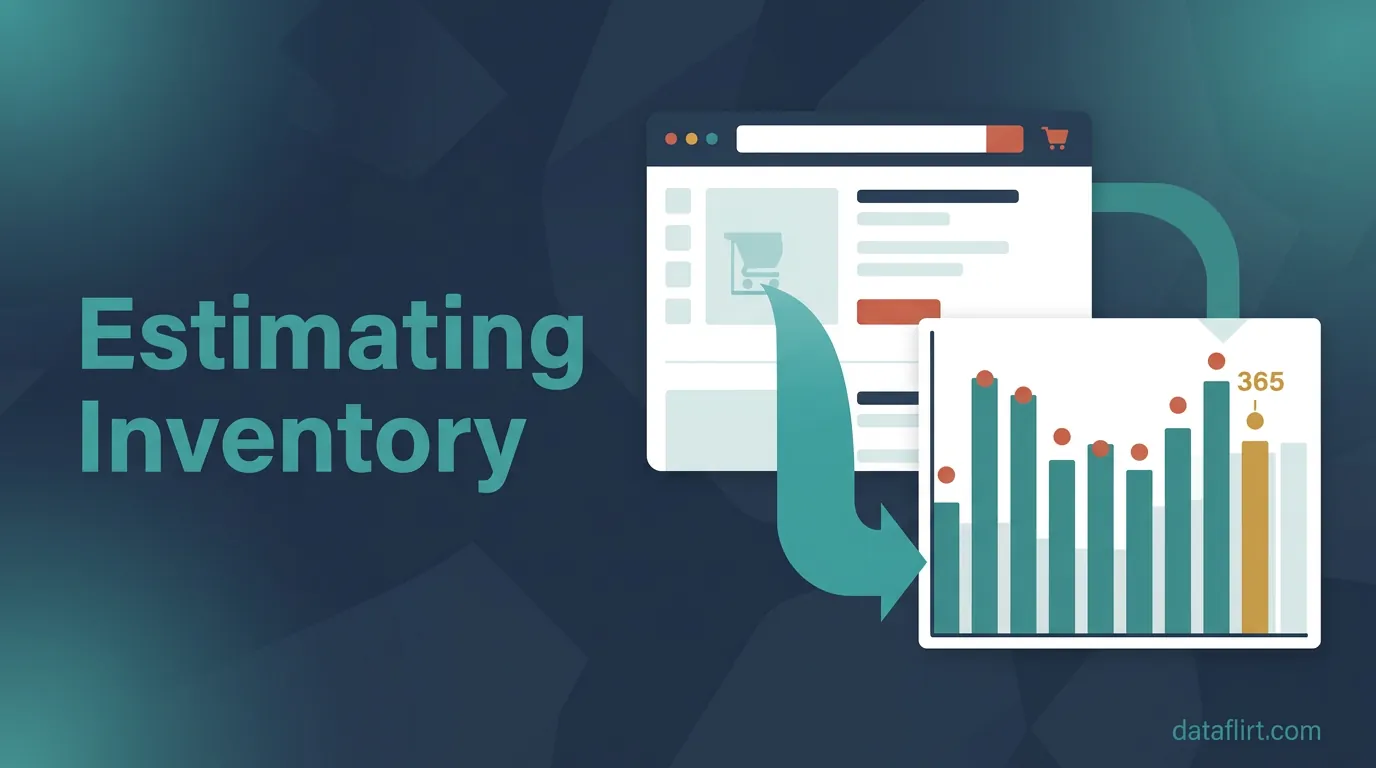
The classic method of estimating competitor stock involves manipulating the shopping cart. You add an item to the cart and manually modify the desired quantity to 999. You then allow the checkout system to return an error. The error message usually reveals the exact remaining inventory. DataFlirt monitors this specific behavior across thousands of product categories.
This trick still functions reliably for many listings in 2025 and 2026. However, the estimate fails if the seller holds more than 999 units of stock in their fulfillment center. In those cases, the cart will simply accept the addition without throwing an error, leaving you blind to the true total.
It also fails if the merchant configures a maximum order quantity per customer limit. When merchants apply these limits, the cart trick only returns the maximum allowed limit rather than the true warehouse stock. DataFlirt identifies these artificial caps to prevent skewed financial models from poisoning your research.
Shopify page source and JSON extraction
Many independent retailers and direct-to-consumer brands run on Shopify infrastructure. Shopify’s native Liquid templating object outputs the total stock available for a variant across all merchant locations. Many standard or custom storefront themes inadvertently expose this JSON object directly in the public HTML page source. You can scrape this directly without ever interacting with the cart. DataFlirt parses this JSON instantly upon page load.
If the theme hides this object, analysts can still ping the cart API endpoints. You send a request for an abnormally high quantity to the add-to-cart endpoint. If the request exceeds available stock, the system responds with a 422 status code. The response payload will then output the precise maximum available quantity for that specific variant. DataFlirt automates this API interrogation at scale.
This method requires precise technical execution. You must ensure your automated requests mimic legitimate browser behavior to avoid immediate bans. You must pass the correct headers, cookies, and session tokens. DataFlirt handles all session management invisibly in the background.
Intercepting cart APIs for custom platforms
Enterprise retailers rarely expose raw inventory numbers in the static page source. Sites like macys or nordstrom utilize custom React or Next.js frontends. To find inventory data here, you must monitor the network traffic panel in your browser developer tools. DataFlirt engineers trace the exact API calls triggered during page load to isolate the data source.
// Conceptual logic for intercepting an availability API response
const fetchAvailability = async (productId) => {
  const response = await fetch(`https://api.retailer.com/inventory/${productId}`);
  const data = await response.json();
  return data.available_quantity;
};
This approach requires reverse-engineering the site’s internal API structure. The endpoints are often undocumented and subject to sudden, unannounced changes. DataFlirt specializes in mapping and maintaining reliable connections to these fragile endpoints.
| Extraction Method | Target Platform Profile | Reliability | Technical Complexity |
|---|---|---|---|
| 999 Cart Error | Custom builds, legacy sites | Moderate | Low |
| Exposed JSON Object | Shopify, WooCommerce | High | Low |
| Cart API Rejection | Shopify, BigCommerce | High | Moderate |
| Network Interception | Enterprise custom builds | Variable | High |
When do public inventory estimates become reliable enough to act on?
Public estimates become reliable when you track delta changes over a long time horizon rather than trusting absolute point-in-time numbers. You must cross-reference these estimates with historical baseline patterns to filter out the noise.
Inventory estimates from public data are inherently uncertain. At what point do they become reliable enough to act on? A public listing might show 40 units available. The merchant might have another 5,000 units sitting in a secondary warehouse that the frontend API never queries. You cannot assume a scraped number represents total enterprise inventory. You must assume it represents the stock currently allocated for online fulfillment.
Tracking delta changes over absolute numbers
To make this data actionable, you must track the rate of change. If you scrape a nike sneaker listing every day for three months, the absolute number matters less than the velocity of the depletion. A sudden drop in available stock across multiple sizes indicates strong consumer demand. A stagnant inventory count signals a high risk of future markdowns. DataFlirt helps funds track this velocity accurately over time.
Consider a quantitative analyst tracking 40,000 SKUs across six marketplaces. Every Monday, she needs last week’s inventory depletion rates. A sudden 30% drop in flagship product availability provides a stronger trading signal than the absolute remaining unit count. Her models rely purely on this relative velocity.
This velocity metric smooths out inconsistencies in the underlying data. If a retailer hides 80% of their stock from the public API, the visible 20% will still deplete at a proportional rate. Analysts build models that extrapolate total sales velocity from this visible subset. DataFlirt ensures this subset is captured consistently every single day.
Building conviction through multi-channel aggregation
Reliability also improves when you aggregate data across multiple platforms. If a brand sells direct-to-consumer and through wholesale partners, you must scrape both channels simultaneously. Tracking inventory on the brand’s own site alongside their listings on ebay provides a composite view of market health. DataFlirt merges these disparate feeds into a highly structured, unified schema.
This composite view filters out noise caused by temporary warehouse transfers. A sudden drop in inventory on one site might just reflect a reallocation of stock to a different distribution center. If you see the stock drop across all channels simultaneously, you have a verified demand signal. DataFlirt prevents analysts from trading on false positives.
Investors use this delta tracking to build deep financial conviction. When you overlay pricing changes with inventory depletion rates, you can accurately estimate gross merchandise value velocity. DataFlirt data feeds provide a strong directional signal for quarterly performance. You build total confidence in the data by proving its historical correlation with actual financial disclosures over several quarters.
The architecture required for high-volume inventory tracking
Tracking millions of SKUs requires a distributed cloud architecture capable of bypassing aggressive bot protection. You need specialized infrastructure to handle headless browser rendering and intelligent proxy rotation.
Scraping inventory at scale requires heavy lifting. Target sites aggressively block automated cart additions using strict rate-limiting and bot detection algorithms. Pinging a cart endpoint 10,000 times a day from a single IP address will result in an immediate network ban. You need rotating residential proxies to distribute the load across thousands of distinct connections. DataFlirt manages this proxy rotation automatically.
Every connection must look like a real human shopper. This means managing cookies, rotating user-agent strings, and mimicking human mouse movements during the page load sequence. Failing to execute these evasion tactics will flag your scraper instantly. DataFlirt bakes these evasion protocols into every extraction job.
Managing schema drift across retail targets
You also face significant maintenance burdens when parsing page source data. Retailers constantly update their frontend frameworks. A simple CSS class change on a target site can break your entire scraping pipeline overnight. DataFlirt engineers must constantly monitor and repair broken extraction scripts before the client even notices the failure.
Data teams often underestimate the engineering cost of this maintenance. Building the initial scraper takes a few days. Keeping that scraper alive for a year takes hundreds of engineering hours. DataFlirt assumes total responsibility for this maintenance burden. DataFlirt ensures your downstream financial models never starve for data due to a minor site redesign.
Normalizing the output data presents another massive challenge. Retailer A might call a color “Midnight Navy”, while Retailer B calls the exact same product “Dark Blue”. You need robust mapping logic to ensure you are comparing identical SKUs. DataFlirt handles this data wrangling natively, delivering clean files that plug straight into your database.
Legal considerations for scraping public inventory data
Scraping public inventory data generally falls outside the Computer Fraud and Abuse Act, provided you only access publicly facing pages. You must still navigate potential breach of contract claims if you violate a platform’s terms of service during extraction.
The legality of public data scraping relies heavily on recent case law. The protracted lawsuit between hiQ Labs and LinkedIn settled via a consent judgment in late 2022. This case established critical boundaries for analysts extracting alternative data. The rulings shape how modern data teams architect their scraping pipelines. DataFlirt monitors these legal developments closely to protect client interests.
The legacy of the hiQ Labs decision
The 9th Circuit reinforced that scraping publicly accessible data does not generally violate the Computer Fraud and Abuse Act. If a product page does not require a password, extracting its stock level is generally permissible under the CFAA. This ruling provided significant relief to the alternative data industry. However, LinkedIn ultimately succeeded on a separate breach of contract claim.
The court ruled against the scraper because they utilized logged-in fake accounts to bypass restrictions. The scraper created artificial identities to access data that was otherwise protected behind a login wall. This action violated the platform’s user agreement explicitly. Data teams cannot ignore these contractual obligations when designing their architecture.
Using fake user accounts directly violates a platform’s terms of service. Analysts tracking inventory must rely strictly on logged-out, publicly facing pages and endpoints to mitigate legal exposure. You cannot create thousands of fake accounts to add items to shopping carts. You must operate as an anonymous visitor. DataFlirt configures all extraction pipelines to respect these specific operational boundaries.
Why DataFlirt insists on logged-out extraction
Data teams must proceed with caution when navigating these boundaries. While public product data is generally fair game, combining it with aggressive evasion tactics introduces serious risk. You must decouple your data collection from authenticated user sessions entirely. DataFlirt builds systems that extract value purely from public signals.
Always consult qualified legal counsel for your specific situation. Legal experts can help you audit your extraction methods to ensure compliance with relevant statutes and contractual obligations. DataFlirt always recommends thorough legal review before launching enterprise pipelines. DataFlirt provides the exact technical transparency your compliance team needs to approve the project confidently.
Operating within these legal boundaries requires discipline. You must accept that some data will remain inaccessible if it sits behind a strict authentication wall. For alternative data investors, the public data provides more than enough volume to build highly predictive models. DataFlirt focuses exclusively on maximizing the value of that accessible, public layer.
How DataFlirt handles high-volume availability tracking
DataFlirt manages the proxy rotation, extraction logic, and pipeline maintenance required to track millions of SKUs daily. DataFlirt transforms fragile scraping scripts into a highly reliable ecommerce product data API stream.
Building an in-house system to track stock levels across fifty retailers is incredibly expensive. Your engineers will spend their days fighting captcha challenges instead of building financial models. DataFlirt removes this operational burden entirely. DataFlirt handles the constant cat-and-mouse game of bot detection so your quantitative analysts can focus purely on generating alpha.
DataFlirt delivers data in the format your team actually wants to consume. Whether you need massive JSON dumps deposited into an S3 bucket or targeted updates sent to a Snowflake warehouse, the delivery mechanism is fully customized. This allows your team to skip the data engineering phase and move directly into analysis. DataFlirt accelerates your time to insight.
Quality assurance for financial models
Quality assurance separates DataFlirt from basic proxy networks. DataFlirt implements strict schema validation to ensure your inventory numbers are accurate and logically consistent. If a target site updates its cart API and starts returning anomalous quantities, DataFlirt detects the error immediately. DataFlirt repairs the extraction logic before your downstream models ingest bad data. DataFlirt guarantees data continuity for mission-critical applications.
DataFlirt provides unparalleled scale for alternative data teams. Whether you need daily stock counts across a few hundred SKUs or hourly pricing updates across a million listings, DataFlirt provisions the necessary infrastructure. DataFlirt operates globally, allowing you to track inventory across international storefronts without triggering geo-blocking defenses. DataFlirt makes alternative data acquisition boring, reliable, and predictable.
Many vendors simply sell raw, unstructured data dumps. DataFlirt partners with you to define the exact extraction parameters and business logic required. DataFlirt helps you navigate the nuances of maximum order quantities, hidden API endpoints, and variant-level tracking. DataFlirt understands the massive difference between a simple page scrape and a complex inventory audit. DataFlirt acts as a dedicated extension of your market intelligence team.
When a single percentage point of alpha can mean millions of dollars in returns, you cannot rely on fragile, open-source scraping scripts running on a local server. You need enterprise-grade infrastructure. DataFlirt gives you the technical foundation necessary to trade confidently on web-scraping-stock-market-data methodologies.
FAQ
Does the Amazon 999 cart trick still work in 2026?
Yes. The trick still functions for many public listings. It fails if the merchant has more than 999 units in stock or if they have actively configured a maximum order quantity per customer limit.
Can you scrape exact inventory numbers from Shopify stores?
Yes. Shopify frequently exposes the total stock available for a variant within a native JSON object in the page source. Analysts can also query the cart API to reveal maximum available quantities.
Is scraping public inventory data legal?
Extracting public data generally avoids Computer Fraud and Abuse Act violations. However, creating fake accounts to bypass restrictions can result in breach of contract claims. You should always consult qualified legal counsel.
How do hedge funds use scraped inventory data?
Hedge funds track inventory depletion rates alongside pricing changes to estimate gross merchandise value velocity. This provides predictive signals regarding quarterly financial performance before official earnings reports are released.
Why do in-house inventory scrapers frequently break?
Target sites constantly update their frontend frameworks and API structures. A minor code change will break an in-house extraction script. Maintaining these scripts requires constant engineering intervention.
If you want to track product availability without dedicating your engineering team to constant pipeline maintenance, DataFlirt can help. DataFlirt delivers clean, normalized alternative data directly to your infrastructure. We handle the proxy management, the API reverse-engineering, and the schema repairs required for modern financial modeling. If you are ready to integrate reliable inventory signals into your workflows, explore the ecommerce data extraction services offered by DataFlirt to schedule a free scoping call today. Let DataFlirt build the pipeline your analysts need, while you focus on extracting actionable insights for your stock-market strategies.