
Key takeaways
- Moving from static CSVs to a live API changes your architecture from batch processing to event-driven logic.
- Target marketplaces employ strict throttling; polling endpoints aggressively will quickly exhaust your allocated token buckets.
- Building a native API from scratch costs tens of thousands of dollars in upfront engineering and requires heavy ongoing maintenance.
- Outsourcing your endpoint management to a dedicated vendor shifts the infrastructure risk entirely off your engineering team.
You have a script extracting product data into a CSV file once a week. Your engineering team is happy; the overhead is low. Then your product manager asks for live inventory tracking across fifty competitor sites. Suddenly, a batch file format is useless. You need a persistent and queryable data feed. You need to productize your extraction pipeline into a reliable application programming interface.
What a live ecommerce data API actually delivers
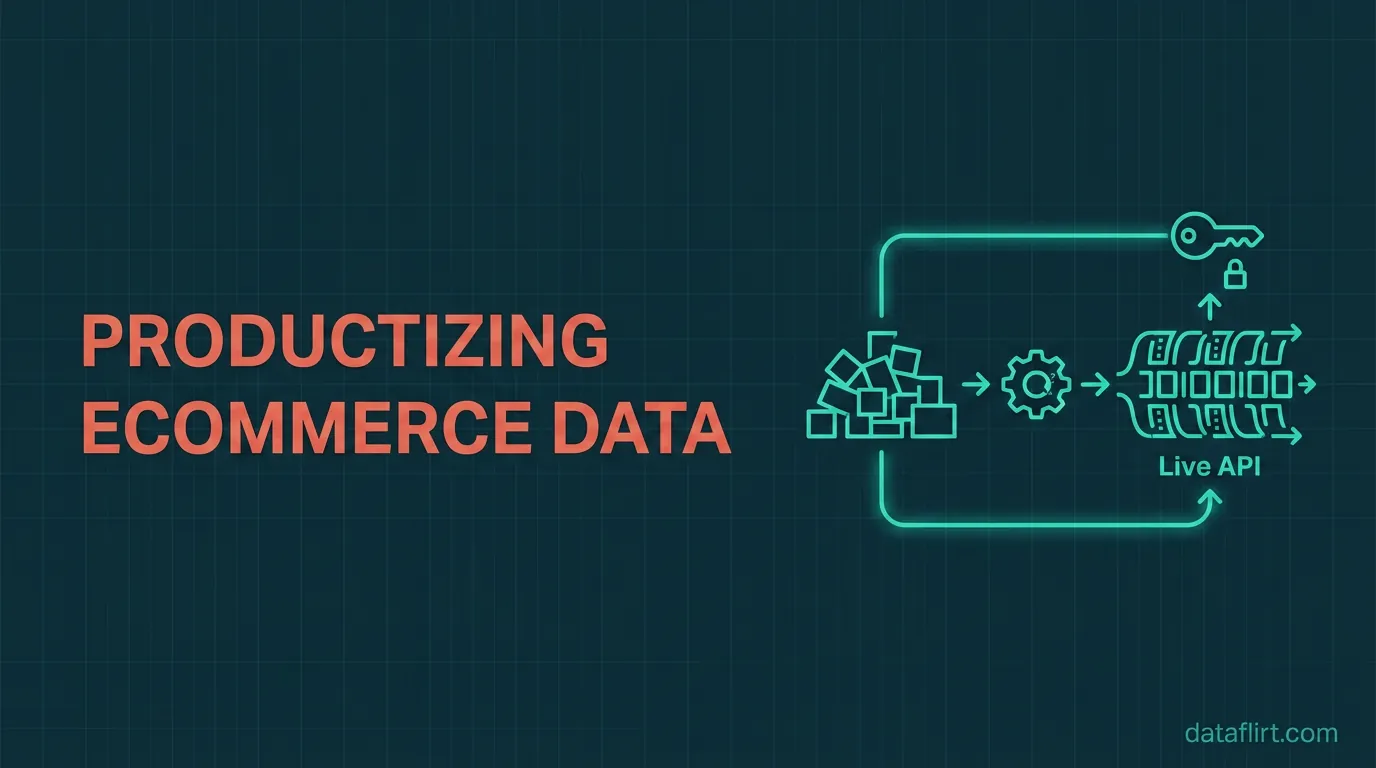
A live API shifts your extraction pipeline from a static snapshot to a continuous queryable stream. It allows downstream applications to request exact inventory or pricing data precisely when a user loads a page. This matters because pricing and inventory change by the minute in competitive retail sectors.
Transitioning to API-first commerce architectures lowers the total cost of making ongoing system and data changes by 40% compared to legacy solutions (Source). Your downstream developers can build dynamic repricing engines without waiting for a daily server cron job. They simply send an HTTP request and receive an immediate JSON response.
Shifting from batch files to event-driven architectures
Batch files force your application to process stale data. An API allows your systems to subscribe to events or poll for updates on a strict schedule. This architectural shift enables true real-time competitive intelligence. If a competitor drops their price on a flagship product, your API instantly reflects that change.
DataFlirt engineers constantly see in-house teams struggle with this transition. Moving to a live feed requires entirely new data extraction methodologies. You can no longer dump an entire website catalog into a database at midnight. You must target specific product nodes and update them continuously.
When you pull stock levels from Amazon, your infrastructure must handle constant state changes. The same applies to fast-moving apparel on Macy’s or Nordstrom. A static CSV cannot capture a flash sale that lasts only four hours. A live API captures that event the moment it happens.
The operational reality of continuous extraction
Maintaining a live endpoint means your servers never sleep. Your scrapers must constantly monitor target sites for structural changes. If a retailer modifies their CSS selectors, your extraction logic must adapt instantly. Otherwise, your API returns null values or throws errors to your downstream applications.
DataFlirt provides teams with the stability they need during this transition. Building the API routing is only the first step. The real challenge is keeping the data flowing when the source websites deploy new anti-bot countermeasures. DataFlirt handles these upstream disruptions silently.
We see developers underestimate the sheer volume of requests required. Monitoring a large catalog on Walmart requires thousands of HTTP requests per minute. Your infrastructure must load balance these requests to avoid IP bans. This is where a managed DataFlirt pipeline proves its immense value.
How to transition to API delivery and what breaks first
Moving to an API requires handling strict rate limits, pagination caps, and complex token buckets. The first component to fail is usually your polling logic when a target marketplace abruptly throttles your requests. You will quickly discover that target sites aggressively defend their infrastructure against automated traffic.
Targeting smaller retailers or Target requires a careful approach to request velocity. If you send too many requests too quickly, their firewalls will block your IP ranges. You must implement exponential backoff algorithms and extensive proxy rotation pools. DataFlirt engineers spend thousands of hours perfecting these rotation strategies.
Navigating rate limits and token bucket algorithms
Major platforms use sophisticated rate limiting to protect their servers. Amazon’s Selling Partner API (SP-API) handles approximately 58 billion calls per year across more than 1.6 million third-party developers, underscoring the massive scale required to handle live e-commerce data feeds (Source). Fetching catalog data via repeated GET calls triggers heavy throttling under Amazon’s dynamic token bucket algorithm.
Modern architecture requires using event-driven logic. You should use the Notifications API combined with bulk endpoints like searchCatalogItems. This endpoint fetches up to 20 items per request at a rate of 40 items per second. You cannot rely on pinging getCatalogItem, which is strictly limited to 2 items per second.
Shopify presents entirely different rate-limiting challenges. Their legacy REST API operates on a strict leaky bucket algorithm capped at 2 requests per second. It provides a brief burst limit of 40 requests. DataFlirt handles these limitations by distributing requests across massive IP networks.
Their modern GraphQL Admin API operates on calculated query costs instead of simple request counts. Standard plans grant 100 points per second. Shopify Plus plans grant 1,000 points per second. Enterprise plans receive up to 2,000 points per second. Your code must dynamically calculate query costs before execution.
To safely query GraphQL points, you must inspect the response extensions. Here is a Python snippet demonstrating how to evaluate the cost.
# Requires python 3.9+ and requests==2.31.0
# python -m venv env && source env/bin/activate
# pip install requests

import requests
import time
import logging

def fetch_shopify_data(query_string, headers):
    url = 'https://your-store.myshopify.com/admin/api/2026-01/graphql.json'
    payload = {'query': query_string}

    response = requests.post(url, json=payload, headers=headers)
    data = response.json()

    cost_info = data.get('extensions', {}).get('cost', {})
    available = cost_info.get('throttleStatus', {}).get('currentlyAvailable', 0)

    logging.info(f"Available points: {available}")
    if available < 200:
        time.sleep(2)  # Pause to allow the bucket to refill

    return data
This script reads the remaining points from the response header. It pauses the thread if the bucket is near depletion. DataFlirt implements highly advanced variations of this logic across all managed extraction projects.
Managing pagination caps and large arrays
A common API bottleneck is strict array limitation. Shopify strictly limits the pagination of arrays of objects to 25,000 items. For arrays larger than this, the API intentionally returns a count of 25,001 to signal the limit has been hit. This forces developers to build robust filtering parameters before parsing all results.
If you monitor Best Buy stock, you will encounter similar catalog limitations. You cannot request an entire category in one query. You must segment your requests by date ranges, price brackets, or sub-categories. DataFlirt automates this segmentation process completely.
When scraping hardware from Home Depot or Lowe’s, pagination logic becomes complex rapidly. Sites often use cursor-based pagination instead of simple numerical offsets. You must capture the cursor token from the previous response and include it in your next request.
DataFlirt engineers constantly update our pagination parsers to handle these dynamic cursor implementations. If the site alters its cursor format, a brittle script will enter an infinite loop. DataFlirt monitors these edge cases and prevents them from impacting your data delivery.
When the engineering cost of a live API justifies itself
The step from a batch file delivery to a live API is enormous in engineering cost. When does it actually justify itself? A live API justifies its cost only when your downstream systems require sub-hour latency to function. If you are doing weekly market research, stick to batch files.
Building a secure, documented, and fully-featured API typically ranges from $10,000 to $50,000, depending on the complexity of the endpoints and data volume (Source). This initial capital expenditure covers routing, load balancing, authentication, and database architecture. It does not cover the cost of writing the actual web scrapers.
Monthly infrastructure and hosting costs range from $100 to $500 for simple APIs, scaling up to $2,000 to $10,000 or more per month for high-traffic enterprise APIs (Source). These recurring costs consume engineering budgets quickly. You must pay for proxy bandwidth, cloud compute instances, and database storage.
Calculating the break-even point for real-time data
You must calculate whether real-time data actually generates revenue for your business. If your repricing engine increases sales by $100,000 monthly, a $10,000 API maintenance bill is acceptable. If you only use the data for internal reporting, you are burning money on unnecessary infrastructure.
Consider a catalog manager tracking furniture on Wayfair. She needs competitor prices to adjust her own margins. If her company only updates prices once a day, a daily CSV is sufficient. If she needs to match flash sales instantly, she needs a live API.
Consider a technical founder building an inventory sync tool for independent sellers. His application must prevent stockouts across multiple platforms. A daily batch file guarantees his sellers will sell out-of-stock items. A live API is the only technical solution that supports his core business logic.
We advise clients to evaluate their true latency requirements before committing to an API build. You must understand how web scraping APIs work before you commit budget to building one. DataFlirt provides honest consultations to help you choose the right delivery format.
| Feature | Batch CSV Delivery | Live API Endpoint |
|---|---|---|
| Data Latency | 24 hours to 7 days | Sub-second to 5 minutes |
| Build Cost | Low ($500 - $2,000) | High ($10,000 - $50,000) |
| Maintenance | Minimal (cron job checks) | Intensive (24/7 monitoring) |
| Best For | Market research, catalog audits | Dynamic pricing, stock syncing |
If you determine that a live feed is necessary, you face a significant build-versus-buy decision. Managing the infrastructure in-house requires dedicated DevOps engineers. This is why many organizations prefer to read up on understanding scraping cost factors and subsequently outsource the heavy lifting.
Why developers outsource API maintenance to DataFlirt
DataFlirt removes the burden of building and maintaining your own data extraction endpoints. We handle the upstream scraping, data normalization, and API hosting so you just query the final dataset. You receive a clean JSON payload without ever touching a proxy server or a headless browser.
Building an API means managing the underlying infrastructure to support it. You must deploy containerized applications, set up message queues, and configure distributed databases. DataFlirt already operates this infrastructure at a massive global scale. DataFlirt guarantees high availability and consistent response times.
A freelancer on a gig platform can deliver a static script that generates a CSV file for a few hundred products. Once you need sub-minute latency across millions of SKUs, the technical requirements shift drastically. That is the exact threshold where DataFlirt’s managed infrastructure and enterprise SLA start paying for themselves.
Bypassing the infrastructure build completely
When you partner with DataFlirt, you skip the $50,000 build cost and the months of development time. DataFlirt delivers a fully authenticated REST endpoint that connects directly to your downstream applications. You simply pass your API key and retrieve the exact ecommerce data you need.
DataFlirt manages all the painful anti-bot mitigation techniques required to maintain live access. If a target site introduces a new browser fingerprinting challenge, DataFlirt engineers resolve it. Your downstream applications never experience a service interruption. DataFlirt acts as an invisible shield between you and the chaotic web.
We provide multiple integration methods to suit your specific architectural needs. You can query the DataFlirt API directly for synchronous data delivery. Alternatively, DataFlirt can push real-time updates to your system via a webhook. This flexibility allows your team to choose the optimal infrastructure patterns for your project.
For large-scale operations on global platforms like eBay or AliExpress, DataFlirt scales resources instantly. You never have to provision new servers or upgrade database tiers. DataFlirt absorbs the complexity of global data collection.
DataFlirt normalizes the extracted data into a unified schema. You do not have to write custom parsers for fifty different website layouts. DataFlirt standardizes the price fields, inventory counts, and product descriptions. You receive predictable data every single time.
Our team monitors the health of your extraction pipeline continuously. DataFlirt sets up automated alerts to catch malformed data before it reaches your endpoints. By relying on DataFlirt, your engineering team can focus entirely on building your core product instead of fighting CAPTCHAs.
DataFlirt takes legal compliance and ethical scraping seriously. We help you navigate the complexities of public data extraction without risking your primary business operations. We strongly recommend that all organizations consult qualified legal counsel to review their specific data usage and storage practices.
FAQ
What is the most common failure point when moving to a live API?
Polling endpoints too aggressively is the most common failure point. Marketplaces use dynamic token buckets to throttle incoming traffic. If your script loops continuously without respecting the target’s rate limits, your IP address will face an immediate block.
How does Shopify handle large array requests in its API?
Shopify strictly caps pagination for arrays of objects at 25,000 items. If your query exceeds this threshold, the API intentionally returns a count of 25,001. You must build specific filtering parameters, like date ranges or categories, to segment the results effectively.
Why does building a native API cost so much upfront?
Building an API requires comprehensive infrastructure routing, secure authentication, load balancing, and database optimization. Constructing a highly available system that guarantees uptime ranges from $10,000 to $50,000 in dedicated engineering hours.
If you would rather not scope this yourself, the DataFlirt ecommerce scraping service handles the extraction, QA, and delivery. We can also provide tailored endpoints for B2B marketplace monitoring and complex competitor intelligence. Reach out to the DataFlirt team today for a free scoping call.