
Key takeaways
- Generative AI models require strictly formatted catalog structures rather than raw HTML to prevent token waste and hallucinated inventory.
- Relying exclusively on platform APIs is risky due to strict bucket constraints and aggressive throttling.
- Rendering modern storefronts consumes vast amounts of proxy bandwidth, easily pushing infrastructure costs into thousands of dollars.
- Minimum viable freshness requires a tiered approach, updating volatile metrics hourly while leaving static attributes untouched for weeks.
- Legal orientation: public product facts are generally accessible, but personal seller contact details require dedicated compliance checks.
What a structured agent corpus actually delivers
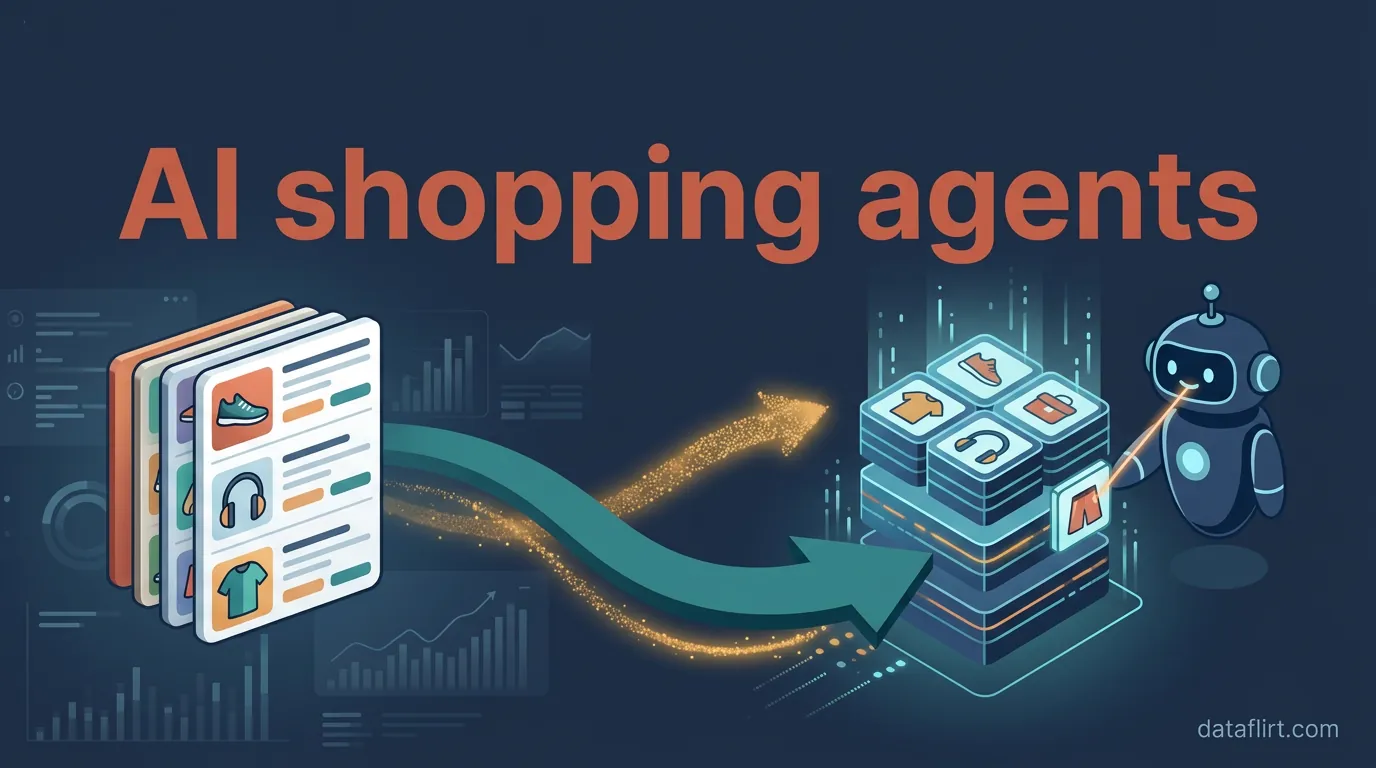
A structured agent corpus provides the exact semantic relationships and real-time inventory signals that generative models need to make purchasing decisions. It transforms scattered storefronts into queryable, deterministic memory.
Developers building AI shopping assistants face a fundamental infrastructure problem right from the start. Your large language model is only as intelligent as the context it retrieves. If your vector database contains outdated inventory, the agent recommends unavailable products. If the schema lacks granular attributes, the agent cannot answer basic compatibility questions. Building a competitive assistant requires a massive, clean dataset.
The shift from search to agentic commerce
Traditional search relies on keyword matching. Agentic commerce relies on semantic understanding and autonomous execution. By 2030, U.S. e-commerce spending handled by AI shopping assistants is projected to reach $190 billion to $385 billion, representing up to 20% of total market share. This shift dictates a new approach to data extraction. Agents do not browse visual layouts. They consume serialized data feeds.
To capture a share of this growing market, developers need robust pipelines. Relying on isolated CSV exports or manual data entry is insufficient for scale. The modern DataFlirt approach emphasizes continuous, API-ready data streams. Your agent needs to know instantly if a product variation is out of stock in a specific geographic region.
Why legacy data pipelines fail generative models
Legacy extraction pipelines dump raw HTML or loosely parsed text into relational databases. This creates chaos for AI models. The average percentage of potential revenue that mid-market ecommerce companies lose to bad, inaccurate, or missing product data currently sits at 23%. When an AI parses messy data, it hallucinates features or hallucinates stock availability.
A DataFlirt extraction pipeline prevents these errors by enforcing strict schema validations. Every product entity must have discrete fields for dimensions, materials, shipping weights, and variant IDs. Without this level of normalization, the agentic workflow breaks down entirely. The DataFlirt schema ensures models ingest pure, structured knowledge.
Defining the required schema for agent memory
Generative models require context windows filled with dense, relevant information. You cannot feed an entire storefront’s DOM into an LLM prompt. Instead, you extract the metadata, vectorize it, and store it in a specialized database. This requires standardizing varying structures from different retailers into a single format.
Consider the difference between a Walmart listing and an IKEA product page. The attributes are named differently, formatted differently, and nested differently. A DataFlirt catalog pipeline normalizes these disparate sources. Every item is flattened into a predictable JSON object. This predictability is what allows the AI agent to confidently compare options across multiple vendors.
How to extract product catalogs at scale
Extracting catalogs reliably requires balancing platform API limitations against the high infrastructure costs of rendered web scraping. You must parse millions of unique URLs without triggering aggressive anti-bot protections or burning through your compute budget.
The reality of platform API limits
Developers often assume they can just use a platform’s native API to populate their agent. This is rarely feasible at scale. For example, standard REST APIs heavily restrict request volumes. Shopify strictly limits standard apps to 2 requests per second. They enforce this using a leaky bucket algorithm. If your agent attempts to query a store’s catalog faster than the leak rate, the bucket fills up.
Once that bucket hits a maximum of 40 requests, the application receives a strict error code. This brings data flow to a sudden halt. You cannot build a responsive AI assistant if your data ingestion is artificially choked. This is a common scenario where DataFlirt engineers must step in. We bypass these arbitrary application limits by interacting with the storefront infrastructure directly.
The hidden costs of parsing JavaScript
Modern storefronts are incredibly dynamic. Prices, reviews, and inventory statuses are often injected via client-side scripts long after the initial page load. Capturing this data requires a headless browser to render the DOM completely. This introduces a massive bandwidth burden. The average bandwidth size of a JavaScript-rendered ecommerce page is 2 to 5 MB.
Because residential proxy pools charge by the gigabyte, bandwidth costs compound aggressively. Scraping one million product pages can quickly cost thousands of dollars in proxy traffic alone. In fact, the true monthly cost of scraping just 1 million pages using self-hosted infrastructure typically ranges from $3,100 to $5,600+. This estimate factors in cloud compute, proxy usage, and necessary engineering maintenance.
Navigating strict schema mandates
Retail data standards are constantly shifting. Google is actively tightening data structure rules for product visibility. By March 2026, Google enforces a mandatory Product ID split. Retailers must use entirely separate IDs for online versus in-store items if their attributes differ. Additionally, new validation warnings begin in April 2026 for a strict 500x500 minimum pixel resolution across all product images.
If your AI training data fails to capture these nuances, your corpus becomes obsolete. DataFlirt monitors these evolving global standards. We adjust extraction logic dynamically so your database remains compliant with industry expectations. When extracting data for how to scrape AI training data, structural fidelity is non-negotiable. DataFlirt handles these adjustments automatically.
Comparing extraction architectures
Understanding the trade-offs between different extraction methods is crucial for controlling costs. The architecture you choose directly dictates your operational budget.
| Extraction Method | Infrastructure Required | Data Freshness | Monthly Cost Profile |
|---|---|---|---|
| Native Platform APIs | Minimal | Very high (subject to limits) | Low, but highly restricted |
| Direct HTML Scraping | High (Proxies required) | Medium | Moderate ($500 - $1,500) |
| Headless JS Rendering | Extreme (Browser clusters) | High | High ($3,000 - $6,000+) |
| Managed DataFlirt Service | None | Custom SLAs | Predictable flat pricing |
Every understanding scraping cost factors analysis reveals that managed services offer better predictability. DataFlirt absorbs the compute overhead. Our clients receive clean data without maintaining server clusters.
What is the minimum viable freshness for a useful agent
AI shopping agents need real-time data, but scraping for real-time is expensive. The minimum viable freshness depends entirely on the product category. Fast-fashion requires daily stock checks; major electronics need hourly price updates; furniture specifications remain static for months.
Developers often want sub-second latency across the entire catalog. This is a fast path to bankruptcy. You have to decouple static attributes from volatile metrics. A DataFlirt extraction strategy addresses this by assigning different refresh frequencies to different data fields.
Category-specific volatility tracking
Prices fluctuate far more rapidly than most developers realize. Amazon changes its product prices an estimated 2.5 million times every single day. This averages out to one price change roughly every 10 minutes across its massive catalog. If your agent recommends an Amazon product based on yesterday’s price, the user experience suffers immediately.
Conversely, a sofa listed on Wayfair rarely changes its dimensions. The DataFlirt methodology maps these volatility profiles carefully. We configure pipelines to scrape pricing nodes constantly while only checking static descriptions once a week. This precision reduces proxy consumption dramatically. DataFlirt clients save thousands by targeting only what changes.
Implementing a tiered synchronization strategy
To balance freshness and cost, you must implement a delta update architecture. A full catalog sync pulls everything. A delta sync only pulls the specific URLs that indicate a state change. DataFlirt engineers design systems that monitor category index pages for timestamp updates.
When the DataFlirt system detects a modified index, it dispatches targeted workers to those specific product pages. This prevents wasting requests on unchanged inventory. A smart rotating proxy network routes these lightweight requests efficiently. DataFlirt makes this delta synchronization process invisible to the end user.
Handling availability versus pricing
Stock availability is the most critical metric for an AI shopping agent. Recommending an out-of-stock item instantly destroys user trust. However, checking inventory often requires simulating Add-to-Cart actions. This triggers aggressive bot protections. When targeting a high-security site like Target or Best Buy, simple GET requests fail.
DataFlirt utilizes advanced session management to check stock levels without triggering blocks. We mimic human browsing patterns to retrieve accurate availability signals. This ensures your generative model always knows exactly what can actually be purchased. DataFlirt delivers this availability data alongside pricing for a complete transactional picture.
Managing IP infrastructure for millions of requests
Maintaining reliable access to target storefronts is a constant battle. Retailers employ sophisticated anti-bot vendors to block automated traffic. If you use standard datacenter IPs, your pipeline will be blacklisted within hours. You must use residential IP networks, which adds enormous complexity.
Residential networks are expensive and highly volatile. Nodes go offline randomly. DataFlirt solves this by orchestrating a massive, proprietary proxy pool. We route traffic through optimized geographic nodes to ensure high success rates. When you rely on DataFlirt, you stop worrying about IP bans.
Bypassing advanced bot protections
Storefronts use advanced behavioral analysis to detect scrapers. They track cursor movements, execution times, and TLS fingerprints. Bypassing a complex captcha challenge requires specialized solvers. This is a game of constant escalation. DataFlirt maintains a dedicated engineering team solely focused on bypassing these protections.
When a site like Sephora or Nykaa updates its security perimeter, self-hosted scrapers crash. DataFlirt detects these changes and deploys counter-measures instantly. We handle the cat-and-mouse game so your data flow remains uninterrupted. Your DataFlirt pipeline heals itself dynamically.
The importance of geographic targeting
Prices and inventory often vary wildly by ZIP code or geographic region. A product available in New York might be out of stock in London. To feed accurate localized data to an AI agent, your scraper must present the correct geographic headers and IP address. DataFlirt supports granular, city-level targeting natively.
If you want to train an agent to shop locally at Home Depot, you need exact store-level inventory. We configure DataFlirt workers to spoof specific regional coordinates. This ensures the extracted prices reflect local reality, not just the national default. DataFlirt makes localized extraction straightforward.
Why developers outsource the extraction layer
Outsourcing extraction allows engineering teams to focus entirely on vector search, prompt engineering, and model fine-tuning. Building infrastructure to bypass security checks and manage proxies is a massive distraction from core product value. You should build the brain, not the plumbing.
Consider an engineering team trying to maintain connections to 50 different retail sites. Every Tuesday, three sites change their DOM structure. Every Thursday, two sites update their anti-bot software. The team spends 80% of their sprints just keeping the pipeline alive. Offloading this to a managed service reclaims those lost hours.
Moving engineering cycles back to the model
When you stop managing infrastructure, you can start optimizing user experience. Developing a reliable web scraping ecommerce product data system takes months of trial and error. DataFlirt offers a proven shortcut. We deliver structured, validated datasets directly into your preferred cloud storage.
DataFlirt acts as your dedicated extraction department. Our team monitors the pipelines, updates the selectors, and pays the proxy bills. You simply consume the JSON feeds. By partnering with DataFlirt, startups can launch their AI agents months ahead of schedule.
How DataFlirt structures the corpus
The quality gap between a generic scraping tool and a specialized managed service is profound. Generic tools dump whatever text they find. DataFlirt cleans, normalizes, and validates every single record. We ensure that a shoe size scraped from eBay matches the formatting of a shoe size scraped from a boutique retailer.
This normalization is the foundation of a successful AI model. DataFlirt applies strict type casting to prices, converts currencies, and structures variant arrays flawlessly. When you use DataFlirt, you receive data that is instantly ready for embedding and vectorization. DataFlirt eliminates the need for messy post-processing scripts.
Designing a resilient data pipeline
Resilience means guaranteeing data delivery even when target sites experience downtime. If a retailer’s server crashes, a basic scraper will just throw an error and corrupt your database. The DataFlirt architecture includes robust retry logic and state management. We ensure transient errors do not pollute your AI corpus.
We utilize decoupled message queues to handle heavy loads smoothly. If rate limits spike, DataFlirt automatically throttles back and queues the requests for later. This intelligent pacing guarantees data completeness. With DataFlirt, you build on a foundation of absolute reliability.
FAQ
Is scraping ecommerce product data legal for AI training?
Publicly available facts, such as product prices and basic specifications, are generally not subject to copyright. However, replicating creative product descriptions or proprietary images carries risk. You must always review the target site’s Terms of Service and consult qualified legal counsel for your specific situation.
How does DataFlirt handle site redesigns?
DataFlirt employs automated monitoring to detect schema drift and layout changes immediately. When a target site redesigns its DOM, our system flags the broken selectors. Our engineering team updates the parsing logic, often before the client even notices a disruption in their data feed.
Can I extract customer reviews along with product data?
Yes. Customer reviews provide excellent semantic context for AI shopping agents. DataFlirt can extract review text, star ratings, and author metadata. However, personal identifiable information must be handled carefully to maintain strict privacy compliance.
What format does DataFlirt use for delivery?
We deliver data in whatever format your stack requires. Most AI developers prefer NDJSON or structured JSON delivered directly to AWS S3, Google Cloud Storage, or a dedicated Snowflake instance. We tailor the delivery pipeline to your exact architectural needs.
If you would rather not scope this yourself, the ecommerce scraping service from DataFlirt handles the extraction, QA, and delivery. We specialize in building reliable pipelines for AI training data, ensuring your generative models have the precise context they need. Reach out today for a free scoping call and let DataFlirt handle the heavy lifting.