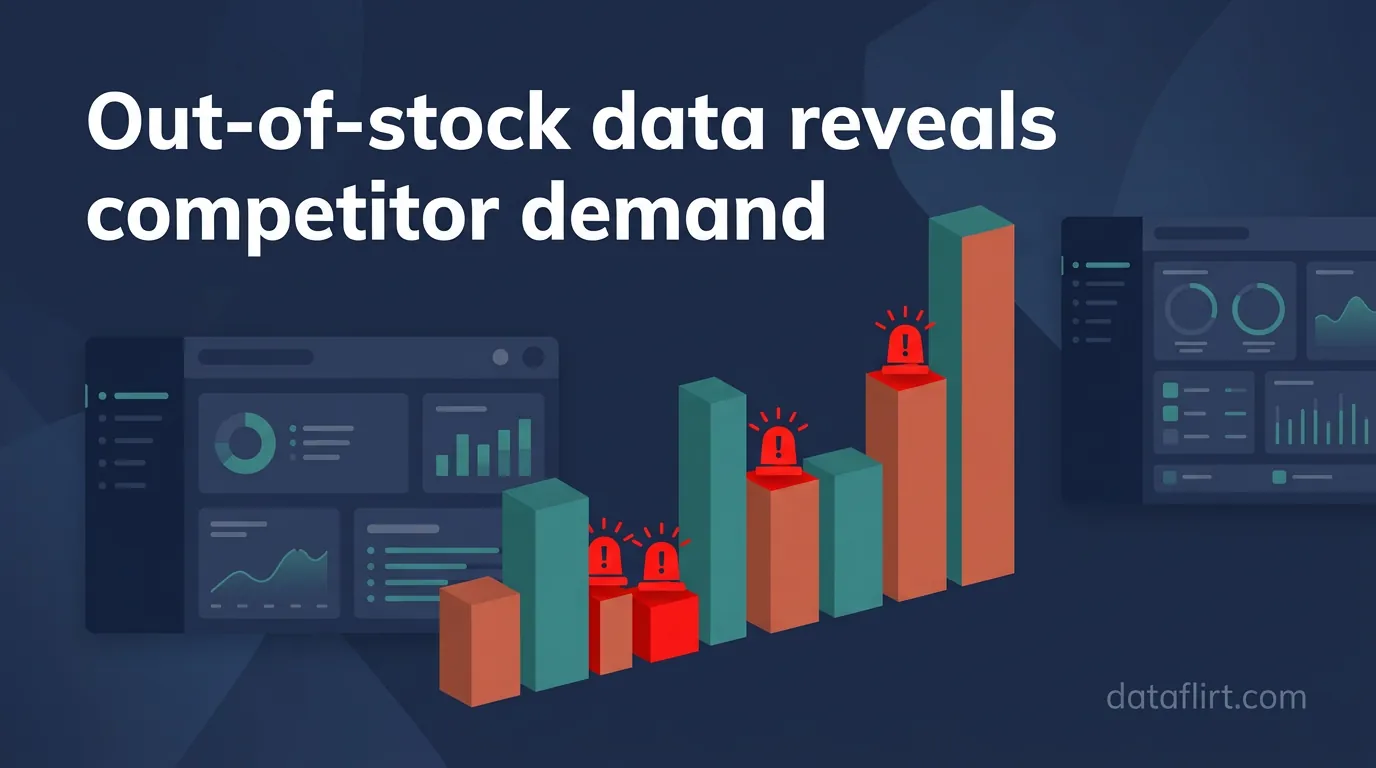

An analyst tracks a publicly traded consumer goods brand carefully. The brand’s flagship product shows as entirely unavailable across multiple regional distribution centers. You must decide whether this represents a viral demand spike or a critical supplier failure. You cannot afford to wait for the next quarterly earnings call to find out. By the time official corporate filings reflect inventory disruptions, the market has already reacted. Quantitative researchers need localized supply data immediately. Extracting product availability signals directly from ecommerce storefronts solves this visibility gap.
Key takeaways
- Public stockouts reveal supply chain bottlenecks and localized demand spikes weeks before official earnings reports.
- Extracting accurate signals requires tracking specific API parameters rather than simply scraping frontend text.
- Marketplace ranking algorithms decay rapidly during stockout events and require weeks of sustained sales to fully recover.
- Investment teams increasingly rely on alternative data to measure real-time market shifts.
- Legal orientation indicates that scraping public product data is generally permissible, provided teams avoid personal data and consult legal counsel.
What out-of-stock data actually delivers for market intelligence
Tracking inventory availability across competitor catalogs provides real-time visibility into supply chain bottlenecks and sudden demand spikes. It transforms qualitative assumptions into quantifiable alternative data.
Investment managers and competitive analysts historically relied on trailing indicators like quarterly earnings reports. Modern intelligence teams pull alternative data directly from the source. They monitor SKU-level inventory availability across vast target domains. They measure delivery lead times to forecast margin compression. They identify immediate white space opportunities left by competitor stockouts.
This shift toward raw signal extraction requires immense data volumes. Analysts spend heavily to acquire clean datasets. Investment managers will spend $2.8 billion on alternative data in 2025. This represents a 17% year-over-year growth. Web-scraped ecommerce data makes up the largest single category within that massive spend.
Identifying margin compression and supply bottlenecks
Supply chain disruptions eat directly into retail profit margins. Extracting catalog availability data highlights these structural failures early.
Retailers lost a staggering $1.77 trillion to inventory distortion globally in 2023. This figure encompasses the combined cost of out-of-stock events and overstock markdowns. When you scrape availability statuses daily, you map these distortions as they happen. You spot systemic issues before the broader market recognizes the vulnerability. DataFlirt extracts these daily snapshots flawlessly.
Consider an analyst monitoring a major apparel brand on ASOS or Zara. A sudden stockout of core seasonal items across all sizes strongly suggests a supplier constraint. A gradual stockout of only highly discounted items indicates a clearance strategy. DataFlirt categorizes these nuanced differences. Analysts use alternative data provided by DataFlirt to model the specific financial impact of each scenario.
Tracking consumer trade-down behavior in real time
Stockouts force consumers to make immediate choices. They rarely wait for an item to restock. They simply move to the next available option.
When online shoppers encounter an out-of-stock item, 69% immediately abandon their purchase and shop with a competitor. This massive abandonment rate creates instant revenue shifts between competing brands. If you monitor a category leader on Target or Walmart, their inventory failure becomes your predictive growth signal for the challenger brand. DataFlirt maps these cross-catalog relationships.
Consider a pricing manager executing a competitor matching strategy for premium pet food. She notices the category leader is completely sold out on Chewy. She immediately cancels her planned promotional discounts. Her brand captures the overflow demand at full retail price. DataFlirt intelligence makes this proactive strategy possible.
Feeding quantitative models with clean data
Quantitative models require strictly formatted inputs. Raw HTML scraping often introduces fatal errors into these sophisticated financial models.
Models fail when stockout indicators are misclassified. A product listed as “temporarily unavailable” might be treated differently than a product marked “discontinued.” DataFlirt standardizes these specific extraction variables. DataFlirt normalizes availability statuses into clean boolean logic. This strict data quality allows analysts to ingest datasets directly into their predictive algorithms.
DataFlirt engineers design custom pipelines that map exact category hierarchies. DataFlirt structures the output schema to match your internal data warehouse requirements. When DataFlirt delivers the payload, your analysts begin modeling immediately. They skip the tedious data wrangling phase entirely. DataFlirt handles the foundational complexity.
How to extract availability signals and what to watch for
Extracting reliable stock indicators requires pulling exact backend API parameters and monitoring specific algorithmic decay loops. You cannot rely on simple frontend web elements.
Modern ecommerce platforms use complex dynamic rendering to display inventory levels. Scraping the text “Out of Stock” from a product page frequently yields false positives. Cached content delivery networks might display stale HTML for hours. To get the truth, you must bypass the frontend and query the underlying data structures. DataFlirt bypasses these caching layers systematically.
DataFlirt recommends structuring extraction priorities based on the specific architecture of the target platform. Different marketplaces present different technical hurdles.
| Signal Type | Extraction Target | Accuracy Level | Implementation Difficulty |
|---|---|---|---|
| Frontend HTML | CSS class names | Low | Low |
| Backend JSON | API responses | High | High |
| Search Ranking | Index position | Medium | Medium |
| Delivery Dates | Shipping calculators | High | High |
Navigating the Shopify GraphQL API transition
Extracting true availability from Shopify storefronts requires precise API interaction. Relying on visual page changes causes catastrophic data blind spots.
Programmatically identifying out-of-stock items in Shopify requires tracking specific backend variables. You must isolate the inventory_quantity and inventory_policy fields on individual product variants. A product variant is technically out-of-stock only if the inventory_quantity hits zero and the inventory_policy is explicitly set to deny. This specific configuration confirms that backorders are not permitted. DataFlirt scripts monitor these exact parameters.
Shopify recently overhauled its entire integration architecture. Shopify’s REST Admin API was classified as legacy in October 2024. All new public apps and extraction pipelines must be built exclusively using the GraphQL Admin API as of April 1, 2025. This transition breaks thousands of legacy scraping scripts. DataFlirt engineers have already migrated DataFlirt systems to the new GraphQL standard.
# Ensure you have a virtual environment set up:
# python -m venv env
# source env/bin/activate
# pip install requests==2.31.0

import requests

def check_shopify_inventory(store_url, access_token, product_id):
    """
    Queries the Shopify GraphQL API to determine true out-of-stock status.
    Returns the inventory quantity and policy.
    """
    endpoint = f"https://{store_url}/admin/api/2025-04/graphql.json"
    headers = {
        "X-Shopify-Access-Token": access_token,
        "Content-Type": "application/json"
    }

    query = """
    {
      product(id: "gid://shopify/Product/%s") {
        variants(first: 10) {
          edges {
            node {
              title
              inventoryQuantity
              inventoryPolicy
            }
          }
        }
      }
    }
    """ % product_id

    response = requests.post(endpoint, json={'query': query}, headers=headers)
    return response.json()
DataFlirt provides fully managed integration with these updated endpoints. Partnering with DataFlirt ensures your data flow remains uninterrupted during massive platform updates.
Decoding Amazon Best Seller Rank decay and recovery
Amazon handles stockouts dynamically within its algorithmic ranking systems. Understanding this specific logic is crucial for accurate competitive intelligence.
The Amazon Best Seller Rank updates approximately every 1 to 2 hours. When a product goes completely out of stock, its rank does not simply freeze in place. The rank begins to actively decay within 6 to 12 hours as competitors continue to register successful sales. Tracking this decay curve reveals exactly when a competitor lost their inventory position. DataFlirt monitors these hourly rank fluctuations.
Even after a competitor replenishes their inventory, the damage persists. The Amazon ranking algorithm uses a weighted rolling window. This algorithm heavily penalizes the days of zero sales during the stockout period. It typically takes 2 to 4 weeks of consistent sales momentum to return to pre-stockout rank levels. DataFlirt maps this entire recovery lifecycle.
Identifying dynamic site rendering quirks
Modern retail sites load pricing and availability asynchronously. Traditional scrapers see only blank templates.
When scraping a site like Home Depot or Best Buy, the initial HTML payload rarely contains inventory data. The site executes heavy JavaScript in the browser to fetch real-time stock levels from local store databases. Extracting this requires a sophisticated headless browser setup. DataFlirt operates vast clusters of headless browsers to execute this JavaScript perfectly.
DataFlirt manages the complex waiting parameters necessary for asynchronous loading. If a scraper pulls the data too early, it records a false negative. If it waits too long, it hits severe timeout thresholds. DataFlirt optimizes these timing execution windows for maximum accuracy.
Can you actually draw supply chain conclusions from public OOS data?
You can confidently draw supply chain conclusions from public stockout data if you rigorously filter out artificial scarcity tactics. Raw data alone is insufficient without contextual baseline metrics.
Analysts rightly question the validity of frontend inventory flags. Brands frequently manipulate consumer perception. They show low stock warnings to trigger immediate conversions. However, sustained true stockouts correlate directly with real-world logistics failures. You simply need the proper analytical framework to distinguish between a marketing tactic and a missing shipping container. DataFlirt provides the clean datasets required to run these comparative models.
Filtering out artificial scarcity and marketing tactics
Brands use inventory manipulation as a conversion rate optimization tool. Recognizing these patterns prevents flawed investment conclusions.
The baseline out-of-stock rate for ecommerce sits steadily at 8%, but it jumps to 10% during promotional periods when customer purchase intent peaks. This baseline metric is vital. You cannot assume a supply chain crisis just because 8% of a catalog is unavailable. You must look for severe deviations from this expected historical norm. DataFlirt helps you establish these critical historical baselines.
Consider a quantitative analyst monitoring home goods on Wayfair. She notices a “Only 2 left in stock” badge on a popular sofa. Instead of logging this as a supply shortage, her DataFlirt script monitors the exact stock number for ten days. The number never drops below two. She flags this as artificial scarcity. Her supply chain model remains uncontaminated.
Cross-referencing pricing volatility
Stock availability provides only half of the economic picture. You must correlate stock levels with pricing adjustments to understand true market dynamics.
When genuine supply constraints occur, brands usually eliminate discounts entirely. They raise base prices to throttle demand and protect their remaining inventory. If a brand shows high stockouts but continues running aggressive clearance sales, they are likely discontinuing product lines rather than suffering logistics failures. DataFlirt extracts both pricing and availability simultaneously. This allows analysts to cross-reference the data points seamlessly. DataFlirt predicts behavioral trends by combining these metrics.
Legal orientation for extracting alternative data
Corporate intelligence teams must navigate data acquisition carefully. Extracting public pricing and inventory numbers carries different legal considerations than harvesting personal information.
Scraping publicly available product data is generally considered fair game for market research. Product descriptions, prices, and stock indicators contain no personally identifiable information. However, teams must be highly cautious regarding specific platform Terms of Service. Bypassing authenticated login walls to scrape proprietary vendor data often violates these terms. DataFlirt strictly targets publicly accessible endpoints to maintain clean operational boundaries.
DataFlirt orientates clients toward sustainable, low-risk extraction methods. DataFlirt advises teams to respect server loads and employ intelligent rate limiting parameters. We always recommend that you consult qualified legal counsel to review your specific alternative data strategies and ensure full compliance with regional statutes.
Why managed extraction makes sense for investment intelligence
Building custom scraping infrastructure internally distracts your quantitative teams from actual financial modeling. Maintaining these pipelines requires constant engineering overhead.
Hedge funds and market analysts succeed by building superior predictive models. They do not succeed by becoming proxy management experts. Attempting to build an internal data extraction team requires hiring specialized developers. It requires negotiating contracts with residential proxy networks. It demands constant vigilance against evolving anti-bot protections. DataFlirt assumes this entire operational burden.
DataFlirt specializes in providing high-fidelity stock market and alternative datasets. DataFlirt scales extraction pipelines across millions of SKUs dynamically. DataFlirt ensures your analysts receive their required intelligence on schedule.
Escaping the scraper maintenance loop
Target websites update their underlying code constantly. Every single code deployment can shatter a brittle internal scraper.
When a major brand redesigns their product page, your internal scraper fails instantly. Your analysts arrive in the morning to find empty data tables. Your engineering team must drop their current sprint to patch the broken CSS selectors. This maintenance loop destroys internal productivity. DataFlirt prevents this downtime through proactive schema monitoring. DataFlirt engineers detect layout changes and repair the extraction logic seamlessly. DataFlirt guarantees data continuity.
Handling aggressive anti-bot countermeasures
Major retailers deploy enterprise-grade bot protection systems to block automated traffic. Overcoming these barriers requires specialized infrastructure.
Sites like Nike utilize sophisticated fingerprinting techniques to detect and ban scraping scripts. They analyze TLS handshakes and canvas rendering profiles. Basic open-source tools cannot bypass these enterprise firewalls. DataFlirt maintains a proprietary anti-bot evasion framework. DataFlirt rotates user agents dynamically. DataFlirt cycles IP addresses to avoid blocklists entirely. DataFlirt ensures your extraction jobs succeed without triggering defensive alarms.
DataFlirt delivers the exact availability signals your investment models require. DataFlirt provides the scale, reliability, and precision necessary for modern competitive intelligence.
FAQ
How often should we scrape inventory data for accurate models?
Daily extraction provides the optimal balance between signal fidelity and operational cost. High-frequency trading models occasionally require hourly extraction during major promotional events like Black Friday.
Do retailers intentionally block alternative data collection?
Retailers block automated traffic generally to protect server resources and prevent competitor pricing algorithms. They rarely target alternative data analysts specifically, but the defensive systems block all unrecognized automation equally.
Can we map SKU data across multiple competing retailers?
Yes. DataFlirt structures data delivery to allow exact cross-matching. DataFlirt extracts universal identifiers like UPCs or standardizes product titles to facilitate direct comparison across diverse marketplace catalogs.
If you’d rather not scope this yourself, DataFlirt’s ecommerce scraping service handles the extraction, QA, and delivery perfectly. Reach out to the DataFlirt team for a free scoping call to discuss your alternative data requirements.