
You need competitor pricing for a quarterly market audit. You search for a vendor to pull the numbers. Every platform you find demands an annual contract for a live dashboard. You will only check this dashboard four times a year. A simple flat file would solve your problem immediately.
The software industry pushes you toward massive ongoing commitments. Recurring revenue benefits the vendor exclusively. Your budget drains away on tools you ignore for months.
Key takeaways
- One-time extractions provide static datasets without recurring software overhead.
- Over half of all enterprise software licenses sit entirely unused.
- Major retail platforms enforce strict token buckets that break poorly built scrapers.
- Pay-as-you-go extraction routes save money compared to rigid annual analytics contracts.
- Legal orientation: public product data is generally permissible to extract while personal data requires strict compliance.
What a one-time scrape actually delivers
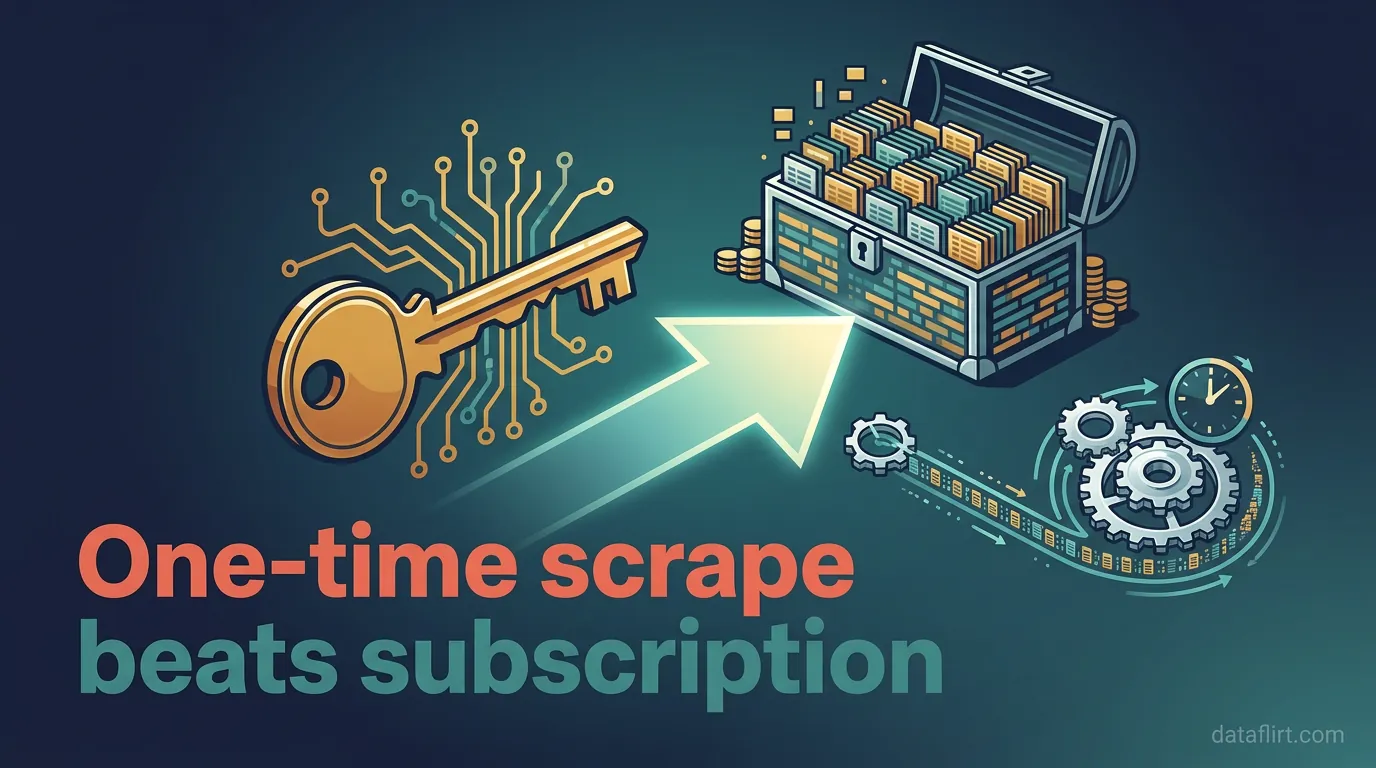
A one-time scrape provides a static dataset of exactly what a target website displayed at a specific moment. It removes the ongoing overhead of maintaining a connection to a competitor database. You specify the target URLs. You define the exact columns you want. The provider runs the script and hands you a clean file.
This approach suits discrete market research perfectly. When you map out an entire category on Amazon, a flat file tells you everything you need to know. You do not need to watch prices fluctuate every minute. You just need a solid baseline.
Consider a catalogue manager tracking 40,000 SKUs across six marketplaces. Every Monday, she needs last week’s prices. She does not need a live feed. A one-time weekly extraction costs her a fraction of a live API subscription.
The format matters just as much as the data. Manual data collection forces you to spend hours reformatting columns. A proper one-time delivery matches your exact internal database schema. This precision is why specialized data extraction beats generic software platforms.
If your inventory system requires a specific date format, the script delivers it. If you need image URLs separated by commas, the extraction handles it. You dictate the structure. The data arrives ready for immediate import.
You own the resulting file completely. There are no access revocations if you cancel a subscription. You can store the CSV on your own servers indefinitely. You can run historical comparisons without paying a vendor for old data.
This ownership empowers your analytics team. They can load the file into their own business intelligence tools. They can merge it with internal sales data. They operate without vendor-imposed limits on data visualization.
The scope of a one-time scrape is entirely flexible. You can pull a thousand products today and a million products next year. Your costs scale directly with your immediate requirements.
Why subscription software bleeds your budget
Recurring software contracts force you to pay for continuous access regardless of your usage frequency. This model optimizes vendor revenue while damaging your company profit margins. The shift toward subscription software has created a massive shelfware epidemic.
The modern corporate tech stack is incredibly bloated. According to recent data from Speakwiseapp, the average enterprise now manages roughly 291 SaaS applications. Teams purchase tools for specific short-term projects. The projects end eventually. The software subscriptions auto-renew silently in the background.
This bloat translates into catastrophic financial losses. Speakwiseapp reports that 51% of enterprise SaaS licenses go completely unused. You are essentially setting half of your software budget on fire. IT departments rarely audit these seats.
The cost of this negligence is staggering. An average enterprise incurs an estimated $18 million in annual financial waste on unused or underutilized SaaS licenses based on Speakwiseapp analysis. Every unused seat contributes to this massive drain. Managers simply forget they have access.
We see this constantly in the ecommerce sector. A brand signs a twelve-month contract for a premium market tracking suite. They use it heavily for a platform migration in January. By March, the tool sits idle. The company continues paying thousands.
A one-time approach completely bypasses this financial trap. You pay for the exact volume of data you request. Once the file is delivered, the billing stops immediately. You control the budget at every single step.
You can read more about how these baseline cost factors for web scraping services operate in practice. The math overwhelmingly favors precision over persistent access. You protect your cash flow effectively.
How to execute a pay-as-you-go extraction
You can execute a flat extraction by routing requests through a consumption-based API or commissioning a custom script. Both paths eliminate recurring software fees. You simply need to choose the method that matches your internal capabilities.
The consumption API route
If you have developers on staff, you can use a raw scraping API. These APIs handle proxy rotation and browser rendering internally. You write a simple script to send URLs to the API endpoint. The API returns the raw HTML.
This model is highly cost-efficient for technical teams. E-commerce API extraction providers currently charge anywhere from $0.10 to $1.50 per 1,000 successful requests. Your balance depletes only when a request succeeds.
The downside is the parsing maintenance. The API gets you the webpage reliably. You still have to write the code to find the price tag. When the target site redesigns its layout, your parsing code breaks entirely.
The custom script route
If you lack internal engineering resources, commissioning a custom scraper is the logical alternative. A specialized developer builds a script tailored to your exact target. You pay for the initial build and a small maintenance retainer.
Tendem.ai 2026 data shows that commissioning a custom scraper costs roughly $500 to $2,000 upfront. This typically includes a $100 to $1,000 monthly server maintenance fee. This path gives you total control over the extraction logic.
Comparing the execution models
| Model | Best For | Typical Cost | Maintenance Burden |
|---|---|---|---|
| Subscription SaaS | Continuous monitoring | $2,000+ monthly | Zero |
| Consumption API | Engineering teams | $0.10 to $1.50 per 1k requests | High |
| Custom Script | Specific formatting | $500 to $2,000 upfront | Medium |
| Managed One-Time | Quarterly audits | Flat project fee | Zero |
When extracting from complex sites like eBay or Walmart, the managed one-time route provides the best balance. You avoid the SaaS trap completely. You avoid the developer headache. You simply receive the exact data you requested.
Navigating technical limits on major platforms
Target sites protect their infrastructure by throttling how fast you can pull data from their servers. If you ignore these ceilings, your requests will fail immediately. Understanding these platform-specific limits is critical for scoping any project.
Every major retail site uses strict rate limiting to manage server load. They track how many requests originate from a single IP address. When you exceed their allowed threshold, they block your connection. You must engineer your extraction to respect these mathematical boundaries.
Shopify’s dual API constraints
Shopify enforces strict traffic rules to protect its millions of hosted storefronts. The platform uses two different mathematical systems depending on how you ask for data. You must calculate your extraction speed accordingly.
The Shopify REST Admin API uses a leaky bucket algorithm. For standard plans, the bucket holds exactly 40 requests. It leaks or processes these at a rate of 2 requests per second. If your script dumps 50 requests instantly, you hit a hard throttle error.
The GraphQL Admin API handles traffic differently. It does not limit the raw number of requests. It uses a calculated query cost system instead. Complex requests that ask for nested data cost more points. Standard plans are limited to 100 points per second.
Amazon’s aggressive token bucket
Amazon protects its seller data with incredibly aggressive infrastructure constraints. The Amazon Selling Partner API enforces a strict token bucket algorithm that heavily restricts data freshness. You cannot pull your entire order history in five seconds.
Specific endpoints are brutally gated for security. The Orders endpoint only allows a sustained rate of roughly 0.0167 requests per second. This equals about one single request per minute. The endpoint permits a maximum burst limit of 20 tokens. If you exceed this burst, you receive an error and must wait.
Public site extraction limits
Extracting public product pages requires different tactics entirely. When you scrape public categories on Target or BestBuy, you are not using official APIs. You are requesting raw HTML payloads.
These sites deploy sophisticated anti-bot software to detect automated scripts. You must rotate residential proxies aggressively. You must spoof your browser fingerprints to look human. You must introduce randomized delays between page clicks.
A naive script will pull fifty pages and get permanently banned. A well-engineered script acts exactly like a human browsing a catalog. You can review what is web scraping to understand these core bypass mechanics deeply.
What you actually pay for during inactive months
When you sign an annual contract for a data dashboard you only use quarterly, you are subsidizing the vendor’s cloud hosting. You are funding their marketing department. You are not paying for your own data.
If I commit to a subscription tool what am I paying for in months where I am not actively using the data? The honest answer is nothing of value to your business. You are simply maintaining vendor revenue.
Software companies love annual recurring revenue because it provides predictable cash flow. Their entire business model relies on you forgetting to cancel. They bake unused capacity into their financial projections.
Organizations globally waste $45 million every single month on completely unused software licenses according to Ramp. Your unused dashboard seat is part of that staggering statistic. During your inactive months, the vendor spins up servers for other active clients using your money.
This waste accumulates because shadow IT purchases tools on corporate cards and leaves them running. Consider the per-employee math closely. Speakwiseapp notes that the average amount companies spend per employee per year on SaaS tools is $3,500. Roughly half of that amount is completely wasted. When you buy a rigid subscription for a temporary problem, you worsen this metric.
Vendors will argue that you are paying for background readiness. They claim the data is continuously updating so it is fresh when you log in. If you are tracking dynamic inventory on HomeDepot daily, that readiness holds value.
If you just need a snapshot of Macys inventory once a season, that readiness is worthless. You must audit your data needs ruthlessly. If your team opens the tool rarely, you need a discrete service provider instead.
From a legal perspective, you must orient your strategy carefully. Scraping public data is generally permissible in most jurisdictions. You must distinguish publicly available product data from protected personal user data.
You must also consider the specific terms of service of your target website. We always recommend you consult qualified legal counsel for your specific compliance situation. You must understand the understanding scraping cost factors before committing to any execution path.
Why DataFlirt handles custom extractions better
DataFlirt builds and executes the exact extraction you need without forcing you into a recurring software trap. We deliver the file and step away until you need us again. DataFlirt aligns our business model with your actual project requirements.
Most companies cannot justify keeping a specialized data engineer on the payroll just to scrape Sephora twice a year. The salary overhead destroys the return on investment. DataFlirt solves this by acting as your on-demand engineering department.
When you hire DataFlirt, you leverage our massive existing infrastructure. DataFlirt already maintains the proxy pools. DataFlirt already rotates the browser fingerprints seamlessly. DataFlirt already knows how to bypass the protections on Wayfair and Overstock.
You do not have to pay DataFlirt to figure it out. DataFlirt simply points our optimized systems at your target and delivers the result. DataFlirt handles the heavy technical lifting while you focus on analysis.
A freelancer might handle a tiny catalog export at a low cost. Once you cross a few thousand SKUs, the job gets technically heavier. The quality gap between a cheap gig and a managed extraction widens fast.
That is the exact range where DataFlirt starts paying for itself. DataFlirt implements strict quality assurance layers to ensure every column matches your schema perfectly. DataFlirt delivers clean, accurate, and structured data every single time.
DataFlirt provides absolute flexibility for your budget. If you need a massive pull from a B2B supplier this month and nothing next month, DataFlirt accommodates that perfectly. DataFlirt does not charge you a retention fee.
DataFlirt does not auto-renew your contract. You pay DataFlirt strictly for the data you receive. DataFlirt believes this transparent pricing model builds long-term trust with our enterprise clients.
This approach scales beautifully as your needs grow. DataFlirt can extract fifty products or five million products. DataFlirt scales our cloud resources up for the duration of the job and spins them down immediately after.
DataFlirt passes those vital infrastructure savings directly to you. DataFlirt understands the nuances of modern web platforms deeply. Whether DataFlirt is navigating Shopify’s GraphQL limits or bypassing Javascript challenges, DataFlirt handles the friction silently.
DataFlirt hands you a clean CSV file that is ready for immediate analysis. DataFlirt removes the headache of software bloat entirely. If you need targeted insights from company data, DataFlirt maps the corporate landscape for you without a restrictive contract.
If you want to stop wasting your budget on idle licenses, you need to change how you procure data. DataFlirt is ready to help you make that transition today. DataFlirt will evaluate your specific targets and give you a flat quote. DataFlirt is your dedicated partner in efficient intelligence gathering.
FAQ
Does a one-time scrape provide live data?
A one-time scrape captures a static snapshot of a website at the exact moment of extraction. It provides historical accuracy rather than live monitoring. You use this file for baseline analysis and market audits.
How do API rate limits affect extraction speed?
Target platforms restrict the volume of requests a server can process within a specific timeframe. Scrapers must mathematically calculate their request intervals to avoid triggering defensive blocks. Ignoring these limits results in immediate connection bans.
Is it legal to extract public ecommerce data?
Extracting publicly available product pricing is generally permissible under most current legal interpretations. You must distinguish public catalog details from private user data. We always recommend you consult qualified legal counsel for your specific situation.
If you would rather not scope this yourself, the DataFlirt ecommerce scraping service handles the extraction, QA, and delivery perfectly. Reach out for a free scoping call and stop paying for software you do not use.