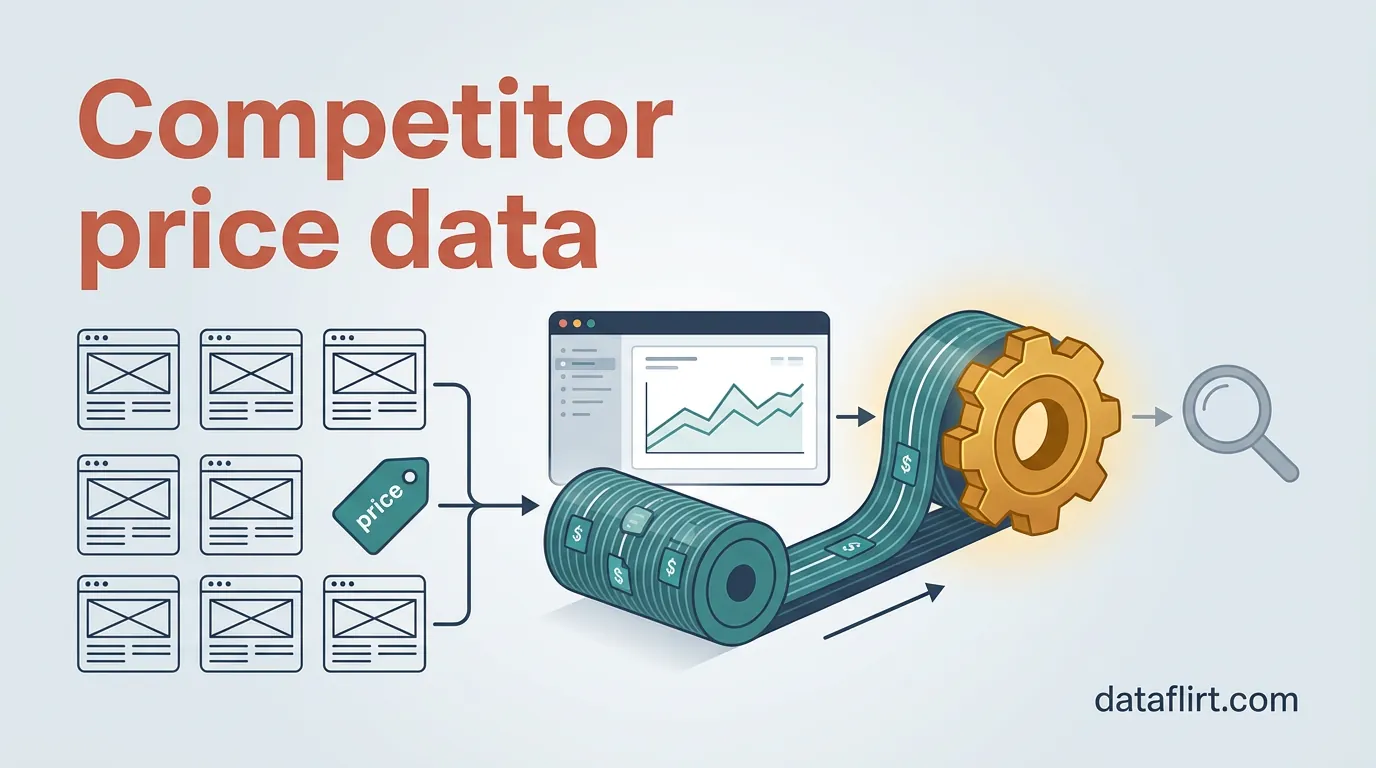

You are building an intelligence tool for online sellers. Your software requires accurate competitor pricing data to function properly. Acquiring this information presents an immediate architectural challenge for any development team. You must decide whether to rely on heavily restricted official endpoints or build systems to parse public web pages directly. This early infrastructure choice will dictate your ongoing maintenance costs and determine your application’s profit margins.
Key takeaways
- Official marketplace endpoints restrict competitor data access to protect native features.
- Amazon restricts single-item price lookups to a strict fraction of a request per second.
- Walmart provides no public portal for competitive research; developers must extract data independently.
- Front-end structural changes occur constantly to intentionally disrupt automated collection scripts.
- Managed extraction shifts the technical burden away from your core engineering team.
Why competitor price data dictates your infrastructure choices
The method you use to source pricing data determines your technical overhead. Your entire backend architecture depends on whether you consume clean application programming interfaces or parse raw hypertext markup language.
The shift in retailer expectations
Retailers increasingly view continuous market monitoring as a mandatory capability rather than an optional luxury. Recent data shows that 81% of US retailers are using automated price scraping for dynamic repricing strategies in 2026. This represents a massive jump from just a few years ago. Tendem notes this upward trajectory is completely reshaping how businesses approach market intelligence. Our DataFlirt experts see this demand scaling rapidly across every major online platform. To meet this need, developers must supply real-time numbers without interruption. If you want to understand the broader market context, reading a retailers guide to price scraping provides excellent background.
The divide among online sellers
The landscape is splitting into two distinct software camps. Large enterprise retailers demand aggressive custom tools. Conversely, a surprising 60% of surveyed Amazon sellers currently use no third-party repricing software at all. According to Nova Data, these smaller merchants are retreating to native, free marketplace tools. This leaves developers targeting a more sophisticated, high-volume customer base. These serious merchants require robust software because the financial stakes are incredibly high. Sellers who do implement automated tools report a 143% average increase in weekly sales volume over thirty weeks. Repricer.com highlights this exact performance metric in their recent case studies. DataFlirt customers routinely build the software platforms that capture this lucrative, high-end market segment.
The developer mandate
Building tools for successful merchants requires flawless execution. Your users will abandon your application if your numbers lag behind the live market by even a few minutes. This urgency forces engineering teams to seek the fastest possible data acquisition methods. Many founders reach out to DataFlirt after realizing their initial data strategies simply cannot scale to meet user demand.
How software platforms source pricing data
Software builders have two primary paths to acquire market numbers. They can attempt to integrate with official marketplace portals, or they can extract pricing directly from public product pages.
Official portals and their severe limitations
Marketplaces intentionally throttle third-party access to competitive metrics. The official Amazon application programming interface utilizes a strict token bucket algorithm for price lookups. The standard pricing endpoint allows a default rate of just 0.5 requests per second. Developers must engineer complex queueing logic to handle these severe limits. If you exceed the allowance, the server returns an error. This is a classic example of severe rate-limiting.
Consider a developer attempting to update prices for 50,000 products every hour. Using official marketplace endpoints at standard throttle limits, this simple synchronization task would take over a full day to complete.
The financial burden of API tier changes
Accessing official data channels carries escalating financial risks. In 2026, new fee tiers were introduced for high-volume software providers accessing the Amazon ecosystem. SaaS platforms making over 2.5 million calls per month now face steep monthly fees approaching ten thousand dollars. This pricing structure forces developers to abandon single-item lookups. They must rewrite their applications to use complex batch endpoints to stay under budget. DataFlirt helps teams bypass these exorbitant API fees by providing an alternative, reliable extraction channel. We maintain custom pipelines for the Amazon scraper that sidestep these specific backend bottlenecks.
The reality of closed ecosystems
Some retail giants refuse to provide any competitive data access whatsoever. Walmart does not offer a public product API to fetch competitor prices. Their partner portal is strictly reserved for merchants updating their own internal catalogs. This system imposes strict limits, restricting updates to a handful of asynchronous feeds per hour. Furthermore, their terms of service explicitly forbid using the partner portal for competitive research. Developers targeting the Walmart scraper ecosystem quickly realize they have no official integration path. DataFlirt encounters this exact scenario constantly during client onboarding calls.
Direct extraction as the mandatory fallback
When official channels fail, engineers must parse public websites directly. This process requires downloading the visible webpage and isolating the relevant text elements. Understanding how web scraping works is crucial for modern intelligence applications. Direct extraction bypasses API rate limits completely. However, it introduces an entirely new category of technical challenges involving proxy management and layout parsing. DataFlirt built its entire business model around solving these specific extraction hurdles for software developers.
| Sourcing Method | Data Freshness | Technical Overhead | Cost Structure |
|---|---|---|---|
| Official Partner APIs | Strictly throttled | High integration complexity | Per-call tier fees |
| In-house Custom Scripts | Real-time capabilities | Massive maintenance burden | High infrastructure costs |
| Managed DataFlirt Pipeline | Real-time capabilities | Zero maintenance required | Predictable subscription |
What happens when Amazon or Walmart alters their page structure
When you build your own repricing tool, a sudden change to a major retailer’s product page structure will immediately break your data collection scripts. Your application will fail to capture new prices until your engineers push a manual code update.
The fragility of static selectors
Automated scripts rely on specific locators to find text on a page. Developers typically use a CSS selector to target the exact box containing a product price. Retailers constantly modify these underlying class names. A price tag previously located inside a div named “price-large” might suddenly move to an element named “sx-9f4j”. When this happens, your script returns an empty value. Your repricing algorithm then halts or makes decisions based on outdated information. DataFlirt engineers monitor these layout shifts continuously to prevent data outages.
Parallel DOM structures in testing
Retailers do not always serve the same page to every visitor. Massive e-commerce companies run continuous A/B tests on their product layouts. One internet protocol address might receive a modern, javascript-rendered layout. A different connection might receive a legacy static layout. Your in-house script must be capable of parsing multiple concurrent versions of the same website. DataFlirt maintains fallback parsing logic specifically to handle these unpredictable parallel layouts.
Defensive engineering and bot detection
Websites actively fight automated traffic using sophisticated defense mechanisms. Amazon frequently alters its front-end structure and dynamically changes URL query parameters specifically to identify bots. They analyze connection patterns to build a browser fingerprinting profile of your scraper. Once identified, the server blocks your access entirely. DataFlirt circumvents these defenses by deploying highly realistic browsing profiles. DataFlirt constantly rotates connection parameters to ensure uninterrupted access.
When a major retailer deploys a site redesign on a Tuesday morning, every hardcoded script fails instantly. The engineering team must drop all feature work to rewrite selectors before the daily pricing cycle runs.
The true cost of in-house maintenance
The financial impact of maintaining custom scripts is rarely fully understood upfront. The average minimum cost to build and maintain a custom web scraping infrastructure sits at roughly $2,000 upfront and $500 monthly. Canopy API published this figure based on standard server and proxy overhead costs. This baseline estimate does not even account for the high salaries of your engineering staff. You can read more about understanding scraping cost factors to fully grasp this financial reality. DataFlirt offers a predictable alternative to these spiraling maintenance expenses.
How to architect a reliable price collection pipeline
A robust data pipeline requires dedicated layers for request routing, browser emulation, and anomaly detection. These components ensure your application receives clean numbers regardless of target site volatility.
Managing throughput and rotation
High-volume data collection requires a massive pool of varied internet addresses. Sending ten thousand requests from a single server will result in an immediate permanent ban. You must route your traffic through localized residential proxies. Furthermore, many modern retail sites require a full headless browser to render dynamic price fields accurately. Operating a fleet of headless browsers consumes enormous memory and processing power. DataFlirt manages this entire hardware infrastructure transparently for our clients. DataFlirt scales browser instances dynamically based on your requested throughput.
Handling validation and quality assurance
Extracted information must be rigorously verified before it enters your database. A broken script might accidentally scrape the phrase “Out of Stock” instead of a numerical price. If your algorithm processes this error blindly, it could trigger disastrous automated repricing decisions for your users. Implementing strict schema validation is absolutely critical. DataFlirt builds automated quality assurance checks directly into every extraction pipeline. DataFlirt immediately flags anomalous drops or missing values for manual engineering review.
Expanding coverage beyond top retailers
Your customers will eventually demand insights from specialized or regional marketplaces. While extracting from giants like the eBay scraper or the Target scraper is standard, niche sites present unique hurdles. Different platforms use entirely different rendering technologies. An architecture optimized for the BestBuy scraper might fail completely against the HomeDepot scraper. Adding coverage for the Macys scraper requires custom programming from scratch. The DataFlirt platform normalizes data across all these varied sources into one unified format.
Scaling for catalog depth
Tracking the top fifty items in a category is trivial. Tracking a full catalog of millions of items requires sophisticated queue management. You must prioritize high-velocity products while backfilling slow-moving inventory. This requires a dedicated database purely for managing crawl states and timestamps. DataFlirt orchestrates these massive queues efficiently. DataFlirt ensures your most critical data points are refreshed with the highest possible frequency.
Why delegating data collection outperforms in-house scrapers
Partnering with a managed provider shifts the technical burden away from your engineering team. This simple administrative decision allows your developers to focus entirely on building core application features.
The build versus buy equation
Founders frequently underestimate the operational drag of maintaining fragile data pipelines. Every hour your team spends repairing a broken parser is an hour stolen from product development. Outsourcing this task converts an unpredictable engineering headache into a fixed, predictable operational expense. You are buying certainty and engineering focus. DataFlirt provides this exact certainty for hundreds of ambitious software teams.
The DataFlirt advantage
DataFlirt specializes in overcoming anti-bot systems and adapting to sudden structural website changes. Our engineering team monitors target sites around the clock. When a layout shift occurs, DataFlirt updates the necessary parsers before your application even notices the disruption. We handle the proxies, the browsers, and the validation logic. We deliver clean, structured data directly to your application endpoints. DataFlirt acts as an invisible extension of your own engineering department.
Moving forward with managed extraction
Building a specialized tool requires specialized data. Attempting to gather this information manually will slow your growth and frustrate your developers. Leveraging a managed service guarantees your software remains powered by accurate, timely market intelligence. DataFlirt stands ready to support your infrastructure needs from day one.
FAQ
What is the Amazon SP-API token bucket limit?
The standard pricing endpoint operates on a strict token bucket algorithm. It allows a default refill rate of 0.5 requests per second with a maximum burst capacity of just one request. This makes bulk price synchronization incredibly slow and technically difficult to manage without hitting error codes.
Can I use the Walmart API to track competitor prices?
No. Walmart does not provide a public interface for competitive market research. Their partner portal is strictly limited to sellers managing their own inventory. The terms of service actively prohibit using this access to monitor rival merchants. You must extract public web pages to gather this intelligence.
How does DataFlirt handle sudden website redesigns?
DataFlirt monitors data streams using automated anomaly detection. When a target website alters its code and breaks a static locator, our system flags the failure immediately. DataFlirt engineers then manually update the parsing logic, ensuring data flows seamlessly to your application without requiring any action from your internal team.
Is it legal to extract public pricing data?
Accessing publicly available information is generally a standard practice in market research. You must ensure you are strictly gathering public facts like prices, rather than personal identifiable information. You must also consider specific terms of service agreements. We strongly recommend consulting qualified legal counsel for your specific situation before launching commercial applications.
If you would rather not scope this yourself, the DataFlirt ecommerce scraping service handles the extraction, quality assurance, and delivery. We also support complex AI training data projects for advanced analytics. Reach out to the DataFlirt team today for a free scoping call and let us manage your data infrastructure.