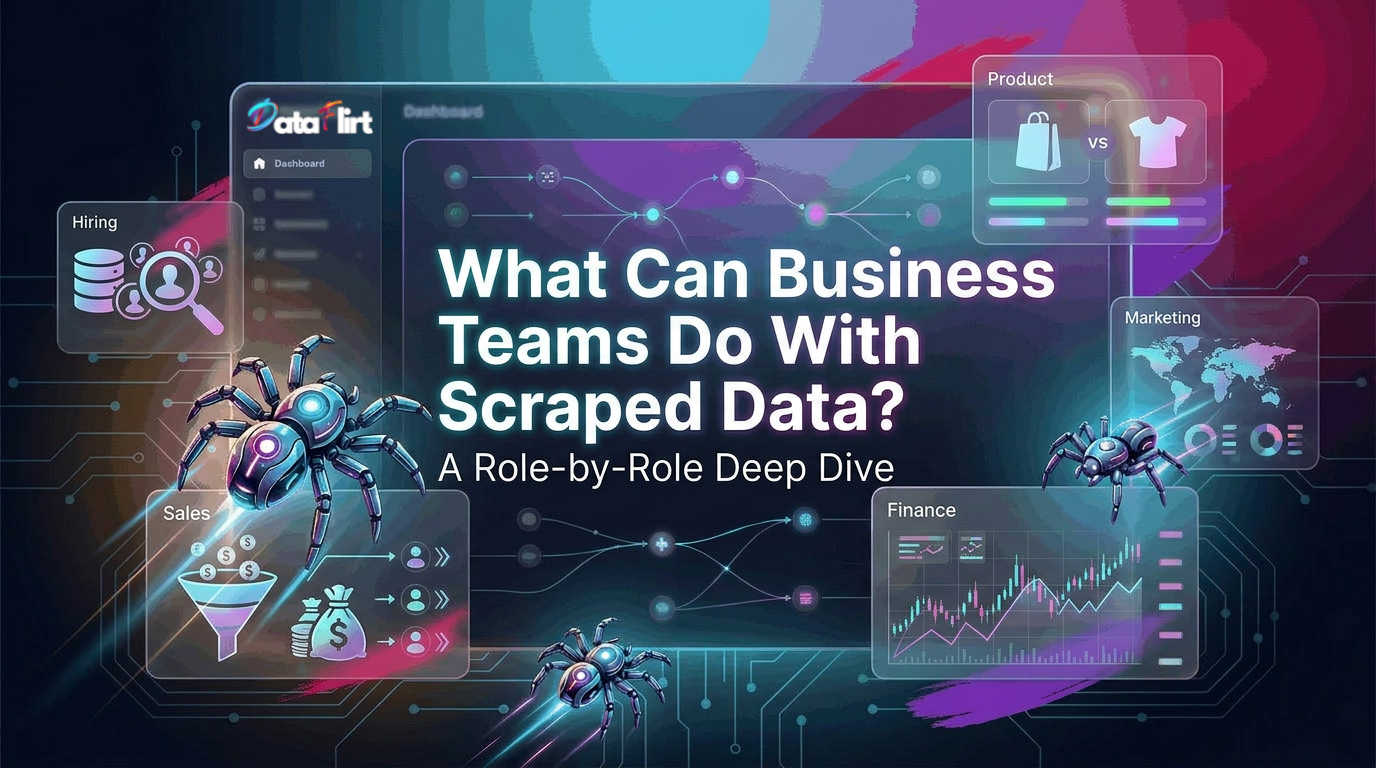

The Business Case for Treating Web Data as Infrastructure
Most business teams interact with data in two modes: internal data their own systems generate (CRM records, transactions, product analytics) and purchased data someone else packaged for resale (research reports, intent platforms, industry databases). Both have established workflows and budgets. The third mode, scraped data for business teams, is the one most organizations underuse, and it is the subject of this guide.
The third data mode
Scraped data is information that exists publicly on the web: competitor pricing pages, job boards, product catalogs, regulatory filings, news archives, review platforms, real estate listings. It is technically accessible to anyone, but collecting it at the scale and frequency that makes it operationally useful requires automated extraction infrastructure. That infrastructure layer is exactly what DataFlirt builds and runs for business teams that want the intelligence without the engineering project.
Why the argument is simple
Your competitors’ pricing is on the web. Their job postings are on the web. Their customer reviews, their changelog pages, and the regulatory filings that will move your market are all on the web. A team that reads that data systematically makes decisions with current market context, and a team that does not is competing against one that does. Web data extraction for business intelligence is the fastest path to external market visibility that does not depend on a vendor deciding what to package and sell.
What Scraped Data Actually Looks Like Before It Becomes Intelligence
Raw scraped data does not arrive clean, structured, and query-ready, and understanding that gap is essential to setting accurate timelines and budgets. The path from a web page to a decision-grade dataset is a pipeline with real engineering in the middle.
The pipeline anatomy
Raw scraped data is HTML, whatever a server returns to an HTTP request or a JavaScript page load. A parser extracts fields from it: a price, a job title, a review text. Each record then passes through normalization (do “$1,200” and “1200 USD” mean the same thing in your schema?), deduplication logic (did three category pages serve the same listing?), and freshness checks (when was this record last confirmed live?). The full chain runs request, parse, extract, normalize, deduplicate, store, serve.
The gap is real but solved
The distance between “I want competitor prices” and “I have a clean competitor pricing table refreshed daily in our warehouse” is genuine work, but in 2026 it is a solved engineering problem rather than a research frontier. The open-source tooling exists, the patterns are documented, and partners like DataFlirt run this pipeline as a service. The remaining variable is organizational will, which is why the rest of this guide focuses on what to do with the output.
The 10 Highest-ROI Business Use Cases for Scraped Data
The use cases below are ordered roughly by how often they justify their cost in DataFlirt’s client work. Each names who it serves and what it looks like running in production.
1. Competitive pricing intelligence
Pricing teams, ecommerce directors, and category managers run the most widely deployed use case for web data extraction, and the one with the most quantifiable ROI. Consider a pricing team at an electronics retailer monitoring competitor pages for 50,000 SKUs across a dozen domains, refreshed every few hours. When a competitor cuts a price beyond a threshold on a high-revenue category, an alert lands in the pricing channel, the team decides whether to match, undercut, or hold, and the response window shrinks from weeks to hours. Sources include competitor product pages, Google Shopping data, Amazon listings, and promotional pages, and DataFlirt’s ecommerce scraping service delivers this as a maintained feed.
A working pricing spider
The technical pattern is Scrapy with auto-throttle for high-volume crawling and Playwright for product pages that render prices client-side. The spider below is the skeleton DataFlirt’s engineers start from on simpler targets:
# pricing_spider.py - Scrapy-based competitive pricing extractor
# Prerequisites:
# python -m venv .pricing-env
# source .pricing-env/bin/activate
# pip install scrapy==2.16.0

import json
import re
from datetime import datetime, timezone

import scrapy


class CompetitorPricingSpider(scrapy.Spider):
    name = "competitor_pricing"

    custom_settings = {
        "CONCURRENT_REQUESTS": 16,
        "DOWNLOAD_DELAY": 1.2,
        "AUTOTHROTTLE_ENABLED": True,
        "AUTOTHROTTLE_TARGET_CONCURRENCY": 8,
        "ROBOTSTXT_OBEY": True,
        "DEFAULT_REQUEST_HEADERS": {
            "Accept": "text/html,application/xhtml+xml",
            "Accept-Language": "en-US,en;q=0.9",
        },
    }

    def __init__(self, target_urls_file="targets.json", *args, **kwargs):
        super().__init__(*args, **kwargs)
        with open(target_urls_file) as f:
            self.target_pages = json.load(f)

    def start_requests(self):
        for page in self.target_pages:
            yield scrapy.Request(
                url=page["url"],
                callback=self.parse_product,
                meta={"competitor": page["domain"], "sku": page["sku"]},
                errback=self.handle_error,
            )

    def parse_product(self, response):
        competitor = response.meta["competitor"]
        sku = response.meta["sku"]

        # Defensive extraction: sites change layouts, so log and skip
        raw_price = (
            response.css("[data-price]::attr(data-price)").get()
            or response.css(".price::text").get()
            or response.xpath(
                "//span[contains(@class,'price')]/text()"
            ).get()
        )
        if not raw_price:
            self.logger.warning(f"No price for {sku} on {competitor}")
            return

        price_clean = re.sub(r"[^\d.]", "", raw_price.strip())
        try:
            price_float = float(price_clean)
        except ValueError:
            self.logger.error(f"Price parse failed: {raw_price!r}")
            return

        stock_signal = (
            response.css(
                "[data-availability]::attr(data-availability)"
            ).get("")
        ).lower()
        yield {
            "competitor_domain": competitor,
            "sku": sku,
            "product_name": response.css("h1::text").get("").strip(),
            "price": price_float,
            "currency": "USD",
            "in_stock": "out" not in stock_signal
            and "unavailable" not in stock_signal,
            "scraped_at": datetime.now(timezone.utc).isoformat(),
        }

    def handle_error(self, failure):
        self.logger.error(
            f"Request failed: {failure.request.url}: {failure.value!r}"
        )
The business team never touches this code. What they consume is a dashboard showing price deltas by competitor, SKU, and category, with alert thresholds they configure themselves.
2. Market intelligence and industry signal monitoring
Strategy teams, corporate development, and leadership traditionally rely on purchased reports and individual reading habits, which is slow and systematically incomplete. A scraping pipeline turns this into a continuous signal stream: competitor changelog pages for launches, review feeds from a G2 scraper or a Capterra scraper for voice-of-customer at scale, LinkedIn job trends for capability signals, and funding news from a Crunchbase scraper. A strategy lead who used to assemble a monthly memo from manual searches instead gets a daily digest, and strategy meetings shift from reviewing last month to reading right now. DataFlirt’s company data service packages these source types into one feed.
3. Lead generation and sales intelligence
SDR teams and revenue operations feel data decay constantly: contacts change jobs, companies pivot, and CRM records go stale within quarters, not years. Scraped data builds a continuously refreshed signal layer on top of the CRM. A pipeline can watch funding announcements, business registries, and job boards for companies that just raised a target round, sit in a target region and headcount band, and posted several engineering roles in the last 60 days, then push each match into the CRM with the trigger event attached. SDRs spend their time selling to qualified accounts instead of building lists. One honest caveat: professional profile data is legally contested in several jurisdictions, so legal review of sources and downstream processing belongs in scope from day one, a guardrail DataFlirt applies by default.
4. Talent intelligence and competitive hiring
Job postings are among the most underused signals in business intelligence, because every posting is a structured declaration of strategic intent: what capabilities a competitor is building, where they are expanding, and what technical bets they are making. A weekly job that pulls postings from competitor career pages plus an Indeed scraper, a Glassdoor scraper, or a Naukri scraper for Indian markets, then tags them by function and keyword cluster, gives a VP of People a talent market report no survey vendor sells. Two competitors ramping ML hiring while cutting traditional engineering says something about their roadmap months before any announcement. DataFlirt’s job board service runs exactly this kind of feed.
5. Product benchmarking and feature parity analysis
Product managers maintain competitive matrices in spreadsheets that are stale the week they ship. Scraped monitoring replaces the quarterly audit with a continuous one: changelog pages, app store listings, documentation structure changes, pricing page diffs, and feature mentions inside reviews. A PM at a project management SaaS gets a structured diff in Slack: competitor A moved time tracking to the free tier, competitor B shipped a Jira integration, competitor C added an enterprise tier with SSO. Each item links to its source, and roadmap conversations happen on current information. DataFlirt builds these change-detection feeds with diffing built in, so the signal is the change itself rather than another page dump.
6. Real estate and location intelligence
Site selection analysts, retail location strategists, and logistics planners make some of the largest capital commitments in the business on data scattered across hundreds of public sources. Scraped pipelines consolidate it: listing prices and days-on-market from a Zillow scraper or a Realtor scraper, commercial availability from a LoopNet scraper, permit filings that signal neighborhood trajectories, and assessor records for valuation context. A logistics director planning fulfillment centers gets a continuously updated model of industrial availability and lease comps across a dozen markets instead of a quarterly broker report. DataFlirt’s real estate service covers the residential and commercial source mix.
7. Financial and alternative data for investment and planning
Alternative data, meaning signals beyond financial statements, is standard practice in institutional investing, and web scraping is one of its primary collection methods: job posting trends as hiring proxies, review velocity as demand signals, commodity prices from exchanges and government portals. For corporate FP&A the applications are closer to home, such as tracking competitor hiring as a growth proxy and watching filings through an SEC EDGAR scraper or market datasets via a Statista scraper. A CFO with a concentrated supplier base can run a news-monitoring pipeline pairing supplier names with risk keywords like strikes, litigation, and distress, which is early-warning infrastructure rather than a data science experiment. DataFlirt’s stock market service handles the financial-source end.
8. Customer review and sentiment intelligence
Reviews are the most unfiltered voice-of-customer data available, but only at scale. Brand teams track sentiment trends and review velocity; product teams extract feature mentions and complaint clusters from unstructured text, increasingly with LLM-based extraction instead of brittle keyword matching; competitive teams mine rival reviews for the weaknesses that never appear in marketing copy. Sources range from a Yelp scraper for local businesses to marketplace and SaaS review platforms, and DataFlirt’s reviews scraping service delivers them as one normalized feed.
An LLM review extractor in Python
The pattern below shows the same extraction through the Google GenAI SDK in both API mode and Vertex AI mode, plus Claude through the Anthropic SDK. All three calls are async-native, so nothing blocks inside the event loop:
# review_extractor_llm.py - LLM-augmented review extraction
# Prerequisites:
# python -m venv .review-env
# source .review-env/bin/activate
# pip install google-genai==2.8.0 anthropic==0.109.1 \
#             playwright==1.60.0 && playwright install chromium

import asyncio
import json

import anthropic
from google import genai
from google.genai import types as genai_types

INSIGHT_SCHEMA = """Return ONLY a valid JSON object with this structure:
{
  "overall_sentiment": "positive|negative|mixed",
  "sentiment_score": <float 0.0 to 1.0>,
  "top_complaints": [<up to 5 themes>],
  "top_praise": [<up to 5 themes>],
  "feature_mentions": [<features named in reviews>],
  "competitor_comparisons": [<products mentioned>],
  "review_count_parsed": <integer>
}"""


def build_prompt(raw_review_html: str, product_category: str) -> str:
    return (
        "You are a product intelligence analyst. Extract structured "
        f"insights from these customer reviews.\n\n"
        f"Product category: {product_category}\n\n{INSIGHT_SCHEMA}\n\n"
        f"Reviews HTML (truncated):\n{raw_review_html[:40000]}"
    )


def parse_json_reply(raw: str) -> dict:
    """Strip markdown fences a model may add despite instructions."""
    raw = raw.strip()
    if raw.startswith("```"):
        raw = raw.split("```")[1].removeprefix("json").strip()
    return json.loads(raw)


# --- Gemini 3.1 via Google GenAI SDK, API mode (GOOGLE_API_KEY) ---
gemini_client = genai.Client()


async def extract_gemini(html: str, category: str) -> dict:
    response = await gemini_client.aio.models.generate_content(
        model="gemini-3.1-flash",
        contents=build_prompt(html, category),
        config=genai_types.GenerateContentConfig(
            response_mime_type="application/json",
            temperature=0.1,
        ),
    )
    try:
        return parse_json_reply(response.text)
    except (json.JSONDecodeError, AttributeError) as e:
        return {"error": str(e), "raw": getattr(response, "text", "")}


# --- Gemini 3.1 via Google GenAI SDK, Vertex AI mode ---
# Requires: gcloud auth application-default login, or
# GOOGLE_APPLICATION_CREDENTIALS pointing at a service account key.
def vertex_client(project_id: str, location: str = "us-central1"):
    return genai.Client(
        vertexai=True, project=project_id, location=location
    )


async def extract_vertex(
    html: str, category: str, project_id: str
) -> dict:
    client = vertex_client(project_id)
    response = await client.aio.models.generate_content(
        model="gemini-3.1-flash",
        contents=build_prompt(html, category),
        config=genai_types.GenerateContentConfig(
            response_mime_type="application/json",
            temperature=0.1,
        ),
    )
    try:
        return parse_json_reply(response.text)
    except (json.JSONDecodeError, AttributeError) as e:
        return {"error": str(e)}


# --- Claude via Anthropic SDK (ANTHROPIC_API_KEY) ---
# claude-sonnet-4-6 for high-volume pipelines,
# claude-opus-4-8 for nuanced competitive analysis.
claude_client = anthropic.AsyncAnthropic()


async def extract_claude(
    html: str, category: str, model: str = "claude-sonnet-4-6"
) -> dict:
    message = await claude_client.messages.create(
        model=model,
        max_tokens=2000,
        messages=[
            {"role": "user", "content": build_prompt(html, category)}
        ],
    )
    try:
        return parse_json_reply(message.content[0].text)
    except (json.JSONDecodeError, IndexError, AttributeError) as e:
        return {"error": str(e)}


async def main():
    from playwright.async_api import async_playwright

    async with async_playwright() as pw:
        browser = await pw.chromium.launch(headless=True)
        page = await browser.new_page()
        await page.goto(
            "https://example-review-site.com/product/123/reviews",
            timeout=20000,
        )
        html = await page.content()
        await browser.close()

    print(await extract_gemini(html, "project management software"))
    print(await extract_claude(html, "project management software"))
    print(
        await extract_claude(
            html, "project management software", model="claude-opus-4-8"
        )
    )


if __name__ == "__main__":
    asyncio.run(main())
9. Regulatory and compliance data monitoring
Legal, compliance, and government affairs teams face data spread across hundreds of portals, court databases, and gazette archives that no analyst can read daily at any meaningful breadth. A pipeline that monitors the relevant portals, tags new filings by topic and jurisdiction, and routes them to the right stakeholder turns reactive compliance into managed risk. A compliance officer at a pharmaceutical company can watch FDA databases, safety communications, patent filings, and trial registries daily, with matches against the company’s therapeutic areas surfaced automatically, eliminating the lag between a regulatory event and internal awareness. DataFlirt’s healthcare scraping service covers these regulated-sector sources with the compliance care they demand.
10. Supply chain and procurement intelligence
Procurement directors and supply chain planners depend on external data at every link: commodity pricing, logistics capacity, vendor financial health, trade policy. Most of it is public but scattered beyond manual reach. A scraping-powered intelligence layer aggregates exchange and government price feeds, news and filings that signal vendor risk, shipping rate indices, and tariff updates from trade ministry portals. Integrated with internal ERP data, this external layer lets procurement act on risk before it becomes a disruption, and DataFlirt builds it as a scheduled feed landing directly in the team’s warehouse.
Role-by-Role Playbook: What Each Function Does With Scraped Data
The use cases above organize by problem. This section organizes the same material by chair, since scraped data for business teams lands differently depending on whose decisions it feeds.
The CEO and C-suite
Senior leaders live on curated reports with 30-to-90-day lag. A scraped signal layer shortens the gap between market events and leadership awareness from weeks to hours: competitor investment moves read from job postings, category sentiment read from reviews, demand signals read from news and listing velocity. It complements structured reporting rather than replacing it.
The VP of Sales
Two persistent problems, a drifting addressable market and degrading outbound lead quality, share one fix. Real-time job board and registry data keeps the ICP current, and trigger-based scoring (funding events, leadership changes, technology adoptions) times outreach to genuine buying moments. A sales leader who can show the board that most new logos closed within weeks of a scraped qualifying trigger is presenting a repeatable system, not a lucky quarter.
The CMO
Competitor positioning is fully visible in public data: website copy changes caught by diff monitoring, ad copy through transparency tools, content output from blogs and social channels, and customer language from review platforms. An LLM-assisted analysis pipeline processing that corpus weekly gives marketing a continuously updated positioning map instead of a quarterly report that ships stale.
The Head of Product
The competitive matrix in a spreadsheet is structurally inadequate for fast markets. Scraped monitoring of changelogs, app store listings, documentation, and developer forums delivers feature intelligence continuously, and review scraping adds unfiltered customer feedback on competitor products: what users love, hate, and request. That is free, public, always-current research most product teams leave on the table.
The CFO and FP&A
Financial models built only on internal data are blind to the external variables that drive variance. Scraped inputs, including competitor pricing trends, labor market conditions, and commodity signals from public databases, let FP&A model reality rather than extrapolate from the inside. External data ingestion in planning is rare at mid-market companies today and will be standard practice soon; starting now is a modeling advantage.
The Head of Talent
Much of what labor market intelligence platforms sell is built on public data: job postings, salary listings, employer reviews. An internal capability scraping those sources directly gives recruiting proprietary insight instead of the same benchmark report every competitor bought, and DataFlirt frequently delivers it as a weekly feed scoped to the roles and markets a team actually hires in.
How Business Teams Get Scraped Data: Three Operating Models
There are three ways to operationalize web data extraction, and the right one depends on strategic value, freshness needs, and engineering bandwidth rather than fashion.
| Model | Best when | Trade-off |
|---|---|---|
| Internal team | Data is strategically differentiated | Hiring, upkeep, proxy costs |
| Managed partner | Speed matters, sites are hostile | Less schema control |
| Hybrid | Mature programs, mixed needs | Coordination overhead |
Model 1: internal engineering team
Building in-house is right when competitive advantage depends on proprietary extraction logic or a cadence nothing off the shelf matches. The open-source stack is mature: Scrapy for high-throughput crawling with auto-throttle and distributed queues via scrapy-redis, Playwright for JavaScript-rendered pages, Camoufox for targets with aggressive fingerprint-based detection, residential proxies for clean rotation, an LLM extraction layer (Gemini 3.1 through the Google GenAI SDK, or Claude through the Anthropic SDK), PostgreSQL or a warehouse for storage, and cron or Kubernetes for orchestration. Budget a dedicated engineer or a meaningful slice of two, plus a monthly proxy spend that scales with target hostility. Internal teams lean on DataFlirt’s guides to IP rotation strategies, proxy management tools, and open-source scraping tools as reference material.
Model 2: managed scraping partner
A managed partner owns the entire extraction layer: spider development, anti-bot handling, proxy management, schema definition, delivery, and the maintenance that never ends. Your team defines sources, fields, cadence, and format, then receives a clean feed by API, file drop, or direct database integration. This model wins when you need data quickly, the targets are technically hostile, or the data is commodity-shaped and your core business is not scraping infrastructure. In DataFlirt’s scoping experience, commodity feeds at moderate volume commonly land between $500 and $2,500 per month, with complex high-frequency pipelines scaling above that. The honest trade-off is control, which is why DataFlirt scopes schema and cadence collaboratively rather than forcing clients onto a generic template, and why our vendor evaluation checklist is worth reading even if you choose someone else.
Model 3: hybrid
Mature companies run both: strategic, high-IP pipelines owned internally, commodity feeds (standard pricing data, job aggregation, review volume) sourced from a partner. Engineering focuses on the pipelines that differentiate, while the partner absorbs the anti-bot and maintenance burden on the rest. DataFlirt’s managed engagements are designed to slot into exactly this split, handling the multi-source extraction layer while your engineers own downstream integration and analysis.
The Technical Reality: A Plain-Language Explainer for Business Stakeholders
You do not need to understand every detail of a pipeline, but knowing the four variables below makes you a better buyer and a better collaborator with whoever builds it.
| Variable | Why it moves cost |
|---|---|
| Site complexity | Static HTML is cheap; JS apps and bot walls are not |
| Freshness cadence | Hourly needs always-on infra; weekly is a cron job |
| Schema drift | Sites redesign; pipelines must adapt or break |
| Proxy needs | Hostile targets require residential IP rotation |
Site complexity and freshness
A static page with prices in the HTML is trivial; a JavaScript app that renders prices client-side needs a headless browser; a site behind enterprise bot protection with behavioral checks needs specialized tooling. Budget to the hardest target on your list. Freshness drives cost more than volume in most business scenarios, so define the cadence the decision genuinely needs before designing anything.
Schema drift and proxies
When a competitor redesigns a page, fixed selectors break, which is why production pipelines run schema drift detection and increasingly use LLM extraction that reads pages semantically, a pattern detailed in DataFlirt’s guide to LLM-powered scraping tools. On access, many targets block cloud provider IP ranges outright, making clean residential rotation the standard layer for anything with moderate or aggressive detection; the proxy management guide covers the operational side.
12 Common Assumptions Business Teams Make About Scraped Data
These misconceptions cause programs to be scoped wrong, budgeted wrong, or abandoned early. Each gets the short, honest correction.
1. “We can scrape data from behind paywalls for free”
You cannot. Authentication-gated content is gated precisely to prevent this, and accessing it with credentials you do not own risks both contract claims and computer fraud statutes such as the CFAA. The correct path for paywalled data is a license or an API from the publisher.
2. “Scraping is a legal grey area, so it is probably illegal”
The legality of scraping public data is nuanced rather than prohibitive. US courts, most prominently in hiQ v. LinkedIn, have held that collecting publicly available data does not violate computer fraud statutes. Terms of service can still create civil exposure, GDPR applies to personal data of EU residents, and the right answer is legal review for your specific sources rather than blanket fear or blanket confidence.
3. “Scraping gives us real-time data”
Scraping is exactly as fresh as the pipeline runs. A spider on a four-hour schedule delivers data up to four hours stale, and true high-frequency collection on many targets demands serious infrastructure. Define the freshness requirement first, then build to it.
4. “The data will arrive clean and structured”
Raw scraped data needs normalization, deduplication, type coercion, and validation before it is query-ready. Prices arrive as strings with symbols, availability arrives as free text, names carry encoding artifacts. Budget engineering time for the cleanup layer, or buy from a partner like DataFlirt that ships it cleaned.
5. “If it is on the internet, it must be easy to scrape”
Difficulty varies enormously across JavaScript rendering, login walls, CAPTCHA systems, and behavioral bot detection. Before committing to a source, get a technical complexity assessment; DataFlirt runs these during scoping in hours, not weeks.
6. “We can scrape social media platforms for marketing intelligence”
Major social platforms prohibit automated scraping in their terms and back it with countermeasures, while official APIs carry tight rate limits. For social intelligence at scale, licensed data providers with platform relationships are the practical path, and an honest vendor will tell you so.
7. “Building internal is always cheaper than a partner”
It depends entirely on volume, complexity, and how you value engineering time. Narrow feeds from easy sources favor internal builds; multi-source pipelines needing constant anti-bot maintenance frequently cost more in salary, proxies, and upkeep than a managed engagement with DataFlirt.
8. “Once the scraper is built, it runs forever”
Sites redesign, add detection, and migrate to JavaScript frameworks, so scrapers need ongoing selector updates, anti-bot adaptation, and schema migration. In DataFlirt’s experience, a moderately complex pipeline consumes a meaningful slice of its build effort every year in maintenance; LLM extraction reduces that burden without eliminating it.
9. “Data quality from scraping is too inconsistent for production”
This was a fair criticism five years ago. Modern pipelines combining LLM extraction, schema validation, deduplication, and freshness monitoring produce quality that production BI systems depend on daily. The key is building quality gates into the pipeline rather than treating every scrape as an experiment.
10. “With enough money, we can scrape anything”
Some data is infeasible at any budget: one-time-token authentication, certificate-pinned mobile apps, and per-user dynamic content with no common URL structure. For those, the answer is API partnerships, licensing, or a proxy signal for the same underlying question.
11. “Scraped data will look the same every day”
Schema drift is the norm for long-running scrapers, not the exception. A production pipeline needs structural monitoring, record-count anomaly detection, and either automated adaptation through LLM extraction or alerting that pages the engineering team, all of which DataFlirt’s guide to pipeline monitoring tools covers in depth.
12. “We do not need to worry about robots.txt”
Robots.txt is not legally binding in most jurisdictions, but disregarding it carries reputational risk and, more practically, ignoring crawl directives and rate limiting on high-volume targets is the fastest route to IP bans. Production pipelines should respect rate limits and keep ROBOTSTXT_OBEY = True in Scrapy unless there is a specific, legally reviewed reason not to.
Feasibility Assessment: Is Your Desired Data Actually Scrapable?
Run every candidate source through four questions before any pipeline design, since each answer changes cost and legal posture.
| Question | If yes | If no |
|---|---|---|
| Public without login? | Lower risk, straightforward | API, license, or skip |
| Rendered by JavaScript? | Headless browser layer needed | Plain HTTP suffices |
| Aggressive bot detection? | Proxies plus stealth tooling | Standard client works |
| Needs hourly freshness? | Always-on infrastructure | Batch jobs suffice |
How to test in an afternoon
Send a request from a standard Python client and look at what comes back: the data itself, an empty JavaScript shell, or a challenge page. Challenge pages mean the target needs specialized handling, the territory DataFlirt covers in its guides to CAPTCHA handling and Cloudflare bypass methods. A 30-minute assessment by an engineer or by DataFlirt during scoping prevents a pipeline designed on wrong assumptions.
Compliance and Legal Framework: What Business Teams Need to Know
Web scraping sits at the intersection of technology law, data protection, and intellectual property, which makes legal teams nervous and data teams impatient. The correct posture is neither panic nor naivety, and it starts with sorting your data into risk categories.
| Data type | Risk profile |
|---|---|
| Public, non-personal | Lowest; review ToS per site |
| Personal data (EU/India residents) | GDPR/DPDP apply; needs lawful basis |
| Copyrighted content | Facts extractable; reproduction is not |
| Login-gated content | Computer fraud exposure; use licenses |
The practical rules
Public, non-personal data such as pricing, catalogs, job postings, and government filings is generally defensible to collect logged-off. Personal data requires genuine legal analysis even when publicly visible, since legitimate interest can be a valid basis for B2B contact data but is never automatic. Extracting facts from copyrighted pages is fine; republishing the editorial content is not. DataFlirt scopes engagements inside these lines by default, excluding personal fields unless a lawful basis is documented, and its guides to web scraping and GDPR and scraping compliance considerations provide the detailed framework. For any commercial deployment, qualified counsel reviews the final scope; that recommendation has no exceptions.
Building Your First Scraped Data Pipeline: A Step-by-Step Framework
For teams ready to move from concept to a running program, the sequence below is the one DataFlirt walks new clients through, and it works the same whether you build or buy.
Step 1: define the business question, not the data source
“We want to scrape competitor pricing” is an aspiration. “We want to know whether our pricing is driving mid-market churn” is a question that specifies the data, the freshness, the competitors, and the action you will take with the answer. Start there every time.
Step 2: map sources to the question
For mid-market pricing intelligence, that map might be competitor pricing pages, pricing mentions in review platforms, app store tier descriptions, and internal sales call notes. Mark each source as scrapable, API-accessible, or internal, because the mix determines the architecture.
Step 3: run a technical feasibility check
A 30-minute assessment per source answers whether pages are static or JavaScript-rendered, whether bot detection is present, and how hard extraction will be. Hours of checking prevent weeks of building on wrong assumptions, and DataFlirt includes this in every scoping call.
Step 4: define the schema before the spider
Fields, types, primary keys, what a quality record looks like, and what counts as a failed extraction belong in a simple data dictionary before any code exists. Schema changes after a pipeline is live are expensive in a way schema design never is.
Step 5: choose your operating model
Weigh strategic importance, engineering bandwidth, and target complexity against the three models above. For most teams running a first program, starting with DataFlirt on the extraction layer while building internal analytical muscle is the fastest path to value.
Step 6: build quality gates alongside the pipeline
Production feeds need record-count anomaly detection (5,000 prices yesterday and 200 today means breakage, not a market crash), field-level null and format checks, freshness monitoring, and alerting. The monitoring and alerting guide covers the observability stack, and DataFlirt ships these gates as standard.
Step 7: integrate output into existing workflows
Scraped data nobody queries is storage cost, not intelligence. The last mile is integration into the BI tool, the CRM, or the Slack channel the team already reads, and the pipeline is not live until that mile is built.
LLM-Augmented Extraction: Why Pipelines Stopped Breaking on Redesigns
The most significant recent shift in web data extraction for business teams is the maturation of LLM-augmented pipelines. Traditional scrapers extract through fixed CSS selectors that break on every redesign; an LLM extraction layer reads the raw HTML and pulls fields semantically, so “find the price of this product as a number” keeps working across wildly different layouts.
A production extraction pattern in JavaScript
The Node.js pattern below pairs Playwright rendering with Gemini extraction and a Claude fallback. Add "type": "module" to package.json so the imports and top-level await work:
// llm_scraper_node.js - Playwright + LLM structured extraction
// Prerequisites:
// node --version  (Node.js 18+)
// npm init -y     (then set "type": "module" in package.json)
// npm install playwright@1.60.0 @google/genai@2.8.0 \
//             @anthropic-ai/sdk@0.104.1
// npx playwright install chromium

import { chromium } from "playwright";
import { GoogleGenAI } from "@google/genai";
import Anthropic from "@anthropic-ai/sdk";

const gemini = new GoogleGenAI({ apiKey: process.env.GOOGLE_API_KEY });
const claude = new Anthropic(); // uses ANTHROPIC_API_KEY

function buildPrompt(html, schema, context) {
  return `Extract structured data from this HTML page.

Context: ${context}

Return ONLY a valid JSON object matching this schema:
${JSON.stringify(schema, null, 2)}

HTML (truncated):
${html.slice(0, 40000)}`;
}

function parseJsonReply(text) {
  const clean = text
    .replace(/^```json?\n?/, "")
    .replace(/\n?```$/, "")
    .trim();
  return JSON.parse(clean);
}

async function extractWithGemini(html, schema, context) {
  const response = await gemini.models.generateContent({
    model: "gemini-3.1-flash",
    contents: buildPrompt(html, schema, context),
    config: {
      responseMimeType: "application/json",
      temperature: 0.1,
    },
  });
  try {
    return parseJsonReply(response.text);
  } catch (e) {
    return { error: e.message, raw: (response.text ?? "").slice(0, 500) };
  }
}

async function extractWithClaude(
  html,
  schema,
  context,
  model = "claude-sonnet-4-6" // claude-opus-4-8 for deeper analysis
) {
  const message = await claude.messages.create({
    model,
    max_tokens: 2048,
    messages: [
      {
        role: "user",
        content:
          buildPrompt(html, schema, context) +
          "\n\nReturn ONLY the JSON. No explanation. No fences.",
      },
    ],
  });
  const raw = message.content[0]?.text?.trim() ?? "";
  try {
    return parseJsonReply(raw);
  } catch (e) {
    return { error: e.message, raw: raw.slice(0, 500) };
  }
}

async function scrapeWithLLMExtraction(url, schema, context) {
  const browser = await chromium.launch({ headless: true });
  const browserContext = await browser.newContext({
    userAgent:
      "Mozilla/5.0 (Windows NT 10.0; Win64; x64) AppleWebKit/537.36 " +
      "(KHTML, like Gecko) Chrome/125.0 Safari/537.36",
  });
  const page = await browserContext.newPage();
  await page.route("**/*.{png,jpg,jpeg,gif,svg,woff,woff2,ico}", (r) =>
    r.abort()
  );

  try {
    await page.goto(url, { waitUntil: "domcontentloaded", timeout: 30000 });
    await page.waitForLoadState("networkidle", { timeout: 10000 });
    const html = await page.content();

    let result = await extractWithGemini(html, schema, context);
    if (result.error) {
      console.warn("Gemini failed, falling back to Claude");
      result = await extractWithClaude(html, schema, context);
    }
    return { url, extracted: result, timestamp: new Date().toISOString() };
  } catch (err) {
    return { url, error: err.message, timestamp: new Date().toISOString() };
  } finally {
    await browser.close();
  }
}

const pricingSchema = {
  product_name: "string",
  tiers: [
    {
      tier_name: "string",
      monthly_price_usd: "number or null",
      annual_price_usd: "number or null",
      key_features: ["string"],
    },
  ],
  free_tier_available: "boolean",
};

const result = await scrapeWithLLMExtraction(
  "https://example-saas.com/pricing",
  pricingSchema,
  "Extract all pricing tiers with monthly and annual USD prices."
);
console.log(JSON.stringify(result, null, 2));
What it changes for the business
Schema drift, the most common killer of long-running pipelines, becomes a managed nuisance instead of an outage. For a program built on continuously refreshed feeds, that reliability compounds, and it is why DataFlirt now runs LLM extraction as a standard tier in client pipelines, with the pattern surveyed in the LLM scraping tools guide.
Measuring ROI on Scraped Data Programs
Programs that cannot answer “what changed because of this data” lose budget in the first review cycle, so build measurement into the design from day one. The common thread is counterfactual reasoning: decision quality and speed before continuous external data versus after.
| Use case | ROI metric |
|---|---|
| Pricing intelligence | Margin-accretive price moves enabled |
| Lead generation | Trigger-lead conversion vs baseline lists |
| Market intelligence | Decision velocity on strategic calls |
| Talent intelligence | Time-to-fill and offer acceptance lift |
Making the metric stick
For pricing, the benchmark is the counterfactual of acting on 30-day-lagged data. For sales, compare conversion and time-to-first-contact on scraped trigger leads against purchased lists. For strategy, the measure is softer but real: how much faster leadership allocates resources with continuous signals. DataFlirt helps clients define these metrics at scoping, because a feed with a named owner and a named metric survives budget season.
DataFlirt’s Recommended Architecture for Business Intelligence Scraping
DataFlirt’s engineering team runs the same six-tier pattern across client programs at medium to enterprise scale, because it isolates each failure mode in a layer that can be tuned independently.
| Tier | Components |
|---|---|
| 1. HTTP crawling | Scrapy, auto-throttle, scrapy-redis queues |
| 2. Browser rendering | Playwright stealth, Camoufox for hard targets |
| 3. Proxy rotation | Residential pool with score-aware retirement |
| 4. LLM extraction | Gemini 3.1 Flash, Claude Sonnet and Opus |
| 5. Storage and quality | PostgreSQL, raw HTML archive, anomaly metrics |
| 6. Delivery | REST API, file drops, warehouse ELT, webhooks |
How the tiers divide the work
Tier 1 handles the bulk of public static and semi-dynamic pages at high throughput per worker. Tier 2 takes the JavaScript-rendered remainder with isolated browser contexts and capped concurrency to manage memory, escalating to Camoufox only where fingerprint-based detection demands it. Tier 3’s proxy rotation retires IPs whose block rates cross thresholds, which in DataFlirt’s experience is the single biggest variable in success rates on difficult targets. Tier 4 runs Gemini 3.1 Flash for cost-efficient high-volume parsing and Claude for analysis tasks needing deeper reasoning. Tiers 5 and 6 land the data: versioned storage with deduplication, then delivery into BigQuery, Snowflake, Redshift, S3 drops, or webhook alerts for threshold events like price drops. Teams scaling past a million pages a day should read DataFlirt’s guides to scraping platforms at scale and enterprise orchestration frameworks.
Building a Scraped Data Culture: The Organizational Change That Makes It Stick
The most sophisticated pipeline in your industry fails if it lives only inside the data team. Programs that compound are the ones where pricing managers, product leads, and recruiters treat web data as a normal decision input, the way they already treat internal dashboards, and that adoption is an organizational design problem.
Make the data accessible without an engineering intermediary
The biggest adoption killer is requiring a ticket to answer a question. If a pricing manager must file a request to see what three competitors charged yesterday, guesswork wins. The fix is a business-facing layer: BI dashboards wired to the scraped warehouse with pre-built views answering each function’s top questions, no SQL required. Engineering builds the pipeline and the model; the business defines the questions. The gap between them is a product spec, and DataFlirt writes that spec with clients during delivery design.
Establish trust through transparency
Stakeholders trust data whose provenance they can see. A feed labeled “updated 4 hours ago, 98 percent field fill on the last run, 2 failures logged” earns dependence; a wall of numbers with no metadata earns suspicion. Build source attribution, freshness timestamps, and quality indicators into every data product, which DataFlirt treats as the minimum viable trust layer rather than extra work.
Create feedback loops from business users to engineering
Business users catch what monitors miss: a redesigned pricing page showing the wrong tier, a double-counted job posting, a discontinued product still in the feed. A lightweight channel routing those observations to engineering continuously improves quality; teams without one erode stakeholder trust until the program loses budget.
Advanced Use Cases: Where Scraped Data Programs Get Sophisticated
Once the core feeds run reliably, a second tier of applications delivers outsized value on more demanding architecture.
Multi-signal fusion
The strongest intelligence programs correlate sources: job posting surges (capability building), review sentiment shifts (product quality), pricing page changes (go-to-market moves), and content output (marketing investment) fused into one view of competitive health. The prerequisite is entity resolution, confirming that “TechCorp,” “TechCorp, Inc.,” and “techcorp.com” are one company, which sounds trivial and is mildly complex in practice, with standard deduplication and entity-linking approaches that DataFlirt applies during normalization.
Predictive signals
Mature programs progress from reporting what happened to monitoring what is happening to reading what comes next. Job posting trends lead product strategy by months; sentiment momentum, the rate of change rather than the level, precedes churn; filing frequency in public databases can flag vendor trouble before the news breaks. None of these predictions is guaranteed, and all of them buy longer reaction windows than waiting for announcements.
Real-time event triggering
The operational endpoint is automation: a competitor drops a key SKU price overnight, the monitoring system detects it, the rule engine confirms the SKU qualifies for an automated match, and your catalog updates before the pricing team’s first coffee. This demands event streaming instead of batch jobs, careful governance to prevent unintended margin compression, and the kind of real-time scraping APIs DataFlirt builds for clients whose pricing tools consume data directly.
Data Pipelines for Business Teams: From Extraction to Insight
The most practical stakeholder question is what the path from scraped page to usable output looks like. It is five stages, and the business team only ever touches the last one.
Stage 1: extraction
Spiders, headless browsers, proxies, and anti-bot handling produce raw, messy output: HTML responses, partial records, encoding artifacts. The engineering complexity concentrates here, which is exactly the layer DataFlirt absorbs in managed engagements.
Stage 2: transformation
Normalization turns raw records into consistent ones: price strings become floats, availability text becomes booleans, names standardize against a canonical list, timestamps coerce to UTC. This is ETL pipeline territory, with LLM-based normalization handling the unstructured fields.
Stage 3: storage
Clean records land somewhere queryable: PostgreSQL for relational work, a cloud warehouse for analytics, a time-series store for high-frequency price history. Design the model around the questions the business will ask, guided by DataFlirt’s comparison of databases for scraped data.
Stage 4: analysis and enrichment
Derived fields get added: price deltas, sentiment scores, skill-cluster tags. LLM enrichment runs as a scheduled batch after each scraping run, updating the warehouse rather than blocking extraction on model inference.
Stage 5: delivery and consumption
Dashboards, alerts, API endpoints, and scheduled reports serve the stakeholders who act on the data. Since this is the only stage business users touch, it gets designed for them, not for the engineers who built the previous four.
Sector-Specific Snapshots: What Scraped Data Looks Like in Your Industry
The mechanics are universal; the sources and decisions are not. Five snapshots show how the same pipeline shape adapts.
Retail and ecommerce
The most mature sector. Price monitoring, stock tracking, promotional surveillance, and marketplace analytics are table stakes at scale, and the 2026 frontier is scraped competitor data feeding algorithmic repricing directly. A head of ecommerce with 30,000 SKUs gets daily parity reports, real-time strategic price alerts, weekly promo summaries, and stock-out detection on competitor category leaders, all delivered through DataFlirt’s ecommerce scraping service into the team’s existing dashboards.
Financial services and insurance
Teams use scraped data on the front end (rate monitoring, quote comparison, product parity) and the back end (alternative data for risk models, valuation inputs, macro signals). Public regulatory databases, led by SEC EDGAR, are rich and structurally underexploited; a compliance team monitoring filing activity in near real time has materially better risk visibility than one reading weekly digests.
B2B SaaS
SaaS competitive data is unusually rich and public: review platforms reachable through a G2 scraper update continuously, changelogs document releases, pricing page diffs signal go-to-market pivots, and community discussion volume proxies adoption momentum. A product-led team tracking this systematically makes roadmap and pricing calls on current data and spots vulnerable competitor customers when rival sentiment deteriorates.
Healthcare and life sciences
Regulatory and clinical sources dominate: FDA approval databases, trial registries, patent filings, and drug pricing programs. A pharma company monitoring competitor trial activity and approval timelines from public databases holds a strategically significant intelligence edge, and DataFlirt’s healthcare service handles these sources with the sector’s compliance constraints built in.
Real estate and property
Listing platforms, assessor records, and permit databases feed every stage of the property cycle. An investment team monitoring a dozen markets through a Zillow scraper and a LoopNet scraper reads price-to-replacement-cost gaps, cap rate trends, and days-on-market dynamics continuously, intelligence that historically required broker relationships and lagged reports, now packaged in DataFlirt’s real estate service.
What Good Scraped Data Governance Looks Like
Effective programs share governance practices worth codifying before data accumulates rather than after an incident.
| Practice | What it means in production |
|---|---|
| Lineage documentation | Every record traces to URL, time, spider version |
| Retention policies | Defined windows, especially for personal data |
| Access controls | Sensitive datasets restricted by function |
| Audit trails | Who accessed what, when, and why |
| Responsible use rules | Explicit boundaries on permitted purposes |
Why each practice earns its keep
Lineage makes quality debugging and compliance demonstrations possible, and modern data catalogs treat it as a first-class concern. Retention and deletion windows matter most where personal data is in scope, since GDPR obligations attach regardless of how the data arrived. Access controls and audit trails protect both the company and the data’s competitive value, and explicit responsible-use boundaries are cheaper to define up front than after a misuse incident. DataFlirt documents provenance on every delivery, so the audit trail starts clean, and the GDPR guide covers the personal-data specifics.
How Web Data Infrastructure Divides Up in 2026
The infrastructure available to business teams has matured into three layers, and most production programs combine all three.
Open-source extraction frameworks
Scrapy, Playwright, Camoufox, and Crawlee are production-ready, free, and exceptionally documented. They demand engineering capability to deploy and maintain, and for teams with that capability they are the correct foundation, which is why DataFlirt builds on them rather than on proprietary black boxes.
Managed infrastructure services
Residential proxy networks, browser-as-a-service platforms, and scraping API services abstract the hardest operational problems, including IP management and fingerprint maintenance. They complement the open-source frameworks rather than replacing them: most production pipelines pair open-source logic with commercial networking.
Fully managed scraping partners
End-to-end providers handle spider development, extraction, cleaning, and delivery, and DataFlirt’s managed scraping services sit in this layer for teams that want the data without building the capability. Two forces drive innovation across all three layers: anti-bot systems getting smarter and LLM extraction making selector-based parsing obsolete, and both reward whoever stays current with the tooling.
The Compound Advantage: Why Starting Now Beats Starting Better
The value of a scraped data program is the historical archive it builds, not only the current snapshot it serves. A pricing pipeline running for 18 months tells you how competitors’ tiers, discounts, and strategies evolved; a job posting feed running for two years gives you a longitudinal view of every rival’s hiring strategy that no quarterly report can reconstruct. That depth cannot be purchased retroactively. You can buy today’s prices, but you cannot buy 18 months of history unless someone was collecting it, which means every month of delay is signal permanently lost.
The practical implication is to start narrow rather than wait for the perfect program: one reliable competitive pricing feed for your three most important categories, cleaned, integrated into the pricing team’s workflow, beats a comprehensive data strategy still in planning. DataFlirt exists to make that start fast, with web scraping services covering the extraction layer and guides on storage at scale and competitive intelligence datasets covering the design context.
Talk to DataFlirt with the decision your team keeps making blind. Most projects are scoped within 48 hours, and we deliver a sample dataset from your actual sources before you commit, so the first thing you evaluate is the data itself.
Frequently Asked Questions
How should a non-technical business team figure out what scraped data they actually need?
The starting point is always the business question, not the data source. Identify what decision your team makes weekly or monthly that would be sharper with external market data, such as pricing, competitor positioning, lead availability, or regulatory filings, then work backward to identify the sources. Trying to scrape everything and figure out the use case later is how data projects die in staging environments.
Is scraping data always legal for business use?
No. Publicly accessible data such as pricing pages, job boards, product catalogs, news articles, and government filings is generally fair game, but the legal picture is nuanced. GDPR applies if any personal data of EU residents is collected. Terms of Service clauses may restrict automated access, and robots.txt files signal crawl preferences. Your team should define scope, engage legal counsel for commercial deployments, and document data lineage before going to production.
Should we build an internal scraping team or hire a scraping agency?
Both options work, and the right choice depends on volume, frequency, and internal engineering bandwidth. An internal team gives you full control over schema, refresh cadence, and pipeline integration. A managed scraping partner like DataFlirt is faster to deploy, handles anti-bot complexity, and maintains the pipeline as sites change. Many mature companies run both: internal for strategic, high-IP pipelines, and a partner for commodity data feeds.
How much does it cost to operationalize scraped data for business use?
In DataFlirt’s scoping experience, infrastructure for an internal setup at moderate volume typically runs $500 to $3,000 per month depending on target complexity, while a dedicated data engineering hire costs far more than that in any market. Managed scraping engagements commonly land between $500 and $5,000 per month depending on data volume and site difficulty. The ROI question is what the decisions currently being made blind, in pricing, hiring, or competitive strategy, are costing you.
Our team tried scraping before and the data quality was too inconsistent. What changed?
The tooling matured. Schema drift and site changes now cause noise rather than catastrophic failure, and LLM-augmented extraction pipelines handle layout changes gracefully. The real quality gate is deduplication, normalization, and freshness monitoring, all of which are solvable engineering problems that DataFlirt builds into every delivery as standard.
What data retrieval success rate should business teams realistically expect?
In DataFlirt’s production experience, a well-configured pipeline combining Scrapy for HTTP crawling, Playwright for JavaScript-heavy pages, LLM extraction for schema-resilient parsing, and a residential proxy layer achieves over 90 percent retrieval success on public-facing pages. The gap to 100 percent usually comes from aggressive bot detection, session-based paywalls, or login-gated content, which require different tooling and a higher investment.