
You need competitor pricing data to adjust your holiday catalog. You ask a freelancer on a gig platform for a price and receive a quote for fifty dollars. You take the exact same requirements to an established agency and they quote you three thousand dollars. This massive discrepancy paralyzes decision-making for catalog managers every day. A staggering 95% of organizations state that data-driven insights are critical to their overall business success. You cannot afford to guess wrong on your data infrastructure. You need to know what drives these costs and how to accurately budget for an extraction project.
Key takeaways
- URL count does not equal SKU count. Pagination and variant clicks multiply the actual number of pages a scraper must visit.
- JavaScript rendering is the single largest cost multiplier in any extraction project.
- Bot protection forces the use of premium residential proxies, significantly raising infrastructure costs.
- Freelancers sell scripts that work today; managed providers sell reliable pipelines that deliver clean data regardless of target site updates.
- Post-delivery formatting requests often blow up budgets. Always define your exact schema before the project begins.
What you are actually paying for in a scraping quote
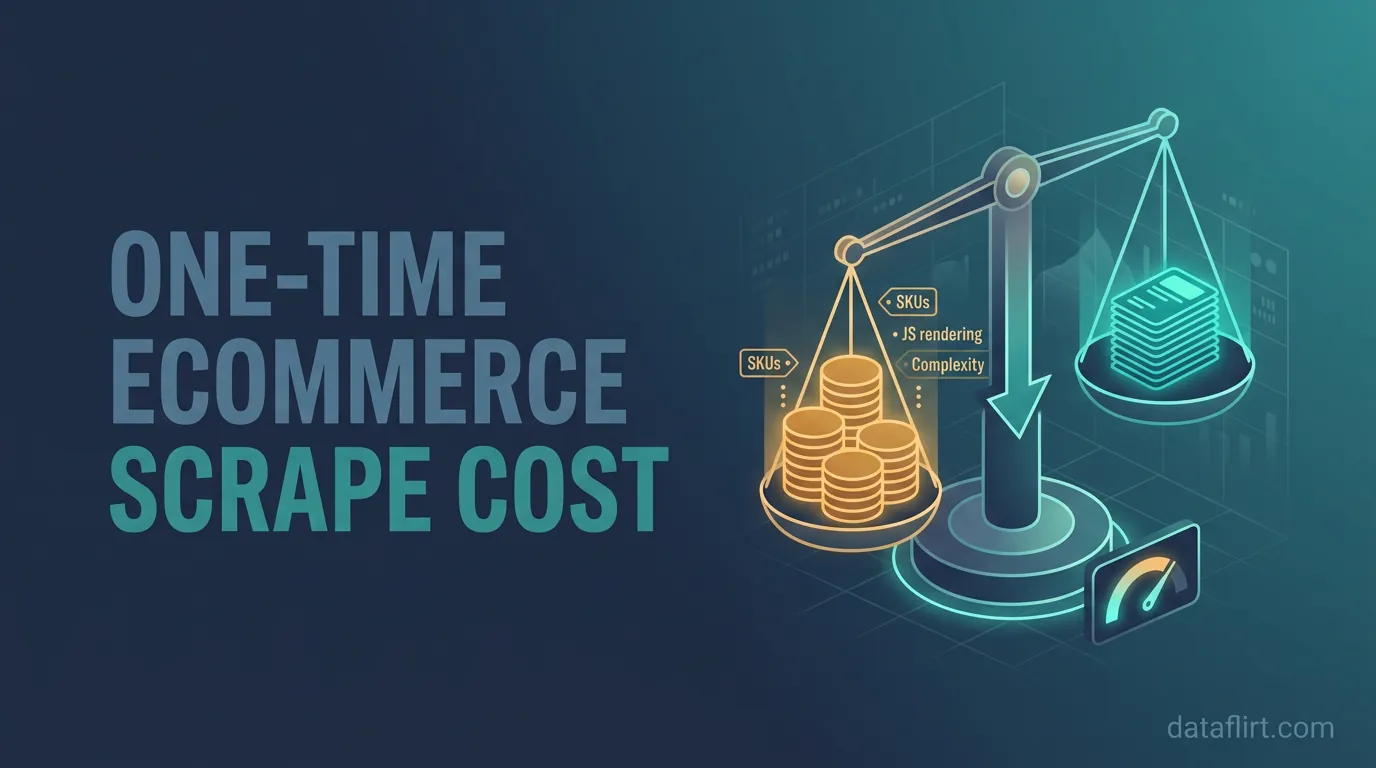
Quotes scale based on infrastructure demands rather than the simple number of rows in your final spreadsheet. The presence of JavaScript and enterprise bot protection determines whether a cheap script works or if you need expensive proxy networks. Every variable adds compute time and engineering hours to the job.
URL count vs page count distinction
Buyers often assume that a ten thousand product catalog requires scraping exactly ten thousand pages. This is mathematically impossible on modern storefronts. The scraper must first navigate through dozens of paginated category pages to locate the product links. Once on the product page, it might need to simulate clicks on five different color swatches to expose unique variant pricing. A ten thousand SKU project frequently requires the scraper to load fifty thousand individual pages. More page loads demand more compute time and proxy bandwidth. DataFlirt scopes projects based on the total necessary page interactions to prevent surprise budget overruns.
JS rendering determines the baseline
JavaScript is the biggest cost multiplier in data collection. An estimated 25% of all web scraped data worldwide is attributed to the e-commerce sector. Most of those storefronts rely heavily on dynamic front-end frameworks like React or Vue. A basic script cannot execute JavaScript. The provider must deploy a headless browser to render the page exactly as a human user would see it. Spinning up headless Chrome instances requires massive amounts of RAM and CPU power compared to simple HTML requests. This hardware requirement directly increases the price of your quote. DataFlirt engineers analyze the target site to see if we can intercept the hidden JSON data APIs instead of rendering the full page. This approach saves compute costs and speeds up delivery.
Image extraction cost
Text is exceptionally cheap to extract and store. High-resolution product images are not. If your project requires downloading the primary image and five gallery angles for every product, you are requesting gigabytes of data transfer. The provider incurs bandwidth charges to download the files and storage costs to host them. Delivering those images requires organizing them into a structured format mapped to your catalog. DataFlirt typically quotes image extraction as a separate line item. We let you decide if you want the raw image files delivered or just the direct URLs to the images hosted on the target server.
Anti-bot complexity tiers
Major retailers actively fight automated traffic. The global web scraping market size reached $1.03 Billion in 2025 due to intense pricing wars. Retailers protect their margins by deploying enterprise bot mitigation tools like DataDome or Cloudflare. Bypassing these systems requires sophisticated residential proxy networks. Providers route requests through real household IP addresses to avoid instant blocks. These residential proxies are billed by the gigabyte. DataFlirt incorporates these proxy costs into your initial quote so you never receive an unexpected bandwidth invoice mid-project.
Data cleaning and schema normalization time
Raw data is rarely ready for immediate import into your database. A target site might display a price as “$1,499.00 USD” on one page and “1499” on another. Specifications might be buried inside a massive, unformatted paragraph of marketing text. A premium provider spends engineering hours writing regular expressions and parsing logic to clean this data. They format the output to match your exact required schema. DataFlirt builds this normalization step into our pipeline. We ensure the final file maps perfectly to your Shopify or Magento import template.
Realistic price ranges for common ecommerce jobs
You can expect to pay anywhere from a few hundred dollars for a basic flat catalog to several thousand for large datasets with high-resolution images. A typical managed web scraping service provider sets a baseline starting price of roughly $450 for a custom project. The actual cost scales predictably based on the technical hurdles involved.
| Job Type | SKU Range | JS Required | Images Included | Typical Cost Range |
|---|---|---|---|---|
| Flat catalog | 500 | No | No | $100 - $300 |
| Mid-size site | 5,000 | Yes | No | $400 - $900 |
| Large catalog | 20,000 | Yes | Yes | $1,500 - $3,500 |
| Competitor audit | 10 sites | Varies | No | $600 - $1,500 |
| Review dump | 1 product line | Yes | No | $300 - $800 |
Flat catalog no JS no images 500 SKUs
This is the simplest possible job. The target site loads basic HTML upon request. The catalog is small enough that a single machine can scrape it in an hour. There are no images to host and no complex bot protection to defeat. A local boutique or a legacy supplier portal fits this profile. DataFlirt handles these small jobs quickly and efficiently. You receive a clean CSV file without paying for unnecessary infrastructure overhead.
Mid-size JS rendered no images 5000 SKUs
Costs increase when the target utilizes dynamic loading. The scraper must wait for product grids to populate via JavaScript before extracting the text. Extracting five thousand products from a site like Target or Macy’s requires careful pacing. The provider must manage connection timeouts and handle occasional layout variations across different categories. DataFlirt builds retry logic into these pipelines to ensure complete data capture. We verify that no products drop out during the dynamic rendering phase.
Large catalog with images 20000 SKUs
Scale changes everything. Extracting twenty thousand products with full image galleries requires distributed computing. The scraper must run concurrently across multiple servers. Target sites like Wayfair or Home Depot monitor for this level of traffic aggressively. Premium proxies are absolutely mandatory here. DataFlirt deploys extensive infrastructure for these jobs. We handle the heavy lifting of storing, deduplicating, and delivering gigabytes of image assets alongside your structured product text.
Marketplace competitor audit 10 competitors
Auditing prices across multiple platforms introduces extreme schema complexity. You might need pricing on a specific drill from Amazon, eBay, and Walmart. Every single site uses a completely different HTML structure. The provider must build and maintain ten separate scrapers. They must then map the disparate results into a single unified dashboard for your analysis. DataFlirt excels at multi-source aggregation. We standardize the chaos into a clean, comparative format.
Review dump one product line all platforms
Extracting reviews requires interacting with pagination deeply nested inside product pages. Sites like Sephora or Best Buy often load reviews dynamically as the user scrolls. The scraper must emulate this scrolling behavior to trigger the next batch of comments. Extracting thousands of textual reviews also requires robust text encoding to prevent weird character formatting in the final file. DataFlirt sanitizes the review text. We deliver readable data ready for sentiment analysis.
Why Fiverr quotes and agency quotes are so far apart
The fifty-dollar freelancer quote buys a rigid script that works today and breaks tomorrow. The three-thousand-dollar agency quote buys the infrastructure to bypass bot protection and deliver a clean dataset guaranteed. Basic DIY scrapers cost under $50 per month, while enterprise scraping projects scale from $200 to over $1,000 per month in purely infrastructural costs. Understanding this difference prevents costly procurement mistakes.
What a $50 gig delivers
A budget freelancer delivers exactly what you pay for. They write a basic Python script using free libraries. They run the script on their personal computer or a cheap cloud server. They do not purchase premium proxies. They do not build error handling for layout changes. If the target site loads quickly and lacks bot protection, this approach might succeed once. DataFlirt regularly speaks with clients who tried this route first. They often arrive frustrated after the freelancer vanishes when the script inevitably stops working.
Where it breaks
Cheap scripts break upon first contact with reality. Major platforms use Machine Learning models that analyze behavioral baselines in milliseconds. The moment a basic script hits a protected site, the server identifies the non-human traffic pattern and issues a permanent IP ban. The freelancer’s code fails to execute. They lack the technical expertise and the financial budget to route traffic through legitimate residential networks. DataFlirt engineers focus entirely on bypassing these modern hurdles. We absorb the complexity so you do not have to worry about broken code.
What managed services include
Agencies price their outsourced web scraping services to cover the full lifecycle of data extraction. You are paying for a dedicated project manager to understand your business logic. You are paying for senior engineers to reverse engineer mobile APIs. Most importantly, you are paying for quality assurance. A managed service verifies the data before delivery. DataFlirt implements automated checks to catch missing prices or truncated descriptions. We fix the scraper before you ever see a flawed dataset.
Hidden cost of cleaning a bad delivery
Cheap data is expensive to fix. A low-tier provider might deliver a spreadsheet where half the prices include currency symbols and the other half do not. Product dimensions might be merged into a single text block. Your internal data team then wastes twenty hours cleaning the file. Paying an internal data scientist to format a messy CSV destroys any savings gained from a cheap scraping gig. DataFlirt delivers import-ready data. We format the output perfectly the first time. Keep in mind that scraping publicly visible data is generally legal under current US frameworks. However, accessing data behind login walls enters murky breach-of-contract territory. We always recommend you consult qualified legal counsel for your specific situation before commissioning a project.
Five questions that determine your actual quote
Every accurate quote relies on knowing your total URL count, your JavaScript requirements, your image needs, your target format, and the site’s bot protection level. Missing any of these five variables will guarantee an inaccurate budget. A professional vendor asks these questions upfront during the initial scoping call.
How many URLs total?
Scope relies on volume. Extracting all running shoes from Nike requires mapping their entire category tree. We need to know if you want just the top-level product data or every single size and color variant nested beneath it. Variant extraction multiplies the request count exponentially. DataFlirt runs a preliminary crawl to estimate the true URL depth. We use this hard data to build your quote rather than guessing based on category counts.
Does the site require JS rendering?
We must inspect the target network traffic to answer this question. If the product data loads immediately in the raw HTML payload, the extraction is fast and inexpensive. If the site requires a browser environment to compile the data, costs rise. DataFlirt engineers audit the target architecture to find the most efficient extraction path. We never charge for browser rendering if we can safely extract data from an underlying API endpoint.
Do you need images and at what resolution?
Image requirements drastically alter server storage needs. Downloading low-resolution thumbnails is relatively cheap. Scraping high-resolution zoomable gallery images for thousands of products is highly resource-intensive. DataFlirt asks you to specify the exact image types required. We then architect a delivery mechanism capable of handling bulk media transfers without corrupting the files.
What is the target delivery format?
The destination dictates the formatting logic. An analyst might want a flattened CSV file for Excel. A developer integrating B2B marketplace services might require a heavily nested JSON object. A catalog manager needs a file formatted specifically for their inventory management software. DataFlirt customizes the export schema. We do the transformation work so your team does not have to build internal parsing tools.
Is the site behind bot protection?
The vendor must identify the defensive stack. An unprotected site allows fast, concurrent scraping. A site shielded by advanced behavioral analytics requires slow, randomized access patterns and high-quality residential IPs. The cost of these proxy networks directly impacts your final price. DataFlirt transparently communicates the presence of bot protection during scoping. We explain exactly what infrastructure is necessary to safely collect your data.
What blows up a budget mid-project
Mid-project budget overruns almost always stem from hidden technical complexity or moving goalposts. Undisclosed bot protection and late requests for schema changes are the primary culprits. Understanding these scraping cost factors allows you to lock in a firm budget before the project starts.
Site structure changes mid-crawl
Target sites occasionally undergo major redesigns right in the middle of an extraction run. The DOM changes completely. CSS selectors fail. The scraper starts returning null values. The provider must pause the job, rewrite the extraction logic, and restart the crawl. DataFlirt monitors extraction metrics continuously. If a site changes its layout during a job, our team immediately updates the code to ensure data continuity without billing you for emergency maintenance.
Dynamic pricing returning inconsistent data
Retailers increasingly display different prices based on user location. If your scraper uses proxies located in California, it will pull California pricing. If you needed the New York price, that data is useless. Geo-targeted scraping requires highly specific proxy routing which carries a premium price tag. DataFlirt works with you during scoping to identify any regional pricing dynamics. We configure our proxy pools to mimic buyers in your precise target geography.
Undisclosed JS rendering
Sometimes a site appears simple but hides complex JavaScript triggers on specific product types. A category page might load fine, but the individual product detail page requires an interactive slider to reveal the price. If this is discovered late in the project, the entire infrastructure must pivot to browser-based rendering. DataFlirt avoids this trap by testing multiple distinct product types during the free scoping phase. We find the edge cases before we finalize your quote.
Image deduplication overhead
Retailers often reuse the same lifestyle image across multiple products. If a scraper blindly downloads every image link it encounters, it will download that exact same lifestyle photo hundreds of times. This bloats the final delivery file and wastes bandwidth. DataFlirt implements hash-checking logic to deduplicate media files on the fly. We deliver a lean, efficient media package that saves you storage space.
Post-delivery schema change requests
Changing the rules after data delivery creates friction. You receive the requested CSV file but decide later you actually want the product dimensions split into three separate columns for length, width, and height. The provider must re-process the entire dataset or even re-scrape the site if the raw strings were discarded. DataFlirt requires a signed-off schema before the final scrape begins. We map everything out clearly to prevent expensive rework cycles.
How DataFlirt scopes and prices a one-time extraction
DataFlirt prices extractions on a fixed project basis after thoroughly testing the target site’s infrastructure. We provide a transparent quote and a sample dataset before you commit any budget. Commercial web data extraction services help growth only when the costs are predictable. We eliminate the guesswork from procurement.
Free scoping call within 48 hours
We start with a technical conversation. We review your target URLs, your desired data points, and your expected volume. Our engineers then spend a few hours quietly probing the target sites to assess their bot protection and structural complexity. DataFlirt does not guess at prices. We base every single quote on hard network data gathered during this initial technical review.
Sample dataset before full commitment
Trust requires proof. Once we map the extraction logic, we run a limited scrape. We deliver a small sample dataset formatted to your exact specifications. You can test this file inside your database or e-commerce platform. DataFlirt requires your explicit approval on this sample before we execute the full extraction job. You know exactly what the final delivery will look like.
Project-based pricing no monthly subscriptions
One-time extractions should not lock you into recurring software subscriptions. You need a specific dataset to make a specific business decision. We calculate the engineering time, the compute cost, and the proxy bandwidth required for your unique job. DataFlirt issues a flat, project-based quote. You pay once for the data you need without any ongoing financial commitments.
Delivery format matched to your platform
We adapt to your technology stack. If you use Shopify, we deliver a CSV that maps perfectly to their import tool. If you use a custom backend, we deliver structured JSON files ready for ingestion. DataFlirt handles all the necessary data transformation. We ensure your team spends their time analyzing the market rather than fighting with misaligned spreadsheet columns.
FAQ
Is there a minimum project size at DataFlirt?
No. DataFlirt handles one-time extractions of any size from a few hundred product pages to multi-million SKU catalogs.
Does price per SKU decrease at volume?
Generally yes. Fixed engineering setup cost is amortized over a larger catalog so per-record cost drops. DataFlirt quotes per project which keeps large jobs cost-predictable.
What does a sample dataset cost?
DataFlirt provides a sample extraction of up to 100 rows as part of scoping at no charge so you can verify quality before committing.
If you prefer not to manage proxies or fight with layout changes yourself, DataFlirt’s ecommerce scraping service handles the extraction, QA, and final delivery. We take on the technical complexity so you can focus on adjusting your pricing strategy. Reach out today for a free scoping call and a sample dataset.