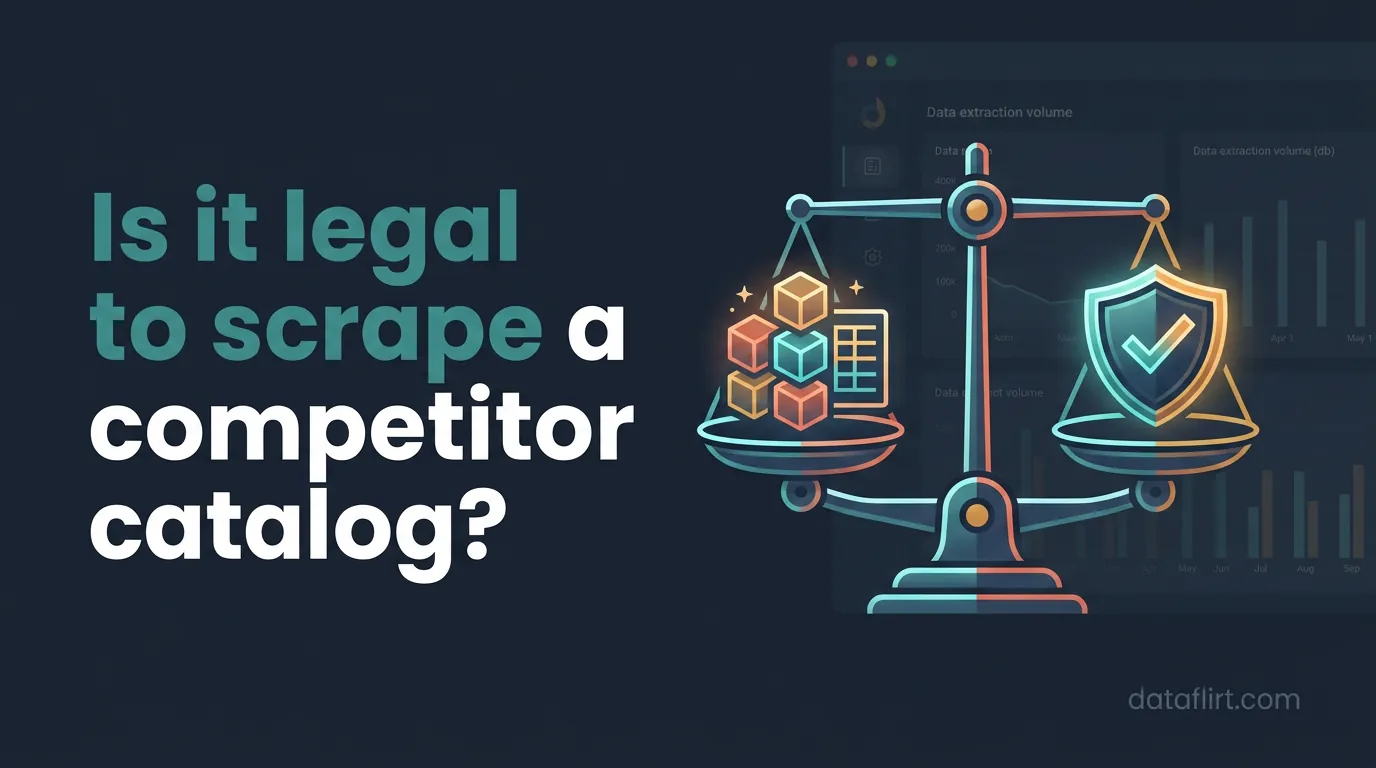

You are staring at a competitor website. You need to know how they keep undercutting your best-selling products. A daily catalog extraction would solve the mystery immediately. Then you scroll down and read their site policies. The legal jargon explicitly forbids automated collection. You freeze. A competitor ToS says no scraping. Does that mean I am breaking the law if I do it anyway? This is the uncomfortable question every technical founder faces when building a market intelligence pipeline. You want the pricing data. You absolutely do not want a federal lawsuit.
Key takeaways
- A website Terms of Service agreement is a civil contract rather than a criminal statute.
- Scraping public data while logged out carries vastly different risk profiles compared to bypassing authentication walls.
- Pricing data is generally factual and uncopyrightable; product descriptions and brand images require strict intellectual property handling.
- Jurisdiction dictates your exposure; GDPR in Europe and the CFAA in the United States apply completely different standards to data collection.
- Always consult qualified legal counsel to orient your specific project requirements.
What happens when a competitor Terms of Service forbids scraping
A website Terms of Service agreement constitutes a civil contract. It does not carry the weight of a criminal statute. This distinction forms the foundation of modern web data extraction. When you read a strict policy prohibiting automated access, you are reading a company preference. You are not reading a federal law.
The difference between a contract and a law
Many business leaders conflate corporate policies with government legislation. They assume violating a website rule makes them a criminal. This fear is understandable but legally inaccurate. A Terms of Service is essentially a set of house rules. If you break those rules, the property owner can ask you to leave. They can block your IP address. They can implement aggressive rate limits to slow your requests.
They cannot typically have you arrested for looking at public price tags. The consequences of ignoring a ToS are overwhelmingly civil. A competitor could theoretically sue you for breach of contract. However, courts historically struggle to enforce browsewrap agreements. A browsewrap agreement is a policy linked at the bottom of a page that a user never explicitly agreed to. If you never clicked a button stating you accept the terms, enforcing that contract becomes extremely difficult for the plaintiff.
This reality drives massive industry adoption. Research from Kanhasoft shows that 85% of e-commerce companies track competitor pricing and promotions through web scraping. They accept the minimal civil risk because the operational cost of flying blind is substantially higher. DataFlirt sees this exact risk calculus play out every day. When catalog managers understand the civil nature of these policies, their hesitation usually evaporates. DataFlirt steps in to manage the technical extraction precisely so our clients can focus on the resulting intelligence.
The reality of enforcement and civil exposure
Because the law largely favors public web scraping, e-commerce platforms deploy aggressive technical countermeasures instead of legal ones. They rely on their engineering teams to block you. They analyze header signatures. They track unusual request volumes. They deploy complex fingerprinting scripts. Lawsuits are expensive, slow, and often unsuccessful. Dropping a connection is free.
Consider a pricing manager auditing 40,000 SKUs across multiple major retailers. If she runs a script against Amazon, she will quickly hit a technical wall. If she pivots to check local hardware inventory at Home Depot or Lowe’s, she faces sophisticated bot mitigation software. The barrier is technical resistance, rarely a legal injunction. You must still operate ethically. You should not overwhelm target servers. However, operating an automated script against public endpoints is a standard business practice. DataFlirt specializes in navigating these technical barriers safely. DataFlirt ensures your data flow remains uninterrupted without resorting to malicious network behaviors.
What makes a scraping project lower-risk versus higher-risk
Publicly accessible product data represents the safest tier of extraction. Bypassing login walls or collecting personally identifiable information elevates your exposure exponentially. The legal landscape explicitly divides the internet into public spaces and private restricted zones.
Navigating public data and the CFAA
In the United States, the Computer Fraud and Abuse Act governs digital access. The CFAA was originally written to prosecute malicious hackers. For years, massive corporations tried to use the CFAA to crush web scrapers. They argued that violating a ToS constituted unauthorized access. Recent court rulings have decisively rejected this interpretation.
Two major cases define the current landscape. The hiQ Labs v. LinkedIn ruling established that scraping publicly accessible data generally does not violate the CFAA. If a page requires no password, it is essentially a public billboard. The Meta v. Bright Data ruling in 2024 further cemented this precedent. The court found that scraping public data while logged out of a platform does not constitute a breach of contract. A platform ToS only applies to account holders while they are actively logged in.
This legal clarity has accelerated automated collection. Actowiz Solutions reports that 81% of US retailers currently run automated data collection for competitive pricing. If you extract public prices, public titles, and public inventory counts, your project sits squarely in the lower-risk category. DataFlirt builds entire enterprise pipelines exclusively within this safe zone. DataFlirt engineers target public endpoints to ensure your dataset remains legally defensible.
The danger of login walls and access controls
The calculation changes entirely the moment you enter a password. An authentication wall is a digital locked door. If you bypass that door, you enter a private space. Scraping behind a login wall is an incredibly high-risk activity. You are now explicitly bound by the clickwrap agreement you signed when creating the account.
If you use a scraper to bypass authentication or defeat session tokens, you risk violating the CFAA. You are accessing a protected computer without authorization. This is where civil disputes can escalate into severe federal territory. Furthermore, extracting personal data introduces immediate regulatory peril. Pulling a public price is fine. Pulling the personal email addresses of third-party marketplace sellers is highly dangerous.
| Data extraction scenario | General risk level | Primary legal reason |
|---|---|---|
| Public pricing and inventory | Low | Data is factual; no access controls bypassed. |
| Logged-in wholesale catalog | High | Breaches explicit clickwrap contract; bypasses authentication. |
| Bypassing a CAPTCHA | Medium | May be viewed as circumventing a technical access barrier. |
| Scraping seller contact info | High | Triggers privacy regulations like GDPR and CCPA. |
We advise clients to evaluate their requirements ruthlessly. Do you genuinely need the data hidden behind the login? Often, the answer is no. You can usually acquire sufficient market intelligence from public-facing category pages. If you must scrape behind a login, we strongly recommend reading about data crawling ethics and best practices and consulting your legal team. DataFlirt generally refuses to build scrapers that bypass hard security walls to steal proprietary backend metrics. DataFlirt protects your business by refusing unnecessarily risky extraction requests.
How jurisdiction changes the rules of engagement
Your legal standing shifts entirely depending on where the target servers reside and where your company operates. A strategy deemed perfectly safe in California might trigger immediate regulatory action in Berlin. Web scraping is a borderless technical activity governed by strictly bordered legal frameworks.
The US approach to public data
The United States takes a relatively permissive approach to public data extraction. As discussed, the CFAA focuses on unauthorized access. If the data is public, US courts generally defend the right to scrape it. This permissive environment explains why massive intelligence pipelines originate in North America.
However, this does not mean it is a free-for-all. US courts still penalize scrapers who overwhelm target servers. If your scraper behaves like a denial-of-service attack, you can be sued for trespass to chattels. You are functionally damaging another company’s property by consuming all their bandwidth. This is why rate limiting your requests is critical. It demonstrates respect for the target infrastructure. DataFlirt strictly monitors concurrent connections. DataFlirt ensures your extraction runs quietly in the background without degrading the host server performance.
European and UK database protections
The European Union presents a much stricter environment. The General Data Protection Regulation applies to any personal data you collect. If you scrape a directory of independent artisans on Etsy and capture their personal names, you must comply with GDPR. You need a lawful basis for processing that data.
Europe also enforces the Database Directive. This directive protects the substantial investment a company makes in organizing a database. Even if the individual data points are public facts, copying the entire structured database might violate European law. You cannot simply clone a competitor site. The UK maintains similar protections under the UK GDPR. If you are targeting European retailers like Zalando or IKEA, your compliance burden increases significantly. We heavily recommend reading about web scraping and GDPR before launching European operations. DataFlirt helps clients navigate this by targeting specific required fields rather than executing massive, reckless database clones.
India and the DPDP Act
India recently introduced the Digital Personal Data Protection Act. Like GDPR, this legislation heavily regulates personal information. India lacks a specific web scraping statute. The legality of an operation depends entirely on the nature of the data collected.
If you are extracting fashion trends from Myntra or product availability from Flipkart, you are dealing with safe, non-personal data. If you begin harvesting customer reviews that include full names and locations, you intersect with the DPDP Act. Always isolate your data requirements. Every jurisdiction penalizes the reckless collection of personal information. DataFlirt architects pipelines to explicitly filter out personally identifiable information during the extraction phase. DataFlirt delivers clean, factual datasets devoid of privacy liabilities.
Recent analysis by Thales CPL in their 2025 Imperva Bad Bot Report indicates that 37% of all internet traffic in 2024 was generated by malicious or bad bots. Because of this massive volume, international regulators are increasingly scrutinizing automated traffic. You must clearly differentiate your commercial intelligence gathering from malicious credential stuffing or fraud.
Why product descriptions and images introduce copyright exposure
Extracting a price is safe because facts lack copyright protection. Copying a competitor’s proprietary description verbatim is a direct intellectual property violation. You can scrape the data to analyze it, but you cannot necessarily republish it.
The distinction between facts and creative work
Copyright law protects creative expression. It does not protect raw facts. A price is a fact. A dimensional measurement is a fact. A product weight is a fact. You can scrape prices from Wayfair all day long without infringing on their copyright. Nobody owns the concept of a chair costing fifty dollars.
Product descriptions are entirely different. A marketing team spent hours writing a compelling, evocative paragraph about that chair. That specific arrangement of words is creative expression. The retailer owns the copyright to that description. If you scrape that paragraph and paste it directly onto your own e-commerce storefront, you are stealing intellectual property. A competitor will easily find it. They will issue a DMCA takedown notice. They may file a lawsuit for copyright infringement.
Consider a catalogue manager tasked with populating a new marketplace. She scrapes 5,000 product descriptions from a rival site to save time. Two weeks later, her company receives a severe cease and desist letter. She saved forty hours of writing but exposed her company to massive legal liability.
This distinction is crucial. You must separate analytical extraction from content syndication. DataFlirt frequently helps clients pull descriptions strictly for internal analysis. DataFlirt feeds that text into natural language processing models to track competitor keyword strategies. DataFlirt ensures clients understand that internal analysis is safe, while external republication is perilous.
Safe usage patterns for scraped intellectual property
Images carry similar restrictions. A brand or a professional photographer owns the copyright to a product photo. Scraping an image off Target does not transfer the usage rights to you. You cannot use competitor images in your own advertising campaigns.
However, you can scrape images for legitimate internal purposes. You can use them to train a computer vision model to recognize product categories. You can run them through an internal visual comparison tool to ensure you are matching the correct SKUs. The extraction itself is rarely the crime. The subsequent usage dictates the legality.
Automated traffic is ubiquitous in modern retail. The same Thales CPL study found that 51% of total internet traffic in 2024 was automated. You are operating in a crowded space. You protect yourself by strictly defining how your organization uses the collected media. We advise implementing strict internal data governance. If your team understands they are gathering intelligence rather than stealing content, your risk plummets. DataFlirt supports this by delivering data into isolated analytical environments. DataFlirt formats your deliverables for backend databases, deliberately separating them from your customer-facing content management systems.
How a compliant extraction pipeline actually functions
True compliance requires embedding legal principles directly into your code. It means respecting technical boundaries while maintaining reliable data yields. You cannot bolt compliance onto a scraper after it is built. You must engineer it from the first line of code.
Respecting technical boundaries and site load
Ethical web scraping begins with the robots exclusion protocol. The robots.txt file is a plain text document hosted on a server that outlines which pages automated bots should avoid. It is a technical convention, not a binding law. However, ignoring it entirely reflects poorly on your intent. If a dispute ever reaches a courtroom, a judge will look at your behavior. Blatantly ignoring a robots.txt file demonstrates a disregard for the property owner’s requests. You can learn more about robots.txt legal standing in our technical glossary.
Furthermore, you must manage your request velocity. A poorly coded scraper will fire thousands of concurrent requests at a server, causing a spike in CPU load. This triggers anti-bot defenses immediately. It also damages the host business. A compliant pipeline uses intelligent delays. It spreads requests across a wide window of time. It utilizes rotating residential proxies not to launch malicious attacks, but to distribute the network load fairly.
When we scope projects targeting major platforms like Best Buy or Macy’s, we calculate the optimal request pacing. DataFlirt believes that a successful extraction should be invisible to the target server. DataFlirt engineers sophisticated throttling mechanisms that mimic gentle human browsing patterns. DataFlirt secures your data by treating the target infrastructure with technical respect.
Provenance tracking and lawful basis
Enterprise data consumers require audit trails. If you purchase a scraped dataset, you need to know exactly where it came from and how it was acquired. This is known as data provenance. If regulators ever audit your operations, you must demonstrate a lawful basis for the data in your possession.
A mature scraping operation documents everything. It logs the target URLs. It logs the date and time of extraction. It explicitly filters out unexpected personal data that might accidentally bleed into a product extraction. If you are scraping cosmetics data from Sephora, your pipeline should automatically discard user review names if you only need the review score.
You can review our extensive guide on the top scraping compliance considerations for a deeper technical breakdown. Building these safeguards internally requires expensive engineering talent. Maintaining them as target sites update their layouts requires constant vigilance. This is why outsourcing to a managed provider is often the safest operational choice. DataFlirt provides comprehensive provenance documentation with every enterprise delivery. DataFlirt acts as your technical shield, guaranteeing the structural integrity and ethical origin of your market intelligence.
FAQ
Does scraping violate the Computer Fraud and Abuse Act?
Generally scraping publicly accessible data without bypassing access controls does not violate the CFAA based on hiQ v. LinkedIn. Bypassing login walls raises different considerations. This is general orientation consult qualified legal counsel for your specific situation.
Can a competitor sue me for scraping their catalog?
A competitor can sue for breach of ToS or copyright infringement if you republish their content verbatim. Successful suits for scraping publicly available non-personal product data are relatively rare but the risk is not zero.
What is robots.txt and does it carry legal weight?
robots.txt is a technical convention not legally binding in most jurisdictions. However ignoring it has been cited as evidence of intent in ToS breach cases. DataFlirt respects robots.txt rate directives by default.
If you want to extract competitor intelligence without carrying the engineering and compliance burden internally, let the experts handle the heavy lifting. DataFlirt’s ecommerce web scraping services provide clean, reliable, and technically respectful data pipelines tailored to your exact business requirements. We manage the proxies, the parsers, and the rate limits so you can focus strictly on your market strategy. Furthermore, if you are working with particularly sensitive legal or public record datasets, explore our specialized legal data scraping services. Reach out today for a free scoping call, and we recommend consulting qualified legal counsel to properly orient your specific data ambitions.