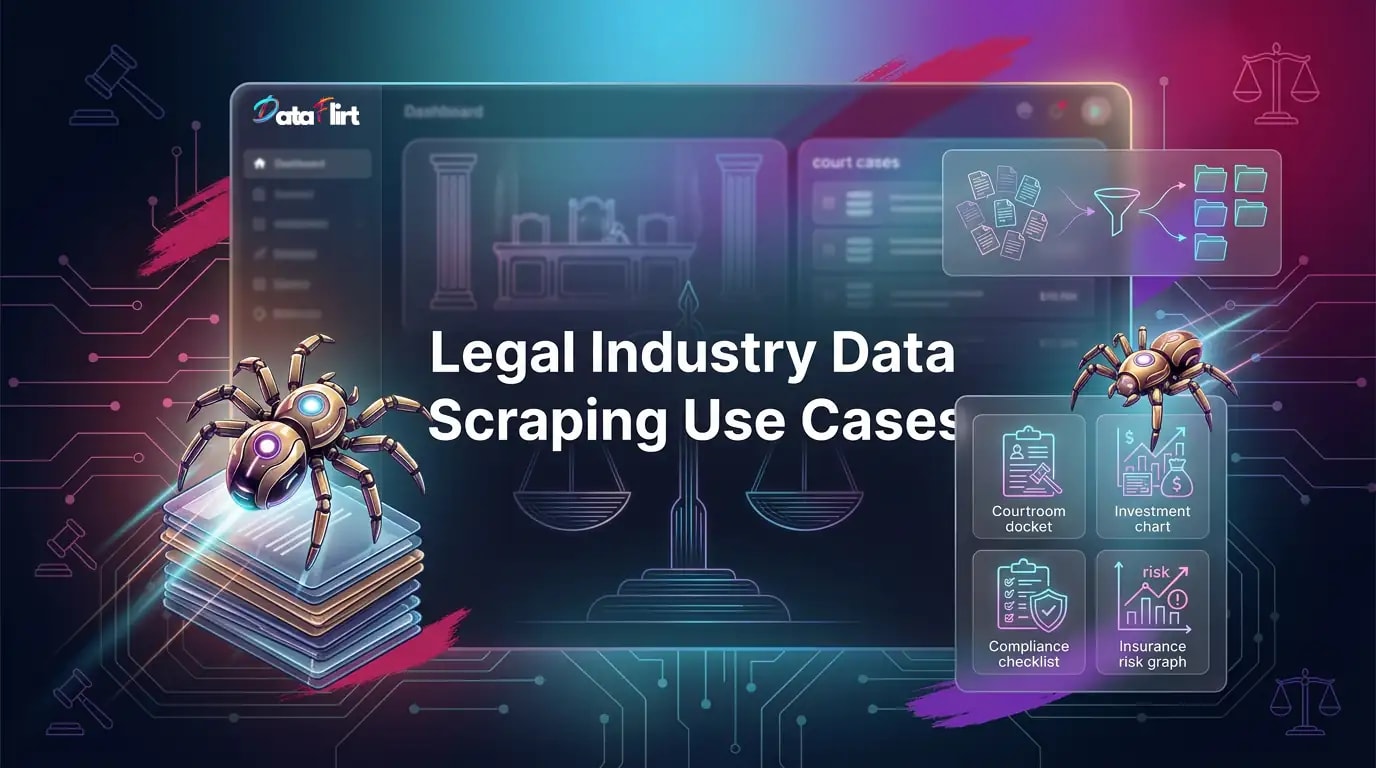

The Intelligence Gap Hidden in Plain Sight: Why Legal Industry Data Scraping Is Now a Strategic Priority
Every court filing is public. Every regulatory enforcement action is public. Every patent grant, trademark registration, corporate insolvency notice, and judicial opinion is, in most jurisdictions, a matter of public record explicitly designed for public access. And yet, despite the staggering volume and strategic value of this publicly accessible legal and judiciary data, the vast majority of organizations that could benefit from it are either not collecting it systematically or are collecting it without the quality architecture that makes it analytically useful.
This is the intelligence gap that legal data scraping directly addresses.
The US federal court system alone processes approximately 400,000 new civil and criminal case filings per year across its 94 district courts, all of which are publicly accessible through the PACER electronic filing system. Add state-level court filings across all 50 US states, and the volume of publicly accessible docket data generated annually runs into the tens of millions of records. The SEC receives and publishes over 2 million regulatory filings per year on EDGAR. The USPTO grants over 350,000 patents annually, each a publicly accessible structured data record. The UK’s Companies House processes over 10 million document submissions per year, all publicly accessible.
“Every major court verdict, every regulatory enforcement action, every patent grant, and every insolvency filing is a data event. Organizations with the infrastructure to systematically collect, normalize, and analyze those data events have an intelligence advantage that point-in-time research and manual monitoring cannot match.”
The legal and judiciary sector, precisely because it operates through public disclosure by design, generates some of the most strategically significant publicly accessible data in the global economy. Litigation patterns reveal corporate risk trajectories. Enforcement actions signal regulatory posture shifts. Patent filing velocities indicate innovation investment trends by sector and by company. Insolvency records surface counterparty risk signals that no credit bureau feed publishes with comparable recency.
Legal data scraping is the systematic, programmatic collection of this intelligence at scale. When executed with proper data quality controls and delivered in structured formats that integrate cleanly into analytical workflows, it becomes a foundational capability for legal tech product companies, investment research teams, compliance functions, insurance underwriters, and any organization that competes on legal and regulatory intelligence.
The market context is significant. The global legal tech market was valued at approximately $28 billion in 2024 and is projected to reach $59 billion by 2031, at a CAGR of approximately 11%. A substantial portion of that growth is driven by data-intensive product categories: litigation analytics platforms, AI-powered legal research tools, regulatory intelligence dashboards, contract analysis engines, and compliance monitoring systems. Almost all of them depend, at least in part, on systematic court data extraction and legal intelligence data from publicly accessible sources.
This guide is written for the business and data teams who need to activate this data: legal tech product managers who need to understand what judiciary data scraping can power in their analytics products, investment analysts building alternative data programs on regulatory and litigation signals, compliance officers who need systematic enforcement monitoring at a coverage breadth that manual research cannot deliver, and data leads designing the quality pipelines that make raw scraped court data analytically reliable.
What Legal Industry Data Scraping Actually Covers: A Data Taxonomy
Legal data scraping is not a monolithic activity. The publicly accessible data generated by courts, regulatory agencies, intellectual property registries, corporate disclosure systems, and legal publication portals spans an enormous range of record types, each with distinct analytical utility and distinct quality requirements.
Court Docket and Case Filing Data
Court dockets are the most foundational category in judiciary data scraping. A docket record captures the procedural history of a legal proceeding: the parties involved, the legal claims asserted, the procedural events from filing through resolution, the presiding judge, the attorneys of record, and the case outcome where the matter has been concluded.
Publicly accessible docket data is available at the federal level in the United States through PACER, which covers all 94 federal district courts, 13 courts of appeals, the US Supreme Court, and specialist courts including the Court of International Trade and the Court of Federal Claims. State-level court portals vary enormously in their data accessibility and structure: some states publish near-real-time docket data through well-structured public APIs; others publish docket records through legacy portals requiring sophisticated parsing logic; and a minority maintain only paper-based records with no systematic digital access.
International court data accessibility is even more heterogeneous. The UK court system publishes judgment texts through the National Archives and via the British and Irish Legal Information Institute. The Court of Justice of the European Union publishes all judgments and opinions through EUR-Lex. Individual EU member state courts vary from comprehensive digital publication systems to largely paper-based records with minimal public digital access.
What court docket data enables:
- Litigation exposure screening for counterparty due diligence
- Judicial outcome analysis by judge, jurisdiction, and claim type
- Counsel performance analytics for law firm benchmarking and selection
- Mass tort and class action monitoring for investment risk assessment
- Patent and IP litigation tracking for competitive intelligence
- Employment and labor litigation trend analysis for HR risk programs
Regulatory Enforcement Action Data
Regulatory enforcement databases represent some of the most analytically dense publicly accessible legal intelligence data available anywhere. The SEC’s EDGAR system, FINRA’s BrokerCheck, the FCA Register in the UK, the CFPB enforcement database, the EPA enforcement and compliance database, OSHA’s enforcement data system, and their equivalents in every major regulatory jurisdiction publish structured enforcement action records that include the regulated entity, the violation type, the enforcement response, the penalty amount, and the resolution status.
The analytical value of regulatory enforcement data is substantial across multiple use cases. For investment analysts, enforcement action data is an alternative data signal for regulatory risk exposure in portfolio companies. For insurance underwriters, enforcement history is a component of risk scoring for D&O, professional liability, and E&O coverage decisions. For compliance teams, monitoring enforcement activity by peer organizations and industry participants is a standard benchmarking practice. For legal tech product companies, enforcement data is a core dataset powering regulatory intelligence products.
The volume of enforcement data published annually is significant. The SEC alone published over 700 enforcement actions in fiscal year 2024 involving orders totaling over $8 billion in penalties and disgorgements, each a publicly accessible structured record available for systematic court data extraction and analysis.
Patent and Intellectual Property Data
Patent and trademark registry data is among the most structurally rich publicly accessible legal intelligence data available. The USPTO in the United States, the EPO for European patents, the WIPO for international filings under the Patent Cooperation Treaty, the UKIPO, the JPO in Japan, and the national IP offices of every major patent-active jurisdiction publish comprehensive structured data on patent applications, grants, assignments, oppositions, and legal status changes.
A patent record contains: inventor and assignee information; claims text describing the protected invention; international patent classification codes enabling cross-sector innovation mapping; priority date, filing date, and grant date; forward and backward citation relationships enabling technology genealogy analysis; and legal status including grant, abandonment, maintenance, and lapsing events.
For investment analysts and corporate strategy teams, patent data is a proxy for innovation investment and intellectual property accumulation by sector, technology domain, and individual company. For legal tech companies, patent litigation data combined with patent grant data powers IP risk intelligence products. For competitive intelligence teams, monitoring competitor patent filing velocity and technology domain focus provides early signals of R&D strategy shifts that predate product announcements by years.
Corporate Legal Disclosure Data
Corporate legal disclosure data covers the publicly accessible legal and regulatory filings made by companies through securities regulators, company registries, and exchange platforms. SEC filings in the United States include: 10-K annual reports with legal proceedings disclosures; 8-K current reports including material litigation events; proxy statements disclosing executive compensation and governance litigation; and Form 4 filings disclosing officer and director transactions.
Companies House in the UK publishes comprehensive corporate filings including incorporation documents, annual accounts, director records, charge registrations (secured creditor filings), and dissolution notices. The EU’s Business Register Interconnection System creates a cross-border view of corporate registration data across EU member states. Similar registries operate in Australia (ASIC), Singapore (ACRA), India (MCA), Canada, and virtually every other major economy.
For investment analysts, legal disclosure data extracted from corporate filings provides a systematic view of litigation exposure, regulatory risk, and corporate governance posture that supplements but does not duplicate financial statement analysis. For credit analysts, charge registration data from company registries provides real-time visibility into corporate borrowing activity and collateral positions.
Insolvency and Restructuring Data
Insolvency, bankruptcy, and restructuring filings represent a high-signal category of legal intelligence data with direct applications in credit risk, investment analysis, and commercial counterparty assessment. In the United States, bankruptcy filings through the federal bankruptcy court system are publicly accessible via PACER and include: the debtor’s schedule of assets and liabilities; creditor claims registers; plan of reorganization documents; trustee reports; and court orders approving restructuring or liquidation.
The UK’s Insolvency Service publishes a public register of insolvency practitioners and proceedings. Companies House records dissolution and liquidation events for UK companies. The EU’s cross-border insolvency framework creates publicly accessible records across member state insolvency proceedings.
For trade credit managers and supply chain risk functions, systematic court data extraction from insolvency portals provides early warning signals of counterparty financial distress that precede formal default by weeks or months. For distressed debt investors and litigation finance firms, insolvency claim data provides structured intelligence on creditor exposure and recovery prospect.
Law Firm and Legal Professional Data
Law firm directory data, attorney state bar registration records, professional conduct and disciplinary records, and firm-level litigation activity data extracted from court dockets constitute a distinct and commercially valuable category of legal intelligence data.
Every US state bar association maintains a publicly accessible attorney directory that includes admission status, disciplinary history, and practice area registration. The American Bar Association publishes aggregated statistics on firm size, lawyer demographics, and practice area distribution. State court docket data, when processed at scale, reveals law firm litigation volume, practice area concentration, win rates by claim type and jurisdiction, and counsel frequency before specific judges.
For legal tech companies selling practice management tools, marketing platforms, or professional development products, this data is the foundation of their sales prospecting and market sizing programs. For in-house legal departments benchmarking outside counsel selection, scraped law firm litigation performance data provides empirical decision support for panel management decisions.
Role-Based Use Cases: Who Uses Legal Intelligence Data and How
The same underlying legal data scraping infrastructure can serve radically different business functions depending on how data is processed, structured, and delivered to each consuming team. Here is a detailed breakdown of how each professional persona actually uses scraped court and legal intelligence data.
Investment Analysts and Portfolio Managers
Investment teams at hedge funds, private equity firms, credit funds, and institutional asset managers have been among the earliest adopters of systematic legal data scraping programs for alternative data purposes. Litigation and regulatory data provides investment signals that are genuinely orthogonal to the financial statement and market price data that most investment analytics programs are built on.
Litigation exposure as investment signal: A systematic legal data scraping program monitoring federal and state court dockets for litigation activity involving portfolio companies and acquisition targets provides a continuous early warning system for material litigation risk that may not appear in financial disclosures until the risk has already been priced into the market. A company accumulating multiple employment discrimination class action filings over a 12-month window is exhibiting a pattern that is analytically significant for both standalone investment risk assessment and for predicting the likelihood of regulatory inquiry.
Regulatory enforcement trend analysis: Monitoring SEC, CFTC, FCA, and equivalent regulatory enforcement databases for enforcement activity against companies in specific sectors provides investment teams with sector-level regulatory posture intelligence that is not captured in any licensed data product. A sector experiencing a step-change increase in enforcement actions is facing elevated regulatory risk that is material to investment thesis formation. Systematic court data extraction from enforcement portals is the only way to monitor this signal at the coverage breadth and temporal granularity that investment research requires.
Litigation finance opportunity identification: Litigation finance funds use legal data scraping to systematically identify cases with the characteristics that make them attractive funding candidates: large claimed damages, financially capable defendants, well-established liability theories, and representation by counsel with strong track records in the relevant claim type. This is a pure legal intelligence data application: the analytical inputs are almost entirely derived from court docket records, judgment databases, and counsel performance analytics.
M&A due diligence support: Acquirers use systematic court data extraction to surface litigation exposure, regulatory history, and intellectual property risk in acquisition targets that would not be captured through standard financial due diligence. A target company with an undisclosed pattern of supplier litigation or a series of recent regulatory inquiries visible in public enforcement databases represents a materially different risk profile than its disclosed financials alone would suggest.
Recommended delivery format for investment teams: Structured JSON or CSV feeds, entity-resolved and normalized, delivered to cloud storage or data warehouse on a defined schedule. For event-driven signals such as new enforcement actions or major judgment entries, webhook delivery with same-day notification is increasingly standard in sophisticated investment alternative data programs.
Legal Tech Product Teams
Legal tech companies building litigation analytics platforms, legal research tools, regulatory intelligence products, contract analysis engines, and professional benchmarking applications depend on systematic legal data scraping as a primary data acquisition method. For these teams, scraped court and legal intelligence data is not a supplementary analytical input; it is the raw material from which product value is manufactured.
Litigation analytics products: The fastest-growing category in legal tech is litigation analytics: products that help law firms, corporate legal departments, and litigation funders assess case strength, predict outcomes, benchmark counsel performance, and optimize litigation strategy using empirical data derived from historical court records. Every litigation analytics product is built, at its foundation, on systematic court data extraction from docket records, judgment databases, and settlement reporting portals.
The data quality requirements for litigation analytics applications are extremely demanding. Entity resolution, the process of identifying that “ABC Corp.,” “ABC Corporation,” “ABC Corp” and “A.B.C. Corporation” are all the same legal entity, is the foundational data quality challenge in court data extraction for litigation analytics. A litigation analytics product where entities are not reliably resolved across cases and jurisdictions produces unreliable outcome statistics that legal professionals can immediately identify as analytically flawed.
Regulatory intelligence dashboards: Legal tech companies building regulatory monitoring products for compliance teams, law firms, and regulated businesses use systematic legal data scraping of enforcement portals, regulatory guidance publication databases, and public rulemaking repositories to power continuously updated intelligence dashboards. The product value is freshness and coverage breadth: a dashboard that surfaces enforcement actions within hours of their publication, across all relevant regulatory agencies and jurisdictions, at a coverage level that no manual monitoring process can approach.
Judge and jurisdiction analytics: Detailed analysis of judicial behavior, including motion grant rates, trial scheduling patterns, damages award distributions, and class certification standards by individual judge and jurisdiction, requires systematic court data extraction at scale. This is a high-value legal tech product capability: law firms making venue selection decisions and litigation strategy choices benefit materially from empirical judicial analytics that go beyond anecdote and colleague opinion.
Contract and legal document intelligence: Publicly accessible legal documents including court-filed contracts, disclosed settlement agreements, patent license agreements referenced in litigation filings, and regulatory consent orders contain structured contractual intelligence that legal tech companies extract for benchmarking databases, contract analytics products, and market intelligence applications.
Compliance and Legal Operations Teams
Corporate compliance teams and in-house legal operations functions use legal data scraping for a set of use cases that are often more operationally specific than the investment or product use cases described above: they need continuous intelligence on regulatory developments, enforcement activity against peers, and litigation patterns in their industry to manage compliance risk proactively rather than reactively.
Peer enforcement monitoring: Systematically monitoring regulatory enforcement actions against industry peers and competitors is a standard compliance practice at sophisticated financial institutions, pharmaceutical companies, and technology platforms. Legal data scraping of enforcement portals provides a more comprehensive and timely view of enforcement activity than any licensed regulatory intelligence subscription delivers. A financial institution whose peer is subject to a novel enforcement theory for a practice that the monitoring institution also employs has material advance warning to assess and remediate its own exposure.
Sanctions and adverse media screening: Corporate compliance functions conducting customer and counterparty due diligence use legal intelligence data extracted from public court records, regulatory enforcement databases, sanction list portals, and public legal notice publications to screen against adverse legal history. The advantage of systematic court data extraction over point-in-time database subscriptions is coverage breadth: public court records contain judgments, orders, and legal proceedings that are not captured in any commercial adverse media or sanctions database, because the commercial databases are built from secondary sources with significant coverage gaps.
Regulatory change monitoring: Public rulemaking portals, regulatory guidance publication systems, and legislative tracking databases publish proposed rules, final rules, interpretive guidance, and no-action letters on a continuous basis across dozens of relevant regulatory agencies. Systematic legal data scraping of these portals enables compliance teams to maintain comprehensive awareness of the regulatory development landscape without relying on incomplete newsletter summaries or manual monitoring processes.
Litigation hold and preservation trigger monitoring: In-house legal teams use monitoring of litigation dockets and regulatory inquiry portals to identify new proceedings involving their company or related entities early in the proceeding lifecycle, enabling timely litigation hold issuance and evidence preservation before record spoliation risk materializes.
Insurance Underwriters and Risk Analysts
Insurance underwriting for D&O, professional liability, cyber liability, errors and omissions, and specialty commercial lines benefits substantially from systematic legal intelligence data derived from public court records and regulatory enforcement databases. The connection between adverse legal history and future claim probability is well-established in actuarial science, and legal data scraping provides the systematic, comprehensive adverse legal history data that actuarial models require.
D&O and professional liability underwriting: Directors’ and officers’ liability underwriters assess the litigation history and regulatory enforcement record of an organization and its key executives as part of the underwriting process. Systematic court data extraction of federal and state civil litigation records, SEC enforcement actions, and regulatory proceeding records provides a more comprehensive adverse legal history view than the self-reported applications and commercial database checks that are the current standard practice.
For large commercial risks, the underwriting premium impact of discovering undisclosed regulatory inquiry or litigation history is material. A D&O program that is priced without visibility into a material regulatory inquiry that is publicly visible in an enforcement database has been underpriced by an amount that is directly proportional to the probability that the inquiry escalates to formal enforcement.
Claims fraud detection: Insurance claims fraud frequently involves organized fraud rings whose participants have prior criminal and civil records that are publicly accessible in court databases. Systematic legal intelligence data from court dockets provides claims investigation teams with the public record screening capability to identify fraud indicators early in the claims process, before large reserves are established or payments are made.
Workers’ compensation and casualty risk: Employers’ workers’ compensation claims history is partially visible through public court records in jurisdictions where disputed claims proceed to formal adjudication. OSHA inspection and penalty records for employer worksites are publicly accessible and provide underwriters with a documented safety record that self-reported applications cannot independently verify.
Litigation Finance and Legal Service Providers
Litigation finance funds, legal process outsourcing companies, expert witness providers, and specialized legal service businesses use legal data scraping for use cases that are squarely within their core commercial functions.
Litigation finance case sourcing: Litigation finance funds use systematic court data extraction to identify cases meeting their investment criteria from the full population of active federal and state court proceedings. The criteria vary by fund strategy: some focus on commercial disputes above a damages threshold; others focus on patent infringement; others on securities fraud class actions; others on mass tort proceedings with large potential plaintiff classes. Applying defined selection criteria programmatically to a continuously refreshed docket dataset is dramatically more efficient than relationship-based deal sourcing.
Expert witness market intelligence: Expert witnesses and expert witness brokerage firms use legal data scraping to monitor the cases in which specific expert categories are being retained, to identify opposing expert witness strategies by claim type, and to track the emergence of new damages theories and technical standards that create demand for new expert specializations.
Legal process outsourcing opportunity identification: LPO companies and e-discovery service providers use litigation volume data extracted from court dockets to identify potential clients based on their docket activity levels, practice area concentrations, and case type distribution. A firm whose docket activity shows a sharp increase in complex commercial litigation with likely high document review requirements is a more qualified target for discovery services outreach than a firm whose practice is primarily dispositive motion work.
Scraped Legal Intelligence Data Quality: The Framework That Matters
Legal data scraping produces raw records that are significantly more difficult to normalize and clean than most other domains of web-scraped data. Court records in particular present data quality challenges that are specific to the legal domain and require specialized processing logic that generic data quality pipelines are not designed to handle.
Entity Resolution: The Core Challenge in Court Data Extraction
The single most consequential data quality challenge in legal intelligence data is entity resolution: the process of identifying and reconciling the multiple textual representations of the same legal entity across thousands of court records filed in different jurisdictions by different attorneys using different naming conventions.
“JPMorgan Chase & Co.,” “JP Morgan Chase,” “JPMorgan Chase Bank, N.A.,” “J.P. Morgan Chase & Co.,” and “JPMorgan Chase” are all the same entity, but they will appear as distinct strings in court dockets filed by different parties in different jurisdictions. Without entity resolution logic, a litigation analytics product analyzing JPMorgan’s litigation exposure is working with a fragmented dataset where the true exposure is systematically understated because multiple entity name variants are treated as distinct parties.
Rigorous entity resolution for court data extraction requires: structured reference data for the canonical names and known variants of major corporate entities; fuzzy matching logic applied to party name strings using similarity scoring against the canonical entity list; jurisdiction-specific normalization rules for entity name formatting conventions; and a human review workflow for ambiguous matches that cannot be reliably resolved by automated logic.
Industry standard for entity resolution accuracy: Above 93% for corporate entity matching in well-maintained datasets against a reference entity list. Below 90%, the data quality degradation is analytically material for litigation analytics and investment risk assessment applications.
Case Identifier Standardization
Court case identifiers follow different conventions across jurisdictions. US federal district courts use a standard format, but state court case numbering systems vary significantly; some use sequential numbers within year, others use judge-specific identifiers, others incorporate court division codes. When court data extraction programs source data from multiple jurisdictions, case identifier normalization is required to prevent cross-jurisdiction analytical errors.
Temporal Metadata Management
Court records have multiple relevant timestamps that serve different analytical purposes and must be explicitly distinguished in the data quality architecture:
- Filing date: when the document or proceeding was filed with the court, which determines temporal positioning in case chronology
- Entry date: when the docket entry was created in the court’s case management system, which may lag the filing date by hours or days
- Scrape date: when the legal data scraping program collected the record, which may lag the entry date by the program’s refresh cadence
- Last update date: when the docket entry was most recently modified, relevant for records that are amended after initial filing
A legal intelligence data product that conflates these timestamps produces systematic analytical errors: proceedings appear to occur out of sequence; event-driven alerts fire on stale data; and temporal trend analysis is corrupted by mixing the filing date distribution with the scrape date distribution.
Document Text Quality for Legal NLP Applications
Legal tech products that apply natural language processing to court document text, including contract analysis, brief quality scoring, damages theory classification, and legal argument extraction, require document text that is clean, correctly encoded, and accurately segmented by document type and section.
Court documents are filed in PDF format in virtually all modern e-filing systems. PDF extraction produces text of variable quality depending on whether the PDF was created from native text (high quality extraction) or from scanned images (variable quality, requires OCR). A legal data scraping program targeting court document text must include PDF text extraction logic that distinguishes native text PDFs from scanned image PDFs and applies appropriate processing to each.
For DataFlirt’s detailed treatment of data quality standards applicable to scraped legal datasets, see assessing data quality for scraped datasets and the pipeline-level framework at data quality in scraped pipelines.
One-Off vs. Periodic Legal Data Scraping: The Decision That Shapes Your Program
The choice between a one-time legal data extraction exercise and a continuous periodic legal data scraping program is a business decision about the temporal relationship between your data need and the velocity of the legal data domain you are targeting.
When One-Off Legal Data Extraction Is the Right Choice
Counterparty due diligence: When your organization is evaluating a specific acquisition target, lending counterparty, joint venture partner, or major supplier, a comprehensive one-time extraction of publicly accessible court, enforcement, and regulatory records for that counterparty and its key principals provides the litigation and regulatory history context that financial statement analysis does not capture. The data requirement is depth and completeness for a specific entity set at a specific point in time, not continuous monitoring.
Litigation risk baseline assessment: An organization entering litigation on a specific matter, or assessing the litigation risk of a specific contractual dispute, needs a one-time extraction of relevant judicial precedent, damages awards in comparable matters, counsel performance data for opposing counsel, and the presiding judge’s relevant decision history. This is a discrete, well-defined legal intelligence data requirement that a one-off extraction serves precisely.
Market research for legal tech product development: A legal tech product team assessing the competitive landscape in a new product category, or sizing the addressable market for a litigation analytics product in a specific jurisdiction or practice area, needs a systematic point-in-time snapshot of publicly accessible legal data in the relevant domain. Completeness and accuracy at a single point in time drives the value.
Regulatory audit preparation: An organization preparing for a regulatory examination or audit needs a one-off systematic extraction of publicly accessible enforcement actions, regulatory guidance, and peer enforcement history in the relevant regulatory domain to benchmark its practices and identify potential exposure areas before the examination.
When Periodic Legal Data Scraping Is Non-Negotiable
Ongoing compliance monitoring: Compliance functions that need to monitor regulatory enforcement activity, emerging enforcement theories, and regulatory posture changes in their industry on a continuous basis require periodic legal data scraping of enforcement portals and regulatory publication systems. The freshness requirement, typically daily or same-day, means that periodic scraping is the only architecture that serves the need.
Investment portfolio surveillance using litigation signals: Investment managers who maintain positions in companies where litigation and regulatory risk is material to valuation need a continuously refreshed view of docket activity and enforcement developments for those companies. A weekly docket monitoring feed for a defined entity watchlist is the minimum data architecture for this use case.
Litigation analytics product data feeds: Legal tech companies powering litigation analytics products require continuous, high-frequency court data extraction to maintain the docket currency that makes their products analytically reliable. A litigation analytics platform where docket data is more than 48 hours stale is analytically unreliable for active case monitoring use cases.
Patent and IP monitoring: Technology companies, pharmaceutical manufacturers, and consumer electronics firms with significant patent portfolios use periodic legal data scraping of patent office databases, patent litigation dockets, and IP review proceeding portals to maintain continuous awareness of patent grant activity by competitors, patent challenge proceedings involving their own portfolio, and emerging prior art developments in their technology domains.
Recommended cadence by use case:
| Use Case | Recommended Cadence | Rationale |
|---|---|---|
| Active docket monitoring for litigation analytics | Daily to real-time | Docket events require same-day notification |
| Investment portfolio litigation surveillance | Daily to weekly | Regulatory and docket developments drive decisions |
| Regulatory enforcement monitoring | Daily | Enforcement actions publish continuously |
| Patent grant and status monitoring | Weekly | Grant velocity warrants weekly refresh |
| Counterparty due diligence screening | One-off or quarterly | Point-in-time or refresh-on-trigger |
| Law firm competitive intelligence | Monthly | Structural market changes are gradual |
| Judicial analytics baseline | One-off with annual refresh | Judicial tenure provides stability |
| Insolvency and restructuring monitoring | Daily | Counterparty distress signals are time-sensitive |
| Corporate legal disclosure monitoring | Weekly | Filing cadence follows regulatory deadlines |
| Market research for legal tech | One-off | Competitive landscape snapshots are point-in-time |
For more on data delivery infrastructure supporting periodic legal data scraping programs, see DataFlirt’s overview on best real-time web scraping APIs for live data feeds and the scheduling guide at best platforms to deploy and schedule scrapers automatically.
Target Portals and Data Sources for Legal Data Scraping by Region
The quality and coverage of a legal data scraping program depends directly on the accessibility and data richness of the public portals targeted in each jurisdiction. The table below maps the highest-value public sources for court data extraction and legal intelligence data by region.
| Region (Country) | Target Websites | Why Scrape? |
|---|---|---|
| USA | PACER (federal courts), CourtListener | Federal civil and criminal docket records, court documents, judge assignment data, and case outcome records across all 94 federal district courts; foundational for litigation analytics and investment due diligence |
| USA | EDGAR (SEC), FINRA BrokerCheck, CFPB Enforcement | Securities enforcement actions, broker misconduct records, consumer financial enforcement data; supports investment alternative data programs and financial services compliance monitoring |
| USA | USPTO Patent Full-Text Database, TSDR | Patent grant records, patent prosecution history, trademark registrations and status; supports IP competitive intelligence and patent litigation risk monitoring |
| USA | State court portals (all 50 states) | State civil and criminal docket records covering the majority of US litigation volume; essential for comprehensive litigation exposure screening and mass tort monitoring |
| USA | PACER Bankruptcy Courts, Bankruptcy Docket Monitor | Bankruptcy petition data, creditor claim schedules, plan of reorganization filings; supports credit risk monitoring and distressed investment opportunity identification |
| USA | OSHA Enforcement, EPA ECHO | Workplace safety and environmental enforcement records; supports insurance underwriting, ESG risk assessment, and supply chain risk programs |
| UK | The National Archives (judicial decisions), BAILII | UK court judgment texts, tribunal decisions, and appellate opinions; supports legal research, judicial analytics, and investment due diligence |
| UK | Companies House | Corporate registration data, director records, mortgage and charge filings, dissolution notices, and annual accounts; supports B2B risk screening and credit monitoring |
| UK | FCA Register, FCA Enforcement | Financial services firm and individual registrations, enforcement decisions, permission changes; supports financial services compliance monitoring and investment due diligence |
| UK | UK Intellectual Property Office | UK patent and trademark registrations, design rights, and IP tribunal decisions; supports UK IP competitive intelligence programs |
| European Union | EUR-Lex, CJEU Database | EU legislation, court judgments from the Court of Justice and General Court, Advocate General opinions; supports pan-EU legal research and regulatory monitoring |
| European Union | EUIPO, EPO (European Patent Register) | European trademark registrations, EU patent grants and oppositions, patent legal status data; supports European IP portfolio monitoring |
| European Union | EBA, ESMA, ECB public registers | European banking and financial markets enforcement data, regulatory sanctions, and authorization registers; supports European financial services compliance monitoring |
| Germany | Bundesanzeiger, Handelsregister | Company insolvency notices, corporate filings, and financial disclosures; supports German market credit risk and M&A due diligence |
| France | Legifrance, BODACC | French legislative and judicial publications, commercial court announcements, and insolvency notices; supports French market legal intelligence and credit monitoring |
| Australia | Federal Court of Australia, AustLII | Australian federal court judgments and tribunal decisions; supports Australian legal research and judicial analytics |
| Australia | ASIC Registers, ACCC Enforcement | Australian corporate registrations, securities enforcement, and competition enforcement data; supports Australian market compliance monitoring and investment due diligence |
| India | Indian Kanoon, eCourts | Indian court judgments across High Courts and the Supreme Court; supports Indian legal research and litigation analytics for the Indian market |
| India | IP India (Patent and Trademark Office) | Indian patent and trademark registrations; supports IP monitoring for the Indian market |
| Singapore | Singapore Legal Publications, ACRA | Singaporean court judgments, corporate registry data; supports Singapore market legal intelligence and due diligence |
| Canada | CanLII | Canadian federal and provincial court judgments and tribunal decisions; supports Canadian legal research and litigation analytics |
| Canada | SEDAR+, OSC Enforcement | Canadian securities filings and enforcement actions; supports Canadian investment due diligence and securities compliance monitoring |
| Japan | J-PlatPat (Patent Office), Courts of Japan | Japanese patent and trademark data, court decisions; supports Japanese IP competitive intelligence and market legal research |
| Global | WIPO PATENTSCOPE, Madrid System | PCT international patent applications, international trademark registrations; supports global IP portfolio monitoring and freedom-to-operate analysis |
| Global | World Bank, OECD legal databases | Comparative legal statistics, cross-border regulatory data, rule of law indicators; supports academic research and global market entry legal assessments |
Data Delivery Frameworks for Legal Intelligence Data
Legal intelligence data delivery requires a more thoughtful architecture than most data domains because the consuming teams span such a wide range of technical sophistication, analytical use cases, and operational cadences. A delivery approach that works well for a data science team building a litigation analytics product will not work for a compliance officer who needs daily enforcement alerts or an investment analyst who needs weekly entity-level litigation summaries in a spreadsheet format.
Delivery by Role and Workflow
For investment analysts: Structured, entity-resolved CSV or JSON files, covering a defined watchlist of portfolio companies and acquisition targets, delivered to a shared cloud storage location or data warehouse on a weekly cadence for baseline monitoring with daily or same-day delivery for material event alerts. The critical requirements are: entity resolution accuracy so that all litigation and enforcement activity is correctly attributed to the monitored entity regardless of name variant; completeness metadata at the field level; and a defined schema that is stable between deliveries so that downstream financial models are not broken by unannounced structure changes.
For legal tech product teams: Incremental JSON feeds via an internal data pipeline or REST API, delivering new and updated docket records since the last refresh, with schema versioning and a changelog. The incremental delivery requirement is non-negotiable for legal tech products powering real-time litigation analytics: full dataset dumps at each refresh cycle impose unacceptable downstream processing overhead for platforms processing millions of docket records.
For compliance teams: Structured alert feeds delivered via email, webhook, or direct dashboard integration, formatted to surface new enforcement actions against peer entities, new regulatory guidance publications, and new proceedings involving monitored entities within a defined response time from the triggering event. The compliance use case is fundamentally an alerting use case; the delivery architecture must prioritize event-driven notification over bulk data delivery.
For insurance underwriters: Point-in-time report packages for specific named insured entities, delivered as structured flat files or formatted reports within a defined SLA, covering litigation history, regulatory enforcement history, professional license records, and adverse public record findings. The one-off due diligence mode is most common for underwriting applications, though ongoing monitoring feeds for large commercial risks and renewal cycles are increasingly standard in sophisticated underwriting programs.
For litigation finance funds: Structured case screening feeds that apply defined investment criteria (damages threshold, claim type, defendant financial capacity, procedural stage) to continuously refreshed docket data and deliver matching opportunities as event-triggered notifications with relevant case attributes pre-populated. The efficiency gain over manual docket monitoring is substantial: a litigation finance analyst manually reviewing court dockets for investment candidates in a single federal district can assess roughly 50 to 100 cases per day; a properly designed legal data scraping program applying the same criteria programmatically can process tens of thousands of docket records per day across all relevant jurisdictions.
For data and analytics teams building legal intelligence products: Direct database integration, either through periodic load to a managed database instance or through streaming delivery via message queue, with complete schema documentation, data dictionary, and field-level quality metrics at each delivery. Data quality SLAs expressed in quantitative terms, including entity resolution accuracy rate, field completeness by field name, deduplication accuracy rate, and average data freshness at delivery, are non-negotiable for teams building production analytical products on top of scraped legal intelligence data.
Critical Data Quality Metrics for Legal Intelligence Data Delivery
Every legal intelligence data delivery program should monitor and report the following quality metrics at each delivery cycle:
- Entity resolution accuracy rate, expressed as the percentage of party name strings successfully matched to a canonical entity record
- Case identifier standardization coverage, the percentage of case records where a normalized cross-jurisdiction case identifier has been successfully applied
- Field completeness by critical field, measured against defined minimum thresholds
- Deduplication accuracy rate, the percentage of records where cross-source duplicates have been correctly identified and resolved
- Data freshness at delivery, the average lag between docket event date and delivery timestamp for records in the current delivery package
- Schema stability flag, a boolean indicating whether any schema changes were made since the previous delivery, with a changelog if true
For more on how data quality architecture supports legal intelligence data programs, see DataFlirt’s guides on large-scale web scraping data extraction challenges and datasets for competitive intelligence.
Building Your Legal Data Scraping Program: A Practical Decision Framework
Before commissioning any legal data scraping program, business and data teams should work through the following decision framework. It prevents the most common and expensive mistakes in legal intelligence data acquisition.
Define the Specific Business Decision First
The most important step is also the most frequently skipped: defining the specific business question the data needs to answer before specifying what data to collect. “We need litigation data” is not a program specification; it is a starting point for a conversation.
“We need to monitor regulatory enforcement actions against financial services companies in the EU and US within 24 hours of publication, to assess whether new enforcement theories create exposure for our clients, delivered as a daily alert to our compliance team” is a program specification. It defines: the data domain (regulatory enforcement actions), the geographic scope (EU and US), the delivery cadence (daily), the consumer (compliance team), and the format (alert).
Every element of the program architecture, including the target portal list, the entity coverage definition, the quality thresholds, the delivery format, and the refresh cadence, follows directly from this specification.
Map Coverage Requirements to Available Public Sources
Legal data coverage varies significantly by jurisdiction. The decision framework for geographic coverage should be driven by where the business operates, where its counterparties operate, and where its investment or competitive intelligence interests are concentrated, not by a generic desire for “comprehensive” coverage.
For most US-focused programs, PACER plus state court portals for the five to ten states with the highest commercial litigation volume, combined with SEC EDGAR and FINRA BrokerCheck, covers the vast majority of relevant legal intelligence data. Adding patent data from the USPTO, bankruptcy data from the federal bankruptcy courts, and OSHA and EPA enforcement data covers the most common additional use cases.
For internationally focused programs, the coverage decision is more complex because data accessibility varies so widely across jurisdictions. Engaging a data partner with established infrastructure for the specific jurisdictions in scope is often more efficient than building jurisdiction-specific collection infrastructure in-house.
Define Entity Coverage Before Defining Data Fields
The entity coverage decision, specifically which companies, individuals, and legal entities will be monitored, is more consequential than the field selection decision for most legal intelligence data use cases. A dataset that has comprehensive coverage of the monitored entity set but moderate field completeness is substantially more useful than one with rich field coverage but gaps in entity monitoring.
For investment programs, the entity coverage is typically a watchlist of portfolio companies, acquisition targets, and competitor entities. For compliance programs, the entity coverage is typically a combination of peer organizations, industry participants, and the monitoring organization’s own entities. For litigation analytics products, the entity coverage must be comprehensive across all corporate entities that appear as parties in the jurisdictions covered.
Set Explicit Quality Thresholds Before Collection Begins
The quality thresholds that make scraped legal intelligence data analytically useful must be defined before collection begins, not negotiated downward after the first delivery reveals gaps. For legal intelligence data, the critical quality dimensions are:
- Entity resolution accuracy: minimum acceptable percentage of party names correctly matched to canonical entity records
- Field completeness for critical fields: minimum acceptable percentage of records with populated values for defined critical fields such as case identifier, filing date, party name, case type, and case status
- Deduplication accuracy: maximum acceptable percentage of duplicate records in the delivered dataset
- Data freshness: maximum acceptable average lag between docket event date and delivery timestamp
For more on enterprise data acquisition strategy, see DataFlirt’s resource on data scraping for enterprise growth and the practical guide on key considerations when outsourcing your web scraping project.
Emerging Use Cases: Where Legal Data Scraping Is Going in 2026 and Beyond
The analytical applications of systematic court data extraction and legal intelligence data are expanding rapidly as legal tech investment accelerates and enterprise legal data sophistication matures.
AI-Powered Legal Research Automation
AI-powered legal research tools require large, well-structured training datasets of court opinions, regulatory guidance documents, and legal brief texts to develop reliable legal reasoning and citation capabilities. Systematic legal data scraping of publicly accessible court judgment databases, regulatory guidance portals, and legal publication repositories provides the training corpus for these models.
The specific quality requirements for legal AI training data: document boundary accuracy (correctly distinguishing separate documents within aggregated PDF filings), citation extraction and normalization (identifying case citations in standard format across variable citation styles), and temporal labeling accurate to the filing or publication date.
ESG Legal Risk Intelligence
Environmental, social, and governance investing programs are increasingly incorporating legal intelligence data as a component of ESG risk assessment. Environmental enforcement actions from the EPA, OSHA, and international equivalents are a quantitative measure of environmental and safety risk management failure. Employment discrimination litigation patterns are a quantitative measure of workforce management practices. Data privacy enforcement actions are a quantitative measure of information governance maturity.
Systematic legal data scraping of the relevant enforcement and litigation databases provides ESG analytics programs with the objective, publicly verified legal risk signal that questionnaire-based ESG assessment methods cannot approach in reliability or granularity.
Predictive Litigation Analytics
Combining historical court data extraction datasets with machine learning models that predict case outcomes, time-to-resolution, and settlement probability is an established and growing legal tech product category. The data requirements for predictive litigation analytics are: large historical datasets of resolved cases with complete procedural history, outcome, and party and counsel information; a continuously refreshed feed of active case data enabling real-time prediction updates; and judge and jurisdiction data enabling model calibration for venue-specific factors.
Cross-Border Regulatory Intelligence
As business operations become increasingly global and regulatory frameworks become increasingly extraterritorial in their reach, compliance teams need cross-border legal intelligence data that spans multiple jurisdictions and regulatory domains simultaneously. Systematic legal data scraping of regulatory enforcement portals across the EU, UK, US, Singapore, and other major regulatory centers, combined with entity resolution that maintains entity identities consistently across jurisdictions, enables the cross-border regulatory intelligence products that global compliance functions increasingly require.
For context on how large-scale data programs are designed and managed, see DataFlirt’s guide on how to build a custom web crawler for data extraction at scale and the enterprise framework overview at web data acquisition frameworks for web scraping.
Additional DataFlirt Resources
The following DataFlirt resources provide deeper context on data quality, delivery architecture, and enterprise data program design relevant to legal data scraping programs:
- Assessing Data Quality for Scraped Datasets
- Data Quality in Scraped Pipelines
- Datasets for Competitive Intelligence
- Data Scraping for Enterprise Growth
- Large-Scale Web Scraping Data Extraction Challenges
- Alternative Data Strategies for Investment and Market Research
- Web Scraping Best Practices for Enterprise Data Programs
- Key Considerations When Outsourcing Your Web Scraping Project
- Outsourced vs. In-House Web Scraping Services
- Custom Web Crawler: Extract Data at Scale
- Best Real-Time Web Scraping APIs for Live Data Feeds
- DataFlirt Managed Scraping Services
- DataFlirt Enterprise Scraping Services
- Web Scraping Use Cases by Business Function
- Data for Business Intelligence
Frequently Asked Questions
What is legal industry data scraping and what data does it actually cover?
Legal industry data scraping refers to the automated, programmatic collection of publicly accessible data from court portals, regulatory agency databases, law firm directories, patent and trademark registries, enforcement action databases, and public legal filing systems. The data collected spans case dockets, judgment records, party and counsel information, regulatory penalties, patent grant and opposition records, corporate legal disclosures, and litigation outcome statistics. The business value lies in the intelligence these datasets unlock for legal tech products, investment analytics, compliance monitoring, and risk assessment programs.
Who actually uses scraped legal and judiciary data and how?
Legal tech companies use it to build litigation analytics products, case outcome prediction tools, and court intelligence dashboards. Investment analysts use court and regulatory filing data as alternative data signals for portfolio surveillance and due diligence. Insurance underwriters use judgment and enforcement data for risk scoring and fraud detection. Compliance teams use regulatory enforcement databases for monitoring and benchmarking. Law firms use publicly accessible docket and outcome data for competitive intelligence and matter pricing. HR and background check platforms use public record data for professional verification.
What makes court data extraction analytically reliable versus analytically dangerous?
Court data extraction quality depends on four dimensions: record-level deduplication across court portals and aggregator platforms that syndicate the same docket data; party name normalization to resolve entity variants across cases; case identifier standardization across jurisdictions with different numbering conventions; and timestamp management to distinguish filing date from scrape date from last update date. A court data extraction dataset missing these quality layers produces entity resolution errors that corrupt litigation analytics and investment research alike.
When should a business choose one-off versus periodic legal industry data scraping?
One-off legal data scraping is appropriate for due diligence on a specific counterparty, litigation risk assessment on a specific matter, competitive landscape research on a law firm or legal tech market, and point-in-time regulatory enforcement snapshots. Periodic legal data scraping is required for ongoing compliance monitoring, investment portfolio surveillance using litigation signals, product data feeds for litigation analytics platforms, and any use case where the freshness of docket and enforcement data directly drives a business decision.
What are the main public data sources for judiciary data scraping globally?
The primary publicly accessible data sources for judiciary data scraping include PACER for US federal court records, individual state court portals across all 50 US states, Companies House and the UK court system portals in the United Kingdom, EUR-Lex and the CJEU database for European Union legal data, national patent and trademark office databases globally, regulatory agency enforcement action portals including SEC EDGAR, FCA, FINRA, and their equivalents in every major jurisdiction, and public legal notice portals and gazette publications that disclose corporate and insolvency events.
How should scraped legal intelligence data be delivered to different business teams?
Delivery format is a function of the consuming team’s analytical workflow. Investment teams need entity-resolved CSV or JSON feeds delivered to cloud storage or data warehouse with event-driven alerts for material developments. Legal tech product teams need incremental JSON feeds via API with schema versioning. Compliance teams need event-triggered alert feeds delivered within a defined response time from the triggering event. Insurance underwriters need point-in-time due diligence report packages. Data and analytics teams building legal products need direct database integration with quantitative quality SLAs.
The In-House vs. Managed Service Decision for Legal Data Scraping Programs
Once your organization has defined its legal data scraping use cases, quality requirements, and delivery architecture, the operational question becomes whether to build and run the program in-house or engage a managed data delivery partner. This decision has material implications for program cost, data quality reliability, and the time between program design and first analytical value.
The Honest Accounting of In-House Legal Data Extraction
In-house court data extraction programs are appropriate when the organization has a mature data engineering team with capacity to build and maintain scraping infrastructure across a complex, heterogeneous set of legal portals; a legal team that can assess and monitor the ToS and access terms of each target court portal; and a data quality team that can design and operate the entity resolution, normalization, and completeness management pipeline specific to legal data.
The legal data domain presents specific engineering challenges that make in-house legal data scraping more resource-intensive than most other data domains. Court portals, particularly legacy state court systems, use aging portal infrastructure with inconsistent structure, session-based access requirements, and frequent schema changes driven by court administration system upgrades rather than engineering best practices. PACER, the US federal court system, uses a fee-per-page access model that requires careful access management to prevent runaway costs in high-volume scraping programs. PDF document extraction from court filings requires specialized processing logic for both native-text and scanned-image documents, and the quality of that extraction directly determines the analytical reliability of any downstream NLP or document analytics application.
The honest total cost of an in-house legal data scraping program at production scale must include: engineering time for initial build across all target portal types; ongoing maintenance time as portal structures change; infrastructure and access costs including PACER page fees; data quality pipeline development and operation; and the opportunity cost of data engineering capacity diverted from analytical product development.
When Managed Legal Data Scraping Services Deliver More Value
For most organizations commissioning their first structured legal data scraping program, a managed service that specializes in legal and judiciary data extraction delivers faster time-to-first-data, more reliable data quality, and typically lower total cost than building equivalent in-house capability from scratch.
The selection criteria for a managed legal data scraping service are meaningfully different from the criteria for general-purpose web scraping services. Legal data-specific requirements include: demonstrated capability with PACER and state court portal infrastructure; entity resolution methodology with documented accuracy benchmarks; temporal metadata management that distinguishes filing date, entry date, scrape date, and last-update date explicitly; PDF text extraction capability for both native and scanned court documents; and delivery format flexibility across the range of consuming team workflows described above.
Explore DataFlirt’s full service offering at managed scraping services and enterprise scraping services for large-scale legal intelligence data programs.
Legal Data Scraping and the Alternative Data Revolution in Investment Management
The investment management industry’s adoption of alternative data, defined as data sourced outside of traditional financial reporting and market price feeds, has been one of the defining trends in institutional investment over the past decade. Legal intelligence data extracted from public court and regulatory sources is an increasingly prominent category within the alternative data ecosystem, and understanding why illuminates why systematic legal data scraping programs are now a standard capability at sophisticated investment firms.
The core value proposition of legal intelligence data as investment alternative data is information asymmetry. Material litigation and regulatory developments that are publicly visible in court dockets and enforcement databases are frequently not reflected in financial disclosures until months after the triggering events, because the materiality threshold for disclosure is higher than the analytical significance threshold for investment decision-making. An institutional investor monitoring a target company’s litigation and regulatory docket in near-real time has an informational advantage over peers who rely on financial statement disclosure or sell-side research alone.
Specific investment signals extractable through legal data scraping:
Patent opposition and validity challenges: Inter partes review petitions filed with the USPTO challenging the validity of a patent can be material to the valuation of pharmaceutical companies, technology firms, and any business whose competitive moat depends on patent protection. These proceedings are public, they are filed and docketed before any required financial disclosure, and systematic legal data scraping of USPTO’s Patent Trial and Appeal Board database surfaces them within days of filing.
Mass tort accumulation signals: The early accumulation of individual cases that will eventually aggregate into mass tort proceedings is visible in court dockets before any public announcement or financial disclosure. A company accumulating a rapidly growing set of personal injury cases in multiple jurisdictions, with different plaintiff firms filing structurally similar complaints, is exhibiting a pattern that precedes formal mass tort litigation class certification by months or years.
Executive personal litigation: Litigation filed against senior executives in their personal capacities, including fraud claims, divorce proceedings involving business assets, and personal guaranty enforcement actions, occasionally surface information relevant to investment analysis that the executives have not disclosed to their employers or to markets. These are public court records, entirely legally accessible, and systematic legal data scraping is the only method for monitoring them at the coverage breadth that makes the signal analytically useful.
The combination of these signals, continuously refreshed through periodic legal data scraping programs and delivered to investment teams in normalized, entity-resolved formats, represents a genuinely differentiated alternative data capability that is difficult to replicate through licensed data products, which are typically built on court record aggregators with multi-week data lags and limited entity resolution quality.
For more on how alternative data programs are structured and managed, see DataFlirt’s resource on alternative data strategies for investment and market research and the broader perspective on data for business intelligence.
DataFlirt’s Consultative Approach to Legal Data Scraping
DataFlirt approaches legal data scraping engagements with the same consultative orientation applied to all data acquisition programs: starting from the business decision that the data needs to power, not from the technical architecture that is most convenient to build.
For legal intelligence data programs, this means working through the entity coverage definition before the portal list: understanding which companies, jurisdictions, and claim types are analytically relevant to the client’s use case before designing the technical collection infrastructure. A litigation analytics product serving US financial services law firms needs different portal coverage, entity resolution methodology, and delivery architecture than a compliance monitoring program for a multinational pharmaceutical company, even if both programs are nominally “legal data scraping programs.”
The quality architecture for legal data is DataFlirt’s primary point of differentiation in this domain. Entity resolution at production accuracy rates requires both reference data quality and matching logic sophistication that most generic scraping infrastructure providers do not invest in for a data domain as specialized as legal records. The difference in analytical reliability between a legal data extraction program with 95% entity resolution accuracy and one with 85% accuracy is not a 10-percentage-point quality gap; it is the difference between a product that legal professionals trust and one that they learn to distrust through accumulated experience with wrong attributions.
For organizations evaluating their legal data scraping program needs, DataFlirt offers both one-off scoping engagements and ongoing managed data delivery relationships. See managed scraping services, enterprise scraping services, and the comparison framework at outsourced vs. in-house web scraping services.
Sector-Specific Deep Dives: How Legal Intelligence Data Is Used Across Industries
The analytical applications of court data extraction and legal intelligence data vary substantially by industry. The following deep dives cover the highest-value sector-specific use cases in detail.
Financial Services and Banking
Financial institutions are among the most active users of legal data scraping programs, and for good reason: the intersection of regulatory enforcement, civil litigation, and financial performance is more direct in financial services than in almost any other industry.
Securities litigation monitoring: Financial services firms monitoring securities fraud class actions against publicly traded companies use systematic court data extraction from federal district courts, particularly the Southern District of New York and Northern District of California where the majority of securities class action filings are concentrated, to maintain current visibility into the securities litigation landscape. This monitoring serves multiple simultaneous use cases: investment analysts tracking litigation exposure in portfolio companies; compliance teams monitoring enforcement theories that may apply to their own practices; and in-house litigation teams tracking parallel proceedings in matters where their institution is a defendant.
Regulatory examination preparation and peer benchmarking: Banks, broker-dealers, investment advisers, and other regulated financial institutions use legal data scraping of SEC, FINRA, OCC, FDIC, FRB, and state financial regulator enforcement databases to build a comprehensive view of enforcement activity against peer institutions. The analytical questions this data answers are: what practices are regulators currently focused on enforcing; what penalty ranges are being imposed for specific violation types; and what remediation measures are being required in consent orders. This peer benchmarking intelligence is more current and more comprehensive than any published regulatory alert service.
AML and sanctions compliance: Anti-money laundering compliance programs use legal intelligence data extracted from public court records, OFAC enforcement actions, FinCEN enforcement database, and foreign law enforcement disclosure portals to enrich transaction monitoring and customer due diligence workflows. Publicly accessible court records of money laundering prosecutions, structuring violations, and Bank Secrecy Act enforcement actions provide typology intelligence that supplements commercial AML intelligence services.
Legal Technology and Legal Services
The legal technology industry’s growth is fundamentally driven by the increasing accessibility and analytical sophistication of legal data scraping programs. Understanding the specific product applications helps define the data requirements.
Matter pricing and profitability analytics: Law firms and alternative legal service providers use systematic court data extraction to build empirical pricing models for litigation matters by claim type, jurisdiction, opposing counsel, and expected proceeding duration. A firm pricing a complex commercial arbitration can access historical outcome data from comparable proceedings to calibrate its fee estimate; a litigation funder evaluating a proposed investment can compare the proposed matter’s characteristics against thousands of historical outcomes in the same jurisdiction.
Talent intelligence and lateral hire analytics: Law firms conducting lateral partner recruiting use scraped court data to analyze the business generation patterns, practice area concentrations, and client industry exposure of potential lateral hires. A lateral candidate’s publicly visible docket history across years of practice provides an empirical basis for evaluating the portability of their practice that reference checks and interview conversations alone cannot approach.
Law firm directory and market intelligence products: Legal directories, legal market research firms, and legal tech companies selling to law firms use systematic court data extraction combined with law firm directory data to build comprehensive market intelligence products covering firm size, practice area concentration, geographic reach, and litigation volume trends. This is a foundational legal data scraping use case for the legal information industry.
Healthcare and Life Sciences
The healthcare and life sciences sector generates enormous volumes of publicly accessible legal data across regulatory enforcement, patent litigation, product liability proceedings, and professional licensing actions.
FDA enforcement and warning letter monitoring: The FDA publishes warning letters, consent decrees, import alerts, and enforcement actions through its public enforcement database on a continuous basis. Pharmaceutical manufacturers, medical device companies, and food producers use systematic legal data scraping of FDA enforcement data to monitor competitor enforcement activity, track emerging enforcement priorities by product category, and assess counterparty enforcement history for licensing and partnership due diligence.
Patent landscape analysis for drug development: Pharmaceutical companies conducting freedom-to-operate analyses and competitive IP assessments use systematic court data extraction from the USPTO Patent Trial and Appeal Board, combined with patent grant data from the USPTO patent database, to maintain current visibility into the patent landscape in specific therapeutic areas. The PTAB database in particular surfaces patent challenges, inter partes review outcomes, and post-grant review proceedings that are directly relevant to the patent risk assessment underlying drug development investment decisions.
Product liability litigation monitoring: Mass tort and product liability litigation against medical device manufacturers, pharmaceutical companies, and diagnostic testing companies is a material financial and reputational risk that surfaces in court dockets before it appears in financial disclosures. Systematic legal data scraping of federal multidistrict litigation dockets and state court mass tort proceedings provides pharmaceutical and medical device companies with early warning of emerging product liability exposure.
Real Estate and Construction
Real estate developers, construction companies, and commercial property investors use legal data scraping for a set of use cases that are specific to the legal dynamics of real estate and construction disputes.
Mechanics lien and lis pendens monitoring: Mechanics liens filed by contractors and suppliers against properties where they are owed payment, and lis pendens notices filed to give public notice of pending litigation affecting a property’s title, are recorded as public documents in county recorder offices across the United States. Systematic court data extraction from these public recording systems provides real estate investors and lenders with visibility into potential title encumbrances and construction payment disputes that are material to property acquisition and lending decisions.
Zoning and land use litigation monitoring: Legal challenges to zoning decisions, permit approvals, and environmental review determinations are filed in state courts as publicly accessible proceedings. Real estate developers monitoring competitor projects and potential acquisition targets use legal data scraping of state court land use litigation dockets to track legal challenges that may affect project timelines and development economics.
Construction defect and contractor litigation: The litigation history of construction contractors, subcontractors, and development companies, extracted from court dockets and construction arbitration databases, provides real estate developers, lenders, and insurance underwriters with empirical data on contractor quality and dispute frequency that self-reported prequalification applications cannot independently verify.
Human Resources and Background Screening
Background screening companies, enterprise HR functions, and professional licensing boards use legal data scraping to build the public record screening capabilities that are central to employment screening and professional verification programs.
Criminal and civil court record screening: Background screening companies access public court records through a combination of direct court portal access, county record retrieval networks, and national court data aggregators. The quality and coverage of these programs depends directly on the court data extraction infrastructure that supplies their databases. The most comprehensive background screening products combine real-time access to court portals in high-population jurisdictions with coverage of court databases in smaller jurisdictions.
Professional license and disciplinary record monitoring: State licensing boards for lawyers, doctors, engineers, accountants, financial advisers, and hundreds of other licensed professions publish disciplinary action records as public data. Systematic legal data scraping of these state board portals provides HR teams and professional verification services with comprehensive disciplinary history data that self-reported applications cannot independently verify.
Executive adverse record monitoring: Corporations conducting ongoing monitoring of executives and key personnel for adverse legal developments use legal data scraping programs that monitor federal and state court dockets for new proceedings naming covered individuals. This is a compliance program use case with direct legal exposure implications: failing to identify a material legal development affecting a key executive can create governance liability for the board of directors.
For context on how enterprise data programs are designed and managed at scale, see DataFlirt’s practical resources on web scraping best practices for enterprise data programs and web scraping use cases by business function.