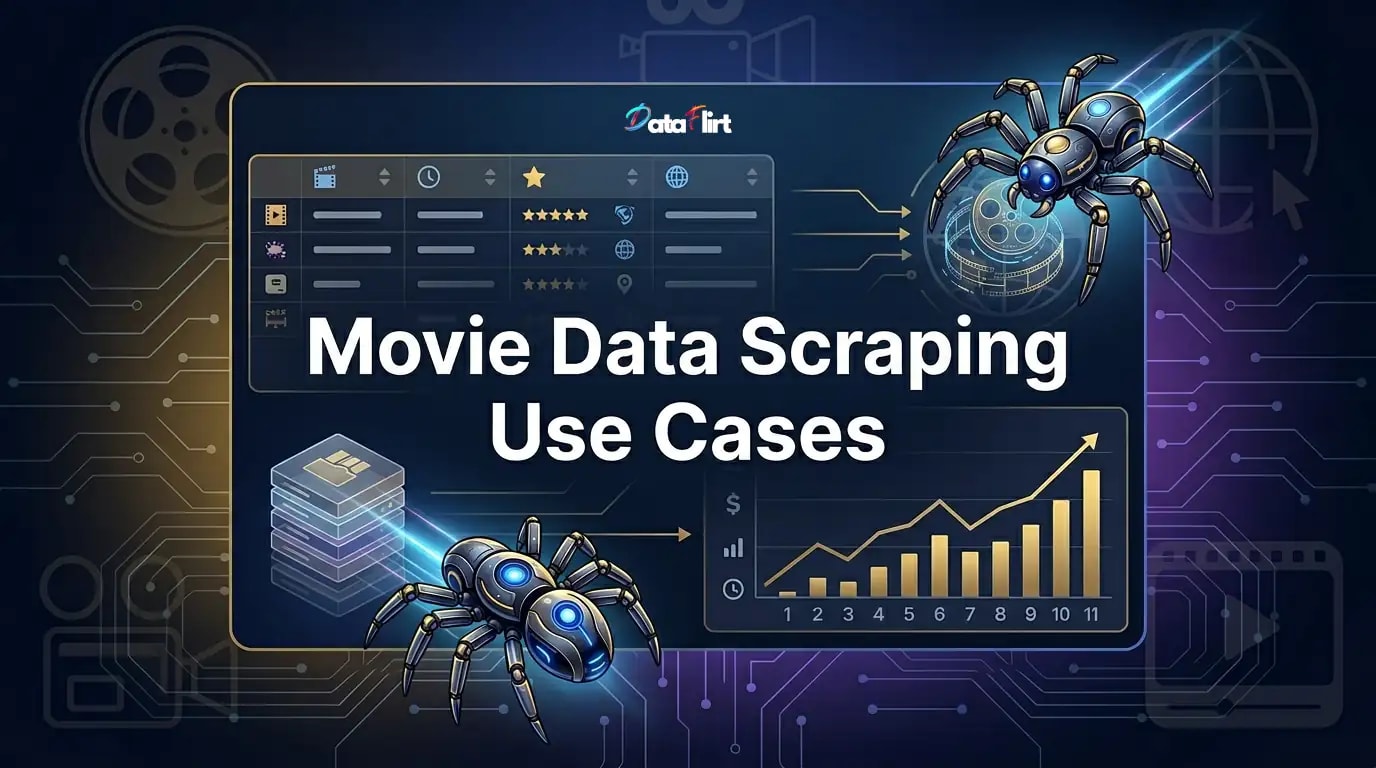

The Streaming Era’s Biggest Blind Spot: Why Movie Data Scraping Is Now a Competitive Necessity
The global filmed entertainment market reached approximately $105 billion in total revenue in 2025, spanning theatrical box office, streaming subscriptions, transactional video-on-demand, licensing, and ancillary rights. The streaming segment alone surpassed $150 billion in global subscription revenue when combined with advertising-supported tiers, with compound annual growth rates in key markets still running at double digits. Yet despite the sheer scale of data being generated every day across theatrical releases, digital catalogs, and audience engagement surfaces, most entertainment businesses, from mid-size streaming platforms to regional distributors, are making their most consequential decisions on surprisingly thin data.
Licensed data vendors in entertainment cover the large-cap surface. Major theatrical releases from the top studios get box office tracking coverage. Flagship titles on dominant platforms get audience demand estimates from a handful of specialized vendors. Award season contenders get detailed sentiment coverage from entertainment press monitoring services. But the moment your business decision touches the middle of the market, regional titles, catalog depth beyond the top 200 titles, independent film performance, or cross-territory content demand dynamics, the commercial data supply chain fails you almost entirely.
This is the intelligence gap that movie data scraping directly addresses.
The publicly available film intelligence sitting on the open web is genuinely staggering in its scope. Box office reporting portals publish weekend and cumulative grosses by territory. Audience review aggregators host tens of millions of user ratings updated in near-real-time. Streaming platform pages surface catalog metadata, regional availability windows, and content freshness signals that reveal acquisition and licensing strategy. Film festival databases catalog submission histories, award nominations, and critical reception patterns for thousands of titles that never appear in a commercial data feed. Ticketing portals publish pre-sale velocity, showtime density, and geographic audience distribution data that predicts opening weekend performance before any analyst report is published.
Movie data scraping is the systematic, programmatic collection of this intelligence at scale. When executed with proper data quality controls and delivered in structured formats that integrate cleanly into existing analytical workflows, it becomes a foundational capability for any organization that competes on entertainment market intelligence.
“The film industry generates more publicly accessible performance data than almost any other sector. Every review, every ticketing pre-sale, every streaming page update is a signal. The organizations that will dominate the next decade of entertainment intelligence are those that can collect, structure, and activate those signals faster than everyone else.”
The streaming wars have further intensified the need. With global streaming platforms investing upwards of $200 billion in original content production annually across the industry, the cost of a bad content acquisition or a mistimed theatrical release has never been higher. Film data extraction from the full ecosystem of public entertainment portals is not a convenience; it is a risk management tool for a capital-intensive business operating in a brutally competitive market.
This guide is written for business, content strategy, investment, distribution, and data teams inside streaming platforms, studios, film distributors, media investment firms, and entertainment analytics companies. It will not walk you through building a scraper. It will walk you through understanding what movie data scraping actually delivers, how different roles inside your organization can extract value from the same underlying dataset, how to think about data quality and freshness for your specific use case, and how to make an informed choice between a one-time data acquisition exercise and a continuous film data extraction program.
For context on how large-scale data programs are structured across industries, see DataFlirt’s perspective on data for business intelligence and the fundamentals of alternative data for enterprise growth.
The Scale of What the Open Web Actually Knows About Film
Before discussing who benefits from movie data scraping, it is worth being explicit about the sheer depth of film intelligence that publicly accessible portals surface. Most business teams dramatically underestimate this.
Theatrical performance data: Weekend grosses, cumulative box office figures, theater count trajectories, per-theater averages, geographic market splits, and week-over-week hold percentages are published by theatrical data portals with sufficient granularity to build sophisticated performance models without purchasing expensive data vendor subscriptions.
Audience review and rating data: Tens of millions of audience ratings and written reviews for titles spanning decades of film history sit on publicly accessible aggregator portals, updated continuously as new viewers engage with content on streaming or theatrical platforms. This data, when processed at scale, produces sentiment models and audience reception indicators far richer than any licensed summary report.
Streaming catalog metadata: OTT platform pages surface title availability by territory, content freshness indicators (recently added versus catalog depth), genre tagging, content ratings, and in some markets, viewership signals surfaced through editorial positioning and “trending” signals. Film data extraction from streaming portals reveals library acquisition strategy in ways that are simply not available through any other channel.
Festival and awards data: Submission histories, nomination records, jury citations, audience award outcomes, and critic reaction patterns from hundreds of international film festivals are publicly documented across festival websites, press portals, and film databases. This data is invaluable for acquisition teams evaluating arthouse and independent content.
Cast and crew metadata: Comprehensive filmography records, career trajectory data, co-production histories, and talent market activity patterns are surfaced through film database portals in a depth that enables genuinely sophisticated talent market intelligence.
Ticketing and pre-sale data: Pre-sale velocity, showtime scheduling density, multiplex allocation decisions, and geographic audience concentration patterns are surfaced by major ticketing portals and exhibitor sites in forms that are excellent leading indicators of theatrical opening performance.
Distributor and release calendar data: Planned release windows, territorial distribution assignments, release date changes, platform premiere announcements, and day-and-date versus exclusive theatrical decisions are tracked by trade press portals and distributor announcement pages in near-real-time.
The breadth of this publicly available film intelligence is what makes movie data scraping such a strategically valuable capability, and it is why the organizations that build systematic collection programs around it consistently outperform those relying solely on licensed data products.
See DataFlirt’s overview of web scraping use cases across industries for broader context on publicly available data as a strategic asset.
The Personas Who Benefit Most from Film Data Extraction
The same underlying movie database scraping infrastructure serves radically different business functions depending on the role of the person consuming the output. Understanding this role-based consumption model is essential for designing a data acquisition program that delivers value across an organization rather than serving a single team’s workflow.
The Content Strategist at a Streaming Platform
Content strategists at subscription streaming services, ad-supported video platforms, and emerging OTT operators face a constant, high-stakes question: what content should we acquire, commission, or license, and for which markets? Entertainment market intelligence derived from systematic film data extraction is the primary tool that separates data-informed content strategy from expensive intuition.
What they extract value from:
- Genre performance data: which categories are driving audience engagement signals on competing platforms, and which are showing saturation?
- Catalog gap analysis: what titles and genres do competing platforms carry that their own service lacks, and what does audience review velocity suggest about demand for those titles?
- International content performance: which non-English language titles are generating disproportionate engagement signals that predict crossover potential?
- Award and critical reception mapping: which festival circuit titles are generating the critical momentum that precedes acquisition price spikes, and where can a platform acquire early?
- Release window strategy: how are competitors structuring theatrical-to-streaming windows, and what does pre-sale data suggest about audience demand for specific titles in specific territories?
For a content strategist, movie data scraping converts what would otherwise be a months-long manual research project into a continuously refreshed intelligence feed that directly informs quarterly slate decisions.
The Investment Analyst at a Media Fund or Entertainment Finance Group
Film investment, content fund management, and entertainment M&A advisory are domains where data quality directly determines deal outcomes. Investment analysts in these roles use scraped box office data and entertainment market intelligence to build financial models, assess content acquisition targets, evaluate distribution company performance, and underwrite completion bond risk.
What they extract value from:
- Historical box office performance by director, cast configuration, genre, and budget tier: these datasets, when assembled through systematic movie database scraping, support comparables analysis at a granularity that no published industry report approaches.
- Pre-sale velocity as a predictive input: ticketing portal data in the weeks before wide theatrical release is one of the strongest leading indicators of opening weekend performance, and investment analysts who access it early gain a material information advantage in decisions about P&A spend allocation and theatrical window duration.
- Catalog value assessment: when evaluating an acquisition of a film library or a distribution company’s title portfolio, comprehensive film data extraction covering performance histories, rights window structures, genre distribution, and talent association maps builds a much more defensible valuation model than reliance on self-reported data from the seller.
- Streaming platform content investment signals: the rate at which specific platform pages are updated with new original titles, the genres being added, and the talent associated with new commissions are all visible through movie data scraping of platform catalog pages, and they are predictive of where the competitive content acquisition market is heading.
For context on how data quality considerations apply to investment-grade analytical use cases, see DataFlirt’s overview on assessing data quality for scraped datasets.
The Distribution Executive
Distribution executives at studios, independent distribution companies, and international rights holders make territorial release decisions, negotiate exhibitor allocations, and structure licensing deals based on their assessment of audience demand by market. Movie data scraping gives them a data infrastructure for making those decisions that goes substantially beyond what their internal reporting systems or licensed data subscriptions provide.
What they extract value from:
- Territory-by-territory box office performance patterns: which genres overperform or underperform relative to global averages in specific regional markets, based on historical theatrical data extracted from local box office portals?
- Exhibitor screen allocation intelligence: how many screens are competing titles occupying in specific multiplex circuits, and how does that change week-over-week as a function of hold percentage?
- Regional streaming platform catalog depth: which titles in their library are already available on competing platforms in specific territories, and where do exclusivity windows remain open?
- Festival circuit momentum: which titles in their acquisition pipeline are generating the critical reception momentum that justifies accelerated international rollout investment?
- Release calendar conflict analysis: what is the competitive theatrical landscape for the four-week window surrounding their planned release dates in priority markets?
The Data and Analytics Lead at a Streaming Platform or Entertainment Analytics Company
Data leads at streaming services, film analytics platforms, and entertainment data companies are the architects of the models that content, distribution, and business teams depend on. Recommendation engines, audience demand forecasting systems, content valuation models, and churn prediction algorithms all require continuous, high-quality inputs that licensed data vendors cannot supply at the required breadth and cost structure.
What they extract value from:
- Recommendation engine training data: comprehensive title metadata including genre tags, thematic descriptors, cast and crew associations, critical reception scores, and audience rating distributions are the feature inputs that distinguish a mediocre recommendation engine from a competitive one. Movie database scraping from multiple source portals is the primary method for assembling this training dataset at sufficient depth.
- Audience demand proxy signals: review velocity on aggregator platforms, ratings distribution evolution over time, and discussion volume on entertainment community portals are all scrape-derivable demand signals that proxy for viewership in the absence of direct platform data sharing.
- Content freshness modeling: tracking how rapidly newly added titles accumulate ratings and reviews versus the decay rate of engagement with older catalog content enables data teams to model content lifecycle curves that inform acquisition and decommissioning decisions.
- Cross-platform availability modeling: systematic film data extraction from multiple streaming platform catalog pages enables data teams to build comprehensive cross-platform availability maps that power exclusivity scoring and competitive positioning models.
The Growth and Marketing Team at a Film or Entertainment Company
Growth and marketing teams at studios, streaming platforms, theatrical distributors, and entertainment technology companies use entertainment market intelligence from movie data scraping in ways that are often invisible to the rest of the organization but directly affect revenue outcomes.
What they extract value from:
- Audience segment intelligence: sentiment analysis of audience review text at scale identifies specific audience sub-segments responding to specific aspects of a title, enabling precision targeting in performance marketing campaigns.
- Influencer and critic network mapping: film data extraction from review portals and entertainment community platforms surfaces the reviewer and creator accounts that demonstrably drive engagement uplift for titles in specific genres, enabling data-driven influencer selection.
- Release timing optimization: historical box office performance data by release week, genre, and competitive context, assembled through systematic movie data scraping, supports data-driven release calendar decisions that reduce competitive exposure.
- Regional market prioritization: box office performance patterns by territory and genre, extracted from international theatrical portals, inform decisions about where to allocate P&A spend and marketing resource in international rollouts.
What Movie Data Scraping Actually Delivers: A Taxonomy of Film Intelligence
Movie data scraping is not a monolithic activity. The specific data types extractable from entertainment portals span an enormous range, each with distinct utility for different business functions. Understanding this taxonomy is the foundation for specifying a data acquisition program that serves your actual needs rather than a generic list of “film data.”
Title Metadata and Catalog Records
This is the structural foundation of any movie database scraping program: title names, release years, runtime, country of origin, language, genre classifications, content ratings by territory, production company affiliations, studio or distributor associations, synopsis text, taglines, and poster or promotional image availability signals.
The richness of title metadata varies significantly by source portal. Comprehensive film database portals surface structured technical metadata including aspect ratio, color format, and sound mix alongside editorial metadata like thematic keywords, mood tags, and audience demographic targeting signals. Streaming platform catalog pages add availability-specific metadata: regional geo-blocking status, audio and subtitle track availability by language, and series or franchise association tags.
For data teams building recommendation engines, this layer of metadata is the feature engineering foundation. For content strategists, it is the competitive catalog map. For distribution executives, it is the rights availability intelligence layer.
Box Office and Theatrical Performance Data
Weekend grosses, cumulative domestic and international figures, opening day performance, per-theater averages, theater count trajectories, week-over-week hold percentages, and territory-level performance splits are all published on theatrical data portals and box office reporting sites with a frequency and granularity that makes systematic film data extraction genuinely viable.
The most analytically valuable elements of scraped box office data are the trend signals rather than the point-in-time figures. How rapidly does a title’s theater count expand or contract week two versus week one? What is the correlation between opening weekend per-theater average and ultimate domestic gross for titles in a specific genre and budget tier? How do international markets sequence in box office contribution relative to domestic performance for different content types?
These trend-based analytical frameworks are only possible when box office data is collected systematically over time through persistent movie data scraping, rather than accessed episodically through one-off vendor reports.
Audience Review and Rating Data
Tens of millions of audience ratings and written reviews across multiple aggregator portals constitute one of the richest publicly available datasets in the entertainment sector. The analytical value embedded in this data goes far beyond the headline rating score.
What scraped audience review data surfaces:
- Rating distribution shape: a title with a 7.2 average from a bimodal distribution of 9s and 5s is a fundamentally different product than one with a 7.2 from a tight normal distribution centered at 7
- Sentiment velocity: how rapidly ratings accumulate in the first 72 hours post-release is a strong predictor of word-of-mouth momentum
- Sentiment segmentation: text analysis of written reviews at scale identifies which specific elements (pacing, performances, visual style, narrative coherence) are driving positive versus negative sentiment for specific titles or genres
- Platform-specific audience reception: the same title often receives systematically different rating profiles on different portals due to user base composition, enabling audience segmentation insights unavailable from any single platform’s data
For streaming platforms, the combination of entertainment market intelligence from audience review data with internal viewership data creates audience reception models that are substantially richer than either source provides independently.
Streaming Catalog and VOD Availability Data
OTT platform catalog pages are among the most strategically information-dense targets for movie data scraping. What appears to be a simple listing of available titles is, when collected systematically across multiple platforms and territories, a detailed map of content acquisition strategy, licensing window structure, territorial rights deployment, and competitive positioning.
What streaming catalog scraping surfaces:
- Title addition velocity by genre and territory: how many new titles of each type is each platform adding per month, in which markets?
- Catalog freshness distribution: what proportion of each platform’s catalog was added in the last 90 days versus the last year versus more than two years ago?
- Originals versus licensed content balance: how is the ratio shifting over time on competing platforms, and what does that signal about content strategy priorities?
- Simultaneous availability mapping: which titles appear on multiple platforms simultaneously, and which are platform-exclusive by territory?
- Pricing tier and availability correlation: on platforms with multiple subscription tiers, which content types appear in premium versus standard tiers?
This data type is particularly valuable for content strategy teams at streaming platforms evaluating competitive positioning and for investment analysts assessing platform content investment trajectories.
See DataFlirt’s context on OTT web scraping for additional background on streaming platform data extraction.
Cast, Crew, and Talent Market Intelligence
Comprehensive filmography data for directors, producers, writers, and actors; career trajectory indicators; co-production histories; talent agency affiliation signals; and recent project announcement data are all surfaced through film database portals in forms that enable sophisticated talent market intelligence.
Use cases for scraped talent data:
- Acquisition targeting: identifying which emerging directors have strong critical reception patterns but limited commercial platform association, indicating potential acquisition leverage
- Slate compatibility assessment: mapping the content type histories of talent attached to titles under evaluation to assess alignment with platform content strategy
- International co-production intelligence: tracking which talent configurations are associated with titles generating strong cross-territory performance, informing co-production development strategy
- Talent market pricing signals: the rate at which specific talent names are appearing in newly announced projects is a proxy for market demand that informs negotiation positioning
Awards and Festival Circuit Data
Film festival submission histories, competition selection records, jury award outcomes, audience awards, special mentions, and critical reception patterns from the global festival circuit constitute a structured dataset of film quality and cultural resonance signals that is deeply underutilized by most entertainment businesses.
Why this matters for business teams:
Festival circuit momentum is one of the strongest leading indicators of content acquisition price trajectory. A title that wins audience awards at two or three major festivals in sequence will see its acquisition price increase substantially before it is widely recognized by platform acquisition teams operating without systematic festival data tracking. Movie database scraping across festival portal sites creates an early warning system for acquisition opportunity windows that close quickly.
For distribution executives, festival data maps the critical reception quality of titles in their pipeline at a point in the commercial cycle where positioning decisions are still open. For investment analysts, it provides an independent quality signal that is not subject to the promotional incentives that color studio-supplied materials.
Ticketing and Pre-Sale Performance Data
Pre-sale ticket volume, showtime density across multiplex circuits, geographic concentration of advance bookings, and session scheduling patterns are surfaced by major ticketing platforms and exhibitor sites in forms that, when collected through systematic film data extraction, produce the most reliable leading indicators of theatrical opening weekend performance available anywhere.
The intelligence premium here is time: pre-sale data from ticketing portals begins accumulating two to four weeks before a wide release, giving organizations with systematic movie data scraping programs a meaningful analytical advantage over those waiting for opening weekend actuals.
Role-Based Data Utility: How Each Team Actually Activates Scraped Film Intelligence
Knowing what data exists is different from knowing what to do with it. This section goes deep on how specific roles inside entertainment, media, and adjacent organizations convert raw scraped movie data into decisions and outcomes.
Content Acquisition and Strategy Teams: Turning Film Data Extraction into Slate Intelligence
Content acquisition teams at streaming platforms and studios operate under relentless pressure to make high-confidence content decisions in compressed timeframes with incomplete information. Movie data scraping changes that information environment fundamentally.
Competitive catalog gap analysis in practice:
A content strategy team uses film data extraction across multiple streaming platform catalog pages to build a comprehensive matrix of title availability by genre, release year, territory, and audience rating tier. This matrix immediately surfaces whitespace: genres or title segments with demonstrated audience demand (as evidenced by high rating density on aggregator portals) that are underrepresented in a platform’s own catalog relative to competitors.
The combination of entertainment market intelligence from catalog scraping and audience review data from aggregator portals produces an acquisition priority ranking that is data-driven rather than editorial intuition-driven.
International content opportunity mapping:
Cross-territory film data extraction from regional theatrical portals, local review aggregators, and territory-specific streaming platforms surfaces the non-English language titles that are generating disproportionate engagement relative to their production budgets. These titles represent acquisition opportunities before English-language platform attention drives prices up.
Recommended data delivery format for content strategy teams:
- Weekly catalog comparison dashboard feed in JSON or CSV
- Monthly genre performance trend report with configurable territory filters
- Real-time alert feed for festival award outcomes and acquisition buzz signals
- Quarterly competitive catalog depth analysis with field-level completeness documentation
DataFlirt Insight: Content strategy teams that integrate systematic movie data scraping into their acquisition workflow consistently report a 30-40% reduction in the research time required to evaluate a title and a demonstrably more defensible acquisition rationale when presenting to senior leadership.
Investment and Finance Teams: Box Office Data as Underwriting Infrastructure
Film investment analysis and entertainment M&A advisory represent the highest-stakes consumption context for movie data scraping outputs. The decisions powered by this data involve capital deployment at scales where data quality gaps translate directly into financial losses.
Comparables modeling with scraped theatrical data:
The foundation of any film financial model is a robust set of comparable title performances. Assembling comps through manual research or quarterly vendor reports produces a comparables set that is limited in depth, potentially stale, and difficult to update as market conditions evolve. A systematic movie database scraping program covering major theatrical reporting portals produces a continuously refreshed comps database that an analyst can query against any combination of genre, budget tier, cast configuration, director history, and release season to produce a statistically grounded performance range.
Pre-sale intelligence as a risk management tool:
Investment analysts covering theatrical film finance increasingly treat scraped ticketing pre-sale data as a real-time risk indicator. A title with strong pre-sale velocity in the two weeks before wide release has materially lower P&A recovery risk than a comparable title with weak pre-sale. This signal, accessible through systematic film data extraction from ticketing portals, is not captured in any commercial data product at the granularity required for financial decision-making.
Library valuation through catalog scraping:
When evaluating a film library acquisition, an investment team needs a comprehensive, independently verified picture of the library’s content quality, audience reception history, territorial rights coverage, and streaming platform availability signals. Movie database scraping across aggregator portals, regional theatrical databases, and streaming catalog pages produces this independent verification layer in a fraction of the time and cost of manual due diligence.
Recommended data delivery format for investment and finance teams:
- Structured CSV or Excel exports with full data provenance documentation for audit trail purposes
- Historical time-series datasets with explicit timestamp documentation for valuation date reference
- Direct database loads to existing financial modeling environments where technical infrastructure allows
- Completeness certification reports documenting field coverage rates for all critical fields
Distribution Teams: Entertainment Market Intelligence for Territory Strategy
Distribution executives making decisions about theatrical rollout sequence, platform premiere timing, and territorial licensing prioritization need a grade of market intelligence that is genuinely current, territory-specific, and competitive-context-aware.
Release window optimization:
Film data extraction from competitive theatrical release calendars, exhibitor scheduling data, and historical box office performance by release week and competitive context enables distribution teams to make data-driven release date decisions. The analysis required is multi-layered: what is the historical box office performance of comparable titles in this specific release window? What competitive titles are already scheduled for that period? What is the screen allocation trajectory of competing titles currently in wide release?
None of this analysis is possible without systematic movie data scraping across theatrical portals, exhibitor sites, and trade press databases.
Territorial sequencing intelligence:
Different territories respond to different content types with different intensity. A film that overperforms its budget in South Korea may underperform in France for reasons that are entirely explicable from historical theatrical performance data by genre and territory. Entertainment market intelligence assembled through film data extraction from regional box office portals allows distribution teams to build territory performance models that are genuinely evidence-based rather than reliant on gut-feel regional knowledge.
Platform window strategy:
The decision about when to move a title from theatrical to premium VOD to subscription streaming has become one of the most consequential choices in modern film distribution. Movie database scraping of streaming platform pages, combined with historical post-theatrical performance data from aggregator portals, produces the data infrastructure needed to model optimal window timing for specific content types in specific markets.
For context on data delivery formats that support operational decision-making, see DataFlirt’s overview of data delivery infrastructure.
Data and Analytics Teams: Movie Database Scraping as Model Infrastructure
For data leads at streaming platforms, entertainment analytics companies, and media investment firms, the quality of their models is a direct function of the quality of their training data. Movie data scraping is not a supplementary input; it is core infrastructure.
Recommendation engine feature engineering:
A recommendation model trained on title metadata limited to genre, release year, and runtime produces qualitatively worse recommendations than one trained on the full feature set available through comprehensive film data extraction: thematic keyword tags, mood descriptors, pacing indicators surfaced from review text analysis, audience demographic response patterns, cultural reference density, and franchise or cinematic universe association.
The delta between these two training datasets is the delta between an adequate recommendation engine and a competitive one, and that delta is achievable only through systematic movie database scraping across multiple metadata-rich source portals.
Audience demand forecasting:
Data teams building content demand forecasting models need proxy signals for viewership that do not require access to private platform data. The most reliable publicly available proxies are:
i. Review velocity on aggregator portals in the first 7-14 days post-release on a streaming platform ii. Rating score trajectory over the first 30 days of platform availability iii. Search volume signals from search data portals correlated with platform availability events iv. Social engagement proxy signals from entertainment community portals
Systematic film data extraction from these sources, processed into time-series datasets, produces demand proxy models that correlate with actual viewership data at levels that make them analytically useful for acquisition decisions even in the absence of direct viewership reporting.
Data quality requirements for analytics team use cases:
| Use Case | Critical Field Completeness | Deduplication Standard | Refresh Cadence |
|---|---|---|---|
| Recommendation model training | 97%+ | Title-level, 98%+ | Monthly |
| Demand forecasting inputs | 93%+ | Title-platform-territory level | Weekly |
| Competitive catalog modeling | 90%+ | Platform-title level | Weekly |
| Box office performance modeling | 95%+ | Title-territory-week level | Weekly |
| Sentiment model training | 85%+ | Review-level | Monthly |
| Award and festival modeling | 92%+ | Title-festival level | Event-driven |
For a detailed treatment of data quality architecture for scraped datasets, see DataFlirt’s overview on data quality in web scraping programs.
Growth and Marketing Teams: Scraped Movie Data as Campaign Intelligence
Audience segment discovery through review text analysis:
A growth team running performance marketing for a theatrical release can use sentiment analysis of audience review text, assembled through movie data scraping, to identify the specific emotional and thematic elements driving positive response among early viewers. This analysis surfaces targeting attributes for performance campaigns that are grounded in actual audience language rather than demographic assumptions.
Influencer and creator network identification:
Film data extraction from entertainment community portals surfaces the specific reviewer accounts, content creator profiles, and critical voices whose ratings and review activity demonstrably correlates with downstream audience engagement for titles in specific genres. This data enables genuinely data-driven influencer selection rather than follower-count-based intuition.
Release timing and campaign window optimization:
Historical entertainment market intelligence from scraped box office data by release week, genre, and competitive context produces the empirical foundation for release timing decisions. A growth team with access to this dataset can model the expected competitive media noise level for any candidate release week and optimize campaign launch timing accordingly.
One-Off vs Periodic Movie Data Scraping: Two Fundamentally Different Strategic Modes
The choice between a one-time film data extraction exercise and an ongoing, periodic movie data scraping program is one of the most consequential architectural decisions in designing an entertainment data acquisition program. These are not variations on the same product; they are fundamentally different strategic tools.
When One-Off Film Data Extraction Is the Right Choice
One-off movie data scraping delivers maximum value when your business question has a defined answer at a specific point in time and the data required to answer it does not need continuous updating.
Catalog acquisition due diligence:
When evaluating the acquisition of a film library, a production company, or a distributor’s title portfolio, you need a comprehensive, independently verified picture of the catalog’s composition and performance history as of the transaction date. This is a classic one-off use case: deep, accurate, fully documented, and time-stamped. The dataset needs to be correct as of valuation date, not continuously refreshed.
Competitive library audit:
A streaming platform evaluating its content positioning against three competing services needs a comprehensive snapshot of each competitor’s catalog: title count by genre and release year, average audience reception scores by content category, catalog freshness distribution, and originals versus licensed content balance. This analysis, powered by a point-in-time movie database scraping exercise, informs a strategic decision that will not require refreshment for six to twelve months.
Market entry research:
A streaming platform expanding into a new regional market needs to understand the competitive landscape of content available in that market before making catalog investment decisions. A comprehensive one-time film data extraction covering local streaming platform catalogs, theatrical performance history, and audience preference patterns in the target region provides the decision-support data for a go/no-go or territory investment sizing decision.
Festival circuit acquisition mapping:
At the start of festival season, an acquisition team may commission a one-off scrape of festival submission databases, prior year award winner performance histories, and current critical reception patterns to build an acquisition target priority list for the season. This is a defined research mandate with a clear analytical output, not an ongoing data need.
One-off data requirements summary:
| Dimension | Requirement |
|---|---|
| Coverage | Maximum breadth across all relevant portals and title types |
| Depth | Maximum field completeness per title record |
| Accuracy | Cross-verified against secondary source portals where feasible |
| Documentation | Full data provenance: source URL, scrape timestamp, schema mapping |
| Delivery | Structured flat files or direct database load within defined SLA |
| Provenance | Explicit valuation date timestamp for use in financial or legal contexts |
When Periodic Movie Data Scraping Is Non-Negotiable
Periodic film data extraction is the right architectural choice whenever your business decision depends on how the entertainment market is moving rather than where it stood at a single point in time.
Box office trend monitoring:
A film investment firm that tracks box office performance across theatrical markets to identify acquisition opportunities and P&A spend signals cannot operate on quarterly snapshots. Markets move weekly. A title’s hold percentage trajectory in weeks two through five is more predictive of ultimate domestic gross than its opening weekend. Daily or weekly refreshed scraped theatrical performance data is the operational infrastructure for making investment decisions based on live market signals rather than historical summaries.
Streaming catalog competitive intelligence:
A streaming platform that needs to maintain current awareness of how competitors are evolving their catalog, by genre, territory, and content type, needs a weekly refreshed dataset of competitor catalog pages. Monthly or quarterly snapshots miss the acquisition velocity signals that indicate competitive strategic pivots.
Audience sentiment monitoring:
A studio’s marketing team managing post-release word-of-mouth for a theatrical title needs real-time awareness of how audience sentiment is evolving on review platforms. A title that starts with positive early audience ratings but begins accumulating negative reviews at volume in week two needs a different marketing response than one that holds steady. Daily scraped review data from aggregator portals is the monitoring infrastructure for this decision.
Recommendation model refreshment:
Machine learning models degrade when input data distributions drift from training distributions. A recommendation engine trained on a movie metadata dataset that is twelve months stale will systematically underperform on recently released titles and emerging genre trends. A monthly refreshed scraped metadata dataset is the minimum cadence for maintaining recommendation model performance in a market where content catalogs evolve rapidly.
Recommended cadence by use case:
| Use Case | Recommended Cadence | Rationale |
|---|---|---|
| Box office performance tracking | Daily to weekly | Market moves weekly |
| Audience review sentiment monitoring | Daily | Sentiment velocity matters |
| Streaming catalog competitive mapping | Weekly | Acquisition velocity signals |
| Festival circuit award monitoring | Event-driven | Outcomes are episodic |
| Recommendation model data refreshment | Monthly | Model drift is gradual |
| Catalog acquisition due diligence | One-off | Point-in-time decision |
| Market entry competitive analysis | One-off | Strategic, not operational |
| Talent market intelligence | Monthly | Career trajectories evolve slowly |
| Ticketing pre-sale monitoring | Daily (release windows) | Predictive value is time-sensitive |
| Distribution territory intelligence | Weekly | Release calendar changes frequently |
Industry-Specific Applications: Where Entertainment Market Intelligence Drives the Most Value
Subscription Streaming Platforms
Streaming platforms represent the highest-volume consumers of movie data scraping outputs across the entertainment sector. Their need for continuous, multi-dimensional film intelligence spans content acquisition, recommendation system performance, competitive positioning, and subscriber retention strategy.
The specific application that is most underinvested relative to its value: catalog decay monitoring. Every title in a streaming catalog has an engagement lifecycle. Systematic film data extraction from aggregator portals tracks the rate at which a title’s review velocity declines after initial platform availability, producing catalog decay curves that are strong predictors of when a title stops contributing meaningfully to subscriber retention and should be decommissioned or replaced.
Platforms that track catalog decay systematically through movie database scraping make significantly better catalog renewal investment decisions than those relying on internal viewership data alone, because the external engagement signals often lead internal viewership decline by four to eight weeks.
Additional streaming-specific applications:
- Original content performance benchmarking against comparable licensed titles on competing platforms
- Regional catalog localization gap identification: which markets have insufficient local language content relative to competitor libraries?
- Audience demand signal modeling for greenlight decisions on original content commissions
- Content freshness scoring for editorial merchandising optimization
Theatrical Distributors and Studio Releasing Arms
For theatrical distributors, movie data scraping is most valuable as a release window optimization and competitive scheduling intelligence tool. The decisions being supported are high-frequency and high-stakes: which weekend to release a title, how aggressively to push theater count in week two, when to accelerate the move to premium VOD, and how to sequence international territorial rollouts.
All of these decisions are better when grounded in systematic entertainment market intelligence from scraped theatrical portals rather than the combination of distributor experience and licensing vendor quarterly reports that most organizations currently rely on.
The P&A spend optimization use case:
Film data extraction from historical box office data, segmented by genre, budget tier, release season, and competitive context, enables distributors to build empirical P&A ROI models that are substantially more accurate than industry rules of thumb. A title that is demonstrably similar in audience profile to a historical comp set that averaged a 2.8x theatrical gross to P&A ratio warrants a different marketing investment decision than one whose comps averaged 1.4x.
Film Financing and Private Credit
Film completion bond companies, private credit funds providing production financing, and bridge lenders covering P&A costs all use movie data scraping for underwriting intelligence that is not available through traditional financial due diligence channels.
The completion risk assessment use case:
A completion bond underwriter evaluating a production needs an independent assessment of the project’s commercial viability that is not solely dependent on the producer’s projections. Film data extraction covering the comparable performance history of similar titles, the track record of the director and key cast, and the acquisition price trajectory for similar content in recent festival markets provides an independent data layer for commercial viability assessment.
The P&A loan underwriting use case:
Bridge lenders providing P&A financing need confidence that the title they are financing will generate sufficient theatrical gross to service the loan. Scraped pre-sale ticketing data, combined with historical performance comps from movie database scraping, produces a data-grounded revenue range that is a stronger underwriting input than the distributor’s projection alone.
Entertainment Analytics and Data Companies
Companies building analytics products for studio executives, streaming platform teams, and film investors are themselves significant consumers of movie data scraping infrastructure. Their business model is, in essence, the systematic collection, processing, and delivery of entertainment market intelligence from public sources, combined with proprietary analytical frameworks.
The data quality and delivery architecture decisions for this use case are the most demanding in the sector. Entertainment analytics companies need:
- Multi-source, cross-validated title records with documented provenance
- Schema consistency across portals that use different metadata standards
- Historical depth spanning decades of theatrical and release history
- Territory-specific performance data with consistent currency normalization
- Continuous refresh cadences that keep analytical products current with live markets
For organizations in this category, the decision between building internal movie data scraping infrastructure and partnering with a managed film data extraction service is a core strategic and capital allocation question.
See DataFlirt’s comparison of outsourced versus in-house web scraping services for a structured framework for this decision.
Media and Entertainment Research Firms
Academic institutions, media research firms, and entertainment journalism organizations use film data extraction to build the primary datasets underpinning market reports, academic publications, and data journalism projects. Their requirements differ from operational users in two important ways: they need archival depth rather than operational freshness, and they need methodological documentation that supports peer review or editorial transparency standards.
Movie data scraping for research contexts must include explicit timestamp documentation for every scraped record, source URL provenance that enables reproducibility verification, and schema documentation that allows third parties to understand field definitions and collection methodology.
Top Film Data Portals to Scrape by Region
The following table provides a region-organized reference for the highest-value entertainment data portal targets for movie database scraping programs in 2026. This is not an exhaustive list; it is a prioritized reference for organizations designing systematic film data extraction programs.
| Region (Country) | Target Websites | Why Scrape? |
|---|---|---|
| USA | Major theatrical box office reporting portals; dominant film metadata aggregator platforms; primary audience review aggregators; theatrical ticketing portals | Deepest available box office data with per-theater averages, hold percentages, and territory splits; tens of millions of audience ratings updated in near-real-time; pre-sale velocity data that predicts opening weekend performance |
| USA | Studio and distributor press portals; entertainment trade press databases; release calendar aggregators | Real-time release date announcements, theatrical window decisions, platform premiere news, and competitive release calendar mapping |
| USA | Streaming platform catalog pages for all major SVOD and AVOD services | Catalog addition velocity by genre and territory; originals versus licensed content balance; pricing tier availability mapping; competitive catalog depth benchmarking |
| UK and Ireland | National box office reporting portals; UK-specific theatrical data aggregators; regional streaming catalog pages | UK-specific theatrical performance data with BBFC rating context; British Independent Film Award nomination and outcome records; regional streaming catalog coverage not captured in US-centric portals |
| France | CNC (Centre National du Cinema) public data portals; French theatrical box office reporting systems; French streaming platform pages | CNC production and distribution support data; French theatrical performance by distributor; mandatory CNC reporting data that is richer than most markets for arthouse and independent film |
| Germany, Austria, Switzerland | German-speaking theatrical portals; DACH streaming platform catalog pages; regional film fund announcement portals | DACH market theatrical performance data; German-language streaming catalog depth; co-production funding announcement data from regional film funds |
| South Korea | Korean Film Council (KOFIC) data portals; Korean theatrical box office reporting systems; Korean streaming platform pages | One of the world’s most transparent film market data environments; KOFIC publishes production budget, P&A spend, and theatrical performance data that is unmatched in depth by any other government film body; essential for K-content acquisition intelligence |
| Japan | Japanese theatrical box office portals; J-cinema database platforms; Japanese streaming catalog pages | Third-largest theatrical market globally; Japanese theatrical data requires Japanese-language parsing capability; anime and live-action performance data with demographic segmentation signals |
| India | Indian theatrical box office portals for Hindi, Tamil, Telugu, Malayalam, and other language industries; Indian OTT platform catalog pages; Indian film festival databases | The world’s largest theatrical market by ticket volume; Bollywood, Kollywood, Tollywood, and Mollywood data require industry-specific portal targeting; Indian OTT platform catalog expansion is among the fastest in the world |
| China | Licensed and partner data through appropriate frameworks; Chinese film review portals; Chinese box office reporting systems where accessible | Second-largest theatrical market globally; Chinese box office data for foreign films includes import quota allocation signals; Chinese audience review portals surface sentiment for titles with Chinese release versions |
| Australia and New Zealand | Australian box office reporting portals; Screen Australia data publications; ANZ streaming platform catalog pages | Strong theatrical data transparency; Screen Australia publishes production and distribution data that supplements portal scraping; ANZ-specific streaming catalog availability mapping |
| Brazil | Brazilian theatrical box office portals; ANCINE public data systems; Brazilian streaming platform pages | Largest theatrical market in Latin America; ANCINE regulatory data is publicly accessible and covers production budget and distribution spend; Brazilian streaming platform catalogs are among the most rapidly expanding in the region |
| Mexico and Spanish-Speaking LATAM | Pan-LATAM theatrical portals; regional film festival databases; Spanish-language streaming platform pages | Mexico is the second-largest Spanish-language theatrical market; Latin American content demand is growing rapidly on global streaming platforms, creating acquisition intelligence value for regional content |
| Scandinavia | Nordic theatrical box office portals; Scandinavian streaming platform catalog pages; Nordic film fund announcement portals | Nordic noir and Scandinavian content has demonstrated strong global crossover performance; Nordic film funds publish detailed production data; Scandinavian streaming platforms have catalog structures that reveal content investment priorities |
| International Festival Circuit | Cannes, Venice, Berlin, Sundance, Toronto, BFI, SXSW, and 200+ international festival databases | Festival selection, award, and audience reception records for thousands of titles annually; the most reliable early-stage quality and commercial momentum signals available for independent and arthouse content |
| Middle East and North Africa | Regional theatrical box office portals; MENA streaming platform catalog pages; Gulf-based film initiative announcement portals | Rapidly growing theatrical and streaming market; Saudi Arabia theatrical market opened in 2018 and is expanding at high velocity; MENA streaming platform investment is accelerating; Gulf region film initiative announcements signal production pipeline |
Data Quality Architecture for Scraped Movie Datasets
Raw scraped film data from entertainment portals is not a finished product. It is a collection of semi-structured records with inconsistent field populations, duplicate title representations across multiple source portals, metadata schema variations between platforms, and temporal attributes that require explicit management. A professional movie data scraping engagement includes mandatory quality processing layers between raw collection and data delivery.
Title-Level Deduplication
A film released in 2024 may have a record on a major aggregator database, a theatrical tracking portal, five regional box office reporting sites, twenty streaming platform catalog pages across different territories, and three festival databases, each with slightly different field populations, title spelling variations (especially for non-English titles with transliteration variations), and release date references (theatrical date versus streaming premiere date versus festival premiere date).
Without a deduplication layer that resolves all of these records to a single canonical title entry, your downstream dataset will overcount titles, corrupt performance aggregations, and produce joining errors when the dataset is linked to internal records.
What rigorous title deduplication requires:
- Canonical title identifier assignment using established industry identifier standards where available
- Transliteration normalization for non-Latin script titles
- Release year disambiguation for remakes and franchise sequels with similar titles
- Platform-specific release date disambiguation (theatrical versus streaming premiere)
- Field conflict resolution rules specifying which source wins when field values disagree
Industry benchmark: Title-level deduplication accuracy above 95% is the minimum threshold for analytically reliable movie database scraping output.
Metadata Normalization
Genre taxonomies differ across portals. One platform’s “Drama” category includes titles that another platform categorizes as “Thriller” or “Crime.” Runtime is expressed in minutes on some portals and hours-and-minutes format on others. Content rating systems vary by territory and by platform. Audience score scales differ: some portals use 1-10 ratings, others use 1-5, others use percentage approval scores.
Metadata normalization translates all of these source-specific formats into a canonical output schema. This is not optional; it is the prerequisite for any cross-portal analysis.
Field normalization requirements by data type:
- Genre: mapping to a canonical genre taxonomy with primary and secondary genre tags
- Runtime: standardization to minutes as integer
- Content ratings: mapping to both source rating system and equivalent canonical tier
- Currency: normalization to a base currency for all box office figures with documented exchange rate and date
- Date formats: ISO 8601 standardization across all temporal fields
- Country of origin: ISO 3166 country code normalization
Field Completeness Management
Not all fields in a scraped title record carry equal analytical weight, and not all source portals populate all fields with equal consistency. A data quality framework for movie data scraping requires explicit completeness rate monitoring and threshold definition.
Recommended completeness thresholds by use case:
| Use Case | Critical Field Completeness | Enrichment Field Completeness |
|---|---|---|
| Recommendation model training | 97%+ | 88%+ |
| Box office performance modeling | 95%+ | 75%+ |
| Catalog competitive analysis | 92%+ | 65%+ |
| Acquisition due diligence | 95%+ | 80%+ |
| Audience sentiment modeling | 88%+ | 55%+ |
| Distribution territory intelligence | 93%+ | 70%+ |
Schema Versioning and Delivery Reliability
Entertainment portals update their page structures with varying frequency. A movie database scraping program that is not actively maintained against portal schema changes will begin producing degraded data quality within weeks of a significant portal redesign, sometimes silently (fields returning null where they previously returned values) rather than through obvious collection failures.
Professional film data extraction programs require:
- Automated field-level completeness monitoring with alerting on completeness degradation
- Schema change detection that triggers human review before degraded data reaches delivery
- Versioned output schemas with documented changelog so downstream consumers can manage breaking changes
- SLA-backed delivery reliability commitments with defined remediation procedures for collection failures
Legal and Ethical Guardrails for Movie Data Scraping Programs
Every film data extraction program must operate within a clearly understood legal and ethical framework. The standards are actively evolving, and ambiguity is not acceptable when commercial interests are at stake.
Terms of Service Compliance
Major entertainment portals, including theatrical tracking sites, review aggregators, and streaming platform catalog pages, include Terms of Service provisions that restrict automated data collection to varying degrees. The enforceability of these provisions varies significantly by jurisdiction, the nature of the restriction, and the technical mechanism (contractual-only versus combined contractual and technical control).
General principle: Movie data scraping of publicly accessible, non-authenticated content carries substantially lower legal risk than accessing content behind authentication walls or explicit paid access controls. However, violating a platform’s ToS creates civil litigation exposure even when the data accessed is technically public, and that risk must be explicitly assessed before any collection program begins.
Personal Data and Privacy Regulations
When film data extraction includes personally identifiable information, specifically cast and crew contact data, talent agency information, or individual reviewer profiles, the collection, storage, and processing of that data falls within the scope of applicable privacy regulations.
In Europe, GDPR requires a documented lawful basis for processing personal data, and the legitimate interests basis requires a balancing test that weighs the controller’s commercial interests against individual rights. In the United States, a growing patchwork of state privacy laws applies similar requirements for California and other state residents’ personal data.
Any movie database scraping program that includes personal data in its scope requires a privacy impact assessment and a documented data retention and deletion policy before collection commences.
Ethical Crawl Practices
Beyond legal compliance, ethical movie data scraping practices matter both for their own sake and for the practical reason that aggressive collection behavior triggers anti-bot countermeasures that degrade data quality and collection reliability.
Ethical film data extraction practices include: rate limiting requests to avoid degrading site performance for legitimate users, respecting robots.txt directives for explicitly excluded portal sections, implementing reasonable crawl delays between requests, and avoiding any technical circumvention of authentication controls.
For a comprehensive treatment of the legal and ethical dimensions of web data collection, see DataFlirt’s analysis on data crawling ethics and best practices and the detailed overview on whether web crawling is legal.
Delivery Frameworks: Getting Scraped Film Data to the Teams Who Need It
The right delivery architecture for movie data scraping output is entirely a function of the downstream consumption workflow. Data that arrives in the wrong format for the consuming team’s existing tooling is data that will not be used, regardless of its technical quality.
For Data and Analytics Teams
Direct database load to PostgreSQL, BigQuery, Snowflake, or Redshift on a defined refresh schedule is the preferred delivery pattern for analytics teams building models against scraped movie data. Alternatively, Parquet files delivered to a partitioned S3 or GCS bucket structure enable efficient query performance for large historical datasets.
Critical delivery requirements for analytics teams:
- Schema documentation accompanying every delivery with field-level type definitions and null handling specifications
- Versioned schema with changelog for breaking changes
- Completeness rate report included with each delivery batch
- Timestamp fields for scrape date, source publication date, and last-updated date on each record
For Content Strategy Teams
Enriched flat files in CSV or Google Sheets-compatible format with geographic tagging, genre normalization applied, and audience score scales harmonized to a common range. Weekly or monthly delivery depending on the decision cadence of the team.
For strategy teams that have invested in BI tooling, a direct connector to a Tableau, Power BI, or Looker instance via a scheduled database refresh is the highest-value delivery pattern.
For Investment and Finance Teams
Structured CSV or Excel exports with full data provenance documentation, explicit valuation date timestamps, currency normalization documentation, and a completeness certification report. Historical time-series datasets with retention of prior delivery snapshots for trend analysis and valuation date reference.
For Distribution Teams
Territory-tagged datasets with ISO 3166 country code fields, release calendar data structured by planned and actual release dates, and platform availability flags by territory and platform type. Weekly refresh is the appropriate cadence for release calendar and catalog availability data; daily for theatrical performance monitoring during active release windows.
For Marketing and Growth Teams
Audience review text datasets with sentiment pre-processing applied, influencer and reviewer network mapping files with engagement correlation scores, and pre-sale velocity trend data formatted for direct import into campaign management platforms.
A Practical Decision Framework for Your Movie Data Scraping Program
Before commissioning any film data extraction program, work through the following decision framework. It takes two to three hours of structured internal discussion and prevents the most common and expensive mistakes in entertainment data acquisition.
Step 1: Define the specific business decision
Not “we need movie data” but “we need to identify which non-English language titles in the festival circuit have the strongest combination of critical reception and audience enthusiasm for consideration in our next content acquisition window.” The specificity of the decision drives every architectural choice downstream.
Step 2: Map data requirements to the decision
What specific fields, at what geographic granularity, from which source portals, does the defined decision actually require? This exercise frequently reveals that teams are requesting far more data than their decision needs, or that critical fields they need are not available from the obvious target portals and require supplementary source identification.
Step 3: Define the cadence requirement
Is this a one-off or periodic need? If periodic, what is the minimum refresh cadence that keeps data current enough to be analytically valid for the target decision? Overspecifying cadence adds cost and operational complexity without adding analytical value.
Step 4: Specify quality thresholds
What are the minimum acceptable completeness rates for critical fields in this use case? What deduplication standard is required for the analysis to be reliable? Defining these thresholds before collection begins prevents the expensive mid-project discovery that data quality delivered does not meet analytical requirements.
Step 5: Specify delivery format and integration requirements
How does this data need to arrive for the consuming team to use it without additional transformation? Specifying this up front prevents the common failure mode where a technically excellent dataset arrives in a format that requires weeks of internal processing before it becomes usable.
Step 6: Legal and ethical boundary assessment
Which portals are in scope? Do any require authentication for the target data? Does the data include personal information? What is the applicable jurisdictional legal framework? These questions require legal counsel review before technical work begins.
For organizations evaluating managed film data extraction services versus internal infrastructure development, see DataFlirt’s detailed comparison of outsourced versus in-house web scraping approaches and the considerations framework for key decisions when outsourcing a scraping project.
Audience Sentiment and Social Signals: The Underrated Layer of Movie Data Scraping
Most conversations about movie data scraping focus on structured data: box office numbers, catalog metadata, cast records, rating scores. The harder and more valuable analytical layer is unstructured sentiment data, the text of what audiences are actually saying about films across review portals, community platforms, and entertainment forums, and the social signal patterns that precede or follow commercial performance outcomes.
This is where entertainment market intelligence gets genuinely differentiated from anything a commercial data vendor delivers.
Review Text as a Structured Intelligence Source
At sufficient scale, audience review text is not unstructured data in any meaningful analytical sense. It is a rich, continuously updated corpus of audience perception data that, when processed through appropriate natural language processing pipelines, yields:
Sentiment polarity by narrative element: Which specific aspects of a film, its pacing, its performances, its visual language, its narrative resolution, are driving positive versus negative audience response? This question is answerable from review text analysis at scale and is not answerable from a headline rating score. A film with a 7.1 average score from audiences who uniformly praise the performances but criticize the third-act structure has a completely different re-watchability and franchise potential profile than a film with the same score from audiences who rate the narrative highly but find the performances flat.
Audience segmentation signals: Different audience segments respond differently to the same film, and those response differences are visible in the vocabulary, reference points, and thematic focus of their written reviews. A horror film that generates enthusiastic reviews from genre enthusiasts who cite technical craft elements and deeply ambivalent reviews from casual viewers citing narrative confusion is revealing a core genre audience that is monetizable as a cult catalog title and a broader audience that requires different marketing framing. Movie data scraping at sufficient depth makes this segmentation analysis possible in a way that quantitative rating data alone never can.
Cross-cultural reception mapping: A title generating strong positive sentiment in Korean-language reviews and neutral sentiment in English-language reviews on the same aggregator platform is demonstrating precisely the kind of regional reception differential that an international content strategy team needs to identify acquisition and marketing opportunities. Film data extraction from review portals with strong regional user bases surfaces these cross-cultural reception patterns at a granularity and speed that no licensing arrangement or market research firm can replicate.
Temporal sentiment evolution: How does the sentiment distribution for a title evolve from its festival debut through theatrical release, through streaming premiere, through catalog availability? A title that generates strong critical early sentiment but shows declining audience sentiment over time has a different catalog strategy implication than one whose audience sentiment improves progressively as it finds its natural audience on streaming. Systematic movie database scraping of review portals over extended time periods captures this sentiment evolution curve.
Community and Forum Intelligence as Demand Proxy
Entertainment community platforms, fan forums, and movie discussion communities are signal-rich environments that are almost entirely ignored by formal data programs. This is a significant missed opportunity for entertainment market intelligence teams.
Discussion volume velocity as a demand proxy: The rate at which discussion threads about a specific title accumulate in film community portals in the weeks before and immediately after a platform release is a strong proxy for organic audience awareness and interest. A title generating high discussion velocity without a large marketing spend is exhibiting organic audience demand; a title generating low discussion despite heavy promotional presence is exhibiting a demand-supply mismatch that is predictive of poor audience retention metrics.
Award season momentum tracking: The entertainment community discussion around award season contenders begins consolidating months before formal nomination announcements. Film data extraction from community platforms tracking discussion volume, sentiment, and category-specific speculation about specific titles produces an early-stage award season intelligence feed that is genuinely predictive of nomination outcomes, and therefore of the content acquisition price trajectory for nominated titles.
Franchise and sequel interest signals: Community platform discussions about potential sequels, franchise extensions, and cinematic universe developments are strong demand signals for future content development or acquisition decisions. Streaming platforms that systematically monitor these signals through movie data scraping have an information advantage over those discovering franchise demand only after a property’s acquisition price has already risen.
For context on how sentiment analysis drives business decisions across sectors, see DataFlirt’s overview of sentiment analysis for business growth and the detailed treatment of social media behavioral data.
Integrating Sentiment Data with Structured Film Metadata
The highest analytical value from movie data scraping emerges not from sentiment data or structured metadata in isolation but from their combination. A title with a 7.8 average score, a strong upward rating trajectory over 90 days post-streaming premiere, review text sentiment strongly positive on performance and narrative, and high community discussion velocity in genre-specific forums is a substantially more defensible catalog investment than a title with the same 7.8 score but flat rating trajectory and minimal community engagement.
This combination analysis, powered by systematic film data extraction from multiple source types, produces audience reception models that are the most reliable available indicator of a title’s long-term catalog value.
Recommended data architecture for integrated sentiment programs:
- Structured metadata: collected from film database portals and streaming catalog pages on weekly or monthly cadence
- Quantitative ratings: collected from aggregator portals on daily or weekly cadence during active release windows, monthly for catalog titles
- Review text corpus: collected on weekly cadence during active release periods, monthly for catalog monitoring
- Community discussion volume: collected on daily cadence for titles in active marketing or award season windows, weekly for catalog intelligence
Delivering this integrated dataset to analytics teams as a unified, schema-consistent feed, rather than as separate data streams that must be joined internally, is the architecture decision that determines whether the data actually gets used or gets stuck in a pipeline backlog.
The Competitive Intelligence Angle: What Scraped Movie Data Reveals About Platform Strategy
One of the most underutilized applications of movie data scraping is competitive intelligence at the platform strategy level. The structural patterns visible in a streaming platform’s catalog, when analyzed through the lens of systematic film data extraction, reveal strategic priorities and investment signals that no press release or earnings call ever articulates explicitly.
Content investment trajectory signals:
The rate at which a streaming platform adds original titles in specific genres, compared against its licensed content acquisition velocity in those same genres, reveals whether it is moving toward content ownership or content curation as its primary strategic mode. This signal, visible through systematic movie database scraping of platform catalog pages over rolling six-month windows, is a meaningful leading indicator of the platform’s competitive positioning evolution.
Territory expansion signals:
The sequence in which a streaming platform adds language-specific subtitle and dubbing tracks for titles in its catalog is a strong indicator of which regional markets it is actively prioritizing for subscriber growth. Film data extraction from platform catalog pages in multiple territories, tracking the addition of localization tracks over time, surfaces territory expansion priorities before they are reflected in public announcements.
Content quality threshold signals:
The average audience reception score distribution for titles added to a platform’s catalog over successive quarters reveals whether the platform is maintaining or relaxing its content quality standards. A platform whose newly added titles show declining average audience scores over four to six quarters is making an observable trade-off between content volume and content quality that has predictable subscriber retention implications.
For organizations building competitive intelligence products or conducting competitive analysis for strategic planning, this application of entertainment market intelligence through movie data scraping is among the highest-value and least-replicated in the sector.
See DataFlirt’s overview on datasets for competitive intelligence for a broader framework for competitive intelligence data programs.
DataFlirt’s Approach to Film Data Extraction Engagements
DataFlirt’s approach to movie data scraping engagements begins with the business outcome, not the technical architecture. The first question is always: what decision does this data need to power, who is making it, and how frequently does the data need to refresh for that decision to be well-grounded?
For a one-off catalog acquisition due diligence project, this means defining the precise title scope, field requirements, geographic coverage, and valuation date before a single collection request is made, then delivering a single, fully documented, schema-consistent dataset with complete data provenance records rather than a raw export that requires weeks of internal processing.
For a periodic film data extraction program serving a streaming platform’s content strategy team, it means designing a delivery architecture that integrates directly with the team’s existing BI or data warehouse environment, with a defined refresh schedule, schema versioning policy, completeness monitoring, and alerting on quality degradation between delivery cycles.
The technical infrastructure enabling DataFlirt’s movie data scraping programs, including residential proxy network access, JavaScript rendering capacity, session management, and distributed crawl orchestration, supports these business outcomes. But the infrastructure is the enabler, not the point. The point is clean, complete, timely film intelligence delivered in formats that reduce the distance between data collection and business decision to the minimum achievable.
Additional Reading from DataFlirt
The following DataFlirt resources provide deeper context on specific dimensions of entertainment and media data acquisition programs:
- Web Scraping for Movie Data: Collection and Visualization
- Web Scraping Movie Data: Sources and Use Cases
- Predicting Movie Success with Web Scraping
- OTT Platform Data Scraping: Use Cases and Approaches
- Sentiment Analysis for Business Growth
- Social Media Behavioral Data for Entertainment Intelligence
- Data Quality Assessment for Scraped Datasets
- Alternative Data for Enterprise Growth Strategy
- Web Scraping Best Practices for Enterprise Programs
- Managed Scraping Services for Data Teams
- Web Scraping for IMDb Data
- Scraping Customer Reviews for Sentiment Intelligence
Frequently Asked Questions
What is movie data scraping and how is it different from licensed entertainment data feeds?
Movie data scraping is the automated, programmatic collection of publicly available film metadata, box office performance figures, audience review data, streaming catalog information, casting and crew records, distributor signals, and award nomination histories from entertainment portals, aggregator platforms, ticketing systems, and VOD libraries at scale. It differs from licensed data feeds because it captures markets, data fields, and update velocities that structured commercial products simply do not cover, especially for regional, independent, and mid-market titles that fall below the reporting threshold of major data vendors.
How do different teams inside a streaming platform or studio actually use scraped movie data?
Content strategists use scraped film metadata to map competitive content libraries and identify genre gaps. Investment analysts use box office data extraction for revenue modeling and slate assessment. Distribution executives use entertainment market intelligence to time release windows and territory prioritization. Data teams use scraped movie datasets to train recommendation engines and audience demand forecasting models. Each role consumes identical raw data through a fundamentally different analytical lens.
When should an entertainment business use one-off movie data scraping versus a continuous data feed?
One-off movie data scraping is the right choice for catalog acquisition due diligence, competitive library audits, market entry research, and any use case where the business question has a defined answer at a specific point in time. Periodic film data extraction, running on daily, weekly, or monthly cadences, is essential for box office trend monitoring, streaming catalog competitive benchmarking, audience review sentiment tracking, and any use case where data freshness directly affects a business or editorial decision.
What does data quality mean specifically for scraped movie datasets?
Data quality in movie database scraping depends on title-level deduplication accuracy across multiple source portals, metadata field normalization across different platform schemas, field-level completeness rates for critical attributes, freshness timestamps, and disambiguation of titles with identical or similar names across release years and markets. A production-grade scraped movie dataset should have title-level deduplication accuracy above 95%, critical field completeness above 90%, and canonical identifiers enabling reliable cross-platform record joining.
What are the legal considerations around movie data scraping for commercial use?
Movie database scraping of publicly available, non-authenticated data generally carries lower legal risk than accessing data behind login walls or paid access controls. However, Terms of Service provisions on major entertainment portals vary widely and some explicitly restrict automated access. Regional regulations including GDPR in Europe and CCPA in California apply when personally identifiable information such as cast contact data is collected. Always conduct a legal review of target platforms, the specific data fields in scope, and applicable jurisdictional law before initiating any film data extraction program.
In what formats can scraped movie data be delivered to different business teams?
Delivery format depends entirely on the downstream consumption workflow. Data teams building recommendation models receive structured Parquet files or direct database loads to their warehouse environment. Content strategy teams receive enriched flat files or dashboard-ready JSON feeds. Investment analysts receive deduplicated CSV exports with documented schemas and data provenance. Distribution teams receive territory-tagged feeds with release calendar and platform availability metadata. The format serves the workflow; there is no universal answer.