
The Signal Layer That Business Teams Are Still Leaving on the Table
There are approximately 5.24 billion active social media users globally as of early 2026. Every day, those users generate an estimated 500 million posts on a single major short-form text platform alone, upload over 3.5 billion pieces of visual content across image-first networks, and leave behind trillions of engagement signals in the form of likes, shares, comments, saves, and reactions. The aggregate volume of publicly available social content being created right now is the largest continuously updated behavioral dataset in human history.
And most business teams are barely touching it.
The tools most organizations use to engage with social data, pre-built listening dashboards with keyword search caps, monthly PDF sentiment reports from agency retainers, and manually compiled influencer shortlists, are not failing because the teams using them are unsophisticated. They are failing because the tools were built for a world where social data was thin enough to manage with a search bar. That world no longer exists.
Social media data scraping is the infrastructure layer that sits beneath these tools and makes them obsolete for any use case that requires genuine depth, breadth, or data ownership. It is the programmatic, systematic collection of publicly available social content, engagement metrics, profile data, hashtag threads, comment chains, and multimedia metadata from social platforms at a scale and frequency that no manual process or API-rate-limited tool can replicate.
This guide is not for the engineer building the scraper. It is for the brand director trying to understand what competitor campaigns are doing with their audiences before the next planning cycle. It is for the data lead trying to build a sentiment classifier that does not drift after 30 days because the training data is stale. It is for the growth analyst trying to identify which micro-influencer cohorts are driving actual purchase behavior versus vanity engagement. It is for the investment analyst using social signals as alternative data to front-run consumer demand shifts.
Every one of those teams has a social media data scraping problem. Most of them have not named it yet.
For additional context on how data acquisition strategies are evolving for enterprise teams, see DataFlirt’s perspective on data scraping for enterprise growth and the foundational overview of what web scraping actually delivers for business teams.
Why the Official APIs Are Not Enough
Before addressing what social media data scraping delivers, it is worth being precise about why the official API routes available from major social platforms are structurally insufficient for serious business intelligence work.
Most large social platforms offer developer APIs. Those APIs are real, functional, and useful, within very specific constraints. The constraints are what matter.
Rate limits are the first constraint. Developer API access on most major platforms is gated behind request quotas that were designed for app integration, not bulk data collection. A data team trying to pull 90 days of historical brand mention data for a consumer electronics company across a single platform can exhaust a standard API quota in minutes. The data they need to do the analysis properly requires either significant API tier costs or an alternative collection method.
Historical access is the second constraint. Most social platform APIs expose a limited historical window, typically ranging from 7 to 30 days for standard access tiers. Brand monitoring, trend analysis, NLP model training, and competitive benchmarking almost universally require historical windows of 90 days to several years. The API does not provide this. Social media data scraping does.
Field restrictions are the third constraint. The data fields exposed through official APIs are a curated subset of what is publicly visible on the platform itself. Engagement breakdowns, comment thread structures, follower-following graphs, profile metadata, hashtag co-occurrence data, and multimedia engagement signals are frequently unavailable or heavily aggregated in API responses. The full richness of publicly available social data is only accessible through direct platform collection.
Coverage gaps are the fourth constraint. No single platform API provides cross-platform coverage. A brand intelligence program that needs to monitor a competitor’s presence across five platforms simultaneously needs five separate API integrations, five separate rate limit budgets, and five separate data schemas to normalize. Social media data scraping consolidates this into a single, schema-consistent data pipeline.
The implication is not that official APIs have no role. They do, for specific use cases where their coverage is sufficient. But for business teams that need social media intelligence at the depth, breadth, and historical range that drives real decisions, social media data scraping is the infrastructure foundation, not an alternative to consider.
The Business Personas Who Extract the Most Value
The same underlying scraped social data, say, a rolling 90-day feed of public posts, comments, and engagement signals for a defined set of brand keywords across four platforms, will be consumed through six entirely different analytical lenses depending on who is using it. Understanding this role-based consumption model is the difference between a data program that serves one team and a program that becomes a cross-functional intelligence asset.
The Brand Intelligence and Marketing Strategy Team
Brand and marketing teams are typically the first organizational group to recognize they have a social data problem. They are trying to track brand health across platforms in real time, monitor share of voice against competitors, understand how creative campaigns are landing with specific audience segments, and identify emerging narratives around their brand before they escalate.
What they need from social media data scraping that existing tools cannot provide: raw post-level data with engagement breakdowns that they can segment however their brand tracking methodology requires, not just the aggregate sentiment scores that a listening dashboard surfaces. They need the ability to define their own brand health metrics based on their specific competitive set, not pre-built benchmarks designed for a generic client profile.
What scraped social data enables for brand teams:
- Share of voice analysis: comparing mention volume and engagement weight for a brand against competitors across platforms over rolling 30 and 90-day windows
- Sentiment trajectory tracking: monitoring how net sentiment shifts in the days following a campaign launch, a PR event, a product release, or a public controversy
- Narrative mapping: identifying the specific themes, vocabulary, and frames that audiences are applying to brand interactions, beyond keyword frequency counts
- Audience segment resonance: understanding which content types and messaging angles are generating disproportionate engagement among defined demographic or interest cohorts
- Creative competitive intelligence: systematic collection and categorization of competitor social content to understand posting cadence, format mix, and messaging evolution over time
For brand teams, the data delivery format that works best is typically a cleaned, deduplicated, platform-tagged dataset delivered on a daily or weekly cadence into a BI tool or brand tracking dashboard, with a defined schema that maps cleanly to their existing brand health measurement framework.
“Social media monitoring at the level that actually informs strategy requires data ownership, not dashboard access. When you own the underlying scraped social data, you can ask any question your brand tracking methodology demands, not just the questions a vendor’s product team anticipated.”
The Growth and Performance Marketing Team
Growth teams use social media data scraping in a fundamentally more operational mode than brand teams. Their questions are not “how is our brand being perceived?” but “which specific creators, communities, and content formats are driving measurable downstream behavior, and how do we get ahead of that before our competitors do?”
Social media intelligence for growth teams is primarily a signals intelligence and prospecting asset. Influencer discovery, audience segment identification, content performance benchmarking, and affiliate tracking are all capabilities that scale meaningfully with access to raw scraped social data.
The specific use cases growth teams extract from scraped social data:
i. Influencer discovery and vetting: Programmatic identification of creators whose audience composition, content quality, engagement rate authenticity, and brand-fit signals match specific campaign parameters, without relying on influencer platform databases that are months stale and coverage-limited.
ii. Engagement rate authenticity scoring: Raw scraped engagement data enables growth teams to calculate the ratio of genuine interaction signals to follower counts in ways that aggregated metrics on creator dashboards do not support. This is particularly valuable for identifying micro and nano influencers whose engagement authenticity makes them more cost-effective than macro creators despite smaller reach.
iii. Trending content identification: Social media data scraping at the hashtag and keyword level, running on a daily or even intraday cadence, surfaces emerging content trends before they saturate and become expensive to participate in. Growth teams that can identify a trending audio or visual format within 24 hours of its emergence have a material first-mover advantage.
iv. Competitor audience mapping: Scraped follower, commenter, and engager data from competitor brand accounts enables growth teams to build demographic and interest profiles of competitor audiences, informing paid social targeting strategies with precision that platform-native audience tools cannot approach.
v. Affiliate and partnership performance monitoring: For brands running affiliate programs, systematic social media monitoring of affiliate creator content provides a more complete picture of affiliate contribution than click-tracking alone, capturing organic mention value that is otherwise invisible to attribution models.
See DataFlirt’s detailed breakdown of social media influencer data scraping and scraping social media for brand audit applications for deeper context on these growth-oriented use cases.
The Product Manager
Product managers at consumer-facing companies, SaaS businesses, and platform companies are sitting on one of the most underutilized applications of social media data scraping: real-world, unfiltered product feedback at a scale and recency that no survey panel or NPS program can replicate.
When a product team launches a new feature, their official feedback channels capture a fraction of actual user response. The majority of what users feel about that feature is expressed publicly, in comments, posts, review threads, and community discussions across social platforms. Social media data scraping makes that feedback systematically accessible.
How product teams consume scraped social data:
- Feature sentiment research: Tracking the sentiment distribution of posts and comments that reference specific product features, sorted by recency and engagement weight, to understand whether shipped features are landing as intended
- Competitive product feedback mining: Collecting and analyzing public user complaints, feature requests, and comparison discussions about competitor products to identify unmet needs and product differentiation opportunities
- Bug and outage signal detection: Monitoring complaint volume spikes around specific product terms as an early warning system for unreported bugs or outage-adjacent issues, often surfacing user-identified problems before internal monitoring catches them
- Category trend intelligence: Tracking emerging vocabulary, use cases, and expectation patterns in the product category to inform roadmap prioritization before those trends are visible in structured research
- User persona validation: Using scraped engagement and content data from known user communities to validate or challenge the behavioral and attitudinal assumptions underlying existing persona models
For product managers, the most valuable delivery format is typically a structured dataset with entity-tagged, sentiment-scored post records that can be queried against specific feature names, product terms, and competitor identifiers, delivered into a data warehouse where product analytics and product feedback data can be joined.
The Data and Analytics Lead
Data teams are the infrastructure layer that everyone else depends on, and for them, social media data scraping is primarily an input quality and coverage problem. The richness and cleanliness of scraped social data determines the ceiling performance of every NLP model, sentiment classifier, and trend forecasting system they build.
The technical requirements that differentiate a usable scraped social dataset from a noisy one:
-
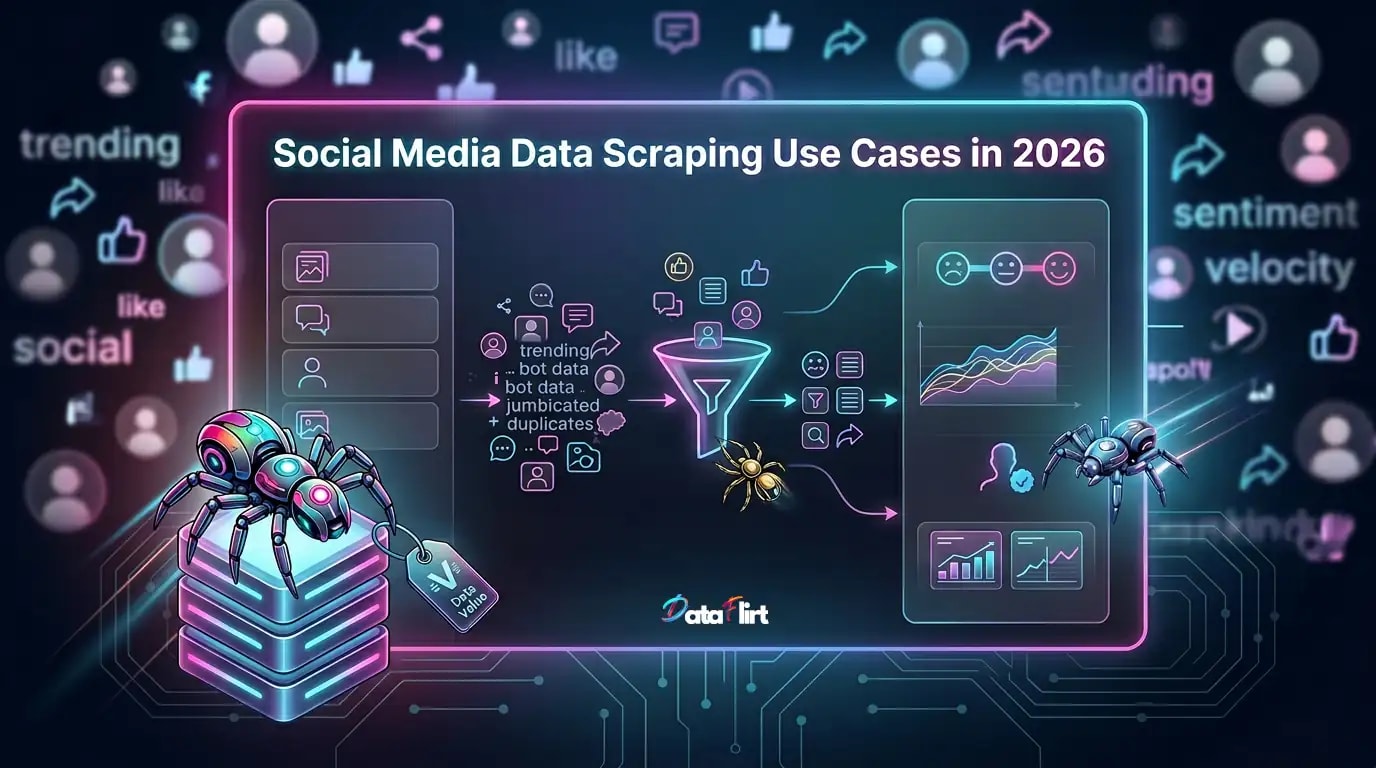
Bot and spam filtering: A raw scraped social media dataset from a high-volume platform will contain a meaningful percentage of automated or spammy accounts whose output corrupts sentiment and trend models if not filtered before the data reaches the analytics layer. Bot filtering requires a combination of account-level signals (posting frequency, follower-to-following ratio, account age, profile completeness) and content-level signals (repetitive phrasing, URL saturation, unnatural engagement patterns).
-
Deduplication: Cross-platform social monitoring frequently results in the same piece of content appearing multiple times, through reposts, shares, platform syncs, and content aggregator amplification. A deduplication layer that resolves identical and near-identical content to a single canonical record is essential for accurate volume and sentiment metrics.
-
Engagement metric normalization: Different platforms define engagement differently. A “like” on one platform is not semantically equivalent to a “reaction” on another, a “retweet” carries different amplification weight than a “share,” and “saves” are absent from platforms that do not surface the metric publicly. Data teams need a normalized engagement schema that translates platform-specific signals into a consistent analytical framework.
-
Language and locale tagging: Global brand monitoring programs scrape content in dozens of languages. Applying the wrong sentiment model to a non-English post produces analytically meaningless output. Every scraped record must be tagged for language and locale before sentiment analysis is applied.
-
Temporal metadata standardization: Social platforms express timestamps in different formats, with different timezone conventions. A dataset where timestamps are not normalized to UTC with millisecond precision will produce distorted trend analysis, particularly for intraday event monitoring.
DataFlirt’s Data Quality Standard: A scraped social dataset that enters an NLP training pipeline without bot filtering, deduplication, and language tagging is not a dataset. It is a noise source with a schema.
The Investment Analyst and Alternative Data Consumer
Investment professionals, including hedge fund analysts, consumer sector equity researchers, venture capital due diligence teams, and alternative data consumers at asset managers, have been using social media signals as alternative data inputs for over a decade. The sophistication of those applications has increased dramatically as social media data scraping infrastructure has matured.
Social media intelligence for investment teams is not about monitoring brand mentions for their own sake. It is about using the behavioral signals embedded in public social content as leading indicators of consumer demand trends, brand health trajectories, and category market share shifts that precede earnings data by weeks or months.
The specific alternative data applications investment teams derive from scraped social data:
- Consumer demand signal extraction: Volume and sentiment trends around specific product categories, brand terms, and purchase intent vocabulary as a leading indicator of retail sales performance
- Brand momentum scoring: Tracking the acceleration or deceleration of brand mention growth, share of voice shifts, and sentiment trajectory as inputs to brand health valuation models
- Product launch reception quantification: Measuring the velocity and sentiment distribution of public social response to product launches as an early indicator of commercial success before any financial reporting period closes
- Category disruption detection: Monitoring the emergence of new product category vocabulary and consumer adoption signals in social content as an early indicator of market share redistribution
- Executive and management perception tracking: Analyzing the tone and content of public social discourse around company leadership as a reputational risk input for due diligence and portfolio monitoring
For investment teams, scraped social data is most useful when it is delivered as a structured signal feed, with numeric engagement metrics, sentiment scores, volume indices, and trend velocity measures, rather than raw post content. The analytical framework is quantitative, not qualitative, and the delivery architecture needs to reflect that.
The Operations and Risk Team
Operations teams at consumer brands, financial institutions, and platform companies use social media monitoring in a reactive risk management mode that rarely gets discussed in editorial content about social data scraping. For them, the question is not “what is the market saying about our brand?” but “what is happening right now that we need to know about before it becomes a crisis?”
The operational risk use cases for scraped social data:
- Crisis detection and early warning: Complaint volume spike detection, negative sentiment acceleration monitoring, and viral negative content identification as inputs to crisis communication protocols
- Regulatory and compliance signal monitoring: Tracking public discourse that references regulatory, safety, or compliance issues related to the brand or its product category as an early warning layer for legal and compliance teams
- Counterfeit and brand abuse detection: Systematic social media data scraping of posts referencing brand terms alongside counterfeit product signals (suspicious pricing, unauthorized seller language, fake giveaway patterns) as an input to brand protection programs
- Supply chain and logistics sentiment monitoring: Tracking customer-expressed delivery, quality, and service complaints in real time as an operational performance metric that complements internal data
- Competitor crisis opportunity identification: Monitoring competitor brand sentiment and complaint volume as an input to competitive response decisions during periods of competitor operational difficulty
What Social Media Data Scraping Actually Collects
Social media data scraping is not a monolithic activity. The specific data that can be systematically extracted from social platforms varies significantly by platform, content type, and collection architecture. Understanding this taxonomy is the prerequisite for specifying a data acquisition program that captures what your business decisions actually require.
Post and Content Data
The core unit of scraped social data is the individual piece of content: a text post, a video upload, an image, a story frame, a short-form clip. At the post level, a well-structured social media data scraping program captures:
- Post text content and character count
- Post type classification (text only, image, video, link share, carousel, poll, live)
- Platform-native post identifier for deduplication
- Post timestamp (creation time, edit history where surfaced)
- Author account identifier and public profile metadata
- Post URL for source attribution
- Hashtags, mentions, and tagged entities extracted and normalized
- Language detection output for multilingual datasets
- Media metadata where accessible (image alt text, video duration, thumbnail URL)
Engagement Metric Data
Engagement data is frequently the most analytically valuable output of social media data scraping, because it transforms raw content from a text corpus into a behaviorally weighted signal. The specific engagement fields available vary by platform, but a comprehensive scraping program collects:
- Like or reaction counts (with reaction type breakdown where platforms surface it)
- Comment counts and, where accessible, comment thread content
- Share, retweet, or repost counts
- Save or bookmark counts where surfaced publicly
- View counts for video content
- Reply and quote counts where platform schema distinguishes them
- Click-through data where surfaced in public post metadata
- Engagement rate calculation (total interactions divided by reach or follower count, depending on what the platform surfaces)
Profile and Account Data
Profile-level scraped social data is a distinct and valuable dataset from content and engagement data. It enables influencer analysis, audience profiling, competitive account tracking, and brand affinity mapping. Profile data fields include:
- Display name and username
- Follower and following counts (with historical tracking for growth rate analysis)
- Account creation date
- Profile description and biography text
- Location where disclosed
- External link in profile
- Verified status
- Post count and posting frequency
- Average engagement rate across recent posts
- Category and industry tags where platforms surface them
Comment and Conversation Data
Comment and conversation data is one of the richest and most underutilized outputs of social media data scraping. Comments on brand posts, competitor posts, and category-relevant content contain the most direct, unfiltered consumer language available anywhere, and they are largely ignored by organizations that focus their social monitoring on primary content.
What comment-level scraping captures:
- Comment text content
- Commenter account identifier and public profile metadata
- Comment timestamp
- Reply chain structure (thread depth and parent-child relationships)
- Likes or reactions on individual comments where surfaced
- Sentiment signal without requiring model inference (explicit positive or negative language is often stated directly in comments)
- Question and complaint extraction (comments that contain direct questions or explicit complaints about product features, service quality, or brand behavior)
Hashtag and Trend Data
Hashtag-level scraped social data provides the structural intelligence that maps the conversation landscape around a topic, rather than individual content instances. This data is particularly valuable for trend detection, campaign reach assessment, and competitive content mapping.
Scraped hashtag data includes: hashtag usage volume over time, associated content volume and engagement totals, co-occurrence frequency with other hashtags, platform-specific trend ranking and velocity metrics, and the account composition of hashtag contributors (brand accounts, creator accounts, consumer accounts, automated accounts).
Multimedia Metadata
For platforms where visual and audio content is the primary post format, multimedia metadata is a critical component of a comprehensive social media data scraping program. While the actual media files are typically not collected (both for legal reasons and practical storage cost reasons), the metadata surrounding them is publicly accessible and analytically useful:
- Video duration and format classification
- Audio track identification where platform APIs or page metadata surface it
- Thumbnail image URL and alt text
- Caption text accompanying visual content
- Comment and engagement data on multimedia posts
- View count and completion rate proxies where surfaced publicly
For a deeper understanding of how large-scale data collection challenges are managed in production scraping environments, see DataFlirt’s overview of large-scale web scraping data extraction challenges and the practical guide to building a custom web crawler to extract data at scale.
Industry-Specific Use Cases in Depth
Social media data scraping serves a remarkably diverse set of industries. Here is the breakdown by vertical where the applications are most mature and the business value is most clearly established.
Consumer Brands and FMCG
Consumer packaged goods companies, fashion brands, food and beverage players, and consumer electronics brands represent the highest-volume audience for scraped social data. Their fundamental use case is competitive brand intelligence at a granularity that no syndicated market research product provides.
The specific applications for consumer brands:
-
Pack and product reception tracking: Social media monitoring of posts referencing new product launches, packaging changes, or formula updates captures genuine consumer reaction within hours of a product reaching retail shelves, weeks before any structured market research fieldwork could be completed.
-
Retail presence verification: Scraped posts that include product photos with location tags and retail environment imagery provide a real-time indicator of in-store availability and shelf presence that complements formal retail audit programs.
-
Seasonal trend anticipation: Consumer brands that monitor seasonal vocabulary, occasion-specific hashtags, and cultural moment discussions in scraped social data can identify emerging seasonal demand patterns 4 to 8 weeks before they surface in point-of-sale data.
-
Influencer campaign measurement: Rather than relying on creator-reported reach and engagement figures, consumer brands using their own social media data scraping infrastructure can verify campaign delivery, measure earned engagement independently, and track the downstream conversation that paid creator content generates.
-
Category conversation mapping: For FMCG categories with high social media engagement (food, beauty, fitness, personal care), scraped hashtag and content data provides a continuously updated map of the vocabulary, aesthetics, and cultural references driving consumer attention, which directly informs content strategy and campaign creative briefs.
Financial Services and Fintech
Financial services brands operate in a uniquely high-stakes social media environment. Reputation events propagate faster on social platforms than any other medium, regulatory scrutiny of financial product marketing is increasing, and consumer trust signals are simultaneously more publicly expressed and more analytically valuable than in almost any other category.
How financial services teams use scraped social data:
-
Trust and reputation monitoring: Social media monitoring of brand mentions alongside sentiment signals provides financial services brands with a continuous pulse on consumer trust that traditional brand tracking surveys, conducted quarterly or annually, cannot approach in timeliness.
-
Product complaint pattern detection: Systematic scraping of comments and posts referencing specific financial products, services, or features surfaces complaint patterns at a volume and speed that customer service ticket data frequently misses, because many consumers vent publicly on social platforms before or instead of contacting customer service.
-
Regulatory risk signal tracking: Comments and posts that reference regulatory issues, misleading marketing allegations, or compliance concerns around specific financial products are valuable early warning inputs for legal and compliance teams.
-
Competitor product launch monitoring: When a competing financial product launches, social media data scraping provides an immediate read on consumer reception, question patterns, and competitive comparison discussions that informs rapid competitive response.
-
Fraud and scam signal detection: Social media platforms are frequently the first place that fraudulent schemes, impersonation attacks, and unauthorized financial product promotion surface publicly. Systematic social media data scraping for brand terms alongside fraud-adjacent vocabulary is a proactive brand protection capability.
Media, Entertainment, and Publishing
Media and entertainment companies live and die by audience attention, and social media is the primary arena where attention is expressed, competed for, and measured. Scraped social data is foundational to the strategic and operational decisions these organizations make daily.
Media-specific applications:
-
Content performance benchmarking: Scraped engagement data from competitor media brands’ social channels provides a performance benchmark that page view data alone cannot supply, because social engagement reveals what audiences actively value and share, not just passively consume.
-
Talent and creator discovery: Publishing houses, talent agencies, podcast networks, and digital media brands use social media data scraping to identify emerging creators before they reach the visibility threshold of mainstream discovery tools, at a point when partnership costs are lower and exclusivity is achievable.
-
Audience interest mapping: Media brands that serve defined audience niches use scraped social content from those audiences’ organic discussions to map the specific topics, formats, cultural references, and vocabulary that drive genuine engagement within the niche, informing editorial decisions with behavioral data rather than editorial intuition.
-
IP and franchise monitoring: For entertainment companies with valuable intellectual property, systematic social media monitoring of scraped content referencing franchise terms, character names, and cultural moments provides a continuous read on franchise health and audience sentiment.
-
Streaming and viewership signal extraction: Social conversation volume and sentiment around specific titles, genres, and platform experiences provides alternative data inputs to streaming platform decision-making, complementing proprietary viewership metrics with external audience voice data.
Technology and SaaS
Technology companies, from enterprise SaaS platforms to consumer apps, operate in social media environments where product feedback, competitive discussion, and category conversation are more publicly visible and more analytically dense than in almost any other sector.
Technology-specific applications for scraped social data:
-
Developer and technical community monitoring: Technical communities on platforms like GitHub-adjacent social networks, programming forums with social layers, and developer-focused discussion platforms generate a uniquely high-signal type of social content for technology companies: specific, technical, and often directly actionable product feedback from the exact user segment that most influences adoption decisions.
-
Feature request and bug detection: Scraped comments and posts referencing specific software features, error messages, or workflow pain points surface product improvement signals at a volume and specificity that formal feedback channels rarely match.
-
Competitive feature comparison tracking: Technology buyers frequently discuss product comparisons, switching decisions, and feature evaluations publicly on social platforms. Social media data scraping of these comparison discussions provides competitive intelligence that no analyst report captures in real time.
-
Developer and technical influencer mapping: The technical influencer landscape in software categories is distinct from consumer influencer ecosystems. Social media data scraping enables technology companies to systematically map the thought leaders, practitioners, and community voices whose recommendations drive adoption within specific technical audiences.
Healthcare and Pharmaceuticals
Healthcare and pharmaceutical companies operate in a socially active but heavily regulated environment. Social media data scraping in this vertical requires particular attention to compliance guardrails, but the analytical value of the data available within those guardrails is substantial.
Healthcare-appropriate applications:
-
Patient experience and disease conversation monitoring: Patients, caregivers, and advocates discuss treatment experiences, medication effects, and condition management strategies on public social platforms at a volume and specificity that creates a real-world evidence dataset with significant research value, within appropriate ethical and legal frameworks.
-
Adverse event signal detection: Public social discussion of unexpected medication side effects or treatment complications represents a pharmacovigilance signal that regulatory guidance in multiple jurisdictions now actively encourages pharmaceutical companies to monitor.
-
Healthcare professional opinion tracking: Social media conversations among public-facing healthcare professionals about therapeutic categories, prescribing considerations, and clinical evidence discussions provide pharmaceutical companies with near-real-time insight into medical community sentiment.
-
Condition stigma and patient community dynamics: Understanding how specific conditions are discussed, stigmatized, or destigmatized in public social discourse informs patient support program design and patient advocacy strategies.
Retail and E-Commerce
Retail and e-commerce operations use social media intelligence across every stage of the customer lifecycle, from category discovery through post-purchase advocacy. Scraped social data is particularly valuable for the speed at which it surfaces purchase intent signals and competitive pricing discussions.
Retail-specific applications:
-
Social commerce intent signal extraction: Posts and comments that contain explicit purchase consideration language, product comparison discussions, or deal-seeking behavior represent high-intent consumer signals that, when captured through social media data scraping and enriched with product-level tagging, become a real-time purchase intent feed.
-
Competitor price promotion monitoring: Social media monitoring of posts referencing competitor promotional events, flash sales, and discount codes surfaces competitive pricing activity in near-real time, far faster than manual price monitoring programs.
-
User-generated content quality mapping: Scraped customer posts referencing a brand’s products provide both a sentiment dataset and a visual content library (for brands with appropriate licensing arrangements) that can directly inform product photography standards, packaging decisions, and creative content strategy.
-
Returns and quality complaint pattern detection: Complaint clusters around specific product attributes, size accuracy, quality consistency, or delivery experience surfaced through scraped comment and post data provide retail operations teams with an early warning system for product or logistics issues.
See DataFlirt’s complementary analysis on scraping customer reviews and social media behavioral data applications for additional context on how review and behavioral signal data complements raw social content scraping.
One-Off Versus Periodic: Two Strategically Different Data Modes
One of the most consequential decisions a business team makes when designing a social media data acquisition program is whether their use case requires a one-time data collection exercise or an ongoing, scheduled data feed. These are not variations on the same product. They are structurally different data programs that serve structurally different business functions.
When One-Off Social Media Data Scraping Is the Right Choice
One-off social media data scraping is appropriate when the business question has a defined answer that does not require continuous updating. The analytical value of a point-in-time social dataset decays at a rate proportional to the velocity of the platform and the time-sensitivity of the use case, but for certain mandates, a well-constructed historical snapshot is exactly what is needed.
Campaign post-mortem analysis: After a major campaign, brand activation, or product launch, a comprehensive retrospective dataset covering the campaign’s full run, including pre-launch baseline, peak engagement, and post-campaign decay, requires a one-off historical pull rather than a continuously running feed. The dataset has a defined start date, a defined end date, and a defined analytical scope.
Competitive audit and benchmarking snapshot: A brand or product team conducting a periodic competitive review needs a systematic, comprehensive snapshot of competitor social presence, content strategy, engagement performance, and audience characteristics at a specific point in time. This is a classical one-off use case: depth, accuracy, and documentation over continuous refresh.
Crisis forensics and retrospective analysis: After a brand crisis, social media data scraping of the crisis period provides the raw material for understanding narrative origin, escalation dynamics, audience segmentation of crisis participants, and platform-specific propagation patterns. This is a retrospective analysis exercise, not a real-time monitoring need.
Research and academic projects: Social science research, market research fieldwork, and academic studies using social media data as primary source material typically require a clearly scoped historical dataset with defined collection parameters, not a continuous feed.
One-off data requirement summary:
| Dimension | Requirement |
|---|---|
| Coverage | Maximum breadth across platforms in scope |
| Historical range | Defined date window with clear start and end |
| Field completeness | Maximum depth per record within defined schema |
| Documentation | Full data provenance with source URL, timestamp, and platform identifier |
| Delivery | Structured flat files or direct database load within a defined SLA |
| Quality | Deduplicated, bot-filtered, language-tagged before delivery |
When Periodic Social Media Data Scraping Is Non-Negotiable
Periodic scraping is the correct architectural choice for any use case where the business decision is a function of how the social landscape is changing, not where it stands at a single point. If your use case requires trend data, velocity signals, or the ability to respond to platform developments as they emerge, a periodic data feed is not optional.
Brand health monitoring: A brand team that needs to track share of voice, sentiment trajectory, and competitive positioning cannot operate on monthly data snapshots. Social media moves in hours and days, not months. A daily or weekly scraped social feed that captures brand mentions, competitive mentions, and category conversations is the operational data infrastructure for continuous brand health management.
Influencer and creator tracking: Influencer landscapes evolve constantly. Creators rise and fall in relative influence, audience composition shifts, engagement authenticity changes over time, and brand partnership histories accumulate. Growth teams that need a continuously current view of the influencer ecosystem in their category need a periodic scraped feed, not a one-off audit.
NLP model maintenance: Machine learning models trained on social media data are particularly susceptible to distribution shift, because language, slang, platform norms, and topical vocabulary evolve rapidly. Maintaining a social sentiment classifier or topic model in production requires a continuous stream of fresh scraped training data to detect and correct for drift.
Trend detection and cultural intelligence: The entire value proposition of trend detection is recency. A trend identified 72 hours after it peaks is not actionable intelligence; it is retrospective reporting. Daily social media data scraping with intraday refresh cadences for high-priority keyword sets is the only data architecture that enables genuine early trend identification.
Recommended cadence by use case:
| Use Case | Recommended Cadence | Rationale |
|---|---|---|
| Crisis monitoring | Real-time to hourly | Narrative escalation is measured in minutes |
| Brand mention tracking | Daily | News cycles move faster than weekly |
| Competitor content monitoring | Daily to weekly | Campaign launches happen without warning |
| Influencer performance tracking | Weekly | Engagement patterns require a rolling window |
| Trend detection | Daily with intraday peaks | Trend windows are narrow |
| NLP model refresh | Weekly to monthly | Drift is gradual but compounds |
| Campaign performance monitoring | Daily during campaign | Optimization requires fresh data |
| Category intelligence | Weekly | Structural shifts are gradual |
| Competitive audit | Monthly or quarterly | Strategic cycles, not tactical |
| Research or forensics | One-off | Point-in-time question |
The Platforms Worth Scraping: A Regional Reference
The following table provides a regional reference for the most analytically valuable social platform targets for data collection programs in 2026. The “Why Scrape?” column reflects the primary business intelligence application that justifies the collection investment, not the technical collection approach.
| Region (Country) | Target Websites | Why Scrape? |
|---|---|---|
| Global | X (formerly Twitter) | Real-time brand mentions, breaking news signal, public opinion velocity, journalist and analyst discourse, crisis escalation tracking, hashtag trend intelligence |
| Global | Visual brand presence monitoring, influencer performance benchmarking, product aesthetics and UX feedback in visual comments, shopping-intent signals, story and reel engagement metadata | |
| Global | TikTok | Short-form trend detection, viral content pattern analysis, creator discovery for campaign targeting, product virality signals, Gen Z and millennial consumer behavior |
| Global | YouTube | Long-form content engagement depth analysis, comment sentiment on product and brand reviews, channel authority mapping in specific niches, ad creative research |
| Global | Community sentiment research, unfiltered product feedback in category-specific subreddits, early adopter opinion mining, competitor complaint pattern extraction | |
| Global | B2B brand monitoring, executive thought leadership tracking, hiring signal extraction, professional community sentiment analysis, SaaS and enterprise product discussion | |
| Global | Visual trend intelligence for retail and consumer brands, product discovery behavior patterns, seasonal demand anticipation, design and aesthetics category analysis | |
| USA, Canada | Consumer group discussion monitoring, local business review aggregation, event and community interest signal extraction, mature demographic brand sentiment | |
| USA, Canada, UK, Australia | Quora | Long-form category intelligence, explicit product comparison discussions, technical question patterns for SaaS and technology brands, intent-rich keyword corpus generation |
| China | Chinese consumer brand sentiment, viral content patterns for China market entry, influencer KOL activity tracking, cross-border consumer electronics and luxury brand discussions | |
| China | Xiaohongshu (Little Red Book) | Lifestyle and product discovery behavior, beauty and fashion consumer sentiment, authentic UGC product review intelligence for brands targeting Chinese consumers |
| China | Douyin | Short-form video trend intelligence for China market, Gen Z consumer behavior, product virality patterns, brand partnership performance in the Chinese TikTok ecosystem |
| South Korea, Japan | Naver Blog, Kakao | APAC consumer sentiment for technology, beauty, and entertainment brands, K-culture trend intelligence, regional campaign reception monitoring |
| India | ShareChat, Moj, Josh | Vernacular language consumer sentiment in regional Indian languages, tier-2 and tier-3 city consumer behavior, FMCG and mobile category intelligence |
| India, South Asia | Twitter/X (India), Instagram (India) | Urban Indian consumer sentiment, startup and technology brand monitoring, entertainment and celebrity culture intelligence |
| Brazil, LATAM | Twitter/X (Brazil), Instagram (LATAM) | Portuguese and Spanish-language brand sentiment, LATAM consumer behavior, political and cultural trend intelligence relevant to regional campaign planning |
| Germany, France, Netherlands | Twitter/X (EU), Reddit (EU subs) | European consumer sentiment with GDPR-compliant collection scope, technology and sustainability brand discourse, EU regulatory discussion monitoring |
| Middle East | Twitter/X (MENA), Instagram (MENA) | Arabic-language brand sentiment, Gulf consumer behavior, luxury and lifestyle category intelligence, regional political and cultural context monitoring |
| Russia, Eastern Europe | VKontakte (VK), Odnoklassniki | Eastern European consumer sentiment, Russian-language brand monitoring where legally permissible, regional gaming and entertainment community intelligence |
| Global: Dark Social and Forum | Discord (public servers), Telegram (public channels) | Community-level brand affinity signals, early adopter product feedback in niche communities, gaming and Web3 brand intelligence, influencer community monitoring |
Regional Collection Notes:
- China-specific platforms require specialized collection infrastructure and GDPR-equivalent compliance with China’s Personal Information Protection Law (PIPL). Scraping Chinese social platforms for Chinese market intelligence programs should be reviewed against PIPL requirements before initiating collection.
- GDPR-applicable regions (EU, UK, EEA) require that any collection including personally identifiable information (commenter names, profile data, contact information) be reviewed against the GDPR’s lawful basis requirements. Public post content from public accounts is generally lower risk; personal data collection requires a documented compliance framework.
- Platform API relationship considerations: Some platforms actively enforce anti-scraping measures. Collection architectures for high-value targets should implement ethical crawl practices including rate limiting, robots.txt compliance, and session management that avoids service degradation for legitimate users.
Data Quality, Delivery, and Integration Frameworks
Raw scraped social data is not analytics-ready. The gap between a raw collection output and a dataset that can inform brand decisions, train a model, or populate a live monitoring dashboard is significant, and it is an architecture decision that must be made before collection begins, not after.
DataFlirt structures social media data scraping deliveries around four mandatory quality layers.
Deduplication
Social content propagates across platforms and within platforms through shares, reposts, quote posts, and cross-platform syndication. A post that goes viral may generate hundreds or thousands of derivative content instances, each of which is a distinct scraped record without deduplication logic. For volume analysis, sentiment tracking, and trend measurement, this creates severe overcounting that distorts every metric downstream.
Effective deduplication for scraped social data requires:
- Content fingerprinting using normalized text similarity (not just exact string match) to catch lightly modified reposts
- Platform-native post ID tracking as the primary deduplication key where accessible
- Cross-platform content matching for posts that are shared verbatim across platforms by the same or different accounts
- Engagement aggregation rules that determine which record is preserved (typically the original rather than the repost, but with aggregate engagement summed to the canonical record)
Bot and Spam Filtering
The proportion of automated, coordinated inauthentic, and spam activity on major social platforms is substantial. Estimates from platform transparency reports vary, but the consensus among researchers is that 10 to 25 percent of active accounts on major platforms exhibit automated or semi-automated behavior. Including this content in a brand sentiment or trend analysis dataset corrupts every output.
Effective bot filtering for scraped social data requires:
- Account-level signal scoring: posting frequency distributions, follower-to-following ratio extremes, account age relative to activity volume, profile completeness scores
- Content-level signal scoring: repetitive phrasing patterns, URL saturation, unnatural hashtag stacking, sequential posting with sub-second intervals
- Network-level signal identification: coordinated behavior clusters where multiple accounts post identical or near-identical content in synchronized timing windows
No bot filter achieves perfect accuracy, but a well-implemented filtering layer should reduce automated content contamination to below 5 percent of the delivered dataset. DataFlirt documents the filtering methodology and false positive rate for every social media data scraping engagement.
Sentiment Scoring and Entity Tagging
Raw scraped post text is not inherently useful for business analysis without a structured intelligence layer applied to it. The two most fundamental enrichments are:
Sentiment scoring: Applying a sentiment classification model to assign each post record a sentiment label (positive, negative, neutral) and a confidence score. For business-grade social media monitoring, a three-class sentiment model is insufficient; a five to seven class model that distinguishes highly positive, mildly positive, neutral, mildly negative, and highly negative, and ideally mixed sentiment, provides the granularity that brand health and crisis monitoring require.
Entity tagging: Identifying and labeling the specific brands, products, people, locations, and events mentioned in each post record enables the structured queries that turn raw social data into actionable intelligence. Without entity tagging, a brand team cannot filter their dataset to posts that specifically mention a named product rather than the parent brand, and an investment team cannot isolate posts that mention a specific executive versus the company name.
Delivery Formats by Team
The right delivery format for scraped social data is entirely a function of who is consuming it and through what workflow.
For data and analytics teams: Delta-mode JSON or Parquet files delivered to a cloud storage bucket (AWS S3, Google Cloud Storage, Azure Blob) on a daily or weekly schedule, with Hive-partitioned directory structure for efficient query performance. Schema versioning documentation ensures that downstream pipeline dependencies are not broken by schema changes.
For brand and marketing teams: Structured CSV or Parquet files delivered to a BI tool connector (Looker, Tableau, Power BI, Metabase) or a direct database connection to a Snowflake, BigQuery, or Redshift instance, with pre-built views for the core brand health metrics the team tracks.
For growth and performance teams: Enriched flat files or database tables with influencer-level aggregation (account performance scores, audience composition estimates, engagement rate authenticity signals) delivered on a weekly cadence into a CRM or influencer management tool.
For product teams: Entity-tagged, sentiment-scored post records with product-feature-level filters pre-applied, delivered to a product analytics data warehouse where they can be joined with event-level product usage data.
For investment and alternative data teams: Normalized signal feeds with numeric volume indices, sentiment score distributions, and trend velocity metrics delivered as structured JSON feeds or database loads into the team’s alternative data ingestion infrastructure.
For operations and risk teams: A monitoring dashboard with real-time alert configuration for volume spike thresholds and sentiment deterioration events, powered by a daily or intraday scraping cadence against defined brand and competitor keyword sets.
For additional context on data delivery infrastructure for ongoing social intelligence programs, see DataFlirt’s guide on best real-time web scraping APIs for live data feeds and the overview of best platforms to deploy and schedule scrapers automatically.
Role-Based Data Utility: Putting the Same Dataset to Work Across the Organization
The following section breaks down, with specificity, how each organizational role applies the same underlying scraped social dataset to generate value through different analytical frameworks.
Brand Intelligence in Practice: From Raw Data to Share of Voice
A brand director at a consumer goods company commissions a social media data scraping program covering 12 brand terms, 6 competitor brand terms, and 4 category hashtags across five platforms, refreshed daily.
What does that director actually do with the data?
Step 1: Volume normalization. Raw mention counts are not comparable across platforms with different user bases. The data team normalizes mention volume to a share of voice index that expresses each brand’s mention count as a percentage of total category mention volume by platform and by day.
Step 2: Sentiment weighting. Not all mentions carry equal analytical weight. A post from an account with 200,000 followers that expresses strong negative sentiment carries more reputational risk than a post from an account with 40 followers expressing mild positive sentiment. Sentiment-weighted share of voice, which factors engagement reach into the sentiment score, gives the brand director a more accurate read on brand health than unweighted mention counts.
Step 3: Narrative mapping. Entity-tagged post records, filtered by negative sentiment and above-threshold engagement reach, reveal the specific themes driving negative brand discourse. Are complaints clustering around product quality, pricing, customer service, a specific campaign, or a sustainability claim? This thematic breakdown, generated from scraped social data, tells the brand team where to focus their response and their next campaign messaging.
Step 4: Competitive trajectory comparison. Plotting the brand’s sentiment and volume trajectories against three competitor trajectories over a rolling 90-day window reveals whether the brand is gaining or losing ground in the category conversation, and whether competitor gains are coming at the brand’s direct expense or from new category entrants.
All of this analysis is generated from the same raw scraped social dataset. The brand director’s analytical framework, not the data itself, determines what she sees.
Growth Intelligence in Practice: Influencer Discovery at Scale
A growth lead at a DTC beauty brand needs to identify 40 micro-influencers in the skincare category for a product launch campaign. Their current process involves manually searching platform hashtags, which takes two weeks of analyst time and produces a shortlist of 20 names with inconsistent quality.
With a social media data scraping program running on the skincare category hashtag set, the growth team can:
- Pull every account that posted using the target hashtag set in the last 90 days with a follower count between 10,000 and 150,000 (the micro-influencer band)
- Filter to accounts with an engagement rate above 3.5 percent on their last 30 posts (authenticity signal)
- Score for content quality using post completeness metrics and caption language sophistication proxies
- Filter out accounts with follower-to-following ratios indicative of artificial growth
- Tag accounts for brand-fit signals based on the product categories mentioned in their bio and recent content
- Sort by engagement rate authenticity score and deliver a ranked shortlist of 200 qualified candidates in 48 hours
The growth lead’s team then applies qualitative judgment to the top 60, selects 40 for outreach, and launches the campaign in 10 days instead of 4 weeks. The data does not replace the judgment call; it removes the manual screening labor that was consuming the time.
Data Team in Practice: Training a Sentiment Classifier That Does Not Drift
A data lead at a financial services company is maintaining a social sentiment classifier that monitors brand and competitor mentions across three platforms. The classifier was trained 8 months ago and its F1 score has dropped from 0.87 to 0.79 on recent test samples.
The source of the drift is language evolution: new slang terms for financial products, platform-specific abbreviations, and emerging negative vocabulary around a competitor’s controversial fee structure change have all entered the platform conversation in the past 8 months, and the model has not seen them.
The fix requires fresh training data: scraped social posts from the last 60 days, labeled for sentiment, balanced across positive, negative, and neutral classes, filtered for bot content, and normalized to the same schema as the original training set.
With a periodic social media data scraping program already running, this data pull is a configuration change, not a new project. The data team adds a labeling step (using an active learning approach with the existing classifier to pre-label and human-review boundary cases), retrains on the augmented dataset, and brings the F1 score back to 0.89 on the refreshed test set.
Without the periodic scraping infrastructure, the same fix would require a 6-week project to scope, collect, clean, and label a new training dataset from scratch. The scraping program converts a 6-week project into a 10-day sprint.
Legal and Ethical Guardrails for Social Media Data Scraping
Social media data scraping operates in a legal environment that is more actively contested than most other web data collection domains. Platform ToS provisions, data privacy regulations, and court decisions around access to publicly available data all create a landscape that requires explicit, documented legal review before any social media data acquisition program begins.
Terms of Service and Platform Access Policies
Major social platforms include provisions in their Terms of Service that restrict automated data collection to varying degrees. The enforceability of these provisions, and the legal risk of operating against them, varies significantly by jurisdiction and by the nature of the access being used.
The general risk gradient runs from lowest to highest as follows:
- Scraping publicly accessible content that requires no authentication: lowest legal risk
- Scraping content accessible only after login, using automated credentials: substantially higher legal risk
- Scraping content in violation of an explicit platform cease-and-desist or technical access block: highest legal risk
Any organization commissioning a social media data scraping program should conduct a legal review of the specific platform’s ToS, the specific data fields being collected, and the applicable jurisdictional law. DataFlirt operates within clearly documented legal parameters and conducts ToS review as a standard component of every social data engagement scoping process.
GDPR, CCPA, and Data Privacy Compliance
Social media data includes personal data. Profile names, usernames, biographical information, location data, and the content of personal posts are all personal data under GDPR and equivalent regulations. Even where that data is publicly accessible, collecting, processing, and storing it for commercial purposes requires a lawful basis under GDPR.
For most commercial social media data scraping programs, the relevant lawful basis is legitimate interests, which requires a documented balancing test that weighs the controller’s commercial interest against the data subject’s reasonable privacy expectations. For consumer posts on public accounts with substantial follower counts, the balance generally favors collection where the use case is brand intelligence or market research. For personal accounts with small followings expressing private opinions, the balance is more contested.
Practical GDPR implications for social media data programs:
- Collect only the data fields necessary for the stated business purpose (data minimization)
- Establish and document a retention period and deletion policy for all collected personal data
- Do not repurpose collected social data for uses beyond the documented scope without a new legal basis assessment
- If the program collects data on EU residents, appoint a data protection lead to own the compliance documentation
CCPA and state-level equivalents in the United States impose similar requirements for California residents’ personal data, and the scope of state privacy regulations is expanding rapidly across the United States.
Ethical Collection Standards
Beyond legal compliance, DataFlirt maintains a set of ethical collection standards for social media data scraping programs that reflect our view of responsible data practice:
- Respecting platform-indicated robots.txt exclusions for areas of a site explicitly excluded from automated access
- Implementing crawl rate limits that prevent meaningful degradation of platform performance for legitimate users
- Avoiding collection of content from clearly private accounts or content behind authentication that was not granted programmatically by the platform
- Not facilitating the identification of individuals from aggregate social data for purposes of harassment, surveillance, or harm
For additional reading on the legal and ethical dimensions of web data collection, see DataFlirt’s detailed analysis on data crawling ethics and best practices and the legal landscape overview on is web crawling legal?.
Building Your Social Media Data Strategy: A Practical Decision Framework
Before commissioning a social media data scraping program, whether internally developed or outsourced to a specialist provider, business teams should work through the following decision framework. This is not a technical checklist; it is a business strategy exercise that takes approximately two to three hours of structured discussion and prevents the most common and expensive mistakes in social data acquisition.
Define the Business Decision First
What specific decision will this data enable? Not “we want social media data” but, for example: “We need to track our brand’s net sentiment against three competitors across Instagram and Twitter on a weekly basis, and we need to understand which specific content themes are driving negative sentiment so we can brief our creative agency accurately.”
The specificity of the decision is everything. It determines which platforms are in scope, which data fields matter, what quality standards are required, and what cadence is necessary. Vague data mandates produce expensive datasets that sit in a data warehouse and inform nothing.
Map Data Requirements to the Decision
What specific platforms, data fields, keyword sets, and geographic markets does the decision require? This mapping exercise frequently surfaces that teams are requesting far more data than their actual question needs, or that a critical field they require is not surfaced by the obvious collection target and needs a supplementary source.
For example: a brand team that says they need “all social media data about our brand” may actually need only public posts containing the brand name or top three product names, engagement metrics, sentiment scores, and platform identifiers. The difference between that specific requirement and “all social media data” is significant in both collection scope and cost.
Assess Cadence Against Decision Velocity
Is this a one-off or periodic need? If periodic, what is the minimum refresh cadence that keeps the data current enough to be actionable for the target decision? Overspecifying cadence, requesting intraday data when weekly is sufficient, adds cost and infrastructure complexity without adding analytical value. Underspecifying cadence, using monthly data for a use case that requires daily signals, produces a program that looks active but doesn’t actually inform decisions.
Define Data Quality Thresholds
What are the minimum acceptable quality standards for this specific use case? This means explicitly specifying: acceptable bot contamination rate, minimum field completeness for critical fields, deduplication standard, and sentiment scoring model accuracy threshold. If these thresholds are not defined before collection begins, they will be discovered mid-project in a form that is more expensive to fix.
Specify Delivery Format and Integration
How does this data need to arrive for the consuming team to use it without additional transformation? A perfectly collected, beautifully cleaned social dataset delivered in the wrong format to a system that cannot consume it is not a data asset. It is a project failure.
Conduct Legal Review
Which platforms are in scope? Does any of the collection touch authenticated content? Does the dataset include personal data subject to GDPR, CCPA, or other privacy regulations? These questions should be answered with legal counsel before any technical work begins, not after the data has been collected and a compliance problem is discovered.
DataFlirt’s Approach to Social Media Data Delivery
DataFlirt approaches social media data scraping engagements from the business outcome backward. The first question in every engagement is not “what platforms can we access?” but “what decision does this data need to power, who is making that decision, how frequently do they need it, and what quality standard makes it analytically useful for them?”
This consultative approach changes the shape of every engagement significantly.
For a one-off competitive brand audit, it means designing the collection scope to answer the specific competitive questions the brand team has, delivering a fully documented, schema-consistent, sentiment-scored dataset with data provenance records, rather than a raw data export that requires weeks of internal processing before it becomes usable.
For a continuous brand monitoring program supporting a marketing leadership team’s weekly decision cycle, it means building a delivery architecture that integrates directly with the team’s BI tool, with a defined weekly refresh cadence, alert thresholds for volume and sentiment anomalies, and a schema versioning policy that prevents breaking changes from disrupting the analytics layer.
For a data team building or maintaining social NLP models, it means delivering a labeled, bot-filtered, balanced training corpus in the specific format and schema that their ML pipeline requires, on a periodic refresh cadence that prevents model drift.
The technical infrastructure behind DataFlirt’s social media data scraping capability, including residential proxy infrastructure for platform access, JavaScript rendering for dynamic content, session management for platform-specific access patterns, and distributed collection orchestration for multi-platform programs, enables these outcomes. But the infrastructure is not the value. The value is the data: clean, complete, timely, and delivered in a format that minimizes friction between collection and the decisions it is meant to inform.
Explore DataFlirt’s managed scraping services for teams that need turnkey social data delivery without internal infrastructure investment at managed scraping services. For organizations evaluating in-house development against outsourcing, see the detailed comparison on outsourced vs. in-house web scraping services. And for teams looking to understand how social data integrates with broader data strategy, see data for business intelligence.
Additional Reading from DataFlirt
The following DataFlirt resources provide deeper context on specific dimensions of social media data acquisition and related web data strategy:
- Social Media Behavioral Data: Applications and Delivery
- Scraping Social Media for Brand Audit: A Practical Guide
- Social Media Influencer Data Scraping for Growth Teams
- Twitter/X Data Scraping: Brand Monitoring Applications
- Sentiment Analysis with Twitter Data
- Sentiment Analysis for Business Growth
- Best TikTok Scraping Tools and APIs for Social Analytics in 2026
- Top Instagram Data Scraping Tools Without Getting Blocked
- Datasets for Competitive Intelligence
- Data Market Research: How Web Data Powers Research Programs
- Assessing Data Quality for Scraped Datasets
- Web Scraping Best Practices for Enterprise Data Programs
- Key Considerations When Outsourcing Your Web Scraping Project
Frequently Asked Questions
What is social media data scraping and how is it different from social listening tools?
Social media data scraping is the automated, programmatic collection of publicly available content from social platforms, including posts, comments, engagement metrics, hashtag threads, profile data, follower counts, and multimedia metadata, at a scale and frequency that manual browsing cannot approach. It is different from licensed social listening tools because it gives you raw, unfiltered, schema-consistent data that you control, rather than a dashboard with capped query limits and pre-baked visualizations built for someone else’s use case. With social media data scraping, you define the schema, the quality standards, the delivery format, and the analytical framework. With a listening tool, you work within the vendor’s constraints.
Which business roles extract the most value from scraped social media data?
Brand teams use scraped social data for brand health tracking and share of voice analysis. Growth teams use it for influencer discovery and audience segment mapping. Product managers use it for feature sentiment research and competitive product feedback mining. Data teams use it to train NLP models, sentiment classifiers, and trend forecasting systems. Investment analysts use scraped social signals as alternative data inputs for consumer demand modeling and early trend identification. Each role consumes the same raw data through an entirely different analytical lens.
When does it make sense to run one-off social media data scraping versus a continuous data feed?
One-off social media data scraping works well for campaign retrospectives, competitive audit snapshots, crisis forensics, and research projects with a defined scope and timeline. Periodic scraping, running daily, weekly, or on a rolling 30-day cadence, is necessary for brand monitoring, influencer tracking, market trend intelligence, and any use case where the recency of data directly affects the quality of a business decision. The distinction is whether your question asks where the social landscape stands at a point in time, or how it is moving. The former is a one-off mandate. The latter requires a data feed.
What does data quality actually mean for scraped social media datasets?
Data quality in social media data scraping depends on deduplication of posts across platforms, normalization of engagement metric definitions across different platform schemas, language and locale tagging for multilingual datasets, bot detection and spam filtering, and timestamp standardization to UTC. A high-quality scraped social dataset should have a bot contamination rate below 5 percent, a deduplication accuracy rate above 95 percent, language tags applied to every record, and sentiment scores with a documented accuracy threshold. Raw scraped social data without these quality layers will corrupt any NLP model or trend analysis that relies on it.
What are the legal and ethical considerations for social media data scraping?
Social media data scraping of publicly available content carries varying legal risk depending on the platform’s Terms of Service, the jurisdiction, and the specific data being collected. Scraping public posts without bypassing authentication mechanisms generally carries lower legal risk than accessing private content or collecting personal data without a legal basis. GDPR, CCPA, and equivalent regional regulations apply whenever personal data is in scope. Always conduct a legal review before initiating any social data acquisition program. DataFlirt conducts ToS and privacy regulation review as a standard component of every social media data scraping engagement.
What delivery formats does DataFlirt use for scraped social media datasets?
Delivery format is always determined by the downstream consumption workflow, not a universal standard. Data teams typically receive Parquet or JSON files delivered to cloud storage on a defined schedule. Brand and marketing teams receive structured data delivered to their BI tool of choice via database connection. Growth teams receive enriched flat files with influencer-level scoring. Product teams receive entity-tagged, sentiment-scored records integrated into their data warehouse. Investment teams receive structured signal feeds with numeric indices and trend velocity measures. The format is a function of who is consuming the data and through what workflow.