
Key takeaways
- Extracting seller identifiers creates a persistent map of corporate entities behind constantly changing marketplace storefront names.
- Hourly chronological tracking of sales ranks provides the required velocity data to underwrite a brand’s true market share.
- Distinguishing real brands from arbitrageurs requires programmatic analysis of fulfillment signals and shipping origin locations.
- Scaling this extraction requires heavy anti-bot infrastructure to prevent IP bans and session blocks across millions of product pages.
- Legal risk orientation requires separating public product catalog data from protected personal consumer information.
You are underwriting a portfolio of ecommerce brands for a private equity acquisition. You load a category page on a major platform. It looks like a standard retail shelf managed by a single corporate entity. That unified interface is a deliberate illusion. You are actually looking at a chaotic global bazaar populated by millions of transient operators.
Third-party platforms captured 83.4% of global e-commerce gross merchandise value in 2025. Source. First-party retail is now a minority fraction of online sales. Investors and market analysts cannot accurately model market share or underwrite brand risk without knowing exactly who owns the underlying inventory. Traditional data aggregators fail here because they track product attributes rather than seller identities. Uncovering the real operators requires targeted web scraping pipelines built specifically for merchant intelligence.
What this data actually delivers
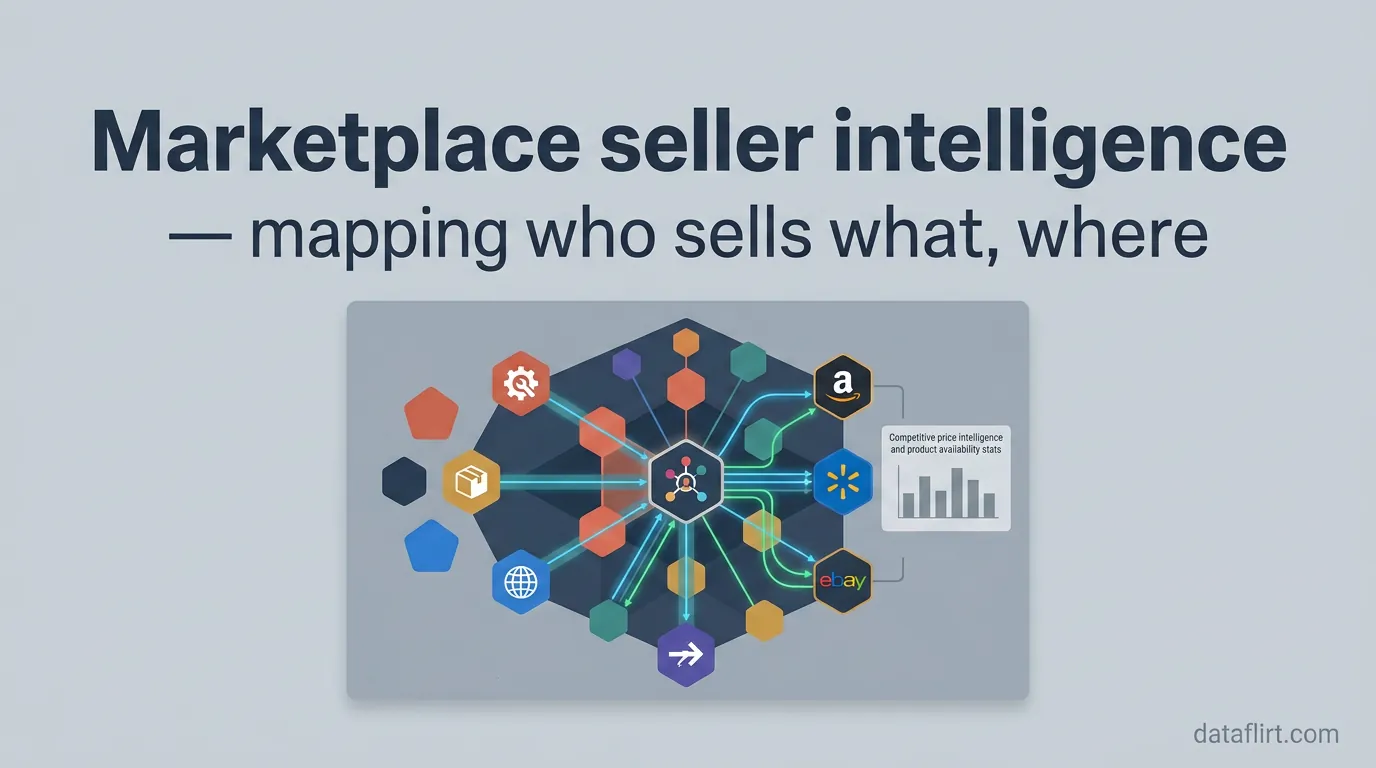
Extracting seller intelligence transforms a generic product listing into a mapped corporate entity. This data tells you exactly who owns the inventory, how fast they move it, and where they store it.
DataFlirt engineers build pipelines that pull the structural metadata behind the buy box. We focus on the persistent identifiers that platforms use to route funds. These identifiers remain static even when a merchant changes their public display name.
Defining the intelligence output
A raw HTML page contains dozens of commercial signals. DataFlirt extracts these unstructured elements and maps them into relational database tables. A comprehensive seller intelligence feed includes the merchant token, the fulfillment network status, the registered business address, and chronological sales rank snapshots.
Analysts use this DataFlirt output to reconstruct a brand’s actual operational footprint. You can see if a seller dominates a single niche or spans multiple unrelated categories. You can also map their presence across secondary platforms using cross-referenced brand registries.
Why analysts and investors need this now
The scale of platform participation has broken traditional market research methods. There are 1.9 million active third-party sellers on Amazon globally in 2025, distilled down from 9.7 million total registered accounts. Source. Sifting through that volume manually is impossible.
Investment teams use DataFlirt pipelines to automate their initial diligence phases. When evaluating an acquisition target, you need proof of consistent sales velocity. You also need to verify that the target brand actually controls their listings rather than fighting daily buy box battles with unauthorized resellers. DataFlirt provides the historical data feeds required to prove these operational realities.
How to get it and what to watch for
Capturing merchant intelligence requires tracking static identifiers chronologically rather than pulling isolated daily snapshots. You must map persistent tokens and track sales rank fluctuations at high frequencies to model true market share.
DataFlirt structures these extraction campaigns around specific anchor points. We ignore volatile display names and focus entirely on the backend variables that govern platform transactions.
Tracking the Merchant Token
A marketplace seller’s storefront display name can be changed at will to evade tracking. Sellers often re-brand or attempt to hijack existing product listings under new aliases. However, their underlying identification string remains static. This is referred to as the Merchant Token or the selling partner ID in official documentation.
Extracting this identifier is the crucial anchor for mapping multiple burner storefronts back to a single corporate entity at scale. DataFlirt pipelines isolate this token from the raw page source or intercepted background network requests. Once DataFlirt captures the token, our systems use it as the primary key for all subsequent historical tracking.
Calculating sales velocity via BSR
Amazon’s Best Sellers Rank is a dynamic metric. It is heavily weighted toward recent sales frequency. Scraping this rank chronologically provides the estimated sales velocity data required to distinguish a consistent operator from an arbitrage account experiencing a temporary spike.
DataFlirt clients typically require rank extractions at hourly or bi-hourly intervals. A single daily snapshot misses the intraday volatility that defines true sales performance. DataFlirt schedules these high-frequency crawls to build a dense time-series dataset. Analysts then apply proprietary math to convert those rank fluctuations into estimated unit volumes.
Platform variations and complexities
Every marketplace structures their seller data differently. A unified analytics dashboard requires normalizing these disparate schemas into a single format. DataFlirt handles this normalization layer automatically.
| Platform | Primary Identifier | Velocity Metric | Fulfillment Signal |
|---|---|---|---|
| Amazon | Merchant Token | Best Sellers Rank | Buy Box FBA Status |
| eBay | Seller User ID | Sold History Count | Item Location |
| Walmart | Seller ID | Review Velocity | Pro Seller Badge |
| AliExpress | Store Number | Transaction Count | Shipping Origin |
Extracting data from an Amazon scraper requires entirely different network protocols than an eBay scraper. Secondary platforms like Walmart and Target use distinct GraphQL implementations for their product grids. DataFlirt maintains custom extraction engines for each specific architecture. This ensures our clients receive unified datasets regardless of the source platform.
Common failure modes in extraction
Attempting to build these pipelines internally usually ends in blocked infrastructure. Marketplaces employ aggressive traffic shaping algorithms to protect their bandwidth. They will terminate any session that requests ten thousand product pages from a single IP address.
In-house teams frequently encounter browser fingerprinting roadblocks. Security scripts analyze your rendering engine, screen resolution, and font libraries. If the profile looks artificial, the platform serves a blank page or a captcha challenge. DataFlirt bypasses these hurdles using advanced session spoofing. We emulate standard consumer behavior to keep our extraction success rates near perfect.
Cost and infrastructure implications
Maintaining a high-frequency velocity tracking system requires massive network resources. You must purchase bandwidth through a highly resilient rotating proxy network. You also need dedicated servers to parse terabytes of raw HTML into structured tables.
Understanding these realities is vital for budget planning. Reading up on understanding scraping cost factors will clarify why bandwidth dominates the expense sheet. DataFlirt aggregates these costs for our clients. We provide a predictable pricing model based on successful record delivery rather than volatile proxy bandwidth consumption.
How to distinguish genuine sellers from drop-shippers at scale
You separate real brand operators from arbitrageurs by analyzing fulfillment network signals and shipment origin locations. High shipping costs, extended delivery windows, and erratic inventory status strongly indicate an arbitrage or dropshipping model.
DataFlirt builds specific classification rules into our extraction pipelines. We categorize sellers based on their logistical footprints before we deliver the data to your data warehouse. This automated triage saves analysts thousands of hours of manual verification.
The rise of the middleman
The global dropshipping market is an estimated $434.98 billion industry in 2025. Source. It is projected to expand rapidly over the next decade. This low-barrier business model floods major platforms with asset-light merchants who never physically touch the inventory they sell.
This creates massive data noise for investment teams. You cannot underwrite a business that relies entirely on scraping another catalog and adding a margin. DataFlirt helps you filter out these transient operators. We allow you to isolate the genuine brands holding actual physical stock.
Fulfillment API signals
Programmatic data extraction allows analysts to profile a seller’s fulfillment network accurately. Dropshippers typically exhibit strong merchant-fulfilled signals. Their listings feature extended delivery windows or origins tracing back to overseas warehousing hubs.
This sharply contrasts with the rapid platform-fulfilled standards utilized by genuine operators. Currently, 62% of the total units sold on Amazon come from third-party sellers. Source. Most serious brands in that cohort utilize the platform’s internal logistics network. DataFlirt scrapes these delivery estimates directly from the buy box. We use that logistical data to flag high-risk arbitrage accounts immediately.
Consider a private equity associate evaluating a top-ranked camping gear brand. The sales volume looks spectacular. DataFlirt extracts the delivery windows across their catalog and reveals a consistent 15-day shipping delay originating from Shenzhen. The associate immediately flags the target as a high-risk dropshipper and halts the underwriting process.
The role of independent 3PLs
Complicating this classification is the rise of alternative logistics networks. Some genuine brands choose to fulfill orders themselves to maintain quality control. In 2025, 24% of marketplace sellers now utilize an independent third-party logistics provider rather than relying solely on platform fulfillment. Source.
DataFlirt analysts know how to differentiate a domestic 3PL signal from a foreign dropshipping signal. We extract the shipping origin zip code and cross-reference it against known commercial warehouse clusters. This deeper layer of logistical data ensures you do not accidentally discard a highly profitable brand just because they manage their own freight.
Structuring the verification logic
DataFlirt structures these classifications using strict logical matrices. We apply these rulesets during the data normalization phase.
| Classification | Delivery Window | Origin Location | Platform Fulfillment |
|---|---|---|---|
| Genuine Brand | 1 to 3 days | Domestic | Yes |
| Independent Operator | 3 to 5 days | Domestic 3PL | No |
| High-Risk Dropshipper | 10+ days | Overseas / Hidden | No |
This matrix allows DataFlirt clients to sort thousands of merchants instantly. If you are specifically looking for domestic manufacturing targets, DataFlirt filters the extraction feed to only include sellers matching those exact parameters. This targeted intelligence gathering is far more efficient than buying generic market reports.
Why analysts use DataFlirt for seller intelligence
DataFlirt turns erratic marketplace HTML into structured, analyst-ready commercial feeds. We handle the heavy anti-bot friction and network orchestration so your team can focus entirely on financial underwriting and market mapping.
Building an internal extraction pipeline requires hiring dedicated data engineers to monitor page structure changes constantly. If a platform redesigns its product grid, your internal data feed breaks. DataFlirt absorbs this maintenance burden completely. Our engineers monitor target schemas around the clock to ensure uninterrupted intelligence delivery.
Scale and network resilience
Tracking the velocity of a single category might require parsing half a million product pages every few hours. Doing this without triggering platform alarms requires sophisticated network architecture. DataFlirt deploys requests across thousands of residential IP addresses. We throttle our access patterns to blend in with genuine human traffic.
This anti-bot engineering is a core DataFlirt competency. We regularly pull comprehensive datasets from highly protected sites like Best Buy and Wayfair. We apply this same resilient technology to obscure wholesale platforms like Alibaba and AliExpress to map global supply chains accurately.
Cross-platform entity resolution
A serious brand rarely limits its operations to a single website. They will maintain storefronts on Flipkart, build custom craft channels on Etsy, and run independent Shopify stores. Tracking these distinct nodes requires broad extraction capabilities.
DataFlirt builds unified intelligence files. We scrape the primary marketplace data, and then we utilize alternative data for ecommerce methods to locate matching corporate entities across the web. DataFlirt clients receive a holistic view of a brand’s total digital footprint.
Clean data integration
Raw scraped data is messy. It contains encoding errors, missing fields, and broken strings. Pouring that garbage directly into your financial models will corrupt your analysis. DataFlirt prevents this by running all extracted intelligence through a strict quality assurance layer.
DataFlirt sanitizes the text, normalizes the currency values, and structures the output exactly to your database schema. If you require JSON payloads for your engineering team or flat CSV files for your analysts, DataFlirt delivers it flawlessly. We ensure every row of data is pristine before it reaches your server.
If you would rather not scope this network architecture yourself, DataFlirt’s ecommerce scraping service handles the extraction, QA, and delivery. We map the sellers, track their velocity, and classify their fulfillment models automatically. You just ingest the clean data. Reach out to our team today for a free scoping call and a sample data extraction.
FAQ
Is scraping marketplace seller data legal?
Extracting publicly available commercial data, such as a merchant’s sales rank or business address, is generally permissible for market research. However, extracting personal consumer information or bypassing authenticated login walls introduces severe legal friction. DataFlirt focuses entirely on public product and corporate data. We strongly recommend consulting qualified legal counsel to review your specific operational use case and ensure full compliance with regional statutes.
How often should we extract seller ranks for velocity mapping?
Most DataFlirt analysts recommend hourly or bi-hourly extractions for high-volume categories. Best Sellers Rank algorithms update frequently based on recent transaction bursts. Pulling a single daily snapshot will miss intraday volatility and skew your estimated volume calculations. High-frequency tracking provides the dense data points necessary for accurate predictive modeling.
Can we use official APIs instead of scraping?
Official platform APIs are designed for merchants to manage their own inventory. They do not provide broad, market-wide intelligence or competitor sales velocities to third parties. If you want to understand how web data flows outside of those restrictive official channels, reviewing how does web scraping work will clarify why programmatic extraction is the only viable path for broad market mapping.
Does DataFlirt provide historical seller data?
DataFlirt specializes in building custom extraction pipelines tailored to your specific analytical needs. While we extract live chronological data moving forward from the start of a contract, we can also configure pipelines to scrape historical review data or past inventory snapshots if the target platform still publicly hosts that historical information. DataFlirt can also generate AI training data based on these vast historical archives.