
You need competitor catalog data to make a strategic decision. You start researching providers and immediately hit a wall of confusing pricing models. A freelancer quotes $500 for a static CSV file, while an enterprise vendor wants $5,000 a month for a live data stream. The difference in cost between a one-time scrape and a live API is enormous. How do you know which engagement model you actually need without overpaying? The answer lies entirely in how your team plans to consume the information.
Key takeaways
- One-time scrapes suit point-in-time audits and catalog migrations.
- Periodic feeds justify their cost when you act on the data weekly or daily.
- APIs are the most expensive route, reserved for software requiring real-time latency.
- The global data extraction market relies on scaling the right infrastructure to your exact consumption needs.
Three engagement models three different use cases
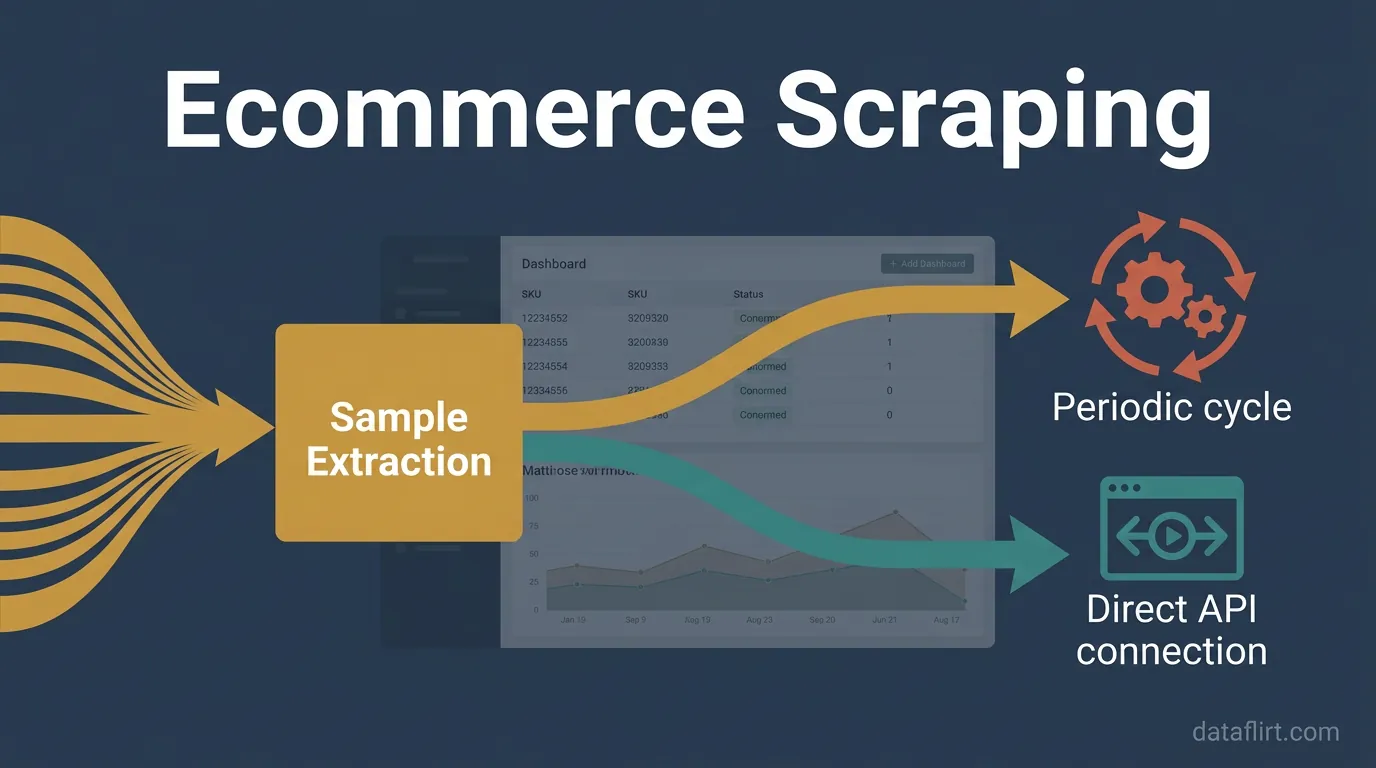
Every data pipeline project falls into one of three structural categories. These formats dictate your ongoing budget, your internal engineering burden, and your data freshness.
| Engagement Model | What it is | When to use it | Typical cost shape |
|---|---|---|---|
| One-time extraction | Single bulk pull delivered as a file with no ongoing contract | Audits, migrations, and machine learning seed data | Flat project fee based on volume |
| Periodic feed | Scheduled re-scrapes delivered to a file or database | Price monitoring and inventory tracking | Recurring monthly retainer |
| Scraping API | Live endpoint maintained continuously | Real-time software integrations | Usage-based billing or high fixed retainer |
One-time extraction
A single bulk pull involves executing a finite script across a defined target list. The vendor delivers a static file or a database dump. You have no ongoing contract. DataFlirt manages the proxy costs and the code execution for that specific snapshot in time.
This model carries the lowest financial risk. You specify the target URLs and the required fields. DataFlirt writes the extraction logic, runs the job, and provides a clean dataset. Your team imports the result into your preferred business intelligence tool.
Periodic feed
A periodic feed runs the same schema on a scheduled basis. You receive automated S3 bucket drops or direct database inserts daily or weekly. DataFlirt maintains the scraper code against site layout changes. You pay a recurring fee for the maintenance and compute.
This setup acts as a bridge between static files and real-time streams. Your operations team gets fresh data without building custom endpoint integrations. DataFlirt handles the heavy lifting of bypassing bot protections on a consistent schedule.
Scraping API
A scraping API is a continuously maintained endpoint that fetches live data at request time. Your internal software pings this endpoint. The infrastructure must bypass anti-bot protections in real time. This requires complex engineering and carries the highest cost.
Driven by a shrinking of traditional API access and demand for real-time retail intelligence, the global web scraping software market will reach an estimated $1.17 billion in 2026. Teams build against APIs to power internal dashboards or customer-facing applications. DataFlirt engineers abstract the scraping complexity behind a simple REST call.
When a one-time extraction is the right call
A flat file extraction solves immediate analytical needs where the data remains relevant for months. You avoid paying for pipeline maintenance when the target data rarely fluctuates.
Point-in-time audits and due diligence
Entering a new product category requires a deep understanding of the existing competitive landscape. A brand manager needs a comprehensive list of all competing SKUs, their price points, and their review counts. This data establishes the baseline for a market entry strategy.
Once the brand manager builds the strategy, the initial dataset loses its immediate operational value. Paying for a recurring feed provides zero additional ROI. A one-time extraction from Amazon or eBay delivers exactly what the strategy team needs to finalize their pricing models.
DataFlirt frequently handles due diligence requests for private equity firms evaluating retail acquisitions. We pull historical pricing trends and review velocities to validate a target company’s market position. The firm pays a flat fee for the intelligence and moves on.
Migration projects and system seeding
Replatforming an ecommerce website is notoriously difficult when the legacy system lacks clean export capabilities. Merchants often find their product descriptions, image URLs, and variant structures trapped in proprietary databases. Scraping the front-end provides the cleanest path to recovery.
A developer migrating a massive catalog to Shopify needs a perfectly formatted CSV file. They do not need a live API connection to their old website. A one-time export bridges the gap between the old platform and the new infrastructure.
DataFlirt maps the target site’s structure directly to your new platform’s required import schema. If you are migrating away from an archaic platform, DataFlirt extracts the data and formats it for immediate upload. This eliminates weeks of manual data entry.
Machine learning datasets and research
Training a large language model on retail terminology requires massive text corpuses. Data science teams need millions of product descriptions and customer reviews. They ingest this data once to train the model weights.
A periodic feed creates unnecessary storage bloat for a static training run. The data scientists simply need a massive JSON file delivered securely. They prioritize volume and schema consistency over real-time latency.
DataFlirt builds robust datasets for academic researchers and commercial AI teams. We can pull ten million product pages from Walmart and deliver the payload in clean JSON Lines format. You can explore our specific approach to these projects via our AI training data services page.
When a periodic feed earns its cost
Recurring feeds justify their cost when your operational workflow requires fresh market inputs at a regular cadence. If your team makes weekly adjustments based on competitor behavior, batch updates become essential.
Price monitoring and dynamic strategy
Manual price checking fails completely at modern retail scale. There is no hard API limit to how often an Amazon seller can change a product’s price. Because of this lack of a ceiling, automated repricing bots will routinely adjust an ASIN’s price dozens of times a day just to maintain the Buy Box.
Amazon changes its product prices approximately 2.5 million times per day as part of its dynamic pricing strategy. By 2026, 81% of US retailers are using automated price scraping for dynamic repricing strategies. A periodic feed captures these fluctuations at a frequency that matches your team’s ability to respond.
If your pricing analysts review margins every Monday morning, a Sunday night extraction provides the perfect input. DataFlirt schedules the run, standardizes the currency fields, and drops the file into your data warehouse. You get actionable intelligence without building a custom ingestion tool.
Stock availability and replenishment
Supply chain managers rely on competitor inventory levels to forecast their own purchasing needs. When a major competitor runs out of a popular SKU, you have a brief window to capture their lost sales. Detecting these stockouts requires consistent monitoring.
A periodic extraction against Target or Best Buy reveals exact inventory levels across regional fulfillment centers. Your team can adjust ad spend to capitalize on out-of-stock competitors. You pause the campaigns when the competitor replenishes their inventory.
DataFlirt structures these jobs to run at whatever interval your supply chain dictates. We handle the geographical proxies required to see localized stock levels. Your logistics team receives a clean spreadsheet highlighting exactly which competitor SKUs dropped to zero.
Competitor launch detection
Brand managers must know immediately when a rival introduces a new product line. Tracking category pages for new additions allows your marketing team to prepare counter-campaigns. A periodic feed automates this discovery process.
Scraping a massive catalog daily just to find ten new products wastes compute resources. DataFlirt optimizes these workflows by monitoring category sitemaps and pagination structures. We extract only the newly detected URLs and deliver the delta to your team.
This approach drastically reduces the total cost of ownership. Instead of paying to scrape 100,000 pages every day, you pay for the delta extraction. To understand how we calculate these compute expenses, review our guide on understanding scraping cost factors.
When a scraping API is worth the infrastructure
A custom API is strictly for when a software application requires data at runtime and batch processing cannot meet the latency threshold. You should only accept this level of engineering complexity when your business model demands it.
Live product integrations
Many SaaS applications abstract retail data for end users. A browser extension that compares flight prices must fetch current rates the moment a user clicks a button. A static database updated overnight is completely useless in this context.
Your application needs an endpoint it can ping dynamically. The scraping infrastructure must instantly route the request, bypass the target’s firewall, parse the HTML, and return a JSON payload. This requires sophisticated proxy management and headless browser execution.
DataFlirt builds these endpoints for enterprise clients who require seamless integration. We abstract the complexity of data extraction behind a simple REST interface. Your developers send us a URL, and DataFlirt returns the structured data milliseconds later.
Under one hour latency requirements
Certain ecommerce metrics fluctuate so rapidly that any delay renders the data obsolete. A product’s Amazon BSR does not represent its absolute sales. It is a strictly relational metric updated continually.
If an ecommerce merchant’s sales remain perfectly flat but their direct competitor has a major sales surge, the merchant’s BSR will actively drop. Amazon recalculates and updates this rank every 1 to 2 hours based on recent sales velocity. Tracking this requires near-instantaneous polling.
DataFlirt engineers APIs capable of hitting specific endpoints at high frequency without triggering blocks. We utilize rotating residential proxies to mask the polling volume. This ensures your dashboard reflects the true, real-time status of your critical SKUs.
Engineering bandwidth considerations
Building a reliable internal scraper demands dedicated engineering resources. As of late 2024, Shopify’s REST Admin API was marked as legacy. Integrations must use the GraphQL Admin API, which evaluates limits via calculated query cost rather than standard request counts.
The standard rate limit sits at 100 points/second for apps utilizing Shopify’s GraphQL Admin API. Furthermore, Shopify explicitly limits the pagination of arrays of objects to 25,000 items. Digging deeper into an array requires your developers to build complex data filtering logic.
Instead of forcing your internal team to learn GraphQL nuances and manage rate limiting protocols, you can outsource the headache. DataFlirt maintains the integration logic. Your engineers focus on your core product, while DataFlirt provides a stable, predictable data stream. You can explore the trade-offs further in our breakdown of in-house web crawler vs hosted web scraping.
The decision framework three questions
You can avoid over-engineering your pipeline by answering three practical questions about your data consumption. These questions force you to separate what sounds impressive from what your business actually needs.
How often will you act on this data?
Frequency of action determines your minimum required data freshness. If your pricing team only meets on the first Tuesday of the month to adjust retail prices, you only need data once a month. Paying for a live API in this scenario burns cash for no operational gain.
Conversely, if you run algorithmic repricing software that bids on the Buy Box every ten minutes, a weekly CSV file will destroy your margins. You must align the extraction frequency with your execution capability.
DataFlirt helps clients map their actual business cadences to technical requirements. We frequently downgrade clients from requested API builds to simple periodic feeds once we analyze their workflow. Our goal is delivering maximum utility, regardless of the engagement model.
Is this for a one-off decision or ongoing operational process?
Strategic pivots usually rely on snapshot data. Deciding whether to expand into power tools requires analyzing the current landscape on Home Depot and Wayfair. Once you decide to launch the category, the initial research phase ends.
Operational processes demand continuous fuel. Tracking the map pricing compliance of your downstream distributors requires constant vigilance. The process never ends, meaning the data flow cannot stop.
DataFlirt categorizes snapshot needs as one-time extractions. We categorize continuous fuel as periodic feeds or APIs. Clarifying this distinction internally saves months of wasted engineering effort.
Does a system need to query data at runtime or will you consume a file?
Human analysts consume files and dashboards. Software applications query endpoints. This distinction fundamentally alters how DataFlirt architects your solution.
If your end user is a financial analyst opening Excel, a live API is technically useless to them. They need a flattened, normalized CSV. If your end user is a dynamic pricing script written in Python, a CSV dropped in a bucket introduces unnecessary parsing steps.
Consider a catalogue manager tracking 40,000 SKUs across six marketplaces. Every Monday, she needs last week’s prices. A one-time weekly extraction costs her a fraction of a live API subscription, and directly matches her workflow.
DataFlirt evaluates the end destination of your data before writing a single line of code. By understanding your downstream consumption, DataFlirt ensures the delivery format accelerates your workflow. To see how these delivery choices impact pricing, read our analysis on cost factors in web scraping services.
How DataFlirt structures each engagement
We map our engineering approach directly to the delivery format that fits your internal capability. Every engagement starts with defining the target sites, such as Sephora for beauty or Etsy for handmade goods, and mapping the schema.
Scoping a one-time project
DataFlirt treats a one-time extraction as a discrete consulting project. You provide a project brief detailing the target URLs and the specific data points required. DataFlirt reviews the brief to ensure technical feasibility against the target’s anti-bot protections.
We then provide a small sample dataset. This allows your team to verify the schema matches your internal systems. Once you approve the sample, DataFlirt executes the full run and delivers the final payload.
You only pay the agreed flat fee upon successful delivery. DataFlirt absorbs the compute costs, the proxy usage, and the engineering time. You walk away with clean data and no recurring obligations.
Automating a periodic delivery
Setting up a periodic feed requires defining strict service level agreements. You agree on the schema, the delivery frequency, and the target websites, such as Alibaba. DataFlirt writes the extraction scripts and deploys them to our managed infrastructure.
We configure automated alerts to notify our engineering team if the target website changes its layout. If a layout change breaks the script, DataFlirt repairs the code before your next scheduled delivery. Your team never interacts with the underlying maintenance.
# Example of how a DataFlirt periodic feed might be configured internally
schedule_job(
    target_site="ecommerce_target",
    frequency="weekly",
    delivery_method="s3_bucket",
    schema=["title", "price", "stock_status", "review_count"]
)
You pay a predictable monthly retainer. This covers the server costs, the proxy rotation, and the ongoing maintenance engineering. DataFlirt guarantees the data arrives in your database on time, every time.
Building and maintaining an API
A custom scraping API represents a dedicated engineering partnership. DataFlirt architects a scalable endpoint designed specifically for your target sites. We handle the load balancing and the dynamic request routing required to maintain high uptime.
Your application sends a request to the DataFlirt API. Our infrastructure instantly proxies the request to the target site, executes the necessary JavaScript, extracts the payload, and returns the response. This entire process happens in milliseconds.
DataFlirt bills this service based on total request volume or through a dedicated infrastructure retainer. We provide comprehensive documentation and direct support channels for your engineering team. We monitor the endpoint 24/7 to ensure your application never experiences a data outage.
FAQ
Can I start with one-time and upgrade to periodic later?
Yes and this is often the sensible path. A one-time pull lets you verify quality before committing to recurring cost. DataFlirt is happy to scope a one-time first and evolve the engagement.
What is the minimum frequency for a periodic feed?
DataFlirt supports monthly fortnightly weekly daily or custom cadence. Monthly is the most common starting point for ecommerce competitive intelligence.
Do scraping APIs handle site structure changes automatically?
A well-maintained scraping API includes monitoring for structural changes and automated alerting when the target site changes in a way that breaks extraction. DataFlirt builds this maintenance into API engagements.
If you’d rather not scope this yourself, DataFlirt’s ecommerce scraping service handles the extraction, QA, and delivery; reach out for a free scoping call.