
You are scoping an intelligence pipeline to track competitor pricing. You need catalog data. You need review counts. The technical execution of this extraction is straightforward enough. The legal reality is entirely different. Extracting public pricing is standard business practice. Extracting personal data carries massive financial risk.
Key takeaways
- The legal distinction between product attributes and personal identifiers dictates your entire extraction architecture.
- Attempting to scrape personal details triggers immediate regulatory liability under strict data privacy frameworks.
- Platforms use aggressive technical countermeasures to permanently redact customer information from API endpoints.
- DataFlirt isolates your pipeline from privacy risks by explicitly restricting extraction to anonymized commercial signals.
- You must consult qualified legal counsel before touching any dataset containing potential seller or buyer details.
Why the distinction between public product data and personal records matters now
The distinction matters because privacy violations trigger immediate regulatory fines and permanent platform bans. Five years ago, developers scraped everything in sight. The primary fear was a polite cease-and-desist letter regarding copyright. The landscape looks completely different today.
Regulators possess sharp teeth; they use them frequently. According to legal case analysis by Cloro, 75% of web scraping lawsuits since 2020 involve privacy violations rather than just copyright or platform terms (Cloro). The era of reckless extraction is over. DataFlirt helps modern businesses adapt. DataFlirt builds pipelines explicitly designed for the current regulatory climate. We focus on scale without liability.
The shift toward aggressive privacy enforcement
Data privacy regulators are actively hunting aggressive data brokers. Total GDPR fines surpassed €4.5 billion by early 2026, with retail and ecommerce remaining primary targets for enforcement actions (Elementor). Fines are no longer slap-on-the-wrist penalties. A single mistake can bankrupt a mid-sized operation.
This is a tangible, daily operational risk. The French DPA levied a €200,000 fine against data broker KASPR specifically for unlawfully scraping user contact details and personal data (EDPB). This enforcement action proves that regulators understand how scrapers operate. They know exactly what to look for during an audit. DataFlirt ensures they find nothing objectionable in your operations. DataFlirt delivers clean commercial intelligence.
The cost of losing consumer trust
Shoppers care deeply about their data. They punish brands that fail to protect it. A massive 61% of UK shoppers report they would permanently stop purchasing from a brand after a data incident or privacy violation (WIRO Agency).
If you aggregate competitor data, you must ensure you avoid accidentally harvesting consumer traces. You cannot risk alienating your own customer base by acting recklessly. DataFlirt helps you maintain a spotless reputation. DataFlirt gives you intelligence devoid of invasive surveillance. We prioritize your brand safety above all else. For more context on navigating these frameworks, review our guide on web scraping GDPR context.
Where the boundary falls in real ecommerce seller data
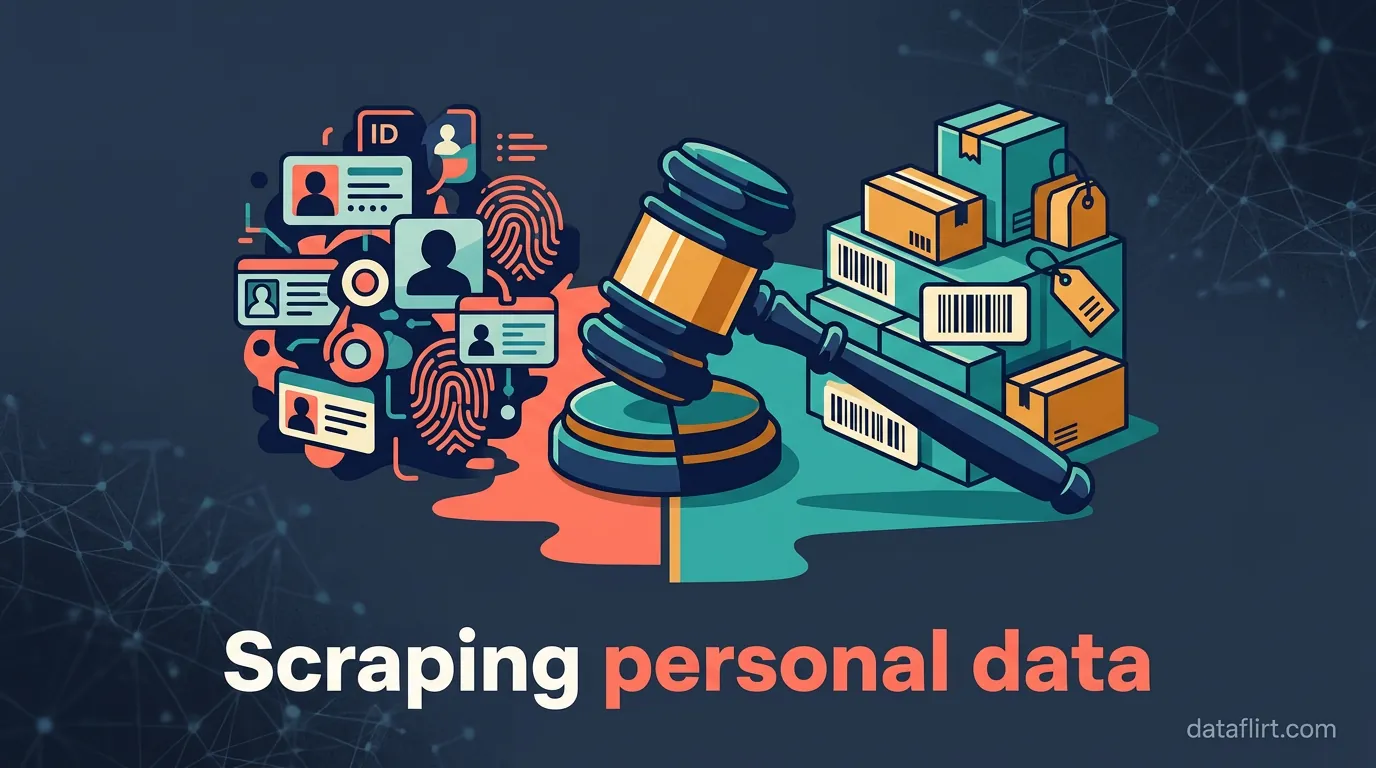
The boundary falls exactly where a commercial attribute becomes an identifiable human detail. You must evaluate every requested data field before writing a single line of extraction code.
The product data vs personal data distinction sounds clear in theory. In practice with ecommerce seller data where exactly does the line fall? The line falls the moment a business metric attaches to a specific individual’s life. A product price is public. A product dimension is public. The personal email address of the individual who listed that product is protected. You must draw a strict boundary.
| Data Category | Examples | Legal Stance | Extraction Risk |
|---|---|---|---|
| Public Product | Price, SKU, dimensions, inventory count | Generally defensible | Low |
| Public Seller | Corporate entity name, aggregate rating | Generally defensible | Low |
| Personal Identifiers | Individual seller names, email addresses | Highly restricted | Extreme |
| Consumer Traces | Username attached to a product review | Restricted | High |
Defining public product attributes
Commercial facts represent the safest category of extraction. If you target amazon or ebay, you can generally safely extract the buy box winner. The price point is a market reality. DataFlirt engineers pipelines to isolate these exact public nodes.
We focus entirely on the product itself. DataFlirt extracts the color, the weight, and the shipping tier. DataFlirt intentionally drops peripheral noise. By focusing strictly on the product, you acquire the necessary market intelligence. You avoid crossing into surveillance territory.
Identifying hidden personal identifiers
Marketplaces contain massive grey areas. Consider a scenario where you want to extract catalog data from etsy or wayfair. The seller might be a registered corporation. In that case, their corporate contact details are generally considered public business data.
However, the seller might be a sole proprietor working from their kitchen. Their business name is their personal name. Their business phone is their mobile device. In these scenarios, the legal protection shifts dramatically. DataFlirt treats these blurred lines with extreme caution. DataFlirt assumes the strictest interpretation of the law. DataFlirt drops ambiguous fields entirely to ensure your database stays pristine.
How target platforms technically enforce privacy rules
Platforms enforce privacy by permanently redacting database exports and mandating strict penetration testing for API access. They do not wait for regulators to step in; they proactively lock down their infrastructure.
If you attempt to circumvent these platform controls, you face immediate IP banishment. You also face potential litigation from the platform itself. DataFlirt respects these technical boundaries. DataFlirt operates strictly within the authorized access doctrines of the modern web.
Handling platform data redaction
Take the Shopify ecosystem as a prime example. The platform actively destroys data to protect consumers. When an ecommerce customer’s personal data is erased to comply with a Data Subject Access Request, Shopify’s database permanently replaces the information. Standard exports return the internally-set, read-only string redacted.
You cannot recover what is gone. DataFlirt builds parsers that handle these expected null values gracefully. DataFlirt ensures your pipeline does not crash when encountering a redaction.
Furthermore, Shopify now requires API apps to be explicitly approved for Protected Customer Data. If an app attempts to query restricted fields without proper permissions, the GraphQL API returns an HTTP 200 OK response. However, it strips the data. It replaces unapproved fields with a redaction error message in the errors hash. A naive scraper will ingest this error message as legitimate data. DataFlirt validates the response schema continuously. DataFlirt flags these anomalies instantly.
Navigating strict vendor retention limits
Amazon imposes equally severe restrictions on its ecosystem. Under the current Amazon Services API Data Protection Policy, developers must completely delete Amazon customer PII within 30 days of order shipment. You cannot hoard historical logs indefinitely.
DataFlirt handles these retention limits by configuring ephemeral storage architectures. DataFlirt integrates with your cloud infrastructure to manage data lifecycles automatically. DataFlirt keeps you compliant with the toughest vendor rules in the world.
To pass the mandatory Amazon SP-API Penetration Test for accessing restricted roles, developers must prove that application logs do not contain PII by default. If you must retain PII strictly for legal or tax purposes, it must be encrypted. It must move to offline cold storage isolated from active application databases. DataFlirt consults on these precise architectural requirements. DataFlirt helps you pass complex vendor audits.
What breaks when you mix public and private data extraction
Mixing public and private data contaminates your entire data lake and exposes your business to catastrophic regulatory audits. You cannot build a sustainable intelligence program on a foundation of toxic data.
The moment a single unauthorized email enters your database, every analytical process touching that database becomes legally compromised. DataFlirt views data hygiene as a mandatory engineering standard. We refuse to cut corners on isolation.
The reality of database contamination
Consider a database storing millions of records from alibaba or aliexpress. If just one percent of those rows contains an unauthorized personal email, your entire system falls under regulatory scrutiny.
You cannot easily untangle the clean data from the toxic data after the fact. DataFlirt prevents this contamination at the network edge. DataFlirt drops restricted fields before they ever hit your database. If you want to understand common misconceptions about these risks, read our breakdown of data scraping myths.
The pivot toward purely anonymized intelligence
Enterprises are reacting swiftly to this hostile environment. They are fundamentally changing how they acquire external data. A massive 68% of enterprises have shut down personal data scraping projects to shift exclusively to anonymized signals (Cloro).
The risk simply outweighs the reward. Knowing a specific seller’s email address rarely justifies a multimillion-dollar lawsuit. DataFlirt champions this pivot. DataFlirt proves that aggregated anonymous data provides superior strategic value. We deliver the commercial insights you need. DataFlirt leaves the surveillance liabilities behind.
Consider a pricing intelligence team tracking 50,000 SKUs across multiple independent vendor portals. They need the stock count and the exact price; they have no use for the store owner’s personal mobile number. A tightly scoped extraction pipeline drops the contact fields at the network edge, giving the team the market signal while completely avoiding the regulatory payload.
How to build a strictly anonymized ecommerce intelligence pipeline
Building a clean pipeline requires aggressive pre-scraping scope reduction, in-flight filtering, and continuous post-extraction auditing. You cannot scrape the entire page and filter the results in your data warehouse.
By the time the data reaches your warehouse, the privacy violation has already occurred. DataFlirt enforces the boundary before the HTTP request finishes parsing. DataFlirt engineers your extraction logic to ignore private data entirely. For a deep dive on specific terms, consult our scraping personal data glossary entry.
Pre-scraping scope reduction
The first step is ruthless scope reduction. Before aiming a spider at walmart or target, you must meticulously map the target elements. You isolate the price tag. You isolate the stock count.
You must deliberately ignore the container holding the user profile link. This approach embodies the data minimization principle. DataFlirt codes these restrictions directly into the extraction logic. DataFlirt makes compliance a mechanical certainty.
In-flight filtering and column masking
Websites change their layouts constantly. A container that held a shipping weight yesterday might hold a customer service contact today. If you blindly extract the text, you ingest a violation.
DataFlirt deploys layout change detection. If a target site like bestbuy redesigns a page unexpectedly, DataFlirt pauses the extraction. DataFlirt alerts an engineer to review the new schema. DataFlirt applies regex rules to mask anything resembling an email address. DataFlirt ensures your delivery payload remains pristine.
When a target website redesigns its layout, a previously safe element might suddenly point to a user profile block. If your pipeline lacks in-flight validation, your database will quietly ingest thousands of personal identifiers before anyone notices the breach.
Managing review data safely
Review text provides immense value for sentiment analysis. The username attached to that review creates a major liability. If you extract reviews from homedepot or macys, you must decouple the sentiment from the individual.
DataFlirt hashes the user identifier automatically. DataFlirt retains the core rating and the descriptive text. DataFlirt gives you the business value while removing the legal exposure. You receive the market sentiment in a completely sanitized format.
What DataFlirt handles to keep your data operations compliant
DataFlirt assumes total responsibility for the technical extraction boundary, ensuring your dataset contains only the commercial signals you requested. You are building an ecommerce strategy. You should not have to spend your days debugging regex filters.
DataFlirt absorbs the technical burden. DataFlirt delivers the finished product. DataFlirt operates at the highest levels of technical excellence. Our team works with you to define the exact scope of your intelligence needs. We audit your target list meticulously. If a specific target presents an unacceptable privacy risk, we advise you immediately. DataFlirt acts as a consultative partner.
The DataFlirt quality assurance layer
Every extraction run passes through our proprietary quality assurance layer. DataFlirt verifies the data types against the agreed schema. DataFlirt guarantees that numerical fields contain numbers and text fields contain safe product descriptions.
We package the data exactly how your engineers need it. We check for compliance violations before finalizing the payload. DataFlirt acts as your dedicated data engineering team. DataFlirt is the reliable engine powering your market research. Review our thoughts on top scraping compliance considerations for more insight.
Legal orientation and external counsel
Orientation is entirely separate from adjudication. While DataFlirt provides deep technical expertise regarding extraction boundaries, we are an engineering firm. We strongly recommend that every client consult qualified legal counsel for their specific situation.
Regulations change rapidly across jurisdictions. Your internal compliance team must approve the final schema. For specialized scenarios requiring advanced oversight, explore our legal web scraping services. DataFlirt provides the technical execution to make your compliant strategy a reality.
FAQ
What happens if I accidentally scrape personal data?
Accidental ingestion still triggers regulatory liability under strict privacy frameworks. You must immediately delete the data, audit your extraction logs, and update your parsing logic to prevent recurrence.
How do platforms detect scraping bots?
Platforms monitor request velocity, browser fingerprint inconsistencies, and network reputations. They also enforce strict API penetration testing and access rules to block unauthorized data requests.
Does DataFlirt provide legal advice for scraping?
No. DataFlirt provides technical extraction services and architectural orientation. You must always consult qualified legal counsel to ensure your data acquisition strategy complies with regional laws.
If you would rather not scope this yourself, DataFlirt’s ecommerce scraping service handles the extraction, QA, and delivery. Reach out for a free scoping call. Our team will audit your requirements and build a safe, reliable pipeline.