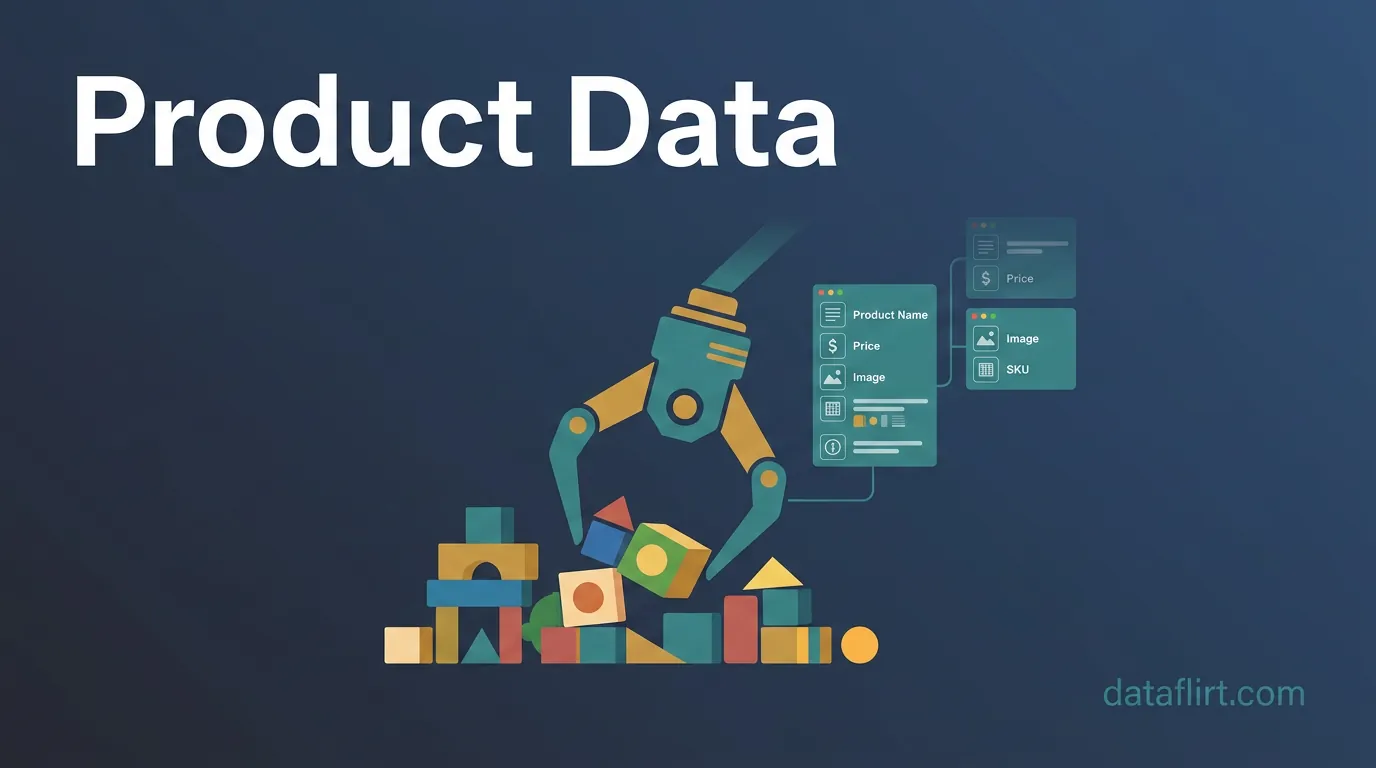

Extracting product data in the toy and game vertical requires navigating a maze of hidden compliance documents. Basic price and title scraping is insufficient for modern ecommerce intelligence. Marketplaces now mandate strict safety metadata to prevent platform liability. This critical safety data is rarely stored in clean HTML tables. You must penetrate image layers and document attachments to build a usable catalog.
Key takeaways
- Toy safety data often lives in embedded images and PDF documents.
- Age suitability strings require programmatic normalization to be useful.
- Compliance shifts are forcing sellers to display structured certificate data.
- OCR pipelines are mandatory for extracting Children’s Product Certificates.
- DataFlirt customizes extraction logic to parse these vertical-specific hurdles.
The critical fields in toys data
The required schema for a toy catalog involves dense regulatory information alongside standard marketing copy. You must capture age grading, safety certifications, material composition, and hazard warnings. These specific data points determine whether a product can legally remain on a digital shelf.
Age suitability ranges
Age grading dictates catalog taxonomy and search visibility. A raw string on a product page might read “Suitable for children 36 months to 8 years”. This plain text string is useless for database filtering. DataFlirt parses these strings into structured integer fields. You need a minimum age and maximum age stored uniformly in months.
Without normalization, filtering a catalog for toddler-safe items becomes impossible. DataFlirt transforms these inconsistent strings automatically. We convert “3+” or “over three years” into a strict min_age_months: 36 format. This normalization step is mandatory for competitive intelligence.
Safety certifications and warnings
Safety certifications are the most heavily scrutinized fields in this vertical. Products require CE, BIS, or ASTM F963 compliance badges to sell in major markets. Choking hazard warnings must be flagged as explicit boolean values in your database. The stakes for missing this data are severe.
Regulatory bodies track these failures closely. A staggering 39,145,357 product units were affected by CPSC recalls in 2025, with the “Toys” category topping the list at 28 separate recalls, according to the Sedgwick 2025 Recall Index. DataFlirt monitors these safety flags to help retailers audit their inventory automatically.
Materials and assembly specifications
Buyers and regulators care deeply about physical product makeup. You must extract plastic types, fabric contents, and chemical warnings accurately. Battery requirements form another critical extraction node. Knowing whether a toy requires lithium-ion batteries impacts shipping logistics and storage compliance.
Assembly requirements should also be extracted as structured boolean fields. A parent needs to know if a playset requires three hours of construction. DataFlirt schemas map these physical attributes explicitly. We pull these details from technical specification tabs and product description blocks.
Educational tags and brand themes
Metadata around educational value drives consumer search behavior. STEM tags, motor skill development markers, and creative play categories are highly valuable. Brand licensing dictates copyright compliance and pricing power. You must differentiate between a licensed Marvel action figure and a generic equivalent.
DataFlirt extracts these thematic tags to enrich marketplace search algorithms. The global toy market relies heavily on this structured categorization. DataFlirt engineers design targeting rules to pull these exact taxonomy breadcrumbs from the document object model.
| Field Name | Target Data Type | Common Extraction Challenge |
|---|---|---|
| Age Grading | Integer (Months) | Highly variable text formatting |
| Safety Certification | Array (Strings) | Often embedded in product images |
| Choking Hazard | Boolean | Buried in long descriptive paragraphs |
| Battery Required | Boolean | Frequently omitted from spec tables |
Where to get the data and platform notes
Finding comprehensive toy data requires targeting different tiers of online retail architectures. Dedicated toy brands offer highly structured metadata. Broad consumer marketplaces bury this same data behind complex DOM structures. DataFlirt navigates these distinct architectural differences daily.
Dedicated toy brand catalogs
Specialized toy retailers maintain the cleanest data architectures. Scraping Toysrus or Hamleys yields structured age ranges and clear safety warnings directly in the HTML markup. These platforms classify products meticulously. They build their websites with parents and gift-buyers in mind.
Extracting data from Lego provides incredibly granular specifications. Their pages include exact piece counts, thematic collections, and structured safety warnings. Lego builds highly rigid page templates. DataFlirt parsers map directly to these structured elements for perfect extraction accuracy.
Similarly, scraping Mattel yields highly standardized brand data. Their direct-to-consumer pages are optimized for detailed product specs. For regional focus, a FirstCry extraction handles the massive Indian market for baby and toddler items. FirstCry structures its catalog with strict age and material filters. DataFlirt handles the pagination logic for all these specialized domains.
Broad ecommerce marketplaces
General marketplaces present a rougher extraction environment. A standard Amazon product page hides safety compliance deep within nested image carousels. Scraping Walmart or Target involves dealing with localized inventory variations and dynamic rendering. An eBay extraction introduces user-generated descriptions lacking any standardized safety taxonomy.
Marketplaces focused on cross-border trade pose unique challenges. Pulling data from an AliExpress listing requires filtering out massive amounts of non-compliant noise. DataFlirt deploys advanced selector logic to separate verified manufacturer specs from unreliable seller text. This distinction is crucial for maintaining a high-quality database.
Online retail channels will capture 38.21% of global traditional toy and game sales in 2025, according to Mordor Intelligence. This massive volume requires automated data monitoring. DataFlirt scales to capture millions of product pages across these global giants.
Shopify and the Metaobjects API
Regulatory changes dictate new technical approaches to data storage. The European Union General Product Safety Regulation took effect in late 2024. This forces merchants to prove safety compliance directly on product pages. Shopify merchants can no longer rely on standard product descriptions to house this data.
They are rapidly transitioning to the Metaobjects API for compliance data. Extracting this data requires querying the Shopify GraphQL Storefront API. You must specifically target custom fields for manufacturer contact details and material composition. Standard HTML parsing will miss this data completely.
// DataFlirt snippet illustrating a GraphQL query for Shopify safety metaobjects
const query = `
{
  product(id: "gid://shopify/Product/123456789") {
    metafield(namespace: "compliance", key: "safety_warnings") {
      value
    }
    manufacturerContact: metafield(namespace: "gpsr", key: "eu_rep") {
      value
    }
  }
}
`;
DataFlirt interfaces directly with these API endpoints. We bypass the visual rendering entirely when targeting Shopify infrastructure. DataFlirt extracts the underlying Metaobjects accurately and maps them to your required schema.
Extraction quirks specific to this vertical
Toy data extraction breaks standard parsers. Critical safety information lives outside standard text blocks. You cannot rely on conventional scraping techniques when targeting compliance metrics. DataFlirt engineers custom solutions to bypass these specific structural hurdles.
The elephant in the room
Safety certification data for toys is often not machine-readable. It is in images or PDFs linked from the product page. This reality paralyzes basic scraping scripts. Standard data extraction tools look for text inside HTML tags.
When the CE mark or the manufacturer address is baked into a JPEG, standard tools return empty fields. You have to bridge the gap between image pixels and structured text. DataFlirt builds specific computer vision pipelines to solve this exact problem.
Parsing Children’s Product Certificates
Marketplaces strictly enforce document formats for compliance. To sell children’s toys on Amazon, sellers must upload a Children’s Product Certificate. They also need test reports from accepted laboratories. Amazon explicitly requires these files to be provided in a non-editable format.
These compliance documents are usually PDFs or high-resolution images. DataFlirt solves this by deploying OCR pipelines. Our OCR nodes process the image layers to extract the ASIN match, manufacturer address, and specific safety rule citations.
# DataFlirt snippet illustrating PDF text extraction for compliance docs
import PyPDF2
import re

def extract_cpc_data(pdf_path):
    reader = PyPDF2.PdfReader(pdf_path)
    text_content = ""
    for page in reader.pages:
        text_content += page.extract_text()

    # Extracting tracking label batch numbers via DataFlirt rules
    batch_match = re.search(r"Batch\sID:\s([A-Z0-9\-]+)", text_content)
    return batch_match.group(1) if batch_match else None
The DataFlirt engine reads the pixels and converts them back into queryable text. We run optical recognition against thousands of documents concurrently. This allows DataFlirt to output clean JSON records from locked PDF files.
Parsing compliance badges from product images
United States federal law requires tracking labels to be permanently affixed to children’s products. Amazon requires clear images of these compliance markings to verify manufacturing location and batch data. This means crucial compliance metadata is stored purely in product image carousels.
DataFlirt downloads these carousels and runs image classification models. We locate the specific image containing the warning label automatically. The DataFlirt OCR module then reads the warning text from that specific frame.
This is a critical capability for risk management. The estimated number of toy-related injuries treated in U.S. emergency rooms hit 231,700 in a single year, based on late 2025 reporting from the CPSC via W.A.T.C.H.. Retailers use DataFlirt to audit their own listings and verify that life-saving warning labels are present and legible.
Normalizing age grading strings
Age grading requires aggressive normalization. A single retailer might use twenty different formats to express the same age range. DataFlirt employs regex-based cleaning pipelines to standardize this data across multiple sources.
Consider a catalogue manager tracking 40,000 SKUs across six marketplaces. She needs every item tagged with a precise minimum and maximum age in months. A raw scrape returning “For kids three and up” or “36m+” breaks her filtering logic completely.
DataFlirt transforms these raw strings into a strict schema. We calculate the integer values automatically. This data normalization step separates a messy scrape from a production-ready database. DataFlirt handles this transformation natively within the extraction pipeline.
| Raw String Example | DataFlirt Min Age | DataFlirt Max Age |
|---|---|---|
| ”3+ Years” | 36 | null |
| ”6 to 12 Months” | 6 | 12 |
| ”For ages 8-10” | 96 | 120 |
| ”Not suitable under 36m” | 36 | null |
DataFlirt for toys catalog extraction
Scoping a toy data extraction project requires vertical expertise. You need a partner capable of parsing embedded certificates and standardizing messy age strings. DataFlirt engineers robust pipelines specifically designed for these complex regulatory environments.
Combating the counterfeit data problem
The toy vertical faces an unprecedented influx of unbranded and non-compliant products. The estimated annual revenue lost by toy manufacturers to counterfeit goods is $32 billion. This represents 11% of global revenue, making toys the second most impacted sector by global counterfeiting, according to The Toy Association.
DataFlirt helps brands track and identify these non-compliant listings at scale. By extracting manufacturer details and cross-referencing brand tags, we flag anomalies. DataFlirt pulls this precise metadata to help legal teams issue takedown notices rapidly.
DataFlirt handles the heavy lifting of navigating bot protection and rendering complex pages. Our infrastructure maintains continuous access to target sites. DataFlirt parsing logic ensures every vital safety field is captured accurately. We build the pipelines that allow you to scrape ecommerce product data without the maintenance overhead.
Ready for your data pipeline
DataFlirt delivers import-ready files formatted to your exact specifications. You define the required fields for your internal systems. DataFlirt extracts the data, normalizes the age ranges, and runs the necessary OCR processes. We manage the infrastructure so you can focus on catalog analysis.
You can learn more about scoping your project by understanding scraping cost factors on our blog. DataFlirt provides transparent pricing and reliable delivery schedules based on your target URL count and rendering requirements.
DataFlirt operates as a true extension of your engineering team. We adapt our extraction rules whenever a target marketplace changes its DOM structure. This proactive maintenance is a core part of the DataFlirt offering. Whether you need to monitor competitors or convert websites into APIs, DataFlirt delivers the precision required.
FAQ
How do you extract safety certificates from product images?
DataFlirt utilizes Optical Character Recognition technology to scan image carousels and PDF files. We locate compliance badges and convert the pixel data into structured, queryable text for your database.
Why is age grading normalization important?
Marketplaces use wildly different text formats to display age suitability. DataFlirt normalizes these varied strings into standardized minimum and maximum integer values stored in months. This allows your internal systems to filter and sort the data accurately.
Can scraping help identify counterfeit toy listings?
Yes. By extracting manufacturer details, brand tags, and compliance certificates at scale, brands can audit marketplaces for unauthorized sellers. DataFlirt pulls this precise metadata to help you identify missing safety documentation and flag potential counterfeits.
If you are ready to automate your compliance auditing and catalog monitoring, DataFlirt manages the entire pipeline. If you would rather not scope this yourself, our ecommerce scraping service handles the extraction, QA, and delivery. Reach out to DataFlirt for a free scoping call and get your toy data formatted exactly how you need it. We also support broader supplier tracking through our B2B marketplace scraping solutions.