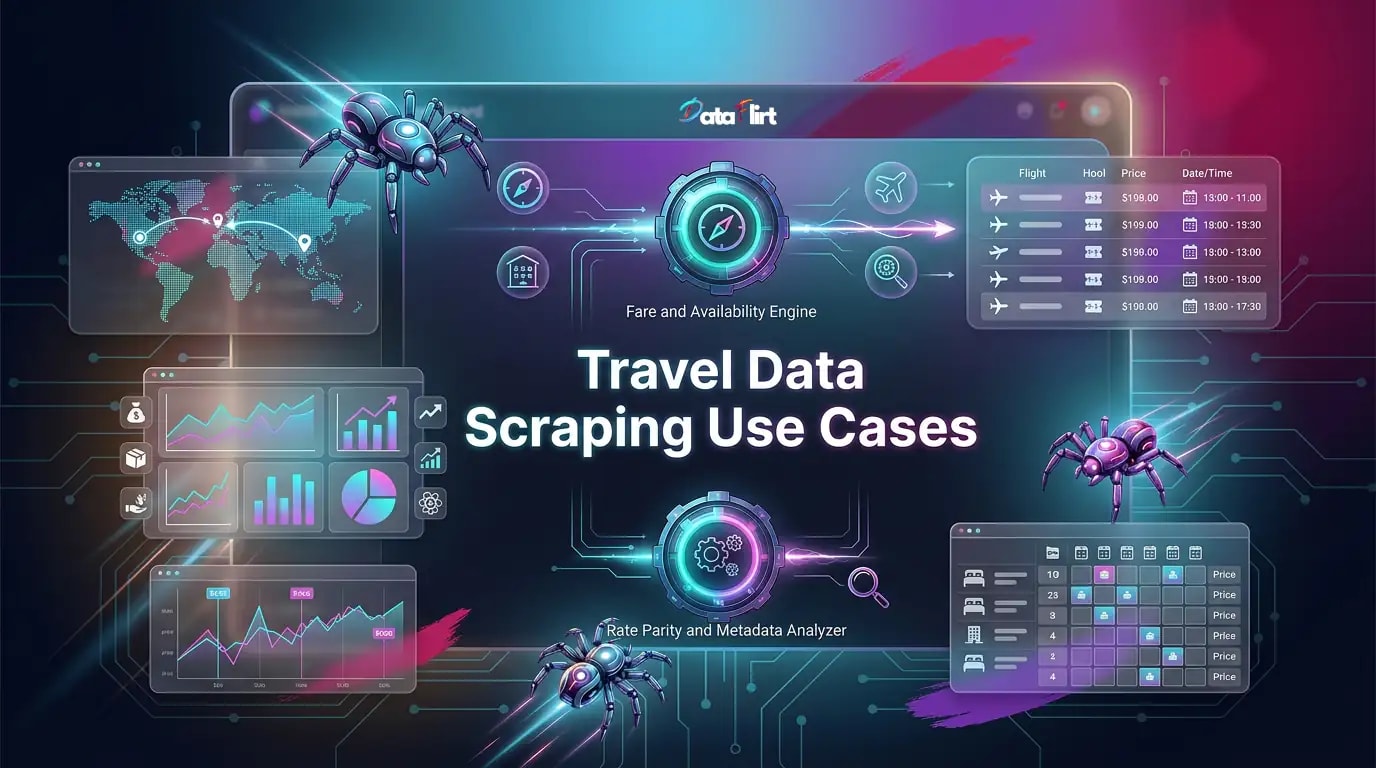

The $11.4 Trillion Pricing Blind Spot: Why Travel Data Scraping Is Now Commercially Critical
The global travel and tourism market is projected to reach $11.4 trillion in economic contribution by 2027, according to the World Travel and Tourism Council’s forward estimates. Airlines globally carried over 4.5 billion passengers in 2024, a figure that had recovered to pre-pandemic peak levels by mid-2023 and continued climbing through 2025. The hotel industry generated approximately $600 billion in global revenues in 2024. Short-term rental platforms now command an inventory count of over 7.7 million active listings worldwide.
These are not abstract market statistics. They represent billions of pricing decisions made every single day, at every price point, across every geography, in an industry that has moved from static tariff pricing to fully dynamic, algorithmically driven revenue management over the past fifteen years.
And yet, despite this scale and this sophistication, the data infrastructure that most travel businesses rely on for competitive intelligence remains dangerously incomplete.
Licensed GDS feeds give airlines and OTAs access to structured fare data, but they capture only what is filed through the system, not what is actually displayed to the consumer at the moment of search. Hotel rate intelligence platforms offer competitive rate snapshots, but they run on scraping architectures that refresh every 4-24 hours and aggregate data in ways that mask the granular signals that actually drive revenue decisions. Review platforms license their sentiment data, but the delivery latency and field restrictions make them analytically thin compared to what a direct data extraction program produces.
This is the intelligence gap that travel data scraping directly and systematically addresses.
“The gap between what a GDS tells you and what a consumer actually sees when they search for your route on a major OTA is the gap where your revenue is lost. Travel data scraping closes that gap.”
The scale of publicly accessible travel intelligence on the open web is staggering. A major global OTA surfaces real-time pricing across over 300 airlines and more than 2.5 million hotels and accommodation properties. Airline websites publish thousands of dynamic fare combinations per route per day, updated in near-real-time based on demand and inventory signals. Rental platforms list nightly rates, minimum stays, availability calendars, and guest review scores across tens of millions of properties. None of this data is available through any licensed commercial feed at the granularity, freshness, and coverage that the web itself provides.
Travel data scraping is the systematic, programmatic extraction of this intelligence at scale. When executed with the right data quality controls, structured with appropriate schema standardization, and delivered in formats that integrate cleanly into existing revenue management and analytics workflows, it becomes one of the highest-leverage data capabilities a travel business can build.
This guide is not written for engineering teams. It is written for revenue managers who need to understand whether scraped fare data is reliable enough to feed into their pricing models, for product managers who want to know what OTA content intelligence can tell them about competitor conversion optimization, for data leads who need to specify a travel data acquisition architecture that actually survives contact with their model pipelines, and for growth teams who want to use destination trend data to time campaigns with precision they have never had before.
For foundational context on how data acquisition disciplines are evolving across commercial verticals, DataFlirt’s overview on data scraping for enterprise growth provides a useful starting framework.
The Personas Who Extract the Most Value from Travel Data Scraping
Before establishing what travel data scraping delivers, it is worth being explicit about who is reading the output. The same underlying dataset, say, a daily feed of airfare prices and availability across a set of competitor routes, will be consumed through five entirely different analytical frameworks depending on who is sitting at the other end of the data pipeline.
Understanding this role-based consumption model is the most important design principle for any travel data acquisition program. A dataset optimized for one persona will actively fail another if the quality requirements, delivery format, and refresh cadence are not specified with each consumer in mind.
The Revenue Manager
Revenue managers at airlines, hotel groups, cruise lines, and short-term rental platforms are the most operationally dependent consumers of scraped travel data. They are making pricing decisions continuously, and those decisions directly determine realized revenue per seat, per room, or per booking night.
For a revenue manager, travel data scraping is not supplementary research. It is the real-time market signal that their dynamic pricing models depend on. Without current, granular, competitor fare and rate data, their pricing algorithm is operating on assumptions rather than evidence.
What a revenue manager needs from scraped travel data:
- Competitor fares by route, by cabin class, by booking window, refreshed intraday
- Rate parity signals: where is the hotel group’s rate appearing on OTAs versus the direct channel?
- Availability inventory signals: how many seats or rooms does a competitor have left at each price point?
- Promotional rate detection: when did a competitor launch a discount, at what depth, and for how long did it persist?
- Ancillary pricing: what is the competitor charging for baggage, seat selection, or breakfast inclusions?
- Review velocity and rating movement as a demand signal for competitive properties or routes
The Product Manager at an OTA or Travel Tech Platform
Product managers building booking platforms, metasearch tools, travel content management systems, or AI-powered itinerary planners have a fundamentally different relationship with travel market intelligence than their revenue management counterparts. They are not making pricing decisions; they are making product decisions. And the inputs those decisions require are structural and comparative, not transactional.
What a product manager extracts from travel data scraping:
- Content quality benchmarks: how complete are competitor property listings? how many photos, what descriptions, what amenity data?
- Search and filter UX patterns: what data fields do leading OTAs expose in their sort and filter interfaces, and what does that tell you about what consumers are prioritizing?
- Pricing architecture intelligence: how are competitors structuring tiered pricing, loyalty discounts, and bundle pricing within their booking flows?
- Inventory gap analysis: which routes, destinations, or property categories have thin competitor coverage, representing potential supply-side opportunities?
- Review ecosystem monitoring: how are competitors managing their review response rate and sentiment trajectory across platforms?
The Data Science and Analytics Lead
Data leads at travel companies are the infrastructure layer that every other team depends on. Demand forecasting models, price elasticity engines, ancillary revenue optimizers, and customer lifetime value models all require continuous, high-quality travel data inputs. The ceiling performance of every model is determined by the quality and freshness of the scraped travel data feeding it.
For data science teams, the primary concern with any travel data acquisition program is not coverage breadth but data architecture quality: schema consistency across heterogeneous source portals, deduplication logic that correctly resolves the same fare or rate appearing across multiple aggregator platforms, and delivery reliability that does not introduce random gaps in training data timelines.
A model trained on travel data with 85% field completeness on critical pricing fields will systematically underperform one trained on data with 97% completeness. This is not a marginal difference; it is a revenue-material difference in the accuracy of every pricing recommendation the model produces.
The Growth and Marketing Team
Growth and marketing teams at airlines, hotel groups, travel insurance companies, tour operators, and travel SaaS businesses use scraped travel data in ways that are frequently invisible to the rest of the organization, and they represent some of the highest-ROI applications of travel market intelligence.
They are mapping destination search trend data to time campaign launches ahead of demand peaks. They are tracking competitor promotional campaign visibility across OTA storefronts to calibrate their own spend. They are using scraped review data to identify the specific product dimensions where their brand is winning and losing sentiment share. They are pulling destination-level supply data to identify emerging markets before they become saturated.
For growth teams, travel data scraping is fundamentally a targeting and timing asset. The question they are asking is not “what is the market pricing at?” but “where is the market moving, and how do we position ourselves in front of that movement before our competitors do?”
The Revenue Strategy and Commercial Team
Commercial teams at travel businesses including airline alliances, hotel management companies, and destination management organizations use travel data scraping at a strategic planning level. They are not making daily pricing calls; they are making quarterly and annual decisions about route expansion, market entry, partnership structures, and distribution channel strategy.
For these teams, the most valuable output of travel data scraping is not the granular daily price feed but the aggregated trend intelligence: how is demand evolving in specific origin-destination markets over rolling 90-day windows? which distribution channels are capturing an increasing share of bookings for a specific competitor? which ancillary revenue categories are competitors successfully monetizing that the commercial team has not yet activated?
What Travel Data Scraping Actually Delivers: A Taxonomy
Travel data scraping is not a monolithic activity. The data that can be systematically extracted from airline websites, OTA platforms, accommodation aggregators, review ecosystems, and ancillary service portals spans an enormous range of data types, each with distinct utility for different business functions. Being explicit about this taxonomy is essential for specifying a travel data acquisition program that delivers exactly what each team needs.
Fare and Availability Data
This is the highest-frequency, highest-stakes category of scraped travel data. Airfare is one of the most dynamically priced commodities on the planet, with prices changing thousands of times per day on high-demand routes based on seat inventory, booking window, day of week, competitive signals, and algorithmic demand forecasting.
Scraped fare data from airline websites and OTA platforms typically includes: origin and destination city pair, flight number and operating carrier, departure and arrival datetime, cabin class, booking class code (the lettered fare bucket that determines refund conditions and upgrade eligibility), base fare, taxes and surcharges, total displayed price in local currency, available seats at that price point (where surfaced), fare rules summary (change fee, cancellation policy), and the timestamp of the observation.
The richness of fare data varies significantly by source. Airline direct channel websites surface the most complete fare condition data. OTA platforms surface the consumer-facing price and often reveal promotional pricing logic that the airline’s own website does not. Metasearch platforms aggregate across multiple booking channels and reveal distribution channel price disparity in real time, which is among the most commercially valuable signals in the entire travel data ecosystem.
Hotel and Accommodation Rate Data
Hotel rate data is the accommodation equivalent of airfare data: a continuously moving pricing signal that reflects demand, inventory, competitive positioning, and distribution channel strategy simultaneously.
Scraped hotel and accommodation data from OTA platforms, direct booking engines, and accommodation aggregators typically includes: property identifier and name, star rating or property category, room type description, board basis (room only, bed and breakfast, half board, all inclusive), rate amount in local currency, number of available rooms at that rate (where surfaced), cancellation policy type (free cancellation versus non-refundable), booking platform (the OTA channel on which the rate appears), promotions applied (member rate, early booking discount, last-minute deal), review score and review count, and rate timestamp.
The rate parity dimension of hotel data extraction deserves specific mention here. Rate parity, the contractual requirement for hotels to offer the same rate across all distribution channels, is systematically violated in practice across the hotel industry. Scraped hotel rate data across multiple OTA channels simultaneously is the only practical method for detecting and quantifying these violations at scale. For hotel revenue managers, this is not an academic concern: rate parity violations directly erode direct booking share and increase distribution cost on every booking diverted to a higher-commission OTA channel.
Short-Term Rental and Alternative Accommodation Data
Short-term rental platforms have emerged as a material share of the total accommodation inventory in virtually every major global destination. Scraped data from rental listing platforms includes: nightly rate by date, minimum stay requirements, cleaning fees, security deposit, availability calendar status, property type and bedroom configuration, amenity set, review score and review count, host response rate, superhost or premier host status, listing quality indicators (photo count, description length, verified amenities), and seasonal pricing variance.
For hotel revenue managers benchmarking against the short-term rental competitive set, for travel insurance underwriters assessing accommodation risk profiles, and for destination management organizations tracking supply dynamics, rental platform data extraction provides market intelligence that simply does not exist anywhere else in a commercially accessible format.
Review and Sentiment Data
Review data from OTA platforms, accommodation review sites, airline review aggregators, and general travel feedback platforms is one of the highest-signal categories of scraped travel data for product and marketing teams. It captures what travelers actually experienced, in their own words, with structured metadata that enables systematic analysis.
Scraped review data typically includes: review title and full text, overall rating, dimensional ratings (cleanliness, location, service, value, facilities), reviewer nationality or origin market, travel party type (solo, couple, family, business), stay date, review date, response from property or carrier, helpful votes, and the platform from which the review was collected.
The velocity of this data matters enormously. A hotel that experiences a service failure on a Friday will typically see its review score begin to move by Monday if the failure generated significant volume. Travel data scraping that captures review data on a daily or weekly cadence provides an early warning system for reputation events that a monthly report cycle would miss entirely.
DataFlirt’s overview of scraping customer reviews for business intelligence provides deeper context on how review data extraction integrates with broader brand management workflows.
Destination and Content Trend Data
Destination trend data extracted from travel content platforms, search aggregators, and travel media properties captures the demand signal upstream of the booking decision. It tells a story about where consumers are looking, before they have decided to book. This includes: search volume by destination (where surfaced through transparent OTA tools), featured destination promotion frequency across platform homepages, content publication velocity on destination pages, package bundling patterns (which destinations are appearing in curated packages and with what ancillary pairings), and editorial trend metadata.
For growth and marketing teams, destination trend data from travel platforms is one of the most valuable and underutilized outputs of travel data scraping. It enables campaign timing decisions based on actual consumer demand signals rather than historical seasonality assumptions.
Ancillary Pricing Data
Ancillary revenue represented approximately 28% of total airline revenue in 2024, according to IdeaWorksCompany’s global ancillary revenue report. For full-service carriers, that translates to tens of billions of dollars annually in fees for checked baggage, seat selection, onboard services, and travel insurance.
Scraped ancillary pricing data from airline direct channels and OTA booking flows captures: baggage fee schedules by route and cabin class, seat selection fee by seat category and aircraft type, priority boarding fee, in-flight meal and service pricing, travel insurance product pricing displayed at checkout, credit card and payment surcharge structures, and upgrade offer pricing by segment and booking window.
For airline product teams and revenue managers, scraped ancillary data from competitor routes is among the most commercially sensitive and strategically valuable outputs of any travel data scraping program.
For a comprehensive overview of the technical architecture behind large-scale travel data collection, DataFlirt’s breakdown of large-scale web scraping challenges provides essential context on the engineering decisions that determine data quality outcomes.
Role-Based Data Utility: How Each Team Actually Uses Scraped Travel Data
Understanding what travel data scraping collects is not the same as understanding how it creates value. This section maps each persona’s specific analytical workflows to the scraped travel data that powers them.
Revenue Managers: Dynamic Pricing and Rate Parity in Real Time
Revenue management is where travel data scraping creates the most immediate, most measurable commercial impact. The gap between a revenue manager operating on competitor data that is 48 hours stale and one operating on data refreshed every 6 hours can represent a 3-8% difference in realized revenue per available seat or room in a high-demand market window.
Dynamic Pricing Calibration:
Airlines and hotels have operated algorithmic dynamic pricing for decades, but the quality of those algorithms is directly proportional to the quality of their competitive data inputs. A pricing model that adjusts fare or rate based on competitor signals requires competitor signals that are:
- Granular enough to distinguish between different fare conditions, not just headline prices
- Fresh enough to capture intraday pricing movements in high-demand windows
- Complete enough to cover the full competitive set, not just the top two or three competitors
- Consistent enough in schema to be fed directly into the pricing engine without manual pre-processing
Travel data scraping, when executed with a properly designed data quality pipeline, delivers all four of these requirements simultaneously. GDS data, by contrast, captures filed fares but misses dynamic promotional pricing that airlines increasingly deploy outside the GDS channel entirely.
Rate Parity Monitoring for Hotels:
Rate parity violations are endemic in the hotel distribution ecosystem. Travel data scraping across all major OTA channels simultaneously, matched to direct channel rates via the hotel’s own booking engine data, creates a real-time rate parity dashboard that identifies violations by property, by OTA, by room type, and by date. For a hotel group managing 200+ properties, this is only achievable through automated travel data scraping; manual monitoring at that scale is operationally impossible.
The commercial consequence of undetected rate parity violations is significant and compounding. Each booking diverted from the direct channel to an OTA with a lower rate costs the hotel group the OTA commission (typically 15-25% of room revenue) on a booking that the direct channel could have captured. Across a portfolio, this represents millions of dollars in unnecessary distribution cost annually.
Demand Signal Integration:
Beyond competitor pricing, scraped availability data (where portals surface remaining inventory signals, such as “only 2 rooms left at this price” or “7 seats remaining”) provides a demand signal that revenue managers can use to calibrate their own inventory release strategies. If a competitor is surfacing low-inventory signals on a specific date, it is a strong indicator of market demand acceleration that should trigger corresponding pricing adjustments.
DataFlirt Insight: Revenue management teams that integrate scraped competitive rate data into their pricing workflows typically report a 6-12% improvement in rate optimization accuracy compared to teams relying on GDS data alone. The gains are most pronounced in markets with high short-term rental competition and on routes with significant low-cost carrier pricing volatility.
For a deeper understanding of hotel pricing optimization through scraped data, DataFlirt’s specialized guide on hotel price scraping and optimization strategy covers the specific data architecture decisions that drive results in hospitality revenue management.
Product Managers at OTAs and Travel Tech Platforms
Product managers at travel technology companies use travel market intelligence derived from scraped data in ways that are structurally different from their revenue management counterparts. Their outputs are product decisions, not pricing decisions. The questions they are asking are: what are leading OTAs doing in their booking flows that we are not? where are the content quality gaps in our property listings relative to the competitive benchmark? what data fields are high-converting competitors surfacing that we are missing?
Competitive Content Benchmarking:
Travel data scraping enables product managers to systematically audit the content quality of competitor property and route listings at scale. A manually conducted content audit across 10,000 competitor hotel listings is a weeks-long exercise. A programmatic content audit via travel data scraping is a daily refresh. The specific dimensions of content benchmarking that scraped data supports include:
- Photo count per listing, photo resolution quality indicators, and photo content categorization (exterior, room, amenities, dining)
- Description length and structured data completeness (amenity fields, location data, policy fields)
- Review response rate and sentiment management patterns
- Trust badge and certification display patterns (sustainability labels, health and safety certifications, accessibility compliance indicators)
- UX merchandising elements: urgency signals, social proof displays, member-rate visibility, and free cancellation prominence
Pricing Architecture Intelligence:
For OTA product teams, understanding how competitor platforms are architecting their pricing display, not just what prices they are showing, is as important as the price signal itself. Scraped travel data captures whether competitors are showing total price or nightly rate in search results, how they are surfacing taxes and fees, where they are placing free cancellation messaging in the visual hierarchy, and how they are structuring bundle pricing for flight-plus-hotel packages. These are conversion optimization signals of significant commercial value.
Destination Coverage Gap Analysis:
For OTAs expanding their destination coverage, scraped travel data from competitor platforms provides a systematic map of where competitors have deep inventory coverage versus where they have thin supply. A destination with high search-demand-to-inventory ratios in competitor data represents a supply-side partnership opportunity. Travel data scraping makes this analysis repeatable and continuously updated rather than a quarterly snapshot exercise.
Data Science and Analytics Teams: Model Inputs That Actually Work
For data science teams at travel companies, the value of travel data scraping is entirely a function of data quality architecture. A raw scrape of a major OTA’s fare data contains duplicate records, inconsistent fare condition taxonomies, currency conversion errors, and booking class codes that vary in meaning between different carrier configurations. None of this raw scraped travel data is model-ready without a structured quality pipeline between collection and delivery.
Demand Forecasting Model Maintenance:
Demand forecasting models for airlines, hotels, and OTAs require continuous retraining as market conditions evolve. A model trained on pre-2024 demand patterns will systematically underforecast demand in markets experiencing travel recovery acceleration and will misread the impact of new low-cost carrier route launches. Continuous travel data scraping provides the fresh data stream that keeps demand forecasting models calibrated to current market reality.
The specific data inputs that data science teams need for demand forecasting include: historical fare availability snapshots by booking class over rolling 12-month windows, search volume proxies derived from OTA availability query response patterns, review velocity as a leading demand indicator at the property level, competitor route capacity changes (aircraft gauge upgrades, frequency additions, route suspensions), and promotional campaign timing signals extracted from competitor OTA storefronts.
Price Elasticity Modeling:
Price elasticity, how demand responds to price changes at different booking windows, cabin classes, and market segments, is one of the most commercially critical analytical outputs any travel data science team produces. Calibrating a price elasticity model requires observed price-to-demand relationships across a range of market conditions, including competitor pricing moves and their demand consequences.
Travel data scraping is the only practical source for this data at the required granularity. It captures the actual prices that were displayed to consumers, at specific booking windows, on specific dates, alongside the availability signals that proxy for realized demand. No licensed data product provides this combination.
Ancillary Revenue Optimization:
Airlines generating 28%+ of total revenue from ancillary fees have built substantial analytical infrastructure around ancillary pricing optimization. The inputs to these models include scraped ancillary pricing data from competitor routes, traveler segment-level ancillary uptake rates (where surfaced through review metadata and booking flow analysis), and bundling pattern data extracted from competitor checkout flow structures.
DataFlirt’s analysis of data quality assessment methodologies provides a practical framework for the quality standards that data science teams should specify before commissioning any travel data scraping program.
Growth and Marketing Teams: Destination Intelligence and Campaign Timing
Growth teams at travel companies have historically operated on a combination of historical seasonality data and intuition when making decisions about campaign timing, destination promotion, and market entry prioritization. Travel data scraping changes this equation fundamentally by providing a demand signal that is current, granular, and competitive.
Campaign Timing Optimization:
The most impactful application of scraped destination trend data for growth teams is campaign timing. A marketing team launching a Caribbean winter sun campaign based on historical January booking peaks is operating on assumptions about when consumers start looking. A team with scraped OTA destination trend data can see, in near-real-time, when search activity for Caribbean winter departures begins accelerating, and launch their campaign 10-14 days earlier than historical patterns would suggest.
In highly competitive travel marketing environments, this timing advantage translates directly to lower cost-per-acquisition at higher conversion rates, because the campaign reaches consumers in the early-consideration phase before the market saturates with competitor messaging.
Competitive Promotion Monitoring:
Growth teams that track competitor promotional visibility across OTA storefronts through travel data scraping gain an early warning system for competitive marketing moves. When a competitor airline launches a flash sale on a key leisure route, scraped OTA storefront data captures that promotional placement within hours. The growth team can respond with counter-positioning within a decision cycle that manual monitoring would have missed entirely.
Market Entry Territory Scoring:
For travel companies evaluating expansion into new origin markets, destination markets, or accommodation categories, scraped travel data provides the market sizing and competitive intensity signals needed to score and prioritize opportunities. The specific variables that growth teams extract from travel data scraping for territory scoring include: total inventory depth at target destinations, average competitor review score distributions, price band segmentation by property or route category, OTA market share by listing volume, and review velocity as a proxy for current demand momentum.
For context on how search behavior and consumer demand signals are captured through web-based data extraction, DataFlirt’s analysis of predicting what customers want through data applies directly to the travel sector’s demand intelligence challenge.
Operations and Commercial Strategy Teams
Operations teams at airlines, hotel groups, and travel management companies use travel data scraping in the most functionally specific mode: they are making operational decisions that need to be informed by current competitive data, not historical analysis.
Capacity and Schedule Benchmarking:
Airlines monitoring competitor schedule and capacity changes use scraped schedule data from OTA platforms as an early indicator of competitive capacity moves, which is often more current than official airline schedule filings. A competitor adding frequencies on a key route will see those frequencies appear in OTA search results before they are reflected in official schedule databases, providing an early signal for capacity strategy adjustment.
Accommodation Portfolio Benchmarking:
Hotel management companies operating branded portfolios use travel data scraping to benchmark individual properties within their portfolio against a defined competitive set on a continuous basis. Metrics tracked include: relative review score trajectory, rate positioning relative to comp set, OTA visibility (does the property appear in the top results for its competitive category?), and promotional participation rate versus comp set.
Travel Management Company (TMC) Intelligence:
Corporate travel management companies use scraped travel data to benchmark the rates their clients are paying against current market rates for the same itineraries. This rate benchmarking service, powered by travel data scraping, is an increasingly core value proposition for TMCs competing on transparency and demonstrated cost savings for corporate travel programs.
For additional context on how competitive data extraction supports commercial strategy across industries, DataFlirt’s guide on datasets for competitive intelligence provides a useful cross-sector framework.
One-Off vs Periodic Travel Data Scraping: Two Fundamentally Different Strategic Modes
The most consequential architectural decision in any travel data acquisition program is whether the need is one-off or periodic. These are not variants of the same product. They are fundamentally different data delivery architectures that serve fundamentally different business needs.
When One-Off Travel Data Scraping Serves the Business Need
One-off travel data scraping is the right tool when the business question has a defined, bounded answer that does not require continuous updating. The intelligence value of a point-in-time dataset decays at a rate proportional to the velocity of the market being studied. In travel, markets can move significantly within 24-72 hours in peak demand windows. However, for certain strategic use cases, a well-executed one-time dataset is precisely what is required.
Market Entry Research:
An airline evaluating entry on a new route needs a comprehensive competitive intelligence snapshot: which carriers are currently operating the route, at what frequency, at what fare levels across all booking windows, with what ancillary structures, and to what OTA distribution depth? A rigorous one-off travel data scraping engagement that captures all of these dimensions across a defined time window provides the analytical foundation for a route entry decision without the overhead of a continuous data feed.
Route Suspension or Capacity Decision Support:
When an airline is considering suspending a low-performing route or reducing gauge, a one-off competitive analysis using scraped travel data validates whether the performance issue is endogenous (carrier-specific) or market-wide. If competitor carriers are showing the same booking window pressure and pricing deterioration on the same route, the signal is market structural. If only the carrier commissioning the analysis is showing those patterns, the signal is competitive positioning.
Hotel Portfolio Acquisition Due Diligence:
Investment firms or hotel management companies conducting due diligence on a hotel portfolio acquisition use one-off travel data scraping to validate the seller’s representations about competitive positioning, rate performance, and review score trajectory. A point-in-time scraped dataset of the acquisition target’s competitive set, captured over a 30-day collection window immediately prior to the deal, provides a third-party validated benchmark that no seller-provided data can replicate.
Product Launch Competitive Audit:
Product teams at OTAs and travel tech companies launching a new feature, a new destination category, or a new pricing model use one-off travel data scraping to audit the current competitive landscape before launch. Understanding exactly what competitors are offering at the moment of your own launch is a prerequisite for differentiated positioning.
Characteristic data requirements for one-off travel data scraping:
| Dimension | Requirement |
|---|---|
| Coverage | Maximum breadth across all target portals and competitive properties or routes |
| Depth | Maximum field completeness per record, particularly for pricing condition metadata |
| Timestamp precision | Explicit observation timestamp accurate to the minute for fare data |
| Documentation | Full data provenance including source URL, scrape timestamp, and schema mapping |
| Delivery | Structured flat files or direct database load, delivered within a defined SLA |
| Validation | Cross-portal consistency check to identify systematic collection gaps |
When Periodic Travel Data Scraping Is the Only Option
Periodic scraping is non-negotiable when the business decision is a function of how the market is moving, not where it is at a single point in time. In travel, this describes the majority of operational and revenue decisions.
Dynamic Pricing Calibration:
Airlines and hotels operating dynamic pricing algorithms cannot calibrate those algorithms on data that is more than 6-24 hours old in high-demand windows. A competitor’s flash sale launched on Tuesday afternoon will be over by Wednesday morning. A pricing model that does not capture that event in near-real-time will miss both the competitive pressure during the sale window and the demand recovery signal after it ends. Intraday refresh of scraped competitive fare and rate data is the operational data infrastructure that makes dynamic pricing function correctly.
Rate Parity Monitoring:
Rate parity violations can emerge within hours of an OTA updating its pricing algorithms or a competitor property making a rate adjustment. A hotel group monitoring rate parity across 200 properties and 15 OTA channels needs at minimum a daily refresh of scraped rate data across all channels to detect violations before they compound. In premium markets where OTA commission rates are highest, same-day detection can prevent meaningful distribution cost leakage.
Demand Forecasting Model Maintenance:
Machine learning models used for demand forecasting degrade when their training data distributions drift from current market conditions. A model trained in Q1 2026 on data from Q1 2025 will systematically misforecast demand in markets experiencing structural change: new route launches, destination recovery, or competitive capacity shifts. Continuous periodic scraping provides the fresh data stream required to retrain forecasting models on a rolling basis without data gaps.
Review and Sentiment Monitoring:
For hotel groups, airlines, and OTAs managing brand reputation across multiple review platforms, weekly or daily scraped review data is the early warning system for reputation events. A service failure that generates 15 negative reviews in 48 hours is visible in a daily scraped review feed and invisible in a monthly report.
Recommended cadence by use case:
| Use Case | Recommended Cadence | Rationale |
|---|---|---|
| Dynamic pricing calibration | Intraday (every 4-6 hours) | Fare and rate moves are intraday events |
| Rate parity monitoring | Daily | Violations can emerge and compound within 24 hours |
| Flash sale detection | Intraday | Promotions can launch and expire within hours |
| Review monitoring | Daily to weekly | Reputation events accelerate over 48-96 hours |
| Demand forecasting inputs | Weekly | Model drift is gradual; weekly refresh is sufficient |
| Market entry competitive audit | One-off | Point-in-time decision with 60-90 day validity |
| Product competitive benchmarking | Monthly | Product architecture changes slowly |
| Destination trend analysis | Weekly | Consumer demand signals move on weekly rhythms |
| Ancillary pricing intelligence | Weekly | Ancillary pricing changes less frequently than base fares |
| Portfolio benchmarking | Weekly | Investment decision cadence matches weekly refresh |
For context on the data infrastructure that supports high-cadence travel data delivery, DataFlirt’s overview of best real-time web scraping APIs for live data feeds covers the technical delivery architecture options relevant to intraday use cases.
Industry-Specific Travel Data Scraping Use Cases
Travel data scraping serves a broad ecosystem of industries beyond the obvious airline and OTA categories. Here is a detailed mapping of the highest-value applications by vertical.
Airlines and Aviation
Airlines represent the most data-intensive consumer segment in the travel sector. Revenue management, network planning, sales strategy, and marketing all have direct dependencies on competitor intelligence that GDS data does not provide. Travel data scraping fills the gap between what is filed in distribution systems and what consumers actually see in the market.
Network and Route Planning: Airline network planners use scraped schedule data from OTA platforms as a leading indicator of competitor capacity intentions. A new route appearing in OTA search results six months before scheduled launch, captured through travel data scraping, gives a network planner a 180-day head start on competitive response strategy. This is not a theoretical advantage; it represents the difference between a coordinated competitive response and a reactive one.
Sales and Corporate Account Management: Airline commercial teams managing corporate travel accounts use scraped travel data to benchmark the negotiated fares they offer against current market dynamics. When a corporate client’s travel manager questions whether their negotiated rate is still competitive, a revenue-validated answer backed by scraped market data is infinitely more persuasive than an opinion.
Low-Cost Carrier vs Full-Service Carrier Analysis: Full-service carriers use travel data scraping to systematically track low-cost carrier pricing behavior on routes where both compete. The specific signals they monitor include: minimum LCC fare at each booking window, ancillary fee structure (to calculate total-of-travel cost comparison), frequency and timing of LCC promotional campaigns, and the booking window distribution of LCC low fares (do they release low fares far out or hold inventory for last-minute channels?).
For a detailed look at how travel data aggregation platforms are built and the data architecture decisions involved, DataFlirt’s guide on building online travel aggregator websites covers the supply-side data requirements in depth.
Hotels and Hospitality Groups
Hotel groups ranging from independent boutique properties to global chains with thousands of properties represent the most diverse consumer segment for travel data scraping, because their use cases span from the granular (individual property rate parity) to the strategic (portfolio-level market positioning).
Revenue Management at Scale: A hotel group operating 500 properties across 40 markets cannot manually monitor competitive rate positioning for each property. Travel data scraping delivers automated, property-level competitive rate intelligence across all properties simultaneously, enabling centralized revenue management teams to identify outlier properties (those significantly overpriced or underpriced relative to their competitive set) without manual data collection.
Direct Booking Channel Optimization: Hotels with significant dependence on OTA distribution use travel data scraping to understand how their properties appear in OTA search results: which properties are ranking in the top 10 results for their category and location? what is the review score threshold required to achieve top-tier ranking? what content completeness standards are correlated with higher OTA visibility? This intelligence directly informs the hotel’s OTA channel management strategy and direct channel investment decisions.
Competitor Renovation and Reposition Tracking: When a competitive set hotel undergoes a significant renovation or repositions its branding, the signal often appears in OTA content before it appears in any industry publication. New photography, updated amenity descriptions, revised category positioning, and rating trajectory changes are all captured in scraped hotel data. For revenue managers watching a renovated competitor emerge as a stronger comp set threat, travel data scraping provides the earliest possible signal.
DataFlirt’s specialist analysis on hotel pricing and web scraping and the guide on scraping Booking.com data cover the specific data extraction considerations for hotel distribution platform monitoring.
Online Travel Agencies and Metasearch Platforms
OTAs and metasearch platforms are simultaneously the most sophisticated consumers and the most significant producers of travel market intelligence. Their internal analytics teams use travel data scraping to benchmark their own platform against competitors in ways that their own platform data cannot reveal.
Conversion Rate Intelligence: OTA product teams scrape competitor booking flows to understand the UX decisions that drive conversion: how many clicks from search result to booking confirmation does a competitor require? at what point in the booking flow do they surface the price breakdown including taxes and fees? how are they merchandising urgency signals (low availability warnings, price trending indicators) relative to our own platform? This is qualitative UX research done at quantitative scale through systematic travel data scraping.
Supplier Coverage Gap Analysis: OTAs use scraped competitor inventory data to identify destination markets or property categories where competitors have meaningfully deeper supply coverage. A destination where a competitor lists 3,400 properties and the scraping OTA lists 1,200 represents a supply-side gap that the business development team can act on with a targeted supplier acquisition campaign. Without travel data scraping, this gap is only visible through customer complaint analysis, which is the most expensive possible way to discover a supply coverage problem.
Price Competitiveness Audit: Metasearch platforms whose core value proposition is showing consumers the best available price use travel data scraping to continuously audit their price competitiveness across the full competitive set. If a metasearch platform is systematically surfacing prices that are 3-5% higher than a competitor metasearch for the same itinerary, that gap will erode consumer trust and traffic over time. Automated competitive price auditing through travel data scraping is the only operationally scalable method for monitoring this at the required breadth and frequency.
Travel Insurance and Financial Services
Travel insurance companies represent one of the most underappreciated consumer segments for scraped travel data. Their underwriting and product decisions depend on understanding the real travel environment that their customers are booking into, not a stylized representation of it.
Dynamic Underwriting Inputs: Travel insurance underwriters price policies based on destination risk, travel type, accommodation category, and trip complexity. Scraped destination review data provides a continuously updated signal on destination-level service quality, infrastructure reliability, and safety incident frequency that no licensed data product captures at this granularity. A destination experiencing a sudden acceleration in negative reviews citing health concerns or infrastructure disruptions is a material underwriting signal.
Product Pricing Calibration: Travel insurance companies that offer coverage for trip cancellation on specific airlines or via specific OTAs use scraped data to track the cancellation policy landscape across carriers and booking platforms. As airlines and OTAs have shifted cancellation policy structures in response to consumer pressure over the past three years, insurance product teams that rely on manual policy monitoring are perpetually behind the market.
Fraud Detection Intelligence: Travel insurance fraud frequently involves claims for trips where the actual booking conditions differ from the claimed booking conditions. Scraped historical fare and booking condition data for specific routes and dates provides underwriters with a reference dataset against which claimed booking prices can be validated.
Tour Operators and Package Travel
Tour operators packaging flight-plus-accommodation products use travel data scraping to optimize their dynamic package pricing in a market where their margin is the residual between what consumers pay for a package and what the operator pays for the individual components.
Component Cost Monitoring: Tour operators use scraped fare and accommodation rate data to monitor the cost of their package components in near-real-time. When accommodation rates in a specific destination spike due to a major event or peak season compression, tour operators with current scraped rate data can reprice their packages before absorbing margin compression on pre-sold inventory.
Competitor Package Intelligence: Package travel data scraping captures not just individual fare and rate components but the bundled pricing logic that competitors apply to specific origin-destination-date combinations. Understanding the bundle discount architecture that a competitor applies to a high-demand winter sun package informs the tour operator’s own bundling strategy and price positioning.
Corporate Travel Management
Corporate travel management companies and in-house corporate travel teams use travel data scraping as a benchmarking and compliance tool for corporate travel programs.
Negotiated Rate Validation: Corporate travel managers responsible for negotiating airline and hotel rates use scraped market data to validate that their negotiated rates are genuinely competitive with the dynamic market rates available through consumer channels. In markets where OTA dynamic pricing consistently produces rates below negotiated corporate rates in certain booking windows, this analysis drives renegotiation of contract terms.
Travel Policy Compliance Monitoring: Travel data scraping of booking window availability enables corporate travel teams to audit whether the “cheapest available fare” requirement in travel policy is being applied against genuine market availability or a sub-optimal reference fare basis.
Destination Management and Tourism Boards
Destination management organizations, national tourism boards, and regional tourism authorities use travel data scraping for a set of use cases that rarely appear in commercial travel intelligence discussions: market demand monitoring, competitive destination analysis, and origin market development.
Visitor Origin Market Analysis: Scraped OTA search data (where platforms surface anonymized demand signal data) and review origin metadata provide destination management organizations with real-time intelligence on which origin markets are showing demand growth or decline for their destination. This intelligence directly drives decisions about which origin market offices to fund and which airline partnerships to prioritize.
Destination Competitiveness Benchmarking: Tourism boards use scraped travel data to benchmark their destination’s competitive positioning against competing destinations on price accessibility, accommodation supply depth, review quality distribution, and OTA promotional visibility. This is the demand-side equivalent of the supply-side intelligence that individual hotel revenue managers use for property benchmarking.
See DataFlirt’s comprehensive analysis of big data applications in the travel industry for broader context on how data strategy is transforming travel sector decision-making.
Data Quality, Freshness, and Delivery: The Architecture That Determines Analytical Value
This is the section that most travel data scraping discussions skip, and it is the section that determines whether a travel data acquisition program delivers revenue-impacting intelligence or fills a data warehouse with analytically useless noise.
Raw travel data scraped from OTA platforms, airline websites, and accommodation aggregators is not a finished analytical product. It is a collection of semi-structured records with duplicate entries across multiple booking channels, inconsistent fare condition taxonomies, currency conversion ambiguities, timestamp gaps created by scrape schedule misalignment with dynamic pricing update cycles, and schema variations between source platforms that make direct comparison impossible without transformation.
A professional travel data scraping engagement that DataFlirt delivers includes four mandatory quality layers between raw collection and data delivery.
Deduplication Across Booking Channels
A fare for a specific flight on a specific date may appear simultaneously on the airline’s direct channel, three major OTA platforms, one metasearch aggregator, and two regional booking platforms. Without deduplication logic, that single fare observation generates seven records in the dataset, each with slightly different displayed prices (due to OTA markup differences), slightly different fare condition descriptions (due to platform-specific terminology), and potentially different available-seat indicators.
For revenue management use cases where the competitive dataset is the input to a dynamic pricing algorithm, duplicate records create systematic bias: the model sees the same fare multiple times and weights it as a stronger market signal than a single unique observation warrants.
What rigorous deduplication requires for travel data:
- Route and flight-number matching across booking channel variations (code-share designations, marketing versus operating carrier distinctions)
- Fare class normalization across carrier-specific booking class taxonomies
- Currency normalization to a canonical base currency with timestamped exchange rates
- Channel-specific price adjustment identification (OTA markups, booking fee inclusions)
- Deduplication priority rules: which source wins when prices differ between channels
Industry benchmark: For travel fare data, deduplication accuracy above 95% is required for direct use in pricing model inputs. For hotel rate data, deduplication across OTA channels at the property-and-room-type level requires address normalization and property identifier resolution as a prerequisite.
Fare Condition and Rate Policy Normalization
This is the data quality dimension most specific to travel data scraping and most frequently underinvested in by organizations building travel data acquisition programs without specialized domain expertise.
Fare conditions on the same flight in the same cabin class can vary enormously: a fully flexible economy fare and a non-refundable, non-changeable economy fare are structurally different financial products that happen to share a cabin class label. A revenue management model that treats these as equivalent pricing observations will produce systematically distorted price elasticity estimates.
Fare condition normalization requires mapping the highly variable fare rule descriptions surfaced across different booking channels and carrier configurations to a canonical fare condition taxonomy that enables like-for-like comparison. The core dimensions of this taxonomy include:
- Refund eligibility (fully refundable, partially refundable, non-refundable)
- Change fee structure (free change, fee-based change, no change permitted)
- Advance purchase requirement (where applicable)
- Minimum stay requirement (for leisure fare conditions)
- Cancellation window (last change or cancellation date relative to departure)
- Included ancillaries (bags included versus purchased separately)
For hotel rate data, the equivalent normalization challenge involves board basis mapping (room-only versus bed and breakfast versus half-board), cancellation policy standardization (free cancellation until 24 hours versus non-refundable), and rate condition mapping (member rate versus public rate versus promotional rate).
Timestamp Precision and Availability Window Management
Travel data is uniquely time-sensitive in a way that most other data categories are not. A fare observation that is 8 hours old is not merely slightly stale; in an intraday dynamic pricing environment, it may represent a market state that no longer exists and never will again.
Timestamp precision requirements vary by use case. For revenue management pricing model inputs, fare data needs a timestamp accurate to within 30 minutes of collection. For weekly demand forecasting inputs, daily timestamp precision is sufficient. For one-off market research, date-level precision is adequate.
The specific timestamp management requirements for travel data include:
- Observation timestamp: when was this data point collected from the source?
- Price validity window: until when does the source platform indicate this fare or rate is valid?
- Departure date: for fare data, the explicit departure date the observation applies to
- Booking window: the number of days between observation and departure, calculated explicitly rather than derived
- Data age flag: an explicit indicator on each record of whether it falls within the freshness threshold for its intended use case
DataFlirt’s recommended freshness thresholds by use case:
| Use Case | Maximum Data Age Acceptable | Rationale |
|---|---|---|
| Dynamic pricing calibration | 6 hours | Intraday pricing moves materially |
| Rate parity monitoring | 24 hours | Daily detection prevents compounding |
| Flash sale detection | 2 hours | Promotions can expire within hours |
| Demand forecasting inputs | 7 days | Model retraining is weekly |
| Market entry research | 30 days | Market structure changes slowly |
| Portfolio benchmarking | 7 days | Investment decision cadence |
| Product competitive audit | 30 days | Product architecture is stable |
Schema Standardization Across Source Portals
A travel data scraping program collecting fare data from 12 airline direct channels and 8 OTA platforms will encounter 20 different data schemas for essentially the same underlying pricing and availability information. One portal will express cabin class as a code (Y, B, M, S); another will use descriptive labels (Economy, Economy Flexible, Business, Business Light); a third will use a proprietary tier nomenclature specific to that platform.
Schema standardization translates all of these source-specific formats into a single canonical output schema that downstream systems can consume without additional transformation. For revenue management systems and data warehouses that are ingesting this data on an automated basis, schema inconsistency is not merely an inconvenience; it is a pipeline-breaking failure mode that creates data gaps at the worst possible times.
Delivery Formats and Integration Patterns for Travel Teams
The right delivery format for scraped travel data is determined entirely by the downstream consumption workflow. DataFlirt delivers travel data scraping program outputs in formats matched to each consuming team’s existing systems and analytical workflows.
For revenue management teams: Structured JSON feeds delivered directly to the revenue management system API, or CSV files formatted to match the import schema of the specific RMS platform in use, delivered on an intraday schedule aligned with the pricing algorithm’s update cycle. Rate parity monitoring outputs are typically delivered as structured alerts (email or Slack notification) identifying specific violations by property, channel, and room type, alongside a dashboard feed for portfolio-level monitoring.
For data science teams: Parquet files delivered to cloud storage (AWS S3, Google Cloud Storage, or Azure Blob Storage) with Hive-partitioned directory structure by date, route, and source portal, enabling efficient query performance for model training jobs. Schema versioning and changelog documentation are mandatory deliverables to prevent breaking changes from corrupting model training pipelines.
For product teams at OTAs: JSON feeds via internal REST API with explicit schema versioning and incremental delivery (only records that have changed since the last delivery cycle, rather than full dataset refreshes), minimizing downstream processing overhead.
For growth and marketing teams: Enriched flat files with destination-level tagging, OTA channel segmentation, and competitor property tier classification, formatted for direct import into business intelligence tools or marketing platform audiences.
For operations and commercial teams: Structured data delivered to operational dashboards via database connection or scheduled feed, formatted to match the team’s existing decision-making workflow cadence.
DataFlirt’s broader framework for data quality in web scraping programs covers the quality assessment methodology that underpins these delivery standards.
Top Travel Portals to Scrape by Region
The following table maps the highest-priority travel portal targets for data collection programs by region. Selection is based on inventory depth, data richness, and commercial intelligence value for the primary use cases covered in this guide.
| Region (Country) | Target Websites | Why Scrape? |
|---|---|---|
| Global / Multi-Region | Major OTA aggregator platforms (flight and hotel, global inventory, multi-currency) | Captures consumer-facing pricing across all channels simultaneously; reveals OTA markup architecture, promotional placement logic, and rate parity gaps at global scale |
| Global / Multi-Region | Global hotel aggregator platforms (accommodation-focused, loyalty program pricing tiers) | Surfaces member rate versus public rate differentials; captures cancellation policy landscape; reveals property ranking signals and review score thresholds for visibility tiers |
| Global / Multi-Region | Short-term rental platforms (residential accommodation, global inventory) | Provides availability calendar proxy for occupancy rate estimation; captures nightly rate by property type and season; tracks new host supply entry rates by destination |
| Global / Multi-Region | Flight metasearch platforms (multi-carrier fare comparison, booking window analysis) | Enables total-of-travel cost comparison including ancillaries across carriers; captures cross-channel price disparity signals; surfaces booking window demand patterns by route |
| North America (USA, Canada) | US airline direct booking channels (major full-service and low-cost carriers) | Captures fare condition data at the booking class level unavailable through OTA channels; surfaces ancillary fee schedules; reveals direct channel promotional campaigns not distributed through OTAs |
| North America (USA, Canada) | US OTA platforms (hotel and package booking, loyalty rate tiers) | Deep residential and leisure market coverage; surfaces bundled pricing logic for flight-plus-hotel packages; captures vacation rental versus hotel pricing dynamics in resort markets |
| North America (USA) | US hotel brand direct booking engines (major chain properties, independent boutique collections) | Validates rate parity against OTA channels; captures member rate structures; reveals direct channel exclusive offers and package configurations |
| Europe (UK, Germany, France, Netherlands, Spain, Italy) | European OTA platforms (multi-country hotel and flight inventory, GDPR-compliant scope) | High-density inventory across urban and leisure markets; captures regional pricing dynamics; surfaces European low-cost carrier ancillary structures and fare condition taxonomies |
| Europe (UK) | UK airline direct channels and charter operators | UK-specific fare structures including holiday package pricing; EU/non-EU route distinction for post-Brexit pricing dynamics; regional airport fare differentials |
| Europe (Germany, Austria, Switzerland) | DACH-region travel portals and German-language OTAs | Deep corporate travel market coverage; mid-haul business route pricing intelligence; hotel rate data in one of Europe’s highest-revenue-per-available-room markets |
| Europe (Spain, Portugal, Greece) | Southern European accommodation aggregators and holiday rental platforms | High-volume leisure destination data; seasonal rate compression and peak pricing patterns; all-inclusive resort pricing benchmarks |
| Middle East (UAE, Saudi Arabia, Qatar) | GCC travel platforms (luxury hotel, regional airline) | Rapidly growing high-value travel market; luxury accommodation rate benchmarks; regional carrier fare structures for intra-GCC and long-haul routes; off-plan and serviced apartment rate data |
| Asia-Pacific (Australia, New Zealand) | Australian OTAs and airline direct channels | Domestic route pricing intelligence in a high-concentration aviation market; accommodation rate data across urban and resort destinations; aviation fuel surcharge tracking |
| Asia-Pacific (Singapore, Malaysia, Thailand, Indonesia) | Southeast Asian OTA platforms and regional airline websites | Regional low-cost carrier fare data; multi-currency booking environment; accommodation rate data across budget-to-luxury segments in high-growth inbound markets |
| Asia-Pacific (Japan, South Korea) | Northeast Asian travel portals and airline booking platforms | High-value origin market demand signals; inbound tourism accommodation rate data; domestic aviation pricing in regulated market structures |
| Asia-Pacific (India) | Indian OTA platforms and Indian airline direct channels | One of the fastest-growing aviation markets globally; domestic route fare dynamics; budget accommodation rate data; high-volume inbound tourism OTA inventory |
| Latin America (Brazil, Mexico, Colombia, Argentina) | LATAM OTA platforms and regional airline channels | Rapidly expanding aviation markets; high-variability fare structures driven by currency dynamics; accommodation rate data across urban and beach resort destinations |
| Africa (South Africa, Kenya, Morocco, Egypt) | African travel portals and international carrier channels | Emerging inbound tourism markets with accelerating OTA penetration; accommodation rate data across safari, beach, and urban destinations; international carrier competitive positioning on intercontinental routes |
| Review and Reputation Platforms (Global) | Travel review aggregators (multi-platform, hotel and airline reviews) | Sentiment trajectory monitoring at property and carrier level; destination-level service quality signals; competitive review score benchmarking; review velocity as demand proxy |
| B2B Corporate Travel Platforms (Global) | Corporate travel management platforms and business travel aggregators | Negotiated rate benchmarking; corporate booking window distribution analysis; TMC markup structure intelligence; policy compliance data reference points |
Legal and Ethical Guardrails for Travel Data Scraping
Every travel data scraping program, regardless of business purpose or data urgency, must operate within a clearly defined legal and ethical framework. In the travel sector, where platform Terms of Service restrictions have historically been enforced aggressively, this is not a box-ticking exercise; it is a genuine legal risk management requirement.
Terms of Service: The Starting Point, Not the Endpoint
Most major OTA platforms, airline websites, and accommodation aggregators include Terms of Service provisions that restrict or explicitly prohibit automated data collection. The legal enforceability of these provisions varies significantly by jurisdiction and by the specific nature of the restriction being imposed.
The general principle in most jurisdictions is that scraping publicly accessible travel data that does not require user authentication carries substantially lower legal exposure than scraping data behind login walls, loyalty program interfaces, or systems protected by technical access controls that are deliberately circumvented.
However, the critical qualifier is that Terms of Service violations can form the basis of civil litigation even when the underlying data is technically public. Before commissioning any travel data scraping program, a legal review of the specific target platforms’ ToS should be completed, with particular attention to clauses relating to automated access, data redistribution, and commercial use.
robots.txt Compliance and Ethical Crawl Practices
The robots.txt file is the standard mechanism through which website operators communicate preferences for automated access to specific site sections. Ethical travel data scraping programs respect robots.txt directives for areas explicitly excluded from crawling, implement rate limits that avoid degrading platform performance for legitimate users, and avoid session-based access that requires authentication the operator has not authorized.
Beyond technical compliance, ethical crawl practice in travel data scraping includes implementing crawl delays that mirror reasonable human browsing behavior on high-traffic portals, avoiding scraping at peak demand windows that would concentrate collection load on already-stressed platform infrastructure, and maintaining audit logs of collection activity that demonstrate responsible access patterns.
GDPR, CCPA, and Travel Data Privacy
Travel data scraping that collects any personally identifiable information, including passenger names, booking reference details, traveler review author identities, or hotel guest review data, falls within the scope of applicable data privacy regulations.
In European markets, GDPR imposes strict requirements on personal data collected through automated means, including a requirement to establish a lawful basis for processing. Travel companies commissioning data collection programs that include any personal data must conduct a Data Protection Impact Assessment (DPIA) and establish appropriate data retention and deletion policies before collection commences.
The practical implication for most commercial travel data scraping use cases is to design data collection programs that exclude or immediately anonymize personal identifiers, focusing collection on pricing, availability, and aggregate content signals rather than traveler-specific data.
Platform-Specific Considerations
Several travel platform categories require specific legal consideration:
- Airline CRS and GDS-connected platforms: Data accessed through or derived from GDS systems may be subject to additional contractual restrictions through airline distribution agreements.
- Loyalty program interfaces: Rate and availability data accessible only through authenticated loyalty program sessions is generally off-limits for travel data scraping without explicit authorization.
- Real-time inventory systems: Some OTA platforms implement technical protections on real-time availability data that may constitute access controls under applicable computer access legislation.
DataFlirt’s legal and compliance framework for data collection programs is built on explicit legal review of target platforms before any travel data scraping engagement commences. This review is not a one-time exercise; as platform Terms of Service evolve and regional data protection regulations develop, ongoing legal review is a mandatory component of any sustained travel data scraping program.
For further reading on the legal and ethical framework governing web data collection programs, DataFlirt’s analysis on data crawling ethics and best practices and the legal landscape overview on web crawling legality provide detailed jurisdictional context.
DataFlirt’s Consultative Approach to Travel Data Delivery
DataFlirt approaches travel data scraping engagements from the business outcome backward, not from the technical collection architecture forward. The starting question in every engagement is not “which portals can we access?” but “what decision does this data need to power, who is making that decision, how frequently do they need updated data to make it well, and what is the current data gap that is costing the business revenue?”
This consultative orientation shapes the engagement significantly.
For an airline revenue management team that needs intraday competitor fare intelligence on 40 key routes, the engagement begins with a precise specification of the route set, the booking window depth required (2 days out to 365 days out), the cabin class coverage, the fare condition granularity, the OTA channels to include, and the integration point with the airline’s existing revenue management system. Only after those requirements are fully specified does the collection architecture discussion begin.
For an OTA product team that wants to benchmark its property content quality against the three leading competitor platforms in five destination markets, the engagement begins with defining the competitive set, the content dimensions to evaluate, the sample size required for statistical confidence, and the frequency of refresh needed to track content quality trend rather than a point-in-time snapshot.
For a hotel group’s revenue management team that needs rate parity monitoring across 150 properties and 12 OTA channels, the engagement begins by mapping which OTA channels are most material to the group’s distribution mix, which room types carry the highest parity violation risk, and what violation severity threshold triggers an alert versus a weekly report.
The technical infrastructure behind DataFlirt’s travel data scraping capability: residential proxy infrastructure deployed across the geographies of the target portals, JavaScript rendering capacity for dynamic pricing interfaces, session management for booking flow traversal, distributed crawl orchestration for multi-portal simultaneous collection, and data quality pipeline automation for real-time deduplication, normalization, and schema standardization.
This infrastructure is the enabler of the outcomes. It is not the point. The point is clean, schema-consistent, timestamp-precise travel data delivered in a format and on a cadence that eliminates the distance between data collection and business decision.
Explore DataFlirt’s full travel data service offering at the travel web scraping services and flight data scraping services pages, and learn more about our managed scraping services for teams that need turnkey travel data delivery without internal infrastructure investment. For hospitality-specific data programs, see DataFlirt’s hospitality data scraping services.
For teams evaluating the build-versus-buy decision for travel data infrastructure, DataFlirt’s comparison of outsourced versus in-house web scraping services covers the total cost of ownership analysis in detail.
Building Your Travel Data Strategy: A Practical Framework
Before commissioning any travel data scraping program, whether managed externally or built in-house, travel business teams should work through the following decision framework. It takes approximately two hours of structured internal discussion to complete and prevents the most expensive mistakes in travel data acquisition.
Define the Business Decision First
What specific decision will this data enable? Not “we want competitor pricing data” but “we need to detect rate parity violations on our top 20 OTA channels for each of our 200 properties, within 24 hours of the violation occurring, so that our channel management team can correct the violation before it compounds into significant direct booking share loss.”
The specificity of the business decision drives every subsequent specification: which portals to collect from, which data fields are critical versus enrichment, what freshness threshold triggers a data quality failure, and what delivery format the consuming team can actually ingest.
Map Data Requirements to the Decision
What specific data fields, at what geographic granularity, with what freshness requirement, does that decision require? This step frequently reveals that teams are requesting far broader data than their actual decision requires, which adds cost and collection complexity without adding analytical value. It also reveals that specific fields the decision genuinely requires are not surfaced by the obvious source portals and need supplementary data sourcing from less obvious channels.
For travel data programs specifically, this step should include an explicit mapping of which data fields are available through which portal types: fare condition data is typically richer on airline direct channels than OTA channels; review metadata is richer on platform-specific review sites than OTA review summaries; availability inventory signals are richer on OTA platforms than airline direct channels.
Specify the Cadence Requirement Explicitly
The cadence of travel data scraping is one of the highest-cost drivers in any program design. Intraday collection from a large set of portals is orders of magnitude more expensive than weekly collection from the same portal set. Overspecifying cadence (requesting intraday data when daily is analytically sufficient) inflates program cost without proportional analytical benefit.
The cadence specification exercise should map each data element to its minimum analytical freshness requirement: what is the oldest this data can be before it stops being useful for the decision it supports? The answer will be different for fare data used in dynamic pricing (6 hours) versus competitor content quality data used in monthly product reviews (30 days). A well-designed travel data scraping program uses different collection frequencies for different data elements rather than a single cadence for all.
Define Data Quality Requirements Explicitly
What are the minimum acceptable completeness rates for each critical field? What deduplication standard is required for the data to be usable in its intended analytical workflow? What fare condition normalization depth is required for the pricing model being fed?
Defining these quality thresholds before collection begins prevents the expensive discovery, mid-program, that the data quality delivered does not meet the analytical requirements. For revenue management system integrations, schema specifications should be provided to the data delivery team before collection begins, not after. For model training use cases, the data science team’s feature specifications should drive the field completeness requirements in the collection specification.
Specify Delivery Format and Integration Point
How does this data need to arrive for the consuming team to use it without additional transformation? For revenue management systems, this is often a direct API integration with the RMS platform’s data ingestion endpoint. For data science teams, it is typically a cloud storage delivery in Parquet format with explicit partitioning. For business intelligence dashboards, it may be a database connection to a dedicated analytical schema.
A travel data scraping program that delivers high-quality data in the wrong format to the wrong integration point is a program that will fail in production regardless of collection quality. The delivery specification is as important as the collection specification.
Assess Legal and Ethical Scope
Which portals are in scope? Do any target data fields require authentication-based access? Does the collection scope include any personally identifiable information? What are the applicable jurisdictional regulations for the markets being collected from? These questions require explicit legal review answers before any technical work begins.
Additional DataFlirt Resources on Travel Data
DataFlirt’s library of travel data intelligence resources covers the full spectrum of travel sector data acquisition and delivery:
- Top 7 Scraping Solutions for Travel and Flight Data Aggregation
- Hotel Price Scraping and Optimization Strategy
- Web Scraping Airbnb Data: Rental Market Intelligence
- Web Scraping Hotel Data: A Revenue Manager’s Perspective
- Hotel Pricing and Web Scraping
- How to Build an Online Travel Aggregator Website
- Scraping Booking.com Data: A Practical Guide
- Big Data Applications in the Travel Industry
- Pricing for Holiday Season Using Web Scraping
- Live Scraping for Price Comparison
- Sentiment Analysis for Business Growth
- Consumer Behavior Analysis in High Inflationary Periods
- Data for Business Intelligence
- Best Real-Time Web Scraping APIs for Live Data Feeds
- DataFlirt Managed Scraping Services
- DataFlirt Travel Web Scraping Services
- DataFlirt Flight Data Scraping Services
- DataFlirt Hospitality Data Scraping Services
Frequently Asked Questions
What exactly is travel data scraping and how is it different from GDS feeds or licensed travel data?
Travel data scraping is the automated, programmatic collection of publicly available fare data, hotel rate and availability records, review signals, ancillary pricing, destination trend indicators, and OTA listing metadata from travel portals, airline websites, accommodation aggregators, and review platforms at scale. It is distinct from licensed GDS feeds or commercial data subscriptions because it captures the precise data that end-users actually see when they search, including dynamic pricing tiers, real-time availability windows, promotional rate visibility, and UX-level metadata that structured data vendors simply do not package.
How do different teams inside a travel company actually use scraped travel data?
Revenue managers use scraped fare and rate data for dynamic pricing calibration and rate parity monitoring. Product managers at OTAs and travel tech platforms use travel market intelligence to benchmark competitor features, content quality, and pricing architecture. Growth teams use scraped destination trend data for campaign timing and territory prioritization. Data teams use high-volume scraped travel datasets to train demand forecasting models, price elasticity engines, and ancillary revenue optimizers. Each persona extracts fundamentally different value from the same underlying dataset.
When should a travel business invest in one-off travel data scraping versus a continuous data feed?
One-off travel data scraping serves discrete, bounded research needs such as market entry analysis for a new route or destination, competitive pricing audits before a product launch, and point-in-time inventory assessments for due diligence. Periodic scraping, running on daily or intraday cadences, is non-negotiable for rate parity monitoring, dynamic pricing calibration, demand forecasting model maintenance, and any operational use case where data freshness directly affects a revenue or inventory decision.
What does data quality actually mean for scraped travel datasets?
Data quality in travel data scraping depends on route and property deduplication accuracy, fare condition normalization across booking classes, availability timestamp precision, schema consistency across multiple source portals, and field completeness rates for critical pricing and availability fields. A high-quality scraped travel dataset should have a deduplication rate above 95%, fare conditions mapped to a canonical taxonomy, and availability windows accurate to within 15 minutes for intraday pricing use cases. Raw scraped travel data without these quality layers produces pricing decisions based on noise, not signal.
What are the legal boundaries around travel data scraping for commercial use?
Travel data scraping of publicly accessible fare and rate data that does not require authentication generally carries lower legal risk than scraping behind login walls or loyalty program interfaces. However, platform Terms of Service restrictions, robots.txt directives, and applicable regional data protection regulations including GDPR for European data subjects create a legal landscape that requires explicit review before any travel data scraping program is initiated. The legal risk profile varies significantly by target platform, data field scope, and jurisdiction.
In what formats can scraped travel data be delivered to different business teams?
Revenue management teams typically receive scraped fare and rate data as structured JSON or CSV feeds delivered to their revenue management system or data warehouse on an intraday or daily schedule. Product teams consume data through internal APIs with defined schema versioning. Growth and marketing teams receive enriched flat files segmented by destination, route, and competitor property tier. Data science teams receive Parquet files partitioned by date and geography, delivered to cloud storage for direct model training use. The delivery format is always a function of the downstream workflow, not the data collection architecture.