
Data engineers building catalog matching tools need reliable product identifiers. You must map a competitor’s inventory to your own internal schema. That process requires extracting GTINs, UPCs, and EANs accurately from target platforms. You face a strict architectural choice early in the build process. You can ping a massive static database API for historical records, or you can build infrastructure to scrape live product pages directly. Both paths present distinct financial and technical hurdles.
Key takeaways
- Static UPC databases offer cheap API access to hundreds of millions of historical records.
- Off-the-shelf databases frequently suffer from stale pricing and outdated category mappings.
- Custom extraction delivers real-time digital shelf data like Buy Box winners and live inventory.
- Custom scraping pipelines require significant investment to handle IP rotation and bot protection.
- DataFlirt manages the entire extraction lifecycle to deliver import-ready catalog files.
What this data actually delivers
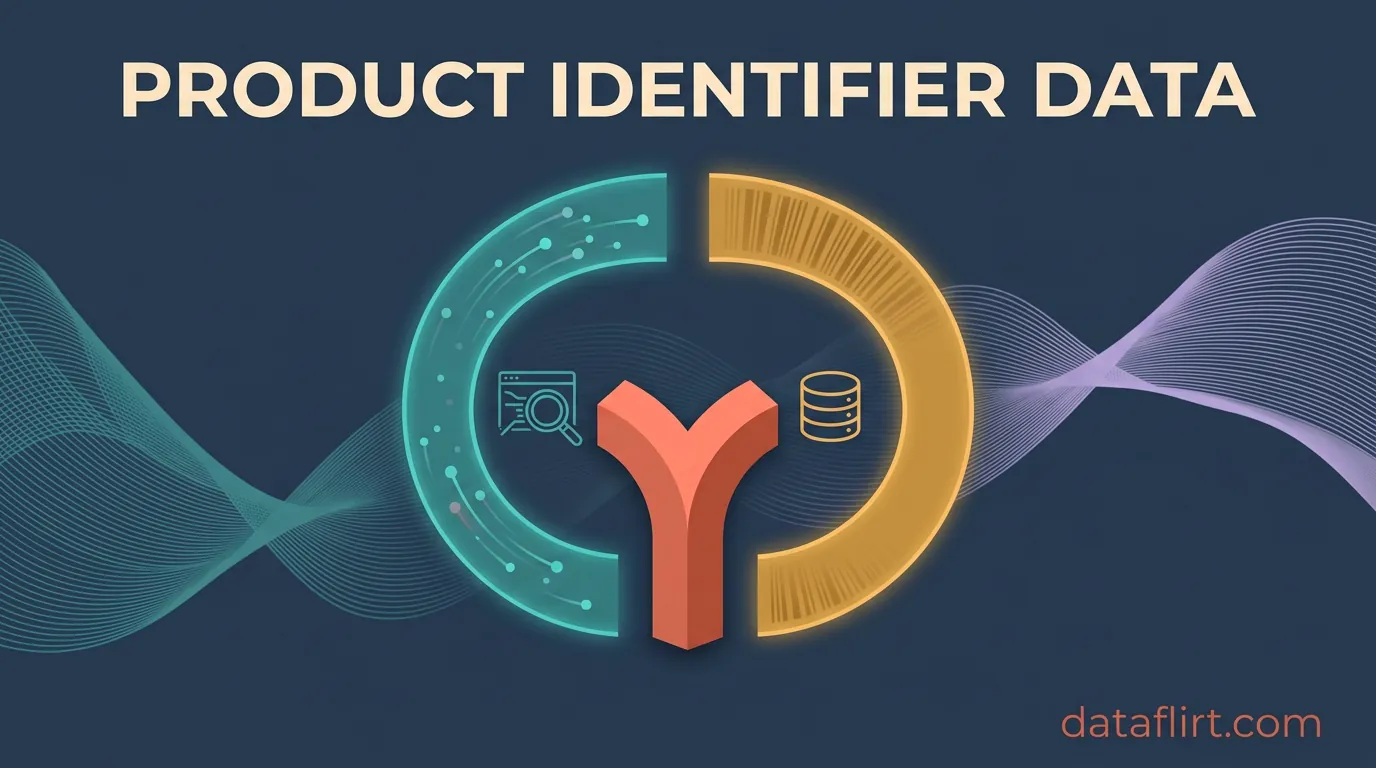
A UPC database provides historical identifier mappings licensed through GS1, whereas custom scraping delivers the exact live attributes displayed on a retailer website today. These two outputs serve entirely different engineering requirements.
The architecture of GTINs and UPCs
Universal Product Codes (UPC) and European Article Numbers (EAN) are standardized identifiers. A UPC is a 12-digit number primarily used in North America. An EAN is a 13-digit number used globally. These identifiers are not assigned dynamically by scraping tools or temporary databases. They must be officially licensed and validated through GS1.
When you query a database, you retrieve a static snapshot of this registration. The record tells you what the manufacturer originally submitted to the central registry. It rarely tells you how a retailer currently packages, prices, or promotes the item. This distinction matters deeply when you are trying to match competitive catalogs dynamically.
The challenge of manufacturer packaging variations
Manufacturers frequently alter product dimensions or packaging configurations without issuing a new GTIN. A brand might reduce a cereal box size from 16 ounces to 14 ounces to combat inflation. The central database often retains the old weight metric for months after the physical change occurs.
If your matching algorithm relies strictly on the database API, you will ingest the outdated 16-ounce specification. Your pricing engine will calculate unit costs based on flawed parameters. Custom extraction prevents this error by pulling the exact weight listed on the live product page.
The payload limitations of static databases
Standard database APIs return very predictable JSON or CSV payloads. These payloads typically include the product name, a baseline description, weight dimensions, and perhaps historical pricing. They are designed for sheer volume rather than real-time accuracy.
Consider the sheer scale of these repositories. The UPCitemdb database stores over 708 million unique UPC and EAN barcode numbers. It ranks as one of the largest off-the-shelf identifier databases available to developers. Similarly, the Barcode Spider database contains an estimated 500 million to 1.5 billion global product records. This volume provides excellent baseline coverage for common consumer goods.
However, that massive scale comes with unavoidable latency. A retailer might slash the price for a weekend sale, or a specific color variant might go out of stock. The static API payload will not reflect these live changes, leaving your system blind to market movements.
The variable schema of digital shelf extraction
Custom data extraction solves the latency problem by ignoring historical databases entirely. Your infrastructure requests the live HTML or JSON from the target website directly. This method guarantees that the data you ingest matches the exact reality of the digital shelf at that precise second.
Scraping payloads include dynamic variables that static databases simply cannot track. You can extract current Buy Box winners, localized promotional banners, and real-time inventory counts. If you monitor a Target product page, you see the active discount applied to a specific regional zip code. A static database API will only ever show the manufacturer suggested retail price.
This live visibility is critical for dynamic pricing engines. If you want to automatically undercut a competitor on Flipkart, historical data is completely useless. You need the live price parsed directly from the page DOM.
How to get it and what to watch for
Integrating a database API involves managing simple token-based HTTP requests, while custom scraping requires advanced infrastructure to bypass bot protection and manage headless browsers. Your architectural choice dictates your entire engineering roadmap for the project.
The mechanics of querying off-the-shelf APIs
Connecting to a UPC database is a straightforward backend task. You purchase an API key and send REST requests containing the target barcode number. The server returns a structured response immediately. This approach requires very little maintenance once the initial integration is complete.
import requests

# Example of a static UPC database API request
def get_upc_data(upc_code):
    url = f"https://api.upcdatabase.org/product/{upc_code}"
    headers = {"Authorization": "Bearer YOUR_API_KEY"}
    response = requests.get(url, headers=headers)

    if response.status_code == 200:
        return response.json()
    return None
This simple implementation requires almost no infrastructure. It makes database APIs highly attractive for rapid prototyping or low-stakes internal dashboards.
Navigating strict endpoint rate limits
The complexity arises when you need to match these identifiers against specific retailer catalogs through official channels. Retailer APIs are notoriously strict. Amazon Selling Partner API (SP-API) enforces aggressive limits using a token-bucket algorithm. For instance, patchListingsItem operations restrict relationship attributes to just 5 transactions per second. They allow up to 100 transactions per second for certain product data attributes, but scaling remains difficult.
If your application relies on naive polling of these endpoints, you will trigger HTTP 429 throttling almost immediately. Data engineers are forced to build centralized, database-backed limiters just to stay within the permitted boundaries. This completely offsets the simplicity of using an API in the first place.
You spend more time managing queue states than parsing actual data. To explore how teams handle these architectural bottlenecks, read our complete guide on ecommerce product data APIs. DataFlirt handles these concurrency challenges natively in our managed pipelines.
Building custom pipelines for live identifier matching
Extracting identifiers directly from product pages requires a completely different technical stack. You cannot simply send a generic request to a major retailer and expect a clean HTML response. Modern ecommerce sites employ complex fingerprinting algorithms to block automated traffic instantly.
To scrape a Walmart catalog successfully, you need to manage rotating proxy networks. You must distribute your requests across thousands of residential IP addresses to avoid detection. If you send too many requests from a single datacenter IP, the target server will ban your scraper.
Furthermore, many sites rely heavily on client-side rendering. The GTIN or price might not exist in the initial HTML payload. You have to deploy a headless browser like Puppeteer or Playwright to execute the JavaScript before parsing the DOM.
const puppeteer = require('puppeteer');

// Example of a custom extraction script targeting live DOM
async function scrapeProductData(url) {
    const browser = await puppeteer.launch({ headless: true });
    const page = await browser.newPage();

    // Simulating a real user to bypass basic bot checks
    await page.setUserAgent('Mozilla/5.0 (Windows NT 10.0; Win64; x64)');
    await page.goto(url, { waitUntil: 'networkidle2' });

    const price = await page.$eval('.live-price-element', el => el.innerText);
    const gtin = await page.$eval('meta[itemprop="gtin13"]', el => el.content);

    await browser.close();
    return { gtin, price };
}
This script provides real-time accuracy but introduces significant compute overhead. DataFlirt absorbs this compute burden, allowing your servers to run lean.
Understanding the parsing logic complexity
Once you bypass the security layer, you face the challenge of DOM parsing. Retailers organize their product pages uniquely. The CSS selector that targets the UPC on a Home Depot page will fail completely on a Lowe’s page.
Your team must write and maintain bespoke parsing logic for every single domain you monitor. Target site layouts change frequently without warning. When a developer pushes a new frontend class name, your selector breaks, and your engineer has to write an emergency patch.
This maintenance debt compounds exponentially as you add more targets. Tracking ten competitors requires a dedicated engineer just to monitor failing selectors. DataFlirt monitors and repairs these selectors automatically across our platform, removing the maintenance headache from your sprint cycle.
The financial and technical trade-offs
The cost difference between these two approaches is substantial. A premium subscription to a static database might cost a few hundred dollars a month. You pay strictly for access, not for the massive compute clusters required to gather the data.
Custom extraction requires a much larger budgetary commitment. You have to pay for the proxy bandwidth, the server infrastructure, and the expensive engineering hours required to maintain the scrapers. You must weigh this operational cost against the business value of real-time accuracy.
Industry data highlights this financial reality. Developing custom, enterprise-level web scraping solutions to pull high-volume, real-time product data typically costs between $2,000 and $50,000 per year, according to Scrapelead. We explore these financial nuances further in our breakdown of understanding scraping cost factors. DataFlirt offers a predictable pricing model that eliminates these cost spikes.
| Criteria | Static UPC Database API | Custom Web Scraping Pipeline |
|---|---|---|
| Data Freshness | Days, weeks, or months old | Real-time at the moment of extraction |
| Payload Content | Basic attributes (name, weight, MSRP) | Dynamic data (live price, inventory, Buy Box) |
| Engineering Effort | Low (Standard REST API integration) | High (Requires proxy rotation and maintenance) |
| Cost Structure | Predictable monthly API subscription | Variable based on bandwidth, compute, and labor |
The technical realities of matching algorithms
Building a reliable catalog matching engine requires handling messy data, regardless of your source. Identifiers are frequently missing from product pages, forcing your system to rely on secondary fallback metrics to verify the item.
Dealing with missing GTIN values
Not every retailer displays the UPC or EAN on their customer-facing frontend. A site like Chewy might hide the GTIN deep within an inline JSON script block, or they might omit it entirely. When the primary identifier is missing, your algorithm hits a wall.
If your pipeline relies exclusively on scraping visible DOM text, you will lose a large percentage of your matches. You must configure your extraction tools to search schema.org markup and hidden metadata tags. DataFlirt configures our extraction engines to parse these hidden elements by default, maximizing your match rate.
Relying on fuzzy text matching as a fallback
When the GTIN is completely unavailable, you must fall back to fuzzy text matching. You compare the product title, brand name, and model number extracted from a site like Macy’s against your internal database. This approach is highly vulnerable to formatting inconsistencies.
A database might list a product as “Sony WH-1000XM4 Wireless Headphones.” A retailer might list it as “Sony Noise Cancelling Over-Ear Headphones XM4.” Simple string comparison will fail here. You need sophisticated natural language processing to bridge the semantic gap.
The success of fuzzy matching depends entirely on the quality of your source data. If your custom scraper pulls clean, normalized strings, your NLP models will perform significantly better. DataFlirt cleans and standardizes text fields before delivery, giving your matching models the best possible input.
Standardizing attributes for your database
Every data source formats attributes differently. A database API might provide weight in grams, while an Etsy listing displays it in ounces. Price fields might include currency symbols or promotional text that break your integer columns.
Your pipeline must include a strict normalization layer to cast these variables into correct data types. You cannot push raw, unvalidated strings into a production pricing engine. A single malformed price field can trigger catastrophic pricing errors on your storefront.
DataFlirt eliminates this friction entirely. We map the extracted data to your exact schema requirements. If you need prices formatted as integers and weights converted to kilograms, DataFlirt applies those transformations during the extraction process.
When is custom scraping worth the extra cost?
Custom scraping justifies its premium price tag when the operational penalty of processing customer returns and fixing stale database records exceeds the engineering cost of extracting live data. This constitutes the break-even point for serious retail catalogs.
The hidden cost of stale attributes
UPC databases claim full coverage but often have stale or incorrect data. A manufacturer might register a barcode for a pack of twelve items, but a retailer might split that pack and sell the items individually. If your matching engine relies blindly on the static database, you will misprice your inventory by a massive margin.
This is not a hypothetical engineering problem. The financial impact of bad product data is staggering. Research from SmartBrief indicates that 40% of online shoppers have returned an item due to incorrect or incomplete product information. Every return eats into your profit margin through reverse logistics and expensive restocking fees.
The macroeconomic view is even more severe. Poor data quality costs organizations an average of $12.9 million annually, according to E-Commerce Times. When you rely on cheap, outdated APIs, you are simply shifting your costs from your engineering department to your fulfillment teams. DataFlirt ensures your data remains accurate, protecting your operational margins.
Calculating the true cost of bad attributes
You must calculate whether building a custom pipeline will actually save your business money. Consider a catalog manager tracking 40,000 SKUs across multiple marketplaces. If 5% of her products have stale pricing in a static database, she risks losing the Buy Box on 2,000 active items.
If losing the Buy Box costs her ten dollars in lost profit per item per week, that represents a massive revenue leak. In this scenario, spending $50,000 a year on a custom extraction pipeline is a highly rational and necessary investment. The live data pays for the infrastructure required to acquire it.
Conversely, if you run a small hobby store with 200 products, a cheap database API is perfectly adequate. The revenue risk of a few mismatched attributes is negligible. The technical overhead of managing custom scripts to scrape eBay or AliExpress is simply not worth your time. DataFlirt scales our services to match the specific gravity of your business needs.
Navigating legal and compliance orientations
When you build custom extraction pipelines, you must consider the legal implications of interacting with third-party servers. Extracting publicly available product facts like prices, dimensions, and GTINs is generally common practice in competitive intelligence. These attributes are factual and rarely subject to strict copyright protection.
However, scraping aggressive volumes of data can violate a target website’s Terms of Service. If your headless browsers consume excessive server bandwidth on a site like Wayfair, the target company might issue a formal cease and desist letter. You must practice polite extraction techniques to minimize your footprint on their infrastructure.
It is absolutely critical to separate factual product identifiers from personal identifiable information. Extracting seller contact details introduces significant compliance risks under frameworks like GDPR or CCPA. You should always consult qualified legal counsel to evaluate your specific extraction architecture and ensure your operations remain fully compliant. DataFlirt prioritizes ethical data collection practices across all our ecommerce operations.
How DataFlirt manages custom product identifier extraction
DataFlirt replaces the unpredictable maintenance of in-house extraction with a fully managed pipeline that delivers clean, import-ready catalog files directly to your storage layer. We handle the infrastructure so you can focus strictly on building your matching engine.
Bypassing bot protection at scale
Building your own extraction tool requires constant vigilance. When a target site like Best Buy updates its Cloudflare security rules, your internal scripts will fail immediately. Your engineers will drop vital feature development just to troubleshoot blocked IP addresses and failing CSS selectors.
DataFlirt eliminates this frustrating technical debt. A freelancer on a gig platform might be fine for a flat catalog export of 500 products. Once you cross 10,000 SKUs and target sites with complex JavaScript rendering, the technical burden multiplies. That is exactly where DataFlirt’s anti-bot engineering and advanced proxy management start paying for themselves.
We maintain specialized infrastructure to scrape complex B2B marketplace platforms efficiently. We route requests through vast residential networks, manage browser fingerprinting dynamically, and resolve CAPTCHAs automatically. This ensures your data flow remains uninterrupted, even when retailers deploy aggressive countermeasures.
Delivering import-ready schema files
Raw HTML is completely useless to your pricing engine. You need structured, validated data that matches your internal database schema perfectly. Writing parsing logic for dozens of different retailer layouts is a tedious, error-prone process that drains engineering morale.
DataFlirt acts as a natural extension of your engineering team. We extract the exact GTINs, live prices, and stock levels you request from targets like Overstock. We then precisely map those fields into your specified JSON or CSV format. Every delivery passes through a rigorous QA layer to catch missing attributes or malformed strings before they enter your system.
This managed approach scales fluidly across multiple retail verticals. Whether you need identifiers mapped from wholesale suppliers or localized pricing data from retail store locations, we configure the pipeline to meet your exact specifications. DataFlirt guarantees the data quality and the delivery schedule, removing the uncertainty from your entire data acquisition strategy.
Our systems automatically adapt to structural DOM changes. When a target website redesigns their category pages, DataFlirt identifies the new HTML elements and resumes extraction without manual intervention. This proactive monitoring ensures your pricing algorithms never operate on stale information.
FAQ
What is the difference between a UPC and an EAN?
A UPC (Universal Product Code) is a 12-digit number primarily used in North America to track trade items in stores. An EAN (European Article Number) is a 13-digit superset of the UPC system used globally. Both serve as standard GTINs for product identification.
Why do Amazon SP-API requests return HTTP 429 errors?
Amazon enforces strict rate limits using a token-bucket algorithm to protect server stability. Naive polling of their endpoints exceeds the permitted transactions per second, triggering immediate HTTP 429 throttling errors.
Can I use fuzzy text matching if the GTIN is missing?
Yes, fuzzy text matching compares product titles and brand names when identifiers are absent. However, it requires complex natural language processing to account for formatting inconsistencies across different retailer platforms.
Is it legal to scrape product prices and identifiers?
Extracting publicly available factual data like prices and GTINs is common practice, but aggressive scraping can violate a website’s Terms of Service. Always separate factual data from personal information and consult qualified legal counsel regarding your specific extraction architecture.
If you’d rather not scope this yourself, DataFlirt’s ecommerce scraping service handles the extraction, QA, and delivery, so reach out for a free scoping call.