
The Industrial Scale of the Data Problem
There is no shortage of data in 2026. There is a profound shortage of accessible, structured, decision-ready data. The web is the world’s largest unstructured database — and web scraping is the extraction layer that turns it into something a pricing algorithm, an underwriting model, or a research pipeline can actually use.
The global web scraping software market, valued at approximately USD 1.1 billion in 2024, is growing at a CAGR of over 18% through 2030. That growth is not being driven by a single vertical. It is being pulled forward simultaneously by eCommerce teams that need daily competitor price feeds, hedge funds that want satellite-corroborated supply chain signals, pharmaceutical firms building post-market surveillance pipelines, and legal tech companies automating case law research. Every industry has a version of the same problem: critical business intelligence exists as public data on websites it doesn’t control, in formats it can’t directly ingest, and at a velocity its analysts can’t manually match.
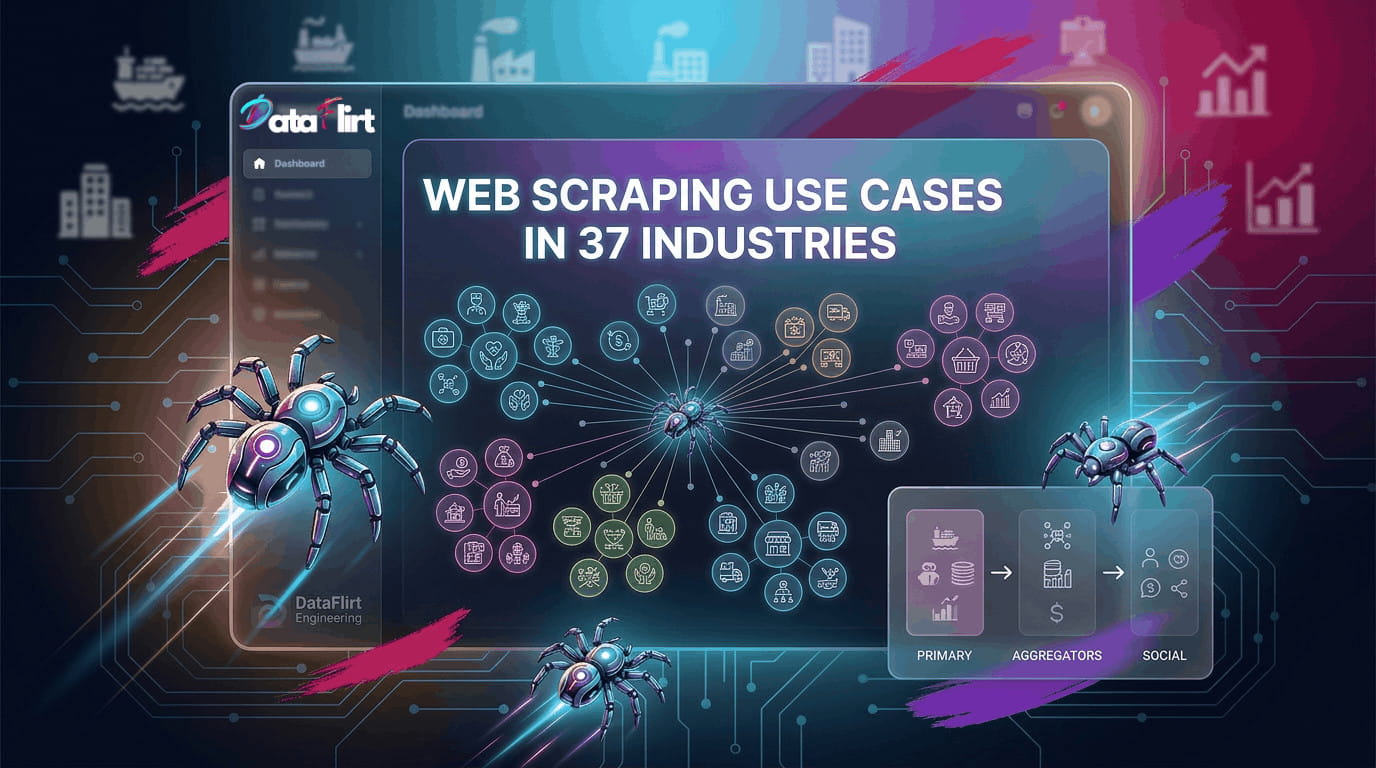
This guide covers web scraping use cases across 37 industries. For each sector, the goal is not to explain how scraping technically works — DataFlirt has done that at depth in its best free web scraping tools guide and its bot bypass architecture guide. The goal here is to answer the question that matters more: what data, scraped from which sources, solves which business problems — and what does that intelligence enable?
Part I: Commerce, Real Estate, and Financial Markets
1. eCommerce: The Original Web Scraping Use Case
eCommerce was the first industry to operationalize web scraping at scale, and it remains the sector with the most mature, highest-frequency scraping infrastructure. The reason is straightforward: on the open web, your competitors’ pricing, availability, and catalog data are public — and if you are not reading it daily, you are flying blind.
What eCommerce companies scrape, and why:
Competitor price monitoring is the flagship web scraping use case in this sector. A mid-size fashion retailer with 50,000 SKUs cannot manually track even five competitors across all products daily. A scraping pipeline that crawls competitor PDPs (product detail pages) every 4–6 hours and feeds a pricing engine changes the economics of dynamic pricing entirely. Companies using automated price intelligence consistently outperform those relying on monthly manual audits — the difference is response latency. A competitor drops a flash sale price at 9am; a scraping-fed pricing engine responds within the hour.
Product catalog enrichment is a less-discussed but high-ROI application. When a marketplace or multi-brand retailer onboards new suppliers, scraped data from brand websites, distributor portals, and manufacturer spec sheets can pre-populate product attributes — images, dimensions, materials, care instructions — reducing manual data entry by 70–90%.
Review and sentiment intelligence tracks customer feedback across your own products and competitors’ SKUs simultaneously. Scraped review data reveals failure patterns (a competitor’s keyboard has 40% of reviews mentioning “sticky keys” in the last 30 days), unmet demand signals (“wish this came in a larger size”), and emerging quality issues before they surface in your own returns data.
Out-of-stock and availability tracking helps merchandisers time restocking, promotions, and ad spend. If a competitor is consistently out of stock on a high-demand SKU, that is a window to capture search traffic and conversions.
Sample scraped data structure for eCommerce price monitoring:
| SKU        | Competitor    | Price (USD) | Was Price | Availability | Scraped At           |
|------------|---------------|-------------|-----------|--------------|----------------------|
| NKE-AJ1-10 | Retailer A    | 149.99      | 179.99    | In Stock     | 2026-04-17 06:02:11  |
| NKE-AJ1-10 | Retailer B    | 162.00      | —         | 3 Left       | 2026-04-17 06:04:47  |
| NKE-AJ1-10 | Retailer C    | 155.00      | 175.00    | In Stock     | 2026-04-17 06:07:33  |
Recommended sources to scrape for eCommerce intelligence:
- Brand manufacturer websites (for MSRP baseline and new product launches)
- Multi-brand marketplaces (for third-party seller pricing and BSR data)
- Review aggregator platforms (for sentiment corpus)
- Google Shopping results (for ad placement and promotional pricing intelligence)
- Return policy pages and shipping estimation engines (for total-cost-of-ownership comparison)
- Social commerce feeds (for UGC-driven product discovery signals)
DataFlirt recommended reading: Best Scraping Solutions for E-Commerce Competitor Intelligence
2. Real Estate and Construction: Every Listing, Every Permit, Every Price Movement
Real estate is a sector defined by information asymmetry. The agent who knows a listing is overpriced before it hits the public feed, or the developer who knows a neighborhood is about to appreciate because of a zoning change three suburbs over — these advantages are built on data. Web scraping web use cases in real estate close that information gap at industrial scale.
Active listing intelligence is the core application. By scraping listing portals, brokerage sites, and FSBO (for sale by owner) platforms, PropTech companies and investment firms build real-time databases of every active listing in their target markets — price, square footage, days on market, listing agent, historical price changes, and photos for computer vision analysis. The velocity matters: a listing that drops in price on day 8 behaves differently than one that drops on day 60.
Rental market surveillance is the parallel use case. Property management companies and institutional landlords scrape rental listings to calibrate their own rents, understand vacancy dynamics, and model the impact of new supply entering the market. When a large new apartment complex lists units, its pricing ripples through the competitive set within weeks — and that signal is fully visible to anyone running a daily scraping pipeline.
Construction permit data is an underused but extremely valuable application. Municipal permit portals publish construction approvals — new builds, demolitions, major renovations, change-of-use permits. For commercial real estate investors, a cluster of restaurant permits in a neighborhood signals rising foot traffic. For residential developers, demolition permits signal land becoming available. For construction material suppliers, permit data is a forward-looking demand signal six to eighteen months ahead of actual purchases.
Zoning and planning change monitoring extends this further. Planning commission agendas, city council meeting minutes, and zoning variance applications are all public record. Scraping them reveals development pressure, neighborhood trajectory, and regulatory risk before it is priced in.
Mortgage rate and financing condition tracking helps buyers, brokers, and lenders understand the market’s cost-of-capital environment in real time, sourced from lender websites, regulatory filings, and financial news.
For construction specifically: material price tracking from distributor and supplier websites allows project managers to time procurement. Concrete, lumber, and steel prices are volatile; a scraping pipeline that monitors distributor pricing enables forward buying when prices dip.
Recommended sources to scrape for real estate and construction intelligence:
- Municipal building permit portals and planning commission agendas
- County assessor and tax record databases
- Auction house platforms (for distressed asset prices)
- Commercial lease listing portals
- Infrastructure project announcement feeds (for development pipeline intelligence)
- Mortgage rate comparison sites and lender disclosure pages
- Environmental impact assessment databases
DataFlirt recommended reading: Best Tools to Scrape Real Estate Listings Data in 2026 | Real Estate Web Data Use Cases
3. Finance and Stock Market: Signal Extraction at Market Speed
Finance is the sector where data latency is measured in milliseconds and the penalty for missing a signal is denominated in basis points. Web scraping use cases in financial services span a wide range from fundamental research augmentation to alternative data sourcing for quantitative strategies.
Earnings call transcript mining is a high-value application for fundamental analysts. Management language — whether a CEO uses hedging words more frequently in Q3 than Q2, whether CFO commentary becomes more cautious on gross margin — carries information that numerical summaries miss. Scraping earnings transcripts from investor relations pages and financial data portals enables NLP-based sentiment scoring at scale.
Regulatory filing monitoring is mission-critical for compliance teams and investment research. SEC EDGAR, Companies House, SEBI, and equivalent regulators worldwide publish filings, insider trading disclosures, 13F holdings, and material event announcements. A fund that discovers an 8-K filing thirty minutes before its research desk does has a measurable timing advantage.
Macroeconomic indicator tracking uses scraping to aggregate central bank communications, government statistical releases, and economic survey publications from dozens of national statistical agencies into a unified feed — something no single commercial data provider covers comprehensively.
Alternative data extraction is the frontier. Foot traffic proxies from review volume on restaurant and retail pages, job posting velocity as a growth signal, web traffic estimates, shipping and logistics announcements, and patent filing data are all publicly available and scrapeable. Hedge funds and systematic trading firms have been building these alternative data pipelines for years — the signal is in the cross-section of data sources, not any single feed.
Sample alternative data signal from web scraping:
| Company    | Job Postings (30d) | % Change (MoM) | Hiring Categories     | Hiring Signal  |
|------------|--------------------|-----------------|-----------------------|----------------|
| Company A  | 847                | +34%            | ML Engineers, Sales   | Expansion      |
| Company B  | 203                | -61%            | All categories down   | Contraction    |
| Company C  | 412                | +8%             | Ops, Support          | Normalization  |
Recommended sources to scrape for finance and stock market intelligence:
- Regulatory filing portals (SEC EDGAR, national equivalents)
- Central bank press release archives
- Corporate investor relations pages
- Financial news aggregators (for event timing, not for verbatim content)
- Government statistical agency releases (CPI, employment, PMI data)
- Job posting platforms (as a leading employment and growth indicator)
- Patent office publication databases (for R&D pipeline intelligence)
- Commodity exchange spot price pages
DataFlirt recommended reading: Web Data for Finance | Top 5 Scraping Tools for Financial Data and Stock Market Intelligence
Part II: Healthcare, Pharmaceuticals, and Life Sciences
4. Healthcare and Pharmaceuticals: Surveillance, Research, and Procurement
Healthcare is a sector where the stakes of missing data are not commercial — they are clinical. Web scraping use cases in this vertical are increasingly being architected as safety infrastructure, not just competitive tooling.
Clinical trial monitoring is one of the highest-value applications in life sciences. ClinicalTrials.gov and equivalent international registries (EU Clinical Trials Register, WHO ICTRP) publish trial statuses, sponsor organizations, inclusion criteria, primary endpoints, and completion dates for tens of thousands of active studies. Pharmaceutical companies, biotech investors, and contract research organizations scrape this data to map competitive pipeline positions, identify potential acquisition targets, and track the speed at which rivals are moving through Phase 2 and Phase 3.
Adverse event and pharmacovigilance monitoring has significant public health implications. The FDA’s FAERS (FDA Adverse Event Reporting System) database, Yellow Card in the UK, and EudraVigilance in the EU all publish searchable adverse event reports. Post-market surveillance teams scrape these feeds to detect emerging safety signals for their products and competitors’, often before formal safety reviews occur.
Drug pricing and formulary tracking is a commercial application. Specialty pharmacy procurement teams scrape distributor pricing portals, GPO (Group Purchasing Organization) formularies, and hospital supply chain platforms to identify pricing anomalies and optimize purchasing. A single price delta on a high-volume drug, identified weekly through automated scraping, can represent millions in annual procurement savings.
Medical literature and research aggregation is used by clinical research teams and medical affairs departments. Scraping PubMed abstracts, preprint servers (bioRxiv, medRxiv), and conference presentation archives allows researchers to track the publication velocity on specific disease areas, identify emerging consensus, and monitor competitor medical affairs activity.
Physician and provider directory scraping is used by medical device companies, pharma field forces, and healthcare marketplaces to build and maintain accurate provider databases. NPI registries, state medical board license directories, and hospital credentialing pages are all public data sources for this purpose.
Recommended sources to scrape for healthcare intelligence:
- ClinicalTrials.gov and international trial registries
- FDA FAERS, Yellow Card, EudraVigilance adverse event databases
- CMS (Centers for Medicare and Medicaid) pricing and utilization data
- State medical board license verification portals
- NIH research grant award databases (for pipeline R&D intelligence)
- Pharmacy benefit manager formulary pages
- WHO drug regulatory databases
- Academic hospital clinical pathway publications
DataFlirt recommended reading: Web Scraping Use Cases in Healthcare | Data Use Cases in Healthcare Industry
Part III: Travel, Hospitality, and Aviation
5. Travel, Hospitality, and Aviation: Dynamic Markets That Never Sleep
No vertical illustrates the need for real-time scraping infrastructure more vividly than travel. Airline fares change hundreds of times per day. Hotel rates fluctuate by the hour based on demand signals. A travel aggregator that cannot update its inventory in near-real time is not in the business.
Airfare price monitoring and fare prediction is the foundational web scraping use case for online travel agencies (OTAs) and meta-search platforms. By continuously scraping fare data across airlines — direct booking sites, GDS-fed aggregators, and budget carrier proprietary platforms — travel companies build historical fare datasets that train predictive models. These models tell travelers when prices are likely to rise and when waiting is worth it, and they power the dynamic pricing advice features that drive OTA conversion.
Hotel rate intelligence is the parallel application for accommodation. Revenue managers at hotel groups scrape competitor properties’ rate pages — including rate parity monitoring to identify whether partners are undercutting direct booking rates, which is a contractual violation they have every right to enforce. Rate parity scraping is not just competitive intelligence; it is compliance auditing.
Availability and inventory tracking is critical for tour operators, activity booking platforms, and accommodation aggregators. If an excursion sells out on a partner platform but that status isn’t scraped and reflected on the aggregator in time, customers see false availability — a UX failure with direct conversion impact.
Aviation-specific applications include flight delay pattern analysis (scraped from airport operational feeds and airline status pages), gate change data aggregation, and codeshare route mapping that is more current than static IATA publications.
Hospitality review intelligence goes beyond simple star ratings. Scraping the full text of reviews from booking platforms, travel forums, and Google Maps surfaces specific operational issues — breakfast service timing, Wi-Fi reliability, housekeeping complaints — at a granularity that aggregate scores obscure. A hotel group with 200 properties uses this to benchmark properties against each other and prioritize capital investment.
Sample scraped data for hotel rate intelligence:
| Property           | Room Type    | Tonight Rate | Weekend Rate | OTA Rate | Direct Rate | Parity Gap |
|--------------------|--------------|--------------|--------------|----------|-------------|------------|
| Hotel A (Comp Set) | Deluxe King  | $289         | $342         | $289     | $299        | OTA -$10   |
| Hotel B (Comp Set) | Standard Dbl | $199         | $244         | $189     | $199        | OTA -$10   |
| Subject Property   | Deluxe King  | $275         | $320         | $275     | $275        | Parity OK  |
Recommended sources to scrape for travel and hospitality intelligence:
- Airline direct booking engines (for fare basis data)
- Airport operational status pages (ATIS, ACARS-derived feeds)
- Visa and entry requirement government portals (for traveler advisory products)
- Tourism board event calendars (for demand surge forecasting)
- Weather service APIs and forecast portals (for travel disruption modeling)
- Conference and event aggregator sites (for business travel demand signals)
- Foreign exchange rate pages (for price-normalization in multi-currency markets)
DataFlirt recommended reading: Hotel Price Scraping and Optimization Strategy | Top 7 Scraping Solutions for Travel and Flight Data Aggregation
Part IV: Human Capital, Sports, and Entertainment
6. Jobs and Recruitment: Labour Market Intelligence at Scale
The labour market is one of the richest publicly available data sources for understanding the economy in ways that lag-heavy government statistics cannot. Job postings are a real-time signal of corporate intent — hiring freezes, expansion plans, technology adoption, geographic footprint changes. Web scraping use cases in HR tech and recruitment have expanded far beyond simple job aggregation.
Talent supply and demand mapping uses scraped job posting data to identify skill shortages and surpluses across geographies and industries. A workforce analytics firm that scrapes all technology job postings in a given metro area and classifies them by required skills can tell a regional economic development authority exactly which technical training programs would be most absorbed by the market.
Compensation benchmarking is enabled by scraping salary disclosure data, where available — in US states with pay transparency laws, job postings increasingly include salary ranges. HR departments and compensation consultants scrape this to build market rate databases that are more current than annual salary surveys.
Competitor talent tracking is a strategic application that finance, tech, and consulting firms use to understand where rivals are building capability. If a competitor posts 40 machine learning engineer roles in a quarter, it signals a product direction. If a company posts 80 sales roles in one region and closes offices in another, it signals a strategic pivot. These signals live in job posting data before they surface in earnings calls.
Candidate sourcing enrichment uses scraped professional profile data — from public profile pages, conference speaker bios, academic department pages, and professional association directories — to augment recruiter outreach lists with context beyond what’s in an ATS.
Recommended sources to scrape for jobs and recruitment intelligence:
- Government labor department job vacancy portals
- Company careers pages (direct, not aggregator)
- Professional licensing and certification databases
- Trade union membership directories
- Conference and professional event speaker databases
- University department faculty and alumni pages
- Freelance platform public project listing feeds
7. Sports, Movies, and Entertainment: Audience Intelligence and Rights Valuation
Entertainment is a data-rich vertical where web scraping use cases span audience measurement, rights valuation, talent market intelligence, and release strategy optimization.
Sports data scraping powers an entire industry. Fantasy sports platforms, sports betting operators, performance analytics firms, and broadcast rights valuers all depend on scraped sports data. Real-time match statistics, player performance metrics, injury reports, transfer news, and historical head-to-head records are scraped from official league sites, sports news outlets, and statistical databases. The downstream applications range from real-time odds adjustment in sports betting to long-term contract valuation in professional sports management.
Box office and streaming performance intelligence is used by studios, streaming platforms, and talent agencies. Scraping box office reporting services, streaming chart publications, and review aggregator scores gives studios a near-real-time picture of how a release is performing relative to comparable titles. For streaming platforms, tracking competitor content performance helps inform content commissioning decisions.
Talent market valuation is a specific application for agencies and talent management firms. Scraping social media follower counts, engagement rates, brand partnership announcements, and press mention frequency creates a quantitative model for talent commercial value that supplements intuition-based negotiation.
Ticketing and event pricing intelligence uses scraped secondary market data to understand the gap between face value and market value for live events. For promoters, this informs primary pricing strategy. For venue operators, it signals underpricing that is leaving revenue on the table.
Recommended sources to scrape for sports and entertainment intelligence:
- Official league and federation statistics portals
- Sports medical and injury report databases
- Box office reporting services and film data databases
- Streaming platform public charts and genre rankings
- Social media public engagement pages for talent monitoring
- Sports betting exchange odds pages (for implied probability modeling)
- Stadium and venue capacity and event booking portals
- Film festival submission and award nomination databases
DataFlirt recommended reading: Sports Data Scraping | Scraping Movie Data for Visualization
Part V: Legal, Government, and Regulatory Data
8. Legal: Case Law, Compliance, and Contract Intelligence
Legal web scraping use cases are among the most technically demanding and value-dense in the data extraction landscape. Court records, regulatory filings, patent databases, and compliance registries are distributed across hundreds of jurisdictions, each with different formats, update frequencies, and access controls.
Case law research and jurisprudence mapping is the flagship application for legal tech firms. By scraping public court record systems — PACER in the US, BAILII in the UK, and national equivalents globally — and processing the resulting documents through NLP pipelines, legal research platforms can answer questions like “what is the median settlement in breach-of-contract cases in this jurisdiction over the last five years involving companies above $100M revenue” in seconds rather than associate-hours.
Litigation risk monitoring is used by corporate legal departments and insurance underwriters. Scraping court filing databases for new cases naming specific companies, executives, or involving specific regulatory violations provides early warning of litigation exposure that may not surface in news coverage for weeks.
Patent landscape mapping is critical for R&D strategy, M&A due diligence, and freedom-to-operate analysis. Patent offices publish full-text patent applications and grants in publicly accessible databases. Scraping these by technology class, assignee, and filing date enables companies to map competitor R&D activity, identify white spaces for innovation, and assess acquisition targets’ IP portfolios.
Regulatory compliance tracking uses scraping to monitor agency rulemaking, federal register publications, and comment periods. For industries subject to frequent regulatory change — financial services, healthcare, environmental sectors — this is essentially mandatory risk management infrastructure.
Sample scraped dataset for patent intelligence:
| Patent ID   | Assignee    | Filed      | Status  | Technology Class    | Claims Count |
|-------------|-------------|------------|---------|---------------------|--------------|
| US11234567  | Company A   | 2024-03-12 | Granted | AI/ML (G06N)        | 23           |
| US11345678  | Company B   | 2024-07-08 | Pending | Biotech (C12N)      | 15           |
| US11456789  | Company C   | 2023-11-30 | Granted | Semiconductor (H01L)| 41           |
Recommended sources to scrape for legal intelligence:
- National patent office public databases (USPTO, EPO, JPO, WIPO)
- Federal and state court electronic filing systems
- Regulatory agency rulemaking and comment portals
- Corporate registry and UCC filing systems
- Sanctions and debarment list portals (OFAC, EU consolidated list)
- Law review and academic legal publication archives
- Arbitration award databases
DataFlirt recommended reading: Web Scraping GDPR | Top Scraping Compliance and Legal Considerations
9. Government Data: The World’s Most Underutilized Open Data Source
Government data is systematically underused as an intelligence source precisely because it is fragmented across thousands of portals, published in inconsistent formats, and updated on bureaucratic rather than business schedules. Web scraping use cases targeting government data are about making this data actually usable.
Procurement and contract award tracking is a high-value application for vendors, consultants, and market researchers. Governments worldwide publish contract awards, tender notices, and procurement data through portals like USASpending.gov, Contracts Finder in the UK, and TED (Tenders Electronic Daily) in Europe. Scraping and structuring this data tells vendors where government is spending, what categories are growing, and which agencies are awarding contracts to specific suppliers.
Public health and safety surveillance aggregates data from food safety recall portals, consumer product safety databases, environmental compliance monitoring portals, and disease surveillance dashboards. Public health researchers, insurance underwriters, and consumer advocacy organizations all benefit from automated aggregation of this data.
Economic statistics and labour market data — employment figures, inflation releases, trade statistics, business formation data — are published by statistical agencies on schedules that are not always conveniently formatted for downstream consumption. Structured scraping pipelines that normalize this data across jurisdictions are foundational infrastructure for macroeconomic research.
Freedom of Information (FOI/FOIA) response tracking is an emerging use case for investigative data teams. Published FOI responses from government websites create a corpus of internal government communications and documentation that, when scraped and indexed, provides unique insight into regulatory decision-making.
Recommended sources to scrape for government data intelligence:
- Government procurement and tender portals (USASpending, Contracts Finder, TED)
- National statistical agency publications (BLS, ONS, Eurostat)
- Environmental protection agency compliance monitoring portals
- Consumer product safety databases (CPSC, EU Safety Gate)
- Land registry and property transaction portals
- Parliamentary and legislative record databases
- Government budget and expenditure transparency portals
- Judicial appointment and court schedule databases
Part VI: Automotive, Insurance, and Industrial Sectors
10. Automotive: VIN-Level Intelligence Across the Full Vehicle Lifecycle
The automotive sector has one of the most sophisticated ecosystems of web scraping use cases — spanning new vehicle pricing, used car valuation, recall monitoring, and dealer network intelligence.
Used vehicle pricing and valuation is the most immediate application. Automotive marketplaces, dealer groups, and financial institutions that provide auto loans need real-time used vehicle price data. Scraping listing prices across dealer websites, auction result announcements, and classified platforms provides the data layer for accurate loan-to-value calculations, trade-in pricing, and retail pricing decisions. The difference between a data-driven used car pricing strategy and a gut-feel one is measurable in gross margin per unit.
New vehicle incentive and inventory tracking is used by dealer groups and OEM market intelligence teams. Manufacturer websites publish current incentive programs — APR financing offers, cash back amounts, lease money factors — on schedules that do not always flow cleanly to dealer inventory systems. Scraping OEM incentive pages keeps retail teams current on the full value stack their customers are evaluating.
Recall and safety notice monitoring is a compliance and customer service application. NHTSA in the US, DVSA in the UK, and Transport Canada all publish active recall notices publicly. Automotive fleet managers, warranty administrators, and insurance underwriters scrape these databases to identify affected vehicles in their portfolios without waiting for OEM notification letters.
EV charging network and infrastructure data is an emerging web scraping use case as the sector electrifies. Scraping public charging network availability, pricing, and location data helps fleet operators plan routes, informs grid operators about demand, and supports infrastructure planning for commercial property developers.
Recommended sources to scrape for automotive intelligence:
- NHTSA and international safety recall portals
- OEM incentive and configurator pages
- Auto auction result publication sites
- State DMV and vehicle registration data portals
- EV charging network availability APIs and status pages
- Consumer review platforms for vehicle reliability signal
- Dealer group inventory feeds
DataFlirt recommended reading: Scraping Auto Part Supplier Websites
11. Insurance: Underwriting Signals, Rate Intelligence, and Claims Data
Insurance underwriting is fundamentally a data quality problem. The better your risk model inputs, the more accurately you price policies — and the less adverse selection you face. Web scraping use cases in insurance are building a richer signal set for every stage of the underwriting and claims lifecycle.
Competitor rate intelligence is the most immediate application for personal lines insurers. Scraping the online quoting engines of competing insurers — by submitting programmatic quote requests with parameterized risk profiles — gives actuarial teams the data they need to monitor rate positioning across customer segments. This is sophisticated competitive intelligence scraping that goes beyond simple product page monitoring.
Property risk data enrichment uses scraped data to enhance underwriting models. Zoning data from municipal portals, flood zone map updates from government environmental agencies, wildfire risk assessments from forestry departments, and crime statistics from law enforcement data portals all inform property insurance pricing. Building permit data indicates renovation activity that may affect coverage needs.
Claims fraud pattern detection leverages scraped data from social media and public records. A claimant reporting total vehicle loss who posts photos of the vehicle days later, or a disability claimant whose public social media shows physical activity inconsistent with claimed injury — these signals are not in the claims file but are on the public web.
Workers’ compensation and employment practice monitoring uses scraped OSHA inspection records, workplace safety violation databases, and employer review platforms to assess risk before binding commercial policies.
Recommended sources to scrape for insurance intelligence:
- OSHA workplace safety inspection and violation portals
- State insurance commissioner rate filing databases
- Property and casualty risk factor government portals (flood maps, wildfire risk, seismic data)
- Court judgment and lien databases (for liability risk assessment)
- Social media public posts (for claims investigation support)
- Building permit and inspection result portals
- Bureau of Labor Statistics industry injury rate publications
12. Manufacturing: Supply Chain Visibility and Procurement Intelligence
Manufacturing’s relationship with web scraping is fundamentally about supply chain visibility and cost optimization. In a sector where bill-of-materials costs determine margins and supply disruptions cascade through production schedules, intelligence about material prices, supplier reliability, and logistics conditions is existential.
Commodity and raw material price tracking is a core application. Copper, aluminum, plastics, rare earth elements, agricultural inputs — prices for many of these are published or inferable from exchange publications, distributor pages, and commodity news sites. A procurement team that monitors these in real time can time spot purchases, hedge effectively, and renegotiate long-term contracts from a position of market awareness.
Supplier risk monitoring uses scraping to aggregate signals that indicate supplier distress or unreliability: court filings naming suppliers, credit rating change announcements, workforce reduction press releases, regulatory violation records, and port authority clearance delays. Early warning here translates directly to supply chain continuity.
Trade tariff and customs data monitoring has become increasingly important in a world of rapidly shifting trade policy. Harmonized tariff schedule pages, customs ruling publications, and trade agreement text portals need to be monitored continuously by manufacturers that source globally.
Competitive product specification tracking uses scraping of competitor product pages, technical data sheets, and catalog updates to monitor product differentiation. In capital equipment, an engineering change on a competitor’s product — new motor efficiency rating, new safety certification — can take 6 months to surface in sales conversations. A scraping pipeline catches it at publication.
Recommended sources to scrape for manufacturing intelligence:
- Commodity exchange and metals trading platform spot price pages
- Customs and border protection trade statistics portals
- Trade association technical standard publication archives
- Supplier credit and business registry portals
- Port authority vessel schedule and cargo manifest public feeds
- OSHA violation and inspection portals (for supplier safety risk)
- Government export control and dual-use technology lists
Part VII: Fashion, Luxury, Retail Verticals
13. Fashion and Apparel: Trend Velocity and Assortment Intelligence
Fashion is a velocity business. The gap between runway trend and consumer adoption, once measured in seasons, is now measured in weeks. Web scraping use cases in fashion are about compressing that intelligence gap.
Trend detection and forecasting uses scraping of social media public feeds, fashion influencer content, street style photography platforms, and fashion week coverage archives to identify emerging aesthetics before they hit mainstream retail. The signal is in the co-occurrence of colors, silhouettes, and styling cues across thousands of public content pieces — patterns that human trend forecasters identify manually, and that scraping-fed NLP and computer vision pipelines can systematize.
Assortment gap analysis scrapes competitor product catalogs to map category coverage. A retailer reviewing whether its shoe assortment adequately covers the platforms/sneakers/sandals mix that competitors are presenting — at what price points, in which colorways, in which size ranges — is doing assortment competitive analysis. At scale across hundreds of SKUs, this requires a scraping pipeline, not a spreadsheet.
Markdown cadence and promotional pattern mapping captures when and how deeply competitors discount. If a fast-fashion retailer consistently starts markdowns in week 8 of a season, that is a strategic cadence signal that informs buying and pricing decisions.
Size inclusivity and availability tracking is both competitive intelligence and a market opportunity signal. Scraping availability data by size across competitors reveals where demand is unmet — extended size ranges that sell out faster than standard sizes signal underserved demand.
Recommended sources to scrape for fashion and apparel intelligence:
- Fashion week live coverage and editorial sites
- Street style and fashion photography platforms (public only)
- Consumer fashion forum and community pages
- Trend forecasting publication preview content
- Fabric and textile trade show announcement portals
- Resale marketplace pricing and volume data (for trend authentication)
- Fashion award and critical recognition databases
14. Luxury Goods: Authentication, Resale Market Intelligence, and Brand Protection
Luxury is a sector where brand perception is commercial infrastructure, and where information asymmetry between buyers and sellers is routinely exploited — by counterfeiters, grey market operators, and unauthorized dealers. Web scraping use cases in luxury span both offensive intelligence and defensive brand protection.
Resale market price tracking is fundamental to luxury brand strategy. The ratio of resale price to retail price is a direct measure of brand heat. Scraping resale platforms for prices of specific SKUs — a particular handbag, watch reference, or sneaker colorway — tells brands whether their pricing power is growing or eroding, and informs limited edition release strategy. A resale premium of 300%+ validates scarcity strategy; a resale price at or below retail signals oversupply.
Grey market and unauthorized seller detection is a brand protection application. Luxury brands scrape e-commerce platforms and marketplace pages for unauthorized listings of their products — unauthorized dealers undercutting MAP (Minimum Advertised Price), counterfeit listings using brand imagery, and geographic market violations (products sold in markets they were not authorized for). This intelligence feeds legal enforcement and platform takedown requests.
Counterfeit pattern monitoring uses image similarity scraping — identifying listings using product images that match brand assets but in suspicious contexts — as a signal for authentication team investigation.
Recommended sources to scrape for luxury goods intelligence:
- Luxury resale and authentication marketplace platforms
- Auction house upcoming sale catalogs and realized price results
- Customs and trade enforcement seized goods databases
- Brand ambassador and influencer public social content
- Luxury goods trade show and exhibition announcement portals
- Domain registration monitoring for brand-adjacent domains (brand protection)
Part VIII: Maritime, Logistics, and Supply Chain
15. Maritime and Shipping: Vessel Intelligence and Trade Flow Monitoring
Maritime is a sector that moves 90% of global trade and generates enormous volumes of publicly available operational data — AIS vessel position broadcasts, port authority vessel schedules, freight rate indices, and cargo manifest data. Web scraping use cases in maritime translate this operational data into strategic intelligence.
Freight rate monitoring is the foundational application. Baltic Exchange indices (Baltic Dry, Baltic Tanker), spot rate publications, and freight forwarder rate card pages are scraped by shippers, commodity traders, and logistics managers to benchmark costs and time contract renewals. The freight market is volatile; a shipper that monitors spot rates daily versus quarterly is operating with fundamentally different procurement leverage.
Port congestion and vessel schedule intelligence is critical for supply chain managers and shippers. Port authority vessel schedule pages, AIS-derived position data published on marine traffic portals, and port operational status communications all provide signals about congestion, delays, and berth availability that directly affect inventory planning and production schedules.
Cargo manifest and trade flow data where publicly available — through customs data portals that publish bill of lading information — enables competitive intelligence on who is shipping what from where. This is used by commodity analysts, market researchers, and competitors tracking supply chain relationships.
Ship registry and ownership intelligence supports M&A due diligence, sanctions compliance, and charter market research. National ship registries and flag state databases publish vessel ownership, classification, and age data.
Recommended sources to scrape for maritime intelligence:
- Port authority vessel arrival and departure schedule portals
- Flag state ship registry databases
- International Maritime Organization (IMO) database publications
- Customs authority trade data portals (for bill of lading data where published)
- Freight rate index publication pages
- Marine classification society survey status portals
- Incident and casualty report databases (IMO GISIS)
16. Logistics: Network Intelligence and Carrier Performance Data
Logistics is where the supply chain meets execution, and web scraping use cases in this sector are primarily about building the real-time awareness that manual tracking cannot provide at scale.
Carrier rate monitoring and comparison is the primary commercial application. Logistics managers scrape carrier websites, freight rate calculators, and logistics marketplace platforms to benchmark rates across LTL, FTL, and parcel services. In a market where carrier pricing changes weekly, a manual rate comparison exercise is obsolete before it is finished.
Service level and delivery performance benchmarking uses scraping of publicly available delivery tracking data, carrier on-time performance publications, and shipper review platforms to assess carrier reliability before contract negotiation.
Route and network change monitoring tracks announced service changes, new lane additions, and capacity adjustments from carrier websites and logistics industry news portals. A carrier announcing exit from a specific lane six weeks before contract renewal is a negotiating reality that a data-informed shipper addresses proactively.
Customs and trade compliance monitoring — tariff changes, import/export restriction updates, new documentation requirements — is published by customs agencies globally and requires continuous scraping to keep compliance management current.
Recommended sources to scrape for logistics intelligence:
- National customs agency tariff schedule and ruling portals
- Carrier rate and surcharge publication pages
- Shipper review and carrier rating platforms
- Freight exchange and load board platforms (public sections)
- Government export control list portals
- Last-mile delivery postal rate publications
Part IX: Technology, Crypto, and Telecommunications
17. Cryptocurrency and Web3: Market Data and On-Chain Signal Aggregation
The cryptocurrency and Web3 sector has an unusual data characteristic: a substantial portion of its most important data — on-chain transaction records, smart contract events, token transfer histories — is public by design. Web scraping use cases in this sector therefore span both traditional web scraping (exchange data, news, social signals) and on-chain data extraction.
Exchange price and volume aggregation is the foundational application. With thousands of trading venues globally, from centralized exchanges to DEXs (decentralized exchanges), price and liquidity data is fragmented. Scraping publicly accessible exchange data — order book snapshots, 24h volume, open interest, funding rates — gives traders, portfolio managers, and analytics platforms the unified view that no single venue provides.
Protocol governance and announcement monitoring is used by DeFi investors and protocol teams. Governance forum posts, protocol upgrade proposals, grant program announcements, and treasury management decisions are all published on public forums and protocol-specific governance pages. Scraping and alerting on these in near-real time is essential for investors who need to understand protocol-level risk.
NFT market and collection tracking uses scraping to monitor floor prices, sale volumes, and rarity-weighted price curves across collections on public marketplace platforms. The signal in NFT data is often in velocity — a floor price collapsing 40% in 4 hours is a liquidity event signal, not just a price movement.
Recommended sources to scrape for crypto and Web3 intelligence:
- Public blockchain explorer pages (for on-chain transaction visibility)
- Decentralized exchange protocol analytics pages
- Crypto project governance forums (Discourse, Commonwealth, Snapshot)
- NFT marketplace public collection pages
- Crypto regulatory agency guidance publications
- Stablecoin reserve attestation publications
- Mining pool hashrate distribution pages
18. Telecommunications: Coverage Intelligence and Competitive Benchmarking
Telecom is a regulated, capital-intensive sector where competitive differentiation increasingly comes from network quality rather than plan pricing. Web scraping use cases here enable both commercial intelligence and network investment planning.
Coverage map and network quality monitoring scrapes published coverage maps from competing carriers to identify service gaps, coverage overlay claims, and geographic competitive positioning. For B2B sales teams at telecom providers, knowing which competitor has weak rural coverage in a target region is a lead qualification signal.
Plan and pricing intelligence is the standard competitive monitoring use case — scraping competitor plan pages for pricing, data caps, international roaming rates, and device financing terms on a daily basis to maintain real-time competitive rate benchmarking.
Regulatory filing and spectrum auction monitoring is used by corporate strategy teams. Spectrum license applications, FCC/Ofcom regulatory submissions, and infrastructure permit applications from competitors are public record and reveal network expansion plans before press releases.
Recommended sources to scrape for telecom intelligence:
- National telecom regulatory agency license and filing databases
- Spectrum auction and assignment portals
- Network quality benchmark publication sites
- Consumer review and complaint portals (for NPS proxy and churn signal)
- Municipal right-of-way and cell tower permit portals
- Trade association technical standard publication feeds
Part X: Energy, Agriculture, and Environment
19. Energy and Utilities: Grid Intelligence and Commodity Price Monitoring
The energy sector is undergoing its most significant structural transformation in a century, and web scraping use cases are enabling the data infrastructure that transition requires.
Electricity market price monitoring is fundamental for energy traders, large industrial consumers, and demand response program managers. Day-ahead and real-time electricity prices are published on market operator websites (PJM, ERCOT, ENTSO-E) for every settlement interval. Scraping and structuring these creates the price signal infrastructure for battery storage dispatch optimization, smart grid management, and industrial load-shifting programs.
Renewable energy project and permit tracking uses scraping of planning applications, environmental impact statement portals, and grid interconnection queue publications to map the pipeline of solar, wind, and storage projects entering the grid. This intelligence is used by equipment suppliers, grid planners, and investors.
ESG and carbon reporting data aggregation is a rapidly growing application. Scraping voluntary carbon market registries (Gold Standard, Verra, American Carbon Registry), corporate sustainability report portals, and environmental regulatory compliance databases provides the data foundation for ESG analytics, carbon credit verification, and corporate sustainability benchmarking.
Utility rate and tariff monitoring scrapes state public utilities commission tariff filings and utility rate change notices to keep energy procurement teams current on retail electricity pricing across service territories.
Recommended sources to scrape for energy and utilities intelligence:
- National and regional electricity market operator portals
- Renewable energy permit and interconnection queue portals
- Voluntary carbon market registry platforms
- State public utility commission tariff filing databases
- EPA and equivalent environmental compliance reporting portals
- International Energy Agency (IEA) and EIA publication portals
- Carbon price and ETS auction result pages
20. Agriculture: Commodity Intelligence and Input Cost Monitoring
Agriculture is a sector where weather, input costs, and commodity prices converge into farm-level economic outcomes — and where data latency translates directly into commodity trading and procurement decisions.
Crop commodity price monitoring scrapes agricultural commodity exchange pages, USDA report publication portals, and futures market data to provide price signals for grain traders, commodity processors, and farm management software. WASDE (World Agricultural Supply and Demand Estimates) reports, crop progress reports, and export inspection data are all publicly available at scheduled publication times.
Agricultural input price tracking monitors fertilizer, pesticide, seed, and fuel prices from distributor and agricultural supply company websites. Input cost visibility is fundamental to farm profitability modeling and planted acreage forecasting.
Crop condition and production forecast aggregation scrapes government agricultural agency crop condition surveys, satellite-derived vegetation index publications, and international agricultural organization forecast publications to build composite production outlook models that outperform any single data source.
Weather and climate risk data is scraped from national meteorological agency portals — NOAA, ECMWF, national services — for crop insurance underwriting, agricultural commodity trading, and precision farming decision support.
Recommended sources to scrape for agriculture intelligence:
- USDA NASS and international equivalent crop report portals
- Agricultural commodity futures exchange data pages
- Meteorological agency seasonal and long-range forecast portals
- Food and Agriculture Organization (FAO) statistical publications
- Agricultural input distributor and cooperative price pages
- International grain trade flow and export certification portals
- Satellite-derived vegetation and crop health index publication sites
Part XI: Education, Science, and Research
21. Education: Institutional Intelligence and Student Market Signals
Education is increasingly a data-driven market where institutions compete for students across global channels, and where employers and skills-based learning platforms need to track the evolving landscape of credentials, rankings, and program offerings.
University ranking and program data tracking is used by educational consultancies, international student recruitment platforms, and institutional research offices. Scraping ranking publication sites, national qualification framework portals, and accreditation body databases creates a current-state picture of the global higher education landscape.
Course and curriculum change monitoring is used by corporate learning and development teams and EdTech platforms. When a major university updates its computer science curriculum to include AI engineering courses, or when a professional certification body changes exam requirements, that signal matters to training providers designing content in adjacent spaces.
Tuition and scholarship data aggregation helps prospective students and their families make financing decisions. Scraping institutional financial aid portals, scholarship database sites, and government student loan repayment data provides the inputs for affordability modeling tools.
Student employment outcome tracking scrapes university career services outcome reports, LinkedIn graduate outcome publications, and employer hiring pattern data to build ROI models for specific programs — the kind of data that increasingly drives graduate enrollment decisions.
Recommended sources to scrape for education intelligence:
- National qualification and accreditation body portals
- Government student loan and repayment data portals
- Online learning platform course catalog and enrollment signal pages
- STEM workforce development grant announcement portals
- Graduate employment outcome publication portals
- International student visa approval and enrollment statistics portals
22. Scientific Research Papers: Literature Intelligence at Academic Scale
Research paper scraping is its own discipline — one where the data engineering challenge is as significant as the application. Preprint servers, open access repositories, and journal abstract databases are all publicly accessible at different levels, and the applications downstream are high-value.
Citation network analysis uses scraped paper metadata — authors, affiliations, citations, publication dates, abstract text — to map the intellectual geography of a research field. Funding agencies use this to identify emerging research fronts. Venture capital firms use it to find academic founders working on commercially relevant science. Pharma R&D teams use it to map university research activity in target therapeutic areas.
Research talent pipeline mapping scrapes academic job market postings, PhD thesis submission portals, and conference program committees to identify researchers moving from academic to commercial positions — a leading indicator of where commercial technology development is heading.
Recommended sources to scrape for scientific research intelligence:
- PubMed and PubMed Central (open access corpus)
- arXiv, bioRxiv, medRxiv preprint servers
- Research grant award databases (NIH Reporter, Horizon Europe, UKRI)
- University institutional repository portals
- Conference program and accepted paper portals
- Journal retraction watch databases (for research integrity monitoring)
Part XII: Emerging and Specialized Verticals
23. Cybersecurity: Threat Intelligence and Vulnerability Monitoring
Cybersecurity has specific web scraping use cases that operate in the narrow band between threat intelligence and reconnaissance. The legitimate applications focus on aggregating publicly disclosed vulnerability data, tracking threat actor announcements, and monitoring the open web for signs of data exposure.
CVE and vulnerability database monitoring is the most widespread application. The NIST National Vulnerability Database, CISA Known Exploited Vulnerabilities catalog, and vendor security advisory pages publish new vulnerability disclosures continuously. Scraping and normalizing this data is the foundation of any automated vulnerability management program — mapping published CVEs to the actual software inventory in an organization’s environment.
Breach and exposure monitoring uses scraping of security researcher disclosure publications, Have I Been Pwned-type databases, and dark web monitoring platforms to detect when credentials or data associated with an organization appear in a public disclosure.
Phishing and malicious domain monitoring scrapes newly registered domain databases, certificate transparency logs, and brand abuse reporting portals to identify domains designed to impersonate legitimate brands before they are used in attacks.
Recommended sources to scrape for cybersecurity intelligence:
- NIST NVD and CISA KEV catalog
- Vendor security advisory pages (major technology, networking, OS vendors)
- Certificate Transparency log aggregation portals
- Newly registered domain databases
- Paste site and code repository public leak monitoring portals
- CVE mitre.org and OVAL definition portals
24. Gaming: Player Economy Intelligence and Platform Strategy Data
Gaming is one of the most data-dense consumer sectors on the planet, and web scraping use cases in gaming span player behavior analytics, virtual economy monitoring, and competitive platform strategy.
In-game economy and virtual goods pricing is a highly specific but commercially significant application. For games with player-driven economies — trading, crafting, auction houses — scraping published market data (some games publish this via APIs or web interfaces) provides the inputs for economic modeling, inflation monitoring, and virtual item investment analysis.
Game review and sentiment tracking across review platforms, gaming forums, and social media gives studios real-time signal on player reception — distinguishing launch-week negative sentiment that is transient from sustained dissatisfaction signals that require product response.
Esports performance and tournament data is scraped by fantasy esports platforms, betting operators, and team management organizations for performance analytics.
Recommended sources to scrape for gaming intelligence:
- Official game economy and marketplace public data pages
- Gaming forum and community discussion platforms
- Esports tournament bracket and result portals
- Streaming platform game viewership public ranking pages
- Gaming industry sales chart publications
- App store gaming chart and ranking pages
25. Non-Profit and NGO: Funding Intelligence and Impact Measurement
Non-profits and NGOs operate with constrained resources in competitive funding environments. Web scraping use cases for this sector are about finding signal in the public funding landscape, monitoring the issue spaces they operate in, and building evidence bases for advocacy.
Grant funding landscape monitoring uses scraping of foundation grant announcement portals, government grant program pages (grants.gov, government digital grant portals), and corporate social responsibility report pages to map where philanthropic capital is flowing. This intelligence helps NGOs identify aligned funders, benchmark their grant sizes against award averages, and time applications to match funder priority cycles.
Policy and legislative monitoring helps advocacy organizations track the progress of bills, regulatory rulemaking, and international agreement negotiations relevant to their issue areas. Parliamentary record databases, regulatory comment period portals, and treaty depository pages are all publicly available.
Impact data aggregation scrapes government statistical portals, international organization databases (UN, World Bank, OECD), and academic research publications to build the evidence base for issue advocacy and donor reporting.
Recommended sources to scrape for NGO intelligence:
- Foundation grant announcement and award portals
- Government grant program portals
- Parliamentary and legislative record databases
- UN, World Bank, and OECD statistical publication portals
- Corporate CSR report portals (for partnership opportunity mapping)
- News media coverage of NGO issue areas (for media impact tracking)
26. Venture Capital: Deal Intelligence and Portfolio Signal Monitoring
Venture capital is a sector where information asymmetry is the entire game. The investor who knows a founder is raising before the round is announced, or who understands a portfolio company’s growth trajectory from public signals before the next board meeting, operates with a fundamental advantage. Web scraping use cases in VC are about closing that information gap.
Startup funding and activity signal monitoring scrapes startup ecosystem portals, accelerator cohort announcement pages, patent filing systems, job posting feeds, and domain registration data to identify companies gaining momentum before they are widely covered. A startup that files five patents in 6 months, posts 20 engineer roles in 3 months, and moves from a co-working address to a dedicated lease in a relevant tech cluster is sending a clear scaling signal — all from public data.
Portfolio company health monitoring uses scraping of company review platforms, web traffic signal proxies, job board activity, and press mention frequency to give investors a between-board-meeting read on portfolio company health.
Fund benchmarking and LP intelligence scrapes public pension fund and endowment portfolio disclosure portals (many institutional LPs publish their alternative investment allocations) to understand allocation trends toward venture as an asset class.
Recommended sources to scrape for venture capital intelligence:
- Startup ecosystem and accelerator program announcement portals
- Patent office publication databases (for IP-driven startup signal)
- Government startup grant and SBIR/STTR award portals
- Institutional investor portfolio disclosure portals
- Corporate venture and M&A announcement portals
- Founder immigration and visa data (O-1, EB-1 as talent signal)
27. Consumer Electronics: Product Launch and Specification Intelligence
Consumer electronics has an exceptionally high rate of product iteration, making competitive specification intelligence both highly valuable and time-sensitive. Web scraping use cases in this sector are about staying current with a product landscape that changes on quarterly cycles.
Specification and feature tracking across manufacturer product pages is the core application. When a competitor launches a new smartphone, laptop, or smart home device, the full technical specification — processor, RAM, battery, camera system, connectivity standards — is public on the manufacturer’s product page within hours of announcement. A product team that scrapes and normalizes this automatically has competitive positioning data before the first press review is published.
Retail availability and channel pricing monitoring tracks where products are available, at what prices, and how quickly initial inventory depletes — a strong signal of demand strength and supply constraint. Products that sell out within 48 hours of launch signal pricing opportunity; products that remain in stock signal pricing or positioning misjudgments.
Technical review and benchmark aggregation scrapes published benchmark scores from performance testing publications — processor benchmarks, display calibration results, battery life scores — to create comparative performance databases that inform both product development and purchase decisions.
Recommended sources to scrape for consumer electronics intelligence:
- Manufacturer direct product specification pages
- FCC and CE marking certification portals (pre-announcement device intelligence)
- Technical review and benchmark publication portals
- Retailer product page availability and pricing feeds
- Developer forum and SDK release announcement pages
- Patent office filings (for pipeline product intelligence)
- Component and supply chain news portals
Part XIII: Food, Beverage, and Specialty Sectors
28. Food and Beverage: Menu Intelligence and Consumer Preference Tracking
Food and beverage is a sector where consumer preferences shift rapidly — driven by health trends, cultural influence, and menu innovation — and where pricing and ingredient cost management requires real-time awareness of both supply and competitive conditions.
Restaurant and menu data aggregation is used by food delivery platforms, restaurant analytics firms, and CPG companies monitoring food service channel activity. Scraping menu data — dishes, prices, category structures, limited-time offers — from restaurant ordering platforms and direct restaurant websites reveals menu strategy, pricing approaches, and food trend adoption across restaurant categories.
Food safety recall monitoring is a compliance and supply chain risk management application. FDA food safety recall portals, USDA FSIS recall pages, and international food safety authority portals publish recall notices that affect ingredient sourcing, private label product programs, and supply chain relationships.
Commodity ingredient price monitoring applies the agricultural data use case to processed food manufacturing — tracking commodity prices for wheat, sugar, cocoa, coffee, and other ingredients to support procurement and cost-of-goods modeling.
Consumer food trend monitoring scrapes food media publications, recipe platform trend reports, and food-focused social media to identify emerging ingredients, dietary movements, and cuisine trends before they reach mainstream restaurant menus or retail shelves.
Recommended sources to scrape for food and beverage intelligence:
- FDA and USDA food safety recall portals
- Recipe platform trend and popular recipe pages
- Restaurant review platform menu and pricing pages
- Food delivery platform restaurant and menu catalog pages
- Agricultural commodity price portals (for ingredient cost modeling)
- Nutrition and ingredient database publications (FDA GRAS, EU food additive lists)
- Foodservice industry event and trade show announcement portals
29. Ad Verification and Brand Safety: Protecting Media Investment
Ad verification is a specialized but commercially critical web scraping use case that sits at the intersection of media buying, brand safety, and fraud detection.
Placement verification confirms that digital advertisements appear where they were contracted to appear — on specific URLs, in specific positions, adjacent to appropriate content. Scraping the pages where ads are contracted to run, and verifying that the brand’s creative is actually present in the intended context, is the core workflow of ad verification. This is a scraping problem because the web is the medium.
Brand safety monitoring uses scraping to classify the content adjacency of ad placements — whether a brand’s video pre-roll is running before content that conflicts with brand values, whether display ads are appearing on content categorized as misinformation, extremism, or adult content. This requires continuous content crawling of the publisher universe.
Competitor ad intelligence tracks what competitors are advertising, where they are advertising, what creative they are running, and what offers they are promoting — intelligence that informs media strategy and creative differentiation.
Recommended sources to scrape for ad verification intelligence:
- Publisher content pages (for brand safety classification)
- Ad creative archive portals (public ad library platforms)
- Domain authority and traffic estimation public portals
- Malware and brand safety blacklist publication portals
- Click fraud and invalid traffic pattern publication portals
Final Synthesis: The Data Intelligence Stack Across All Industries
Looking across all 37 sectors, several architectural patterns emerge that separate organizations with mature web scraping use cases from those still treating scraping as a one-off exercise.
Primary source priority is universal. In every sector, the highest-quality data comes from primary government, regulatory, and official institutional sources — not from aggregators. FDA databases beat health news sites. Patent office feeds beat IP analytics platforms. Municipal permit portals beat real estate aggregators. The engineering investment to reach primary sources is higher; the data quality and reliability payoff is decisive.
Velocity varies by use case. Price monitoring requires hourly or intra-day crawls. Regulatory monitoring requires daily checks. Competitive intelligence on product launches requires weekly or monthly cycles. A well-architected industry data scraping program maps data type to appropriate crawl frequency, rather than running everything on the same schedule.
Cross-domain signal is where the real insight lives. A financial services firm that correlates job posting data with patent filing velocity and regulatory submission activity has a signal that none of those datasets provides individually. The most sophisticated web scraping use cases are multi-source intelligence integrations, not single-feed monitoring programs.
Compliance is not optional. Across every sector — but especially healthcare, finance, legal, and EU-targeted pipelines — the legal and ethical framework for what data can be scraped, processed, and retained is a first-class engineering concern. DataFlirt’s guides on web scraping GDPR compliance and top scraping compliance considerations should be required reading before any production pipeline is deployed.
DataFlirt Recommended Reading by Use Case
Building the right scraping infrastructure for your sector requires going deep on both the technical and strategic dimensions. Here is a curated reading list organized by what you are trying to build:
For scaling your scraping infrastructure:
- Best Free Web Scraping Tools in 2026 for Developers
- Top 10 Open-Source Web Scraping Tools Worth Using in 2026
- 5 Best Scraping Orchestration Frameworks for Enterprise Pipelines
- Top 7 Scraping Infrastructure Patterns Used by High-Volume Data Teams
For handling bot detection and dynamic sites:
- How to Bypass Google CAPTCHA: Web Scraping Guide
- Best Approaches to Scraping Dynamic JavaScript Sites Without Getting Blocked
- Top 7 Anti-Fingerprinting Tools Every Scraper Should Know About
- 7 Reasons Your Scraper Keeps Getting Blocked
For proxy architecture and IP management:
- 5 Best IP Rotation Strategies for High-Volume Scraping Projects
- Best Proxy Management Tools to Rotate and Manage Proxies at Scale
- Best Residential Proxy Providers for Scraping in 2026
For LLM-augmented extraction pipelines:
For data storage and pipeline integration:
- Best Databases for Storing Scraped Data at Scale
- Top 10 Data Pipeline Tools to Move Scraped Data Into Your Stack
For compliance and legal framework:
- Web Scraping GDPR
- Top Scraping Compliance and Legal Considerations Every Scraper Should Know
- Is Web Crawling Legal?
Frequently Asked Questions
What are the most impactful web scraping use cases across industries?
The highest-ROI web scraping use cases share two characteristics: high data velocity (prices, listings, regulatory changes that update frequently) and high business criticality (pricing decisions, underwriting models, supply chain continuity). eCommerce price monitoring, financial alternative data extraction, pharmaceutical post-market surveillance, and real estate permit monitoring consistently deliver the strongest business outcomes.
Which industries are adopting web scraping most aggressively in 2026?
Beyond the established verticals of eCommerce and finance, the fastest-growing adoption is in legal tech (case law and compliance monitoring), climate and ESG analytics (carbon registry and sustainability reporting data), maritime intelligence (vessel and trade flow monitoring), and government procurement analytics. These sectors have historically had limited data infrastructure and are now building it.
How should I prioritize which data to scrape for my industry?
Start with the data that most directly feeds a decision that currently has the worst information quality. For a retailer, that is often competitor pricing. For an insurer, it is often risk factor data for specific geographies. For a hedge fund, it is often the alternative data signal that correlates most strongly with portfolio company performance. Build the pipeline for that use case first, then expand.
What is the difference between industry data scraping and traditional market research?
Traditional market research is periodic, sampled, and retrospective. Industry data scraping is continuous, comprehensive, and real-time. A quarterly competitor pricing survey tells you what prices were three months ago. A daily scraping pipeline tells you what prices are now, what they were yesterday, and what the trend looks like. The decision-making quality is categorically different.
How do I handle anti-bot systems when scraping across multiple industries?
The infrastructure answer is the same across industries: clean residential proxy pools, browser fingerprint hygiene, behavioral mimicry, and a circuit-breaker pattern for handling elevated CAPTCHA rates. The site-specific answer varies — government portals rarely implement aggressive bot detection, while eCommerce and financial platforms invest heavily in it. Match your evasion stack to the sophistication of your target. DataFlirt’s full bot bypass guide covers the technical architecture in depth.
Should I build or buy scraping infrastructure for enterprise use cases?
For standard use cases with well-supported targets — product pricing, news monitoring, review aggregation — managed scraping solutions or scraping APIs provide faster time-to-value than building from scratch. For highly specialized, primary-source targets (regulatory databases, government portals, court record systems), custom pipelines maintained by engineers who understand both the technical and domain context typically outperform generic solutions. DataFlirt’s managed scraping services cover both models.
DataFlirt is a data engineering and web scraping services firm focused on production-grade data pipelines for enterprise and research clients. For bespoke scraping architecture, infrastructure audit, or managed data extraction services, visit dataflirt.com/web-scraping-services.