
Shoppers expect complete category coverage and will readily abandon carts when a marketplace lacks popular product variations or specific pack sizes. Assortment has become the critical competitive factor in modern ecommerce operations. Ecom managers constantly face an uncomfortable question. How do I know if I am missing categories competitors are selling without manually browsing their entire site? Because catalog metadata and product taxonomies differ vastly between competitors, manual browsing for gap analysis is effectively impossible at scale.
This reality has driven a sharp shift toward AI-powered catalog extraction pipelines. The market reflects this urgency. The global Assortment Gap Analysis AI market was valued at $1.42 billion in 2024 and is projected to reach $6.12 billion by 2033. You cannot optimize a catalog you cannot see. Retailers are turning to DataFlirt for automated data collection to map out competitor offerings. DataFlirt allows you to cross-reference market availability, compare overlapping categories automatically, and rapidly identify the blindspots costing you market share.
Key takeaways
- Assortment gap analysis exposes missing categories, underserved price tiers, and unrepresented brands in your catalog.
- Manual browsing fails at scale due to differing metadata tags and nested site architectures.
- An effective extraction starts with a full category tree mapping before attempting to pull individual product metrics.
- Shopify imports carry massive risks; missing a Handle column or option tag can permanently delete active variants.
- Programmatic web scraping transforms unstructured competitor pages into standardized gap analysis pivot tables.
What assortment gap analysis tells you
Assortment gap analysis tells you exactly which products, categories, and price tiers your competitors carry that are completely absent from your catalog. This specific intelligence allows you to identify missing brands and spot shifting market trends before you lose significant customer loyalty.
Research proves the financial impact of this visibility. Optimal assortments are expected to enhance retailer profit considerably by 30%, which increases to 40% when SKU prices are optimized simultaneously. DataFlirt extracts this exact intelligence so you can confidently adjust your buying strategy.
Categories competitors carry that you do not
The most basic function of gap analysis is uncovering entire categories missing from your site. A competitor might launch an entire sub-department for smart home accessories while you still only sell basic lighting fixtures. Tracking these broad category additions manually requires daily site audits.
When you use a managed data-extraction pipeline, you immediately see when a rival spins up a new navigation node. DataFlirt isolates these category additions the moment they go live.
SKU count parity per category
Having a category on your site does not mean you are competitive within it. You might sell running shoes, but if your rival carries 400 distinct SKUs and you carry 30, you effectively lack category coverage.
DataFlirt quantifies these depth metrics. By scraping the total variant count per category node, DataFlirt provides a direct numerical comparison. You can quickly spot where your inventory depth is dangerously shallow.
Price tier coverage gaps
Your competitors might carry the exact same categories, but they could be targeting entirely different price segments. You might stock camping tents exclusively in the $50 to $150 range. A DataFlirt analysis might reveal your closest competitor aggressively expanding into premium $400 expedition tents.
Price tier gaps expose abandoned market segments. Mapping competitor pricing distributions via ecommerce data extraction allows you to capture high-margin buyers your current catalog ignores.
Brand representation differences
Exclusive brand partnerships drive massive traffic in retail. If a key supplier launches a new line exclusively with your competitor, you need to know immediately.
DataFlirt captures brand metadata across every scraped SKU. We normalize this manufacturer data so you can run a simple boolean check against your own database. This highlights exactly which trending brands your merchandising team missed.
New arrivals competitors listed in last 60-90 days
Static catalog comparisons lack temporal context. You need to know what your competitor prioritized recently.
By running periodic Extractions, DataFlirt applies a recency flag to any product discovered within the last 60 to 90 days. This velocity metric highlights emerging trends. It shows you exactly what buyers are demanding right now.
Structuring a one-time catalog extraction
Structuring a one-time catalog extraction requires defining your target competitor list, mapping out the exact data fields needed, and extracting the full category tree before pulling individual product variants. This exact sequence prevents you from missing nested subcategories hidden deep within site navigation menus.
Many DataFlirt clients initially attempt to scrape search result pages instead of category trees. That method consistently drops products due to pagination limits. DataFlirt engineers structure the extraction to guarantee total catalog coverage.
Competitor set typically 3-5 direct plus 1-2 aspirational
Scraping the entire internet is wasteful and expensive. DataFlirt recommends selecting three to five direct competitors who compete for your exact customer base.
You should also include one or two aspirational competitors. If you are a mid-tier fashion retailer, pulling data from Nordstrom or Macy’s provides visibility into upcoming premium trends that will eventually trickle down to your market segment.
Category tree extraction first
Before DataFlirt attempts to scrape a single product, the DataFlirt pipeline maps the target’s entire category tree. Competitor metadata and product taxonomies differ vastly. You cannot assume their site structure mirrors yours.
DataFlirt engineers build specific CSS selector rules to traverse the target’s navigation menus. This creates a master list of category URLs. We then use this master list to systematically crawl every product listing without relying on flawed search algorithms.
Fields: product title category path brand price variant count date first seen
A gap analysis is only as useful as the specific fields extracted. DataFlirt standardizes competitor data into a strict schema.
The mandatory fields include the product title, the full category path, the brand or manufacturer, the exact price, and the total variant count. DataFlirt also appends a timestamp indicating when the product was first seen. This structured metadata is critical for downstream database matching.
Delivery: flat CSV with category as column one row per variant
Complex JSON files are excellent for developers, but ecom managers need data they can immediately pivot. DataFlirt delivers one-time catalog extractions as flat CSV files.
We structure the CSV with the category classification in column one. Every individual product variant gets its own dedicated row. This flat structure allows you to upload the DataFlirt export directly into BI tools or spreadsheet software for immediate cross-referencing.
| Extraction Field | Purpose in Gap Analysis | Shopify Counterpart |
|---|---|---|
| Full Category Path | Highlights missing departments | Product Type / Tags |
| Product Title | Keyword matching for exact gaps | Title (Mandatory) |
| Image URL | Visual verification of competitor SKUs | Image Src |
| Variant Count | Exposes shallow inventory depth | Option1 Value |
Running the gap analysis
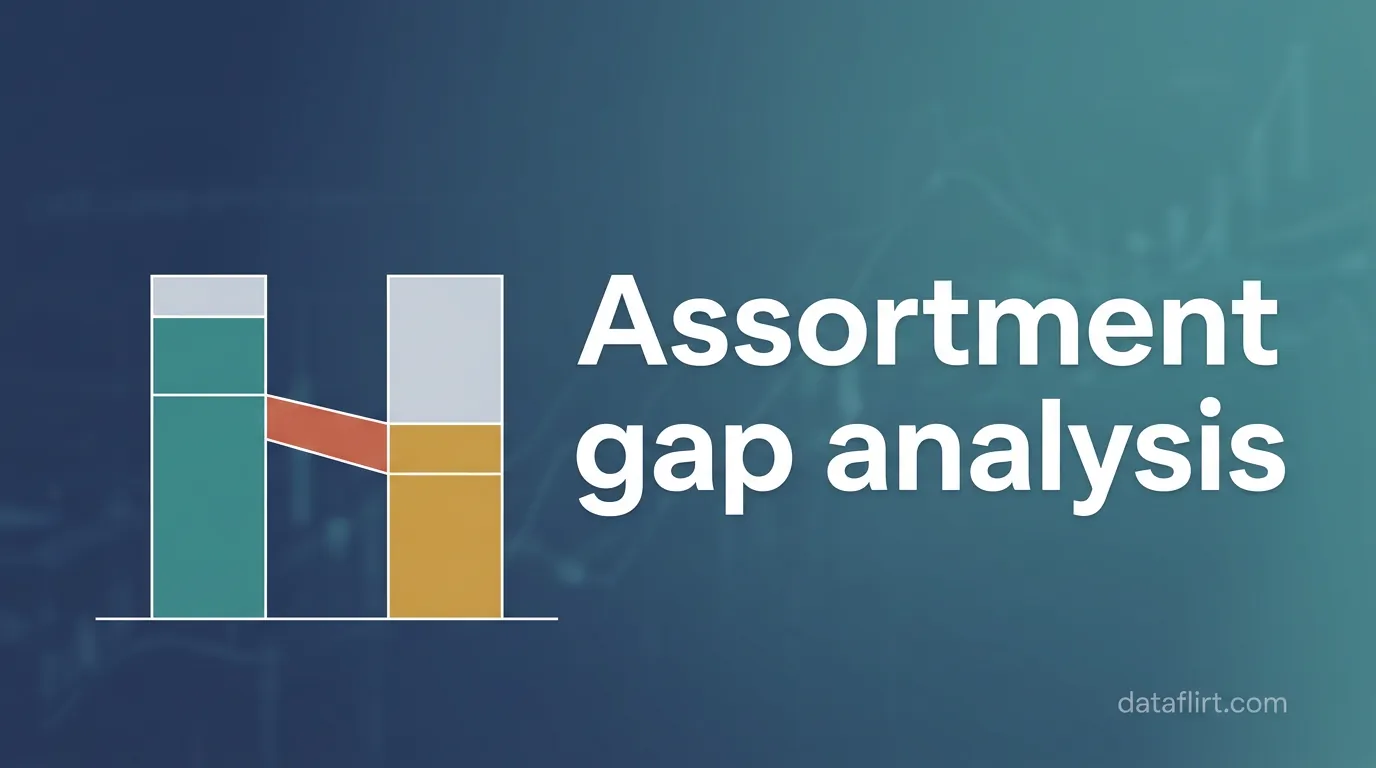
Running the gap analysis involves importing your standardized DataFlirt extraction data into a database and pivoting the competitor metrics against your own active catalog. This programmatic approach replaces impossible manual browsing with automated, mathematically precise discrepancy reporting.
Scale defines this process. Category-wise gap analyses reveal massive disparities between top retailers; for instance, Target lacks approximately 40% of the Asian/International grocery items that are available on Amazon. DataFlirt gives you the data to expose similar gaps in your own niche.
Pivot by category your SKU count vs competitor count
The fundamental gap analysis operation is a category pivot. You group the DataFlirt dataset by category and sum the unique SKUs. You run the exact same operation on your internal catalog export.
Merging these two tables immediately reveals deficits. If Home Depot lists 800 products under “Outdoor Power Equipment” and you list 45, you have found a massive catalog gap. DataFlirt standardizes the nomenclature so these pivots actually align.
import pandas as pd

# DataFlirt extraction data loaded for analysis
dataflirt_comp_df = pd.read_csv("dataflirt_competitor_export.csv")
my_store_df = pd.read_csv("my_shopify_catalog.csv")

# Aggregate SKU counts by category to spot gaps
comp_category_counts = dataflirt_comp_df.groupby('Category')['SKU'].nunique()
my_category_counts = my_store_df.groupby('Category')['SKU'].nunique()

# Merge and calculate the absolute difference
gap_analysis = pd.merge(my_category_counts, comp_category_counts, on='Category', suffixes=('_Mine', '_Comp'))
gap_analysis['SKU_Deficit'] = gap_analysis['SKU_Comp'] - gap_analysis['SKU_Mine']
Brand coverage which brands does competitor carry that you do not
Once category gaps are established, you must drill down into brand representation. You filter the DataFlirt dataset to extract a unique list of manufacturers per category.
You then subtract your active supplier list from the competitor’s list. The remaining manufacturers represent your brand gap. If your rival added five new trending cosmetic brands from Sephora, DataFlirt data highlights that exact supplier deficit.
Price tier map what price bands are underserved
Analyzing price gaps requires segmenting the extracted data into logical bands. You might bucket products into $0-$50, $51-$100, and $100+ tiers.
DataFlirt extracts the precise current selling price, stripping out promotional badges or currency symbols. When you graph the competitor’s price distribution against your own, underserved price bands become instantly visible. You might discover you are completely locked out of the entry-level market.
Recency flag new products in competitor catalog last 60 days you lack
To identify momentum, you analyze the recency flags provided in the DataFlirt export. You isolate every competitor SKU tagged with a discovery date within the last 60 days.
This subset represents their current strategic merchandising focus. If a major competitor like Walmart or Target is suddenly heavily listing a specific type of kitchen appliance, the DataFlirt recency flag allows you to catch the trend before consumer demand peaks.
Interpreting and acting on findings
Interpreting and acting on findings requires filtering your gap data through the lens of actual consumer demand and your specific brand positioning. You must determine which missing categories represent genuine lost revenue and which represent strategic exclusions you deliberately made to protect your brand identity.
Retailers executing assortment optimization programs typically see baseline sales improvements of 2% to 6%, depending heavily on their starting point. The DataFlirt data provides the roadmap; your merchandising team provides the context.
Not every gap is an opportunity check demand first
A massive numerical gap does not automatically equal a massive revenue opportunity. A competitor might carry 2,000 obscure electronics cables that generate zero actual sales.
DataFlirt delivers the visibility, but your team must validate the business case. You should cross-reference the missing categories identified by DataFlirt against external keyword search volume and internal site search logs to confirm actual buyer intent.
High-SKU-count gaps often signal demand
While some gaps are noise, high-SKU-count gaps usually indicate a proven market. Competitors do not allocate warehouse space and digital merchandising resources to 500 variations of a product unless it sells.
If DataFlirt reveals your competitor has doubled their inventory depth in a specific department, you can safely assume they are seeing high conversion rates. You should immediately prioritize sourcing suppliers for that exact category.
Price tier gaps in your favor signal premium segment they have abandoned
Sometimes a gap analysis reveals a strategic advantage. You might discover through a DataFlirt extraction that a competitor has completely abandoned the sub-$20 market in favor of premium goods.
This is a highly actionable finding. You can aggressively market your budget-friendly alternatives to capture the price-sensitive shoppers they left behind. DataFlirt pricing data helps you confirm their abandonment is deliberate rather than a temporary stockout.
Next step: validate top-gap categories with search volume before sourcing
Once you finalize your priority list of missing products based on DataFlirt data, you must integrate them into your platform safely. This is where technical constraints require extreme caution.
When using Shopify’s native CSV upload to plug assortment gaps, the Title column is always mandatory. When updating existing products or adding new variants to combat a competitor, the Handle column is strictly required. Furthermore, Shopify CSVs do not accept actual image files; you must host images externally and pass valid URLs through the exact Image Src column.
A Shopify catalog update is permanent and irreversible. If a CSV upload is missing variant option columns like
Option1 Name, your existing variants will be deleted entirely by default. DataFlirt extracts clean, structured data so your database engineers can format safe, error-free import files.
How DataFlirt extracts for gap analysis
DataFlirt extracts for gap analysis by deploying concurrent scraping pipelines across your specific competitor set and standardizing their disparate category trees into a single cohesive dataset. We handle the complex anti-bot bypass mechanisms and taxonomy alignment so your team receives ready-to-analyze data without managing infrastructure.
Building an in-house scraper to track a site like Best Buy or Wayfair requires constant maintenance. Understanding scraping cost factors reveals that maintaining proxy networks and rewriting broken selectors quickly drains engineering resources. DataFlirt absorbs that overhead entirely.
Multi-competitor extraction in one engagement
A true gap analysis requires comparing your catalog against multiple rivals simultaneously. Writing custom Python scripts for five different storefronts is highly inefficient.
DataFlirt runs multi-competitor extractions in a single unified engagement. We point our proprietary crawlers at your defined target list. DataFlirt navigates their distinct layouts, bypasses their security firewalls, and aggregates the results. You get one clean dataset regardless of how many sites DataFlirt scraped.
Category-tagged date-stamped delivery
Data hygiene dictates the success of a gap analysis. Raw HTML dumps are useless to a merchandising team. DataFlirt ensures every single record is meticulously cleaned before delivery.
We tag every product with its full breadcrumb path and apply a precise timestamp. The DataFlirt QA layer standardizes brand names, strips out promotional text from price fields, and verifies the image links. When DataFlirt hands over the file, your analysts can begin pivoting immediately.
FAQ
How frequently should a retailer perform assortment gap analysis?
Periodic extractions ensure you catch emerging trends early. Most DataFlirt clients run full catalog gap analyses quarterly, with high-velocity categories updated weekly to monitor fast-moving competitor inventory changes.
Can I directly import a competitor’s extracted catalog into my Shopify store?
No. Shopify requires a highly specific CSV format with mandatory Title and Handle columns, plus external links in the Image Src field. DataFlirt provides the raw standardized data, which your developers must format to match your exact Shopify schema to prevent irreversible variant deletions.
Why is category tree extraction necessary before scraping products?
Competitor metadata and architectures vary wildly. Extracting the category tree first ensures you capture hidden or nested subcategories that pagination scripts or simple search queries routinely miss. DataFlirt uses this method to guarantee comprehensive catalog coverage.
If you would rather not manage proxy rotation or navigate complex Shopify import schemas yourself, DataFlirt’s ecommerce scraping service handles the complete extraction, QA, and data delivery. Whether you need a one-time catalog audit of a direct rival or a continuous feed from a complex B2B marketplace, DataFlirt delivers the precise data required for profitable assortment optimization. Reach out to the DataFlirt team today for a free scoping call.