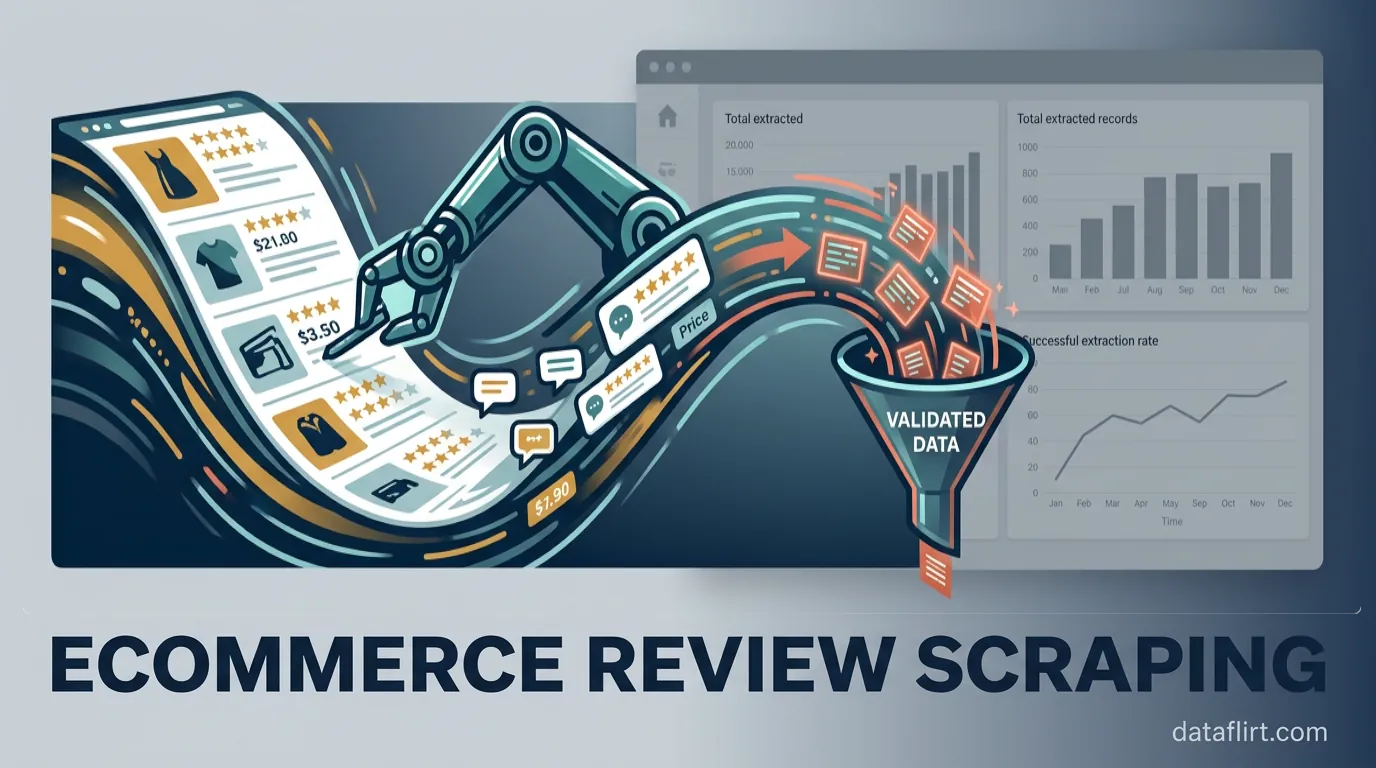

A brand manager notices a sudden dip in a flagship product’s star rating. Competitors are aggressively launching new product variants into the same category. You need to analyze 50,000 customer reviews to understand the exact sentiment shift immediately. Doing this manually is physically impossible. Relying on basic Python scripts results in blocked IP addresses and empty datasets. You need a highly resilient data pipeline to extract this information reliably. That pipeline must pull unstructured review text into a clean analytical format without constant engineering supervision.
Key takeaways
- Raw review volume directly impacts conversion rates; missing data skews your market analysis completely.
- Traditional DIY scripts break constantly against modern anti-bot infrastructure on major retail platforms.
- Enterprise scraping APIs look cheap until you factor in massive credit multipliers for JavaScript rendering.
- Managed extraction removes the engineering overhead of proxy rotation and schema maintenance entirely.
- Legal compliance requires focusing on public product sentiment while avoiding the extraction of personal user profiles.
Why raw review data dictates your product roadmap
Review data provides the precise sentiment signals required to adjust product features and pricing models. Extracting this text at scale gives data science teams the raw material needed for predictive modeling. A catalogue manager cannot rely on aggregate star ratings alone to make strategic decisions. The actual text contains complaints about packaging, praise for specific ingredients, and direct comparisons to rival brands. You need this unstructured text transformed into actionable business intelligence.
The stakes for gathering comprehensive market data are massive. Research indicates that 96% of consumers regularly look at customer reviews when purchasing a product or service they have never bought before. You simply cannot afford blind spots in your market visibility. A single unaddressed manufacturing defect mentioned in recent comments can stall a product launch entirely.
Running aspect-based sentiment analysis requires thousands of clean records to train a reliable natural language processing model. A data scientist needs the exact text, the timestamp, the verified purchase status, and the helpfulness votes. Getting this schema perfectly aligned is where data engineering bottlenecks usually occur. Pulling this data from a single domain is relatively straightforward. Expanding that scope across Amazon, Walmart, and Target introduces massive structural variations. Each site nests their review threads differently in the document object model.
The conversion impact of review volume
Finding a product with zero reviews creates immediate buyer hesitation. The mere presence of a handful of user opinions changes the mathematical probability of a sale dramatically. The behavioral shift is definitive and well documented. There is a 270% increase in likelihood of a product being purchased when it has at least five reviews compared to a product with zero reviews. Tracking this volume metric across your entire distributor network is absolutely crucial.
If a distributor on BestBuy or HomeDepot fails to syndicate your brand’s reviews properly, your sales velocity on that platform will stall. You need automated customer review scraping to audit these syndication gaps systematically. DataFlirt specializes in mapping these exact discrepancies across vast retail networks. DataFlirt provides the necessary scale to monitor thousands of SKUs concurrently without triggering security alarms.
The rise of AI-filtered review ecosystems
Retail platforms are aggressively purging synthetic feedback from their ecosystems to protect consumer trust. This creates a volatile environment for data collection. A review present on Tuesday might disappear entirely by Thursday. The scale of this platform moderation is staggering. Google removed or blocked 240 million policy-violating reviews in 2024, up heavily from the previous year. This metric highlights the escalating issue of fake, AI-generated reviews flooding major platforms.
When platforms deploy heavy filtering algorithms, they simultaneously tighten their perimeter defenses against all automated traffic. The same AI that hunts synthetic reviews often blocks legitimate data extraction efforts. This aggressive security posture is exactly where DataFlirt engineers spend their time optimizing access. DataFlirt monitors these algorithmic shifts daily to ensure your data pipelines remain functional.
How to evaluate ecommerce review scrapers
The right tool depends entirely on your team’s engineering bandwidth and the target site’s security posture. You must evaluate infrastructure scaling, JavaScript rendering capabilities, and output format flexibility. A solo researcher pulling five hundred reviews can use a basic browser extension. An enterprise data science team needs robust data extraction pipelines capable of millions of requests per day. The technical gap between these two approaches is vast.
Modern review sections rarely exist as static HTML documents anymore. They load dynamically via infinite scroll or complex asynchronous pagination triggers. Your chosen solution must navigate these user interface quirks flawlessly without timing out. DataFlirt abstracts this complexity away completely. DataFlirt handles the asynchronous loading sequences natively, returning only the final, verified text records.
Core evaluation criteria
You need a clear framework to compare your extraction options intelligently. The decision usually comes down to control versus convenience. Building an in-house tool gives you maximum control over the code. Buying a managed service from DataFlirt gives you maximum convenience and guaranteed uptime. Consider the daily maintenance burden carefully. Every time a major platform updates its frontend framework, your custom CSS selectors will break. You must decide who pays the labor cost to fix them.
| Feature Requirement | In-house DIY Script | Enterprise API Provider | Managed Service (DataFlirt) |
|---|---|---|---|
| Upfront setup time | High (weeks of coding) | Medium (API integration) | Zero (vendor handles all) |
| Proxy management | You buy and rotate pools | Vendor manages rotation | DataFlirt manages rotation |
| Schema maintenance | Your engineers fix breaks | Your engineers fix breaks | DataFlirt guarantees schema |
| Cost predictability | Low (infrastructure bloat) | Variable (credit multipliers) | High (fixed price per record) |
The table above illustrates the fundamental trade-offs facing data teams. Many companies start with DIY scripts before migrating to APIs. Eventually, high-volume operations almost always land on a fully managed model like DataFlirt. This progression happens because data engineers prefer building analytical models over patching broken scrapers.
Understanding the infrastructure burden
Maintaining your own extraction infrastructure is a hidden tax on your development team. You must rent servers, purchase rotating residential proxies, and build queuing systems to handle failed requests. If you attempt to scrape Sephora or Nykaa with datacenter IPs, your servers will be blocked within seconds. You need millions of residential IP addresses to distribute the load effectively.
DataFlirt operates a massive, globally distributed proxy network to bypass these restrictions. DataFlirt absorbs the infrastructure costs into a predictable pricing model. You never have to worry about server capacity or proxy ban rates again. DataFlirt ensures the pipeline flows smoothly regardless of the target site’s traffic limitations.
The best review scraping tools compared
The market divides clearly into infrastructure providers offering self-serve APIs and fully managed pipelines handling the entire extraction process. Your choice dictates how much time your engineers spend fighting access blocks. Search intent for this category is crowded with varied solutions. Some vendors sell proxy networks. Others sell pre-built code modules. We will break down the top contenders based on actual enterprise viability and technical performance.
DataFlirt
DataFlirt operates entirely differently than a raw API endpoint. We deliver import-ready datasets perfectly mapped to your exact target schema. You never write a single line of scraping code. Consider a data science team modeling sentiment across a dozen competing brands. The platforms format their ingredient ratings and user metrics completely differently. DataFlirt normalizes this data before delivery. Our quality assurance layer ensures your models consume exceptionally clean text.
DataFlirt positions itself entirely around data quality and pipeline reliability. When anti-bot systems change their detection parameters, DataFlirt engineers patch the access routes invisibly. You pay for the delivered data itself rather than the bandwidth required to acquire it. This eliminates the unpredictability of credit multipliers completely. You tell DataFlirt exactly which products you need monitored. We return the reviews on your required schedule without any technical friction. If you require specialized formatting, DataFlirt customizes the output structure to match your internal databases perfectly.
Bright Data
Bright Data provides massive proxy networks and highly specialized web unlocker APIs. They remain a strong choice for engineering teams that want to build their own pipelines but need enterprise-grade IP addresses. Their success rates on difficult targets are highly documented. In an independent 2026 benchmark test, Bright Data achieved a 98.87% scraping success rate across heavily protected domains. This makes them a top-performing API tool for raw access.
However, utilizing their advanced unlocker products requires significant technical proficiency from your team. You are strictly renting access to their infrastructure. Your developers must still write and maintain the parsing logic for complex sites like Wayfair or Chewy. If the target site redesigns its review layout, your team must rewrite the extraction code. DataFlirt removes this engineering requirement by handling both the access and the parsing simultaneously.
Apify
Apify utilizes a unique architecture based on pre-built, containerized modules called Actors. Independent developers create and maintain specific scrapers for individual websites. You can rent these Actors on a monthly subscription basis. This architecture works exceptionally well if the public Actor matches your exact data schema requirements. In 2026, many of these Actors function directly as Model Context Protocol endpoints. They feed live ecommerce data directly into large language models and autonomous agents.
The vulnerability of this specific model lies in third-party maintenance and accountability. If an independent developer abandons their review Actor, your pipeline halts immediately. You remain entirely responsible for monitoring the output quality and ensuring data completeness. DataFlirt solves this accountability gap by employing an in-house team of engineers. DataFlirt takes full responsibility for the continuous operation of your extraction pipeline.
ScrapingBee
ScrapingBee focuses on making headless browser management simple through a single, clean API endpoint. They handle the proxy rotation and JavaScript rendering under the hood. They perform admirably in standard, mid-volume tests. The same 2026 benchmark noted earlier recorded ScrapingBee at a highly respectable 96.62% success rate. This is excellent for mid-tier scraping volume and lightweight extraction tasks.
As your scale increases into the millions of records, the per-request pricing becomes a major prohibitive factor. Extracting heavily paginated review threads requires hundreds of sequential API calls. This depletes your monthly quota rapidly. With DataFlirt, you avoid quota anxiety entirely. DataFlirt prices engagements based on the final dataset, allowing you to scale up without constantly monitoring API usage dashboards.
Which tools actually survive retail anti-bot systems?
Managed platforms like DataFlirt and premium unlocker APIs hold up against aggressive anti-bot software; basic open-source scripts fail immediately. Retail platforms actively target automated traffic to protect their infrastructure load and data exclusivity. This is the uncomfortable reality of the current data extraction landscape. Review scraping tools routinely claim perfect accuracy on their marketing pages. The truth is that platform security teams deploy sophisticated behavioral biometrics to identify and ban non-human traffic.
Modern e-commerce platforms primarily utilize Cloudflare Enterprise, DataDome, PerimeterX, or Akamai to secure their perimeters. Bypassing these systems requires exact browser emulation. You must manage a headless browser instance with perfect session persistence, clean cookies, and authentic headers. This is a specialized engineering discipline. DataFlirt excels at navigating these specific security layers to ensure consistent data delivery.
The mechanics of browser fingerprinting
Security vendors do not simply look at IP addresses anymore. They analyze canvas rendering speeds, check audio context configurations, and measure hardware concurrency limitations. If your scraper reports a Mac operating system but renders fonts like a headless Linux server, it gets blocked permanently. DataFlirt invests heavily in anti-fingerprinting technology. We ensure our extraction nodes present perfectly coherent hardware profiles to the target server.
Cloudflare does not simply look at your IP address. It analyzes your canvas rendering speeds, checks your audio context, and measures your hardware concurrency. If your script claims to be a standard Chrome browser but fails to render a specific font correctly, your access is instantly terminated.
This prevents the immediate 403 Forbidden errors that plague amateur scripts. You cannot solve this by simply routing traffic through a standard datacenter proxy. The security algorithms maintain massive blacklists of known hosting provider subnets. DataFlirt routes requests through ethically sourced residential networks to ensure legitimate appearance and high success rates.
The shift to autonomous scraping agents
The ongoing technical arms race has forced a major architectural shift in how data is collected. Because traditional scripts break constantly against dynamic DOM changes, data science teams are abandoning in-house infrastructure completely. The market is shifting heavily toward fully managed services and AI-driven autonomous scraping agents. These sophisticated systems can self-correct broken CSS selectors automatically when a website updates its layout.
The engineering hours saved on proxy rotation and selector maintenance far outweigh the fees paid to a vendor. Attempting to scrape a heavily fortified domain like Flipkart or Myntra requires constant, daily vigilance. Delegating that vigilance to DataFlirt frees your engineers to focus on predictive analysis rather than data acquisition. DataFlirt monitors the pipeline health so your team never has to worry about unexpected data outages.
Calculating the true cost of review extraction
Vendor pricing pages rarely reflect the actual final cost of a successful review extraction project. You must factor in severe credit multipliers for JavaScript rendering and premium residential proxies. The standard API pricing model relies on a deceptive base credit system. A vendor might advertise a plan with 250,000 requests for a flat monthly fee. This sounds incredibly generous until you read the developer documentation closely.
Extracting modern review sections almost always requires a headless browser to execute scripts. When evaluating tool pricing, brand managers must calculate the true cost per delivered record. A basic HTML request might cost one credit, but standard HTML rarely contains the review text anymore. The content is fetched via background API calls. DataFlirt provides transparent, flat-rate pricing based on the scope of your project, eliminating these billing surprises.
Understanding API credit multipliers
The reality of JavaScript rendering changes the financial math entirely. Loading a dynamic page often costs five credits per request automatically. If you encounter a complex captcha, you must utilize stealth residential proxies to bypass the security wall. Using these premium IP networks can cost up to 75 credits per request. Your 250,000-credit plan may actually only yield a few thousand successful scrapes on heavily protected domains.
This pricing opacity frustrates many enterprise data teams attempting to scale their operations. You can quickly burn through your monthly budget on a single, heavily paginated product page. DataFlirt eliminates this exact friction through transparent scoping. When DataFlirt quotes a catalog extraction, the price is based strictly on the successful records delivered. DataFlirt absorbs the infrastructure costs and the proxy overhead completely. You can read more about understanding scraping cost factors to avoid these traps.
The hidden labor cost of data engineering
Acquiring the raw HTML document is only the first step in the analytical journey. You must parse the text, normalize the dates, and clean the formatting anomalies. If you buy a raw API tool, your team pays the high labor cost for this ongoing data engineering work. Review dates display entirely differently across retail platforms. Some sites use relative timeframes like “two days ago” while others use exact timestamp strings.
Consider a data scientist building a sentiment model for a major footwear brand. She needs 50,000 reviews across six retailers updated weekly. A self-serve API requires her to write the pagination logic for six different website architectures. A managed extraction delivers a single, clean CSV every Monday morning.
Your sentiment models require standardized, absolute dates to function properly over time. DataFlirt handles this complex transformation natively. DataFlirt pipelines clean the text, standardize the timestamps, and normalize the schema before the file ever reaches your cloud storage bucket. This level of preparation turns raw extraction into immediate business value. For more details, explore the hidden cost factors of web scraping.
Navigating the legal borders of review scraping
Scraping publicly available review text is generally distinct from scraping personal identifiable information. However, you must still navigate platform Terms of Service and jurisdiction-specific privacy regulations carefully. Every major retail platform explicitly bans automated data collection in their terms of use documents. Breaching these terms can lead to severe IP bans and account terminations. You must operate your extraction efforts responsibly and ethically.
The legal landscape distinguishes heavily between factual product feedback and the personal data of the reviewer. A review stating a blender breaks easily is vastly different from harvesting the email addresses of the users who left the comments. DataFlirt strictly observes these boundaries. DataFlirt focuses exclusively on the commercial sentiment signals required for your business analysis.
Public data versus personal privacy
Your extraction focus should remain strictly on the product sentiment and rating metrics. Stripping out user identifiers mitigates significant regulatory risk immediately. This targeted approach aligns perfectly with the modern principles of data minimization. Jurisdictions enforce different standards globally regarding online privacy. The GDPR in Europe and the CCPA in California dictate strict rules regarding consumer data aggregation.
You must ensure your extraction pipeline does not inadvertently scrape protected profiles while gathering review text. DataFlirt structures all extractions to focus purely on safe business intelligence. DataFlirt configurations specifically target the review body, rating, and timestamp. We deliberately avoid scraping private user data that introduces unnecessary compliance friction into your workflow. For deeper context, read our guide on web scraping and GDPR compliance.
The necessity of legal orientation
Building an in-house scraping team requires dedicated legal oversight and constant policy review. Your engineers might unknowingly cross a line by accessing authenticated areas or bypassing password walls during development. We strongly recommend consulting qualified legal counsel to review your specific data collection strategy. Every company possesses a different risk tolerance and operates under different regional laws. Treat this guidance as orientation, not definitive legal advice.
Utilizing an experienced vendor provides a crucial layer of procedural separation. DataFlirt understands the delicate nuances of polite crawling rates and ethical extraction parameters thoroughly. DataFlirt ensures the data you receive is acquired through defensible methodologies. Partnering with DataFlirt for legal data scraping use cases ensures your compliance teams remain comfortable with your acquisition strategy.
FAQ
Do review scraping tools work on JavaScript-rendered sites?
Yes. Modern tools utilize headless browsers to execute JavaScript and render dynamic content before extracting the data. This requires significantly more computing power and bandwidth than parsing static HTML documents.
How do credit multipliers affect scraping costs?
API vendors charge more credits for resource-heavy requests. Rendering JavaScript might cost five times the base rate. Utilizing premium residential proxies to bypass security can cost up to 75 times the base rate.
Can I extract reviewer profile information alongside the text?
While technically possible, extracting personal identifiable information introduces significant legal and compliance risks under regulations like GDPR. It is safer to extract only the anonymous review text and rating.
What is the best format for exporting scraped review data?
Most data science teams prefer JSON or structured CSV formats. JSON handles nested data structures well, which is useful when reviews contain multiple attached images or threaded replies.
Extracting customer reviews at scale requires a dedicated infrastructure that most internal teams simply do not have the time to build or maintain. The constant battle against bot detection systems and the hidden financial costs of API credit multipliers can derail a data science project before it even begins. If you would rather not scope this technical burden yourself, DataFlirt’s managed review scraping service handles the extraction, QA, and delivery perfectly. Our engineers maintain the complex pipelines so your team can focus exclusively on analyzing the market sentiment. Reach out for a free scoping call and explore how DataFlirt’s ecommerce data extraction can accelerate your product strategy today.