
Key takeaways
- A one-time extraction delivers a structured list of marketplace merchants mapped to their business details and performance metrics.
- Finding seller data requires scraping individual product pages first, as marketplaces do not publish open merchant directories.
- Regional privacy laws strictly regulate the scraping of B2B contact information, even when that data is publicly visible on a storefront.
- Relying on public data exemptions works under India’s DPDP Act, but fails completely under the European GDPR framework.
Sales development representatives face a massive scaling problem when targeting independent ecommerce merchants. Manual prospecting across major retail platforms takes hours and yields disjointed spreadsheets filled with incomplete business profiles. Independent third-party sellers now generate 60% of all products sold on Amazon (Source). You need a programmatic, automated pipeline to capture this specific data asset at scale.
What a one-time seller list extraction actually delivers
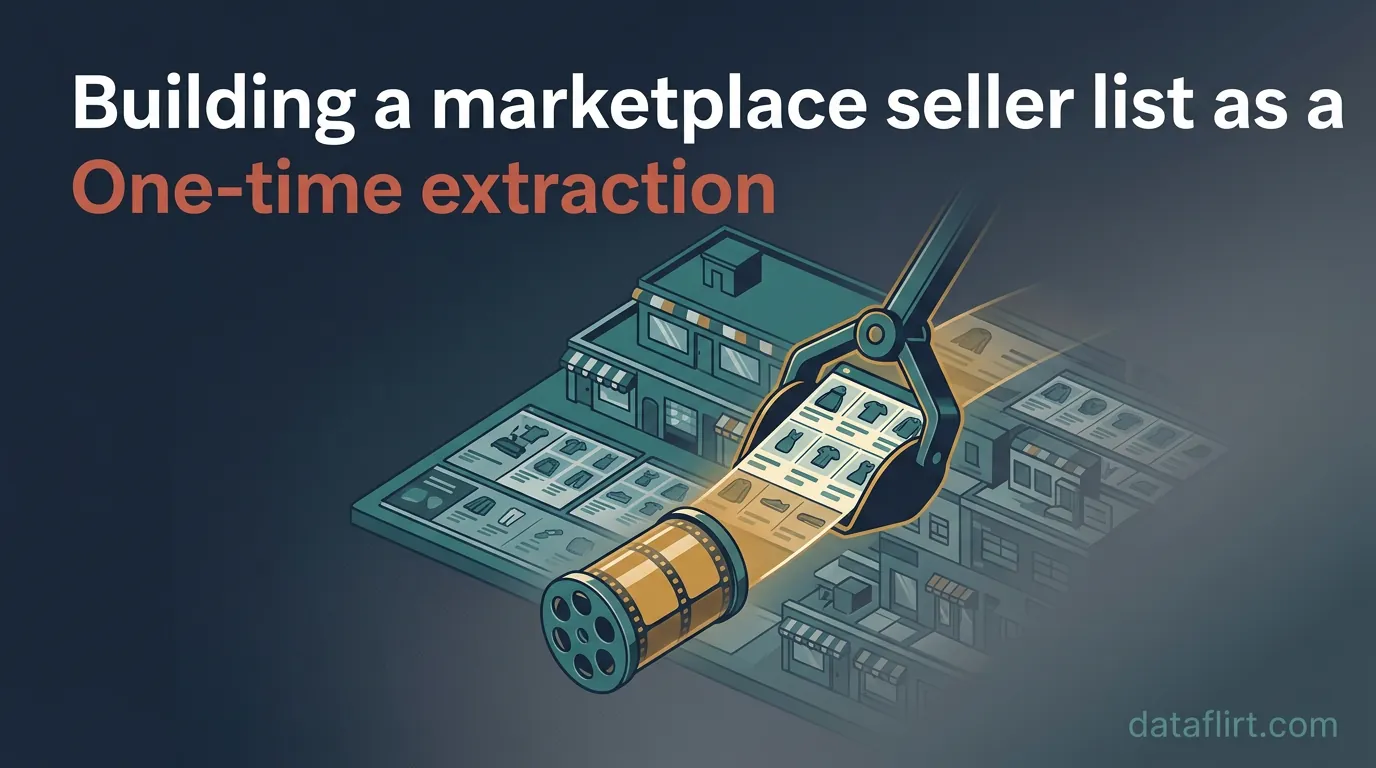
A one-time extraction produces a structured dataset mapping storefront URLs to specific merchant business details. You receive a flat file formatted perfectly for immediate import into your sales engagement platform.
The base data versus enriched contact profiles
Marketplace platforms display different layers of seller information depending on regional regulations and site architecture. A standard base extraction pulls exactly what the storefront renders. This includes the legal business name, the registered physical address, the aggregated customer rating, and the primary product category.
DataFlirt focuses on capturing this base structural data accurately across thousands of pages. You use this foundational data to qualify the account size and geographic territory. You cannot simply scrape the entire platform without a strategy. With 1.9 million active third-party Amazon sellers worldwide (Source), you must define strict filtering criteria before the scrape begins. DataFlirt helps you isolate specific product niches or review count thresholds to keep the dataset highly relevant to your outreach campaign.
Once DataFlirt delivers the base commercial data, many sales teams run the output through secondary enrichment APIs. This two-step process separates the web data extraction workload from the contact discovery phase. You identify the target businesses using DataFlirt. You then find the specific decision-maker emails using a dedicated B2B contact provider.
Designing the target schema for your sales pipeline
Your extraction is only useful if it maps directly to your existing customer relationship management software. You must design the schema before any code executes. DataFlirt requires a clear column definition phase to prevent data wrangling headaches later.
The specific fields available vary wildly by platform. An extraction targeting Etsy yields deep aesthetic category data and shop creation dates. A scrape focused on Walmart provides strict corporate registration details. DataFlirt standardizes these outputs into a single unified format.
| CRM Target Field | Marketplace Source Element | SDR Business Value |
|---|---|---|
Account_Name | Storefront header or Legal Entity Name | Primary identifier for outreach. |
Physical_Address | Seller profile business address block | Geographic territory assignment. |
Review_Count | Lifetime aggregated seller feedback | Proxy for merchant revenue volume. |
Primary_Category | Most frequent top-level product category | Campaign personalization and segmentation. |
When DataFlirt manages the project, the engineering team configures the extraction logic to populate this exact table. DataFlirt ensures that null values are handled gracefully and that irregular address string formats are cleaned before delivery.
How to execute the extraction and what breaks
You will face dynamic pagination limits, hidden seller profile pages, and aggressive bot mitigation systems. You must script intelligent navigation that mimics human browsing while routing traffic through residential proxy networks.
Navigating category trees and seller storefronts
Major ecommerce platforms do not offer a centralized directory of active merchants. To find the sellers, you must scrape the products first. The extraction script must navigate through category search results, extract individual product IDs, load the product detail pages, and finally parse the buy box to locate the seller’s storefront link.
This multi-step traversal multiplies the required server requests exponentially. Out of 9.7 million registered Amazon seller accounts globally (Source), only a fraction are actively trading. Scraping live product listings guarantees that DataFlirt only captures merchants who currently possess active inventory.
The code required to handle this traversal must manage session states carefully. Below is a conceptual Python example demonstrating how an extraction script isolates the seller profile URL from a product page.
# Virtual environment setup requirement:
# python -m venv env
# source env/bin/activate
# pip install requests beautifulsoup4

import requests
from bs4 import BeautifulSoup

def extract_seller_link(product_url):
    # DataFlirt uses advanced rotation networks in production.
    # This assumes a simplified local execution context.
    headers = {
        "User-Agent": "Mozilla/5.0 (Windows NT 10.0; Win64; x64)",
        "Accept": "text/html,application/xhtml+xml"
    }

    try:
        response = requests.get(product_url, headers=headers, timeout=10)
        response.raise_for_status()
        soup = BeautifulSoup(response.text, 'html.parser')

        # Locate the specific element containing the seller profile
        seller_node = soup.select_one("a#seller-profile-trigger")

        if seller_node and 'href' in seller_node.attrs:
            return seller_node['href']
        return None

    except requests.RequestException as e:
        print(f"Network error encountered: {e}")
        return None
Overcoming bot mitigation systems
Retail platforms protect their merchant ecosystems fiercely. They deploy complex security layers that analyze request patterns and browser variables. If you attempt a naive scrape against Target or Wayfair, the platform will block your server IP immediately.
DataFlirt engineers spend extensive resources managing browser fingerprinting defenses. Modern bot mitigation software looks for headless browser execution flags. It checks canvas rendering signatures. It analyzes the specific order of HTTP headers. DataFlirt neutralizes these checks by deploying custom browser environments that perfectly emulate standard consumer traffic.
Traffic routing presents another massive hurdle. DataFlirt integrates a rotating proxy infrastructure to distribute requests across millions of residential IP addresses. This prevents rate limiting and ensures the extraction pipeline continues flowing even if an individual request fails.
Infrastructure costs for large geographic targets
The scale of the target marketplace dictates the financial viability of an in-house build. There are an estimated 1.1 million active Amazon sellers operating specifically within the US marketplace (Source). Attempting to traverse millions of product pages to find these sellers requires significant compute power.
You must provision high-memory servers to run concurrent browser instances. You must purchase bandwidth from residential proxy vendors. You must allocate senior engineering hours to maintain the code when the target site redesigns its layout. These compounding expenses are understanding scraping cost factors realities that often surprise internal data teams. DataFlirt absorbs all of these infrastructure costs into a single predictable project fee.
How to handle the legal reality of personal contact data
Scraping seller contact data almost certainly involves personal data. You must navigate GDPR, CCPA, and DPDP frameworks carefully without falling foul of regulatory enforcement.
The GDPR public data fallacy
A dangerous myth persists among sales teams regarding European privacy law. Many believe that if a merchant publishes their email address on a public AliExpress or eBay storefront, that data is exempt from privacy restrictions. The Dutch Data Protection Authority and other European regulators have ruled explicitly that public availability does not exempt data from the General Data Protection Regulation.
Under GDPR, a corporate email address containing a person’s name constitutes personal data. Scraping this information requires a documented Legitimate Interest Assessment under Article 6(1)(f). More importantly, Article 14 dictates that you must provide a transparency notice to the data subject within one month of scraping their details. You must tell them what you scraped, where you got it, and how they can opt out.
Regulators are enforcing this strictly. In late 2024, the French privacy regulator CNIL issued a €200,000 fine against the B2B prospecting tool Kaspr. The firm failed to disclose data sources when responding to subject access requests. DataFlirt mitigates this risk by ensuring all extraction methodologies are strictly documented. DataFlirt provides the origin URLs for every row of data, allowing your compliance team to build accurate transparency notices.
CCPA expiry and strict California rules
California imposes similarly strict limitations. The temporary B2B exemption within the California Consumer Privacy Act expired in January 2023. A California-based seller’s work email, direct dial phone number, and professional title now hold the exact same protections as standard consumer data.
Teams scraping California merchants must implement immediate “Do Not Sell or Share” opt-out mechanisms. Violating CCPA carries severe financial penalties, with fines starting at $2,663 per individual violation. DataFlirt helps teams navigate this by offering geographic filtering during the extraction phase. If your legal team prohibits California outreach, DataFlirt simply excludes those specific territory strings from the final dataset.
The DPDP Act exemption in India
Privacy frameworks in emerging markets offer different operational rules. Unlike the European model, India’s Digital Personal Data Protection Act of 2023 contains a very specific carve-out for public data. Section 3(c)(ii) explicitly exempts personal data that the individual voluntarily made publicly available.
If you target merchants on Flipkart or Shopee who operate within India and voluntarily list their business contact numbers on their profiles, you generally bypass the DPDP consent requirements. This makes specific regional extractions significantly less complex legally. However, broad web scraping can still face scrutiny under India’s Information Technology Act regarding unauthorized server access.
| Region | Primary Regulation | Public B2B Exemption | Core Scraping Requirement |
|---|---|---|---|
| European Union | GDPR | None. Fully protected. | Article 14 Transparency Notice. |
| California (US) | CCPA | Expired in 2023. | Do Not Sell / Share mechanism. |
| India | DPDP Act 2023 | Explicitly exempt. | Adherence to general IT Act rules. |
DataFlirt expects clients to understand these parameters. DataFlirt provides raw public data extraction, but the client acts as the ultimate data controller. DataFlirt strongly advises consulting qualified legal counsel to review your specific outreach use case before launching campaigns based on scraped contact details. Taking compliance seriously is one of the top 5 scraping compliance and legal considerations every scraper should know.
Why teams delegate extraction pipelines to DataFlirt
Managing the entire pipeline from category traversal to proxy rotation drains engineering resources away from core product development. DataFlirt centralizes the operation, delivering a structured list directly to your cloud storage environment.
Validating business logic at scale
Raw scrapes often produce duplicate entries. A seller might list products across twenty different categories, causing your script to extract their profile twenty times. DataFlirt runs aggressive automated validation scripts to deduplicate the dataset based on unique seller identification strings.
DataFlirt ensures every extracted row represents a unique, active business entity. The DataFlirt quality assurance team manually audits data samples against the live target website to verify that the extracted review counts and geographic locations match reality. This prevents your sales team from wasting time pursuing phantom leads or defunct stores.
Custom delivery formats for seamless activation
Your sales operations team needs data they can use immediately. Complex JSON nests or messy CSV files require additional engineering work to normalize. DataFlirt formats the final dataset to match your exact specifications.
Whether you need the data pushed directly to an Amazon S3 bucket, delivered via secure file transfer, or provided as a flat CSV file, DataFlirt handles the last mile. This reliability helps companies avoid the most common avoid ecommerce mistakes web scraping pitfalls. DataFlirt gives you the clean asset you need to start selling immediately.
FAQ
How long does a one-time seller extraction take?
Delivery timelines depend entirely on the scale of the target marketplace and the required data depth. A scrape targeting ten thousand active sellers takes roughly three to five days to build, execute, and validate. Extracting millions of profiles requires massive concurrency and can take several weeks of sustained execution. DataFlirt provides an exact timeline during the initial scoping phase.
Can we filter sellers by specific product categories?
Yes. Because DataFlirt must navigate through the product category tree to find the sellers anyway, we can restrict the scrape to specific vertical paths. If your campaign only targets consumer electronics merchants, DataFlirt will ignore the apparel and home goods categories entirely.
Does DataFlirt provide the direct email addresses of sellers?
DataFlirt extracts exactly what the storefront renders publicly to any standard web browser. If the seller publishes an email address on their public profile, DataFlirt captures it. If the contact information is hidden behind a contact form or requires a proprietary database search, DataFlirt will extract the business name and address so you can use a dedicated enrichment provider.
Are we allowed to email scraped European marketplace sellers?
European data protection law considers business email addresses containing personal names to be protected personal data. You must conduct a Legitimate Interest Assessment and provide a transparency notice to the merchant within one month of the scrape. DataFlirt extracts the data, but you must consult your legal counsel regarding your outreach strategy.
What happens if the marketplace changes its layout during the scrape?
Ecommerce platforms push code updates frequently. These updates often break extraction selectors mid-project. DataFlirt actively monitors the extraction pipeline for drop-offs in data volume. When a selector fails, the DataFlirt engineering team pauses the scrape, patches the code, and resumes the job without passing any maintenance delays or costs onto you.
If you prefer to bypass the engineering headaches of building custom traversal scripts, managing proxy networks, and formatting data dumps, DataFlirt has you covered. The DataFlirt ecommerce scraping service handles the entire extraction lifecycle from scoping to final QA delivery. If you need clean merchant lists to fuel your outbound pipeline, explore our company data extraction capabilities and reach out to the DataFlirt team today for a free scoping call.