
Key takeaways
- Machine learning datasets require an exact, verified match between a specific product image and its corresponding variant attribute.
- Scraping images in bulk without tracking the exact DOM state for each variant creates poisoned datasets with high labeling error rates.
- Relying on official affiliate APIs is no longer viable for high-volume ML extraction due to strict rate limits and account suspension policies.
- You must implement automated deduplication using perceptual hashing to prevent redundant images from skewing your class balance.
- Outsourcing the extraction pipeline shifts the engineering burden away from your data science team, delivering clean files directly to cloud storage.
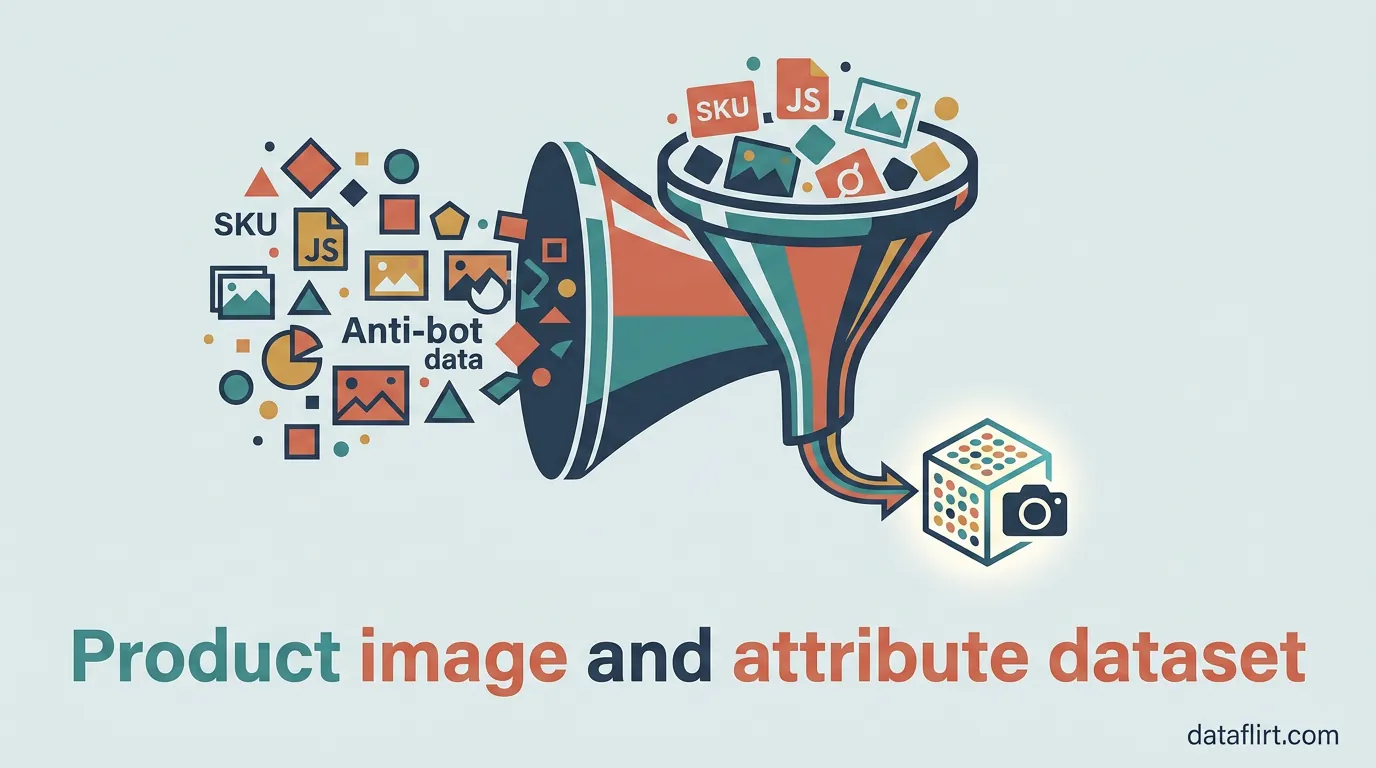
Computer vision models for retail search require perfect symmetry. A system trained to recognize a midi dress must receive an exact image of a midi dress. Scraping product data is one thing. Building a paired machine learning dataset in a single pull is a completely different engineering challenge. You need thousands of perfectly matched images and attributes. Extracting them separately and attempting to join them later creates garbage data. Garbage data creates failed models. Organizations suffer massive financial consequences when bad data enters their training pipelines. You must build an extraction architecture that guarantees absolute integrity between the unstructured visual media and the structured text labels. DataFlirt specializes in solving this exact problem. DataFlirt engineers design pipelines that lock the visual data to the attribute data at the moment of extraction. The resulting dataset is clean, verified, and ready for immediate ingestion into your machine learning workflow. When DataFlirt handles your pipeline, your data scientists spend their time training models instead of cleaning spreadsheets.
What an ML-ready ecommerce product dataset looks like
A machine learning dataset maps a single ground-truth attribute directly to a specific, standardized product image. Every row must represent a discrete variant with its unique visual representation.
The structural requirements differ entirely from standard competitive intelligence feeds. You are not tracking daily price fluctuations. You are extracting the fundamental visual characteristics of an item. A clean dataset removes ambiguity. It drops promotional banners. It filters out lifestyle images where the product is obscured. DataFlirt builds these datasets with strict adherence to the required taxonomy.
The structure of a ground-truth row
Your output schema must lock every image URL to a definitive set of product properties. A flat list of product names and an array of five images is useless for classification tasks. DataFlirt architects define an ML-ready row as a perfectly paired record.
Every variant gets its own row. If a shirt comes in red and blue, the red shirt row contains only the red shirt images. The blue shirt row contains only the blue shirt images. This granular structure ensures your model learns the specific visual signature of the color attribute.
| Column Name | Purpose | Example Value |
|---|---|---|
product_id | Groups variants together | PROD_98234 |
variant_id | Unique identifier for the exact item | VAR_001_RED |
image_url | Direct link to the highest resolution file | https://example.com/img/red-shirt-front.jpg |
category_path | Hierarchical classification | Apparel > Shirts > Button-Down |
ground_truth_label | The target attribute for the model | Red |
Image requirements for computer vision
Models require consistent visual inputs. You need high-resolution, single-subject photos. Images with plain white backgrounds are ideal for initial classification training. Edge Delta notes that 80% of global data is unstructured. Your job is to bring structure to those raw image files.
Resolution matters immensely for convolutional neural networks. Thumbnail images introduce noise. DataFlirt configures extraction pipelines to parse the source code and locate the native resolution image file. This often involves stripping URL parameters that dynamically resize the image for the browser. DataFlirt ensures you receive the raw asset exactly as the supplier uploaded it.
Metadata and versioning
Training datasets require strict version control. You must track exactly when and where the data originated. Every row must include the source URL and the specific scrape date. DataFlirt includes this metadata by default in every delivery.
When a model misclassifies an object, your engineers need to audit the training data. The source URL allows them to revisit the original product page. The scrape date ensures reproducibility. You can version the dataset, run a new extraction three months later, and confidently measure model improvements against the updated data. DataFlirt recommends maintaining a strict metadata schema to support long-term model auditing.
Designing the extraction for ML use
Target specific deep category trees on supplier sites rather than broad sweeps on generic marketplaces. You need thousands of examples per class to train a resilient model.
Extracting ten products from five hundred different categories yields terrible training data. Your model will not learn enough variance within any single class. DataFlirt advises clients to architect their extraction strategies around class depth. If you want to train a model to recognize footwear, you need exhaustive examples of specific sub-categories like combat boots, stilettos, and running shoes.
Category depth over breadth
Deep category targeting provides the volume required for accurate classification. You should map the taxonomy of your target site before running the scraper. Select one to three specific categories and extract them entirely. DataFlirt systems map category trees automatically during the scoping phase.
This focused approach ensures your dataset contains adequate examples of edge cases within a class. A shallow scrape might only capture standard black combat boots. A deep, category-specific scrape captures suede variants, buckled variants, and tall variants. DataFlirt ensures your class distribution remains robust by exhausting the entire pagination sequence for the target categories.
Selecting the right target platforms
You must evaluate platforms based on their image quality and extraction feasibility. Amazon provides professional shots, but the platform aggressively restricts access. You cannot rely on the official API for high-volume dataset building.
Extracting verified image-attribute pairs directly from Amazon is heavily throttled. The Product Advertising API defaults to one request per second. Amazon now dynamically throttles low-performing Associates to as little as one request every ten seconds. API keys without at least ten qualifying affiliate sales in a thirty-day window face automatic suspension. DataFlirt bypasses these API limitations by deploying resilient data extraction architectures that pull directly from the rendered frontend.
Supplier sites often provide superior training data. Platforms like Alibaba or AliExpress feature extensive catalogs with multiple variant images. Retailers like Walmart and Target offer highly structured categorization. Specialty retailers like BestBuy are excellent for electronics datasets. Home goods models benefit from Home Depot and Lowe’s. Furniture models require data from Wayfair or IKEA. DataFlirt routinely targets these platforms to build specialized, niche datasets.
Salesforce indicates 77% of ecommerce organizations are either fully using or experimenting with AI. This massive adoption drives the need to scrape AI training data efficiently from diverse sources.
Dropping incomplete records
Incomplete records damage model performance. You must drop products with missing key attributes rather than attempting to impute the missing data. If the material field is blank, discard the row entirely. DataFlirt enforces strict validation rules at the pipeline level to filter out incomplete items automatically.
Imputing values for computer vision datasets is dangerous. Guessing that a shoe is leather based on the image defeats the purpose of providing ground-truth training data. Envive statistics show 83% of ecommerce shoppers abandon sites when product information is mismatched. You must apply the same strict standards to your ML data. If the data is not explicit, DataFlirt discards it.
Ensuring image-attribute pair integrity
You might be asking the elephant question: How do I ensure scraped image-attribute pairs are correctly matched? Mismatched labels destroy a training dataset. You must capture the exact DOM state that ties a specific variant to its corresponding media file.
This is the single most critical point of failure in ML dataset extraction. A flat extraction approach will ruin your project. You cannot simply scrape the page title, grab all ten images from the carousel, and assign them all to the base product. DataFlirt pipelines are specifically engineered to avoid this critical error.
The danger of flat extraction
Many developers scrape all images into a single array and flat-match them to all variants. This is entirely wrong. If a product page contains images for a red shirt and a blue shirt, flat extraction assigns the blue shirt image to the red shirt variant label. DataFlirt identifies this as the primary cause of poisoned datasets.
According to IBM’s report on the True Cost of Poor Data Quality, organizations average $12.9 million in annual losses due to bad data. The stakes are massive. Unity Technologies lost approximately $110 million in revenue after discovering inaccurate data ingestion corrupted their machine learning models, as highlighted in the same cost of poor data quality research. Furthermore, Shaip reports a 3.4% average labeling error rate across top machine learning datasets. DataFlirt protects your models from these costly failures by enforcing strict variant-level pairing.
Interaction-based variant extraction
The correct approach requires a headless browser to interact with the variant selection UI. Your scraper must systematically click each variant option, wait for the DOM to update, and capture the specific image set that loads for that variant. DataFlirt automates this interaction flawlessly.
When the script clicks the “Blue” swatch, it must intercept the resulting network requests or parse the newly injected image tags. This guarantees that the images captured belong exclusively to the “Blue” variant. DataFlirt infrastructure handles the complex timing and wait states required to ensure the variant image is fully loaded before extraction occurs.
GraphQL extraction architectures
When targeting modern platforms like Shopify, you can achieve perfect pairing without browser interaction by querying the underlying API directly. Shopify has actively deprecated its REST Admin API, finalizing custom app migration by April 2025. DataFlirt pipelines now extract paired data via the GraphQL Admin API.
Using the MediaImage node within MediaConnection, DataFlirt engineers extract native image sizes up to twenty megapixels. They pull the exact ID and URL to map flawlessly to product attributes.
query GetProductVariants($id: ID!) {
  product(id: $id) {
    variants(first: 10) {
      edges {
        node {
          id
          title
          image {
            id
            url
            altText
          }
        }
      }
    }
  }
}
You must budget against Shopify’s calculated query cost system to pull images and attributes concurrently. In 2026, standard plans are limited to 100 cost points per second. Advanced plans are capped at 200 points per second. Shopify Plus allows 1,000 points per second. DataFlirt manages these rate limits dynamically to maintain maximum throughput without triggering blocks.
Deduplication across variants
Retailers often reuse the exact same lifestyle image across multiple variants. If you scrape five variants, you might download the same background image five times. This skews your dataset. DataFlirt implements automated perceptual hashing to detect and remove these duplicates.
You must compute a pHash across all extracted images. Standard cryptographic hashes fail because image URLs or slight compressions change the file hash. Perceptual hashing evaluates the visual structure of the image. DataFlirt flags cross-variant duplicates based on their pHash and queues them for removal or manual review.
from PIL import Image
import imagehash

def get_perceptual_hash(image_path):
    # Calculate the pHash for deduplication
    img = Image.open(image_path)
    return str(imagehash.phash(img))

# DataFlirt pipelines run this concurrently across millions of files.
Validation before training
Manual sampling and automated heuristics prevent poisoned datasets from reaching your training pipeline. You cannot assume the extraction ran perfectly. Evaluating data quality requires a structured validation phase. DataFlirt builds these validation checks directly into the delivery process.
You scraped the data. Now you must prove it is accurate. The validation phase requires both human oversight and programmatic filtering. DataFlirt engineers establish strict gating mechanisms that quarantine suspicious records before they enter your final storage bucket.
Manual verification protocols
You must sample one hundred random image-attribute pairs and manually verify them. Look at the image. Look at the ground-truth label. If the label says “V-neck” and the image shows a crew neck, the extraction logic failed. DataFlirt requires this manual sampling step before certifying any ML dataset delivery.
If you find errors in the sample, you must halt the pipeline. A failure in the sample indicates a systemic failure in the pairing logic. DataFlirt investigates the exact DOM structure of the failed product page to patch the selector logic and reruns the extraction.
Class balance correction
Analyze the distribution of your ground-truth labels. Datasets with over a ten-to-one imbalance require immediate correction. If you have ten thousand images of black boots and only five hundred images of brown boots, your model will develop a severe bias. DataFlirt runs frequency analysis on all extracted labels.
When DataFlirt identifies a severe class imbalance, the extraction parameters are adjusted. The scraper is redirected to search specifically for the minority class. If the target sites lack sufficient inventory, you will need to apply data augmentation techniques or stratified sampling to balance the classes prior to training.
Automated image quality gating
Programmatic checks ensure the visual data meets your model’s standards. You must implement blur detection using variance of Laplacian algorithms. Set a minimum resolution filter to drop images below 500x500 pixels. DataFlirt integrates these automated quality gates natively.
You must also filter out images containing heavy text overlays or watermarks. Supplier sites often plaster their logos across the product. These watermarks confuse computer vision models. DataFlirt uses heuristic checks to identify and quarantine heavily watermarked files, ensuring only clean product photos enter the final dataset.
DataFlirt for ML training dataset extraction
Building a pipeline that enforces strict variant-image pairing is technically expensive. Outsourcing the extraction shifts that engineering burden away from your data science team. You should build an ecommerce scraping agent only if you have the dedicated engineering resources to maintain it. Otherwise, DataFlirt is the ideal partner.
Your machine learning engineers are highly paid professionals. They should be fine-tuning neural networks, not debugging pagination loops on a retail site. DataFlirt takes ownership of the entire data acquisition layer. DataFlirt delivers the precise pairs you need to train accurate, high-performing models.
Variant-matched image-attribute extraction
DataFlirt guarantees absolute integrity between the product variant and the extracted image. The infrastructure utilizes advanced browser automation to mimic human interaction exactly. DataFlirt systems click the swatches, wait for the network to resolve, and capture the specific media tied to that variant.
This meticulous approach eliminates the labeling errors that plague flat-scraped datasets. DataFlirt understands that an image of a red shoe labeled “blue” is worse than useless. DataFlirt ensures your ground-truth labels are unimpeachable.
Automated pHash deduplication included
DataFlirt runs perceptual hashing on every extracted image by default. The pipeline compares the visual structure of the files and eliminates cross-variant duplicates automatically. DataFlirt ensures your model trains on diverse visual data rather than seeing the same lifestyle image a hundred times.
This deduplication step saves you significant cloud storage costs and compute time during the model training phase. DataFlirt handles the computational heavy lifting of hashing millions of images so your internal systems remain fast and uncluttered.
Delivered directly to cloud storage
DataFlirt delivers the final, validated dataset directly to your infrastructure. DataFlirt supports native integration with Google Cloud Storage and Amazon S3. The data arrives in an ML-ready directory structure, fully optimized for your ingestion pipelines.
If you prefer not to scope this complex extraction yourself, DataFlirt handles the pipeline architecture, the deduplication, and the final quality assurance. The AI training data services team at DataFlirt is ready to map your exact requirements. For broader retail data needs, explore the ecommerce web scraping services page and reach out for a free scoping call today.
FAQ
What is the most common mistake when scraping image datasets?
Scraping all images from a product page into a single array and matching them flatly to all variants. This assigns the wrong images to specific variant labels, poisoning the training data. You must extract images interactively per variant.
How do you handle missing attributes in a training dataset?
You must drop the row entirely. Imputing values for missing ground-truth labels introduces false data into your model. If a key attribute like color or material is blank, discard the record.
Why can’t we use the Amazon Product Advertising API for high-volume ML extraction?
The Amazon PA-API 5.0 is heavily throttled, often restricting access to one request every ten seconds for low-performing accounts. Furthermore, accounts without ten qualifying affiliate sales in a thirty-day window face automatic suspension, making it unviable for large-scale data extraction.
What is perceptual hashing (pHash) and why is it necessary?
Perceptual hashing evaluates the visual structure of an image rather than its cryptographic file signature. It is necessary to detect and deduplicate images that are visually identical but have different URLs or minor compressions, preventing identical images from over-representing a class in your dataset.