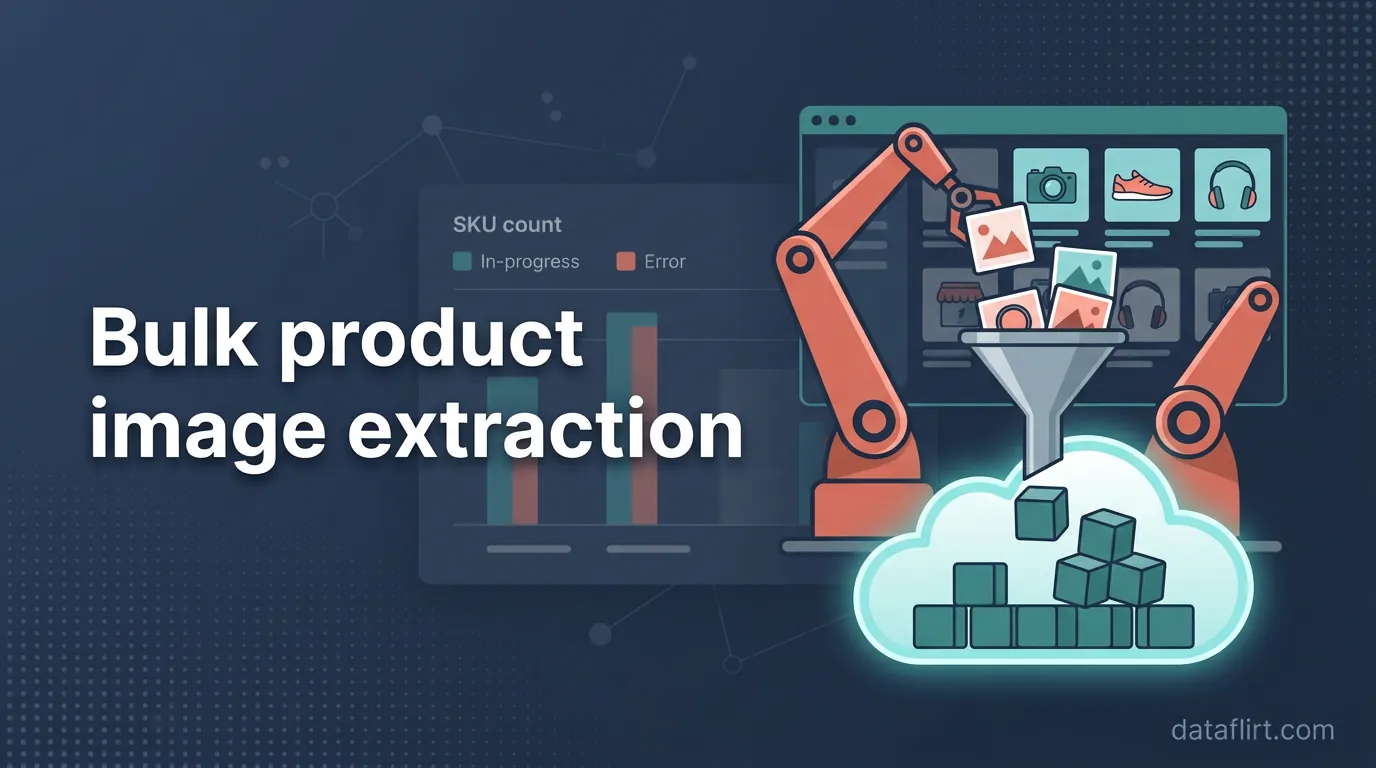

Migrating an entire product catalog or training a visual recognition model requires thousands of high-resolution images. You need the raw media files secured in your own cloud storage bucket. Grabbing text is cheap and relatively simple. Pulling gigabytes of media assets across aggressive content delivery networks is a completely different engineering challenge. Finding the right infrastructure will determine whether your project succeeds or drains your budget overnight. You have to navigate bandwidth markups, severe API limits, and anti-bot systems that flag bulk download attempts.
Key takeaways
- Bulk image extraction requires separating your HTML parsing logic from your media downloading queue.
- Cloud storage in environments like AWS S3 is virtually free compared to the cost of proxy bandwidth needed to extract the files.
- Extracting 100,000 standard product images through a commercial scraping platform can easily cost $800 in proxy fees alone.
- DataFlirt isolates media extraction pipelines to minimize bandwidth waste and delivers payloads directly to your infrastructure.
- Legal orientation requires distinguishing between publicly accessible product images and copyrighted creative assets.
What bulk image extraction actually delivers for ecommerce models
Extracting product imagery at scale feeds machine learning pipelines and enables clean cross-platform migrations. You secure the exact visual assets that drive competitor conversions directly into your own infrastructure.
Visual data dictates online revenue. A stunning 93% of consumers state that visual content is the key deciding factor when making a purchasing decision (mastercard.com). Text descriptions and specification tables support the sale. The image secures the sale. When you build a marketplace or analyze competitor catalogs, you cannot rely on low-resolution thumbnails. You need the primary hero images and all supporting angle shots.
DataFlirt engineers build extraction pipelines designed specifically for these high-fidelity assets. We understand that a single missing angle can break a machine learning training model. Our systems parse the target page, identify the highest resolution variants in the source code, and schedule them for extraction.
Fueling machine learning and computer vision
Artificial intelligence teams require massive datasets of structured product images to train categorization algorithms. A model designed to identify sneaker brands needs tens of thousands of varied images to achieve acceptable accuracy. You cannot scrape these manually. You need an automated system that extracts the image, names the file according to your schema, and uploads it to your storage environment.
DataFlirt frequently provisions data for these exact scenarios. We map the source URL to your target nomenclature. This ensures your data science team spends their time training models instead of renaming files. You can review our specific approaches for these tasks in our guide on how to scrape AI training data.
Supporting catalog migration and market intelligence
Moving a retail operation from legacy software to a modern platform requires transferring every single product asset. A catalog manager overseeing forty thousand products faces a logistical nightmare if the legacy system lacks a clean export function. Extracting the live site is often the only viable path forward. DataFlirt manages this entire process. We map the legacy category tree, extract the media, and deliver an import-ready payload.
Market intelligence relies on understanding presentation. Research shows a conversion rate increase of up to 40% for ecommerce product listings that feature multiple high-quality images compared to those displaying a single image (rewarx.com). If you are tracking competitor strategies, you need to audit their visual density. DataFlirt extracts these assets so your analysts can quantify exactly how competitors present their products.
How to execute high-volume image scraping and what to watch for
You must separate your HTML crawling phase from your media downloading phase. Trying to download gigabytes of images through the same synchronous pipeline that parses product pages guarantees severe bottlenecking and frequent timeouts.
When DataFlirt architects a media extraction pipeline, we utilize a strictly asynchronous queue system. The initial crawler navigates the target website, isolates the image URLs, and pushes those addresses into a specialized queue. A separate fleet of worker nodes then processes this queue. This architecture prevents a slow media server from stalling your entire scraping operation. You can learn more about pipeline architecture in our overview of data migration with RPA.
Bypassing content delivery network throttling
Major retailers host their media on robust content delivery networks like Akamai, Cloudflare, or Fastly. These networks monitor connection requests aggressively. If a single IP address requests five hundred high-resolution images from a Target scraper pipeline within ten seconds, the network will drop the connection. They will flag the IP. They will return forbidden status codes.
DataFlirt bypasses this friction by distributing requests across a heavily rotated pool of IP addresses. We tune the request velocity to mimic legitimate human browsing patterns. We also mimic the specific browser headers expected by the target content delivery network. This precise tuning ensures your download workers maintain stable connections.
Navigating platform API constraints
Many modern ecommerce platforms offer official APIs, but these endpoints are heavily fortified against bulk extraction. Shopify, for example, utilizes strict algorithms to govern data flow. Hitting these limits triggers immediate error responses. Your scraping script must detect these errors, pause execution, and retry the request later. This logic requires careful engineering.
DataFlirt handles these limitations natively. We build custom retry mechanisms that respect server limits while maximizing throughput. If an API is too restrictive, DataFlirt pivots to extracting the data directly from the frontend DOM. We use specific routing techniques to avoid common rate limiting traps.
| API Protocol | Rate Limit Algorithm | Standard Plan Allowance | Recovery Rate |
|---|---|---|---|
| REST Admin | Leaky Bucket | 40 requests | 2 requests per second |
| GraphQL Admin | Calculated Query Cost | 1000 cost points | 50 points per second |
| Storefront | IP-based Throttling | Dynamic based on load | Dynamic recovery |
Managing file types and data normalization
Websites serve images in various formats. You will encounter standard JPEGs, transparent PNGs, and highly compressed WebP files. Your target system might only accept JPEGs. If you extract fifty thousand WebP files, you now have a massive conversion task ahead of you.
DataFlirt solves this at the extraction layer. We configure our workers to request specific file types via HTTP accept headers. If the target server only provides a WebP file, DataFlirt can process the conversion in transit. The final payload delivered to your cloud storage matches your exact format requirements. This saves your engineering team hours of frustrating data wrangling.
The real cost of extracting 100,000 product images
Image extraction services charge per image but platform CDNs throttle aggressively, forcing the use of expensive proxies. What is the real cost at 100k images? Pulling 100,000 standard images costs around two dollars to store but can easily cost one thousand dollars to extract through a commercial platform.
This is the elephant question that vendor pricing pages try to obscure. You are not just paying for server compute time. You are paying heavily for the network bandwidth required to move gigabytes of data across premium proxy connections. A visual dataset is heavy. Text is light. When you scrape text, a gigabyte of bandwidth covers millions of records. When you scrape images, a gigabyte covers perhaps one thousand files.
The hidden fees in commercial scraping platforms
Commercial platforms like Apify use multi-layered billing structures that punish media extraction. You pay for base compute units. You pay external data transfer fees. You often pay a pay-per-result premium to the developer who built the script. Most importantly, you pay massive markups on residential proxies.
Consider the raw numbers for a 100,000 image extraction project. If the average product image is 1MB, your total payload is 100GB. Apify currently charges $8.00 per GB for residential proxy bandwidth. That equals $800 simply for the privilege of routing the images through their IP network. Add the compute units and actor fees, and your total bill quickly approaches $1,000 for a relatively small catalog.
DataFlirt approaches pricing entirely differently. We do not mark up residential bandwidth by 400 percent. DataFlirt engineers analyze the target site to determine the minimum viable proxy requirement. If a site allows media downloads via cheaper data center proxies, DataFlirt routes the traffic there. This significantly drops the total cost of your extraction. We explain these pricing mechanics deeply in our guide to understanding scraping cost factors.
The reality of cloud storage pricing
In stark contrast to extraction fees, storing your data is incredibly cheap. Major cloud providers treat storage as a commodity to lock you into their ecosystem. The cost of maintaining your media assets is a fraction of a fraction of the acquisition cost.
Amazon S3 Standard storage costs roughly $0.023 per GB per month for the first 50 terabytes. Storing our hypothetical 100GB dataset costs just $2.30 a month. For long-term archiving, S3 Glacier Deep Archive drops the cost to $0.00099 per GB per month. The only significant cloud cost comes from egress fees, which AWS charges at $0.09 per GB after your first free 100GB.
DataFlirt optimizes this process by pushing the extracted images directly to your designated cloud bucket. We utilize multipart uploads to ensure massive files transfer securely without tying up local memory. DataFlirt effectively eliminates intermediary storage steps.
| Expense Category | 100GB Volume (100k Images) | Primary Cost Driver |
|---|---|---|
| Commercial Scraper Proxies | ~$800.00 | Premium residential IP bandwidth rates |
| Commercial Scraper Compute | ~$50.00 - $150.00 | CPU/RAM time and base network egress |
| AWS S3 Standard Storage | $2.30 / month | Persistent cloud hosting |
| AWS S3 Egress (Download) | $0.00 (First 100GB free) | Transferring data out to local servers |
Why volume dictates your infrastructure choices
Extracting product data from a top-tier Amazon scraper or a specialized eBay scraper pipeline requires a nuanced approach to volume. An average product listing contains a surprising amount of visual data. Research indicates an average of 5.64 images are featured on the #1 ASINs for the top 500 search terms on Amazon (mastercard.com).
If you plan to scrape twenty thousand products, you are actually targeting over one hundred thousand images. This multiplier effect catches many data teams off guard. They scope their project based on the product count, ignoring the media payload. DataFlirt scopes projects based on total asset count and aggregate file size. This provides transparent, predictable pricing before we extract a single byte.
When to bypass DIY pipelines for managed extraction
Handing off your extraction pipeline makes sense when your proxy bandwidth bills exceed the cost of a managed service. DataFlirt engineers the network routing to keep your media retrieval costs grounded while ensuring impeccable data quality.
Building an in-house media scraper seems straightforward until you hit production scale. Your developers write a beautiful Python script. It works flawlessly for the first five hundred products. Then the target server recognizes the signature of your HTTP library. It issues a silent block. Your script continues running, but it begins downloading empty files or generic placeholder images.
DataFlirt prevents this exact scenario. We monitor the integrity of the downloaded assets in real time. We verify file headers. We check for minimum file size thresholds. If a target site like a BestBuy scraper target starts serving one-kilobyte error images, DataFlirt pauses the queue immediately. We rotate the network parameters and resume extraction. Your team never receives a polluted dataset.
Handling complex frontend architectures
Modern retail sites do not serve static HTML images. They use lazy loading, dynamic JavaScript rendering, and complex canvas elements. A standard request library will not see these images. The script must execute the JavaScript, scroll the virtual page to trigger the lazy load, and intercept the network requests to find the actual media URLs.
DataFlirt specializes in this exact technical layer. We deploy customized headless browsers that execute the target site’s code exactly as a human user would. When managing a Walmart scraper pipeline or a HomeDepot scraper project, DataFlirt captures the high-resolution source URLs that are deliberately obfuscated in the frontend code.
Visual priority continues to shift. Currently, 67% of online shoppers rate high-quality ecommerce images as very important to their purchase decision, explicitly outweighing product-specific information and reviews (cxl.com). This means the visual data is the most critical asset you can acquire. You cannot afford to lose quality due to poor extraction engineering.
Scaling across multiple domains
Extracting from one website is a project. Extracting from thirty websites is an entire department. Every target domain requires a unique extraction logic. The JSON structure of a Wayfair scraper target looks completely different from the DOM layout of an Overstock scraper target. Maintaining thirty different scripts requires constant developer attention.
DataFlirt removes this maintenance burden. You provide the list of target domains and your desired output schema. DataFlirt builds, deploys, and maintains the extraction logic for every single site. Whether you need assets from a specialized Sephora scraper or a broad Macys scraper, DataFlirt standardizes the output. We deliver one unified dataset directly to your AWS S3 bucket.
Legal orientation and extraction compliance
Extracting bulk images touches specific legal considerations that differ from scraping pricing text. Product images are generally copyrighted creative works owned by the brand or the photographer. You must understand your operational boundaries.
If you scrape images to display them on your own competing storefront without permission, you are likely violating copyright law. However, if you extract images internally to train a machine learning model, your actions may fall under fair use doctrines in certain jurisdictions. You must also distinguish between publicly available product data and personal identifiable information. DataFlirt strictly avoids extracting personal data. We strongly recommend that you consult qualified legal counsel to evaluate your specific use case before deploying any bulk extraction project.
FAQ
How does DataFlirt handle image extraction without bloating proxy costs?
DataFlirt isolates the HTML parsing phase from the media download phase. We route the heavy media downloads through highly optimized, lower-cost data center networks whenever the target CDN allows it. We only deploy expensive residential IPs when strictly necessary to bypass hard blocks. This hybrid routing drastically reduces the total bandwidth expense.
Can DataFlirt rename the image files to match my internal SKU numbers?
Yes. DataFlirt can map any extracted data point on the source page to the resulting media file. If a product page contains a specific SKU or UPC, DataFlirt can rename the downloaded JPEG to match that identifier precisely. This ensures seamless integration into your database.
Do I have to pay for cloud storage through DataFlirt?
No. DataFlirt delivers the extracted payload directly into your own cloud environment, such as your AWS S3 bucket or Google Cloud Storage. You maintain complete ownership of the data and pay your cloud provider their standard, highly economical storage rates.
What happens if the target website changes its layout during an extraction run?
DataFlirt utilizes robust monitoring systems that detect schema drift and layout changes in real time. If an image selector fails, our pipeline flags the error, pauses the affected worker nodes, and alerts our engineering team. DataFlirt updates the selector logic and resumes the extraction, ensuring you do not receive incomplete data.
If you would rather not scope this network architecture and bandwidth math yourself, DataFlirt handles the extraction, pipeline maintenance, and direct cloud delivery. We engineer the specific routing necessary to acquire massive visual datasets without the commercial proxy markups. Reach out to our team via our ecommerce data extraction services page or our AI training data services page for a free scoping call.