
Key takeaways
- Media extraction demands distinct infrastructure to handle heavy binary files and bypass lazy-loading scripts.
- Cloud storage is highly preferable to direct URL delivery when building permanent machine learning datasets.
- Perceptual hashing stops you from downloading and storing duplicate photos across dozens of product variants.
- Commercial use of supplier photos requires explicit legal rights; scraping a site does not grant you copyright ownership.
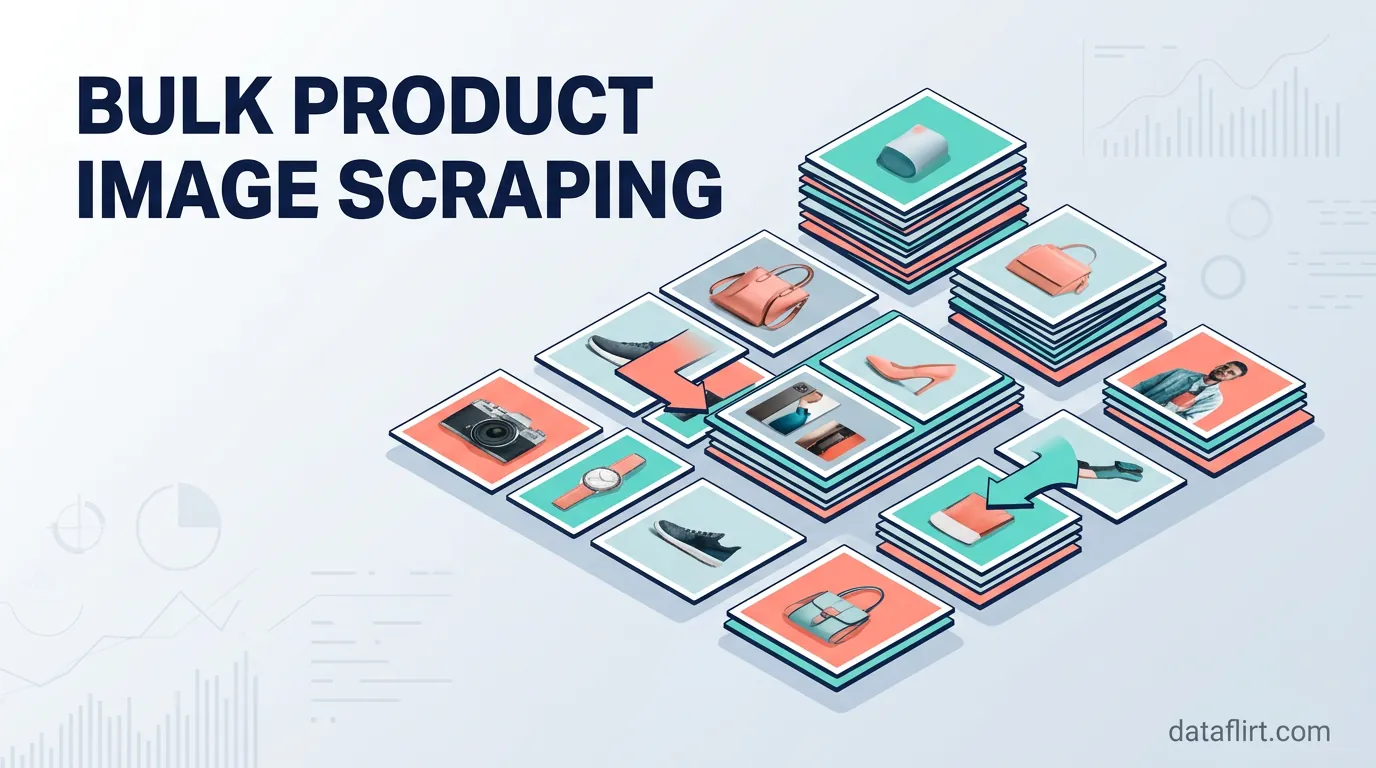
Visual assets dictate ecommerce revenue. A text description cannot replace a clear product photo. Products with five or more images convert at roughly 60% higher rates than products with a single image. You need those visual assets to survive in competitive markets. Pulling text descriptions from a catalog is technically straightforward. Pulling thousands of high-resolution media files introduces massive bandwidth friction and legal complexity.
Extracting catalog data is a standard practice for market research. Grabbing the associated media at scale forces your infrastructure to handle terabytes of binary data. You must manage complex content delivery networks and navigate strict copyright boundaries. This guide explains how to build a resilient image pipeline for modern ecommerce.
Why image extraction is technically heavier than text
Extracting text involves parsing lightweight HTML documents. Image extraction requires downloading heavy binary files stored on specialized external servers. This fundamental difference breaks simple scraper scripts immediately.
The lazy-loading hurdle
Modern storefronts defer loading visual assets until they enter the user’s viewport. If you send a basic GET request to a site like Target, the response contains empty placeholder tags instead of real photo URLs. The target server conserves its own bandwidth by hiding the media from automated scripts.
You must use javascript rendering tools to force the page to load fully. The scraper needs to simulate a real user scrolling down the entire height of the page. This scroll action triggers the network requests that fetch the actual media files. Building reliable scroll simulations takes significant engineering effort. DataFlirt specializes in managing these interaction triggers. DataFlirt configures automated browsers to trigger every lazy-loaded element smoothly.
Reconstructing original CDN URLs
Retailers heavily compress files for mobile viewing. You will usually scrape a tiny thumbnail URL by default. You must look at the query string parameters attached to the content delivery network link.
A standard Cloudinary or Shopify URL includes specific width and crop instructions. You must write regular expressions to strip out these limiters. Removing the constraints ensures you grab the uncompressed master file. DataFlirt automated pipelines handle this parameter stripping natively. When DataFlirt targets a storefront, the system automatically reconstructs the highest resolution path available.
Volume and bandwidth math
Consider the scale of a standard catalog migration. A store pulling 20,000 SKUs with six photos each is requesting 120,000 distinct binary files. The text data for that entire catalog might total twenty megabytes. The media files will easily exceed several hundred gigabytes.
Your infrastructure must handle heavy concurrent downloads without crashing your local memory. This extreme volume triggers anti-bot systems much faster than standard HTML requests. Rate limits become aggressive when your script drains a supplier’s server bandwidth. DataFlirt architects custom proxy rotation specifically for high-bandwidth jobs. The DataFlirt engine spreads the payload across localized IP nodes. This prevents the target server from blocking your extraction script based on traffic spikes.
Delivery options and when to use each
Your specific project goal determines the best delivery method. You must choose whether to store direct media URLs in a spreadsheet or download the raw binary files to a permanent cloud bucket.
| Delivery option | Best for | Storage cost | Speed | Notes |
|---|---|---|---|---|
| Direct URLs in CSV | Fast platform imports | Zero | Immediate | URLs will break if the source CDN changes. |
| Cloud storage (S3/GCS) | ML datasets and archives | Low to medium | Slower transfer | Best for permanent retention and querying. |
| Zip download | Tiny manual audits | Zero | Slow | Impractical for anything above 10,000 files. |
| Re-hosted on your CDN | Production listings | Medium | Fast delivery | Safest choice to prevent random 404 errors. |
Direct URLs for quick imports
Keeping the data in a spreadsheet is the fastest method. Your script extracts the image web addresses and places them directly into your database. This approach incurs absolutely zero storage costs. It is highly effective for merchants moving data between Shopify stores.
However; relying on direct URLs introduces high risk. If the original supplier deletes the photo or changes their domain structure, your store will immediately display broken image links. DataFlirt often provides URL-only delivery for clients conducting temporary competitive audits. For long-term catalog building, DataFlirt recommends securing your own copies of the media.
Cloud buckets for permanent storage
Downloading the files to an Amazon S3 or Google Cloud Storage bucket provides total control. This is mandatory when compiling data for machine learning models. You must control the exact environment where the files live to guarantee pipeline stability.
Storing scraped assets in a data lake allows your engineering team to run asynchronous processing tasks. DataFlirt configures direct cloud bucket delivery for enterprise clients. DataFlirt connects securely to your AWS environment and drops the organized files exactly where your models expect them.
Re-hosting on custom infrastructure
If you are building an independent storefront, you should re-host the assets on your own content delivery network. This ensures your site loads quickly for international customers. It also hides the fact that you sourced your photos from an external supplier. DataFlirt helps facilitate this migration. DataFlirt can map the scraped asset names to your new internal naming conventions during the transfer process.
Deduplication across product variants
Deduplication stops you from storing the exact same blue shirt photo six times for six different sizes. Failing to filter out identical files wastes expensive cloud storage and severely complicates database imports.
The cost of duplicate visual assets
Apparel and hardware catalogs reuse base photos heavily. A single t-shirt style might have twenty size and color combinations. The supplier website often lists the exact same hero photo for every single variant row.
If your scraper blindly downloads every image linked on the page, you will burn through bandwidth instantly. This creates a massive headache when training AI agents. Duplicate data biases machine learning models. High-quality product images increase conversion rates by up to 40%, but feeding a model the same photo fifty times ruins its accuracy. DataFlirt strictly sanitizes datasets to prevent this exact training bias.
Perceptual hashing explained
You cannot rely on file names to identify duplicates. Suppliers frequently rename identical photos dynamically based on the session ID. You must use deduplication logic based on the actual visual contents.
Perceptual hashing (pHash) generates a unique alphanumeric string derived from the visual features of the image. If two images look identical to the human eye, their pHash values will match almost perfectly. Your script calculates the hash upon download. If the hash already exists in your database, the script discards the duplicate file. DataFlirt runs advanced pHash algorithms on all bulk media extractions. This DataFlirt quality layer ensures you only pay for unique visual assets.
Formatting variants for platform imports
Ecommerce platforms demand strict data structures. Shopify CSV files expect image data in specific columns like Image Src, Variant Image, and Image Position. You cannot simply cram twenty URLs into a single cell.
Consider a catalog manager trying to upload 5,000 products to Shopify. To attach multiple images without breaking the variant structure, she must place secondary images on separate, subsequent rows. These rows must share the exact same product Handle but leave all variant-specific fields completely blank.
DataFlirt formats your final delivery file to meet these exact platform specifications natively. When DataFlirt processes your catalog, the system maps the deduplicated image references to the correct variant rows flawlessly.
Resolution and format handling
You must actively request the highest available resolution directly from the server. Accepting the default thumbnail sizes will ruin your listing quality and drive customers away.
Meeting marketplace specifications
Every major retail platform enforces rigid technical rules for media uploads. If you attempt to list items on Amazon, your files must meet exact specifications or your listings will be suppressed automatically.
| Amazon Specification | Requirement | Enforcement |
|---|---|---|
| Background color | Pure white (RGB 255, 255, 255) | Strict validation |
| Minimum resolution | 1,000 pixels on longest side | Required for zoom function |
| Watermarks | Absolutely none allowed | Automated rejection |
| Allowed formats | JPEG, PNG, TIFF, GIF | Animated GIFs banned |
Products featuring professional, multi-angle photography show return rates 23% lower than those with basic images. Extracting low-resolution files harms your business metrics permanently. DataFlirt extraction pipelines always validate image dimensions before finalizing a download. DataFlirt ensures your deliverables meet marketplace thresholds.
Sizing for machine learning datasets
AI researchers do not need 4K resolution files. Machine learning models require specific tensor dimensions. Depending on your model architecture, you generally need photos scaled to 512px or 1024px squares.
Downloading massive original files only to compress them later wastes compute resources. DataFlirt can resize the extracted photos on the fly. If you need AI training data, DataFlirt standardizes the resolution across the entire batch. DataFlirt delivers clean, uniform datasets ready for immediate ingestion.
Managing file formats correctly
You will encounter a mix of JPEG, PNG, and WebP formats during an extraction. JPEGs are standard for complex product photos due to efficient compression. PNGs are required when you need a transparent background. WebP offers superior compression but is occasionally rejected by older inventory systems.
If you pull WebP files from HomeDepot or BestBuy, you might need to convert them before uploading to your store. DataFlirt handles bulk format conversions seamlessly. DataFlirt standardizes your entire media library to your preferred format during the extraction phase.
Rights orientation for scraped product images
Am I allowed to use images scraped from a supplier site in my own store listings? No; you are not automatically allowed to do this unless you have explicit permission. Using a supplier’s copyrighted product image to sell your own goods is a commercial use.
The limits of fair use in commerce
Many store owners mistakenly believe that scraping public data grants them ownership of that data. A recent e-commerce analytics compilation noted that high-quality product photos command a 94% higher conversion gap than low-quality ones. Brands invest heavily in creating those valuable assets.
Product images are copyrighted creative works owned by the brand or the photographer. Scraping a public URL does not transfer those rights to you. Commercial use heavily disqualifies the action from fair use protections. A search engine indexing a photo is considered transformative. Taking a photo from Macys and putting it on your own store to generate revenue is not transformative; it is direct infringement.
Store owners must distinguish between technical access and legal rights. The fact that a web scraper can technically download a file from a public directory provides absolutely zero legal shield against copyright claims from the original creator.
Authorized reseller agreements
The legal landscape shifts if you are an authorized seller. Authorized dropshippers and resellers often utilize official supplier media kits. If you have an established relationship with a supplier on Alibaba or AliExpress, check your specific contract.
Your reseller agreement usually grants you a limited license to display their marketing materials. You must verify these terms before deploying a scraper. DataFlirt focuses strictly on building the technical extraction pipeline. DataFlirt experts advise clients to review their supplier contracts independently. DataFlirt cannot provide legal clearance for your commercial activities.
Legal context for machine learning
Using scraped media to train machine learning models remains a highly volatile legal area. Regulatory bodies are increasingly scrutinizing AI training datasets. Scraping provider platforms must adapt to bot disclosure mandates and stricter terms of service enforcement.
If you are extracting millions of files to build a proprietary AI agent, you face distinct liability risks compared to a standard retail merchant. You should always consult qualified legal counsel regarding copyright law. Legal data extraction requires careful navigation. DataFlirt prioritizes ethical scraping practices. DataFlirt respects target server limits and adheres to standard technical boundaries.
DataFlirt for bulk image extraction
Scaling a media pipeline requires heavy bandwidth management, format standardization, and automated deduplication. Attempting to build this infrastructure internally drains engineering resources quickly.
DataFlirt handles the heavy lifting of visual asset extraction. The DataFlirt engine bypasses lazy-loading scripts and reconstructs optimal CDN URLs automatically. DataFlirt implements perceptual hashing to guarantee you receive clean, deduplicated datasets without bloated storage costs. Whether you need direct cloud bucket delivery for an ML project or perfectly formatted CSV files for a Shopify migration, DataFlirt adapts to your architecture.
If you prefer to review how to convert websites into APIs yourself, our documentation covers the basics. However, if you are struggling with bandwidth constraints or formatting errors, what business teams do with scraped data changes drastically when they stop worrying about the pipeline. DataFlirt removes the friction completely.
If you would rather not scope this yourself, DataFlirt’s ecommerce scraping service handles the extraction, QA, and delivery; reach out for a free scoping call.
FAQ
How do you scrape original resolution product images?
You must isolate the CDN URL in the page source and strip out any width, height, or crop parameters. This forces the server to return the master file instead of a compressed thumbnail.
Can I legally use scraped supplier images for my store?
No; you cannot legally use a supplier’s copyrighted product image for commercial sales without explicit permission. You must check your authorized reseller agreements to confirm what media assets you are licensed to display.
Why are my scraped product images failing to upload to Shopify?
Shopify requires primary product images to use absolute URLs in the Image Src column. Secondary variant images must be placed on entirely separate rows that share the same product Handle while leaving the variant fields blank.
What is the best method for deduplicating product images?
Perceptual hashing (pHash) is the most reliable method. It generates a unique string based on the visual features of the image. This allows your script to identify and discard duplicate variant photos even if their file names differ.
If you want to understand the deep mechanics behind storing scraped data at scale, our engineering blog breaks down the database strategies required for massive media catalogs. If you are ready to execute your project, contact DataFlirt today.