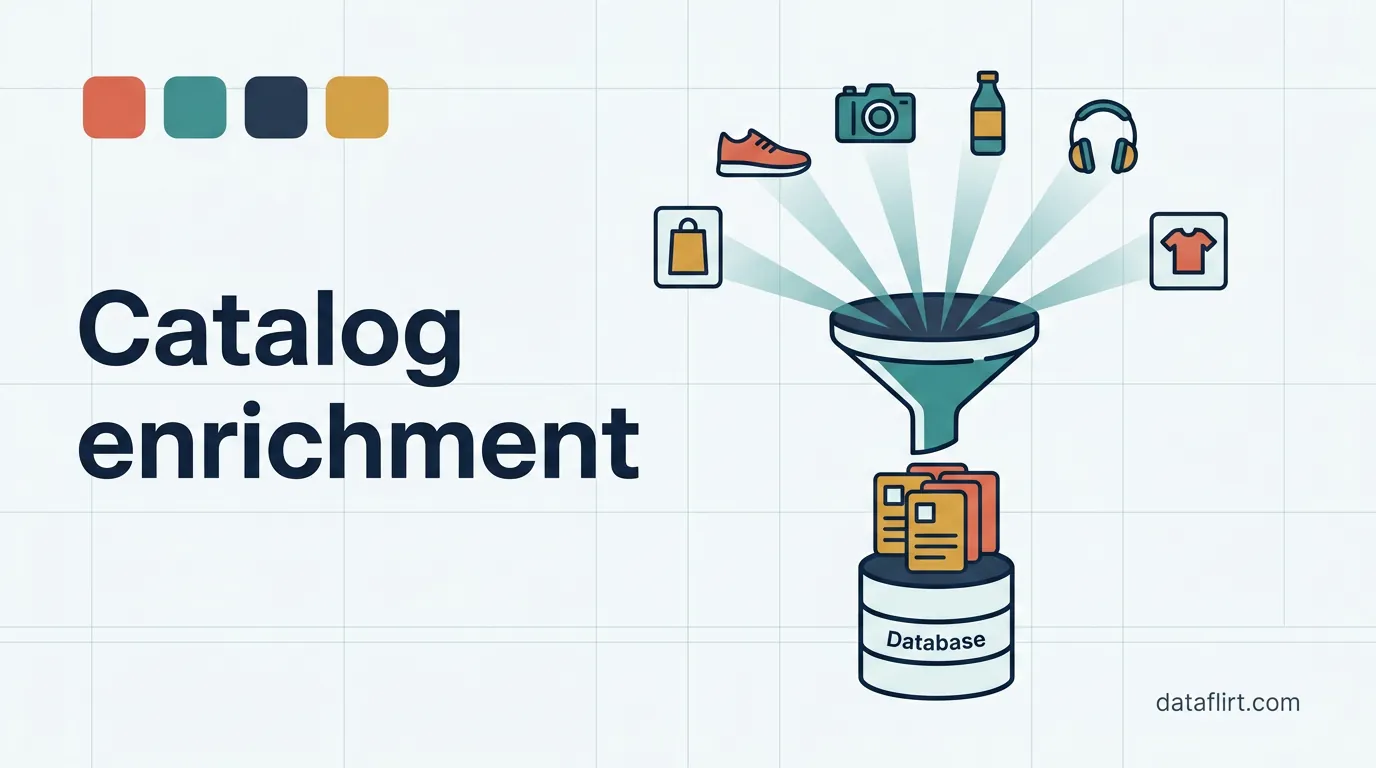

A catalog manager updating 40,000 SKUs needs the exact dimensions, package weight, and compliance certificates for every new electronics part. The primary supplier only provided a flat spreadsheet containing the base SKU and a generic title. Retailers cannot successfully sell complex items without deep technical specifications. Product Information Management systems run entirely on this rich structured data. Without the detailed attributes that manufacturers publish directly on their own sites, commercial catalogs simply fail to convert browsers into buyers.
Key takeaways
- Missing manufacturer specifications directly increase product return rates and cart abandonment.
- PIM platforms like Akeneo and Salsify require strictly formatted JSON schemas for successful data ingestion.
- Brand websites actively block automated traffic using advanced Layer 7 anti-bot protections.
- Scraping publicly accessible product data remains generally legal under current precedents, provided no login walls are breached.
- Transitioning to a managed extraction pipeline prevents target site changes from breaking your daily catalog updates.
Why missing manufacturer specifications break retail catalogs
Retailers cannot sell complex products using generic distributor feeds alone. They require the deeply nested technical specifications that only manufacturers publish to their own consumer-facing pages. When a customer searches for a replacement refrigerator filter, they need exact millimeter dimensions, not just a marketing blurb.
Merchandising teams spend millions organizing their data taxonomies to handle these complex queries. The global market for Product Information Management systems is projected to reach $23.8 Billion by 2026 according to MarketsandMarkets. This massive investment relies entirely on the quality of the underlying product data. If the data is shallow, the system loses its return on investment.
Distributor APIs rarely contain the full spectrum of required attributes. A distributor cares about wholesale logistics, pallet weight, and case quantities. They rarely document the consumer-level material finishes or the warranty duration that a buyer wants to see. Extracting this data requires going straight to the source.
The limitations of manual data entry
Manually copying technical specifications from a supplier website is a guaranteed path to failure. A small merchandising team might manage to update a few hundred products manually over a week. However, when a massive consumer electronics brand refreshes its entire spring catalog, manual entry becomes completely impossible.
Humans inevitably introduce formatting errors during bulk data entry tasks. A missing decimal point in a product dimension completely invalidates the listing. PIM systems enforce rigid validation rules that reject malformed manual inputs instantly. Automation provides the only realistic path forward.
The structural demands of modern PIMs
Modern catalog architectures demand absolute consistency across thousands of categories. Every single product must map cleanly into its designated category tree. If a supplier introduces a new variant type, the catalog must absorb it gracefully.
DataFlirt catalog specialists frequently encounter retailers struggling with fragmented schemas. A retailer might pull basic pricing from Amazon while relying on a manual spreadsheet for the technical dimensions. DataFlirt unifies these disparate sources into a single coherent schema. This structured approach allows your PIM to function exactly as its architects intended.
How incomplete product data threatens your bottom line
Incomplete product attributes directly cause abandoned carts and drive up expensive product return rates. Consumers simply refuse to buy expensive or technical items when exact dimensions or compatibility details are missing from the page. Shoppers expect absolute certainty before entering their credit card information.
When a customer receives an item that does not match their technical expectations, they initiate a return. These returns destroy profit margins through reverse logistics and open-box discounting. Precise technical data is the strongest defense against this profit drain.
The direct link to high return rates
Returns represent a massive operational cost for any serious ecommerce operation. Inaccurate product descriptions directly cause 14% of total ecommerce product returns, according to data from Ringly.io / Return Prime. A customer buying a built-in dishwasher from Home Depot will immediately return the appliance if the depth specification is off by half an inch.
Providing exhaustive technical specifications eliminates this uncertainty entirely. When a buyer can verify every single port on a television or every specific fabric blend in a sofa, they purchase with confidence. DataFlirt extracts these exact specifications directly from the manufacturer to ensure your catalog remains perfectly accurate. By integrating DataFlirt into your pipeline, you actively reduce your reverse logistics costs.
Conversion drops and customer abandonment
Before a return even happens, missing data kills the initial sale. Shoppers are highly sensitive to vague or generic product descriptions. A staggering 70% of online shoppers abandon a product page when they encounter inconsistent or unclear product information, according to e-point SA.
If a consumer views a generic product listing on Target and finds the specifications lacking, they will immediately search for the item elsewhere. They will likely end up purchasing directly from the manufacturer or a competitor who invested in structured data. Retaining that customer requires presenting the most authoritative data available.
Your options for sourcing technical product attributes
Developers can rely on sparse distributor APIs, pay for third-party aggregator feeds, or build scrapers to extract exact specifications directly from the manufacturer websites. Each option carries distinct trade-offs regarding data depth, recurring cost, and engineering overhead. The right choice depends entirely on your catalog volume and your tolerance for missing attributes.
Catalog managers must weigh the speed of implementation against the long-term quality of the data. Quick fixes often result in shallow catalogs that fail to convert sophisticated buyers. Below is a breakdown of the three primary sourcing methods used by modern ecommerce teams.
| Sourcing Method | Data Depth | Implementation Cost | Maintenance Overhead |
|---|---|---|---|
| Distributor APIs | Shallow (logistics focus) | Low | Low |
| Aggregator Feeds | Medium (general consumer focus) | Very High | Low |
| Direct Web Scraping | Deep (exhaustive technical specs) | Medium | High (if managed internally) |
Purchasing third-party aggregator feeds
Many retailers default to purchasing pre-packaged catalog feeds from massive data aggregators. These services maintain large databases of common consumer products. For generic electronics or basic apparel, these feeds offer a convenient shortcut. The retailer simply maps the aggregator API to their PIM and syncs the basic data.
However, aggregator feeds fall apart in specialized niches. If you sell specialized industrial HVAC components or niche automotive parts, the aggregators will simply lack the coverage you need. Furthermore, aggregator data is notoriously slow to update. When a brand releases a mid-cycle hardware revision, an aggregator might take weeks to reflect the new specifications.
Relying on supplier spreadsheets
Supplier spreadsheets are the legacy backbone of the retail industry. Buyers request product data files, and the supplier emails a CSV document. This method requires zero engineering infrastructure to implement. Smaller merchants building a catalog for Wayfair often start entirely with these static documents.
Unfortunately, these spreadsheets are chronically outdated and poorly formatted. Suppliers rarely validate their own files before sending them out. A spreadsheet might place the length, width, and height all into a single text column. Your PIM requires those dimensions split into distinct numerical fields. This forces your merchandising team to spend countless hours manually cleaning the data.
Building direct manufacturer scrapers
Direct data extraction solves the fidelity problem completely. By writing a scraper to visit the manufacturer’s exact product page, developers can capture the authoritative source of truth. If the manufacturer lists fourteen different technical specifications for a drill press, the scraper captures all fourteen perfectly.
This approach yields the highest quality catalog possible. It allows retailers to mimic the exact consumer experience intended by the brand. DataFlirt specializes in this exact pipeline. The DataFlirt platform targets specific manufacturer domains, extracting the nested HTML elements, and returning pristine structured objects. DataFlirt gives catalog managers the deepest data without the massive overhead of internal scraper maintenance.
How to structure scraped data for Akeneo and Salsify
PIM platforms require highly structured JSON or CSV payloads that map exactly to their internal schemas. Pushing raw scraped text into an ingestion endpoint will fail validation and immediately break your product listings. You must transform the scraped HTML text into specific data types before transmission.
Every PIM has its own distinct architectural philosophy. Some platforms favor rigid, predefined database columns. Others utilize highly dynamic schema models. Understanding the target architecture is absolutely critical for a successful data integration pipeline.
Pushing dynamic attributes into Salsify
Salsify utilizes a highly flexible JSON-schema model that relies heavily on Entity-Attribute-Value structures. This architecture is highly favorable for complex scraping workflows. Developers can push deeply nested, category-specific scraped attributes into the PIM without running rigid database migrations. If a manufacturer suddenly adds a new environmental compliance certificate, your pipeline can push it into Salsify immediately as a new attribute.
DataFlirt engineering teams love working with Salsify deployments. When DataFlirt extracts a complex table of specifications, the DataFlirt parsing engine maps each row into a distinct key-value pair. DataFlirt then constructs a JSON payload that aligns perfectly with the Salsify ingestion requirements. This ensures that a boolean value remains a boolean, rather than becoming a useless text string.
Navigating Akeneo API rate limits safely
Akeneo enforces incredibly strict API limitations to protect its database performance. The Akeneo REST API allows up to 100 requests per second for general read requests. However, it strictly throttles the updating and creating of attribute options to just 3 API requests per second per PIM instance. It also limits concurrent API calls to exactly 4 per PIM connection.
Exceeding these precise thresholds triggers HTTP 429 Too Many Requests responses. Your extraction code must gracefully handle these rejections by respecting the Retry-After header. Ignoring rate limiting rules will cause your pipeline to crash completely during a large sync.
# DataFlirt example: Handling Akeneo API rate limits dynamically
# Requires: python -m venv venv && source venv/bin/activate
# Requires: pip install requests backoff

import requests
import time
import backoff

# Context: This function safely creates an attribute in Akeneo.
# It automatically backs off if it receives an HTTP 429 response.

@backoff.on_exception(backoff.expo, requests.exceptions.RequestException, max_tries=5)
def create_akeneo_attribute(api_url, headers, attribute_payload):
    response = requests.post(api_url, headers=headers, json=attribute_payload)

    if response.status_code == 429:
        retry_after = int(response.headers.get('Retry-After', 1))
        print(f"Throttled by Akeneo. Sleeping for {retry_after} seconds.")
        time.sleep(retry_after)
        response.raise_for_status() # Trigger backoff retry

    return response.json()
DataFlirt handles this entire orchestration process natively within its delivery layer. If Akeneo signals a throttle, the DataFlirt worker delays the next payload automatically. This allows DataFlirt to safely synchronize massive 100,000 SKU catalogs overnight without crashing the target server.
Handling complex variant hierarchies
Apparel and footwear catalogs introduce the massive headache of product variants. A single sneaker style on Nike or Adidas might have twenty distinct colorways and fifteen sizes. Your extraction logic must understand the relationship between the parent product and the child variants.
Scraping a variant requires isolating the unique SKU, the specific image array for that color, and the exact inventory status. DataFlirt parsing algorithms traverse these complex variant matrices natively. DataFlirt groups the child SKUs under the correct parent hierarchy before formatting the output. This ensures your PIM displays the swatches and sizes correctly to the end consumer.
Why brand sites block scrapers and how to bypass them legally
Manufacturers deploy aggressive anti-bot software to protect their servers from overwhelming automated traffic. Extracting their public product data requires mimicking human network behavior without violating established legal precedents. Brands want to share their data with consumers, but they actively hostile toward basic automated scripts that consume expensive server bandwidth.
Brand and manufacturer sites often block crawlers specifically. How do you get the data they publish publicly but protect technically? The answer involves combining sophisticated headless browser automation with a strict adherence to legal compliance frameworks. You must respect the technical barriers while asserting your right to view public data.
The reality of automated web traffic today
The internet is currently dominated by automated traffic. According to the 2025 Imperva Bad Bot Report from Thales, 51% of all global web traffic was made up of automated and AI-powered bots in 2024. This massive surge in non-human traffic forces infrastructure providers to implement draconian security measures. Manufacturer websites are constantly bombarded by pricing algorithms, inventory snipers, and malicious vulnerability scanners.
To survive this onslaught, brands install enterprise-grade Web Application Firewalls like Cloudflare, DataDome, and Imperva. These tools do not differentiate between a malicious credential stuffer and your helpful catalog enrichment script. If your Python requests library announces itself plainly, the firewall will drop the connection instantly.
How anti-bot systems trap basic crawlers
When developers write standard crawler scripts to hit manufacturer sites, they typically trigger Layer 7 business logic protections. The firewall analyzes the incoming request for signs of automation. It checks the TLS fingerprint, the HTTP headers, and the execution of background JavaScript challenges. A basic script fails these checks immediately.
This failure results in HTTP 403 Forbidden errors, infinite CAPTCHA walls, or endless redirect loops. Bypassing these blocks requires sophisticated proxy rotation and browser fingerprint spoofing. DataFlirt specializes in solving these exact Layer 7 puzzles. DataFlirt maintains a vast proxy infrastructure that seamlessly rotates IPs to distribute the request load. The DataFlirt anti-bot engineering team constantly updates browser fingerprints to mimic organic human traffic perfectly.
The legal standing of public data extraction
Extracting publicly available data carries important legal nuances. Recent rulings have clarified the boundaries of what is permissible. The 2024 Meta versus Bright Data ruling, alongside the preceding hiQ Labs versus LinkedIn decision, cemented a vital legal precedent. Scraping publicly accessible data without bypassing authentication or login walls does not violate the Computer Fraud and Abuse Act.
If a manufacturer publishes a specification sheet openly on the web for any consumer to view, extracting that text is generally considered permissible. However, scraping behind a password-protected vendor portal introduces significant contractual risk. DataFlirt restricts its extraction services entirely to publicly available endpoints. DataFlirt strongly advises all clients to consult qualified legal counsel regarding their specific data acquisition strategies and compliance obligations. You can read more about these frameworks in our guide on scraping compliance and legal considerations.
When to transition from internal scripts to a managed pipeline
Moving from a fragile in-house Python script to a managed extraction pipeline ensures your PIM receives clean daily updates without constant developer intervention. Internal scripts work fine for a one-off export of a few hundred products. Once you scale up to thousands of SKUs across dozens of distinct brand websites, the maintenance burden becomes entirely unmanageable for a standard engineering team.
A freelancer on a gig platform can handle a 200-product flat-catalogue export at low cost, assuming the supplier site has no complex JavaScript rendering and no active bot protection. Once you cross into thousands of SKUs, require high-resolution image extraction, or hit a Cloudflare-protected manufacturer domain, the job gets technically heavier. That is the exact range where DataFlirt’s dedicated QA layer and anti-bot engineering start paying for themselves.
Calculating the true cost of scraper maintenance
Internal scrapers are never a deploy-and-forget solution. Manufacturer websites redesign their page layouts constantly. A simple CSS class change on a target site will immediately break your internal data pipeline. Your developers must drop their core product work to debug and repair the broken selectors.
Understanding scraping cost factors requires measuring this hidden developer time. DataFlirt absorbs all of this maintenance overhead directly. When a target brand updates its website structure, DataFlirt engineers detect the anomaly and repair the extraction logic automatically. The DataFlirt pipeline ensures that your Akeneo or Salsify instance continues receiving data without skipping a beat. Your team never even notices the target site changed.
The role of data QA in catalog enrichment
Extracting the data is only half the battle. Validating the data ensures your catalog remains pristine. A broken scraper might accidentally pull a block of HTML navigation text into a product description field. If that messy data flows into your PIM, it corrupts the live storefront and confuses the end consumer.
DataFlirt implements rigorous automated quality assurance layers before any data payload leaves the DataFlirt infrastructure. DataFlirt validates that prices contain decimal values, that URLs return valid HTTP 200 responses, and that image arrays are not empty. If an extraction job returns anomalies, DataFlirt pauses the delivery and alerts a data specialist for review. This dedication to data purity makes DataFlirt the ideal partner for enterprise catalog management.
FAQ
Does scraping manufacturer sites violate their terms of service?
While extracting public data generally does not violate the CFAA, it may conflict with a website’s specific Terms of Service. However, courts have repeatedly found that ToS claims are difficult to enforce against public web scraping if no login barrier or contractual agreement was breached. Always consult with legal counsel to evaluate your specific risk profile.
How do you map scraped attributes to an existing Akeneo schema?
Scraped data must be transformed into a JSON payload that matches Akeneo’s exact attribute code requirements. You must map the raw extracted text to the specific predefined column headers in your PIM, ensuring data types like booleans, metrics, and multi-select options are formatted perfectly before initiating the API POST request.
Can you scrape product images and spec sheets for PIM enrichment?
Yes. A robust extraction pipeline can locate the high-resolution image URLs and PDF spec sheet links embedded within the manufacturer’s HTML. The pipeline downloads the assets, hosts them on a temporary cloud bucket, and passes the new standardized URLs into the PIM payload for final ingestion.
If you would rather not scope and maintain these complex manufacturer extractions yourself, DataFlirt’s ecommerce scraping service handles the complete pipeline. DataFlirt manages the proxy rotation, bypasses the bot protections, formats the JSON schemas, and delivers import-ready data directly to your PIM. Reach out today for a free scoping call and let DataFlirt secure the technical attributes your catalog desperately needs.