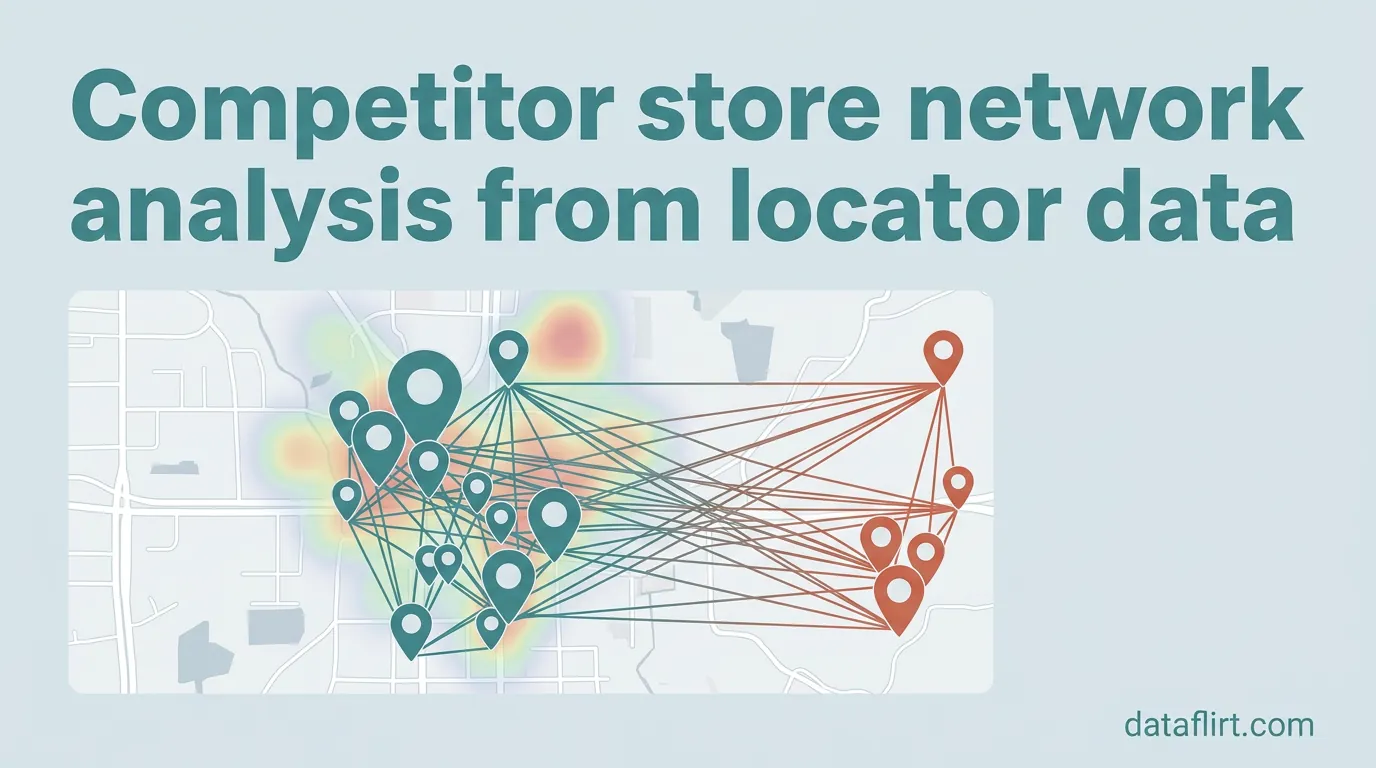

Planning a retail expansion strategy requires precise mapping of where your competitors already operate. You cannot confidently sign a commercial lease without knowing exactly how many competing stores overlap your projected trade area. Manual data collection fails immediately at this scale. Visiting hundreds of individual store locators and copying addresses into a spreadsheet wastes valuable analysis time. You need a programmatic way to turn dynamic web maps into structured coordinate datasets. Real estate strategists require an automated pipeline that pulls complete store networks across multiple regions.
Key takeaways
- Intercepting underlying JSON payloads is faster and more reliable than simulating clicks on an interactive store map.
- Raw location data requires heavy normalization to standardize inconsistent address formats and nested operating hours.
- Request header blocks and rate limits present the biggest technical hurdles to extracting complete store lists.
- Legal orientation indicates that scraping publicly accessible store information is generally permissible but requires adherence to proper extraction protocols.
What competitor locator data actually delivers
Store locator data provides an exact coordinate map of competitor market penetration and coverage gaps. It turns anecdotal real estate assumptions into a deterministic site selection model. Expansion teams use this structured location data to visualize spatial advantages and make informed investment choices.
The global location intelligence market size is projected to reach $28.37 billion in 2026, growing from $25.43 billion in 2025. Brands are investing heavily in geospatial analytics because guessing at local demographics is no longer sufficient. You need hard evidence of where competitors are thriving and where they are retreating. DataFlirt extracts this exact competitor footprint so you can feed it directly into your spatial mapping software.
Identifying precise trade area overlaps
Expansion strategists look for saturation points. If a target zip code already contains three established competitor locations, opening a new store there presents significant cannibalization risk. Scraping complete store lists allows you to overlay competitor coordinates against your own existing locations. This reveals immediate blind spots in your coverage.
DataFlirt engineers routinely pull full geographic datasets for brands looking to enter new states. Having the exact latitude and longitude of every competitor store lets you calculate drive times and catchment zones accurately. DataFlirt delivers this information in clean tabular formats that integrate seamlessly with major GIS platforms.
Capitalizing on legacy store closures
Record store closures by legacy chains have created prime vacancies with favorable terms for expanding brands. Roughly 7,700 new retail store openings were announced between 2024 and 2025, even as legacy retail closures hit a cyclical high of 9,900 business shutdowns. Tracking these changes manually is impossible.
Monitoring competitor store locators on a weekly schedule highlights disappearing locations immediately. When a competitor removes a store from their site, your real estate team can immediately investigate that vacated property. DataFlirt monitors these specific changes over time and delivers automated alerts when a location drops off a competitor’s directory. This specific retail location data provides a massive first-mover advantage for your leasing team.
Supporting fluid omnichannel expectations
Physical stores now serve as fulfillment hubs for digital orders. While 39% of shoppers still prefer physical stores as their primary channel, 40% now expect to interact with retailers fluidly across multiple touchpoints. Consumers expect to buy online and pick up in store on the same day.
Understanding which competitor locations support curbside pickup or in-store returns is critical intelligence. Store locators often tag locations with specific amenities or service capabilities. Extracting these specific attributes helps you benchmark your own omnichannel offering against the local market standard. DataFlirt ensures every available amenity tag is parsed and included in your final dataset.
How to extract store locator data at scale
You extract this data by bypassing the visual map interface and intercepting the underlying JSON payloads sent to the browser. This approach is significantly faster and more resilient than writing scripts to simulate clicks on a map interface.
Data engineers focus on the network traffic rather than the rendered page. Most modern store locators operate as single-page applications. They load a blank map and then request the store data from a backend server based on the user’s viewport or zip code entry. DataFlirt targets these specific backend requests to pull clean data directly from the source.
Bypassing complex visual maps for raw JSON
Store locator interfaces are notoriously difficult to scrape directly via HTML due to dynamic Javascript rendering, rotating layouts, and map overlays. However, data engineers bypass the UI entirely by inspecting the browser’s Network tab. You locate the hidden JSON payloads or XHR API calls that populate the map with latitude and longitude coordinates.
These requests often ping Google Maps Platform, Mapbox, or Yext backends. When you identify the correct endpoint, you can request the entire dataset without loading any visual elements. DataFlirt specializes in identifying these hidden endpoints across complex ecommerce platforms. DataFlirt ensures your extraction process avoids the heavy overhead of rendering Javascript maps.
| Extraction Method | Speed | Resilience | Data Cleanliness |
|---|---|---|---|
| HTML DOM Parsing | Very Slow | Low | Poor |
| Headless Map Clicking | Slow | Medium | Fair |
| XHR JSON Interception | Extremely Fast | High | Excellent |
Intercepting the hidden XHR network payloads
Finding the right endpoint requires careful network analysis. You open the developer tools in your browser, navigate to the network tab, and filter the requests by XHR or Fetch. As you type a zip code into the store locator, you watch for the specific request that returns a JSON object containing store details.
Most locators rely on third-party backend services like Mapbox or Yext. When you analyze the network traffic, you bypass the visual map rendering entirely and pull the raw coordinate data directly from the source.
Once you find this URL, you can replicate the request programmatically. Sites like Target and Home Depot use highly structured APIs to deliver location data to their frontends. DataFlirt analysts map these APIs quickly to build efficient, lightweight extraction pipelines. DataFlirt focuses purely on the data transmission layer to maximize speed.
Structuring the extraction request
Replicating the backend request often requires passing specific query parameters. The API might require a radius value, a latitude and longitude origin point, or a specific limit on the number of results returned. You must experiment with these parameters to force the API to return the maximum number of stores per request.
import requests

headers = {
    "User-Agent": "Mozilla/5.0 (Windows NT 10.0; Win64; x64) AppleWebKit/537.36",
    "Accept": "application/json",
    "clientApplicationId": "retail-web-app-v2"
}

url = "https://api.competitor.com/store-locator/v1/stores"
params = {"radius": "100", "zip": "90210", "limit": "500"}

response = requests.get(url, headers=headers, params=params)
data = response.json()
print(f"Extracted {len(data['stores'])} store locations.")
When scraping a site like Best Buy or Walgreens, adjusting the radius parameter to a massive number can sometimes trick the server into returning the entire national database in one call. DataFlirt tests these parameter boundaries extensively to minimize the total number of requests needed. DataFlirt optimizes the call volume to keep the extraction footprint as light as possible.
Normalizing messy address and hours fields
Store locator data is rarely analysis-ready upon extraction. Fields like temporary closures, wildly varying address strings, and nested hours of operation require rigorous regex parsing to be normalized into a consistent schema for competitor-to-competitor comparisons. You cannot run spatial queries on an address that contains random line breaks or merged suite numbers.
DataFlirt applies strict normalization rules to every extracted dataset. DataFlirt breaks down single address strings into discrete street, city, state, and zip columns. DataFlirt also converts messy operating hours into structured daily open and close times. This clean delivery format means your team can begin analysis immediately without spending days cleaning the output.
| Raw Extracted Field | Normalized DataFlirt Output |
|---|---|
"123 Main St. Ste 400\nNY, NY 10001" | Street: 123 Main St., Suite: 400, City: NY, State: NY, Zip: 10001 |
"Mon-Fri 9am-8pm, Sat-Sun 10am-6pm" | MondayOpen: 09:00, MondayClose: 20:00, SaturdayOpen: 10:00 |
"[\"Drive-Thru\", \"Pharmacy\"]" | HasDriveThru: TRUE, HasPharmacy: TRUE |
Are protected store locators actually extractable?
Yes. Store locator data is entirely extractable when you bypass the visual interface and authenticate your network requests properly. You must respect the site’s security parameters while mimicking legitimate traffic patterns to access the data.
Major retail platforms invest heavily in bot protection. They do not want competitors casually downloading their entire real estate portfolio. However, the data must remain accessible to legitimate customers trying to find a store. DataFlirt bridges this gap by ensuring automated requests perfectly mirror standard user behavior. DataFlirt succeeds where generic scripts fail by managing the complex nuances of request validation.
Overcoming strict header authentication blocks
Even when a locator’s API endpoint is isolated, unauthenticated direct requests often return a 400 Bad Request or Whitelabel Error Page. Extractors must reverse-engineer the request to include specific header parameters to successfully mimic an actual browser session. Missing a single custom header will trigger an immediate block.
Retailers like CVS and IKEA frequently use custom authorization tokens generated dynamically when the page first loads. DataFlirt engineers build specific pre-flight requests to capture these tokens. DataFlirt then injects the valid tokens into the subsequent API calls to ensure the server authenticates the request as legitimate. DataFlirt maintains an extensive library of header profiles to bypass these specific validation checks.
Managing rate limits and proxy routing
Unthrottled scraping typically triggers automatic IP bans after 100-500 requests on major e-commerce sites, establishing 1-5 requests per second as a practical baseline to evade bot detection. You cannot blast a target server with thousands of concurrent requests and expect to survive. You must implement intelligent delays and distribute your traffic.
Understanding rate-limiting is critical for sustained access. DataFlirt manages this by utilizing vast pools of rotating residential IPs. Quality proxy providers report success rates exceeding 98% in bypassing anti-bot measures during large-scale web scraping when paired with realistic request headers and delay logic.
DataFlirt configures these proxies to rotate automatically upon encountering any resistance. When extracting data from highly protected domains like Macy’s or Nordstrom, DataFlirt manages the proxy health in real time. DataFlirt ensures your extraction job completes successfully without triggering defensive alarms or compromising data integrity.
Legal orientation around public location data
The highly cited hiQ Labs v. LinkedIn legal saga established that scraping publicly accessible web data does not generally violate the Computer Fraud and Abuse Act. However, publishers still occasionally lean on common law claims like trespass to chattels or breach of contract if a scraper blatantly ignores Terms of Service or a formal cease-and-desist.
Store locations and hours are inherently public facts. They contain no personally identifiable information and are explicitly published to be found. Even so, aggressive extraction that degrades website performance can invite legal scrutiny. DataFlirt ensures all extraction pipelines operate politely and efficiently to minimize server load. DataFlirt always advises clients to consult qualified legal counsel regarding their specific data acquisition strategies and jurisdictional requirements.
When to scope a managed extraction pipeline
A managed extraction pipeline makes sense when you need ongoing updates across multiple competitor sites rather than a one-off data pull. Maintaining scripts against frequent site updates quickly consumes internal engineering resources and distracts from core business analysis.
If you only need to check a single competitor’s footprint once a year, a simple in-house script might suffice. However, if your strategy demands weekly updates from ten different brands to track new openings and closures, the technical debt escalates rapidly. DataFlirt assumes that technical debt for you. DataFlirt provides the reliable data feed you need without the maintenance headaches.
The hidden costs of scraper maintenance
Websites redesign their store locators frequently. An API endpoint that worked flawlessly last month will suddenly change its response schema today. When you build your own scrapers for sites like Sephora or Zara, your engineers are responsible for fixing those scripts every time they break. This maintenance requirement is the most overlooked expense in data extraction.
Consider an expansion strategist evaluating ten target markets for a new apparel rollout. She needs the exact latitude and longitude of every competing store in those zip codes to run a spatial analysis. A clean CSV delivery saves her weeks of manual data entry.
When a site updates its browser fingerprinting countermeasures, your in-house team must drop their primary projects to reverse-engineer the new defenses. Understanding scraping cost factors reveals that maintenance often exceeds the initial build cost. DataFlirt eliminates this unpredictable overhead by offering fixed-cost deliveries. DataFlirt monitors target sites proactively and repairs broken selectors before they impact your scheduled data delivery.
Choosing a managed data provider
Expansion strategists need reliable data, not software engineering projects. You require pristine, formatted coordinates that map perfectly onto your GIS platforms. A freelancer on a gig platform can handle a simple, unprotected locator for a flat fee. Once you cross into extracting data from dozens of major chains protected by enterprise anti-bot systems, the quality gap between a cheap gig and a managed extraction widens fast.
That is the exact range where DataFlirt’s QA layer and anti-bot engineering start paying for themselves. DataFlirt verifies the completeness of every store list. DataFlirt confirms that no zip codes were skipped and no locations were duplicated. DataFlirt formats the final output to match your internal database schema perfectly. Partnering with DataFlirt ensures your real estate team always has the most accurate market intelligence available.
FAQ
How do you find the hidden JSON API for a store locator?
You open your browser’s developer tools, navigate to the Network tab, filter for XHR or Fetch requests, and trigger a search on the store locator map. Look for the specific network request that returns a JSON payload containing the latitude, longitude, and store details.
Are competitor store locations public data?
Yes, store locations and operating hours are factual, publicly accessible data points intended for consumer use. They do not contain personal data. However, you should still consult legal counsel regarding your specific scraping frequency and adherence to website Terms of Service.
Can you bypass CAPTCHAs on store locators?
Yes, bypassing CAPTCHAs involves using high-quality rotating proxies, matching exact browser request headers, and keeping request rates low to avoid triggering the security challenge in the first place. Proper API interception often bypasses the visual CAPTCHA entirely.
How often should store location data be scraped?
For retail expansion strategy, a weekly or monthly extraction schedule is usually sufficient to track new store openings and legacy closures accurately. High-frequency daily scraping is rarely necessary unless you are monitoring very short-term pop-up locations.
If you’d rather not scope this yourself, DataFlirt’s ecommerce scraping service handles the extraction, QA, and delivery for retail locators. Our real estate scraping solutions provide the exact competitive coverage maps you need. Reach out for a free scoping call and let DataFlirt manage the complexity.