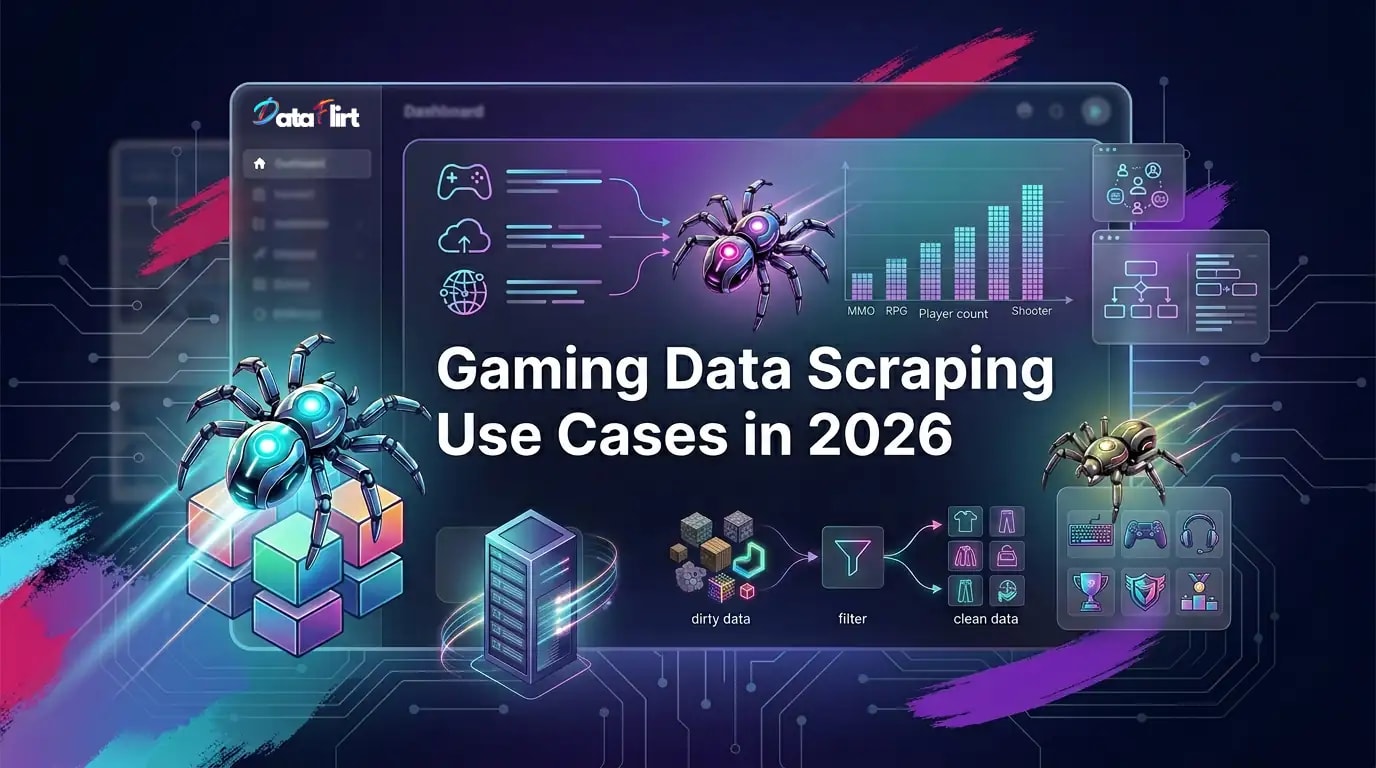

The $200 Billion Intelligence Gap: Why Gaming Data Scraping Is Now a Business Imperative
The global video game market crossed an estimated $200 billion in total revenue in 2025. That number includes PC and console game sales, mobile gaming, in-game purchases, subscription services, esports prize pools, game streaming, and the rapidly expanding gaming hardware and peripheral segment. By 2030, industry projections place the market above $300 billion, driven by mobile gaming expansion in Southeast Asia and Latin America, the continued maturation of cloud gaming infrastructure, and the accelerating integration of AI-driven content generation into game development pipelines.
Here is what makes that scale remarkable from a data perspective: the gaming industry generates, and publicly surfaces, more granular, high-velocity, structured intelligence than almost any comparable consumer market. Every game distribution platform publishes game metadata, pricing, user review volumes, and aggregate rating signals. Every esports organization maintains public match result records, player performance statistics, and tournament bracket outcomes. Every game developer and publisher pages list their portfolio, their team size, their funding history, and their release pipeline. Game community forums surface player sentiment, feature demand, and quality signals in real time, at a volume that dwarfs most consumer feedback channels.
Yet despite operating at this data richness, the majority of gaming companies, investment firms, market research organizations, and adjacent technology businesses that serve the gaming sector rely on data infrastructure that is fragmented, expensive, delayed, and structurally incomplete.
Licensed data products covering gaming market activity are sparse compared to sectors like real estate or financial services. Platform APIs for major game distribution services are rate-limited, field-restricted, and in several cases have been progressively narrowed over the past three years, reducing what developers and data teams can extract through official channels. Third-party market research reports covering gaming market sizing, genre trends, and publisher rankings are expensive, published quarterly or annually, and based on survey methodology that misses the granular, real-time intelligence that gaming businesses actually need to compete.
This is the intelligence gap that gaming data scraping directly addresses.
“The web is the world’s largest, most frequently updated gaming intelligence database. Every game store page, every esports result feed, every player review, every developer profile, and every patch note is structured, publicly accessible, and updating in near-real time. The competitive advantage belongs to the organizations that can systematically collect, clean, and activate that data at scale.”
The opportunity is real and it is large. Gaming data scraping across distribution platforms, review portals, esports databases, developer directories, gaming news aggregators, and community forums can deliver datasets running from 100,000 records to tens of millions of rows, refreshed daily or weekly, covering every meaningful signal from game-level pricing to developer-level portfolio activity. For business, product, and data teams operating in or adjacent to gaming, this is the data infrastructure that separates reactive organizations from proactive ones.
Who Should Read This, and What They Will Get Out of It
This guide is not for engineers building scrapers. It is for the business, product, and data professionals who need to understand what gaming data scraping actually delivers, how to specify a data acquisition program that serves their specific decision-making needs, and how to think about data quality, delivery format, and legal boundaries before they commission any collection work.
Read this if you are:
- a product manager at a game distribution platform, gaming SaaS company, or gaming analytics tool, trying to understand how scraped gaming data can sharpen your competitive intelligence and feature roadmap
- an investment analyst at a gaming-focused fund, venture firm, or hedge fund covering gaming equities, evaluating how game data extraction can surface performance signals earlier than your current research process allows
- a data or analytics lead at a game studio, publisher, or gaming platform, trying to build recommendation engines, pricing models, or churn prediction systems on something richer than internal telemetry alone
- a growth or marketing team leader at a gaming technology company, esports platform, or gaming peripheral brand, looking to use scraped gaming data for market sizing, territory planning, and B2B prospecting
- a strategy or operations professional at a gaming company, trying to understand how gaming market intelligence from web scraping compares to what you are currently purchasing from data vendors
By the end of this guide, you will have a clear framework for: what gaming data scraping delivers across source types, how different roles activate the same underlying data differently, when one-off versus periodic scraping is the right architectural choice, what data quality standards are non-negotiable, and what delivery formats actually reduce friction between collection and decision-making.
For broader context on how web data acquisition powers business strategy, see DataFlirt’s perspective on data for business intelligence and the strategic case for data scraping as an enterprise growth lever.
The Anatomy of Gaming Data: What Is Actually Scrapable and at What Scale
Before discussing how gaming data scraping serves specific business functions, it is worth establishing a clear taxonomy of what is actually available for systematic collection. The volume, structure, and update velocity of each data category varies significantly, and matching your specific intelligence need to the right data source is the first architectural decision in any gaming data program.
Game Catalog and Metadata
This is the foundational layer of gaming data scraping: structured game-level records covering title, developer, publisher, genre classification, platform availability, release date, game engine, supported languages, age rating, DLC and expansion records, system requirements, and feature tags. At scale across major PC, console, and mobile distribution platforms globally, game catalog metadata runs to millions of records. The density of structured fields per game record varies by platform, with some surfacing 40+ attributes per title and others providing a leaner set of 10-15 core fields.
For product teams, data teams, and investment analysts, game catalog data is the reference layer on which all other analytics are built. A well-structured game metadata dataset at 1 million to 5 million records across platforms enables genre mapping, platform distribution analysis, publisher portfolio tracking, and developer activity monitoring that no commercial data product currently delivers at this breadth or cost-efficiency.
Pricing and Promotional Data
Game pricing data is one of the highest-velocity, highest-value categories in gaming data scraping. Game prices on distribution platforms change frequently: new releases enter at launch price, seasonal sales events drive temporary price reductions of 20-90% on back catalog titles, regional pricing varies enormously across geographies, and subscription service inclusions change the effective pricing calculus for millions of titles continuously.
Pricing signals extracted systematically from gaming platforms include: base game price, current promotional price, discount depth and duration, regional price variants across major markets (US, UK, EU, AU, BRL, INR, and others), DLC and bundle pricing, subscription service inclusion flags, and historical price change records. For investment teams, pricing data is a margin signal. For product managers, it is a competitive positioning input. For growth teams targeting gaming consumers, it is a campaign timing lever.
Scale context: A systematic gaming data scraping program across major PC and console distribution platforms in 10 geographic markets can generate 500,000 to 2 million pricing records per weekly refresh cycle, depending on catalog depth and regional coverage.
Player Reviews and Ratings
User review data is one of the most analytically rich outputs of gaming data scraping, and one of the least exploited by business teams outside of platform operators themselves. Game reviews contain structured metadata (rating score, hours played at time of review, platform, review language, thumbs-up count from other users, review timestamp) alongside unstructured review text that is a direct, real-time signal of player satisfaction, feature demand, bug frequency, and sentiment trajectory.
At scale, review datasets from major gaming platforms run to hundreds of millions of records. Even at the per-game level, popular titles accumulate tens of thousands of reviews over their lifetime, creating a dataset rich enough to power sentiment models, feature extraction pipelines, and quality signal dashboards that inform product, investment, and marketing decisions with a granularity that survey-based approaches cannot approach.
The analytical applications for scraped review data in gaming are broad:
- Quality signal tracking: Review score velocity (the rate at which average ratings are changing) is a leading indicator of post-launch health or decline, more sensitive than aggregate score alone
- Feature demand extraction: Natural language processing applied to review text surfaces the specific features, mechanics, and content additions that players are most actively requesting
- Bug and issue detection: Review text analysis detects emerging technical issues before they appear in official support channels, enabling proactive studio response
- Sentiment benchmarking: Comparing review sentiment for a game against its genre competitors provides competitive positioning intelligence that no licensed data product delivers
Player Count and Concurrent User Data
Live and historical player count data, where publicly surfaced by platforms or community tracking tools, is one of the most direct measures of game health available for external observation. Concurrent player data, peak player counts, and player count trajectory over time are inputs for:
- Game lifecycle analysis by investment teams evaluating gaming company valuations
- Competitive performance benchmarking by product managers assessing genre rivals
- Content scheduling decisions by studios planning update release timing
- Advertising campaign targeting by gaming brands aligning campaign windows with peak engagement periods
The public availability of this data varies by platform. Some platforms surface current and peak concurrent player counts publicly. Community-maintained tracking databases aggregate historical player count data across thousands of titles with records going back years, creating historical time series that are genuinely valuable for trend analysis.
Esports Match Results, Player Statistics, and Tournament Data
Esports data is a structurally distinct category within gaming data scraping, with its own source ecosystem, update cadence, and analytical applications. Public esports data includes: match results by tournament, team and player performance statistics by game and event, tournament structures and prize pool records, player roster changes and transfer history, team ranking movements over time, and broadcast viewership data where publicly reported.
At scale, esports data scraping across the major competitive gaming titles generates datasets in the millions of rows annually across match results, player stats, and tournament records. For esports organizations, betting analytics platforms, sports media companies expanding into gaming, and gaming investment firms, this data is the primary intelligence layer for evaluating organizational performance, player valuation, and market sizing.
See DataFlirt’s breakdown of sports data scraping for applicable methodology context that translates directly to esports data collection.
Developer and Publisher Profile Data
Developer and publisher data represents a distinct, high-value output of gaming data scraping that serves B2B business functions rather than consumer-facing analytics. Structured developer profile data includes: studio name, headquarters location, team size indicators, founding date, portfolio of released and announced titles, platform focus, genre specialization, funding history where publicly disclosed, and contact and social media information where publicly available.
At scale across global game developer directories, job listing aggregators, and platform developer portals, developer profile datasets run to hundreds of thousands of records. For gaming SaaS companies, investment analysts tracking the independent development ecosystem, and gaming publishers evaluating acquisition targets, this data is a self-updating prospecting and market intelligence asset.
Game News, Patch Notes, and Announcement Data
Gaming news and patch note data occupies a distinct analytical niche within gaming data scraping: it is not structured in the same way as catalog or pricing data, but it carries high-signal intelligence about game development trajectories, studio priorities, competitive product roadmaps, and market event timing. Systematic collection of patch notes, update announcements, developer blog posts, and gaming news articles enables:
- Competitive roadmap intelligence: Tracking competitor update cadences and feature release patterns as signals of development velocity and product investment
- Market event detection: Identifying upcoming release windows, expansion launches, and major content events that affect competitive dynamics and market timing
- Player sentiment drivers: Correlating patch note content with post-patch review score changes to build models that predict the player sentiment impact of specific game changes
For the broader context on how content-layer data extraction serves business intelligence purposes, see DataFlirt’s perspective on scraping web data for content marketing intelligence.
The Professionals Who Benefit Most from Scraped Gaming Data
The same gaming data scraping infrastructure can serve radically different business functions depending on the professional consuming it. The most sophisticated data acquisition programs in gaming are designed with this role-based consumption model in mind from the start, delivering the same underlying data through different processing and formatting layers to serve each team’s specific workflow.
The Investment Analyst Covering Gaming
Investment analysts at gaming-focused venture funds, public equity funds covering gaming stocks, and private equity firms evaluating gaming company acquisitions need data-driven signals about game performance, market positioning, and competitive dynamics that public financial reporting alone cannot provide.
The quarterly earnings calls of publicly traded gaming companies provide revenue and user numbers at a 90-day lag. Gaming data scraping delivers the leading indicators that predict those numbers weeks or months in advance:
Player count trajectory: A game losing 40% of its concurrent player base in the six weeks following launch, visible through public player count data, is a leading indicator of disappointing revenue performance that will not appear in financial reporting for another two quarters. Investment analysts who catch this signal early hold a structural advantage over those relying on financial disclosures alone.
Review score velocity: A game receiving 15,000 negative reviews in its first 72 hours post-launch, with an average score dropping from 7.2 to 4.8, is a sell signal for a game publisher’s equity that precedes any analyst downgrade by days or weeks. Review data, captured through systematic gaming data scraping, delivers this signal in near-real time.
Pricing signal analysis: The depth and frequency of discount events for a publisher’s back catalog is a data-available proxy for unit sales pressure. A publisher moving from 40% to 70% discount depths on titles that are 18 months old, at higher frequency than competitors, is communicating demand weakness that pricing data surfaces before financial filings do.
Developer ecosystem monitoring: For venture-stage investments in game studios, systematic game data extraction from developer directories and job posting platforms surfaces team growth rates, platform diversification, and release pipeline health that seed-stage pitch decks may not fully represent.
Recommended data cadence for investment analysts: Weekly refresh for game performance signals (player counts, review velocity, pricing moves); daily monitoring for high-conviction holdings or active due diligence targets; one-off snapshots for market entry research and competitive landscape analysis.
A practical signal framework for investment analysts using scraped gaming data:
The value of gaming data scraping for investment purposes is maximized when signals are defined in advance rather than derived ad hoc from each data delivery. The following signal taxonomy gives investment analysts a starting framework:
| Signal Category | Data Source | Alert Threshold | Lead Time to Financial Impact |
|---|---|---|---|
| Review score decline | Game portal review data | Average score drops >1.0 point in 14-day window | 6-10 weeks to quarterly revenue impact |
| Player count collapse | Public player count tracker | Monthly active concurrent peak drops >30% vs prior 4-week average | 4-8 weeks to engagement revenue impact |
| Discount depth escalation | Platform pricing data | Discount depth increases >20 percentage points vs genre average for title age | 8-12 weeks to volume/margin signal in reporting |
| Negative review velocity spike | Review timestamp data | Negative review share exceeds 40% in 7-day rolling window post-patch | 2-4 weeks to community crisis signal |
| Developer hiring freeze | Gaming job board data | Job posting volume for a studio drops >50% in 60-day window | 3-6 months to organizational health signal |
| Release window delay signals | Announcement tracking | Announced title disappears from all confirmed release calendars | Variable; execution risk indicator |
This signal framework requires clean, consistent, timely data delivery to function. A gaming data scraping program that delivers data quality above the thresholds defined in Section 6 enables this kind of systematic signal monitoring. One that delivers below those thresholds generates false positives and erodes analyst trust in the data infrastructure.
The Product Manager at a Gaming Platform or Publisher
Product managers at game distribution platforms, gaming analytics SaaS companies, game studio internal tooling teams, and gaming hardware brands use scraped gaming data to answer questions that are structurally impossible to answer with internal data alone.
Competitive feature benchmarking: What features are competing game store pages surfacing for their top-selling titles that your platform is not? What metadata fields do high-performing game pages consistently populate that low-performing pages omit? What store page elements (video count, screenshot count, tag density, achievement count) correlate with higher conversion rates across the catalog? Gaming data scraping enables systematic, data-driven answers to these questions at catalog scale.
Genre and category mapping: How is the genre distribution of new releases shifting quarter over quarter? Which subgenres are growing in catalog volume relative to player count growth? Where are there catalog supply gaps relative to demonstrated player demand? These are market sizing questions that product managers building platform catalog strategy need to answer with data, not intuition.
Pricing tier intelligence: What is the distribution of launch prices across a specific genre? How quickly do games in a given price tier move to discount, and at what typical discount depth? Gaming market intelligence from systematic pricing data scraping enables product managers to build data-driven pricing recommendations for developer partners and internal pricing policy decisions.
Localization coverage gaps: Which languages are underserved in a specific game genre relative to the geographic distribution of active players in those markets? Scraped game metadata combined with player count data by region surfaces these gaps at catalog scale.
Recommended data cadence for product managers: Weekly catalog and pricing refresh; daily review velocity monitoring during product launch windows; monthly genre and competitive landscape snapshots.
The Data and Analytics Lead at a Gaming Company
Data leads at game studios, publishers, gaming platforms, and gaming-adjacent technology companies are the architects of the models that drive personalization, pricing, acquisition, and retention decisions. For them, gaming data scraping is primarily a training data and feature enrichment problem: the quality and breadth of the external data they can integrate with internal telemetry determines the ceiling performance of every model they build.
Recommendation engine enrichment: An internal game recommendation system trained only on a platform’s own behavioral data has no visibility into the broader market landscape. Enriching internal interaction data with externally scraped game metadata, genre classifications, cross-platform review signals, and player count trajectory data from public sources materially improves recommendation quality for users whose interaction history on a single platform is sparse.
Dynamic pricing model training: Building a game pricing optimization model requires historical pricing data at catalog scale, across multiple platforms and geographies, over multi-year time horizons. This data does not exist in any licensed commercial feed at the breadth or cost-efficiency that systematic gaming data scraping delivers. Scraped pricing history across 500,000 titles over three years is a training dataset that enables pricing models with genuine market coverage.
Churn prediction feature engineering: External signals from scraped gaming data enrich internal behavioral churn models. A player whose interaction history on your platform is declining, at the same time that player count data for their primary game genre is declining platform-wide, is a different churn risk from a player whose platform engagement is declining while their genre is growing. External market signals, available through gaming data scraping, add a market context layer to churn models that internal data alone cannot provide.
AI training dataset assembly: The demand for high-quality, labeled gaming content data for AI model training is growing rapidly as game AI research expands. Game review text, structured game metadata, patch note content, and esports match commentary are all candidate training data sources for language models specialized in gaming domains. Scraped gaming data at millions of records is the volume required for meaningful AI training dataset assembly. See DataFlirt’s overview of best scraping platforms for building AI training datasets for applicable context.
Recommended data cadence for data teams: Continuous or daily ingest for model feature freshness in production systems; weekly batch refresh for retraining pipelines; one-off large-scale historical collections for model training dataset assembly.
The Growth and Marketing Team at a Gaming Technology Company
Growth and marketing teams at gaming SaaS companies, esports infrastructure platforms, gaming peripheral brands, gaming media companies, and advertising technology firms serving the gaming sector use scraped gaming data in a fundamentally different mode from their analytical counterparts: they need to understand where the market is moving, who the relevant actors are, and how to position themselves ahead of demand shifts.
Developer and publisher B2B prospecting: Gaming SaaS companies selling game analytics tools, live operations platforms, player support software, and game marketing technology need a continuously refreshed database of active game developers and publishers as their prospect base. A developer directory assembled through game data extraction from platform developer portals, gaming job boards, and publisher databases creates a self-updating B2B prospecting asset that is structurally superior to any static contact list. Game studios that launched a new title in the past 90 days, have above a defined review count threshold, and are headquartered in a target geography are a pre-qualified, data-defined prospect segment that can be assembled programmatically from scraped gaming data.
Market sizing and territory planning: For gaming technology companies evaluating geographic expansion, scraped game catalog data by language support and regional pricing reveals where gaming market density is highest relative to current tool and technology penetration. A market with a large active catalog of locally developed titles, limited developer tool adoption signals (measured through job posting technology stack mentions), and strong player count growth is a data-defined expansion opportunity.
Campaign timing intelligence: Gaming market intelligence from player count data, major title release calendars, and esports event schedules enables marketing and growth teams to align campaign windows with peak gaming engagement periods. A gaming peripheral brand running a campaign for a competitive gaming mouse during a major esports tournament in their target genre, timed precisely to the event’s viewership peak, outperforms an untargeted campaign by a measurable margin. Scraped event schedule data and esports viewership signals power this timing intelligence.
Influencer and content creator identification: Gaming content creator data, including creator follower counts, game coverage focus, upload frequency, engagement rate proxies, and sponsorship history (where publicly disclosed), is scrapable from gaming-adjacent social and video platforms at scale. For gaming brands building influencer marketing programs, this data enables systematic creator identification and segmentation that manual research cannot replicate efficiently.
See DataFlirt’s related perspective on social media influencer data scraping for applicable methodology.
A structured approach to gaming B2B prospect segmentation using scraped data:
Growth teams at gaming SaaS companies that adopt a data-driven approach to prospect segmentation using scraped gaming data consistently outperform those relying on manual research or purchased contact lists. The segmentation logic that delivers highest conversion rates combines multiple scraped data signals into a composite prospect score:
- Activity signal: Game release in the past 12 months (indicating active studio, not dormant)
- Scale signal: Review count above a defined threshold for the studio’s primary title (indicating player base large enough to justify software investment)
- Platform signal: Multi-platform release history (indicating development complexity that benefits from tooling)
- Growth signal: Player count trajectory positive over the past 90 days (indicating a studio in growth mode, more receptive to investment in tooling)
- Funding signal: Public funding disclosure in the past 24 months (indicating capital available for tooling expenditure)
- Geographic signal: Headquarters in a target geography with confirmed sales capacity
Each of these signals is extractable through gaming data scraping from publicly available sources. Combined into a prospect scoring model, they create a continuously refreshed, behaviorally qualified lead list that is structurally superior to any static purchased database of game developer contacts.
The Strategy and Operations Team at a Game Publisher or Studio
Strategy and operations teams at mid-to-large game publishers and studios use gaming data scraping for a set of use cases that are operationally specific: they are making decisions about portfolio positioning, release timing, genre investment, and competitive response on timelines measured in weeks and months rather than years.
Portfolio competitive benchmarking: A publisher with a live-service game in active operation needs to know, on a weekly basis, how their title’s player count, review score trajectory, and content update cadence compares to the three or four direct competitors in their genre. Systematic gaming market intelligence from scraped data enables this benchmarking on a continuous basis, replacing monthly manual research cycles with automated, data-driven competitive dashboards.
Genre investment prioritization: Which genres are showing accelerating new release volume, high review velocity, and growing player count? Which genres are saturating, with high new release volumes but declining per-title review counts and player numbers? Gaming data scraping across catalog, review, and player count sources enables genre-level market mapping that informs where to concentrate next game development investment.
Release window planning: Major title release windows, expansion launch dates, and content event calendars are publicly available through gaming portals, developer announcements, and esports scheduling systems. Systematic collection of this data enables studios to identify release windows with lower competitive density, avoiding direct launch conflicts with dominant titles in their genre. For a mid-size studio, this is a potentially multi-million dollar decision that gaming data scraping can inform with evidence rather than intuition.
Post-launch monitoring automation: The 90-day window following a game launch is the period of highest operational intensity and the highest data monitoring need. Automated, daily collection of player count data, review score trajectory, player forum sentiment, and competitive response signals during this window enables operations teams to make live service adjustments, content prioritization decisions, and marketing spend reallocations based on data rather than internal assumptions.
One-Off vs Periodic: Two Fundamentally Different Strategic Modes for Gaming Data
The most consequential architectural decision in a gaming data scraping program is whether you need a single, high-quality snapshot of the market or a continuously refreshed data feed. These are not variations on the same product; they serve different decision types, require different infrastructure, and deliver value on different timelines.
When One-Off Gaming Data Scraping Is the Right Choice
One-off gaming data scraping is appropriate when the business question you need to answer has a defined answer at a point in time, and when the market dynamics you are studying change slowly enough that a snapshot remains analytically valid for your decision window.
Market entry research: A gaming SaaS company evaluating entry into the Asian mobile gaming market needs a comprehensive snapshot of active game developers in that region, their portfolio characteristics, their platform focus, and their technology indicators. This is a go/no-go decision that requires completeness and accuracy at a single point in time. A one-off game data extraction program covering developer directories, platform developer portals, and gaming job boards in target markets delivers exactly this.
Genre competitive landscape analysis: A game studio beginning development on a new title in a specific genre needs a comprehensive snapshot of the competitive landscape: how many active titles exist in the genre, what are their player counts, what are their pricing tiers, what features do their review texts most frequently mention, and what gaps exist in the competitive offering set? This is a research mandate with a defined answer that does not require continuous refreshment during the development cycle.
Acquisition due diligence: Investment firms and gaming publishers evaluating acquisitions of game studios or gaming technology companies need a documented, timestamped snapshot of the target’s portfolio performance: review scores, player count data, pricing history, and competitive positioning relative to genre benchmarks. One-off gaming data scraping, with explicit data provenance documentation, serves this due diligence need precisely.
AI training dataset assembly: Building a large-scale labeled dataset for gaming AI model training is a one-time (or periodic) research exercise rather than an operational data need. A single high-volume collection of game review text, game metadata, patch notes, or esports commentary, with structured labeling applied, creates a training dataset that serves model development over an extended period.
Characteristic data requirements for one-off gaming data scraping:
| Dimension | Requirement |
|---|---|
| Coverage | Maximum breadth across all relevant portals and regions |
| Depth | Maximum field completeness per record |
| Accuracy | Cross-validated against multiple source portals where feasible |
| Documentation | Full data provenance: source URL, scrape timestamp, schema mapping |
| Delivery | Structured flat files (CSV/JSON/Parquet) or direct database load within defined SLA |
| Scale | 100K to 10M+ rows depending on scope |
When Periodic Gaming Data Scraping Is Non-Negotiable
Periodic scraping is the right architecture whenever your decision is a function of how the gaming market is moving rather than where it stands at a single point in time. If your use case requires trend data, velocity signals, or the ability to respond to market changes before competitors do, periodic gaming data scraping is not optional.
Game pricing monitoring: Pricing on major gaming platforms changes continuously: seasonal sales events, publisher-specific promotions, regional price adjustments, and subscription service inclusions all affect the competitive pricing landscape in real time. A product manager or investment analyst relying on monthly pricing snapshots in a market where prices change daily is making decisions on systematically stale data.
Review sentiment tracking: Review score trajectory is a high-signal, time-sensitive metric. A game whose average review score drops from 7.5 to 6.1 in a 14-day window following a major patch is sending a signal that requires a same-week response from the studio’s operations and marketing teams. Weekly or daily review data collection is the minimum cadence that enables this responsiveness.
Player count trend analysis: Player count data has meaningful predictive value for game lifecycle analysis, but only when tracked as a time series. A single player count snapshot tells you where a game is; a weekly time series tells you where it is going. Investment analysts and studio strategy teams need the time series.
Esports standings and performance monitoring: Esports competitive standings change after every match event, and the intelligence value of standings data is directly proportional to its freshness for teams building betting analytics, fantasy sports products, or competitive intelligence dashboards. Daily or event-driven data collection is the operational requirement.
Developer ecosystem monitoring: The gaming developer landscape evolves continuously: new studios are founded, existing studios announce new titles, funding rounds close, and acquisition activity reshapes competitive dynamics. Weekly monitoring of developer directory data, gaming job postings, and platform developer portals keeps a B2B prospecting database current in a way that quarterly snapshots cannot.
Recommended cadence by use case:
| Use Case | Recommended Cadence | Rationale |
|---|---|---|
| Game pricing monitoring | Daily | Flash sales and promotions move in 24-hour cycles |
| Review sentiment tracking | Daily to weekly | Post-patch sentiment shifts can be rapid |
| Player count trend analysis | Weekly | Trend signal requires time series density |
| Esports standings | Daily or event-driven | Competitive dynamics change per event |
| Developer ecosystem monitoring | Weekly | Ecosystem evolves; weekly is operationally adequate |
| Genre competitive landscape | Monthly | Structural market shifts are gradual |
| Market entry research | One-off | Point-in-time decision |
| AI training dataset assembly | One-off or quarterly | Model retraining cadence drives refresh need |
| Acquisition due diligence | One-off | Timestamped snapshot required |
| Release window planning | Monthly | Calendar events have predictable lead times |
Industry-Specific Use Cases in Depth
Gaming data scraping serves a remarkably diverse set of industries and organizational functions. The specific data requirements, quality standards, and delivery formats differ significantly across them.
Game Studios and Publishers
For game studios and publishers, gaming data scraping is both a competitive intelligence function and an operational data function. The competitive intelligence dimension is about understanding market positioning: where does your title stand relative to genre competitors on review score, player count, pricing, and content update cadence? The operational dimension is about live service management: what are players saying in reviews and forums right now, and how does that compare to your internal metrics?
Studios and publishers in the mid-market segment, with one to five live-service titles and development teams between 20 and 200 people, represent the highest-value audience for systematic scraped gaming data delivery. Enterprise studios have internal data teams capable of building proprietary collection infrastructure. Indie studios operate below the scale threshold where systematic data collection is operationally justified. Mid-market studios have the decision-making velocity and resource constraint combination that makes a well-delivered external gaming data program immediately value-additive.
The specific data products that deliver highest value for studios and publishers:
i. Competitive dashboard data: Weekly-refreshed player count, review score, and pricing data for a defined set of 10-20 genre competitors, delivered in a format that integrates directly with an existing dashboard or BI tool ii. Review text corpus: Bulk export of review text for owned and competitor titles, structured with metadata (timestamp, score, hours played, language), for NLP analysis iii. Release calendar intelligence: Aggregated upcoming release data for the relevant genre, structured by release window, platform, and developer, refreshed monthly iv. Patch note corpus: Historical and ongoing patch note collection for genre competitors, structured for NLP analysis of feature velocity and content investment patterns
Gaming Investment Firms and Funds
Investment firms with concentrated positions in gaming equities or gaming company portfolios need gaming market intelligence delivered as a systematic, continuous data service rather than a periodic research project. The decision frequency of investment management, particularly for funds with active trading mandates or portfolio monitoring obligations, demands data that is more current than quarterly earnings and more granular than analyst reports.
The core data products for investment-focused gaming data scraping programs:
i. Game performance signal feed: Daily player count snapshots and weekly review score aggregations for a defined watchlist of titles, covering both held positions and competitive set titles ii. Publisher portfolio tracker: Weekly-refreshed catalog data for all titles associated with monitored publishers and studios, including new title announcements, pricing events, and review trajectory iii. Market share proxy data: Aggregated new release volume, player count share, and review count share by publisher within defined genre segments, as a proxy for market share dynamics iv. Distressed title identification: Algorithmic signals derived from scraped data: titles with review score velocity below a defined threshold, player count decline rate above a defined threshold, and pricing discount depth increasing beyond historical norms for that title’s lifecycle stage
Investment analyst note: Gaming data scraping-derived signals are most valuable as leading indicators, not as direct performance metrics. Review score trajectory leads reported revenue performance by 6-10 weeks for titles where user-generated review data correlates with purchase intent. This lead time is the analytical edge.
Esports Organizations and Analytics Platforms
Esports is one of the most data-transparent segments of the gaming ecosystem: match results, player statistics, tournament outcomes, and organizational rankings are systematically published by tournament operators, game publishers, and community-maintained tracking platforms. The challenge is not data availability; it is data aggregation and normalization across dozens of source systems with inconsistent schemas, variable update cadences, and heterogeneous data quality.
A well-executed esports gaming data scraping program, aggregating match data across major competitive titles, delivers:
- Player performance databases: Per-player statistics aggregated across tournaments, normalized to standard performance metrics for cross-event comparison
- Team ranking time series: Historical ranking data for esports organizations across multiple titles, tracking organizational performance trajectory over multi-year periods
- Roster change tracking: Player transfer and roster update data, which is a leading indicator of organizational health and competitive trajectory
- Prize pool and earnings data: Tournament prize pool records and player earnings history, used for player valuation, contract benchmarking, and market sizing
For esports betting analytics platforms, fantasy esports products, and sports media companies covering esports, daily or event-driven collection is the minimum viable cadence for production systems. For esports investment and organizational analytics, weekly aggregated data with monthly historical trend reports is operationally sufficient.
Mobile Gaming and App Store Intelligence
Mobile gaming represents the largest and fastest-growing segment of global gaming revenue, and it is served by a distinct source ecosystem for gaming data scraping: mobile app stores surface game catalog data, download rank history (where available), rating and review data, and pricing at a breadth and update velocity that requires specialized collection infrastructure for sustained, high-quality extraction.
App store data at scale runs to millions of records per platform per region. The key data categories for mobile gaming intelligence:
- Chart position and ranking data: Current and historical chart positions by category, region, and device type, as a proxy for download volume and revenue performance
- Rating and review data: User ratings and review text, with platform-specific metadata (helpful votes, device type, OS version), at scale across the mobile gaming catalog
- Update frequency: App update cadence as a signal of developer engagement and live operations investment
- Pricing and in-app purchase structure: Base game pricing and in-app purchase item listings where publicly accessible
For mobile game publishers, gaming market intelligence from app store gaming data scraping enables competitive benchmarking, genre trend analysis, and localization opportunity identification at a granularity that industry market research reports cannot approach.
Gaming Advertising Technology
Ad tech companies serving the gaming sector, including gaming-specific ad networks, programmatic platforms with gaming inventory, and gaming data management platforms, use scraped gaming data to enrich audience targeting, validate contextual signals, and build gaming audience taxonomies that improve campaign performance for gaming and gaming-adjacent brands.
Game metadata, genre classifications, player count data, and review signals feed targeting models that allow advertisers to reach audiences engaged with specific game genres, player skill levels, or platform types with greater precision than panel-based audience data allows. Gaming data scraping at catalog scale is the data infrastructure that makes gaming-specific audience enrichment possible for ad tech platforms.
Market Research and Academic Institutions
Market research firms, academic researchers studying digital economy dynamics, and media organizations publishing gaming industry analysis use game data extraction to build the primary datasets underpinning their reports, publications, and editorial content. For these users, the requirements are weighted toward historical depth, methodological documentation, and geographic breadth rather than operational delivery speed.
The most valuable gaming data scraping outputs for market research applications:
- Multi-year pricing history: Longitudinal pricing data across a defined game catalog, enabling analysis of price elasticity, discount event patterns, and lifecycle pricing dynamics
- Review corpus with temporal metadata: Time-stamped review data at catalog scale, enabling sentiment trend analysis across genre cycles, patch events, and seasonal patterns
- Developer ecosystem census: Point-in-time snapshots of the active game developer ecosystem, with portfolio metadata, for market sizing and competitive landscape reporting
Where to Collect Gaming Data: Key Portals by Region
The following reference maps the highest-value source portals for gaming data scraping by region. Collection complexity and data richness vary significantly across platforms, and a well-designed scraping program selects sources based on the specific data requirements of the downstream use case rather than defaulting to the most prominent platforms.
All complexity ratings reflect sustained, production-quality collection at scale (100K to 10M+ rows per refresh cycle), not single-page access.
| Region (Country) | Target Websites | Why Scrape? |
|---|---|---|
| Global / USA | Steam (store.steampowered.com) | Largest PC gaming catalog globally; 50,000+ games; pricing, review data (200M+ reviews), player count signals, game metadata, developer profiles, DLC data, tag taxonomy, regional pricing. Highest data density per game record of any platform. |
| Global / USA | GOG.com | DRM-free PC catalog; strong back catalog pricing data; regional price comparison; developer and publisher metadata; curated catalog that signals quality benchmarks in premium indie and classic segments. |
| Global / USA | Epic Games Store | Console-comparable PC gaming catalog; frequent free game events that affect pricing signals; metadata on exclusivity windows; developer partnership data relevant to gaming market intelligence. |
| USA / Global | Metacritic (Games) | Aggregate review scores from professional critics and user reviews; historical score records for thousands of titles; score trajectory data; cross-platform performance comparison; publisher reputation scoring. |
| USA / Global | OpenCritic | Professional critic review aggregation; coverage breadth data (how many outlets reviewed a title); score distribution; emerging title early signal before Metacritic coverage consolidates. |
| USA / Canada | GameFAQs | Community-maintained game database; genre and platform classification; active discussion thread volume as engagement proxy; FAQ and guide availability as player complexity signal; historical game records back to 1990s. |
| USA | IGDB (Internet Game Database) | Community game database covering 200,000+ games; structured metadata including genre, theme, game mode, perspective; developer and publisher records; release date by region; franchise mapping. |
| Global / USA | Twitch Directory | Live streaming game catalog; concurrent viewer counts by game; historical peak viewer data where accessible; game category classification; streamer count by game as engagement proxy. |
| Global / USA | YouTube Gaming (public search data) | Video upload volume by game title; view count aggregates; engagement signal by genre; gaming content creator activity by game; public comment volume as sentiment proxy. |
| Global | SteamDB / SteamSpy-equivalent community trackers | Historical Steam player count time series; price history; review history; tag analysis; concurrent player peak records. Community-maintained data with multi-year historical depth. |
| Global | HLTV.org | CS2 and Counter-Strike esports match results; team rankings; player statistics; tournament data; historical match archive; transfer news. Highest quality Counter-Strike esports data source publicly available. |
| Global | Liquipedia (liquipedia.net) | Multi-game esports wiki covering 30+ competitive titles; tournament brackets; match results; player profiles; team rosters; prize pool records; structured enough for systematic extraction. |
| Global | Esports Earnings (esportsearnings.com) | Player prize earnings history across titles and tournaments; country of origin; active career span; game specialization. Useful for player valuation and esports market sizing. |
| Global | GamesIndustry.biz | Industry news, studio announcements, acquisition records, funding news, and executive movement. Structured enough for systematic monitoring of industry events relevant to investment and strategy teams. |
| UK / Europe | GamesRadar, Eurogamer, Rock Paper Shotgun | English-language gaming media review content; structured review scores; publication dates; genre classifications; publisher identification. Complementary to Metacritic for UK and European market review coverage. |
| Japan | Famitsu (famitsu.com) | Japanese gaming media reviews; weekly sales chart data; Japanese market-specific release calendar; hardware sales signals. Highest-value Japanese-language gaming data source for market entry research. |
| Japan | Gematsu (gematsu.com) | English-language coverage of Japanese game announcements; structured data on Japan-exclusive and Japan-first release pipelines; localization signal data. |
| South Korea | Naver Game / Plaync | Korean gaming portal with active domestic game catalog; Korean game ratings (Game Rating and Administration Committee data where public); local game developer portfolio data. |
| China | TapTap (taptap.com) | Chinese mobile and PC game catalog; domestic and internationally accessible; user rating data; game download data (rank proxies); community forum data; developer profiles. Viable alternative data source given access restrictions on primary domestic platforms. |
| China | 3DM / A9VG gaming portals | Chinese gaming media covering domestic and international titles; structured review scores; Chinese player sentiment data; market-specific release calendar and pricing signals. Requires Chinese language processing. |
| India | Rooter, Mobile Premier League game directories | Indian gaming platform game catalogs; mobile gaming focus; regional pricing data; Indian player community engagement signals. Fastest-growing single gaming market by new player additions. |
| Brazil / Latin America | Jovem Nerd, Voxel, TecMundo Games | Brazilian gaming media; Portuguese-language review data; Brazilian market pricing and release calendar signals; Brazilian player sentiment. |
| Australia / NZ | PEGI equivalent ratings data (Classification Board public records) | Australian game classification data; content ratings; classification decision dates. Useful for market entry compliance research and content policy analysis. |
| Global (Mobile) | App Annie public charts / Sensor Tower public rankings | Mobile game chart positions by country and category; ranking trajectory; top grossing and top download lists. Public chart data is limited but directionally useful for mobile gaming market intelligence. |
| Global (Mobile) | Google Play Store (play.google.com/store/games) | Mobile game catalog; ratings and review data; pricing; in-app purchase disclosures; developer profiles; category classification; install count ranges (public). Largest single mobile game data source accessible at scale. |
| Global (Mobile) | Apple App Store (apps.apple.com) | iOS mobile game catalog; ratings; review text; pricing; in-app purchase listings; developer data; featured placement tracking where accessible. Complementary to Google Play for cross-platform mobile intelligence. |
Regional data quality notes:
- North America and Global English-language platforms offer the highest structured data density per record, with the most consistent field populations and the richest review datasets
- Japan is the second most data-rich gaming market by structured portal availability, but Japanese language processing is required for full extraction value
- China presents significant access complexity; TapTap is the highest-value accessible alternative for Chinese gaming market intelligence without requiring domestic infrastructure
- India is the highest-growth market by new player volume but has the least developed structured gaming data portal ecosystem; mobile platform data is the primary accessible source
- Latin America requires Portuguese and Spanish language processing; Brazilian and Mexican markets have distinct data sources with meaningful coverage gaps relative to North American and European equivalents
Data Quality, Freshness, and Delivery: What Separates Useful from Analytical Noise
Raw gaming data scraping output is not a finished product. It is a collection of semi-structured records with inconsistent field populations, duplicate game representations across multiple portals, title name formatting variations that prevent reliable cross-source joins, and temporal metadata that degrades in value rapidly if not managed explicitly.
A professional gaming data scraping program applies four mandatory quality layers between collection and delivery.
Deduplication Across Platform Identifiers
A game like a popular action RPG may appear across Steam, GOG, the Epic Games Store, Metacritic, OpenCritic, IGDB, and five regional gaming portals. Without deduplication logic, that single title generates 10+ records in your dataset, each with slightly different field populations, potentially different release dates (due to platform-specific launch windows), and different pricing that may or may not reflect the same regional market.
Rigorous deduplication for gaming data scraping requires:
- Primary identifier resolution using platform-specific game IDs where available (Steam App ID, IGDB ID, Metacritic game slug)
- Fuzzy title matching logic for games with formatting inconsistencies across portals (subtitle variations, punctuation differences, edition suffixes)
- Developer and publisher name normalization across sources (a studio may be listed under its parent company name on some portals and its operating name on others)
- Price conflict resolution rules specifying which source takes precedence when pricing differs across portals for the same market
- Update timestamp management ensuring the most recently scraped record version is preserved when fields conflict
Industry benchmark: Deduplication accuracy above 95% is the minimum threshold for gaming datasets used in model training or systematic market analysis. Below 90%, duplicate inflation corrupts genre distribution analysis, publisher market share calculations, and any aggregate metric derived from record counts.
Title and Entity Normalization
Gaming data scraping from multiple international sources surfaces game titles in multiple transliteration formats, developer names in both operating and corporate entity forms, and genre classifications in platform-specific taxonomies that are not directly comparable across sources. Before any cross-source analysis is possible, a normalization layer must:
- Map platform-specific genre taxonomies to a unified classification schema
- Resolve developer and publisher entity names to canonical forms with associated entity records
- Handle regional title variants (games released under different titles in different markets) with explicit linkage to a primary canonical title record
- Normalize release date formats across sources to a consistent temporal standard with timezone handling
Field Completeness Management
Not all fields in a scraped gaming data record are equally critical, and not all source portals populate all fields consistently. A data quality framework for gaming datasets defines:
- Critical fields: Fields where a missing value renders the record analytically unusable for primary use cases. For game catalog data: game title, developer, publisher, platform, release date, genre classification. For pricing data: base price, current price, currency, region. For review data: score, timestamp, platform
- Enrichment fields: Fields that add analytical value but whose absence does not disqualify the record: game description text, tag list, achievement count, DLC count, language count, age rating, system requirements
- Completeness rate monitoring: Per-field, per-source completeness tracking to identify systematic gaps that require alternative sourcing or explicit null handling documentation
Recommended completeness thresholds by use case:
| Use Case | Critical Field Completeness | Enrichment Field Completeness |
|---|---|---|
| AI / ML Model Training | 97%+ | 80%+ |
| Investment Signal Analysis | 95%+ | 70%+ |
| Competitive Product Benchmarking | 92%+ | 65%+ |
| B2B Prospecting Database | 90%+ | 55%+ |
| Market Research Dataset | 88%+ | 45%+ |
Schema Standardization Across Portals
A gaming data scraping program sourcing from 20 different portals will encounter 20 different data schemas for essentially the same underlying game attributes. One portal might express genre as a single string; another as an array of tags; a third as a hierarchical category tree with primary and secondary classifications. One portal might surface review scores as a 0-100 integer; another as a 0-10 decimal; a third as a percentage with a “very positive / mostly positive” label system.
Schema standardization translates all source-specific formats into a single canonical output schema. This is an engineering investment that pays dividends across every use case the dataset serves and is the most frequently underestimated quality requirement in gaming data programs that teams attempt to build in-house.
For context on how data quality considerations apply across large-scale scraping programs more broadly, see DataFlirt’s detailed guide on assessing data quality for scraped datasets.
A Note on Game Title Normalization at Scale
Game title normalization is one of the most underestimated data engineering challenges in gaming data scraping programs, and it is worth addressing explicitly because it affects every downstream analytical function.
Consider a title released as “Game of the Year Edition” on one platform, “Complete Edition” on a second, and under its base title on a third, with a fourth platform listing both the base game and the edition as separate catalog entries. Without explicit normalization logic, a market analysis counting total active titles in a genre will overcount. A pricing comparison across platforms will fail to surface the edition-adjusted price differential that is the actual market intelligence. A review aggregation will split sentiment data across what should be unified records.
The normalization approach DataFlirt applies to gaming datasets includes:
- Primary identifier anchoring: Using platform-native game IDs (where available and consistent) as the primary deduplication key, with title-based fuzzy matching as the fallback for platforms without stable identifiers
- Edition suffix normalization: Stripping and cataloging edition suffixes separately from base titles, maintaining the relationship between editions and base games as a structured metadata field rather than resolving them into a single record that loses edition distinctions
- Franchise mapping: Identifying franchise relationships across titles through shared developer, publisher, and keyword patterns, enabling franchise-level aggregation that no single platform’s taxonomy natively provides
- Cross-language title resolution: For games with distinct titles in Japanese, Korean, Chinese, and Western markets, maintaining a canonical cross-language entity record that links regional title variants to a single game identity
This level of normalization adds processing time and infrastructure complexity to a gaming data scraping program. It also adds the analytical precision that separates a dataset that teams actually use from one that creates more questions than it answers.
Delivery Formats and Integration: Getting Data Into the Workflows That Use It
The most analytically rigorous gaming dataset in the world has zero business value if it arrives in a format that requires three weeks of internal data engineering to make usable. Delivery format is not a secondary consideration; it is the final determinant of whether a gaming data scraping program generates return on investment or generates a data warehousing problem.
For data and analytics teams: Direct database load to PostgreSQL, BigQuery, Snowflake, or Redshift on a defined schedule; or Parquet files delivered to S3 or GCS bucket with Hive-partitioned directory structure. Schema versioning policy with changelog documentation is non-negotiable for production systems that depend on the feed.
For investment analysts: Structured CSV or Excel files with explicit field documentation and data dictionary, delivered to shared drive or email with each scheduled refresh. Format is optimized for direct import into financial modeling tools without additional transformation.
For product managers: JSON feed via internal REST API with defined schema versioning; or structured flat files with explicit field mapping documentation enabling clean integration into product analytics pipelines and BI tools.
For growth and marketing teams: Enriched flat files with geographic tagging, developer and publisher contact normalization, and CRM-ready formatting. Salesforce or HubSpot import template compatibility reduces time from delivery to active prospecting.
For strategy and operations teams: Data delivered directly to operational dashboards via scheduled database refresh or structured spreadsheet update, formatted to match the team’s existing decision cadence workflow without requiring additional transformation steps.
The right delivery architecture for your organization is a function of how your teams consume data today, not a universal recommendation. A gaming data scraping engagement that begins with delivery format specification avoids the most common failure mode in enterprise data programs: technically excellent data that no one can act on because it does not fit the workflow.
For additional context on data delivery architecture for ongoing data feeds, see DataFlirt’s overview of best real-time web scraping APIs for live data feeds and the infrastructure considerations in best databases for storing scraped data at scale.
Legal and Ethical Boundaries for Gaming Data Scraping
Every gaming data scraping program, regardless of business purpose, must operate within a clearly understood legal and ethical framework. The standards in this space are actively evolving, and organizations that treat legal review as an afterthought rather than a precondition for collection expose themselves to material civil litigation risk.
Terms of Service Analysis
Gaming platforms, app stores, and esports portals vary significantly in how their Terms of Service address automated data collection. Some platforms explicitly prohibit scraping in their ToS; others are silent or address only specific data categories. ToS provisions are not uniformly legally enforceable across jurisdictions, but violation creates litigation risk even when the data being collected is technically publicly accessible.
The general principle: scraping publicly accessible data that does not require user authentication, bypassing of technical access controls, or violation of explicit contractual prohibitions carries substantially lower legal risk than accessing data behind login walls or paywalls. Any gaming data scraping program should document the ToS review for each target platform before collection begins.
robots.txt and Ethical Crawl Behavior
robots.txt files communicate platform operator preferences for automated access. Ethical gaming data scraping programs respect these directives as a professional standard, even where legal enforceability is uncertain. Beyond robots.txt compliance, responsible crawl behavior for gaming portals includes: request rate limiting that avoids degrading site performance for legitimate users, crawl delay implementation proportional to the sensitivity of the target platform, and explicit avoidance of session-based access that has not been contractually authorized.
GDPR and Personal Data in Gaming Contexts
Gaming data scraping programs that collect any personally identifiable information, including usernames, player profiles, developer contact information, and creator identity data, fall within the scope of GDPR in European markets and equivalent regulations in other jurisdictions. User review text may be personal data when it is attributable to an identified individual.
The practical requirement: any gaming data scraping program with a personal data component requires a privacy impact assessment and a documented data retention and deletion policy before collection begins. This is not optional for organizations operating in or processing data about individuals in GDPR-covered territories.
Platform API Terms and Rate Limits
Where gaming platforms offer official APIs, those APIs typically include Terms of Service that restrict how collected data can be stored, processed, and redistributed. Gaming data scraping that supplements or replaces API access for data that an API formally covers requires careful legal analysis. The relationship between ToS-restricted API access and scraping of publicly visible equivalent data is one of the most contested questions in web data law, and jurisdictional guidance varies materially.
For a thorough grounding in the legal and ethical dimensions of web data collection programs, see DataFlirt’s detailed analysis on data crawling ethics and best practices and the legal landscape overview at is web crawling legal?
Building Your Gaming Data Strategy: A Practical Decision Framework
Before commissioning any gaming data scraping program, internal or managed, work through the following decision framework. It is designed to take approximately 90 minutes of structured discussion with the relevant stakeholders and will prevent the most expensive mistakes in gaming data acquisition programs.
Step 1: Define the Business Decision
What specific decision will this data enable? Not “we want gaming market intelligence” but “we need to identify which game genres are showing accelerating review velocity and player count growth relative to catalog supply, updated weekly, to inform our next title greenlight decision.” The precision of the business question drives every subsequent architectural choice.
Step 2: Map Required Data to the Decision
What specific data fields, from which source portals, at what geographic coverage, with what update cadence, does that decision require? This mapping exercise consistently reveals two things: teams are requesting broader data than their actual decision requires, and critical fields they genuinely need are not available from the obvious source portals without supplementary collection.
Step 3: Determine Cadence Requirement
One-off or periodic? If periodic, what is the minimum refresh cadence that keeps the data analytically current for the target decision? Daily collection for a decision made monthly adds infrastructure cost and operational complexity without adding analytical value. Specify the minimum viable cadence, not the ideal one.
Step 4: Define Data Quality Thresholds
What is the minimum acceptable field completeness rate for critical fields? What deduplication standard is required for the downstream use case? What entity normalization is needed to enable joins with internal data systems? Define these thresholds explicitly before collection begins. Discovering mid-project that delivered data quality does not meet analytical requirements is the most expensive outcome in gaming data programs.
Step 5: Specify Delivery Format and Integration Requirements
How does the consuming team need data to arrive? What format, what cadence, what schema, delivered to what system? A dataset delivered in the wrong format to the wrong system will not be used regardless of its technical quality. This step should be defined by the data consumer, not the data producer.
Step 6: Conduct Legal and Ethics Review
Which platforms are in scope? Do any require authentication for the target data? Does the data include personally identifiable information? What is the applicable jurisdictional legal framework? These questions require legal counsel input before technical work begins.
DataFlirt’s Approach to Gaming Data Delivery
DataFlirt approaches gaming data scraping engagements from the business outcome backward. The starting question is not “which portals can we scrape?” but “what decision does this data need to power, who is making it, and how frequently do they need updated inputs to make it well?”
This consultative orientation changes the shape of the engagement at every stage. For a one-off genre competitive analysis, it means defining precise game catalog scope, field requirements, and quality thresholds upfront, then delivering a single, well-documented, schema-consistent dataset with full data provenance documentation rather than a raw data dump that requires weeks of internal processing before it becomes usable.
For a periodic gaming market intelligence program supporting a studio’s competitive monitoring function, it means designing a delivery architecture that integrates directly with the team’s existing data warehouse, with a defined refresh cadence, schema versioning policy, and automated data quality monitoring at each delivery cycle.
For a gaming investment firm integrating scraped gaming data into its portfolio monitoring infrastructure, it means building a signal feed that is formatted for financial modeling workflows, documented at the field level, and delivered with the precision and reliability that investment decision-making requires.
The technical infrastructure behind DataFlirt’s gaming data scraping capability, including distributed crawl orchestration, JavaScript rendering capacity, proxy infrastructure for platform-specific access, and multi-language processing for Asian gaming market sources, is the enabler. The point is the data: clean, complete, timely, and delivered in a format that reduces the distance between collection and decision to the minimum achievable level.
For teams evaluating whether to build gaming data collection infrastructure internally or procure a managed solution, see DataFlirt’s comparison of outsourced vs. in-house web scraping services and the practical considerations in key factors when outsourcing your web scraping project.
Additional Reading from DataFlirt
The following DataFlirt resources provide deeper context on data acquisition methodology, quality standards, and delivery architecture that applies directly to gaming data programs:
- Sports Data Scraping: Methods and Use Cases
- Web Scraping Use Cases Across Industries
- Scraping Customer Reviews for Sentiment Intelligence
- Data Quality Assessment for Scraped Datasets
- Best Scraping Platforms for Building AI Training Datasets
- Large-Scale Web Scraping: Data Extraction Challenges
- Datasets for Competitive Intelligence Programs
- Alternative Data for Enterprise Growth Strategy
- Best Real-Time Web Scraping APIs for Live Data Feeds
- Social Media Influencer Data Scraping
- Outsourced vs In-House Web Scraping Services
- Data for Business Intelligence: A Strategic Framework
Frequently Asked Questions
What is gaming data scraping and how does it differ from using platform APIs?
Gaming data scraping is the automated, programmatic collection of publicly available data from game distribution platforms, gaming portals, review aggregators, esports databases, developer pages, and community forums at scale. It differs from platform API access in three fundamental ways: breadth (scraping covers dozens of platforms simultaneously where APIs are platform-specific), field depth (scraped data surfaces fields not included in official API responses), and cost structure (scraping at scale is substantially more cost-efficient than purchasing equivalent API access across multiple platforms). For business teams, gaming data scraping is the difference between point-in-time API snapshots and a continuous, multi-source intelligence layer.
How do different teams inside a gaming or tech company use scraped gaming data?
Product managers use scraped game metadata and pricing data to benchmark competitors and inform catalog strategy. Investment analysts use player count trends, review score velocity, and pricing signals to evaluate gaming company performance ahead of financial reporting. Growth teams use scraped developer and publisher data for B2B prospecting and territory planning. Data teams use game catalog data, review corpora, and esports statistics to train recommendation engines, pricing models, and churn prediction systems. Each role extracts distinct value from the same underlying dataset through different analytical frameworks.
When should a business choose one-off gaming data scraping versus a continuous data feed?
One-off gaming data scraping is appropriate for market entry research, genre competitive landscape analysis, acquisition due diligence, and AI training dataset assembly. Periodic scraping is required for pricing monitoring (prices change daily during sales events), review sentiment tracking (post-patch sentiment shifts require weekly or daily data), player count trend analysis (time series is required for trend intelligence), esports standings (competitive dynamics change per event), and developer ecosystem monitoring for B2B prospecting databases. The decision criterion is whether your business question has a defined point-in-time answer or whether it requires trend data and velocity signals.
What does data quality mean in the context of scraped gaming datasets?
Data quality in gaming data scraping means: deduplication accuracy above 95% across platform-specific game identifiers, schema standardization across portals using heterogeneous field formats, field completeness rates meeting use-case-specific thresholds (97%+ for AI training, 90%+ for market research), entity normalization for game titles and developer names across sources, and freshness timestamps accurate to the collection cycle. Raw scraped gaming data without these quality layers is analytically unreliable: duplicate records inflate aggregate metrics, title normalization gaps prevent cross-source joins, and schema inconsistencies corrupt model training pipelines.
What are the legal boundaries for commercial gaming data scraping programs?
Gaming data scraping of publicly accessible, non-authenticated pages carries lower legal risk than accessing data behind login walls or paid subscription portals. Platform Terms of Service vary widely in their treatment of automated access and are not uniformly enforceable across jurisdictions. GDPR applies to any personally identifiable data including usernames and developer contact information in European markets. The Computer Fraud and Abuse Act in the United States and equivalent international legislation add complexity for any program involving technical access control bypass. A legal review of target platform ToS, robots.txt directives, and applicable regional data protection regulations is mandatory before any gaming data scraping program initiates collection.