
You need to extract a competitor’s catalog to analyze their pricing strategy. Or perhaps you must migrate thousands of product listings from an ancient supplier portal to your new storefront. The project is a strict one-off requirement. You do not need a daily API feed connected to your database. You simply need a perfectly clean spreadsheet delivered to your inbox by Friday. Now you face a difficult procurement choice. You can hire a temporary worker, buy a temporary software license, or engage a specialized vendor. The market offers a confusing array of solutions for a single extraction job.
Key takeaways
- A freelance developer suits small, straightforward catalog exports from flat HTML websites without bot protection.
- Visual no-code tools handle basic paginated lists well; they break quickly on dynamic Javascript rendering and infinite scroll layouts.
- Managed services provide end-to-end extraction, quality assurance, and precise schema formatting for complex target architectures.
- Poor data quality creates massive hidden costs; processing bad data costs companies up to 25 percent of their revenue.
- Legal compliance requires careful navigation; scraping publicly available data is generally permissible, but bypassing authentication walls creates severe liability.
What each option actually gives you
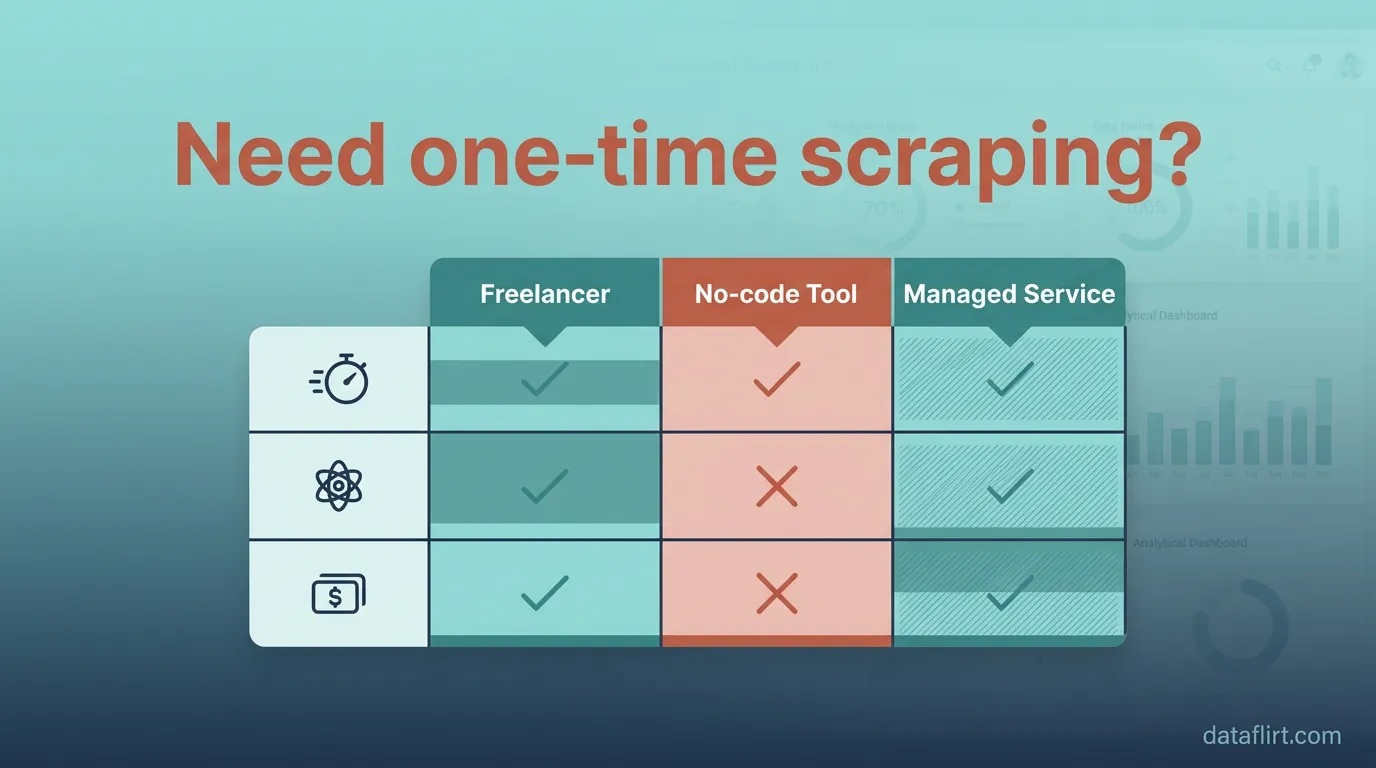
A freelance developer provides human flexibility, a no-code tool delivers self-serve software infrastructure, and a managed service gives you a guaranteed final dataset. Your choice dictates how much technical responsibility you must shoulder yourself.
| Option | Best for | Cost range | Hands-on required | QA included | Scales to |
|---|---|---|---|---|---|
| Freelancer | Flat HTML sites | Highly variable | Medium | No | ~2,000 SKUs |
| No-code tool | Simple directories | Software license fee | High | No | ~5,000 SKUs |
| Managed service | Complex targets | Project-based quote | Low | Yes | Unlimited |
Hiring a freelancer represents the lowest barrier to entry. You visit a gig marketplace and post your requirements. A developer writes a custom Python script for your specific target site. They execute the script on their local machine. They send you the resulting file. You pay for their time, and you accept the output as delivered.
Purchasing a no-code tool puts the extraction mechanics entirely in your hands. You pay a monthly fee for access to a cloud platform or a browser extension. You navigate to the target site and visually select the data points. The software generates the extraction logic automatically. You execute the run yourself.
Engaging a managed extraction partner functions as a complete data supply chain. You provide the target URLs and the required output schema. The provider provisions the infrastructure, rotates the IP addresses, and handles the CAPTCHA solving. They perform rigorous quality assurance on the raw data. They deliver the final file ready for immediate use.
Where freelancers work well and where they do not
Freelance developers excel at pulling small product lists from unprotected, legacy websites. They struggle significantly when tasked with bypassing modern web application firewalls or organizing messy data into strict formats.
Can you trust a $30 Fiverr gig with 20,000 product records? The honest answer is almost always no. The average cost for a fixed-price data extraction project on Fiverr sits at $123. A deeply discounted gig indicates the developer will rely on generic, unmaintained code libraries. If the target website employs any modern security layers, a cheap script will crash immediately.
Let us examine the ideal scenario for a gig worker. You need to pull 1,500 replacement parts from a specialized B2B industrial supplier. The site serves basic HTML pages without dynamic content. There is no requirement to extract high-resolution product images. A freelancer can scrape this easily using standard tools. They will deliver a functional comma-separated values file at a very low cost.
This approach shatters upon contact with sophisticated target architectures. Major retailers utilize aggressive security vendors to block automated traffic. Overcoming advanced TLS fingerprinting requires deep engineering knowledge. A typical gig worker lacks the budget to provision elite residential proxies or properly configure a headless browser fleet. They will hit a security wall. They will abandon the project or demand more money to proceed.
Imagine the script pulls 10,000 rows perfectly; then the target site flags the IP address. The script crashes. The freelancer must rewrite the headers, purchase a new proxy, and attempt to resume the job. Often, they accidentally duplicate the first 10,000 rows or miss a block of products entirely. You are left sorting through a massive CSV file trying to deduplicate entries manually.
You absorb the entire quality assurance burden when hiring temporary help. The developer delivers the raw script output. If the script misses the third variant option for fifty different shirts, you must identify the gap manually. If a description field contains broken HTML tags, you must scrub the text yourself. You spend hours auditing the spreadsheet.
This hidden administrative tax often negates your initial savings entirely. Review our comprehensive guide on understanding scraping cost factors to evaluate this dynamic. When your timeline is tight, gambling on a cheap script introduces unacceptable operational risk.
Where no-code tools work well and where they do not
Self-serve extraction software performs beautifully on simple paginated lists and direct JSON data feeds. These applications fail completely when forced to navigate complex image carousels, nested variant menus, or infinite scroll layouts.
The appeal of bypassing the engineering department is undeniable. Companies desperately want direct access to market intelligence. Consequently, the global web scraping software market is projected to reach $1.17 billion in 2026. You simply log into a dashboard. You open the target page in a specialized interface. You click on a product title, and the software learns your intent.
Visual platforms handle straightforward directory layouts effectively. If you are targeting a small, regional retailer with basic category structures, a no-code tool succeeds. You configure the pagination logic. You let the cloud servers run the job. You export the resulting table. You bypass the need to hire a developer entirely.
The reality of extracting deep ecommerce data is much messier. Target storefronts push layout updates constantly. A minor change to a CSS selector immediately breaks your visual workflow. The tool returns blank columns. You must pause your day, log back into the software, and repair the selectors manually.
Performance degrades sharply on dynamic infrastructure. Consider a site utilizing variable pricing matrices based on size and material. Extracting that matrix requires simulating clicks on every single swatch combination. Most visual tools time out during this intensive interaction process. They fail to parse asynchronous data loaded via background API calls.
When a target site detects unusual behavior, it serves a security challenge. A human user simply clicks the specific images. A visual scraper immediately stalls. Unless the software integrates a dedicated third-party solving API, the entire job halts. You return to your computer hours later to find the workflow stuck on product number 45 out of 10,000.
Ultimately, your own engineering time becomes the hidden cost of the software license. You are acting as the extraction engineer. You must monitor the job queue. You must diagnose the empty fields. For a one-time project, the learning curve required to master a robust no-code platform rarely justifies the investment. Check out our post on avoiding ecommerce web scraping mistakes for more context on these software traps.
When managed scraping is worth the premium
Managed extraction makes financial sense when your project exceeds 5,000 SKUs, requires complex schema matching, or targets platforms protected by military-grade anti-bot systems. You are paying to eliminate technical friction.
Data quality is a severe operational risk. Processing bad data costs most companies 15 to 25 percent of their revenue. You cannot afford to upload corrupted catalogs to your live storefront. If pricing fields shift by just one column in your spreadsheet, you might sell premium inventory at a devastating loss.
The financial penalty for messy data is staggering. The average annual financial cost of poor data quality per enterprise organization reaches $12.9 million. A managed provider justifies its cost by assuming responsibility for this data hygiene. DataFlirt normalizes the raw output into a pristine format.
Formatting requirements complicate even the simplest data pulls. Consider the strict constraints of a Shopify migration project. Shopify enforces a hard 15 megabyte maximum file size limit per product upload. Furthermore, the Handle column is strictly required as the unique URL slug and product identifier. You cannot simply upload a raw export from Target or Wayfair directly into your admin panel.
There is also a massive danger during a Shopify overwrite procedure. Leaving a column blank in your spreadsheet actively erases the existing product data for that field on your live store. Conversely, an omitted column entirely preserves the existing data. Your extraction provider must understand these precise, platform-specific differences. DataFlirt maps the raw target data into your exact required schema perfectly.
Image extraction adds another significant layer of technical complexity. High-resolution product photos sit behind protected content delivery networks. Shopify requires public HTTP links without cookie restrictions for a successful import. A managed service downloads the assets automatically. DataFlirt hosts them temporarily on accessible servers. We provide clean URLs mapped to the correct variant rows.
Managed providers also maintain the sophisticated proxy networks required to access the modern web. Currently, 10.2 percent of all global web traffic consists of scraper traffic that makes it past mitigation layers. To join that successful group, you need residential IP addresses and advanced evasion techniques.
When you require data from heavily fortified sites like Sephora or Home Depot, a basic approach is useless. DataFlirt handles this invisible proxy war on your behalf. We absorb the cost of blocked requests. DataFlirt guarantees the final delivery volume regardless of the target’s defensive posture. Read our guide on how to evaluate a scraping services vendor to see how we handle these challenges.
Modern product pages contain far more than just a title and a price. You need the breadcrumb trails for category mapping. You need the customer review aggregates. You need the underlying metadata that contains hidden stock levels. DataFlirt writes custom parsing logic to target these specific elements in the source code.
The decision matrix
Weighing your options requires matching your specific technical scenario to the correct procurement model. This decision matrix clarifies the ideal choice based on product volume, structural complexity, and required output format.
| Scenario | Target Complexity | Recommended Option |
|---|---|---|
| 200 products, flat HTML site | Low | Freelancer or No-code tool |
| 5,000 SKU Shopify store migration | Medium | Managed service |
| 20,000 products, JS-rendered, anti-bot | High | Managed service |
| 10 products across 5 competitor sites | Low | No-code tool |
| 1,000 seller profiles with legal limits | Medium | Managed service |
Let us examine a simple baseline scenario. You need to pull a few hundred basic products from a local distributor. The website uses ancient technology. The data is entirely static. A freelancer or a basic visual scraper will handle this flawlessly. You will spend very little money and acquire the data quickly.
Scale the requirement laterally. You need to track a short list of specific items across several different market platforms. The total product count remains low. A no-code tool gives you the control to build these small, independent workflows. You can execute this targeted audit without engaging an external team.
The calculus changes dramatically for major catalog migrations. Imagine you are moving a 5,000 SKU catalog from a custom backend to a new storefront. You absolutely must have the final file match your destination platform’s schema perfectly. A managed service prevents the catastrophic data overwrite risks mentioned in the previous section. DataFlirt formats the delivery file; you simply click upload.
Extreme complexity always demands a managed approach. You require deep catalog data from Macy’s or Best Buy. The site relies entirely on Javascript rendering. You need every color variant, every high-resolution image, and all nested technical specifications. The target uses aggressive behavioral blocking.
A freelance script will fail against this defense. A visual tool will crash trying to process the asynchronous data loading. Only a dedicated managed infrastructure can execute this scale of extraction reliably. DataFlirt maintains the engineering depth to overcome these barriers consistently.
Business-to-business intelligence projects also require careful execution. You need a list of seller contacts from Amazon or eBay. This involves traversing deep pagination paths and extracting obscure link attributes. It also requires navigating strict legal boundaries. A managed provider ensures the technical extraction succeeds while keeping the methodology entirely sound.
How DataFlirt fits in
DataFlirt operates exclusively as a premium managed data extraction partner. We deliver the final, clean dataset directly to your team so you never have to configure a proxy server or debug a broken Python script.
We understand the inherent hesitation surrounding data procurement. You want to verify the output before you authorize payment for a massive catalog extraction. DataFlirt provides a comprehensive sample dataset during the initial scoping phase. You review the exact columns. You verify the image links resolve correctly. You approve the exact schema structure before DataFlirt executes the full run.
Our commercial model aligns perfectly with one-time operational projects. We utilize project-based pricing. There are no mandatory ongoing software subscriptions if you only require the data once. You pay strictly for the successful delivery of your specific catalog requirements. Learn more about how web scraping works under our managed umbrella.
DataFlirt absorbs the heaviest technical burdens internally. If you need massive volume from Walmart or Nike, our engineers provision the correct residential proxy rotation pools. DataFlirt manages the cloud browser fleets required to render dynamic frontend frameworks. We extract the hidden attributes seamlessly.
We then normalize messy variant data into clean, flat spreadsheet rows. If a target site uses mixed date formats or inconsistent currency symbols, the DataFlirt quality assurance layer standardizes the text. We format the final output to match your destination platform flawlessly.
DataFlirt also prioritizes compliance and legal orientation in every project. The legal landscape surrounding data extraction requires careful navigation. Based on the final resolutions of recent landmark cases like hiQ Labs v. LinkedIn, scraping publicly visible data while logged out generally does not violate the US Computer Fraud and Abuse Act.
However, creating fake accounts, bypassing technical login walls, or violating an accepted Terms of Service agreement exposes the scraper to strict breach-of-contract liability. DataFlirt strictly extracts public, unauthenticated data points. We always recommend you consult qualified legal counsel to evaluate your specific commercial use case.
DataFlirt gives you absolute confidence in your ecommerce data supply chain. When you cannot afford missing variants, broken images, or corrupted pricing fields, our quality assurance process protects your business. DataFlirt bridges the gap between complex web targets and your internal systems reliably.
FAQ
Can a no-code tool handle Shopify product pages?
Answer. Simple Shopify stores with standard layouts are achievable. Headless Shopify and custom React themes typically require a headless browser setup most no-code tools handle poorly.
What recourse do I have if a freelancer delivers unusable data?
Answer. Freelance platforms offer escrow and dispute resolution but success depends on how well the brief was written. Without a schema agreement and sample approval step disputes are hard to win.
Does DataFlirt offer a sample before full commitment?
Answer. Yes. DataFlirt delivers a 100-row sample extraction as part of scoping so you can verify quality before approving the full run.
Managing complex product data migrations internally drains valuable engineering resources. If you would rather not scope and build this extraction yourself, DataFlirt’s ecommerce scraping service handles the target evaluation, quality assurance, and final delivery completely. We can also assist with broader market research through our company data extraction service. Reach out to our team today for a free scoping call and a guaranteed 48-hour response time.