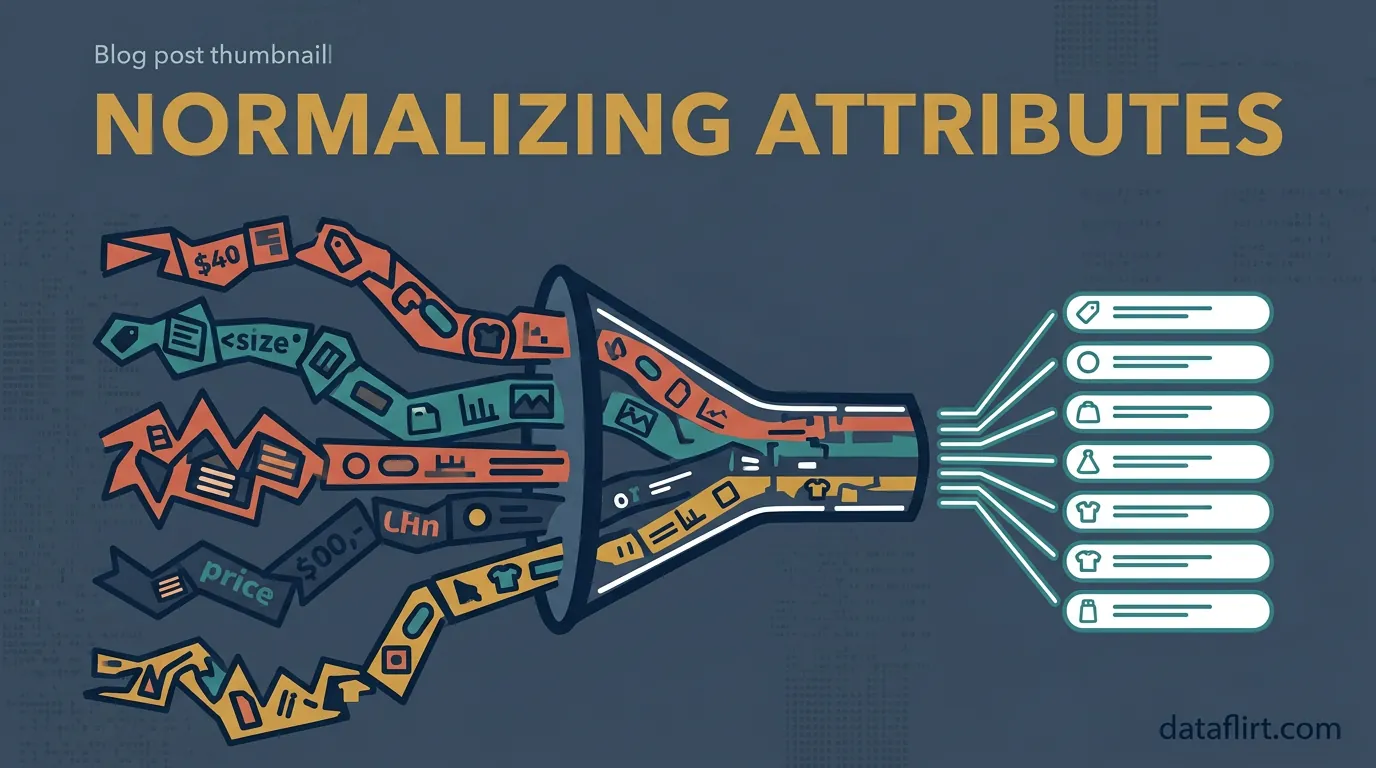

You scrape a dozen competitor catalogs to monitor a single retail product. One site lists the screen size inside a complex specification table. Another hides the exact same dimension deep within a flat text description. The raw output is chaotic. Data engineers cannot build reliable pricing algorithms or inventory forecasting models on top of a mess. You need a unified schema. This guide covers how to clean those disparate inputs and format them for strict ingestion systems.
Key takeaways
- You must define your target output schema before you write a single extraction rule.
- Automated normalization requires moving away from rigid regular expressions toward semantic clustering.
- Target platforms like Shopify enforce strict column headers and variant limits that will reject unformatted data.
- Conversational AI search features require entirely new attribute categories to support natural language queries.
What normalized product data actually delivers
Normalized product data delivers a unified schema that allows identical items from different sources to be directly compared and ingested into your systems. Without this standardization layer, your pricing intelligence tools simply cannot recognize that two different database rows describe the identical television. Raw scraping gets the HTML off the page. Normalization turns that text into actual business intelligence.
Consider a data engineer pulling catalog information from Amazon and a regional competitor. The competitor lists a laptop’s RAM as “16GB DDR4” in the title. Amazon places “16 GB” in a dedicated hardware specification table. Your inventory system needs a distinct integer value for memory size. If you feed the raw scraped text into your database, the system throws an error. You must standardize the naming conventions, the units of measurement, and the structural hierarchy.
This preparation phase represents a massive operational bottleneck for engineering teams. Industry analysis confirms that data professionals spend 80% of their time strictly on data cleaning, integration, and preparation before the information can be utilized for analysis or AI applications. That leaves very little capacity for building actual software architecture. DataFlirt eliminates this friction by delivering pre-normalized feeds.
Poor standardization directly impacts the bottom line for ecommerce brands. Mid-market ecommerce companies lose an average of 23% of potential revenue directly due to bad product data like missing attributes and inconsistencies. When a user filters a category page by “Bluetooth compatibility” and your product lacks that normalized tag, the item effectively disappears. DataFlirt ensures your catalog fields remain perfectly aligned with your master schema.
Centralizing this information has become a mandatory infrastructure investment. Analysts project the global market valuation of Product Information Management (PIM) systems will reach $19.95 Billion in 2026. This explosive growth is driven heavily by the need for centralized, standardized product attributes across channels. Companies rely on these PIM tools to syndicate perfect data to every storefront. DataFlirt integrates directly into these management pipelines.
DataFlirt engineers see the consequences of fragmented catalog ingestion every week. Clients come to DataFlirt after spending months trying to stitch together custom pipelines. When you let DataFlirt handle the extraction and the schema alignment, your engineering team reclaims that lost time. DataFlirt hands you an import-ready asset.
How to map disparate raw attributes to a master schema
You map raw attributes to a master schema by defining your strict target output first and then building transformation layers that cast varied inputs into those exact fields. You never attempt to merge two raw feeds directly. Instead, you build a central definition of what a product should look like in your system. Every incoming feed must bend to fit that definition.
If you want to track sneaker prices, your master schema needs defined columns. You need brand, model, colorway, and size. When you scrape eBay, you might find colorway information nested in the item specifics block. When you scrape a direct supplier, the color might just sit at the end of the product title. You need logic to extract the color string and route it to your master color column.
This process requires aggressive data normalization. You must strip whitespace, convert casing, and standardize units. If one site uses “cm” and another uses “centimeters,” your transformation layer must convert both to a standardized unit identifier. DataFlirt builds these conversion dictionaries directly into the extraction pipeline.
| Source Retailer | Raw Attribute Name | Raw Value Format | Target Master Column | Target Master Value |
|---|---|---|---|---|
| Retailer A | Display Resolution | 4K Ultra HD | screen_resolution | 3840x2160 |
| Retailer B | Res | 3840 x 2160 pixels | screen_resolution | 3840x2160 |
| Retailer C | Picture Quality | 4K UHD (2160p) | screen_resolution | 3840x2160 |
This table illustrates the complexity DataFlirt handles automatically. You cannot write a simple database join command for these three sources. You need an intermediate processing layer that understands that “4K Ultra HD” and “2160p” mean the exact same thing in a consumer electronics context. DataFlirt maintains massive proprietary dictionaries to execute these exact translations.
The volume of custom logic required to manage this across multiple retailers scales exponentially. If you add Best Buy to your tracking list, you have to map their entire category structure to your internal taxonomy. If you add Target, you have to write a whole new set of parsing functions. A DataFlirt managed service prevents this endless development cycle.
Properly mapping these attributes is not optional for customer experience. A staggering 83% of online shoppers will abandon an ecommerce site if it has insufficient or incomplete product information. If your scraper fails to map the “waterproof” attribute correctly, your customer assumes the jacket will not keep them dry. DataFlirt protects your conversion rates by ensuring attribute completeness.
DataFlirt recommends starting small. Pick your top fifty revenue-driving SKUs. Define the perfect schema for those items. Map two competitor feeds to that schema. Once you prove the transformation logic works, you can scale the architecture to your entire catalog. DataFlirt can accelerate this testing phase significantly.
Why rigid string matching scripts fail in production
Rigid string matching scripts fail because retailers constantly change their HTML layouts and invent new attribute variations that bypass hardcoded regular expressions. A script looking for a specific text string will break the moment a retailer updates their content management system. You cannot build a durable data pipeline on fragile text anchors.
Consider an engineer who writes a regular expression to find weight attributes. The script looks for any number followed immediately by “lbs”. This works perfectly for six months. Then the retailer redesigns their site and starts rendering the weight as “Pounds: 15”. The regular expression returns a null value. Your database registers a missing attribute. DataFlirt avoids this by using structurally aware parsers.
Retailers actively combat scraping through dynamic obfuscation. They inject random CSS classes and alter DOM structures daily. If your parsing script relies on finding an attribute inside a specific div tag, it will crash. You can read more about building resilient extractors in our guide to web scraping ecommerce product data. DataFlirt engineers monitor these layout shifts continuously.
The maintenance burden of repairing these scripts destroys ROI. Your team fixes the weight extraction bug on Monday. On Tuesday, the retailer changes how they list apparel sizes. You are trapped in an endless loop of emergency patching. A DataFlirt extraction pipeline isolates you from these front-end changes.
Relying on regular expressions to parse product specifications is like using a dictionary to translate poetry. You might get the literal words right, but you will miss the context, the structure, and the actual meaning of the data.
You need systems that understand context. If a product title includes “Red/Black,” the system should identify those as colors without needing a specific HTML tag telling it so. This requires natural language processing capabilities. DataFlirt deploys lightweight machine learning models to identify attributes contextually rather than relying on strict HTML paths.
DataFlirt understands that data quality degrades over time if pipelines are left unattended. When you hire DataFlirt, you buy peace of mind. DataFlirt handles the breakages. DataFlirt writes the patches. You simply receive the clean data in your storage bucket every morning.
Is normalization at scale even feasible
Attribute normalization at scale is highly feasible if you abandon manual regex rules in favor of machine learning models and strict data contracts. Every retailer calls the same attribute something different. Is normalization at scale even feasible? Yes, but only if you change your fundamental engineering approach. You cannot brute-force your way through ten million SKUs.
Consumers demand this level of precision across the internet. In fact, 38% of consumers cite inconsistent product information as a primary factor impacting their decision-making and causing cart abandonment. If they see mismatched features or attributes across different retailers, they lose trust and leave. DataFlirt ensures your syndicated catalogs remain perfectly aligned.
To achieve this scale, you have to utilize semantic clustering. Instead of writing a distinct rule mapping “navy,” “crimson,” and “teal” to your color column, you train a model to recognize color entities. When the model encounters “midnight blue” on Walmart, it automatically categorizes it as a color attribute. DataFlirt leverages these entity recognition models extensively.
When dealing with home improvement goods across Home Depot and Lowe’s, the dimensional data gets incredibly complex. One site lists length by width by height. The other lists depth by height by width. A smart normalization engine detects the unit types and standardizes the dimensional array regardless of presentation order. DataFlirt builds these specific vertical transformations for enterprise clients.
Many businesses ask DataFlirt if this process infringes on supplier copyrights. While DataFlirt provides technical orientation and not legal advice, factual product specifications like weight, dimensions, and color are generally considered public facts. They lack the creative originality required for copyright protection. You should always consult qualified legal counsel regarding your specific scraping use cases.
The alternative to automated normalization is deploying an army of manual data entry clerks. This approach is slow, expensive, and prone to human error. Humans get tired. They mistype dimensions. They categorize items incorrectly. A DataFlirt automated pipeline runs flawlessly twenty-four hours a day.
By leveraging an ecommerce product data API, you can bypass the extraction phase entirely and focus solely on the transformation logic. However, if your API provider hands you unformatted JSON, you still have a massive engineering problem. DataFlirt provides both the extraction and the semantic mapping layer.
What to watch for when formatting for target platforms
Structuring data for specific platforms usually breaks when your normalized output violates hard constraints like variant limits or mandatory system column names. Getting the data clean is only the first half of the job. The second half is twisting that clean data into the precise shape your target ingestion system demands.
Shopify presents a notoriously strict ingestion environment. When building normalized outputs for Shopify ingestion, the CSV remains heavily variant-centric. The system strictly requires Handle and Title columns for the parent product, but variant attributes must be strictly mapped to Option1 Name (e.g., “Size”) and Option1 Value (e.g., “Large”), up through Option3 Name.
Data engineers must be aware of platform limits. Shopify limits products to a maximum of 3 option types and 2,048 variants per product. If you scrape a complex product from Wayfair that has four variant dimensions, you have to programmatically concatenate two of them together to fit into Shopify’s three-option limit. DataFlirt handles these concatenation rules automatically.
You must also handle missing data with extreme caution during updates. Including empty variant columns during a Shopify update will permanently delete existing variant options. Your transformation script must know the difference between a genuinely blank attribute and a field you simply want to ignore during an update. DataFlirt pipelines are designed to handle these delicate state changes safely.
import pandas as pd

# DataFlirt example: Formatting scraped raw data for Shopify CSV ingestion
def format_for_shopify(raw_dataframe):
    # Rename standard columns to match Shopify strict headers
    shopify_df = raw_dataframe.rename(columns={
        'product_url_slug': 'Handle',
        'product_name': 'Title',
        'variant_color': 'Option1 Value',
        'variant_size': 'Option2 Value'
    })

    # Enforce mandatory option names
    shopify_df['Option1 Name'] = 'Color'
    shopify_df['Option2 Name'] = 'Size'

    # Drop any products exceeding the 3 option limit to prevent import crashes
    # (Complex concatenation logic would go here in a production DataFlirt pipeline)
    return shopify_df
Google Merchant Center (GMC) imposes a completely different set of architectural rules. The 2026 GMC product data specification updates reflect an increasing reliance on granular product attributes for Performance Max campaigns. Data engineers now need to map scraped data to new fields, including video_link and mandatory minimum pricing limits (auto_pricing_min_price).
If your current pipeline drops video URLs because they do not fit your legacy schema, your GMC campaigns will suffer. You must continuously audit target platform documentation to ensure your master schema captures all necessary fields. DataFlirt monitors these major platform specification updates and adjusts our output schemas accordingly.
Working with beauty and cosmetic data from Sephora or Macy’s requires mapping complex ingredient lists. Some platforms require ingredients to be submitted as a comma-separated string. Others require a JSON array. Your export layer must dynamically cast the data type based on the destination. DataFlirt delivers the precise data type your endpoint requires.
Structuring specifications for AI and conversational models
Normalizing data for large language models requires converting standard tabular specifications into rich conversational context that an AI can easily read and summarize. The traditional row-and-column approach works perfectly for SQL databases. It fails miserably when a user asks an AI chatbot, “Which of these laptops has the best battery life for video editing?”
To adapt to AI-powered search, platforms like Google Merchant Center now support “conversational attributes” (e.g., question_and_answer, variant_option, document_link). This requires data pipelines to not just normalize traditional tabular specs, but to structure attributes specifically for ingestion by consumer-facing LLMs and conversational agents.
You must extract the latent context from the product page. If you scrape an FAQ section from Overstock, you cannot just dump the text block into a single database cell. You need to parse the distinct questions and answers, normalize the terminology within them, and format them as distinct relational objects. DataFlirt specializes in this type of deep structural extraction.
Many brands now use scraped catalog data to fine-tune their internal customer service models. You can review how teams operationalize this in our breakdown of what business teams do with scraped data. The formatting required for these models looks entirely different from a Shopify CSV. You need heavily annotated JSON or JSONL files. DataFlirt provides outputs optimized for machine learning environments.
This shift toward AI ingestion means your extraction targets must expand. You can no longer rely solely on the main specification table. You need to pull warranty documentation, user manuals, and detailed feature narratives. DataFlirt builds broad-spectrum scrapers that capture the entire informational ecosystem of a product page.
When formatting for AI, clarity of relationships is paramount. The model needs to know definitively that a specific “battery life” attribute belongs to the “15-inch model” and not the “13-inch model.” If your normalization script flattens variant data incorrectly, the AI will hallucinate product capabilities. A DataFlirt architecture preserves hierarchical variant relationships perfectly.
If your engineering team is building retrieval-augmented generation systems, you need specialized feeds. Our AI training data services deliver pre-processed, fully normalized catalog data formatted explicitly for vector database ingestion. DataFlirt handles the heavy lifting so your data scientists can focus on model performance rather than text parsing.
Fashion and apparel retailers face unique challenges here. When scraping ASOS or Zalando, the fabric composition data is often buried in unstructured text blocks. “Made from 100% organic cotton” needs to be parsed into a material_type attribute with the value organic cotton and a material_percentage attribute with the value 100. DataFlirt uses advanced parsing techniques to structure this conversational text into hard data points.
Frequently asked questions
How do you handle missing attributes in a scraped catalog?
Missing attributes must be explicitly handled in your transformation layer. If a field is blank, your script should insert a standardized null value (like None or N/A) rather than leaving the column empty. This prevents structural shifts in your CSV or JSON outputs that could crash downstream ingestion tools.
Should normalization happen during extraction or after?
Normalization should always happen after the raw data is safely stored. This pipeline pattern ensures you never lose the original source material. If your normalization script contains a bug and overwrites valid data, you can simply replay the raw extraction file through the corrected script. DataFlirt strongly advocates for this decoupled architecture.
Does Shopify allow partial variant updates via CSV?
Shopify requires extreme caution when updating variants via CSV. If you upload a file with an empty variant column, Shopify assumes you want to delete that variant option permanently. To execute a partial update safely, you must include the existing Option Name and Option Value fields exactly as they currently exist in the system.
How do conversational attributes affect standard table schemas?
Conversational attributes break standard flat tables because they introduce unpredictable, nested data structures. A single product might have twenty FAQ pairs or zero. To handle this, you must migrate from flat CSVs to relational databases or JSON-based document stores that can support dynamic arrays without breaking the schema constraints.
If you would rather not scope this yourself, DataFlirt’s ecommerce scraping service handles the extraction, QA, and delivery. Our team builds the normalization rules, monitors the target sites for layout changes, and delivers clean, import-ready catalogs directly to your staging environment. Reach out for a free scoping call.