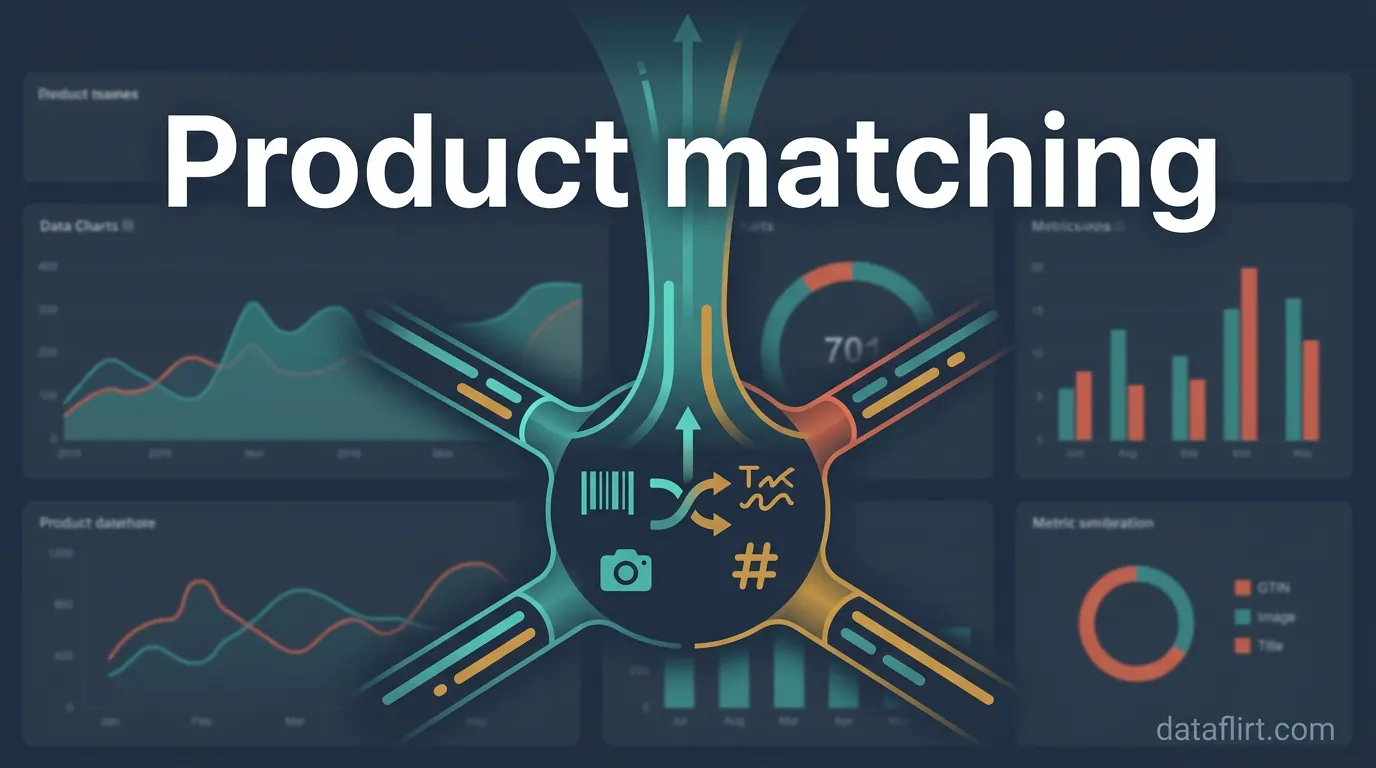

Catalog fragmentation breaks retail intelligence pipelines daily. You want to track competitor pricing for a specific electronics item. You immediately face an unavoidable obstacle. Without a universal identifier, how do you match the exact same physical product listed differently across an amazon storefront, a flipkart listing, and the manufacturer’s own brand site? The answer requires a multi-signal data approach. Simple keyword matching produces too many false positives. Relying strictly on barcodes leaves massive gaps in your coverage. Modern data engineering teams solve this by building cascade pipelines that evaluate identifiers first, move to fuzzy text scoring, and use visual hashing as the final arbiter.
Key takeaways
- Cascade pipelines route records through sequentially heavier matching logic to minimize overall compute costs.
- Matching on exact GTIN or UPC codes guarantees near perfect precision but only covers a fraction of most vendor catalogs.
- Fuzzy text matching compares preprocessed titles to calculate a similarity score for unidentified items.
- Perceptual hashing converts product images into numerical strings to act as a definitive tiebreaker when text matching is inconclusive.
Why product matching is hard across retailers
Retailers actively alter product metadata to fit their specific taxonomy requirements and search engine optimization goals. This destroys structural parity between identical items across the web. You cannot rely on a single data point to confirm a match. The data architecture of third-party marketplaces encourages extreme fragmentation.
Same product different titles across platforms
Marketplace sellers constantly manipulate product titles to capture long-tail search traffic. A standard coffee maker might have a clean, concise title on target. That exact same machine on another site will feature a title stuffed with generic keywords, promotional phrases, and unnecessary spec details. This renders exact string matching completely useless. DataFlirt analysts consistently see identical items represented by wildly divergent title lengths. You have to clean this text before any comparison algorithm can work.
Missing or inconsistent GTINs
Global Trade Item Numbers are the theoretical gold standard for product matching. The reality is much darker. Millions of products simply lack these codes. If a product genuinely does not have a GTIN, sellers must explicitly set the Google Merchant Center identifier attribute to false. The system defaults to true. This causes widespread errors. According to recent data, 47% of the time products missing GTIN codes are rejected from Google’s free product listings. DataFlirt clients frequently build scraping pipelines specifically to hunt down these missing attributes. DataFlirt extraction modules flag missing identifiers automatically.
Bundle variants share base product but have different GTINs
Bundling creates a secondary layer of matching complexity. A digital camera body sold on bestbuy has one specific UPC. A third-party seller on ebay might take that exact same camera, add a cheap memory card, include a generic carrying case, and list it as a unique bundle. The base product is identical. The price comparison is highly relevant to your market intelligence. However, the bundle possesses a completely different identifier. DataFlirt mapping tools must decouple these bundles into distinct parent and child components for accurate matching.
Private label copies visually similar different brand
White-label manufacturing floods platforms like wayfair and homedepot with physically identical items bearing different brand names. A single factory in Asia might produce a specific office chair. Fifty different drop-shipping companies sell that exact chair under fifty different brand names. The visual data is identical. The physical specifications are identical. The branding and identifiers are entirely unique. DataFlirt clustering algorithms handle these edge cases by grouping visually identical products into macro-categories. You have to decide if your business logic considers these the same product.
| Fragmentation Type | Retailer Example | Matching Challenge |
|---|---|---|
| Keyword stuffing | Marketplace sellers | Title lengths and phrasing vary wildly. |
| Missing identifiers | Vintage or custom | No barcode exists to anchor the record. |
| Value bundles | Electronics retailers | Base item is obscured by added accessories. |
| Private label | Furniture outlets | Identical physical goods carry different brands. |
GTIN-first matching the most reliable approach
Matching on exact GTIN or UPC codes guarantees near perfect precision when both datasets contain clean identifiers. It is the fastest, cheapest, and most definitive resolution method available. Your data pipeline should always attempt this lookup before triggering any heavier computational logic.
Match on GTIN-13 or UPC across datasets near 100% precision when both records have identifier
When you possess a valid GS1-registered barcode, matching becomes a simple database lookup. There is zero ambiguity. A specific UPC corresponds to one exact physical product. This reduces your computational load drastically. Providing these codes also boosts visibility. Industry tracking shows that advertisers see a 40% potential increase in click-through rates for Google Shopping campaigns when they correctly provide GTINs compared to those without. DataFlirt systems prioritize GTIN extraction during every crawl. When DataFlirt delivers your payload, the GTIN columns serve as your primary relational keys.
Limitation coverage typically 50-70% of catalog
Universal identifiers fail because they lack universal adoption. A massive segment of ecommerce inventory consists of custom, vintage, handmade, or private-label goods. These categories rarely possess registered barcodes. Amazon explicitly requires GS1-registered barcodes for most items, but they grant GTIN exemptions for unbranded or handmade goods. This creates blind spots. Research indicates that missing attributes like GTINs cause 23.49% of all product ad disapprovals. Relying solely on barcode matching means you will blind your system to nearly half of the available market data. DataFlirt engineers design pipelines assuming the GTIN will be absent.
Normalization strip leading zeros from UPC before matching check digit validation first
Raw identifier data is notoriously dirty. Sellers manually type UPCs into backend systems, introducing spaces, hyphens, and padding errors. A 12-digit UPC is often padded with a leading zero to meet the 13-digit EAN format standard. If you attempt a direct SQL join without normalization, the match will fail. DataFlirt processing pipelines always sanitize these strings. We strip leading zeros, remove non-numeric characters, and validate the mathematical check digit before storing the record. This DataFlirt sanitation step prevents false negatives.
This simple validation script demonstrates the exact check digit logic DataFlirt extraction nodes use to verify scraped barcodes before committing them to your database.
def validate_upc_check_digit(upc_string: str) -> bool:
    clean_upc = ''.join(filter(str.isdigit, upc_string))
    if len(clean_upc) != 12:
        return False

    digits = [int(d) for d in clean_upc]
    odd_sum = sum(digits[0:11:2]) * 3
    even_sum = sum(digits[1:11:2])

    total = odd_sum + even_sum
    check_digit = (10 - (total % 10)) % 10

    return check_digit == digits[11]
Validating the check digit ensures you are not matching against garbage data. The DataFlirt extraction pipeline runs this silently in the background, dropping corrupted barcodes before they infect your matching tables.
Fuzzy title matching the workhorse for unidentified products
When identifiers are absent, fuzzy text matching compares preprocessed product titles to calculate a statistical similarity score. This fallback methodology handles the vast majority of fragmented inventory across the web. You must transform messy human language into structured mathematical vectors.
Preprocessing lowercase remove stopwords normalize brand names
Raw text matching always fails. You must aggressively preprocess product titles before any algorithm touches them. The first step involves converting all text to lowercase and stripping punctuation. Next, you remove common stop words like “with”, “and”, or “for”. Finally, you must standardize unit measurements and brand names. A product listed as “16 oz” must match a product listed as “16 ounce”. DataFlirt text parsers handle this normalization automatically. By the time DataFlirt feeds the title into the matching engine, the text is perfectly sterile.
TF-IDF cosine similarity fast interpretable works well for over 80% similarity threshold
Term Frequency-Inverse Document Frequency calculates the mathematical importance of each word in a title relative to your entire product catalog. Words like “shirt” get a low weight because they are common. Specific model numbers get a massive weight because they are rare. You then convert these weighted titles into vectors and calculate the cosine similarity between them. This approach is highly interpretable and computationally cheap. DataFlirt data scientists recommend this method for your initial text pass. If the cosine similarity scores above eighty percent, you likely have a match. DataFlirt pipelines execute millions of these calculations per second.
BERT-based embedding similarity higher recall on paraphrased titles use as second pass
Legacy vector matching struggles with synonyms and paraphrased titles. A “crimson pullover” and a “red sweater” mean the same thing but share zero keywords. Deep learning models like BERT solve this by understanding semantic context. Modern infrastructure relies heavily on these models. Studies reveal that 71% of commerce queries where retrieval-augmented generation systems now rely on structured product fields alongside semantic embeddings. DataFlirt incorporates these advanced language models for secondary text evaluation. When TF-IDF fails, DataFlirt triggers an embedding comparison to catch semantic matches.
Manual review threshold over 95% auto-match 80-95% review queue under 80% no match
You must establish rigid confidence thresholds to prevent corrupted data from entering your production systems. If an algorithm returns a similarity score above 95 percent, you can safely automate the match. Scores between 80 and 95 percent enter a gray zone. These require human verification or an image tiebreaker. Any score below 80 percent is rejected immediately. DataFlirt builds these exact routing parameters into every delivery architecture. DataFlirt quality assurance teams can also manage that middle-tier review queue for you. Setting these boundaries protects your ultimate business intelligence.
Image hash matching the tiebreaker
Perceptual hashing converts product images into condensed numerical strings to compare visual similarity regardless of file size, dimensions, or compression rates. It resolves borderline text matches where product titles are ambiguous. You use this when the metadata fails you completely.
pHash compares images visually regardless of filename or URL
Cryptographic hashes like MD5 change completely if a single pixel shifts. Perceptual hashing algorithms behave differently. A pHash reduces an image to grayscale, shrinks it to a tiny matrix, and computes a discrete cosine transform. This captures the underlying visual frequencies. Two identical products photographed with slight lighting differences will generate extremely similar hashes. The DataFlirt image processing cluster utilizes advanced perceptual hashing to map visual similarities across disparate retailers. When DataFlirt processes an image URL, the resulting hash becomes a permanent column in your dataset.
Best use confirm a fuzzy title match by verifying images look the same product
Image hashing is too computationally expensive to run against your entire catalog blindly. You should deploy it exclusively as a validation step. If your fuzzy title algorithm returns an 88 percent similarity score, you have a tentative match. You then pull the image hashes for both products. If the hashes exhibit a low Hamming distance, you confirm the match. This protocol ensures high accuracy. DataFlirt engineers structure extraction pipelines to gather high-resolution image URLs specifically to enable this downstream verification. The visual data provides the final proof.
Limitation packaging variants retailer photography and color variants all hash differently
Visual matching is not foolproof. A beauty brand on sephora might display a smeared color swatch as the primary product image. A big-box retailer like walmart might display the exact same cosmetic item in its cardboard retail packaging. The perceptual hashes for these two images will be completely different. Color variants of the exact same shirt will also generate divergent hashes. DataFlirt explicitly warns clients about these edge cases. You cannot rely on visual data alone when retailers exercise immense creative control over their photography.
Not standalone use as confirmation step after title match
You must strictly govern when image matching triggers in your pipeline. Treating visual hashing as a standalone discovery mechanism will bankrupt your compute budget and yield terrible results. The internet is filled with visually identical but functionally different products. Consider a 10-inch frying pan and a 12-inch frying pan from the same manufacturer. They look perfectly identical in an isolated photograph. The pHash will confirm a match, but the actual products are different. DataFlirt recommends using visual data solely to break ties. DataFlirt pipelines surface the URLs; your logic dictates the application.
The cascade pipeline for production matching
A cascade pipeline routes records through sequentially heavier matching logic. It starts with cheap identifier lookups and funnels unresolved records toward expensive manual reviews. This architecture preserves your computational resources while maximizing match rates.
Step 1 GTIN match exact auto-accept
The pipeline ingests two records. The very first operation attempts a direct match on the GTIN, EAN, or UPC fields. If the normalized identifiers match exactly, the system automatically accepts the pairing and merges the records. The process terminates here for that specific item. This step consumes negligible processing power. DataFlirt formats all structured glossary/structured-data-markup/ fields to facilitate this immediate join. DataFlirt ensures these crucial data points are extracted perfectly from the source code.
Step 2 GTIN on one record only look up in GS1 registry
Often, the brand site provides a UPC, but the marketplace listing does not. The pipeline intercepts this discrepancy. It takes the known UPC and queries an external GS1 registry or an internal cross-reference table. It pulls the verified manufacturer title and dimensions. It then compares those verified attributes against the marketplace listing. If they align, the match is accepted. DataFlirt architectures frequently incorporate these external API callouts. DataFlirt manages the proxy rotation required to query these global registries without triggering rate limits.
Step 3 Both records lack GTIN fuzzy title match over 95% auto-accept
When universal identifiers are completely absent, the pipeline triggers the text analytics engine. It runs the TF-IDF and BERT embedding models against the normalized product titles. If the algorithmic confidence score breaches the 95 percent threshold, the system automatically accepts the match. No further processing is required. This step resolves the vast majority of your unbarcoded inventory. DataFlirt optimizes the raw text delivery so your machine learning models do not choke on messy HTML characters. DataFlirt delivers clean JSON structures.
Step 4 80-95% title match run pHash image comparison if images match accept else queue
Records returning a fuzzy match score between 80 and 95 percent require validation. The pipeline fetches the primary images, generates the perceptual hashes, and calculates the Hamming distance. Better matching drives real revenue. Market reports show that AI-powered personalization engines drive a 21% average order value increase by utilizing these precise bundle and product matches. If the visual distance is minimal, the system accepts the match. If the images diverge, the record is flagged for human review. DataFlirt extraction services deliver both the primary image URL and the high-resolution variant precisely for this step.
Step 5 under 80% title match queue for manual review
The bottom of the funnel catches the hardest edge cases. Any tentative match scoring below 80 percent on text similarity with conflicting visual data goes into a manual review queue. Data stewards evaluate the metadata, read the product descriptions, and make a definitive human judgment. This is expensive but necessary for high-stakes intelligence. DataFlirt clients often use DataFlirt’s blog/data-quality/ dashboards to monitor the volume of records hitting this specific queue. If the queue grows too large, DataFlirt engineers help recalibrate the upstream scraping parameters to capture cleaner data.
DataFlirt for cross-retailer product matching
DataFlirt engineers build resilient data extraction systems that deliver pristine catalog metadata ready for immediate algorithmic matching. We handle the brutal mechanics of targeted web scraping so your internal data engineering teams can focus entirely on entity resolution and pricing logic. You dictate the target retailers, and DataFlirt provides the pipeline.
Extraction plus matching pipeline in one engagement
You do not have to piece together fragmented tools. A complete DataFlirt engagement covers the entire lifecycle from raw HTML extraction to final entity resolution. We manage the anti-bot evasion, proxy rotation, and DOM parsing. We then feed that raw data directly into a dedicated matching architecture. Using DataFlirt means you get a single unified vendor responsible for the ultimate accuracy of your competitor tracking. DataFlirt acts as an extension of your own intelligence team.
GTIN extraction from JSON-LD plus table parsing
Finding hidden identifiers requires deep technical scraping. Many sites obscure GTINs within the page source. Recent audits show that only 28.5% of ecommerce pages ship with valid Schema.org markup. When structured data fails, DataFlirt extractors dive into the rendered DOM. We parse hidden specification tables, intercept XHR requests, and extract identifiers buried in front-end JavaScript variables. DataFlirt guarantees maximum identifier yield. Our proprietary blog/web-scraping-ecommerce-product-data/ methodologies uncover data points standard scrapers miss entirely.
Title normalization and fuzzy matching included
We do not just hand over raw, dirty text. The DataFlirt platform includes robust pre-processing layers. We normalize brand names, standardizes unit measurements, and execute the fuzzy matching algorithms on your behalf. You receive a clean relational database linking identical products across all requested platforms. If you are struggling to build a reliable product matching pipeline, explore DataFlirt’s ecommerce web scraping service. DataFlirt handles the heavy lifting from data acquisition to definitive product matching. Contact us for a technical scoping call.
FAQ
What is the success rate of fuzzy title matching?
Success rates depend entirely on the aggressiveness of your preprocessing and your chosen thresholds. Well-tuned TF-IDF and BERT models combined generally achieve 85 to 90 percent accuracy on unidentified products, assuming the raw text has been aggressively cleaned and standardized prior to vectorization.
How does perceptual hashing handle different image backgrounds?
Perceptual hashing struggles with drastic background changes. Because the algorithm compresses the entire image into a frequency matrix, a product shot on a pure white background will yield a different hash than the exact same product shot in a complex lifestyle setting. You must account for this by lowering your acceptable Hamming distance threshold or using object detection to crop the product first.
Can GTIN matching be fully automated without human review?
Yes. Assuming you strictly normalize the identifiers to strip leading zeros and validate the mathematical check digit, joining datasets on GTINs or UPCs is virtually flawless. False positives only occur if a third-party seller has intentionally hijacked a valid UPC for a different physical product, which violates major marketplace policies.
What happens when a product has multiple valid UPCs?
Manufacturers frequently assign different UPCs to the exact same product based on geographic market or packaging iteration. When a base product carries multiple valid identifiers, your database must support a one-to-many relationship structure. The pipeline should group all associated UPCs under a single master parent SKU to prevent duplicate internal records.