
Key takeaways
- Store locators offer meticulously updated regional merchant data directly from leading brands.
- Extracting this data requires intercepting map API payloads rather than parsing static HTML.
- Public data extraction is generally defensible in the United States under CFAA precedent.
- European extraction requires rigorous Legitimate Interest Assessment documentation under GDPR.
Sales development representatives require highly targeted regional lead lists of active distributors. Buying generic database access often yields outdated contact information and inactive merchants. Building these lists manually takes weeks. Extracting dealer directories directly from brand websites solves this problem entirely.
What this data approach actually delivers for sales teams
Store directories provide a continuously updated map of active authorized sellers directly from the brand. This method bypasses generic aggregator databases entirely.
Regional sales teams waste hours calling disconnected numbers from purchased lists. Brands invest heavily in their own directories. They actively remove defunct dealers and add new partners. This makes the brand’s own website the most accurate source of truth for market penetration. Growth teams use this extracted data to identify gaps in competitor coverage.
According to digitalcommerce360.com, 96.4% of the Top 500 retail chains offered store locator services on their websites in 2023. These companies maintain strict data hygiene. They know their customers rely on this information. A single bad address costs them foot traffic. That same strict hygiene creates a perfect dataset for B2B outreach. DataFlirt extracts these pristine records to fuel highly precise email campaigns.
The value of hyper-localized B2B targeting
Modern outreach requires relevance. Generic pitches fail. Knowing exactly which brands a local distributor currently carries provides immediate conversational leverage. This context drastically improves cold outreach conversion rates.
Consider a wholesale manager trying to place a new line of industrial adhesives. They need to locate every independent hardware store currently carrying a rival brand. Scraping a major competitor directory provides that exact list in hours. Research shows 78% of businesses utilize web scraping for market research and lead generation as of 2024, according to codewords.ai. If your competitors automate this intelligence gathering, manual prospecting leaves your team severely disadvantaged.
DataFlirt specializes in mapping these massive dealer networks. We extract the exact geographical footprint of target brands. DataFlirt delivers clean localized lists directly into your CRM. You never have to manually copy an address again. Scraping a massive portal like Target or Walmart requires significant infrastructure. DataFlirt handles that heavy lifting seamlessly.
The shift to live inventory integration
Basic directories are becoming obsolete. Brands now tie their locators directly to live dealer stock. This creates an even richer target for data extraction.
Shoppers demand certainty before driving to a physical location. Survey data reveals 68% of online shoppers checked a retailer’s website for product availability at a nearby physical store within a six-month period, per digitalcommerce360.com. This consumer demand forces brands to expose deep B2B merchant data. They reveal store hours, contact details, and precise stock levels.
Scraping a site like Home Depot or Lowe’s requires navigating complex inventory APIs. The locator is no longer just a static map. It is a live query into the local merchant’s database. DataFlirt engineers build extraction pipelines that capture this live stock data alongside the contact information. DataFlirt ensures your lead list reflects actual current business activity.
How to extract localized merchant data from dynamic directories
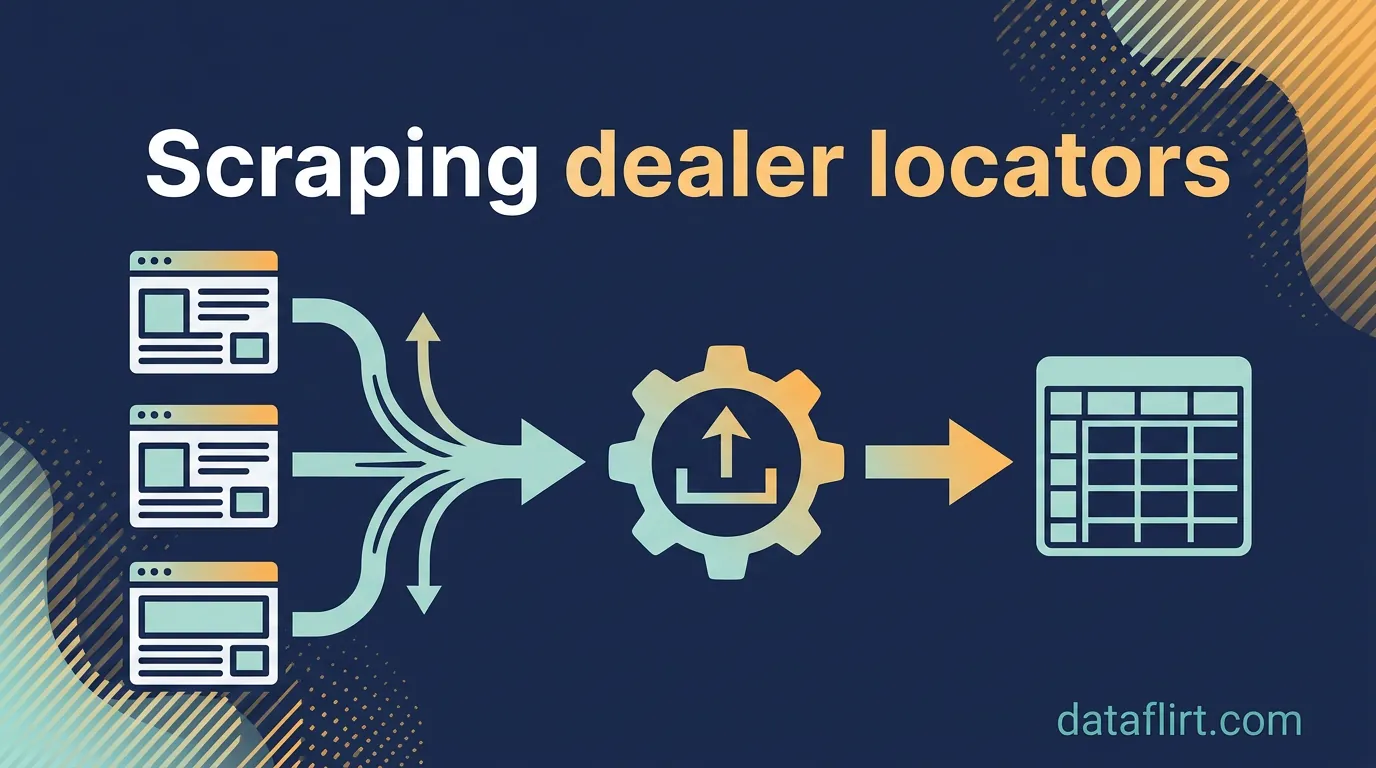
You must capture the underlying API payloads powering the map interfaces to acquire this data efficiently. Standard HTML parsers fail because locator data loads dynamically via JavaScript after the initial page request.
Most directories rely on third-party map providers. They do not hardcode addresses into the page source. When a user enters a zip code, the site fires an asynchronous request to a backend server. That server returns a dense block of structured data. This data populates the visual map points.
DataFlirt bypasses the visual map entirely. We target the hidden data pipelines. This approach is faster and significantly more reliable than attempting to read the rendered screen. You can read more about these mechanics in our guide on web scraping retail store locations.
Intercepting map provider APIs
Extracting data from the network layer requires specialized tools. You must monitor the browser’s network traffic and isolate the specific responses containing the location data.
These payloads often return clean formatting. You avoid the messy process of cleaning poorly written HTML tags. However, finding the correct request requires careful inspection. The data might be buried under obscure endpoint names or encoded in unfamiliar formats. DataFlirt data engineers excel at isolating these specific payloads. DataFlirt extracts the raw information before the browser even attempts to draw the map.
Consider the difference between the primary extraction approaches.
| Extraction Method | Speed | Data Richness | Breakage Risk |
|---|---|---|---|
| HTML DOM Parsing | Very slow | Low | Extremely high |
| API Interception | Very fast | High | Moderate |
| Map Tile OCR | Extremely slow | Very low | Low |
| DataFlirt Managed | Immediate | Comprehensive | Zero |
DataFlirt standardizes the output regardless of how the target site structures its backend. We deliver a flat, readable file. This relies heavily on advanced JSON parsing techniques.
Handling Shopify locator ecosystems
Smaller brands frequently rely on standardized plugin ecosystems to build their directories. These plugins leave recognizable footprints that simplify the extraction process if you know what to look for.
The Shopify platform hosts dozens of these off-the-shelf tools. Data from storecensus.com indicates there are 56,241 total active installations across the top 25 tracked store locator apps on Shopify. Each of these apps structures its data differently. Some expose a clean public API endpoint. Others bury the locations inside encrypted configuration files.
Extracting from a mid-market brand like Sephora or Nykaa often involves reverse-engineering these specific plugin behaviors. DataFlirt maintains a library of extraction schemas for the most common ecommerce plugins. DataFlirt adapts immediately when these underlying apps push mandatory updates. DataFlirt shields your lead generation team from plugin-related outages.
Common structural failure modes and schema traps
Store locators employ several hidden mechanisms designed to limit bulk data extraction. Radius limitations and strict pagination present the most common hurdles for amateur scraping scripts.
Most locators force the user to input a specific location. They only return the nearest ten or twenty stores. They will not provide a nationwide list from a single query. You must programmatically simulate hundreds of searches across a grid of zip codes to capture the entire network. This process inevitably creates overlapping results. DataFlirt implements advanced deduplication logic to ensure your final list contains zero duplicate entries.
Furthermore, these repeated queries often trigger automated defenses. If you query every zip code in California within ten minutes, the server will block your IP address. This is standard rate limiting. DataFlirt manages complex proxy rotation to distribute these queries safely. DataFlirt spreads the load globally to mimic natural user behavior. Navigating sites like Best Buy or Macy’s requires this level of infrastructure.
import json
from playwright.sync_api import sync_playwright

# Basic snippet for intercepting API payloads during extraction
def intercept_locator_api():
    with sync_playwright() as p:
        browser = p.chromium.launch()
        page = browser.new_page()

        # Listen for network responses matching the locator endpoint
        page.on("response", lambda response:
            print(response.json()) if "api/stores" in response.url else None
        )

        page.goto("https://example-brand.com/store-locator")
        browser.close()
This basic script intercepts the network traffic. It bypasses the visual rendering entirely. DataFlirt scales this basic concept across millions of concurrent requests. Managing this infrastructure internally creates massive hidden expenses. We break down these hidden expenses thoroughly in our post on understanding scraping cost factors.
Are store locators legally defensible sources for sales prospecting?
Using store locator data for B2B sales carries distinct civil and regulatory risks depending on your jurisdiction. Store locator data exists for navigation, and using it for sales prospecting enters a complex legal gray area.
You must understand the difference between public accessibility and authorized use. Just because a directory is visible on the open internet does not mean you have a blanket right to extract and monetize it. DataFlirt always recommends a careful evaluation of your specific use case. DataFlirt provides the technical infrastructure, but you govern the application of the data.
United States legal precedents and contract law
The legal landscape in the United States heavily favors the accessibility of public data. However, the mechanism of extraction and the presence of user agreements complicate the matter significantly.
The landmark 9th Circuit ruling in hiQ Labs v. LinkedIn established a critical boundary. The court ruled that scraping publicly accessible data does not violate the Computer Fraud and Abuse Act. Scraping information that does not require a login or bypass a technical barrier is not considered a federal hacking crime. This ruling provides a strong foundational defense for extracting public store directories.
This protection has strict limits. A subsequent 2022 ruling in that exact same case confirmed that scraping public data can still constitute a Breach of Contract. If you agree to a website’s Terms of Service, you are bound by those rules. Many brands explicitly prohibit automated extraction in their terms. Bypassing a simple pop-up agreement can trigger civil liability. DataFlirt navigates these public domains with strict adherence to ethical extraction principles. We discuss this extensively in our review of scraping compliance and legal considerations.
European compliance and legitimate interest
European data regulations aggressively protect any information that can identify a specific individual. B2B merchant directories frequently contain personal email addresses and direct phone numbers belonging to franchise owners.
The General Data Protection Regulation applies strictly to this personal data. Regulators in Italy and the Netherlands aggressively levied heavy fines in 2024 and 2025 against companies treating public availability as a legal basis for scraping. You cannot simply claim the data was public. DataFlirt advises strict caution when targeting European directories.
SDRs scraping under GDPR must rely on the concept of Legitimate Interest. This legally requires a rigorous and fully documented three-part Legitimate Interest Assessment. You must prove your sales outreach represents a legitimate business need that does not override the fundamental rights of the targeted franchise owner. DataFlirt strongly suggests consulting qualified legal counsel before initiating any European extraction projects.
The risk of active monitoring and terms of service violations
Brands monitor their locator traffic carefully because these pages represent critical touchpoints in the customer journey. High traffic volume means high visibility for anomalies.
According to partoo.co, an estimated 20% of an ecommerce website’s total traffic is generated by the store locator page. Brands analyze this traffic to determine where to open new physical locations. Automated scraping scripts that query thousands of zip codes skew this vital analytics data. When a brand notices a massive spike in searches for rural Montana, their engineering team will investigate. DataFlirt prevents this analytical distortion. DataFlirt paces extractions slowly to avoid triggering internal alarms.
Brands protecting major directories like Nordstrom or IKEA will actively block aggressive scrapers. DataFlirt implements sophisticated browser fingerprinting evasion to ensure sustained access. DataFlirt mimics real user behavior precisely. We distribute the queries across residential proxy networks to avoid detection.
When to outsource directory extractions to managed pipelines
Delegating the extraction to specialized teams ensures you receive clean data without the massive overhead of maintaining custom infrastructure. Building your own scraping tools for a handful of sites is feasible. Scaling that effort across hundreds of unique brand locators quickly becomes technically impossible for a standard sales team.
A basic script can pull fifty locations from a local boutique. Once you target a national brand with ten thousand distributors sitting behind Cloudflare, the architectural requirements change dramatically. Every brand implements their directory slightly differently. One site might use Google Maps. Another might use MapQuest. A third might build a custom interface. Maintaining scrapers for all these variations requires constant developer attention. When a site updates its design, your script breaks. DataFlirt absorbs this maintenance burden entirely.
DataFlirt monitors the target sites continuously and repairs broken selectors before you ever notice a gap in your data feed. Data quality issues plague amateur scraping efforts. Extracting the data is only the first step. You must normalize the addresses, standardize the phone numbers, and verify the email formats. Raw scraped data is rarely ready for CRM ingestion. DataFlirt applies a rigorous quality assurance layer to every extraction. DataFlirt standardizes data extraction outputs to match your exact pipeline requirements.
Consider a growth manager tracking retail locations across fifty different B2B suppliers. Every month, she needs an updated list of authorized dealers to cross-reference against her own CRM. A managed extraction pipeline delivers this file automatically, saving her team hundreds of hours of manual labor.
Sales professionals should spend their time closing deals. They should not waste their afternoons writing regular expressions to fix broken zip codes. If your prospecting strategy relies on localized dealer networks, DataFlirt provides the fastest path to execution. DataFlirt delivers the actionable intelligence your team needs to dominate regional markets.
If you’d rather not scope this yourself, DataFlirt’s directory scraping service handles the extraction, QA, and delivery. We manage everything from the initial technical evaluation to the final CRM integration. Reach out for a free scoping call. You can also explore our broader company data extraction capabilities for comprehensive B2B intelligence.
FAQ
Can I scrape store locator data using standard HTML parsers?
Standard HTML parsers typically fail on modern store locators. Most directories load their location data dynamically via JavaScript after the initial page load. You must use headless browsers or intercept the underlying map API payloads to extract the data successfully.
Is scraping dealer directories legal for B2B lead generation?
Extracting public directory data is generally defensible in the United States under the CFAA, provided you do not bypass technical barriers. However, it can constitute a breach of contract if you violate the website’s Terms of Service. European extraction requires strict GDPR compliance and a formal Legitimate Interest Assessment. Always consult qualified legal counsel.
How do map API limits affect directory scraping?
Store locators usually restrict the number of results returned per query based on a geographic radius. To extract an entire national directory, you must programmatically search across a broad grid of zip codes. This requires careful deduplication to merge overlapping results accurately.
How does DataFlirt handle dynamic locator data delivery?
DataFlirt intercepts the asynchronous network requests powering the locator map rather than scraping the visual rendering. We manage the necessary zip code permutations, handle the proxy rotation, and deduplicate the final dataset. DataFlirt delivers clean, normalized contact information ready for immediate CRM import.