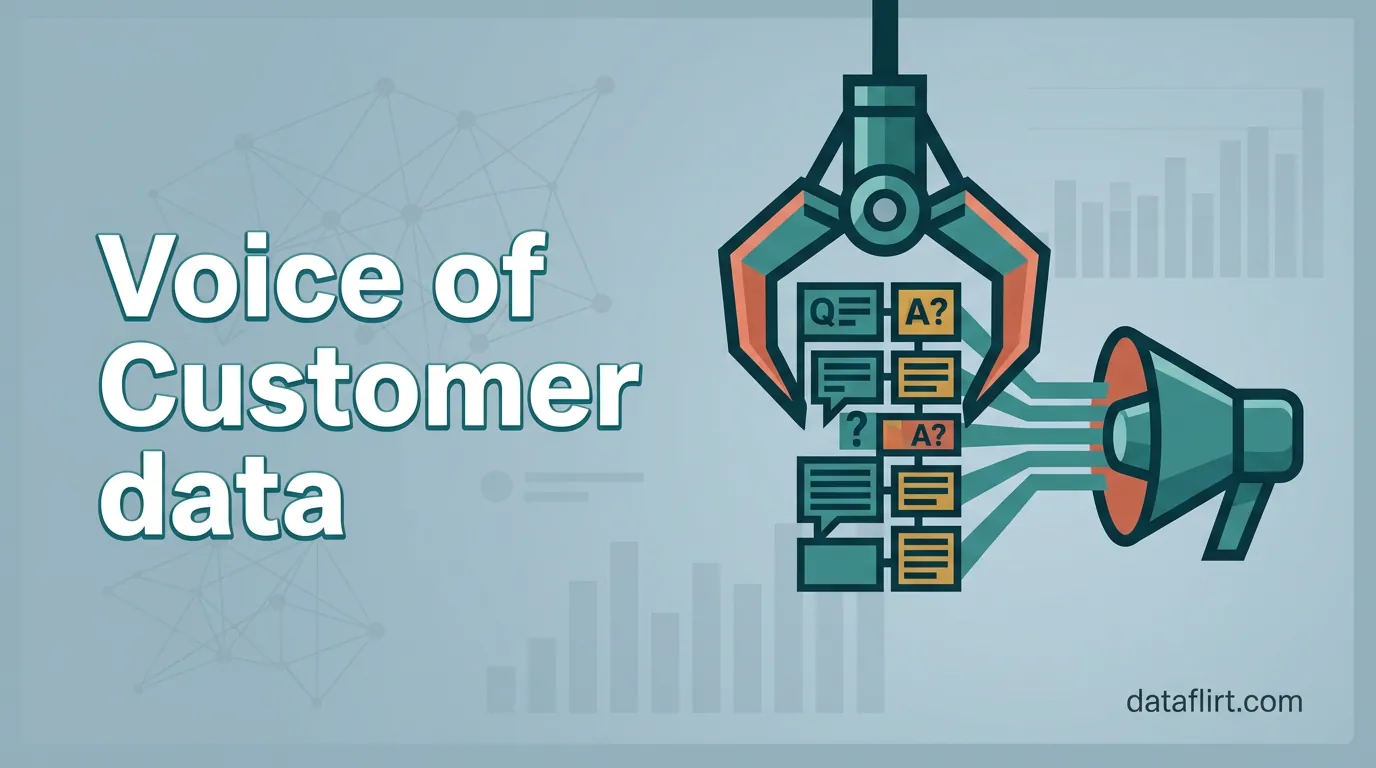

Product teams and data scientists need unfiltered feedback to understand exactly why customers bounce. Relying solely on internal post-purchase surveys is slow and completely misses the competitive context. The raw questions shoppers ask on public product pages reveal exact friction points and feature gaps right at the moment of consideration. Extracting these questions at scale turns qualitative curiosity into a structured product intelligence pipeline.
Key takeaways
- Scraping customer questions reveals specific product gaps your competitors are failing to address.
- Major retail platforms lack public APIs for user-generated content, forcing reliance on DOM parsing and headless browsers.
- You will need natural language processing to normalize misspelled and poorly formatted question text.
- Scraping public product questions is generally considered safe under established legal precedents, provided you avoid behind-login walls.
- DataFlirt manages the complex bypass of anti-bot systems required to extract this content reliably.
What this data or approach actually delivers
Customer Q&A scraping delivers unfiltered product gap analysis directly from the consumer. This data format provides exact phrasing for customer anxieties and feature requests right before the purchase decision.
The global market for Voice of Customer (VoC) analytics is expanding rapidly. Analysts project growth from $21.15 Billion to $62.59 Billion by 2032, driven heavily by digital channels and e-commerce platforms. Kings Research attributes this massive jump to brands realizing that qualitative customer feedback dictates market share. Extracting the questions shoppers ask on competitor product pages feeds directly into these VoC pipelines.
When customers interact with Q&A capabilities, their purchase intent skyrockets. Shoppers engaging with Q&A modules show a 7.5% conversion rate, significantly outperforming standard industry benchmarks. Answerbase data confirms this direct correlation between asking questions and checking out. If you scrape this text, you understand exactly what information pushes a hesitant buyer to convert.
Publishing targeted answers creates a persistent SEO and conversion asset. Approximately 21% of published customer Q&A pairs are directly attributable to a future conversion after resurfacing in site search. Answerbase found that answering a specific question once continues to generate revenue for months. Data scientists scrape competitor Q&A sections to identify these exact high-value questions and pre-emptively answer them on their own platforms.
Integrating user-generated content into product pages is a proven revenue driver. Displaying user-generated content yields a 161% conversion lift on e-commerce product pages compared to pages without it. Influencer Marketing Hub notes that visual reviews and answered questions provide the social proof necessary for high-ticket items. Your content strategy requires this data to compete effectively.
DataFlirt standardizes this unstructured text into a clean schema. When DataFlirt engineers design a pipeline for Voice of Customer analytics, they map volatile DOM elements to a predictable relational database structure. This schema design allows your analytics team to query the data immediately upon delivery.
| Field Name | Data Type | Purpose in VoC Analysis |
|---|---|---|
Question_ID | String | Unique identifier to prevent duplication during delta updates. |
Product_ID | String | Maps the question to the parent SKU or ASIN for catalog matching. |
Question_Text | Text | The raw customer inquiry used for natural language processing. |
Answer_Type | Categorical | Classifies the response format as Yes/No or Open-ended text. |
A structured approach is mandatory for downstream machine learning. The DataFlirt team ensures fields like Answerer_Type accurately differentiate between a random customer response and an official brand statement. This distinction is critical for evaluating how well a competitor supports their active user base.
How to get it and what to watch for
Extracting this data requires parsing the DOM while managing heavy JavaScript rendering and persistent anti-bot systems. You cannot rely on public APIs for user-generated content on major retail sites. Data teams must deploy sophisticated crawling infrastructure to navigate pagination and dynamically loaded question modules.
Major marketplaces actively protect their customer interaction data. Platforms like Amazon and eBay do not offer bulk endpoints for Q&A extraction. Scraping these platforms requires simulating genuine user behavior to trigger the network requests that load the answers. You must intercept the specific AJAX calls populating the question feed.
If you are targeting big-box hardware retailers, the technical hurdles increase. Extracting Q&A data from Home Depot or Lowe’s means dealing with aggressive rate limiting based on your IP address reputation. Every product page load triggers multiple background scripts checking for automated behavior. Bypassing these checks requires routing requests through highly trusted proxy networks.
Similarly, consumer electronics platforms deploy strict validation layers. Scraping Best Buy requires solving or bypassing challenges that test your browser fingerprinting signals. When DataFlirt handles these targets, we deploy automated rotation strategies for user agents and TLS fingerprints. This ensures the target server interprets the request as a standard consumer device.
Here is a simplified Python example demonstrating how to approach a DOM structure using Playwright to extract questions. This code handles a basic dynamically rendered accordion module.
# Environment setup:
# python -m venv venv
# source venv/bin/activate
# pip install playwright==1.40.0
# playwright install chromium

import asyncio
from playwright.async_api import async_playwright

async def extract_questions(url):
    async with async_playwright() as p:
        browser = await p.chromium.launch(headless=True)
        page = await browser.new_page()
        await page.goto(url)

        # Wait for the Q&A module to render in the DOM
        await page.wait_for_selector('.qa-container')

        questions = await page.locator('.qa-question-text').all_text_contents()
        for q in questions:
            print(f"Extracted: {q}")

        await browser.close()

# This requires specific environment configuration to avoid immediate blocking.
# asyncio.run(extract_questions('https://example.com/product/123'))
Writing the initial script is easy. Keeping it running when the target site updates its front-end framework is the real challenge. A simple change to an XPath or a CSS selector will break your entire pipeline. DataFlirt monitors these selector mutations and automatically applies self-healing logic to maintain data flow.
Fashion and beauty sites present their own unique extraction problems. Crawling Sephora or Nykaa means handling infinite scroll implementations rather than traditional pagination. The scraper must execute precise scroll events, wait for the network to idle, and capture the new DOM nodes before memory consumption crashes the process.
If you are building an in-house solution, you must implement a durable queueing system. Scraping a large apparel catalog on Myntra requires distributing tasks across hundreds of worker nodes. Without proper concurrency management, you will trigger severe IP bans and receive corrupted HTML payloads.
Furniture and home goods retailers often hide answers behind secondary clicks. Extracting full threads from Wayfair or IKEA requires the crawler to interact with expansion buttons on every single question. DataFlirt writes custom interaction scripts for these edge cases to ensure no text is left behind in the hidden DOM.
You must also handle the inevitable security challenges. When you hit a CAPTCHA wall, your pipeline must pause the worker and route the challenge to a solving service without dropping the active session. This is where managing a headless browser becomes computationally expensive and difficult to scale.
Department stores like Macy’s and Target use complex regional pricing and localized inventory rendering. Your scraper must inject the correct zip code cookies before attempting to read the Q&A section. The questions displayed often vary based on the specific product variant or regional availability selected in the browser session.
To maintain high success rates, engineering teams rely on massive proxy pools. Integrating a rotating proxy network ensures that repeated requests to the same domain appear to originate from different users. DataFlirt manages these proxy pools internally so your data scientists never have to debug network blocks.
Table data is often required to contextualize the Q&A text. You need to pull the specific product specifications alongside the questions to understand what details the listing failed to communicate. This requires a dual-extraction strategy that DataFlirt handles natively within our standard ecommerce pipelines.
The cost of maintaining these scrapers scales linearly with your target list. A team building an ecommerce data extraction pipeline must factor in developer salaries for constant maintenance. Outsourcing this headache to DataFlirt transforms a volatile engineering expense into a predictable operational cost.
If you plan to ingest this text into Large Language Models, formatting is critical. The data must be cleaned of HTML artifacts and normalized before it enters your AI training data workflows. DataFlirt provides post-extraction normalization to ensure your NLP models digest pure text.
Consider the alternative of scraping thousands of pages manually. The process is prone to human error and simply cannot keep pace with the velocity of e-commerce interactions. Using automated pipelines provided by DataFlirt guarantees data freshness and strict adherence to your custom schema.
Is there enough data to draw statistically meaningful conclusions?
Q&A sections are incredibly sparse on most products, requiring broad aggregation and NLP normalization to extract statistically meaningful conclusions. A single product listing rarely contains enough questions to justify a dedicated analysis. Data scientists must aggregate data across entire categories to build a reliable Voice of Customer model.
User-generated content strictly follows a power-law distribution. Just 8,620 top sellers on Amazon account for 50% of all received customer reviews and interactions. Marketplace Pulse highlights this extreme concentration of data at the top of the market. The long tail of any e-commerce catalog will look like a ghost town by comparison.
To counteract this sparsity, DataFlirt clusters parent-child product variations. By grouping questions asked on all color and size variants of a specific shoe, we pool enough text to analyze intent. This aggregation strategy requires mapping the unique identifiers across the target site’s internal catalog structure.
You must also scrape broadly across multiple competitors. If a single product yields only five questions, tracking the top fifty products in that category provides a sample size of two hundred and fifty interactions. DataFlirt specializes in this horizontal scaling to ensure your analytics team has sufficient volume.
Raw Q&A text requires heavy preprocessing before analysis. Customers use slang, misspelled words, and highly abbreviated sentence structures. NLP teams frequently augment this sparse text with character n-grams or multi-channel neural networks to derive clear sentiment vectors. You cannot feed raw, uncleaned text into a business intelligence dashboard.
Legal standing is a common concern when extracting user content. Scraping public product questions is generally considered safe under the hiQ v. LinkedIn precedent, provided the data is completely public and not behind a login wall. E-commerce product pages are designed for public consumption and indexing by search engines.
Data privacy regulations rarely conflict with Q&A extraction. These sections almost never contain Personally Identifiable Information. Shoppers ask about battery life or fabric dimensions, keeping the data strictly focused on the product. DataFlirt compliance teams configure scrapers to ignore reviewer profile links to maintain strict adherence to data protection standards.
Always consult qualified legal counsel for your specific situation. While extracting product sentiment is standard industry practice, your internal compliance requirements may dictate specific data retention policies. DataFlirt provides transparent logging and documentation to satisfy these internal legal reviews.
Normalizing the extracted text for downstream analytics
Raw user-generated content is messy and requires immediate transformation. Once the scraper pulls the HTML payload, the text must be stripped of line breaks, emojis, and platform-specific markup.
Your pipeline must differentiate between genuine questions and miscategorized reviews. Shoppers often post complaints in the Q&A box instead of asking a clear question. A reliable text classifier flags these anomalies so they can be routed to your reviews and ratings extraction pipeline instead. DataFlirt implements these classification layers during the post-processing phase.
Categorizing the answers is just as important as reading the questions. Answering a simple format inquiry is a binary classification problem. Evaluating a multi-paragraph response about the durability of a laptop hinge requires aspect-based sentiment analysis. Your data engineering team needs clean labels to route this text to the correct model.
Deduplication saves significant compute cost. E-commerce platforms frequently display the same Q&A thread across multiple related product pages. If your crawler hits every variant, it will extract duplicate text. DataFlirt uses cryptographic hashing on the question text and timestamp to guarantee absolute uniqueness in the final dataset delivery.
Monitoring the velocity of questions is a powerful predictive signal. A sudden spike in questions about shipping delays indicates a logistical failure in the competitor’s supply chain. Tracking this velocity requires scheduling daily or weekly scrapes. DataFlirt configures scheduled extraction jobs to provide this critical time-series data.
Cross-referencing questions with product documentation reveals immediate copywriting opportunities. If fifty customers ask about the voltage of an appliance, the manufacturer failed to include that spec in the bullet points. Extracting this data allows your content team to update your own listings before you lose a sale to confusion. DataFlirt provides the exact frequency counts of these recurring questions.
This intelligence extends beyond marketing into product development. Hardware manufacturers scrape these sections to identify parts that break frequently. If a competitor’s blender generates dozens of questions about replacement blades, your engineering team knows exactly which component to reinforce on your next model.
Designing a resilient web scraping architecture
Scraping a high volume of pages requires a distributed cloud architecture. You cannot run a script on a local machine and expect to pull millions of records. The infrastructure must handle network timeouts, proxy failures, and sudden DOM layout changes without dropping data.
Task queues are the backbone of a successful extraction pipeline. When an orchestrator initiates a job, it pushes thousands of URLs into a distributed queue. Worker nodes pull these URLs, execute the headless browser commands, and return the payload. If a worker crashes due to a memory leak, the queue simply reassigns the URL to the next available node. DataFlirt uses enterprise-grade message brokers to guarantee zero data loss.
Monitoring and alerting systems prevent silent failures. If a target site pushes a redesign at midnight, your selectors will return empty arrays. Without proper observability, you might ingest blank data for weeks. DataFlirt configures automated alert thresholds; if the question count drops by twenty percent on a daily run, an engineer is immediately notified to inspect the target.
Database selection impacts your ability to query the extracted text. Document stores like MongoDB are excellent for capturing unstructured HTML chunks, but relational databases like PostgreSQL are better for joining questions to product metadata. DataFlirt delivers data in your preferred format, whether that is a flat CSV in an S3 bucket or a direct insert into your data warehouse.
Managing hardware costs is a hidden burden of in-house scraping. Running thousands of Chromium instances consumes massive amounts of RAM and CPU. Optimizing the browser arguments to block image loading and unnecessary scripts reduces this overhead. DataFlirt engineers fine-tune these execution parameters to minimize compute costs and maximize extraction speed.
You must also defend against browser fingerprinting techniques. Modern bot defense scripts evaluate your canvas rendering, audio context, and available fonts to determine if you are a real user. Spoofing these parameters requires constant research and updates to your stealth libraries. DataFlirt maintains a dedicated research team solely focused on bypassing these evolving detection vectors.
Consider the implications of a blocked IP address. If your scraper hits a retail site too aggressively, the server will block your entire subnet. This halts your pipeline and can interfere with your company’s legitimate network traffic if not isolated properly. DataFlirt executes all extractions on completely isolated infrastructure to protect your corporate network.
Learning understanding scraping cost factors is vital for any data leader. You must calculate the cost of proxies, server compute, developer maintenance, and QA engineering. Often, teams vastly underestimate the maintenance burden of keeping selectors updated.
If you want a broader view of market intelligence, extracting questions must be paired with catalog data. Reading web scraping ecommerce product data reveals how pricing strategies correlate with customer confusion. A deeply discounted product might generate a suspicious number of questions regarding its authenticity.
Similarly, reviews provide the post-purchase context to the pre-purchase questions. Reviewing the strategies in scrape amazon product reviews shows how to match a customer’s initial inquiry with their eventual satisfaction rating. DataFlirt can merge these datasets into a unified Voice of Customer dashboard.
Why in-house data teams struggle with maintenance
An internal engineering team usually approaches a scraping project with optimism, only to be overwhelmed by the maintenance burden. The initial build takes a week, but keeping the pipeline alive requires daily intervention. Target sites employ dedicated security teams whose sole job is to break automated data collection scripts.
When an internal scraper breaks, data trust erodes immediately. If the Voice of Customer dashboard shows zero new questions for a week, the product team stops using the tool. Restoring that trust requires the data engineering team to drop their core ML projects and manually debug proxy headers. DataFlirt guarantees data delivery so your data scientists never have to apologize for an empty dashboard.
The true cost of extraction is hidden in compute and proxy bandwidth. Teams often prototype with cheap datacenter proxies, which work fine for a hundred requests. Scaling to a hundred thousand requests requires expensive residential proxy networks to avoid detection. DataFlirt uses enterprise volume discounts on residential IP networks, providing you with top-tier stealth capabilities without the exorbitant per-gigabyte pricing.
Speed to insight is critical when evaluating a competitor’s product launch. If a rival brand releases a flagship item, your PMs want to see the customer Q&A data on day one. An internal team might need weeks to build a custom crawler for that specific storefront. DataFlirt already maintains active infrastructure across all major retail targets, allowing us to spin up new data feeds in hours.
Building a proprietary QA layer is extremely complex. How does a script know if a extracted question is actually a question? Without a dedicated validation schema, null values and corrupted HTML tags bleed into your production database. DataFlirt runs every extracted row through a rigorous rules engine. If a field violates the expected format, the payload is quarantined and automatically reviewed by our QA systems.
Scale introduces profound architectural challenges. Moving from daily to hourly scrapes to catch flash-sale dynamics requires a massive redesign of your database connections and worker pools. DataFlirt operates on elastic infrastructure designed to absorb sudden scaling requirements without degrading performance or triggering target site alarms.
Consider a data scientist tracking 50,000 SKUs across a major electronics retailer. Every morning, she needs the delta of new questions asked overnight to update the company’s sentiment model. A fully managed pipeline delivers this specific subset reliably, sparing her the immense cost of re-crawling the entire catalog.
Scoping your Voice of Customer extraction pipeline
Scoping an extraction pipeline requires choosing between building internal infrastructure or outsourcing the maintenance of target site selectors. Building internally gives you total control over the codebase but forces your data scientists to spend their hours debugging blocked requests instead of analyzing sentiment.
Internal teams invariably struggle with scale. A script that works flawlessly for fifty products will collapse when asked to parse fifty thousand. The network latency and memory management required for high-volume extraction require dedicated data engineering expertise.
DataFlirt eliminates this operational friction. We manage the proxy rotation, bypass the captchas, and maintain the selectors across every major e-commerce platform. Your team receives clean, normalized text ready for immediate ingestion into your analytics platform.
Quality assurance is the differentiator between a raw script and a managed service. DataFlirt pipelines include automated validation checks that verify data types, enforce string length minimums, and flag missing fields. If a target site redesigns their Q&A accordion, our system catches the anomaly before it corrupts your database.
FAQ
What is the primary challenge in scraping customer Q&A data?
The main challenge is the sparsity of the data. Because user interactions follow a power-law distribution, most products have zero questions. You must aggregate data across thousands of product variants and employ NLP to extract meaningful trends from this scattered text.
Can I use a public API to get ecommerce questions and answers?
No. Major retail platforms do not provide public APIs for their user-generated content. You must rely on web scraping, DOM parsing, and headless browsers to extract this information directly from the product pages.
Is it legal to scrape customer questions from product pages?
Scraping public product pages is generally considered safe under established precedents like hiQ v. LinkedIn, provided the data is not behind a login wall and does not contain personal information. You should always consult qualified legal counsel to ensure compliance with your specific internal policies.
If you would rather not scope this yourself, DataFlirt’s ecommerce scraping service handles the extraction, QA, and delivery, so reach out for a free scoping call.