
Key takeaways
- Validating product compliance requires cross-referencing e-commerce marketplace claims against official government registries.
- Certification badges embedded as images require deep learning OCR pipelines to extract registration numbers.
- Integrating compliance data back into platforms requires strict schema mapping for fields like Safety Attestation.
- Legal orientation focuses on public registry data being accessible; automated retrieval requires strict adherence to rate limits.
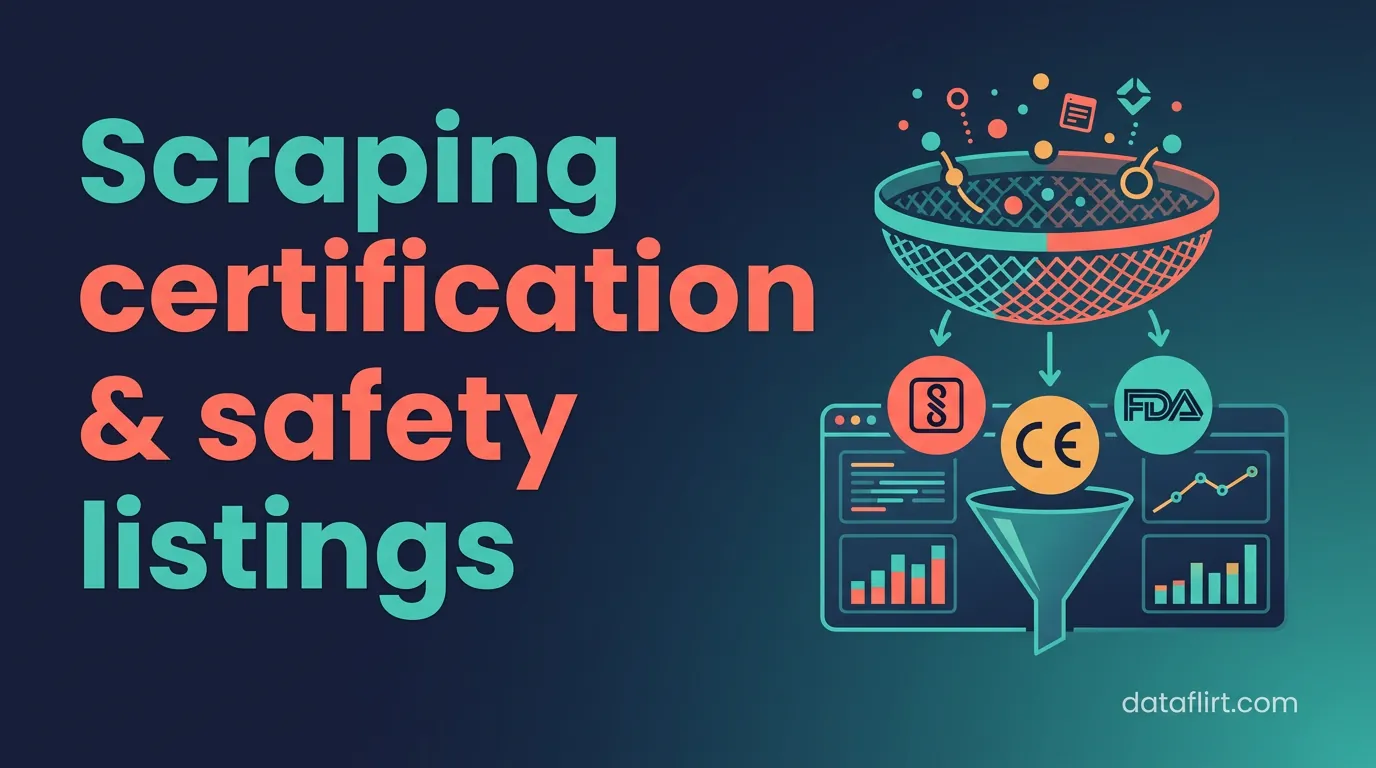
Compliance officers face an impossible math problem. Sifting through product pages to verify CE, FDA, or BIS certifications manually cannot scale against current supply chain volumes. Rogue operators constantly upload invalid or expired safety badges. Finding these violations requires programmatic extraction of compliance markers across thousands of product listings. You need structured data to separate legitimate vendors from bad actors.
What this compliance data actually delivers
Scraping certification listings converts static vendor claims into verifiable intelligence. This allows compliance teams to block counterfeit inventory before it triggers liability actions.
The surge in unverified cross-border shipments
Market surveillance authorities are overwhelmed by the sheer volume of untested consumer goods. According to the European Commission, 4.6 billion low-value e-commerce shipments entered the European Union in 2024. That figure represents almost double the volume recorded just one year prior. Human auditors cannot inspect a fraction of this inventory. Without automated data extraction, compliance teams rely on random sampling. Random sampling inevitably misses hazardous electronics or non-compliant toys.
Scraping marketplace listings allows brands to monitor thousands of SKUs daily. You can flag products missing mandatory safety markings immediately. A DataFlirt extraction pipeline systematically checks every new listing against your compliance criteria. DataFlirt identifies the exact moment a seller uploads a product lacking the required CE marking.
The financial risk of falsified certifications
Counterfeiters do not just copy product designs. They forge the compliance documentation required to clear customs and list on major platforms. The TIC Council estimates the annual international value of counterfeited products reaches $509 Billion. Falsified product safety testing and certification documents heavily drive this illicit market.
Consider a compliance manager monitoring third-party sellers on Amazon or eBay. Sellers frequently upload generic CE mark images or invalid FDA clearance numbers. If the platform or the brand fails to catch these, the resulting product recalls cause severe financial damage. Programmatic data collection serves as an early warning system. It matches seller claims against active regulatory databases. DataFlirt automates this cross-referencing to eliminate manual lookup errors.
Shifting the burden of proof to sellers
Platforms are no longer giving sellers the benefit of the doubt. Regulatory pressure forces marketplaces to demand active proof of compliance. Teams monitoring Target or Walmart third-party marketplaces must verify that supplier attestations match government records perfectly.
This requires pulling data from both sides of the transaction. You extract the seller’s provided documentation from the marketplace. Then you query the corresponding regulatory body. Any mismatch in registration numbers triggers a delisting workflow. Web scraping automates this matching process. DataFlirt routinely configures these dual-source pipelines to ensure your internal databases reflect the exact reality of the market.
Tracking non-compliant inventory globally
Identifying a fake certification is only the first step. You must track where else that specific seller or product appears across the e-commerce ecosystem. Sellers banned from one platform frequently migrate to another. A merchant caught using a fake CE mark on Etsy might immediately spin up a new storefront on a different site. Tracking these actors requires wide-scale monitoring.
The volume of packages bypassing standard checks exacerbates this issue. The World Customs Organization reports that 1.36 billion parcels entered the United States under the Section 321 de minimis threshold in fiscal year 2024. These shipments bypass standard duty requirements and stringent compliance inspections. DataFlirt helps brands track these fragmented seller identities. DataFlirt isolates the seller’s unique identifiers and runs those data points against catalogs on other marketplaces.
How to extract safety listings and certification databases
Extracting compliance data requires querying official APIs for clearance records and parsing marketplace HTML for seller claims. You then map these two datasets together using a standardized schema.
Querying the openFDA API for medical devices
Medical device compliance relies on rigid clearance documentation. The FDA provides direct programmatic access to device clearances via the openFDA API. As reported by Medical Design Briefs, developers can query 141,000 device clearance decisions publicly. This includes both 510(k) and de novo classifications.
The API operates on an Elasticsearch backend. You retrieve data by hitting specific JSON endpoints. A standard query to the 510(k) endpoint returns a metadata object and a results array. DataFlirt configures scripts to ingest this data continuously.
import requests

def fetch_fda_clearance(k_number):
    url = f"https://api.fda.gov/device/510k.json?search=k_number:{k_number}"
    response = requests.get(url)

    if response.status_code == 200:
        data = response.json()
        return data['results'][0]['device_name']
    return None
This requires accurate JSON parsing. The returned payload contains detailed applicant information and decision dates. You can cross-reference these dates against seller claims on sites like Alibaba. If a seller lists an expired clearance, the DataFlirt system flags it immediately.
Scraping European CE marks and BIS registries
Unlike the centralized FDA API, CE compliance and Indian BIS certifications often require navigating fragmented regional databases. The Bureau of Indian Standards provides a registry for electronics and consumer goods. Extracting from these portals often involves navigating complex search forms.
You must input the specific R-number or registration ID provided by the manufacturer. Web automation tools handle this by injecting the ID into the search field and extracting the resulting table. Monitoring platforms like Flipkart requires running these checks continuously. DataFlirt builds specific navigation flows to bypass the captchas often found on these regional government portals. DataFlirt ensures your query reaches the database without triggering automated blocks.
Mapping compliance data to Amazon API fields
When uploading valid compliance data for your own catalog, strict schema alignment is mandatory. Amazon forces sellers to accurately map specific regulatory attributes through their API. Sending unstructured data results in fatal export errors.
Key fields include the Safety Attestation flag. This indicates whether a product requires specific warning labels. You must also specify the compliance media language and the exact content type. Content types range from a standard Test Report to a formal Declaration of Conformity. DataFlirt formats all extracted compliance data to perfectly match these rigid upload requirements.
| Amazon API Field | Required Format | Description |
|---|---|---|
Safety Attestation | Boolean (Yes/No) | Confirms presence of mandatory safety warnings. |
Compliance media language | ISO Language Code | The language of the uploaded compliance document. |
Compliance media content type | Pre-defined Enum | Must match accepted types like “Test Report”. |
hazmat/aspect | UN Regulatory ID | Required identifier for hazardous materials. |
Hazardous materials demand exceptional precision. You must map both the aspect and the value correctly. Failing to provide the UN Regulatory ID blocks the product from fulfillment centers entirely. DataFlirt validates these fields before you ever attempt an upload.
Storing safety markers in Shopify Metafields
Brands managing their own storefronts need a place to store this extracted compliance data. Default Shopify product schemas lack dedicated fields for complex regulatory information. The standard methodology involves using Product Metafields.
Metafields allow developers to attach custom JSON objects to products. You can store sustainability certifications, manufacturing origin codes, and safety attestations neatly. This preserves clean data structures. DataFlirt delivers scraped certification data formatted specifically as Metaobjects. This allows your front-end themes to conditionally render compliance badges only when the DataFlirt validation check passes.
How to extract text from certification logos and badge images
Certifications on product pages are often just logos or badge images; they are rarely queryable text. You can successfully extract these registration numbers using modern optical character recognition paired with deep learning object detection.
The limitation of standard HTML parsers
Many counterfeiters attempt to bypass automated compliance checks by uploading their fake certifications as flat images. A seller on AliExpress might display a CE mark or an FDA logo in their product carousel. Standard HTML parsing cannot read the text inside these images.
If your pipeline only looks for text-based registration numbers in the product description, it will miss these image-based claims. The API response pagination will return a blank compliance field. The compliance team remains blind to the unverified badge presented directly to the consumer. DataFlirt solves this by pulling the image URLs and routing them through a secondary vision pipeline.
Digitizing static compliance badges via OCR
This is where computer vision bridges the gap. You route product images through an OCR (Optical Character Recognition) pipeline. Deep learning models identify the bounding box of a certification logo and transcribe the alphanumeric characters inside it.
This technology has reached remarkable accuracy. According to ResearchGate, modern deep learning-based OCR models achieve a Character Error Rate of just 0.028 when extracting names from identification badges. These models regularly hit flawless scores for registration number extraction. They convert a static JPEG into a precise, queryable string. DataFlirt engineers tune these OCR models specifically for the fonts and layouts used in international compliance documentation.
Validating extracted registration numbers
Once the OCR pipeline extracts the string, the validation process begins. You take the transcribed R-number from the image and ping the relevant government registry.
Consider a supplier on Shein or Temu displaying a BIS certification badge on a toy. The OCR reads the registration number from the image. Your system checks the official Bureau of Indian Standards database. If the database returns no matching record, the image is a forgery. DataFlirt automates this entire sequence. DataFlirt connects the vision output directly to the API validation step.
Handling obfuscated images
Malicious actors sometimes intentionally blur or watermark their fake certificates to confuse automated systems. They hope a human auditor will glance at the blurry logo and assume it is legitimate. Advanced OCR engines apply pre-processing filters to enhance contrast and remove noise before attempting extraction.
If the image quality is too degraded for the model to achieve a high confidence score, the system flags the listing for manual review. This ensures that blurry, potentially deceptive compliance documents do not pass automatically. DataFlirt uses confidence thresholding to categorize these edge cases. DataFlirt guarantees that only highly confident extractions proceed to the database verification stage.
Legal considerations for scraping public regulatory records
Accessing public government databases and marketplace listings involves navigating terms of service and jurisdictional data laws. Always isolate compliance data collection from personal data extraction.
Public data versus personal data
The registration numbers, device classifications, and safety testing results found on compliance documents qualify as business or regulatory data. Scraping a public FDA clearance database does not inherently trigger privacy frameworks like GDPR or CCPA.
However, you must exercise care if the certification documents contain individual employee names or personal contact details. Filter this information out during the parsing stage. Keep your database strictly focused on the product compliance metrics. DataFlirt builds redaction steps into the parsing layer. DataFlirt ensures your final dataset remains completely clear of protected personal identifiers.
API limits and marketplace terms of service
Government portals provide open APIs specifically to encourage compliance checks. The openFDA API welcomes programmatic queries. Conversely, e-commerce marketplaces actively defend their infrastructure against automated traffic.
Extracting seller listings to locate certification badges means interacting with heavy anti-bot protections. Scraping marketplace data without violating acceptable use policies requires careful rate limiting and ethical crawling practices. You should consult qualified legal counsel to ensure your specific extraction workflow complies with relevant regional statutes and platform terms. DataFlirt configures extraction speeds to respect target server loads. DataFlirt balances data freshness with responsible collection methods.
Why scaling compliance validation requires specialized infrastructure
Running a few API checks manually is simple. Continuously monitoring thousands of product listings across distinct platforms, extracting images, and running OCR pipelines demands enterprise-grade engineering.
The hidden costs of building in-house
An internal engineering team can build a script to ping the FDA API. The real challenge emerges when you ask them to scrape a million product pages across a dozen marketplaces to find the badges in the first place. They must manage rotating proxies, bypass complex Javascript rendering, and maintain parsing logic when the target site redesigns its layout.
Add the complexity of deep learning OCR for image extraction, and the infrastructure costs spiral. You are no longer just making HTTP requests. You are orchestrating GPU instances for image processing and managing massive storage repositories for product photos. Attempting to build this internally usually distracts core engineering teams from revenue-generating product work. DataFlirt exists to absorb this exact operational friction.
What DataFlirt manages in the compliance pipeline
A compliance director tracking tens of thousands of electronic components cannot afford gaps in the data. Missing a falsified CE mark exposes the company to severe legal liability. A freelancer on a gig platform might handle a flat CSV export, but they lack the infrastructure to maintain OCR pipelines at scale. That is the exact scenario where DataFlirt’s anti-bot engineering and QA pipelines justify their value.
DataFlirt handles the heavy lifting of the extraction process. DataFlirt bypasses the bot protection, renders the JavaScript, locates the certification images, and delivers the structured data directly to your team. You receive clean, verified tables comparing the seller’s claimed registration number against the official government database. High data quality in your historical archives provides undeniable proof during dispute resolutions.
By outsourcing the extraction layer, your compliance officers spend their time enforcing safety standards, rather than fighting code blockages. DataFlirt ensures your regulatory intelligence is accurate, comprehensive, and delivered on schedule. DataFlirt acts as the silent engine behind your compliance dashboard. DataFlirt gives your legal team the confidence to issue targeted, evidence-backed takedowns.
FAQ
Can OCR reliably extract text from low-resolution certification badges?
Yes. Modern deep learning models can process relatively low-quality images by applying contrast enhancement and noise reduction. If a badge is intentionally obfuscated beyond legibility, the system flags it for manual review.
How frequently should compliance teams scrape product listings?
Most enterprise teams run daily or weekly extractions on high-risk categories like electronics or toys. This frequency ensures you catch fraudulent listings quickly before significant transaction volumes occur.
Does the FDA restrict programmatic access to its clearance data?
No. The FDA provides the openFDA API precisely to allow developers and compliance teams to query device clearances and registration records programmatically.
Can you extract compliance data from sites protected by Cloudflare?
Yes. Specialized scraping infrastructure utilizes anti-detect browsers and proxy rotation to successfully navigate enterprise bot protection while gathering necessary product data.
If you would rather not scope this yourself, DataFlirt’s intellectual property scraping service handles the extraction, OCR processing, and delivery of complex compliance data. We turn fragmented marketplace images into verified regulatory intelligence. Reach out for a free scoping call.