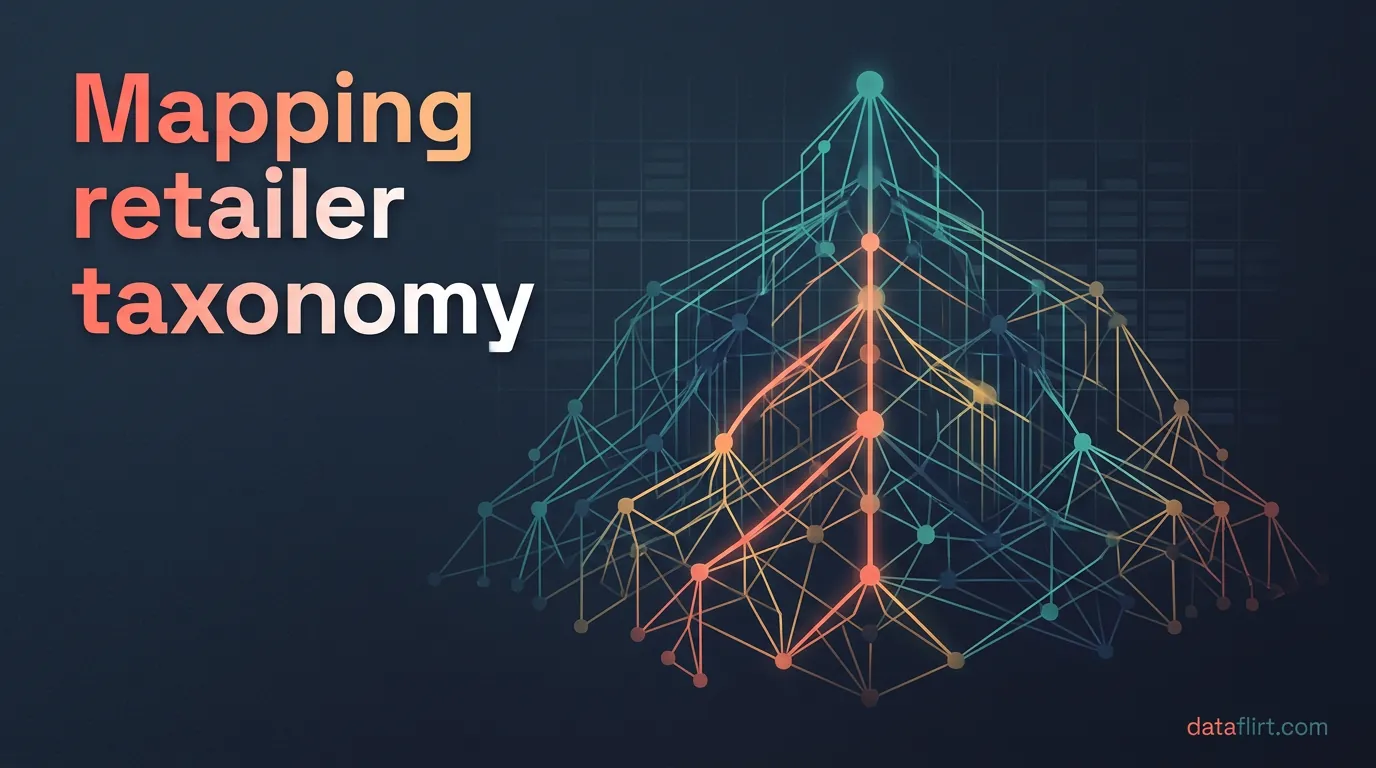

You have extracted two million product records from a major competitor. The dataset includes titles, prices, images, and descriptions. None of it is categorized. It is a flat, unsearchable dump. A catalog extraction without a taxonomy map is impossible to analyze. You need the category tree.
Key takeaways
- A flat catalog extraction requires a taxonomy map to become actionable market intelligence.
- Major platforms recently overhauled how their APIs expose category hierarchies and product grouping.
- Normalizing category paths across multiple competitors is mandatory before running direct price comparisons.
- Category trees change constantly; hardcoded extraction logic will break without active maintenance.
- Best practice requires isolating your taxonomy mapping logic from your raw product extraction pipeline.
Why taxonomy extraction defines catalog analysis
Taxonomy extraction provides the structural blueprint for raw product lists. It maps exactly how a retailer groups, merchandises, and categorizes their inventory. Those groupings define the entire catalog strategy.
The limitations of a flat product dump
A flat CSV file of products lacks business context. You cannot pivot a flat list to find the average price of running shoes. The data has no relational hierarchy. You simply have a list of disconnected items. DataFlirt analysts see this issue frequently. Clients attempt to analyze competitor pricing but fail because they skipped the taxonomy map. The hierarchy is the foundation. Without it, your data pipeline hits an immediate wall.
Revealing competitor merchandising strategies
A category tree operates as a strategic roadmap. The way a competitor structures their navigation reveals their commercial priorities. If a site features five subcategories for mechanical keyboards, they are targeting that niche heavily. Retailers track these shifts aggressively. Industry reports show 81% of US retailers will use automated price scraping for dynamic repricing strategies in 2026. DataFlirt clients use taxonomy extraction to monitor exactly where competitors expand their catalog footprint.
The necessity of a common taxonomy map
Comparing prices across three different websites requires a unified map. Retailers do not use the same category names. One site uses “Consumer Electronics” while another uses “Tech Gadgets.” You need a baseline structure. Consider the standard Google Product Category taxonomy tree. It contains ~6,000 discrete categories spanning up to seven levels deep. DataFlirt engineers often use the Google structure as a universal crosswalk. Every custom extraction must eventually map back to a normalized master tree. Our DataFlirt pipelines automate this mapping step.
Data quality and schema validation
Raw product dumps often contain malformed fields. Without a category tree, you cannot validate the schema effectively. A television requires a screen size attribute, while a t-shirt requires a fabric type. DataFlirt uses the extracted taxonomy to enforce schema validation rules. If a product sits in the televisions category but lacks a resolution attribute, the DataFlirt quality assurance layer flags it. The category tree dictates the expected data shape. This validation guarantees high-fidelity datasets.
How major platforms expose category trees
Retailers expose category hierarchies through sitemaps, breadcrumbs, and navigation menus. The underlying platform architecture dictates which extraction method works best. A custom site behaves very differently from a modern marketplace.
Amazon and the new Product Types API
Amazon completely changed its category extraction landscape recently. They officially phased out their legacy Flat File Feeds in July 2025. Sellers and developers must now use the Product Types API. This JSON feed organizes listings by highly specific product types rather than legacy browse nodes. If you target the Amazon scraper endpoints today, you cannot rely on the old category paths. DataFlirt updated all Amazon extraction protocols to map these new JSON structures natively. DataFlirt users get clean hierarchical data without dealing with legacy node failures.
Category mapping on Shopify and Adobe Commerce
Platform defaults define how categories render in the browser. Shopify manages category trees programmatically via two endpoints. The SmartCollection endpoint handles rule-based product grouping and caps at 5,000 collections per store. The CustomCollection endpoint handles manual product grouping. Shopify deprecated the REST Admin API for listing products. As of April 2025, all new public apps must be built exclusively on the GraphQL Admin API. DataFlirt builds specific GraphQL parsers for Shopify targets. Adobe Commerce utilizes root categories where products assign to multiple categories simultaneously.
Extracting paths from Flipkart and marketplaces
Marketplaces often expose their taxonomy in plain sight. For a Flipkart scraper operation, the XML sitemap usually exposes most category URLs directly. The crawler fetches the sitemap and extracts the nested URL structure. The URL strings themselves indicate the hierarchy. A path containing “electronics/cameras/dslr” gives you three distinct levels. DataFlirt bots parse these sitemaps instantly. We then cross-reference those URLs against the live page breadcrumbs. This dual validation is a core DataFlirt capability.
B2B directory structures like IndiaMART
Business directories feature massive, complex category trees. An IndiaMART scraper job requires parsing deeply nested left-navigation menus on search result pages. These directories organize by industrial sector, material type, and application. The menus are completely HTML-parseable. DataFlirt uses targeted CSS selectors to walk these DOM elements systematically. For large scale B2B marketplace extraction, the DataFlirt system iterates through every left-nav expansion toggle. We map the entire industrial taxonomy before touching a single product page.
Big box retailers and dynamic navigation
Sites like Home Depot and Best Buy load navigation menus dynamically. When building a Home Depot scraper, you will notice the primary menu requires user interaction to render subcategories. The JavaScript fetches JSON payloads when a user hovers over a department. A simple HTTP GET request will not see the category tree. DataFlirt solves this by intercepting the background API requests directly. For our Best Buy scraper deployments, DataFlirt captures the raw JSON category objects. This bypasses the need for full browser rendering.
Auction sites and user-generated categories
Marketplaces with third-party sellers feature chaotic taxonomies. An eBay scraper encounters categories created or modified by user behavior. Standard tiers remain static, but item specifics vary wildly. Navigating this requires strict adherence to primary category IDs. DataFlirt engineers map the persistent numeric IDs rather than the raw text strings. DataFlirt systems recognize that text labels change continually, yet numeric category IDs remain stable across API versions.
Methods for extracting the complete taxonomy
You pull a taxonomy by parsing XML sitemaps, crawling navigation menus, or aggregating product breadcrumbs. Combining all three methods yields the most accurate and resilient category tree. DataFlirt recommends a hybrid approach for enterprise scale.
The sitemap-first approach
The fastest extraction method starts with the sitemap. You utilize DOM parsing on the XML document to extract all URL patterns. The structure of the URL path often implies the category depth. If the path has four distinct segments, you likely have a level four category. DataFlirt scrapers grab the sitemap first to build a primary queue. This provides an immediate structural skeleton. We use this skeleton to direct the web scraping for ecommerce product data.
Navigation menu crawling
Sitemaps occasionally omit deeper category links. The next step involves crawling the actual navigation menu. You extract the hierarchy exactly as a human user sees it. Most e-commerce navigation elements nest lists three or four levels deep. DataFlirt writes recursive XPath expressions to traverse these nested lists. Our DataFlirt parsers map the parent-child relationships perfectly. A Target scraper job relies heavily on this visual hierarchy mapping to capture promotional seasonal categories.
Breadcrumb extraction validation
Breadcrumbs provide the final source of truth. You scrape breadcrumbs from a subset of product pages per category to confirm the hierarchy. Breadcrumbs show exactly where a product sits in the database tree. DataFlirt validates the sitemap paths against these live product breadcrumbs. If the sitemap claims one path but the product page shows another, DataFlirt flags the discrepancy. This quality assurance step prevents broken relationships. A Walmart scraper requires this validation due to frequent taxonomy testing on live pages.
Structuring the output tree
The final output must be machine-readable. DataFlirt delivers taxonomy maps as flat relational tables. The columns typically include level tracking, the category URL, and a product count estimate. Industry architects suggest keeping hierarchies tight. Experts recommend 3 to 5 maximum hierarchy levels for a practical catalog taxonomy. Beyond that depth, the structure collapses under its own maintenance weight. DataFlirt normalizes deeper trees to fit these standard relational constraints.
| Level 1 | Level 2 | Level 3 | Category URL | Product Count |
|---|---|---|---|---|
| Electronics | Computers | DSLR Cameras | /category/dslr | 1,450 |
| Home & Garden | Furniture | Living Room | /category/living | 3,200 |
| Apparel | Men | Athletic Shoes | /category/mens | 8,900 |
| Automotive | Parts | Brake Pads | /category/brakes | 4,100 |
Consider a catalogue manager tracking 40,000 SKUs across six marketplaces. Every Monday, she needs last week’s prices categorized exactly by her internal taxonomy. A flat data dump forces her to map categories manually in spreadsheets. A structured taxonomy extraction delivers import-ready data directly into her analytics dashboard.
Managing infinite scroll and pagination
Category pages rarely load all products at once. They use infinite scroll or strict pagination. To estimate product counts per category, your scraper must parse these pagination tokens. DataFlirt deploys headless browsers to simulate user scroll events when API endpoints are hidden. We calculate the total items by reading the pagination metadata usually hidden in the page footer. DataFlirt ensures your category size estimates are highly accurate.
Overcoming bot detection during crawls
Modern retailers deploy sophisticated bot mitigation to protect their catalogs. When your scraper iterates through a navigation menu too quickly, security systems flag the session. DataFlirt utilizes residential proxy networks and advanced browser fingerprinting techniques to emulate human browsing patterns. The DataFlirt proxy management layer rotates IP addresses seamlessly. This allows our crawlers to map the entire category tree without triggering CAPTCHAs or IP bans. Clean taxonomy extraction requires invisible operation.
Normalizing diverse category paths across competitors
Normalization aligns distinct competitor category structures into a single unified taxonomy map. This allows direct price and assortment comparisons. Without normalization, cross-market intelligence is impossible. DataFlirt makes normalization a priority.
The path discrepancy problem
Retailers name their categories differently. Amazon might use the path Electronics to Cameras to DSLR. Flipkart might use Electronics to Cameras & Accessories to DSLR Cameras. The end product is the same, but the strings do not match. A Macy’s scraper might classify a jacket under Outerwear, while a different site uses Coats. DataFlirt recognizes these discrepancies immediately. Our DataFlirt matching algorithms map these distinct paths to a unified master structure.
Manual crosswalk constraints
Smaller teams attempt to map these relationships manually. A manual crosswalk for the top fifty categories takes hours of analyst time. It is a necessary step before any cross-platform analysis can occur. However, it simply does not scale. When managing datasets across twenty retailers, manual mapping becomes a massive bottleneck. DataFlirt clients offload this manual burden entirely. DataFlirt analysts build initial seed dictionaries to train automated matching systems.
Automating with embedding similarity
Modern pipelines automate the crosswalk using machine learning. DataFlirt utilizes embedding similarity on category names to suggest matches. The system vectorizes the category strings and calculates the distance between them. Athletic Footwear maps to Running Shoes automatically based on semantic meaning. DataFlirt flags low-confidence matches for manual review by a human operator. This hybrid approach guarantees accuracy while processing massive category trees. It is essential when scraping ecommerce websites for price matching.
| Retailer | Original Category Path | Normalized Master Path | Match Confidence |
|---|---|---|---|
| Retailer A | Electronics > TV & Video > OLED | Electronics > Televisions | High |
| Retailer B | Tech > Screens > Smart TVs | Electronics > Televisions | High |
| Retailer C | Home > Entertainment > OLED Screens | Electronics > Televisions | Medium |
| Retailer D | Audio Video > TV | Electronics > Televisions | High |
Handling localized taxonomies
Global retailers modify their category trees based on region. A home goods store in the UK categorizes items differently than its US counterpart. A Wayfair scraper targeting different geographic domains will return different category IDs. DataFlirt builds region-aware crosswalks. The DataFlirt engine tags every extracted category with a locale identifier. We then map regional equivalents to a single global parent node.
Resolving multi-parent category assignments
Some platforms allow a single product to exist in multiple categories simultaneously. A running shoe might sit under Mens Shoes and Clearance Sale. A raw extraction creates duplicate product rows. DataFlirt handles multi-parent assignments by establishing primary and secondary category flags. DataFlirt scripts trace the canonical URL of the product to determine its true primary home. This prevents massive data inflation in your analytics dashboard.
Preventing dataset failure when taxonomy changes
Category trees change frequently. If you scrape a taxonomy today and use it to structure a dataset, it will break when the retailer reorganizes. You must treat the taxonomy as a living document. DataFlirt treats category maintenance as a continuous process.
The frequency of category reorganizations
Major platforms reorganize categories quarterly to reflect seasonal trends. Some fast-fashion retailers shuffle subcategories monthly. Google updates its Merchant Center taxonomy four times a year. When mapping Google data, developers must index the persistent numeric category IDs rather than the text paths. Text paths frequently change during quarterly updates. Relying on text paths breaks downstream data pipelines. DataFlirt monitors these numeric IDs constantly. DataFlirt alerts clients when core structural IDs deprecate.
Building change detection systems
You cannot assume a static taxonomy. The best practice is to date-stamp every extraction and re-extract the entire tree quarterly. DataFlirt builds automated change detection systems for enterprise clients. The DataFlirt platform compares the new taxonomy to the previous version automatically. It flags new categories, highlights removed nodes, and tracks renamed paths. Retailers benefit from this agility. Records indicate 85% of retailers report faster catalog updates after adopting no-code taxonomy tools. The market moves quickly.
Maintenance debt and bot protection
Tracking taxonomy changes requires constant crawling. This generates significant maintenance debt. Retailers aggressively block frequent category scraping. Data points show 10.2% of all global web traffic now comes from scrapers, even after bot-mitigation systems apply filters. Retailers know bots hit their navigation menus first. DataFlirt bypasses these blocks through advanced request routing. Understanding scraping cost factors means calculating the cost of this continuous maintenance. A broken category tree ruins months of historical pricing data. DataFlirt prevents these outages entirely.
Decoupling the extraction pipeline
If you build a rigid pipeline around today’s category tree, it will fail. A retailer will merge two departments tomorrow, and your ETL process will crash. DataFlirt isolates the taxonomy map from the raw product extraction. We build decoupled pipelines. The DataFlirt product scraper extracts the raw node IDs. The DataFlirt taxonomy service maintains the mapping table independently. When the retailer renames a category, we simply update the map. The historical product data remains perfectly intact.
Setting up automated taxonomy alerts
When a primary category vanishes, business teams need to know immediately. DataFlirt sets up webhook alerts for structural anomalies. If a competitor drops their smart home category, DataFlirt pings your internal communications channel. This gives your merchandising team real-time visibility into competitor strategy shifts. The DataFlirt alerting system operates independently of the daily product scraping runs.
Compliance considerations for public catalog extraction
Extracting public category trees involves scraping publicly available web data. You must approach this responsibly to respect target infrastructure. Compliance is a foundational aspect of professional extraction.
Infrastructure load and fair use
Crawling a navigation menu or an XML sitemap generates very little server load compared to scraping millions of product pages. The taxonomy is typically static HTML or cached JSON. However, scraping live breadcrumbs requires hitting thousands of product pages. DataFlirt paces these requests deliberately to avoid overwhelming the retailer’s servers. We respect rate limits and follow polite crawling protocols at all times.
Legal orientation for catalog data
Publicly available product categories, names, and prices are generally factual data points rather than creative works. Most jurisdictions treat factual market data as fair game for extraction. Personal data requires distinct handling, but taxonomy maps contain zero personal identifiable information. You must still review the Terms of Service for specific retail sites. DataFlirt always recommends that you consult qualified legal counsel for your specific operational situation before deploying large-scale catalog scrapers.
Securing taxonomy extraction with DataFlirt
Managing moving category trees requires dedicated engineering. Taxonomy extraction is not a one-time script. It is an ongoing structural commitment. DataFlirt provides the infrastructure and the expertise to maintain these critical data maps.
Full category tree extraction per platform
DataFlirt runs full category tree extractions across all major global retailers. We handle the complex API reverse-engineering required for dynamic platforms. Whether a site uses REST, GraphQL, or hidden JSON payloads, DataFlirt extracts the complete hierarchy. Our DataFlirt pipelines capture the exact parent-child relationships and product counts. You receive a clean, flat table detailing the entire merchandising strategy.
Cross-platform normalization included
DataFlirt does not just hand you a raw path list. DataFlirt provides the cross-platform normalization crosswalk as part of the delivery. We map competitor structures to your internal taxonomy. Your data team receives import-ready files. DataFlirt eliminates the manual spreadsheet mapping that delays business intelligence.
FAQ
How do you scrape a category tree from a site using dynamic JavaScript?
Dynamic sites load categories via background API calls rather than static HTML. You extract the taxonomy by intercepting the network traffic using a headless browser. You capture the raw JSON payloads containing the category tree instead of parsing the visual interface.
What is the difference between a sitemap taxonomy and a breadcrumb taxonomy?
A sitemap taxonomy is derived from the URL paths listed in an XML sitemap file. A breadcrumb taxonomy is extracted directly from the navigational links on live product pages. Breadcrumbs represent the active database hierarchy, making them the most accurate source of truth.
How often should a competitor taxonomy map be updated?
Industry experts recommend re-extracting and auditing competitor category trees at least once a quarter. This captures seasonal merchandising shifts and new product line introductions. High-velocity fashion retailers may require monthly taxonomy updates to maintain data accuracy.
Why do my product category paths keep changing?
Retailers utilize AI-driven personalization to automatically reorder category visibility based on regional demand and user behavior. Additionally, major backend updates frequently alter text-based category paths. You should always index persistent numeric category IDs instead of relying on volatile text strings.
Maintaining an accurate taxonomy map is the hardest part of competitive catalog intelligence. Category structures break, APIs change, and manual normalization consumes countless hours of analyst time. If you would rather not scope this yourself, DataFlirt’s ecommerce scraping service handles the extraction, QA, and delivery. Reach out for a free scoping call to discuss your catalog requirements.