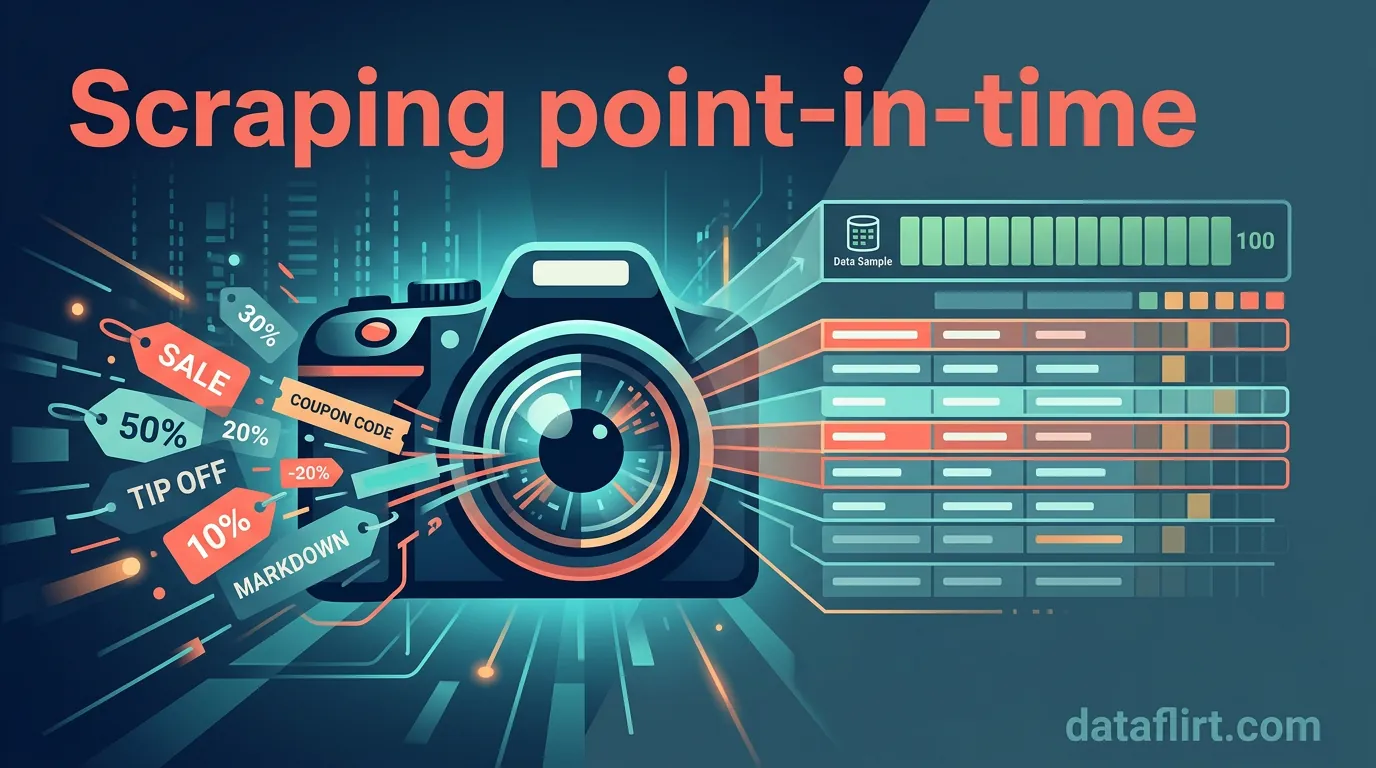

Retailers are accelerating their promotional cadences to move inventory quickly in an increasingly competitive market. Flash sales, influencer exclusives, and dynamic markdowns shift hourly across digital storefronts. Relying on manual checks to track a competitor’s discount strategy leaves you reacting to yesterday’s news. You need a structured, automated view of their promotional logic. Point-in-time scraping captures these fleeting deals before they vanish into the archive. DataFlirt builds and manages the pipelines required to extract this pricing intelligence automatically. DataFlirt ensures your pricing team never misses a strategic market shift.
Key takeaways
- Point-in-time extraction captures a snapshot of live markdowns, active coupon strings, and hidden pricing rules.
- Most promotional codes have extremely short lifespans. High-frequency extraction is critical for building an accurate historical timeline.
- Modern ecommerce platforms separate the mathematical discount logic from the text string the consumer actually types at checkout.
- Anti-bot systems aggressively protect cart endpoints to prevent automated coupon testing.
- DataFlirt handles the complex infrastructure required to monitor thousands of product pages without triggering these defenses.
What point-in-time promotional data actually reveals
Point-in-time scraping captures a competitor’s active discounts, coupon strings, and underlying pricing rules at a specific moment. This output maps their broader margin flexibility. You are looking beyond the individual text codes to understand their true clearing prices. DataFlirt extracts this hidden layer of intelligence to give your pricing team a complete, unfiltered market view.
Advertised list prices rarely tell the whole story. A retailer might hold firm on the manufacturer’s suggested retail price on the main product page to maintain brand positioning. They then quietly distribute deep discounts through segmented email lists or private affiliate links. Finding these restricted codes reveals the actual price a consumer pays. This helps you identify hidden minimum advertised price violations. DataFlirt systematically uncovers these hidden discount strategies.
Consumers are highly conditioned to look for these deals before purchasing. Research from DemandSage indicates that 62% of U.S. online shoppers actively search for promo codes and coupons prior to completing a checkout. This pervasive consumer behavior forces retailers to constantly generate new codes. They must satisfy the relentless demand for deals without permanently devaluing their brand. DataFlirt tracks how competitors manage this delicate balancing act.
When you analyze a massive catalog on Target or Walmart, capturing the raw markdown percentage is just step one. You must extract the specific conditions attached to that markdown. DataFlirt identifies whether the deal requires a minimum cart value, a specific item bundle, or a loyalty account. We parse the fine print automatically. This structured data flows directly into your business intelligence tools.
This promotional data reveals critical inventory pressure points. If a competitor suddenly issues a site-wide coupon for winter coats in early November, they are likely sitting on excess stock. DataFlirt tracks these subtle shifts over time. Your team can then adjust your own promotions accordingly. You can leverage this intelligence to optimize your own clearance strategies. You can read more about mapping these market movements in our web scraping business strategy overview.
How to scrape competitor coupon codes and markdowns
You need to target specific product detail pages, promotional banners, and cart endpoints to capture this data accurately. The method requires mimicking human interaction to reveal conditionally loaded discounts. DataFlirt maps the exact architecture of the target site before writing a single line of extraction code. We locate exactly where the platform stores the discount logic.
Targeting platform-specific pricing structures
Understanding the underlying ecommerce platform is critical for successful extraction. Shopify natively separates promotional logic into two different architectural objects. The PriceRule resource holds the actual mathematical discount logic. This defines the conditions, entitlements, and whether the discount is a percentage off or a fixed dollar amount.
The DiscountCode resource is simply the redeemable text string the buyer uses. DataFlirt engineers target these distinct resources to rebuild the full promotional picture.
{
  "price_rule": {
    "title": "WINTERSALE26",
    "target_type": "line_item",
    "target_selection": "all",
    "allocation_method": "across",
    "value_type": "percentage",
    "value": "-20.0"
  }
}
DataFlirt parses these structured JSON payloads to extract the exact parameters. This allows your team to see that a code offers twenty percent off all line items across the store. You do not have to guess the deal mechanics or manually calculate the final price. DataFlirt structures this raw payload data into clean, accessible tables.
Finding these active codes requires scanning multiple surface areas simultaneously. SimplyCodes reports that 40% of tracked online stores currently offer at least one verified, working coupon code at any given time. DataFlirt deploys crawlers to monitor homepage banners, dedicated offer pages, and pop-up modals.
When tracking massive retailers like BestBuy or Amazon, deals are often hidden in localized or user-specific components. A shopper in New York might see a different banner than a shopper in London. DataFlirt utilizes localized proxies to uncover every variant of these geo-targeted promotions.
Comparing extraction methods for discount data
There are several ways to capture promotional information. Each approach carries different engineering costs, infrastructure requirements, and reliability metrics. DataFlirt helps clients choose the right balance based on their required extraction frequency and data depth.
| Extraction Method | Target Surface | Complexity | Best For |
|---|---|---|---|
| DOM Parsing | HTML product pages | Low | Catching advertised list prices and highly visible markdowns. |
| API Interception | Internal network requests | Medium | Capturing structured PriceRule data and hidden conditions. |
| Cart Emulation | Checkout endpoints | High | Validating promo strings and calculating final clearing prices. |
| Banner OCR | Promotional hero images | High | Extracting flash sale codes embedded purely in graphic assets. |
DataFlirt often combines these distinct methods into a single unified pipeline. Extracting a visually styled code from a homepage banner image might require optical character recognition. Validating that extracted text requires a subsequent cart emulation step. DataFlirt handles this entire orchestration layer effortlessly.
This comprehensive approach ensures you receive verified data rather than raw, unvalidated text strings. Trying to manage these distinct extraction methods internally often drains engineering resources. DataFlirt takes this technical burden entirely off your shoulders.
Why scraping fast-expiring coupon codes remains useful
Scraped promotional data reveals a competitor’s overarching pricing strategy even if the individual codes expire within hours. You are mapping their behavioral patterns to build historical intelligence. This historical asset is far more valuable than a single active code on any given Tuesday. DataFlirt builds this comprehensive archive for your analysts to query.
The speed of retail promotions is staggering in the current market. Research from CouponFollow shows that 78.5% of analyzed coupon codes have a short, one-day lifespan. You will almost never react fast enough to match a twenty-four-hour flash sale manually. A competitor launches a deal on Tuesday morning. By Wednesday morning, the code is entirely dead.
If the code dies in a single day, why does DataFlirt continue to extract it? Tracking historical promotions tells you exactly when a competitor typically feels margin pressure. The data reveals their weekly, monthly, and seasonal promotional cadences. DataFlirt provides the timeline you need to predict their next strategic move.
Mapping the cadence of competitor discounts
The same industry data from CouponFollow reveals the average run time for a broader coupon campaign is just 72 hours. These incredibly tight windows drive immediate conversions without training regular customers to always wait for a sale. DataFlirt tracks these brief windows across hundreds of competing brands simultaneously.
We see exactly when Sephora or Nykaa deploys weekend-only beauty codes. This historical intelligence allows our clients to preemptively launch their own campaigns the following week. Your team is no longer reacting; they are anticipating. DataFlirt powers this transition from reactive to predictive pricing.
Despite shorter lifespans, overall coupon density is actually rising across the industry. Stores averaged 9.7 working codes in early 2026, a 31 percent year-over-year increase per SimplyCodes. Brands are aggressively segmenting their discounts rather than offering site-wide sales. DataFlirt captures this complex segmentation strategy flawlessly.
Retailers give different discount codes to different influencers, specific email segments, and diverse affiliate sites. DataFlirt aggregates these disparate codes into a single comprehensive view. This shows you exactly how aggressively a competitor is quietly discounting their catalog.
Your pricing team can analyze this segmented approach to refine your own affiliate strategy. You might discover that a competitor moves all their clearance inventory exclusively through a specific network of bloggers. DataFlirt brings this hidden pricing architecture to light.
Common pitfalls when extracting checkout deal data
Modern retail sites deploy aggressive anti-bot measures around their cart and checkout flows. Extracting discount data often triggers these defenses immediately because the scraping behavior closely mimics automated purchasing. You cannot simply fire thousands of requests at a checkout endpoint to test random coupon strings. Security platforms anticipate and instantly block this brute-force behavior.
DataFlirt navigates these severe restrictions by carefully managing request volumes and mimicking legitimate user flows. We bypass common data extraction hurdles by meticulously blending into normal human traffic patterns.
Navigating cart-level throttles and rendering limits
Shopify’s GraphQL Admin API enforces rate limits using a calculated query cost mechanism rather than simple call volume. For example, standard limits are restricted to 100 points per second. The Storefront API has no simple rate limits on the sheer number of requests. However, the Storefront API implements a strict checkout-level throttle specifically to prevent cart manipulation.
Furthermore, pagination of arrays is strictly capped at 25,000 objects. If you request more, the system throws an error. DataFlirt engineers design extraction pipelines that naturally respect these specific architectural boundaries. We pull the data you need without ever crossing the threshold into malicious traffic territory.
If you aggressively poll the cart on Nike or Adidas, your IP addresses will be blacklisted permanently. DataFlirt utilizes residential proxy networks and advanced javascript rendering to simulate a genuine shopper journey. We load the page, add an item to the cart, apply the code, and read the final response.
We then intentionally clear the browser session, drop the cookies, and rotate the identity. DataFlirt manages this complex dance automatically. Your team simply receives the verified discount output. We absorb all the technical friction of managing these fragile browser sessions.
Legal orientation for public price extraction
Standard web scraping of publicly available ecommerce data remains fully legal in the US and EU under the CFAA. The precedent-setting 2024 Meta Platforms Inc. v. Bright Data Ltd. ruling reaffirmed this standard for un-gated pricing and promotions. You are free to collect data that any regular internet user can view without logging in. DataFlirt operates strictly within these established legal parameters.
The legal boundary is decisively crossed when scrapers bypass technical authentication to access restricted deal data. You cannot legally use stolen login credentials to scrape wholesale discount tiers or private employee pricing. DataFlirt strictly adheres to these boundaries by only extracting publicly accessible information. We advise every client to consult their own legal counsel regarding their specific data usage plans.
DataFlirt focuses exclusively on gathering data that any human could naturally see in a standard web browser. This uncompromising approach ensures your intelligence gathering remains compliant, ethical, and highly defensible in an audit. For a broader view of these compliance concepts, consider reading our comprehensive retailers guide to price scraping.
How DataFlirt manages point-in-time promotional extraction
DataFlirt builds and maintains the enterprise-grade infrastructure required to extract fast-moving coupon data without triggering security blocks. We handle the complex pipeline orchestration so your internal team can focus on pricing analysis. Managing a small Python script for a single site is easy. Scaling that logic to track hourly flash sales across twenty competitors requires dedicated, full-time engineering. DataFlirt solves this scale problem entirely.
DataFlirt delivers clean, schema-matched outputs directly to your data warehouse or preferred storage solution. You do not have to worry about broken css selectors when Zara or Macys updates their website theme over the weekend. DataFlirt actively monitors the target sites and automatically repairs the extraction logic. We guarantee the structural integrity of your incoming data feeds.
Our infrastructure handles the heavy lifting of proxy rotation, header spoofing, and checkout emulation. DataFlirt ensures your point-in-time extraction runs flawlessly regardless of the target’s technical complexity. We have meticulously built our systems to tolerate the aggressive bot protections found on modern, high-traffic storefronts. DataFlirt acts as an integrated extension of your own engineering department.
When calculating the total cost of ownership, maintaining an in-house team to fight anti-bot systems rarely makes financial sense for a retailer. You want your engineers building customer-facing features, not babysitting scrapers. DataFlirt offers a highly predictable alternative. You can learn more about evaluating these technical trade-offs in our post on understanding scraping cost factors. DataFlirt consults with you to define the exact promotional metrics you need. DataFlirt then engineers the pipeline to deliver those metrics reliably, every single day.
FAQ
Is it legal to scrape competitor promotional prices?
Yes. Extracting publicly available pricing and promotional data is generally legal under the CFAA in the US, as reaffirmed by recent rulings. Bypassing login portals to access restricted deals crosses a legal boundary. Always consult qualified legal counsel for specific situations.
How do you extract discounts that only apply at checkout?
This requires cart emulation. The scraper must realistically add an item to the cart, navigate to the checkout endpoint, and inject the coupon code to read the final calculated price without triggering anti-bot protections.
Why do my scrapers get blocked when checking coupon codes?
Ecommerce platforms use strict cart-level throttling to prevent automated purchasing and coupon brute-forcing. You need proper proxy rotation and human-like request pacing to avoid triggering these sensitive security defenses.
If you would rather not scope and maintain this complex pipeline yourself, DataFlirt’s ecommerce scraping service handles the extraction, quality assurance, and daily delivery. We can also assist with broader review data extraction to match your pricing strategies against active customer sentiment. Reach out for a free scoping call to see how DataFlirt can accelerate your market intelligence operations.