
Key takeaways
- Recommerce scraping abstracts single-SKU listings into brand and category clusters to calculate median market values.
- Vinted blocks direct catalog queries via API; scrapers must handle complex session cookies and user-agent spoofing to avoid 403 errors.
- Depop relies on an internal JSON API that provides clean structural data if your pipeline can accurately parse the payload.
- Condition normalization is mandatory. Mapping hundreds of custom user descriptions into a standard four-tier scale is required for accurate pricing intelligence.
- New IRS tax reporting thresholds in the US create artificial inventory bottlenecks by driving casual sellers off major platforms.
Analysts tracking apparel pricing face a critical blind spot today. The primary retail channel is evolving rapidly away from wholesale catalog distribution. Millions of single-stock items now circulate on peer-to-peer marketplaces. Capturing structured intelligence from these user-generated listings requires specialized techniques. You cannot rely on standard MAP monitoring software to track these assets.
Why recommerce data breaks traditional retail scraping
Traditional pricing intelligence relies on fixed product identifiers. You track a specific barcode or SKU across multiple vendor domains. Secondhand marketplaces destroy this model completely. Every item uploaded by an individual user represents a totally unique piece of inventory.
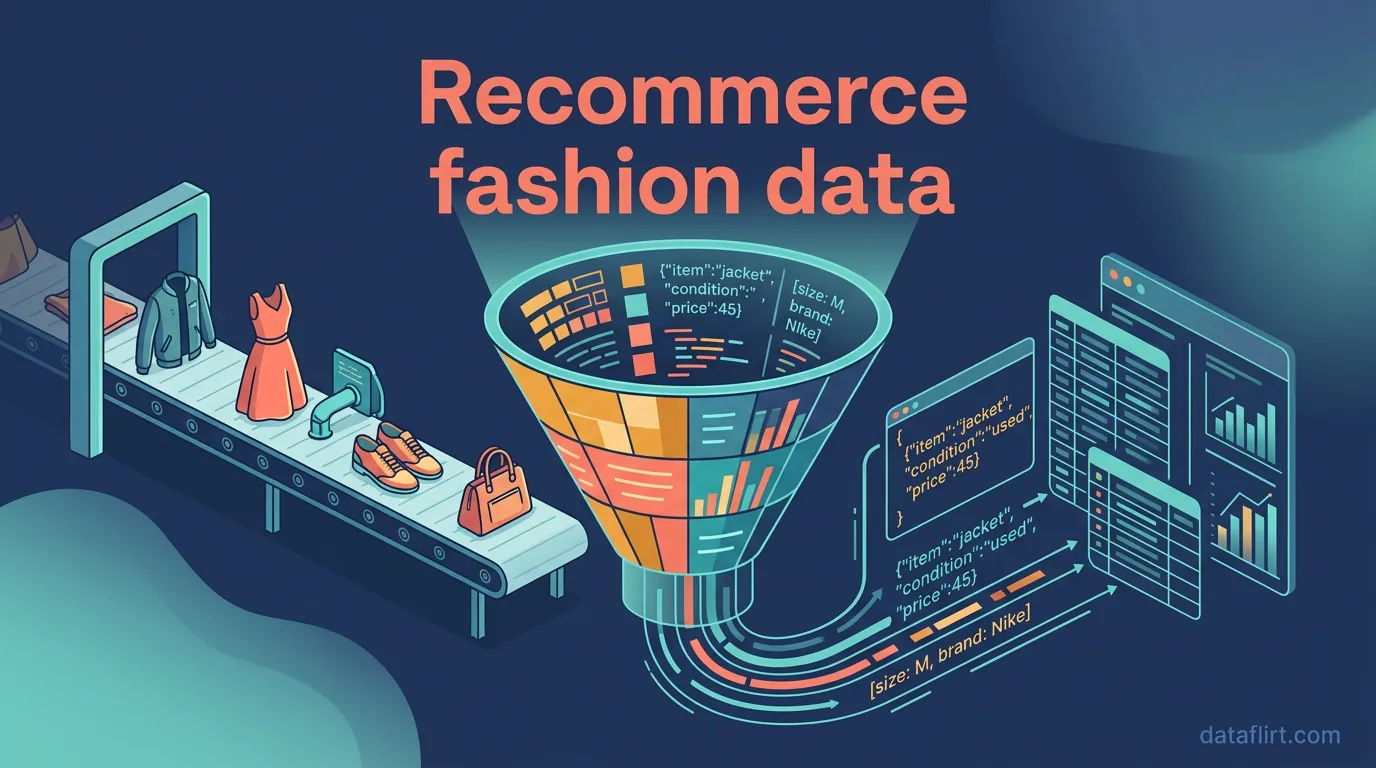
Every listing on platforms like Vinted or Depop is a unique item. How do you aggregate pricing data from millions of individual listings? You must abstract the product data entirely. Instead of attempting to track an exact item, your extraction pipeline must track brand, category, and condition clusters. This mathematical grouping allows data teams to find the median secondary market value for specific product lines.
The volume of this inventory dictates retail strategy. The US secondhand fashion market will generate $55.5 billion in sales in 2025, accounting for 12% of all American spending on clothing, footwear, and accessories. Brands ignoring this secondary market lose visibility on their own true product valuation.
Globally, the opportunity is even larger. The worldwide secondhand apparel market holds an estimated value of $198.6 billion in 2025. Extracting ecommerce data from these platforms provides immediate visibility into post-retail product lifecycles. DataFlirt helps enterprise analysts map these massive user-generated catalogs to track long-term brand equity.
The critical fields in recommerce and resale data
Grouping chaotic listings into actionable intelligence requires extracting ten specific data points. DataFlirt structures recommerce datasets around these mandatory attributes. Without these exact fields, comparing peer-to-peer inventory is mathematically impossible.
Core product identifiers
The brand and item type are the foundational anchors for resale data. A seller might list an item as “Vintage Nike Windbreaker,” so the scraper must isolate the brand “Nike” and the item type “jacket.” DataFlirt deploys extraction rules to separate the manufacturer from the user’s stylistic description. Condition grade is equally vital. A jacket labeled “New with tags” holds a vastly different market value than one marked “Fair.”
Pricing and transaction signals
Three distinct price points matter in the secondhand market. The original retail price indicates the benchmark value if the seller provides it. The listing price shows current seller expectations. The sold price reveals actual market clearing value, though platforms often hide this metric after a transaction completes. DataFlirt tracks listing dates to calculate time-on-market metrics. Analysts use alternative data for ecommerce to match these timelines against primary retail discount schedules.
Seller and geographic context
Secondary markets operate heavily on trust. Seller ratings and transaction counts act as proxies for listing reliability. A professional reseller with a thousand positive reviews commands higher prices than a new account. Location data provides cross-border demand analysis. DataFlirt captures geographic coordinates to help retail brands map regional brand saturation. Finally, extracting description hashtags allows analysts to link specific items to emerging fashion micro-trends.
| Data Field | Extraction Purpose | DataFlirt Normalization Logic |
|---|---|---|
| Brand & Item Type | Categorization | Exact string matching to brand dictionary |
| Condition Grade | Valuation baseline | Mapped to strict four-tier logic scale |
| Listing Price | Current market asking rate | Currency conversion and numerical float |
| Sold Price | True market clearing rate | Extracted from historical API endpoints |
Where to get the data and platform-specific extraction notes
The top fashion resale applications rely on heavily guarded internal frameworks. DataFlirt engineers must build custom network requests for each target. Standard HTML parsing rarely works for modern peer-to-peer catalogs.
Vinted session management and anti-bot barriers
Vinted dominates the European secondhand market with massive scale. The platform reported 105 million registered users globally as of 2023, generating €596 million in revenue. Scraping this platform is notoriously difficult. While the company offers a Pro Integrations API, it strictly limits access to approved professional sellers managing their own stock. It offers zero endpoints for catalog searching or competitor extraction.
Unofficial extraction relies on hitting internal endpoints like api/v2/catalog/items. Vinted protects these routes with aggressive rate limiting and session validation. Direct requests immediately return a 403 Forbidden error. A scraper must first establish a valid session, fetch the access_token_web cookie, and pass it alongside pristine TLS signatures. DataFlirt handles this entire session negotiation. Our specialized Vinted scraper infrastructure rotates residential IP addresses to maintain stable, persistent connections during large catalog pulls.
Depop JSON structures and demographics
Depop captures the younger demographic entirely. Internal metrics show 90% of Depop’s 35 million users are under the age of 26, driving a projected 2025 Gross Merchandise Value of $1.1 billion. The platform architecture is heavily optimized for mobile application traffic. Unlike Vinted, Depop relies on a relatively clean internal web API accessible via webapi.depop.com/api/v2/search/products.
This API returns highly structured JSON payloads. The critical challenge involves accurate JSON parsing at scale. DataFlirt isolates the item name under the slug key. We then unpack the nested price object into priceAmount and currency. The stock_status field is crucial for determining if an item is active or sold. The Depop scraper pipeline built by DataFlirt automatically formats these nested arrays into flat, analyzable spreadsheet rows.
{
  "slug": "vintage-leather-jacket-90s",
  "price": {
    "priceAmount": "45.00",
    "currency": "USD"
  },
  "brands": ["brand_id_123"],
  "stock_status": "AVAILABLE"
}
Poshmark and Grailed condition formats
Other platforms use distinct vocabularies that require careful parsing. Poshmark sellers rely heavily on acronyms like NWT for “New with tags” or NWoT for “New without tags.” The Poshmark scraper built by DataFlirt decodes these abbreviations during the extraction phase.
Grailed focuses intensely on premium menswear and streetwear. Its user base utilizes terms like “Deadstock” to indicate unworn, factory-new condition. The Grailed scraper pipeline captures these specific cultural tags. When analysts compare data across platforms, they often pull in primary market pricing from retail giants. DataFlirt routinely cross-references this resale intelligence with data from our ASOS scraper and Zara scraper tools to map total brand depreciation.
Extraction quirks specific to this vertical
Recommerce data is fundamentally messy because users write the descriptions and set the prices. Building a reliable data extraction pipeline requires heavy post-extraction normalization. DataFlirt specializes in cleaning this exact type of unstructured user input.
Condition normalization logic
Sellers invent infinite ways to describe wear and tear. A shirt might be listed as “gently used,” “worn once,” or “minor pilling.” DataFlirt solves this by mapping all text variations into a strict four-tier scale. We categorize items exclusively as New, Like New, Good, or Fair. This standard covers 90% of all secondary market transactions.
Without this normalization, comparing prices is useless. A “Good” condition dress on Vinted must align perfectly with a “Good” condition dress on Poshmark. DataFlirt engineers write extensive mapping rules to enforce this consistency. Analysts use this structured output to track the average asking price by brand against specific condition tiers.
Calculating the sell-through proxy
Determining actual market demand requires tracking inventory velocity. Because platforms rarely publish real-time sales volume, analysts must calculate a sell-through proxy. You compare the volume of active listings against the volume of sold listings over a rolling 30-day window.
High sell-through indicates that demand for a brand exceeds secondary supply. DataFlirt runs periodic extractions to capture these state changes. We track when an item ID transitions from active to sold status. This intelligence is a core component of scraping ecommerce websites for price matching, adapted specifically for peer-to-peer markets.
The impact of tax reporting thresholds
The regulatory environment directly impacts inventory volume. In the United States, the enforcement of the new IRS $600 threshold for 1099-K reporting creates high friction for casual sellers. Many users delete accounts or pull listings offline to avoid generating taxable events.
This creates a massive inventory bottleneck. Scrapers tracking listing volume must account for this tax-avoidance churn. A sudden 15% drop in platform inventory in late December is rarely a shift in fashion demand. It is a regulatory reaction. DataFlirt analysts help enterprise clients interpret these sudden volume shifts to prevent skewed market intelligence models.
Legal considerations for scraping user-generated fashion listings
Extracting peer-to-peer marketplace data requires distinguishing between public product facts and personal user information. You must navigate platform terms of service and international data privacy regulations. DataFlirt prioritizes strictly ethical extraction methodologies.
The core principle is avoiding Personally Identifiable Information. A jacket’s brand, price, and condition are factual data points. A seller’s real name, private messaging history, or exact residential address represents protected personal data. DataFlirt configures all extraction logic to ignore private user attributes completely. We focus entirely on the commercial transaction signals.
Marketplace platforms frequently update their terms of service to prohibit automated data collection. While collecting public factual data generally remains protected in many jurisdictions, aggressive scraping that degrades site performance can trigger legal challenges. Always consult qualified legal counsel for your specific situation before deploying automated collection tools.
How DataFlirt structures recommerce catalog extraction
Normalizing millions of user-generated listings into clean competitive intelligence requires a specialized pipeline. Managing the proxy networks, bypassing bot protections, and cleaning the JSON payloads consumes vast engineering resources. DataFlirt handles the entire extraction lifecycle for you.
We build custom pipelines tailored exactly to recommerce platforms. DataFlirt manages the session cookies required to access Vinted. DataFlirt parses the nested JSON from Depop. DataFlirt automatically standardizes the chaotic condition descriptions from Grailed and Poshmark into uniform datasets. We deliver this data in clean, flat formats ready for immediate database ingestion.
If you want to track sneaker depreciation across platforms, we route your logic through our StockX scraper and GOAT scraper networks. If you need broader fast-fashion resale metrics, DataFlirt connects our H&M scraper retail data to our eBay scraper secondary market feeds. The DataFlirt ecosystem is built specifically to connect these disparate intelligence nodes.
If you prefer not to scope the networking infrastructure or condition logic yourself, DataFlirt manages the process end-to-end. Our company data extraction services provide verified, production-grade intelligence. We ensure your team spends time analyzing market trends rather than debugging browser fingerprinting blocks. Reach out to the DataFlirt team to schedule a free vertical catalog scoping call today.
FAQ
What is the most important data field to scrape on secondhand platforms?
Condition grade is the most critical variable. In the primary market, all items are identical. In the secondary market, the difference between “New with tags” and “Fair” dictates the entire valuation model. Normalizing condition text into a standard scale is mandatory for accurate pricing analysis.
Can you extract data directly from Vinted’s official API?
Vinted’s official Pro Integrations API only provides endpoints for approved sellers to manage their own inventory. It cannot be used to search the platform catalog or extract competitor data. DataFlirt utilizes internal web endpoints coupled with advanced session management to extract public catalog intelligence.
How do you track item sales if the platform hides the transaction date?
DataFlirt uses a state-tracking methodology. We perform periodic extractions on a defined schedule. By comparing today’s active item IDs against yesterday’s item IDs, we identify exactly when a specific product transitions to a “sold” or “unavailable” status. This provides an accurate proxy for transaction velocity.
Is it legal to scrape peer-to-peer clothing marketplaces?
Extracting public, factual product data like price and brand is generally permissible in most jurisdictions, provided you do not extract Personally Identifiable Information. However, platform terms of service frequently forbid automated access. Always consult qualified legal counsel for your specific situation.