
Key takeaways
- Seeding your database via bulk extraction solves the initial marketplace cold start problem.
- Platforms like Shopify require variant-centric CSV formatting for bulk catalog imports.
- Image extraction requires hosting files on external public URLs before ingestion.
- Scraping public product data is generally legal under the CFAA.
- Outsourcing the extraction pipeline keeps your engineering team focused on core platform features.
You are building a new ecommerce platform. The software infrastructure is fully deployed. The payment gateways are actively configured. Your database is completely empty. Buyers will avoid a store with zero inventory. Suppliers will ignore a platform with zero buyers. You must seed the marketplace manually to break this deadlock.
Why bulk extraction solves the marketplace cold start problem
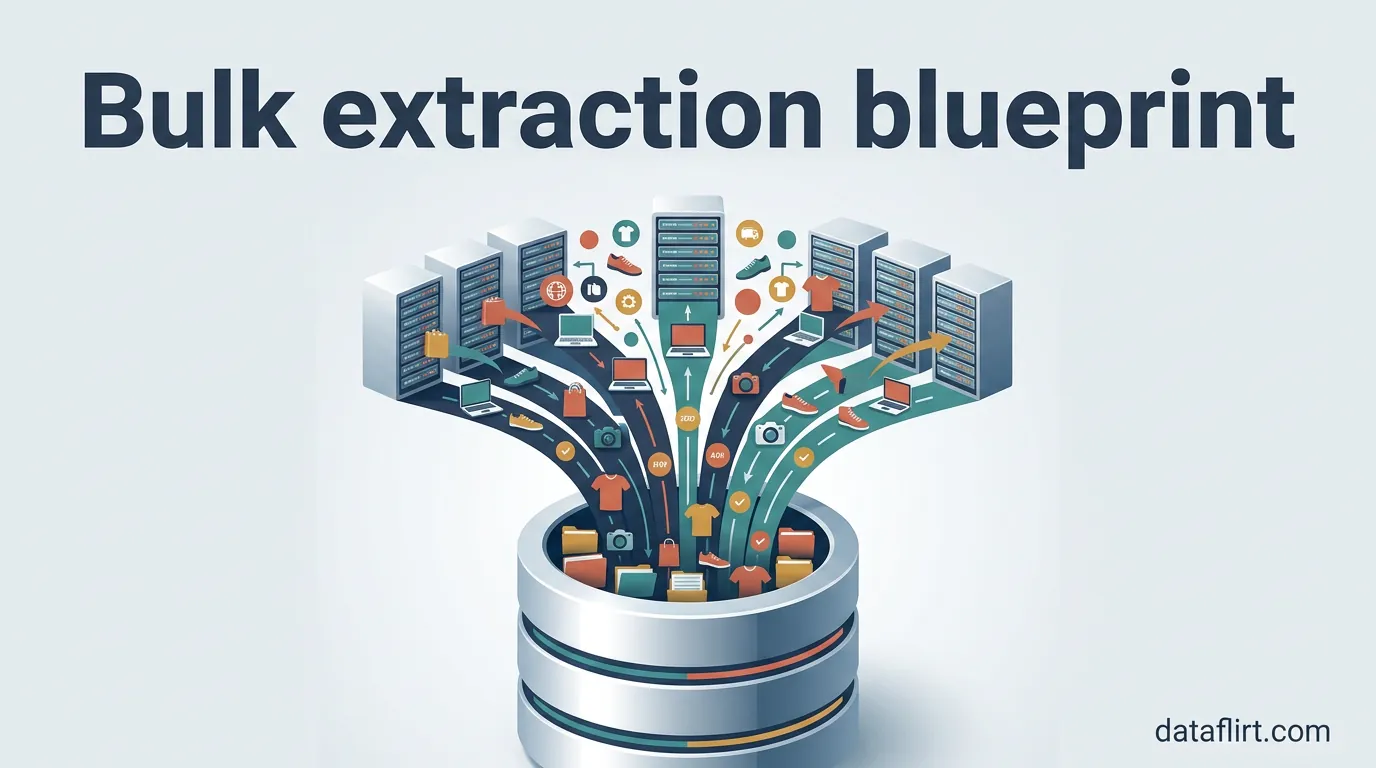
Extracting product catalogs from established suppliers allows you to populate your platform instantly. This creates the critical mass needed to attract your first wave of real buyers.
Marketplaces are structurally difficult to launch. The chicken-and-egg dynamic kills most platforms before they record a single transaction. You cannot attract demand without supply. You cannot acquire supply without proven demand.
Founders solve this by artificially seeding the supply side. They extract public catalog data to populate their own categories. This makes the storefront look active and established. Once buyers arrive, convincing real suppliers to claim their listings becomes significantly easier.
This tactic is now standard infrastructure for platform builders. Consider the scale of the broader market. Research shows that 72% of global e-commerce revenue currently flows through marketplace platforms (Prospeo). Competing in this space requires starting with a dense catalog.
DataFlirt sees platform founders struggle with manual data entry constantly. Uploading products one by one is impossible at scale. Automated data extraction is the only viable path to a rapid launch. When planning how to build an ecommerce website, data ingestion speed dictates your entire go-to-market timeline.
DataFlirt configures bulk extraction pipelines to pull from massive target sites. This transforms a blank database into a fully merchandised storefront within days. You define the target suppliers. DataFlirt extracts the attributes.
The shift from manual entry to programmatic supply
Manual curation works for a twenty-item boutique. It fails completely for a multi-vendor hub. You need automation to bridge the gap between an empty shell and a viable business.
Consider a founder launching a specialized hardware marketplace. She needs 40,000 highly specific technical SKUs to attract professional buyers. Attempting to manually enter thread pitches and voltage ratings will delay her launch by six months. A managed bulk extraction solves this overnight.
DataFlirt maps out the precise category structures of your competitors. We deploy scripts that navigate their menus automatically. DataFlirt then mirrors that architecture directly into your platform.
How many products a new platform needs to be useful at launch
A general marketplace typically needs upward of 10,000 SKUs to present a credible browsing experience. Highly targeted niche stores can often launch with a few hundred curated items.
This is the uncomfortable question every founder asks. How many products actually matter? If you launch with twenty items, buyers bounce immediately. They perceive the site as abandoned or unreliable.
Industry logistics provide a solid baseline for general retail. Data indicates that 10,371 is the average SKU count managed in a typical distribution center (OPEX). This represents a standard threshold for consumer expectations regarding variety and choice. If you aim to be a generalist destination, your initial scrape must target similar volume.
Scaling up requires serious data architecture. Looking at established mid-market players reveals even larger catalogs. The average SKU count for e-commerce companies managing their product catalog on the Plytix PIM platform sits at 21,000 (Plytix).
Setting the baseline catalog depth for your niche
DataFlirt regularly advises clients on these volume targets. A platform catering to specialized industrial parts might need 50,000 rows to cover all technical variations. A curated lifestyle boutique might only need 500.
When DataFlirt scopes a new project, we align the extraction volume with your specific market position. Our B2B marketplace scraping services are built to handle these massive SKU counts effortlessly. DataFlirt ensures your database matches the density of your primary competitors.
What a clean extraction and import pipeline actually requires
You must map scraped unstructured data precisely to your platform’s ingestion schema. Failing to format variations and image links correctly will cause bulk imports to fail completely.
Raw scraped JSON is useless to a platform administrator. You cannot simply upload an unformatted file to Shopify or BigCommerce. The data must conform to strict column headers.
Shopify relies on a variant-centric structure. Products are grouped by a unique handle. The first row contains the parent product details. Subsequent rows sharing the same handle represent the different variations.
DataFlirt engineers spend significant time normalizing this exact data structure. If you place the product title on a variant row, the platform throws an error. If you miss a specific option value, the variation disappears from the frontend entirely.
Mapping the Shopify CSV import structure
Here is a standard example of how DataFlirt formats a Shopify-ready import table.
| Handle | Title | Option1 Name | Option1 Value | Variant SKU | Variant Price |
|---|---|---|---|---|---|
| coffee-mug | Ceramic Mug | Color | Red | MUG-RED | 12.99 |
| coffee-mug | Color | Blue | MUG-BLU | 12.99 | |
| desk-lamp | Desk Lamp | Size | Large | LMP-LRG | 45.00 |
| desk-lamp | Size | Small | LMP-SML | 35.00 |
Transforming raw extraction data into this format requires dedicated scripting. The following Python snippet demonstrates how DataFlirt structures a basic variant grouping process.
import pandas as pd
import json

# Load raw scraped product data
with open('scraped_catalog.json', 'r') as file:
    raw_data = json.load(file)

# Transform logic for Shopify variant grouping
rows = []
for product in raw_data:
    handle = product['url_slug']

    # Parent product row
    rows.append({
        'Handle': handle,
        'Title': product['name'],
        'Body (HTML)': product['description'],
        'Vendor': product['brand'],
        'Option1 Name': 'Color',
        'Option1 Value': product['variants'][0]['color'],
        'Variant SKU': product['variants'][0]['sku'],
        'Variant Price': product['variants'][0]['price']
    })

    # Subsequent variant rows
    for variant in product['variants'][1:]:
        rows.append({
            'Handle': handle,
            'Title': '',
            'Body (HTML)': '',
            'Vendor': '',
            'Option1 Name': 'Color',
            'Option1 Value': variant['color'],
            'Variant SKU': variant['sku'],
            'Variant Price': variant['price']
        })

df = pd.DataFrame(rows)
df.to_csv('shopify_import.csv', index=False)
Overcoming the image hosting constraint
Beyond text attributes, images present a major ingestion hurdle. You cannot upload images directly from a local drive via a CSV file.
Your platform requires publicly accessible URLs. Every image scraped from the target must be downloaded, hosted externally, and mapped back to the spreadsheet. DataFlirt solves this by hosting extracted media in dedicated S3 buckets. DataFlirt provides the formatted CSV with active image links ready for immediate upload.
How to execute a catalog extraction from supplier targets
You can extract product data by intercepting hidden frontend APIs or by parsing the raw document object model. The approach depends entirely on the target site’s architecture.
Modern supplier websites rarely serve flat HTML. They load content dynamically using complex JavaScript frameworks. This heavily complicates traditional extraction methods.
DataFlirt often begins by analyzing network traffic. If the target site uses an internal API to populate product grids, DataFlirt intercepts that JSON payload directly. This method is incredibly fast and resilient to minor layout changes.
Intercepting APIs versus DOM parsing
When APIs are heavily secured, DataFlirt shifts to DOM parsing. This requires loading the page in headless browsers to execute the JavaScript. Once the content renders, we use precise CSS selectors to target the exact price, title, and specification elements.
Extracting data from major retail aggregators highlights these different approaches. Scraping Amazon requires solving intense bot protection layers. Extracting from eBay demands handling massive pagination inconsistencies. Sites like Walmart and Target serve highly dynamic pricing based on localized zip codes.
DataFlirt configures scripts specifically for each target. A script built for Best Buy will fail immediately on Wayfair due to fundamentally different underlying codebases. DataFlirt maps out the distinct category hierarchies for every individual source.
Managing pagination and infinite scroll
You must also handle infinite scroll implementations. Many modern catalogs load more items as the user scrolls down the page. DataFlirt writes automation routines that simulate human scrolling to reveal the entire product list before extraction begins.
Extracting furniture dimensions from Home Depot requires different logic than pulling apparel sizes from Macy’s. Even artisanal marketplaces like Etsy present unique parsing challenges due to unstructured seller descriptions. DataFlirt neutralizes these format variations. DataFlirt normalizes the disparate outputs into one cohesive master catalog for your new platform.
What breaks when extracting supplier catalogs at scale
Automated scrapers break when target sites alter their frontend code or deploy aggressive bot mitigation software. Maintaining a reliable data feed requires constant script repair and diligent proxy management.
Web scraping is never a deployment that you can simply set and forget. The internet is hostile to automated data collection. Target websites actively work to block unverified traffic.
It is a massive commercial battleground. Projections indicate the global web scraping market will reach a value of $9 billion by the end of 2025 (Kanhasoft). Companies spend millions trying to collect data, while target sites spend millions trying to stop them.
Dealing with proactive bot mitigation
Browser fingerprinting is the primary defense mechanism. Security platforms analyze your connection to determine if you are a real human. They look at canvas rendering, font installations, and WebGL outputs. If your scraper looks suspicious, the connection drops.
DataFlirt utilizes advanced fingerprint spoofing to bypass these defenses. We cycle through thousands of residential proxies to distribute the request load. DataFlirt masks the automation signals that trigger immediate bans.
When simple blocks fail, target sites deploy CAPTCHAs to halt the pipeline entirely. Solving these requires specialized third-party integrations or AI-assisted vision models. DataFlirt bakes automatic CAPTCHA resolution directly into our extraction infrastructure.
The maintenance burden of selector degradation
Beyond security, layout changes destroy scrapers instantly. If a supplier renames a single CSS class, your DIY scraper will return null values for every price in the catalog. DataFlirt monitors output quality continuously. When a layout shift occurs, DataFlirt engineers patch the broken selectors within hours.
This continuous maintenance is why ecommerce web scraping use cases are notoriously expensive to run in-house. A single developer will spend their entire week fixing broken scripts. DataFlirt assumes full responsibility for this maintenance burden.
Where legal and performance boundaries sit for bulk product collection
Extracting public e-commerce data is generally legal under the CFAA, provided you do not bypass authentication barriers. You must also implement strict rate limiting to avoid degrading the target server’s performance.
Legality is a mandatory consideration when building your platform infrastructure. Founders need to understand the distinction between public extraction and unauthorized access.
Under US law, guided by the 9th Circuit rulings in the hiQ Labs v. LinkedIn case, scraping publicly available data does not violate the Computer Fraud and Abuse Act. The CFAA focuses on unauthorized access to protected systems.
The CFAA and public data access
DataFlirt operates strictly within these legal boundaries. If a product catalog is visible to a logged-out user on the open internet, it is generally considered public data. DataFlirt does not bypass login walls, crack passwords, or breach paywalls. Doing so crosses the line into unauthorized access.
However, legality under the CFAA does not mean you can extract data recklessly. Aggressive scraping exposes you to civil liability under the doctrine of Trespass to Chattels.
Trespass to chattels and rate limit compliance
If your scraper hits a supplier website with ten thousand requests per second, you might crash their server. Causing financial harm through bandwidth consumption is a surefire way to invite litigation.
DataFlirt implements mandatory rate limiting to prevent this scenario. We space out requests, adding deliberate delays of one to two seconds between page loads. DataFlirt prioritizes polite extraction protocols. We extract the data safely without overwhelming the target infrastructure.
It is also vital to distinguish product data from personal data. Scraping a list of shoe sizes is safe. Scraping personal seller contact information triggers major privacy compliance issues. DataFlirt filters out sensitive personal information to maintain strict regulatory compliance. We recommend all platform founders consult qualified legal counsel for their specific jurisdictional requirements.
Why outsourcing the initial database seed minimizes launch friction
Managing your own proxy networks and headless clusters drains engineering resources. Outsourcing the extraction pipeline allows your team to focus exclusively on building the core platform experience.
Platform founders face a strict build-versus-buy calculation. You can write your own Python scripts, rent a proxy pool, and spend weeks debugging Cloudflare blocks. Or you can hire a dedicated service.
Building an in-house pipeline is highly inefficient for a one-time database seed. Your engineers should be optimizing your checkout flow, not writing regex rules for a supplier’s messy HTML.
The gap between raw extraction and import-ready delivery
DataFlirt shifts this entire workload off your engineering sprint. You provide DataFlirt with the target URLs and the required data schema. DataFlirt delivers a pristine, normalized CSV file that uploads perfectly into your admin dashboard.
We see this reality clearly in the market. More than 80% of top online retailers scrape competitor data daily for pricing and catalog monitoring (Kanhasoft). The successful ones use dedicated infrastructure to do it.
When you attempt scraping ecommerce websites for price matching on your own, the hidden costs accumulate rapidly. You pay for failed proxy bandwidth. You pay for server downtime. You pay for developer hours spent fixing broken code.
| Metric | In-House DIY Scraping | DataFlirt Managed Service |
|---|---|---|
| Engineering Focus | Drained by script maintenance | 100% focused on core platform |
| Block Mitigation | Constant manual IP rotation | Automated proxy management |
| Data Formatting | Manual Excel wrangling | Import-ready schema delivery |
| Image Hosting | Complex local scripts | Hosted S3 bucket URLs |
DataFlirt specializes in complex, high-volume extractions from sites like Alibaba and AliExpress. We understand the intricacies of massive global catalogs. DataFlirt ensures your startup launches with a professional, fully populated storefront.
If your platform requires ongoing intelligence, DataFlirt can easily transition a one-time seed into a recurring daily feed. Our ecommerce scraping services scale automatically as your platform grows. DataFlirt handles the extraction, the QA layer, and the delivery formatting.
FAQ
Can I scrape product images directly into my platform?
No, most ecommerce platforms do not support direct local file uploads via bulk CSV. You must host the scraped images on an external, publicly accessible URL and map those links to the appropriate image column in your import file. DataFlirt handles this hosting step for you.
Is it legal to scrape competitor products to seed my store?
Scraping publicly available e-commerce data generally does not violate the CFAA, provided you do not bypass login walls or authentication measures. However, you must implement polite rate limiting to avoid civil liability under Trespass to Chattels. Always consult legal counsel regarding your specific use case.
How much does it cost to extract a full catalog?
Costs vary based on the target site’s complexity, JavaScript rendering requirements, and the total SKU count. A flat 500-product catalog on a simple site might cost $200, while extracting 50,000 variants from a heavily protected supplier requires custom scoping. DataFlirt provides exact quotes based on your specific target URLs.
If you would rather not scope this yourself, the ecommerce scraping service at DataFlirt handles the extraction, QA, and delivery. Reach out today for a free scoping call to get your platform launched.