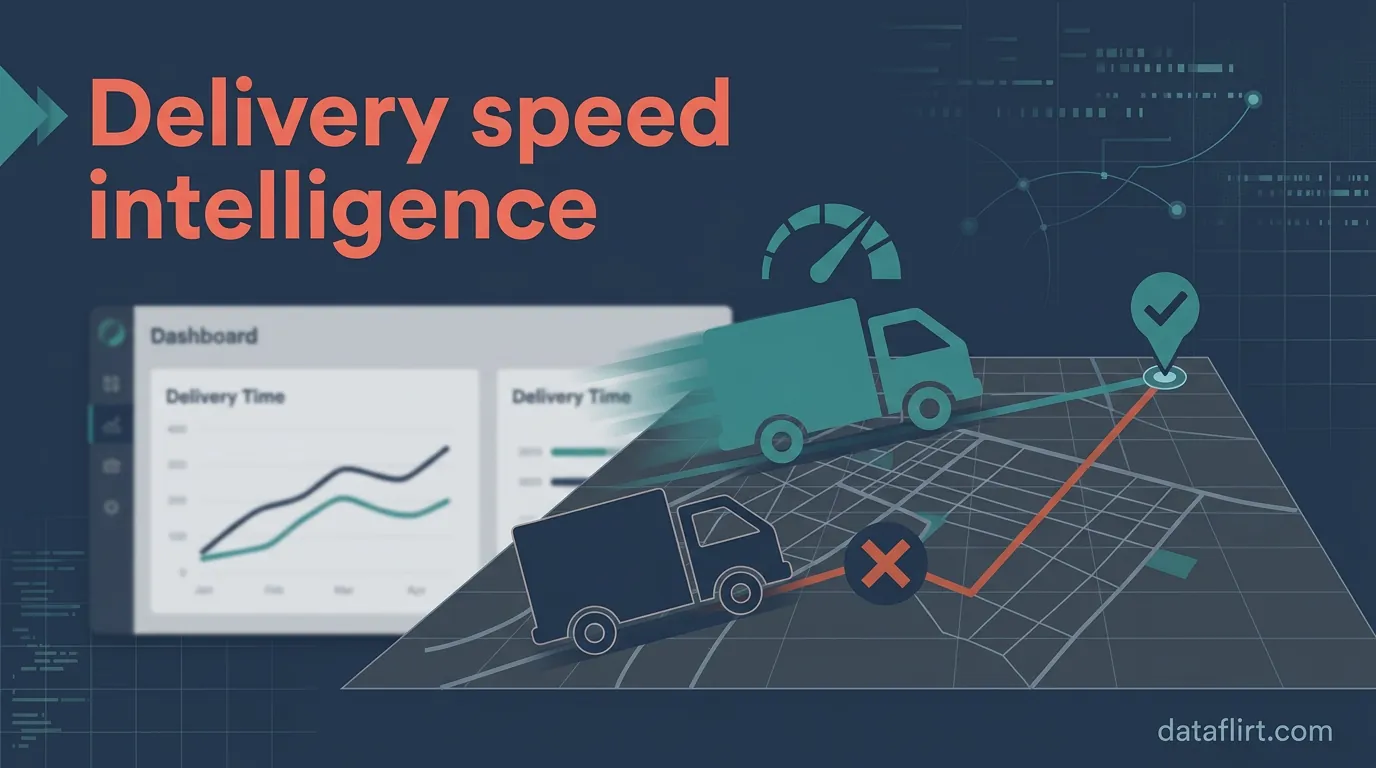

A customer reaches the checkout screen after spending twenty minutes browsing your site. They see a flat delivery fee and a vague shipping window of five to seven days. They leave immediately. This sequence repeats thousands of times a day across your catalog. You lose the sale to a competitor who offered a specific delivery date and transparent pricing.
Key takeaways
- Delivery estimates directly impact conversion rates; vague windows drive buyers away.
- Scraping shipping data requires interacting with protected checkout endpoints and managing complex session tokens.
- Platform limitations dictate how target sites display carrier rules and calculate transit times.
- Extracting this data reveals where competitors stage their inventory and how much they subsidize shipping costs.
- Public shipping quotes are generally safe to extract when you structure requests carefully.
- DataFlirt manages the technical overhead of checkout interactions to deliver clean competitive intelligence.
Why delivery speed dictates conversion rates
Checkout friction destroys revenue across every product category. The global average online shopping cart abandonment rate in 2024 stands at a staggering 70.19%. A major portion of this lost revenue stems directly from post-purchase logistics. Data shows that 23% of online shoppers abandon their orders specifically due to slow shipping speeds.
Consumer expectations have fundamentally shifted over the last few purchasing cycles. Shoppers no longer demand ultra-fast delivery at any cost. Instead, 90% of consumers are now willing to wait two or three days for a delivery, particularly if waiting helps them avoid shipping costs entirely.
Certainty matters more than raw speed. Buyers want to know exactly when a package will arrive. Research indicates that 75% of shoppers are more likely to make a purchase when they see a specific, trackable estimated delivery date rather than a vague shipping window. If your competitor guarantees arrival by Thursday while you offer a broad timeline, you lose the conversion.
Balancing this cost-to-speed ratio requires deep market awareness. You must know exactly what your competitors charge for standard, expedited, and overnight tiers across various cart values. DataFlirt builds the extraction pipelines necessary to capture these specific pricing tiers automatically.
The components of a shipping dataset
A valuable shipping dataset maps out exactly what competitors charge based on cart value and destination zip code. You need a matrix mapping product categories against geographic delivery zones. DataFlirt extracts these points to build a clear picture of the market.
| Data Point | Extraction Target | Strategic Business Use |
|---|---|---|
| Origin Zip Code | Warehouse location indicator | Reveals competitor 3PL distribution networks |
| Destination Zip Code | Customer location | Highlights geographic pricing advantages |
| Carrier Name | FedEx, UPS, USPS | Identifies carrier negotiation leverage |
| Delivery Cost | Price displayed to user | Shows margin subsidization thresholds |
DataFlirt normalizes this raw checkout text into structured data. You can then feed this structured data directly into your pricing algorithms.
How to extract delivery estimates from competitor checkouts
You must simulate the buyer journey to capture accurate shipping costs. This means adding items to a digital cart and triggering the exact shipping calculation endpoint used by real customers. Scraping a static product page rarely yields accurate delivery intelligence.
The technical mechanics require complex session management. A scraper must first send a GET request to the product page to retrieve the product ID and generate a valid session token. DataFlirt handles this initial handshake to ensure the server recognizes the connection as valid.
Next, the scraper sends a POST request to the cart addition endpoint. This payload contains the product ID and the desired quantity. Finally, the scraper hits the shipping rates endpoint, passing the destination zip code to calculate the final price. DataFlirt automates this multi-step sequence perfectly.
Bypassing bot protection at the checkout gateway
Checkout endpoints deploy the strictest security measures on any ecommerce website. Sending anomalous requests to these URLs results in immediate bans. Retailers aggressively protect their cart infrastructure from automated traffic.
Understanding browser-fingerprinting is essential here. Security systems evaluate the user agent, canvas hashes, and hardware concurrency limits. DataFlirt mimics legitimate browser signatures to bypass these checks reliably.
Proxy selection also dictates your success rate. Standard datacenter IPs fail immediately at checkout gateways. You must use rotating-proxy infrastructure equipped with residential IP addresses. DataFlirt routes requests through residential IPs that physically match the target destination zip code, ensuring the target server returns accurate local shipping quotes.
Managing session state and cookies
Checkout scraping requires stateful extraction. The server must remember what the scraper added to the cart three requests ago. This requires meticulous cookie management across the entire session lifecycle.
If a cookie drops or expires prematurely, the cart empties. The subsequent shipping calculation request will return an error or a zero-dollar value. DataFlirt maintains persistent cookie jars across distributed headless-browser fleets to prevent session degradation.
Sites like Target and Best Buy enforce strict session timeouts. DataFlirt engineers build custom retry logic to handle these timeouts gracefully. If a session expires during extraction, DataFlirt automatically regenerates the token and rebuilds the cart payload without losing data continuity.
Navigating platform constraints and API limits
Many target websites operate on hosted ecommerce platforms with rigid internal architectures. Understanding these structural rules helps you parse the data you extract accurately. Platform constraints dictate how shipping options appear to the end user.
Shopify presents several specific extraction challenges. A Shopify store can only activate a maximum of 25 delivery customization functions at one time. This hard cap restricts how complex their shipping logic can become. DataFlirt identifies these threshold behaviors during routine extractions.
Carrier renaming also follows strict platform rules. When using the Shopify Delivery Customization API to rename carrier-backed shipping options at checkout, the carrier name is automatically prepended to the shipping method title. This string cannot be altered or removed through the API.
Handling pagination and fulfillment options
Platform limitations also affect fulfillment variations. Shopify Functions for delivery customization only apply to standard shipping options. They are strictly incompatible with local delivery, local pickup, or pickup point options. DataFlirt maps these structural quirks to ensure accurate data categorization.
Pagination caps limit bulk data extraction speed. When pulling inventory or shipping array data via Shopify’s GraphQL APIs, pagination is strictly hard-capped at 25,000 objects. DataFlirt resolves this by chunking queries systematically.
If a retailer hosts 100,000 SKUs, hitting the API limit stalls the pipeline. DataFlirt segments the catalog by category or updated timestamp to stay well beneath the 25,000 object limit. DataFlirt ensures constant data flow despite these platform constraints.
Can variable delivery estimates actually drive strategy?
You might wonder if fluctuating shipping estimates are too variable to serve as actionable intelligence. Delivery networks face weather delays, carrier strikes, and seasonal volume spikes. The actual delivery day often shifts.
The real value lies in tracking the baseline promises over time. You are tracking what the competitor believes they can achieve. If a competitor consistently promises next-day delivery to Dallas and five-day delivery to Seattle, you uncover their logistics strategy.
Consider a catalog manager tracking supply chains across three major retailers. Every Monday, she checks the promised delivery dates for a specific television model across fifty zip codes. She discovers one retailer suddenly expanded its two-day delivery radius by four hundred miles. She immediately knows they opened a new fulfillment center.
Failing to match these promises carries heavy penalties. Nearly half, specifically 47%, of consumers will stop buying from a brand entirely after experiencing a poor delivery or packaging experience. DataFlirt tracks these promises so you can capitalize when competitors overextend their logistics networks.
Identifying shipping subsidization tactics
Tracking the difference between item price and cart price reveals margin strategies. Retailers frequently subsidize shipping costs to win conversions. They absorb the carrier fee and advertise free delivery.
You can calculate exactly how much they subsidize by cross-referencing package weight against standard carrier tables. DataFlirt extracts the raw pricing data required to run these subsidization formulas. DataFlirt gives your pricing team the raw inputs they need.
If a competitor offers free shipping on a fifty-pound item sold for thirty dollars, they are losing money on the fulfillment. DataFlirt highlights these anomalies. You can use this intelligence to wait out their aggressive pricing periods or match them strategically.
Structuring the extraction pipeline for scale
Extracting shipping data once provides an interesting snapshot. Extracting it weekly across thousands of zip codes provides a strategic map. Scale introduces entirely new technical hurdles that require dedicated infrastructure.
Large catalogs demand parallel execution. You cannot scrape ten thousand checkouts sequentially without running into multi-day extraction times. DataFlirt manages the concurrency models needed to execute thousands of simultaneous cart additions.
Sites like Amazon and Walmart update their fulfillment logic constantly. A script written last month will likely fail today due to a subtle change in the JSON payload structure. DataFlirt monitors these endpoints continuously for schema drift.
The cost of building checkout scrapers
Building checkout scrapers in-house drains engineering resources. Developers must learn the intricacies of API token generation, rate-limiting avoidance, and payload formatting. This distracts them from building your actual product.
Maintaining the pipeline costs more than building it. Anti-bot systems evolve weekly. Proxies burn out. Data schemas break. DataFlirt absorbs all of this maintenance overhead. DataFlirt keeps the data flowing regardless of target site updates.
Read our guide on understanding scraping cost factors for a deeper look at infrastructure expenses. DataFlirt turns variable engineering costs into a predictable operational expense. DataFlirt provides the intelligence without the technical headaches.
Legal orientation for checkout scraping
Scraping publicly available shipping estimates is generally distinct from extracting protected user data. You must orient your strategy around accessing unauthenticated pricing tiers. Public data extraction carries different implications than bypassing authenticated user gates.
Focus entirely on the product data and the public carrier quotes. Never attempt to parse actual transaction records or personal user details. DataFlirt limits all extraction operations strictly to public cart pricing estimates.
Review the Terms of Service for your target websites. While ToS documents often forbid automated access, the legal landscape regarding public data continues to evolve. Always consult qualified legal counsel for your specific situation before launching large-scale extraction projects.
Turning coverage data into strategic adjustments
Raw shipping data holds zero value until you apply it to your business rules. Once you have the data, you must adjust your own thresholds and fulfillment networks accordingly. DataFlirt delivers the data, but your team drives the strategy.
Review our post on ecommerce web scraping use cases to see how different departments utilize this data. Marketing teams use it to adjust “free shipping” banners based on regional competitiveness. Logistics teams use it to negotiate better rates with 3PL providers.
If the data shows Macy’s dominating the northeast with overnight delivery, you might need to relocate some inventory. DataFlirt uncovers these regional disparities. DataFlirt provides the geographic resolution needed to make expensive inventory staging decisions.
Automating the competitive response
Advanced teams feed this shipping data directly into automated pricing engines. If a competitor drops their free shipping threshold from fifty dollars to thirty dollars, your system can trigger an immediate alert. DataFlirt builds the webhooks necessary to facilitate these real-time alerts.
You can also adjust pricing dynamically based on the competitor’s delivery window. If Home Depot shows a shipping delay due to inventory shortages, your system can raise prices slightly to capture the premium demand. DataFlirt enables this level of responsive pricing.
For more details on how these pipelines function mechanically, explore how does web scraping work. DataFlirt bridges the gap between raw web text and actionable competitive intelligence.
FAQ
How often should we scrape competitor shipping rates?
Weekly extractions provide the best balance between data freshness and operational cost. Major retailers adjust their shipping subsidization thresholds and 3PL routing rules periodically, not daily. Weekly snapshots reliably capture these structural network changes.
Can we extract delivery costs without adding items to a cart?
Rarely. Most modern ecommerce architectures calculate shipping dynamically through a specific checkout endpoint that requires a valid session token and a populated cart payload. Scraping static product pages typically only yields generic, inaccurate shipping marketing text.
Do proxy locations affect the shipping rates we extract?
Yes, absolutely. Target servers often use IP geolocation as a secondary verification step or default origin point. To get accurate regional shipping quotes, you must route your automated requests through residential proxies located in the target destination zip code.
If you’d rather not scope this yourself, DataFlirt’s ecommerce scraping service handles the extraction, QA, and delivery. Our team builds the logic to safely interact with complex checkout flows and manage logistics data pipelines. Reach out for a free scoping call to see exactly how we map competitor delivery networks.