
Somewhere in your company, someone said “we need this data,” and now you are staring at vendor pages where web scraping and data extraction get used as if they were the same thing. They are not, and the difference decides what you should build, what you should buy, and what a fair price looks like. Pick wrong and you either pay for scraping infrastructure to fetch data an API would have handed you, or you stall a quarter waiting for an API that does not exist.
The distinction takes two sentences to state and the rest of this guide to apply. DataFlirt scopes data extraction projects every week, and a third of the early conversations begin with untangling exactly this confusion, so the framework below is the one we actually use.
Web scraping vs data extraction: the short answer
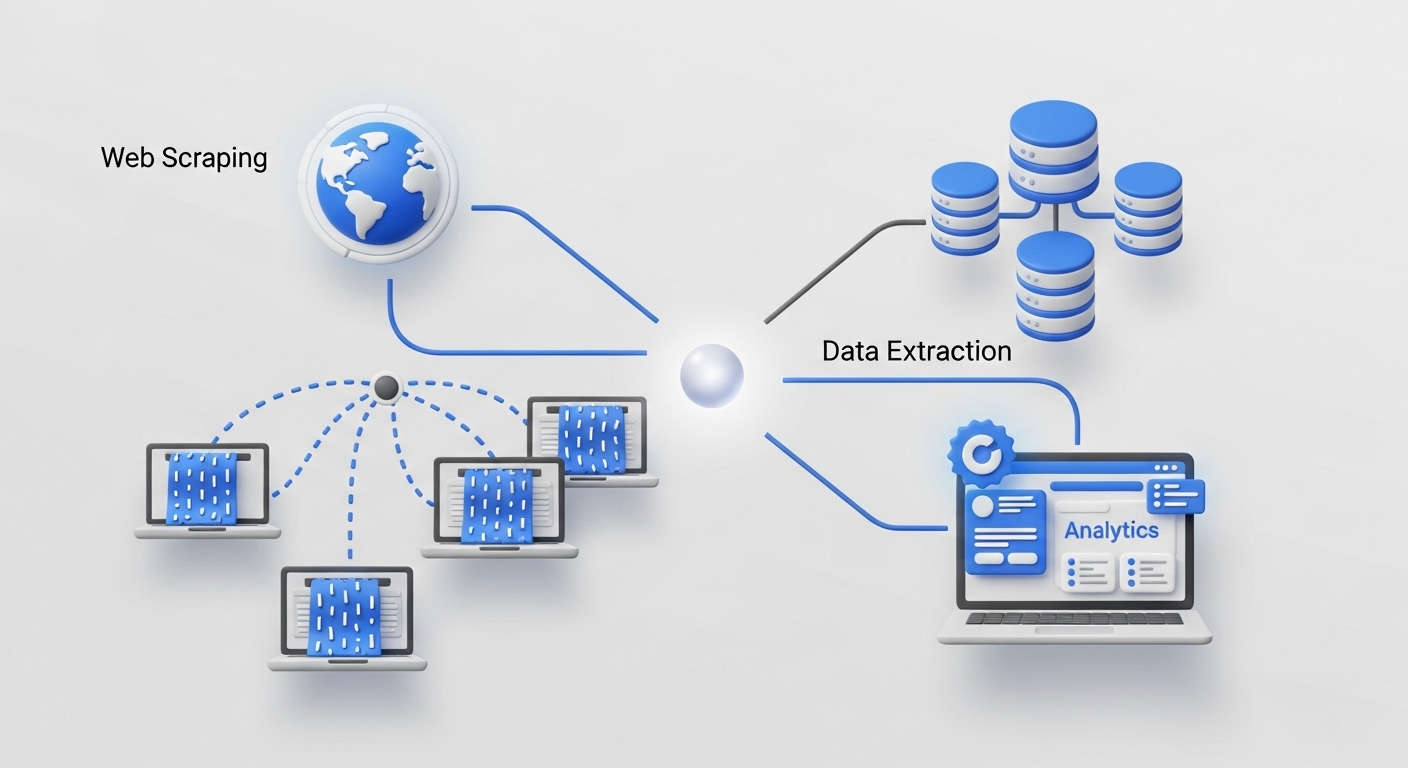
Data extraction is the umbrella term: any process that pulls data out of a source and into a usable structure, whether that source is a database, an API, a folder of PDFs, or a website. Web scraping is one branch of that umbrella, the branch that collects data from websites by fetching pages and parsing what they contain. Every scraping project is a data extraction project. Most data extraction projects inside a company never involve a scraper.
| Dimension | Web scraping | Data extraction (broad) |
|---|---|---|
| Source | Public web pages | Databases, APIs, files, documents, web |
| Access | HTTP requests, browsers | SQL, API keys, connectors, exports |
| Typical tools | Scrapy, BeautifulSoup, Playwright | SQL, ETL/ELT platforms, API clients |
| Main friction | Anti-bot systems, layout changes | Schema mapping, system permissions |
Why the terms blur in practice
Vendors blur them because “data extraction services” sounds broader and “web scraping” sounds technical. Teams blur them because the deliverable looks identical from the outside: a clean table of records. The difference lives upstream, in how hard the source fights back and who controls access. DataFlirt uses both terms deliberately: scraping for web-sourced collection, data extraction for the full discipline, and the scoping call always establishes which one a project actually is.
Where your data lives decides the method
Start from the source, not the tool. The location of the data answers most of the web scraping vs data extraction question before anyone writes a line of code, and it is the first thing DataFlirt maps in a scoping session.
Public web pages: scraping territory
If the data exists only as rendered pages on someone else’s site, web scraping is the method, full stop. Most teams arrive with specific targets rather than “web data” in the abstract: an Amazon scraper for marketplace pricing, a Flipkart scraper for Indian retail, an Indeed scraper for job postings, a Zillow scraper for property listings, or a Booking scraper for hotel rates. DataFlirt maintains hundreds of these source-specific scrapers, which is why a new feed usually starts from a working baseline instead of a blank repo.
Internal systems and files: classic extraction
Data sitting in your own CRM, ERP, or document archive needs no scraper. This is the world of SQL queries, exports, and the ETL pipeline: extract from the source system, transform into a target schema, load into a warehouse. If a vendor proposes scraping your own systems, walk away. The honest answer here is connectors and pipelines, and sometimes data migration tooling when legacy systems lack clean exports.
APIs: the middle path
An official API is data extraction without the adversarial part. The provider hands you structured data under documented rules, which makes APIs the default whenever they genuinely cover your need. The catch is coverage: many APIs omit the fields that matter, cap volumes far below business needs, or price per call until the bill dwarfs a scraping pipeline. Understanding how scraping APIs work helps you spot when an “API” is really a managed scraper underneath.
How the techniques differ in practice
The methods feel different the moment work begins. Scraping is parsing and access management. Broader extraction is schema mapping and credentials. Knowing which kind of work you are buying keeps quotes comparable.
Parsing pages on the scraping side
A scraper fetches HTML and pulls fields out of it using CSS selectors or XPath expressions, with a headless browser added when pages render through JavaScript. The open-source stack is mature: Scrapy for crawling at volume, BeautifulSoup for parsing (our BeautifulSoup tutorial walks through it with working code), and Playwright for browser automation. DataFlirt builds on exactly this stack, which keeps client pipelines portable and license-free.
Queries, connectors, and ETL on the extraction side
Internal extraction replaces parsing with querying. SQL pulls records, API clients page through endpoints, and transformation logic reconciles formats, a process that often turns into data wrangling when sources disagree about what a customer or an order is. No anti-bot systems, no layout changes, but plenty of permissioning and schema politics. The skill set is data engineering rather than scraping engineering, and the two are not interchangeable hires.
What lands on your desk
Both paths should end in the same place: structured, deduplicated records with timestamps and source attribution. Scraped data needs more cleanup on the way there because websites are built for eyeballs, not schemas. Prices arrive as strings with currency symbols, availability arrives as free text, and names arrive with encoding artifacts. DataFlirt treats normalization as part of the deliverable, not an upsell, so the dataset you receive is the dataset you query.
When web scraping is the right call
Web scraping earns its complexity when the data you need lives on websites you do not control and no API will sell it to you. That covers more business questions than most teams expect.
Competitor and market data you do not own
Competitor prices, product catalogs, promotions, and stock levels exist only on competitor sites and marketplaces. This is the core of price scraping and the reason ecommerce teams treat scraped feeds as standard infrastructure. The same logic powers competitive intelligence datasets built from review platforms and company pages, where a G2 scraper or a Crunchbase scraper reads signals no internal system holds. DataFlirt’s ecommerce scraping service packages the retail version of this end to end.
Signals no API will sell you
Some data has no commercial feed at any price: a competitor’s careers page, niche classifieds, regional directories, or the long tail of customer reviews scattered across platforms like a Yelp scraper or a Tripadvisor scraper can reach. For market research in these gaps, scraping is the only collection method that exists. When clients bring DataFlirt a source nobody packages, that absence is usually the point: unpackaged data is where the edge still lives.
When extraction without scraping wins
Sometimes the honest recommendation is no scraper at all. DataFlirt makes that call in scoping more often than a scraping vendor is supposed to admit, because a client steered to the cheaper right answer comes back with the harder project later.
Your own systems already hold the answer
Questions about your customers, sales, and operations belong to internal extraction. The work is choosing the right database or warehouse target and building reliable pipelines into it. Scraping your own rendered dashboards instead of querying the database underneath them is a real anti-pattern we still see, and it produces fragile pipelines for data you already own.
An official API exists and covers your fields
When a platform offers an API that includes your fields at a workable price and volume, take it. It is more stable than any scraper, and it removes the terms-of-service question entirely. The evaluation takes an afternoon: list your required fields, check them against the API docs, price your volume, and only reach for scraping where the API falls short. DataFlirt runs this exact check during scoping and has shipped plenty of projects that mix API pulls for covered fields with scraping for the rest.
Challenges nobody budgets for
Whichever method wins, the failure modes are knowable in advance. Scraping has the adversarial ones, extraction has the organizational ones, and both have data quality.
Anti-bot defenses on the scraping side
Defended sites combine rate limiting, browser fingerprinting, and CAPTCHA challenges, and cheap requests from datacenter IPs get flagged first. Sustained collection needs rotating proxies, request pacing, and monitoring, which is the gap between a script that worked once and a feed that works in March. Our guide to choosing a proxy service covers the access layer; DataFlirt treats it as core engineering and sizes it to the target rather than defaulting to the priciest option.
The legal question, answered honestly
Is web scraping legal? For publicly accessible, non-personal data collected without logging in, US courts have answered yes under the Computer Fraud and Abuse Act, anchored by hiQ v. LinkedIn and the Supreme Court’s Van Buren decision. Real boundaries remain: terms of service create contract risk, especially behind logins; copyright limits reproducing editorial content; and personal data triggers GDPR, CCPA, and India’s DPDP Act even when it is public. Our piece on web crawling legality goes deeper, and the standing advice holds: this is orientation, so review your specific sources with qualified counsel. DataFlirt scopes projects inside these lines by default, collecting logged-off and excluding personal fields unless a lawful basis exists.
Data quality in both worlds
Scraped data drifts because sites redesign; extracted data drifts because source systems change schemas. Either way, a feed without validation rules, deduplication logic, and freshness checks degrades silently until someone makes a bad decision on it. DataFlirt ships quality gates as part of every pipeline, including record-count anomaly alerts, because a feed that fails loudly is worth more than one that lies quietly.
Delivery formats and storage that keep data usable
Collection is half the project. The other half is landing the data where your team can actually use it, in a format matched to the consumer rather than to habit.
| Format | Best for | Watch out for |
|---|---|---|
| CSV | Spreadsheets, quick analysis | No nesting, breaks on commas in text |
| JSON | Applications, nested records | Analysts need tooling to query it |
| Database/warehouse | Recurring feeds, BI dashboards | Needs schema design up front |
Matching format to the consumer
A pricing analyst living in Excel wants CSV. A product team wiring data into an app wants JSON with clean JSON parsing guarantees. A BI stack wants rows landing in Postgres, BigQuery, or Snowflake on a schedule, with no human in the loop. DataFlirt delivers all three and also turns recurring feeds into live API endpoints when software, not people, is the consumer. The format conversation happens at scoping, not at handoff, because retrofitting delivery is wasted spend.
Deciding your path
The decision compresses to three questions. Is the data in systems you control? Use extraction tooling and pipelines. Is it behind an official API that covers your fields at a workable price? Use the API. Does it exist only on public web pages? Then web scraping is the method, and the real choice becomes build versus buy.
Building in-house makes sense when scraping is close to your product’s core and you have engineers to spare for permanent maintenance. For everyone else, the math favors a partner: DataFlirt runs the crawlers, the proxies, and the upkeep, and delivers data extraction as a finished dataset rather than an engineering project. If web scraping is new to your team, start with what web scraping is, then bring the actual question to us.
Talk to DataFlirt with the decision you are trying to make and the sources you suspect hold the answer. Most projects are scoped within 48 hours, and we will tell you plainly whether scraping, an API, or a simple export is the right path, then prove it with a sample dataset before you commit budget.
Frequently asked questions
What is the difference between web scraping and data extraction?
Data extraction is the umbrella term for pulling data out of any source: databases, APIs, documents, and web pages. Web scraping is the subset that collects data from websites by fetching pages and parsing their HTML. Every web scraping project is a data extraction project, but most data extraction work inside companies never touches a scraper.
When should I use web scraping instead of an API?
Use an official API whenever one exists, covers the fields you need, and allows your volume, because it is more stable and contractually cleaner. Web scraping becomes the right tool when no API exists, the API omits the fields you care about, or rate limits and pricing make it unusable at your scale.
Is web scraping legal for business use?
Collecting publicly accessible, non-personal data without logging in has solid legal footing in the US after hiQ v. LinkedIn and Van Buren v. United States, but terms of service, login walls, copyright, and privacy laws such as GDPR and India’s DPDP Act still apply. Treat this as orientation and review your specific sources with qualified legal counsel.
What tools are used for web scraping and data extraction?
Scraping work leans on open-source libraries such as Scrapy, BeautifulSoup, and Playwright, plus proxy infrastructure for access. Broader data extraction relies on SQL, API clients, and ETL or ELT tools that move data between systems. DataFlirt builds its pipelines on the open-source stack, so clients never inherit a license fee.
Which delivery format should I ask for: CSV, JSON, or a database?
CSV suits flat, tabular data headed for spreadsheets, JSON preserves nested structures for applications, and direct database or warehouse delivery suits recurring feeds that your tools query automatically. DataFlirt delivers in all of these formats, and the right pick depends on who, or what, consumes the data.
How does DataFlirt decide whether my project needs scraping or another extraction method?
Scoping starts from the decision you need to make, then maps backward to sources. If the data sits on public websites, DataFlirt designs a scraping pipeline. If an official API or export covers it, DataFlirt will say so and build around that instead, because the goal is the dataset, never the method.