
Why Marketing Teams Are Still Flying Blind
Most marketing analytics stacks look impressive on paper. A CRM, a BI tool, maybe a CDP. What they don’t have is a live feed of what’s happening outside the firewall - what competitors are charging today, what customers are saying about a rival product on review platforms this week, what topics are quietly gaining traction in the forums where your buyers hang out.
The reason is simple: that data lives on other people’s websites, and fetching it manually doesn’t scale. A merchandising analyst tracking 200 competitor SKUs across four retailers is spending twenty hours a week on a job that should take twenty minutes. A content strategist checking competitor blog cadence by hand is always working from a mental snapshot, not current reality.
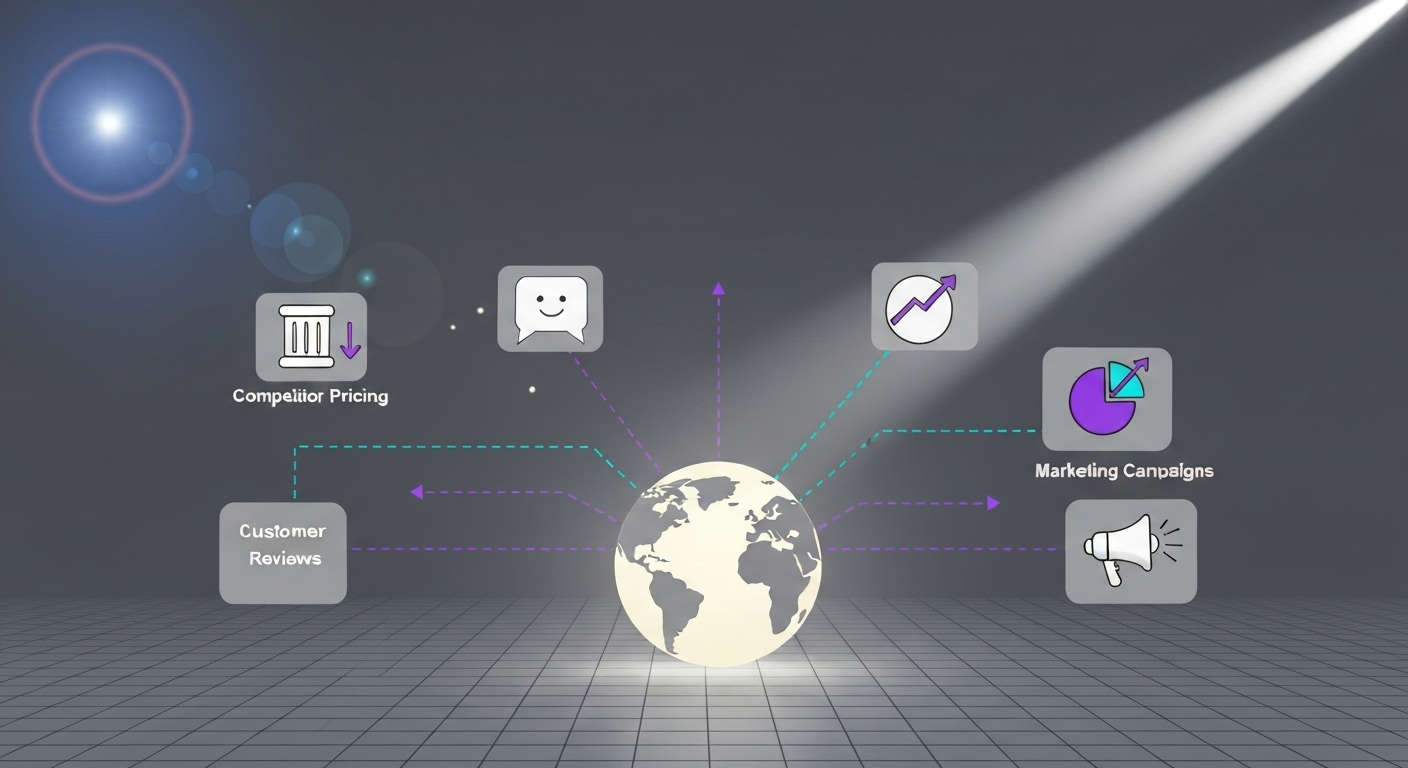
This is the gap web scraping closes. It automates the collection of structured data from public web sources - competitor pages, review platforms, news sites, app stores, social feeds - and delivers it on a schedule, in a format your analytics tools can actually use. The result isn’t just time saved. It’s a qualitatively different kind of intelligence: continuous, consistent, and comparable over time rather than collected in occasional manual bursts.
According to Mordor Intelligence’s 2025 web scraping market report, the price and competitive monitoring use case is the fastest-growing segment of the market, expanding at a 19.8% CAGR. Marketing-driven demand - competitor tracking, review mining, sentiment analysis - is a significant part of that growth, and for good reason. The teams already doing it have a structural information advantage over those that aren’t.
This post covers what that advantage looks like in practice across the three highest-ROI use cases: competitor price monitoring, customer review intelligence, and social/forum sentiment tracking. It also covers the two real obstacles - data quality and legal compliance - that determine whether your scraping setup lasts three weeks or three years.
The Three Use Cases That Actually Move the Needle
Not every data source is worth scraping. The most valuable targets for marketing teams are those where the data is public, changes frequently enough to matter, and connects directly to a decision you’re making. Three categories consistently deliver the clearest ROI.
Competitor Price and Promotion Monitoring
Pricing is the fastest-moving variable in most markets. A competitor running a flash sale, a new entrant undercutting by 15%, or a market leader quietly dropping prices on a category you anchor on - all of these events have marketing implications that go beyond repricing. They affect messaging, ad spend allocation, promotional timing, and margin defense strategy.
Manual monitoring can’t keep pace. Consider a catalogue manager tracking 500 SKUs across five competing retailers. Even a daily spreadsheet check is a multi-hour task, and prices can change multiple times in a day on high-velocity categories. Automated scraping changes the equation entirely: a scheduled job runs every few hours, normalizes the data into a comparison table, and flags changes above a threshold for review.
The data you want to pull from competitor pages goes beyond the displayed price. Structured extraction should capture the promotional badge (if any), the original price for calculating discount depth, the stock status, and - where visible - the delivery promise. Together these signals tell you not just what a competitor is charging but whether they’re in a promotional push, clearing inventory, or reacting to margin pressure.
For ecommerce teams, this feeds directly into dynamic repricing workflows. For brand and content teams, it informs whether a “best value” angle is defensible right now or whether a different differentiator - quality, service, assortment depth - needs to carry the message. DataFlirt’s ecommerce scraping service handles the extraction layer here, maintaining scrapers for specific retailer and marketplace pages so your team can focus on the pricing strategy rather than the pipeline maintenance.
Relevant sources for competitor price scraping, depending on your category, include:
- General marketplaces: Amazon scraper, eBay scraper, Google Shopping scraper, Temu scraper
- Fashion and apparel: Zara scraper, ASOS scraper, Zalando scraper, Myntra scraper, Shein scraper
- Consumer electronics: Best Buy scraper, Target scraper
- Home and furniture: Wayfair scraper, Etsy scraper
Each of those sites deploys different anti-bot defenses - rate limiting, JavaScript rendering, browser fingerprinting, and CAPTCHA challenges at varying frequencies. A scraper that works reliably against one won’t necessarily handle another without modification, which is why maintaining a multi-source price monitoring setup has real ongoing engineering overhead.
Customer Review Intelligence
Customer reviews are the most underused data asset in most marketing teams’ reach. They’re public, they’re detailed, and they’re written by real buyers describing exactly what they value, what frustrated them, and what made them choose one product over another.
The challenge is scale. A product with a thousand reviews across Amazon, G2, Yelp, and the App Store is not something a human analyst can systematically process. But scraped and structured, that corpus becomes a queryable dataset. You can calculate an NPS proxy by category, track average star ratings over time, cluster complaints by topic (shipping, packaging, product quality, customer service), and surface the language real buyers use - which is often quite different from the language in your own marketing copy.
This connects directly to a few high-value marketing actions:
Messaging refinement. If 40% of negative reviews mention a problem your product doesn’t have, that’s a positioning angle. If buyers consistently praise a feature in their own words, those words belong in your ad copy, not the sanitized version from your brief.
Competitive gap analysis. Scraping reviews on competing products - not just your own - surfaces the unmet needs your product could address. A cluster of reviews saying a competitor’s software is “powerful but too complex for our team” is a clear signal for a “built for non-technical teams” positioning angle.
Product development input. Marketing teams with access to review data become a legitimate input to the product roadmap, backing requests with quantified signal rather than anecdotal customer calls.
DataFlirt’s reviews scraping service covers the full range of review platforms. For software products, the priority sources are typically the G2 scraper, Capterra scraper, and GetApp scraper. For consumer products, the Amazon scraper and Yelp scraper are usually the starting point. App-store reviews - increasingly a channel for unfiltered buyer sentiment - are accessible through the Google Play Store scraper.
A note on data quality here: review scraping surfaces noise as well as signal. Fake reviews, review bombing, and platform manipulation are real. Any serious review analytics setup needs deduplication, outlier handling, and ideally a credibility filter (review age, reviewer history where visible) before the data goes into a model or dashboard.
Social and Forum Sentiment Tracking
Review platforms give you structured feedback. Social media and forums give you something different: unprompted, real-time, often unfiltered opinion. The signal-to-noise ratio is lower, but the latency is much shorter - conversations about a product launch, a PR incident, or an emerging competitor capability often surface on Reddit, LinkedIn, and industry forums days or weeks before they show up in reviews or search trends.
Sentiment analysis on scraped social data is a well-established use case in marketing analytics, but “social sentiment” covers a wide range of data types with different scraping characteristics:
| Source | Signal type | Scraping complexity |
|---|---|---|
| Reddit threads and comments | Long-form opinion, buyer intent signals | Moderate - rate limits, pagination |
| LinkedIn posts and comments | Professional/B2B sentiment, competitor hiring signals | High - login walls, aggressive anti-bot |
| Review site forums (G2, Trustpilot) | Structured competitor feedback | Low-to-moderate |
| Industry news comments | Topic-level awareness, influencer opinion | Low |
| App store reviews | Short-form, mobile-user sentiment | Low |
For most marketing teams, the highest-value starting point is aspect-based sentiment tracking on review platforms and industry forums - sources that are public, consistently structured, and legally lower-risk than social media APIs with restrictive ToS. This gives you topic-level sentiment scores (pricing, onboarding, support, specific features) rather than an aggregate star rating, which is far more actionable for messaging and positioning decisions.
The brand monitoring scraping guide covers the platform landscape in more detail. For social analytics specifically, DataFlirt’s SEO data service and news scraping service handle the extraction of signals across public web sources including news sites, industry publications, and accessible forum content.
What Gets in the Way (and How to Deal With It)
The concept of web scraping for marketing analytics is easy to agree with. The execution is where teams run into trouble. Two categories of problems cause most pipelines to fail: data quality and legal/technical friction.
Data Quality: Garbage In, Wrong Decisions Out
The output quality of a scraper is entirely dependent on the quality of what was extracted and how it was cleaned before analysis. A few common failure modes in marketing analytics scraping:
Stale data treated as current. A scraper that ran successfully last week may be pulling cached pages, previously rendered content, or failed requests that returned a default page rather than the actual product data. Without a data freshness check built into the pipeline, stale data can propagate into dashboards silently.
Inconsistent structure across sources. Price data from five different retailers formats the same concept - “the price a customer pays today” - in at least five different ways: with and without tax, with and without delivery, in different currencies, as a range for variable products, hidden behind a “see price in cart” flow. Normalization logic needs to handle every variant, not just the clean cases.
Incomplete records from partial page loads. Many ecommerce pages load prices, reviews, and promotional badges via JavaScript after the initial HTML response. A scraper that only reads static HTML will miss them entirely. A headless browser solves this but at higher infrastructure cost and slower throughput - a trade-off that depends on which sites you’re monitoring. For guidance on this, see DataFlirt’s post on challenging scraping tasks.
Deduplication failures. Review scraping across multiple platforms frequently returns the same review posted by the same customer to multiple sites. Without deduplication, sentiment analysis treats these as independent signals and inflates counts for the most cross-posted reviews.
At DataFlirt, validation and deduplication are built into the extraction layer rather than left to the client’s downstream cleaning. That matters because a data quality problem that reaches your BI tool requires manual remediation; one caught at source doesn’t. The data quality principles that apply to scraped datasets are worth reading before designing any marketing analytics pipeline.
Legal and Technical Friction
This is the elephant in the room for web scraping in marketing contexts, and any post that glosses over it is doing you a disservice.
The legal picture. Web scraping law in 2025 is genuinely unsettled. The hiQ v. LinkedIn litigation in the US established that scraping publicly accessible data is not a violation of the Computer Fraud and Abuse Act - but that ruling covers CFAA, not copyright, database rights, or contract law through Terms of Service. Different jurisdictions treat the collection of public web data differently, and ToS violations - while typically civil rather than criminal - can result in injunctions, account termination, and reputational risk. The honest guidance here: scraping publicly accessible data that doesn’t contain personal information is generally lower-risk; scraping behind login walls, scraping at high volume against explicit ToS prohibitions, and scraping data that includes personal details (covered by GDPR or CCPA) carries real risk. For anything beyond basic public pricing or review data, consult legal counsel before building the pipeline.
Anti-bot defenses. Sites that care about their data spend considerable engineering effort preventing automated access. The current generation of defenses includes rotating proxy detection, browser fingerprinting, behavioral analysis (mouse movement patterns, scroll behavior, request timing), and CAPTCHAs. Defeating these reliably requires a combination of residential proxy rotation (to vary IP reputation), headless browser execution with realistic browser profiles, and careful scraping frequency management to stay below detection thresholds.
The practical implication for marketing teams: the sites you most want to monitor are often the ones with the most sophisticated defenses. Amazon, Google Shopping, and major social platforms have bot-mitigation infrastructure that makes reliable scraping technically demanding. The proxy selection guide covers the proxy layer in detail.
DataFlirt maintains scrapers against these defended targets as a managed service. The engineering required to keep a scraper running reliably against a target that actively updates its defenses is significant; for most marketing teams, that’s not a core competency worth building internally.
Turning Raw Data Into a Marketing Intelligence Feed
Scraping is the extraction step. What happens to the data afterward determines whether it delivers value or accumulates in a folder somewhere.
A minimal working setup for competitive intelligence has four layers:
Extraction. Scheduled scrapers running against your defined target set - competitor pricing pages, review platforms, relevant news and forum sources - on a cadence matched to how frequently that data changes. Pricing pages for high-velocity categories might need to run every few hours; review sentiment analysis on a weekly or biweekly cadence is usually sufficient.
Transformation and cleaning. Normalization of formats, deduplication, outlier flagging, and enrichment (e.g., tagging reviews by product line or feature area). This is often the most underestimated step. Budget time for it.
Storage. The right choice depends on your downstream use. For analyst-driven workflows, a SQL database makes data explorable and queryable without engineering support. For large-scale unstructured text (reviews, social posts), a NoSQL or document database handles variable schema better. For one-off analysis, structured CSV or Excel export is often the simplest path. DataFlirt delivers to whichever format your stack uses - CSV, JSON, Excel, SQL, or NoSQL - based on the project requirements.
Activation. Getting the data into the tools where decisions get made. That might be a BI dashboard showing competitor pricing trends alongside your own, a spreadsheet that flags SKUs where you’re priced more than 10% above market, or an automated alert when a competitor’s average review score drops, signaling an opportunity to lean into comparisons. The real-time data pipeline glossary entry covers the infrastructure considerations if you’re building the activation layer in-house.
DataFlirt’s post on what business teams actually do with scraped data covers these activation patterns in more depth, with specific examples across ecommerce, content, and demand-generation teams.
Who Builds This and Who Buys It
This is a decision that marketing and data teams face early, and it’s worth being direct about.
Building your own scraping pipeline gives you maximum control over data freshness, source selection, and format. The engineering investment is real: scraper development for a handful of defended targets takes weeks, not hours, and ongoing maintenance - as sites update their structure and defenses - is a recurring cost. Teams with a dedicated data engineer who has web scraping experience are positioned to build and own this infrastructure. Teams that don’t have that capacity, or where the data engineer’s time is better spent on other problems, typically find managed scraping services deliver better ROI.
The build vs. buy framing depends largely on two variables: the number of distinct target sites you need to cover, and how frequently those sites change their structure. A single competitor with a stable, simple pricing page is a reasonable DIY project. Monitoring 30 SKUs across 15 ecommerce sites with varying anti-bot sophistication is an ongoing engineering commitment.
DataFlirt’s managed scraping service is the right choice when you want the data without the maintenance overhead. You specify the sources, the fields, the delivery schedule, and the format - and the pipeline keeps running even when target sites change their structure. For a discussion of your specific use case, the web scraping services overview is the starting point.
Getting Started: A Practical Sequence
If your team hasn’t done any competitor data collection through scraping before, the highest-ROI entry point is usually pricing. It’s concrete, immediately actionable, and easy to measure. Here’s a sensible starting sequence:
Step 1 - Define your data targets. List the specific competitor URLs you want to monitor: product listing pages, pricing pages, promotional banners. Keep the initial scope narrow - five to ten URLs across two or three competitors. You can expand once the pipeline is validated.
Step 2 - Decide on cadence. For most marketing analytics use cases, daily extraction is sufficient. If you’re in a category where prices change intraday (consumer electronics, airlines, fast fashion flash sales), hourly makes sense. Cadence drives infrastructure cost, so be deliberate.
Step 3 - Choose build or buy. If you have Python competency in-house, a simple static-site scraper using BeautifulSoup can cover a basic initial use case. For JavaScript-heavy sites or any target with meaningful anti-bot defenses, the investment required moves significantly higher. DataFlirt is worth a conversation at that point.
Step 4 - Define your activation. Where does this data need to land for it to change a decision? A shared dashboard, a weekly pricing report, an alert channel? Build that before you build the scraper, or you’ll extract data nobody looks at.
Step 5 - Add review and sentiment data once pricing is running. Review mining from platforms like G2, Yelp, Capterra, Tripadvisor (for hospitality brands), or finance-related platforms adds a qualitative layer to the competitive picture. Scraping reviews is structurally simpler than real-time pricing, but the analysis layer is more complex. DataFlirt’s sentiment analysis guides cover the analysis methodology in detail.
Conclusion: The Information Advantage Is Structural
Web scraping for marketing analytics isn’t a tactical shortcut. It’s a structural capability that compounds over time. A team that has been tracking competitor pricing for twelve months has trend data that a team starting today won’t have for another year. A brand that has been mining review sentiment across its category has a product messaging understanding that can’t be replicated from a quarterly NPS survey.
The alternative data for ecommerce post makes this point well: the companies that are hard to displace in their categories aren’t just better at marketing execution. They’re better informed, and they got that way by building systems that collect and act on data their competitors don’t have.
Getting started is less about the technology than about deciding which questions you need your data to answer. Competitor pricing trends, customer pain point language, emerging category signals - pick one, build a focused pipeline around it, and validate the value before expanding. That’s how sustainable competitive intelligence programs get built, and it’s what separates marketing teams that are genuinely data-driven from those that just describe themselves that way.
DataFlirt handles the scraping and data delivery layer for teams that want the intelligence without the engineering overhead. Explore the ecommerce scraping service and reviews service as starting points, or contact us to discuss a setup matched to your specific targets and cadence.
Frequently Asked Questions
How can businesses effectively monitor competitor pricing strategies?
Automate collection with a scheduled scraper that pulls pricing pages, product listings, and promotional banners on a set cadence - hourly for fast-moving categories, daily for most markets. Feed the output into a comparison dashboard so your team sees gaps and opportunities in near real time rather than discovering them a week later.
What are the key challenges in collecting accurate market data for marketing analytics?
The main challenges are legal compliance (data collection laws vary by jurisdiction and ToS terms differ per site), data quality (incomplete or stale records skew every downstream decision), and anti-bot defenses (CAPTCHAs, JavaScript rendering, fingerprinting, IP bans) that require rotating proxies and headless browsers to navigate reliably.
How can social media sentiment analysis improve marketing campaigns?
Scraped social and review data gives you a continuous signal on what customers actually say about your brand and your competitors - not what a quarterly survey suggests. Feed that data into a sentiment pipeline to track topic-level scores over time. When a competitor’s score dips on shipping speed or a new product feature earns praise, you can adjust positioning and messaging fast.
What types of data are most valuable for refining product offerings and marketing messages?
The most actionable data points are competitor pricing (to set and defend your own margins), customer reviews from platforms like Amazon, G2, Yelp, and app stores (for NPS proxies and pain-point mining), product specs and availability (to spot gaps in assortment), and social/forum discussion (to surface emerging demand signals before they hit mainstream reporting).
How can businesses overcome website restrictions when trying to gather competitive intelligence?
Use rotating residential proxies to vary your IP footprint, headless browsers to execute JavaScript and render dynamic pages, realistic request intervals to avoid rate-limit signatures, and proper session handling. Always check the target site’s robots.txt and terms of service - some restrictions are enforceable and violating them carries legal risk.
How can DataFlirt’s web scraping solutions help improve my marketing ROI?
DataFlirt builds and maintains custom scrapers for the specific sites your marketing team actually monitors - ecommerce marketplaces, review platforms, news sources, social channels. You get structured, deduplicated data delivered on your schedule to your preferred format or database, without maintaining the pipeline yourself.
What kind of data delivery formats and storage solutions does DataFlirt offer for scraped marketing data?
DataFlirt delivers data as CSV, JSON, or Excel files and can write directly to SQL or NoSQL databases. The right choice depends on your stack - CSV and Excel for analyst-driven workflows, JSON for direct pipeline ingestion, SQL for query-heavy analytics setups, and NoSQL when you need schema flexibility for unstructured review and social data.
How does DataFlirt ensure data accuracy and compliance when performing web scraping for marketing analytics?
DataFlirt applies validation and deduplication at the extraction layer so bad records don’t propagate downstream, and operates within the legal and ToS framework of each target site - advising clients when a data request carries compliance risk rather than just executing it blindly.