
The Pricing Gap That Quietly Costs Small Retailers
You check a competitor’s site manually on Monday morning, note a few prices, update your own sheet, and move on. By Wednesday they’ve run a flash promotion. By Thursday their category-leading SKU is back in stock after a week-long gap. You find out on Friday, if you find out at all.
This isn’t a discipline problem. It’s a frequency problem. A human can refresh a dozen competitor pages a few times a week — a scraper can do it hourly across hundreds of SKUs. The difference between those two tempos is the difference between reactive pricing and pricing that actually leads.
The numbers support how expensive the reactive mode gets. According to data cited by Firework, 43% of small businesses either don’t track inventory at all or rely on outdated manual systems — and poor inventory management costs the average business up to 11% of annual revenue from stockouts and overstock combined. Separately, global stockout losses across retail exceed $1 trillion annually, with 69% of shoppers who hit an out-of-stock item buying from a competitor instead.
Automated web scraping doesn’t solve every retail problem. But for two specific problems — knowing what competitors are charging and knowing what they have in stock — it’s the most direct tool available, and it scales in a way that spreadsheet-based monitoring never will.
What “Automated” Actually Means Here
Automated web scraping for retail means a scheduled process that visits competitor product pages, pricing aggregators, and review platforms on a defined cadence, extracts the structured fields you care about (price, availability, review score, promotion flags), and delivers them to wherever your team can act on them — a CSV drop, a JSON feed, or a direct database write.
The automation isn’t the interesting part. The interesting part is what you do with consistently fresh data. That’s what the rest of this post covers.
What Data Actually Moves the Needle for Small Retailers
Before setting up any scraping pipeline, it’s worth being precise about which data types pay off versus which ones generate noise.
Competitor Pricing: The Highest-Signal Feed
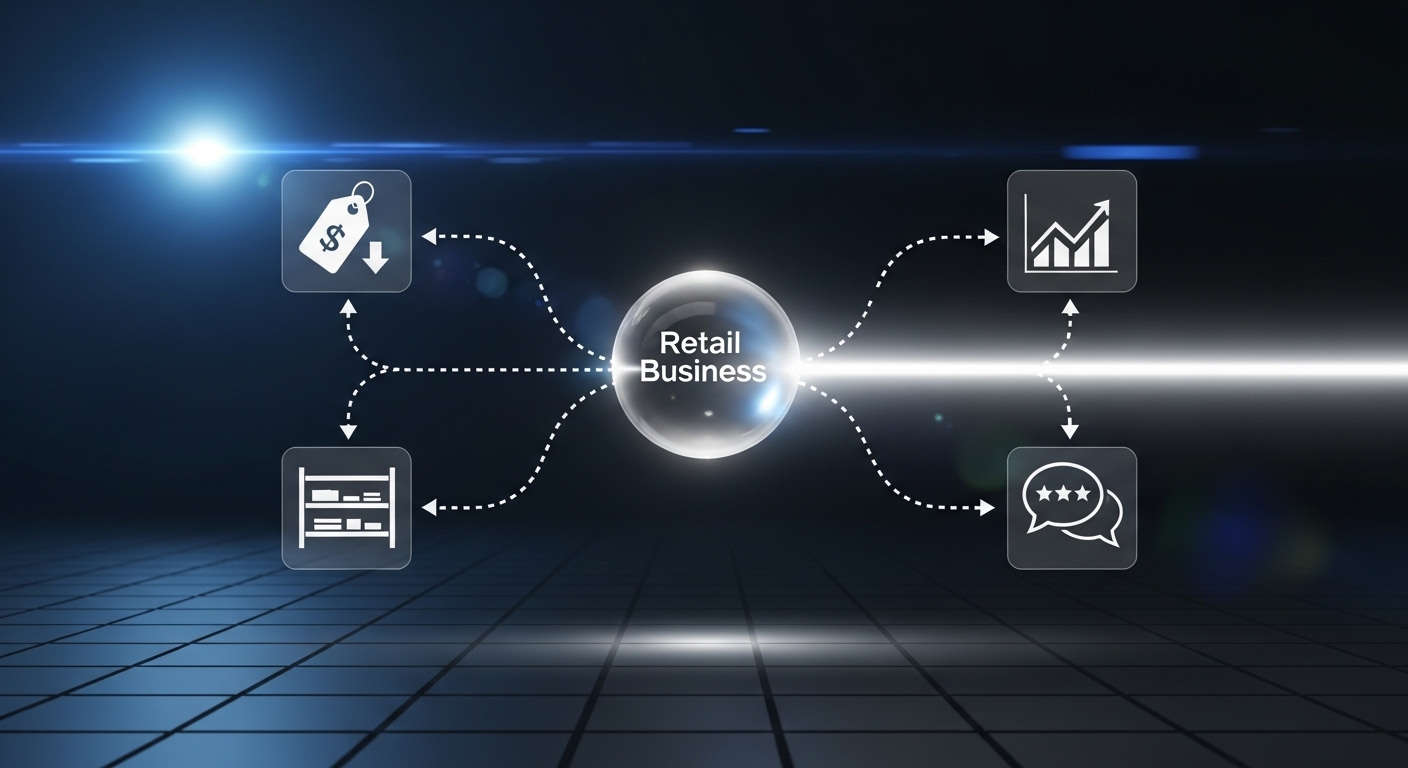
For most small retailers, live competitor prices are the single highest-value scraped dataset. Consider a catalogue manager tracking 200 SKUs across three direct competitors plus a marketplace like Google Shopping. Without automation, that’s 600+ manual price checks per cycle, typically done weekly — which means you’re operating on a 7-day lag against real market movement.
A well-structured price scraping setup pulls those same 600 data points daily (or hourly during peak periods like holiday weekends) and writes them to a table where your pricing team can see deltas at a glance: which items competitors discounted since yesterday, by how much, and on which channels. That’s the input that makes dynamic pricing decisions possible for a team without a dedicated data analyst.
For a practical walkthrough of how to structure this kind of feed, DataFlirt’s retail price scraping guide covers the field-level detail.
Product Availability: The Inventory Intelligence Layer
Competitor stock status is underused by small retailers. When a rival goes out of stock on a popular item, that’s a demand signal — their shoppers are now looking elsewhere, and if you carry the same or a close substitute, the window is live. Scrapers that track availability fields alongside prices give you this signal automatically.
The same logic applies to your own supply chain planning. If you monitor your key suppliers’ B2B product pages or distribution partner portals, scraping their availability data tells you about incoming shortages before they hit your purchase orders.
DataFlirt builds availability-tracking pipelines for retailers using a combination of product variant scraping to capture size/color/configuration availability and data freshness monitoring so you always know how recent your availability data is.
Review Aggregation: Where Customer Sentiment Lives
Customer reviews scattered across Google Shopping, category-specific platforms, and retailer sites contain the most direct language buyers use when deciding whether to purchase. For a small retailer, scraping reviews for your own products (across platforms) and your competitors’ equivalent SKUs gives you:
- Feature gaps: complaints that keep appearing about a competitor product are product improvements you can either make or highlight as already solved
- Pricing sentiment: reviews that mention price as a deciding factor tell you where in the value stack buyers are making decisions
- Stock-out frustration: “finally back in stock” or “waited weeks” reviews are demand-signal gold for category planning
DataFlirt’s review scraping service handles multi-platform aggregation with deduplication and sentiment tagging, so you’re not manually reading hundreds of reviews per week. For more on how review scraping connects to retail strategy, see the ecommerce reviews data post.
Market Trend Signals: Useful but Lower Priority
Industry reports, social listening, and news scraping can surface demand trends early, but they require more curation to turn into actionable retail decisions. For most small retailers, the right sequencing is: get pricing and availability tracking working first, use that data for two to three months to build a decision baseline, and then layer in trend monitoring once the core feeds are clean and trusted.
The Sites Worth Scraping (and How to Think About Coverage)
For a small retailer, the question of which sites to scrape is more strategic than it might appear. More coverage isn’t always better — what matters is covering the sites that actually drive purchasing decisions in your category.
Marketplace Price Feeds
The major marketplaces are the ground truth for market pricing in most retail categories. An Amazon product scraper gives you the live price, Buy Box status, and fulfillment type for any ASIN — critical context for retailers competing with marketplace listings. For fashion and apparel, an ASOS scraper or a Zara product feed tells you where fast-fashion pricing is anchored this season.
For retailers with India-facing inventory, Flipkart pricing data, Myntra, Nykaa, Ajio, and Meesho are the relevant ground-truth sources. DataFlirt maintains scrapers for all of these with structured price and availability output.
Direct Competitor Sites
Marketplace prices are one layer. Direct competitor sites — especially those with their own ecommerce storefronts — are another. A Target product scraper, a Nordstrom feed, or a Macy’s scraper captures pricing that sometimes diverges meaningfully from what those brands list on third-party marketplaces, particularly during site-exclusive promotions.
For footwear and sportswear, tracking Nike’s direct-to-consumer site alongside its marketplace listings reveals how the brand manages channel pricing — useful competitive context if you carry similar categories.
Cross-Border Comparison
If you sell internationally or compete with cross-border sellers, coverage should extend to eBay, Aliexpress, Temu, Shein, Lazada, and Shopee. These aren’t always direct competitive threats, but their pricing creates a price floor expectation in category-aware buyers that you need to understand. A Snapdeal feed or Overstock scraper rounds out coverage for specific categories.
For a broader look at what ecommerce scraping covers across channels, DataFlirt’s ecommerce web scraping service and the ecommerce use cases guide are good reference points.
The Technical Reality: What Actually Gets in the Way
Here is where most “how to use web scraping for retail” content gets vague. The practical obstacles are real, and they’re worth understanding specifically rather than dismissing with a wave at “rotating proxies.”
IP Blocking and Rate Limiting
Most retail sites deploy some form of rate limiting — requests above a threshold from the same IP get throttled or blocked outright. Major ecommerce sites like Amazon use layered detection that includes request frequency, session behavior, and header patterns. A naive scraper sending 100 requests per minute from a single datacenter IP will get blocked within minutes.
The reliable approach is rotating proxy infrastructure with residential or mobile IPs, combined with request pacing that mimics organic browse behavior — randomized delays, realistic HTTP headers, and session management. DataFlirt builds its retail scrapers on this infrastructure by default, which is why the pipelines it maintains keep running when a naive in-house scraper would have gone dark.
JavaScript-Rendered Prices
A significant portion of retail prices don’t appear in the raw HTML response — they’re loaded by JavaScript after page render, sometimes behind authentication-gated personalization layers. If you’re scraping with a basic HTTP client like Python’s requests library, you’ll often get a page skeleton with no actual price in it.
The standard solution is JavaScript rendering via a headless browser — Playwright or Puppeteer — that actually executes the page’s JavaScript and waits for the price element to appear in the DOM before extracting. This adds latency and infrastructure cost compared to a lightweight HTTP scraper, which is why it makes sense to use headless rendering selectively (only for sites that require it) rather than universally. DataFlirt’s pipeline architecture makes this selection automatically based on site behavior.
Terms of Service and Legal Grounding
This is the uncomfortable question most posts avoid: is scraping competitor pricing actually legal?
The honest answer is that it depends on what you’re scraping, how you’re scraping it, and whose jurisdiction applies. For publicly available pricing data — prices visible to any anonymous visitor — the legal picture in most jurisdictions is relatively clear: the hiQ v. LinkedIn line of cases in the US established that scraping publicly accessible data doesn’t automatically constitute unauthorized computer access under the CFAA. The EU’s Database Directive creates some IP protections for database compilations, but price monitoring has generally been treated as lawful competitive intelligence across member states.
What matters in practice:
- Scrape only publicly available data — no bypassing login walls, no bypassing CAPTCHA systems for data gated behind authentication
- Review the target site’s terms of service and document your review; some ToS prohibit automated access, and violating them creates civil liability even if not criminal
- Don’t collect personal data (names, emails, contact info) — that triggers GDPR, CCPA, and India’s DPDP Act in ways that pricing data doesn’t
- Respect crawl delay directives in
robots.txtas a good-faith gesture, even when they’re not legally binding
For a fuller treatment, DataFlirt’s legal guide to web crawling and GDPR scraping post cover jurisdiction-specific nuances. When your scraping program reaches significant scale, consult qualified legal counsel — this orientation is useful, but it isn’t a legal opinion for your specific situation.
DataFlirt operates within this framework on behalf of its clients and builds pipelines that scrape publicly available data via standard HTTP(S) requests, without bypassing access controls.
Data Quality Drift
Sites restructure. A class name changes, a page layout gets redesigned, a site migrates from one ecommerce platform to another — and your carefully built XPath selector silently returns empty strings instead of prices. Without active monitoring, you won’t notice until you trace a bad business decision back to a feed that stopped updating six weeks ago.
The solution is data accuracy monitoring built into the pipeline itself: schema validation on every extraction run, anomaly detection for sudden null rates or price distributions that fall outside expected ranges, and alerting when extraction failure rates exceed a threshold. DataFlirt’s QA layer handles this for every retail pipeline it runs — if a target site changes structure, the team rebuilds the extractor and validates the output before it reaches your data feed.
Building a Scraping Strategy That Actually Scales
A common failure pattern for small retailers who try web scraping is starting too broad: “let’s scrape everything from 20 sites.” Six weeks later the pipeline is unreliable, the dataset is messy, and the team has lost confidence in the data. The more effective approach starts narrow and expands deliberately.
Phase One: One Feed, One Decision
Pick a single, high-frequency decision that bad data is currently costing you. Most commonly this is pricing: you’re repricing weekly because daily data doesn’t exist, and that lag lets competitors undercut you between cycles. Build a scraping feed for that specific decision — one category, three to five competitor SKUs per product, daily refresh. Run it for 60 days and measure whether the pricing decision quality improves.
This is what DataFlirt calls a scoping engagement: a focused first pipeline with clean delivery that proves the ROI before expanding coverage. It’s a more honest way to evaluate whether scraping fits your workflow than spinning up a broad enterprise-grade setup on day one. If you want to talk through what this looks like for your specific category, reach out to DataFlirt for a scoping conversation — the team will tell you whether what you need is a custom pipeline or whether a lighter solution fits.
Phase Two: Add Inventory Signals
Once pricing data is flowing reliably, add availability tracking for the same SKU set. This doubles the signal without significantly increasing pipeline complexity, since you’re already visiting the same pages. The inventory layer is what turns a pricing feed into a demand intelligence feed.
For this phase, DataFlirt’s ecommerce product data service covers how to structure availability fields alongside pricing for clean downstream analysis.
Phase Three: Expand Coverage Thoughtfully
With a working, trusted two-feed pipeline, coverage expansion is a matter of adding sources that the data has already shown to be relevant — not adding sources because they theoretically might be useful. This is where the data-driven organization principles start to show up: you’re adding feeds that answer specific questions your pricing and inventory decisions have raised, not collecting data for its own sake.
DataFlirt’s scraping architecture is built horizontally — adding a new site to an existing client pipeline doesn’t require re-platforming. The crawling layer scales independently from the delivery layer, which means a pipeline that starts with 200 SKUs across 3 sites can expand to 20,000 SKUs across 30 sites without a rebuild.
Data Delivery: Getting the Output Into the Places Where Decisions Happen
A scraping pipeline is only as useful as the form its output takes. If your team makes pricing decisions in a Google Sheet, a weekly CSV drop works. If your pricing is handled by a repricing engine, a database write or webhook makes more sense. If you’re feeding marketing attribution models, a JSON API endpoint is likely the cleanest integration.
Common Delivery Formats
CSV and JSON are the two standard formats for structured scraped data. CSV is immediately consumable in any spreadsheet tool; JSON is more flexible for downstream processing and works naturally with most analytics stacks. DataFlirt delivers in both, and in JSON Lines format for large datasets where streaming delivery makes more sense than a monolithic file.
Direct database integration — writing scraped data to a Postgres, BigQuery, Snowflake, or MySQL table on a schedule — removes the manual import step entirely. For retailers with even a basic analytics setup, this is the format that makes scraped data a live operational feed rather than a periodic report.
Webhook and API delivery work well for pricing automation: when a competitor price drops below a threshold, the scraper triggers a webhook that feeds your repricing system in near-real time. This is the architecture behind the dynamic pricing operations that large retailers run, and it’s accessible at small-retailer scale with the right pipeline design.
For more on how data delivery frequency affects pricing decision quality, DataFlirt’s live price comparison scraping post covers the operational tradeoffs between real-time, hourly, and daily refresh cadences.
Integration with Existing Tools
One question DataFlirt hears from small retail clients is: does scraping require a data engineering team to operationalize? The honest answer is: less than you’d think, if the pipeline is built with your existing stack in mind. If your team lives in Google Sheets or Airtable, a scheduled CSV or Sheets API write is the right delivery mechanism. If you have a basic BI tool like Metabase or Looker, a database table is the right format. DataFlirt scopes delivery format in the initial client conversation so the output lands where your team can actually use it, not in a format that requires a separate integration project.
What DataFlirt Builds for Retail Clients
DataFlirt is a managed web scraping service that builds and maintains custom data pipelines for retail and ecommerce teams. Rather than giving you a self-serve tool that your team has to learn, configure, and fix when sites change, DataFlirt owns the pipeline: build, maintenance, schema-change recovery, QA, and delivery.
For retail specifically, DataFlirt maintains scrapers for the major marketplaces and direct-to-consumer sites most relevant to pricing intelligence — including Amazon, eBay, Flipkart, Google Shopping, ASOS, Myntra, Etsy, Gap, H&M, Poshmark, and Forever 21. DataFlirt also builds site-specific extractors for competitor pages that aren’t covered by pre-built scrapers, within the legal framework described above.
The standard retail engagement includes:
- A scoping call to identify the specific pricing and inventory decisions that need better data
- A sample dataset from the agreed sources before any payment commitment
- Delivery in the format that integrates cleanly with your existing stack
- Ongoing maintenance when source sites change structure — covered, not billed separately
- Price scraping countermeasure management built into the pipeline from day one
For teams weighing whether to build in-house versus outsource, DataFlirt’s outsourced vs. in-house scraping comparison gives an honest breakdown of where the hidden costs sit on the in-house side. The short version: building a scraper is the easy part. Keeping it running reliably when sites change — and validating that the output is clean — is where most in-house efforts lose momentum.
DataFlirt’s open-source foundation (Scrapy, Playwright, httpx, lxml, Pydantic for schema validation) means the pipelines are auditable and not locked into a proprietary extraction layer. If a client eventually wants to bring a pipeline in-house, the code is maintainable.
For a more detailed look at how vendor evaluation should work, DataFlirt’s scraping vendor checklist walks through the criteria that matter — reliability, schema maintenance, delivery SLAs, and QA practices.
Marketing Intelligence: The Third Use Case Worth Exploring
Pricing and inventory are the primary use cases, but for retailers running paid acquisition or SEO-driven growth, scraped data also improves marketing decisions in ways that are worth flagging.
Competitor review scraping surfaces the exact language buyers use to describe products in your category — language that often translates directly into high-converting ad copy or product description updates. If you scrape reviews for a competitor’s top-selling product and the top-cited complaint is “runs small,” that’s a product description improvement you can make today. If the top cited praise is “ships fast,” that’s a positioning claim you can test in your own ads if you match it.
For apparel retailers, scraping fashion portals for trend data — what styles are getting new listings, which categories are seeing price pressure — gives early signals for buying decisions. DataFlirt’s fashion retail scraping post covers how this works in practice.
The broader marketing analytics angle — how scraped data feeds attribution, campaign optimization, and audience targeting — is covered in DataFlirt’s marketing analytics scraping guide.
The Honest Assessment: When Scraping Doesn’t Make Sense
Web scraping for retail makes the most sense when: (1) your pricing is reactive because you lack data velocity, (2) you’re losing sales to stockout gaps that better competitor intelligence would help you anticipate, or (3) your category has meaningful price dispersion across channels that you’re currently not tracking.
It makes less sense when: your category has few SKUs and stable competitor pricing, your differentiation is on service or experience rather than price, or the operational capacity to act on pricing signals doesn’t yet exist in the business. Scraping generates data — if there’s no process to turn that data into a repricing decision within 24 hours, the feed’s value drops significantly.
The right first question isn’t “should I scrape?” but “what specific decision would improve if I had better data, and how quickly would the improvement show up in a metric I already track?” If the answer is clear, scraping is probably worth building. If it’s vague, the problem is probably upstream of data collection.
DataFlirt is straightforward about this in initial conversations. If what you need is a lighter manual monitoring workflow, the team will say so rather than oversell a custom pipeline you don’t need yet. The goal is a data partnership that delivers ROI — not a pipeline for its own sake.
Getting Started
The practical starting point for most small retailers is a scoping conversation that maps the specific data needs to a workable pipeline design. DataFlirt offers this as a no-commitment first step: you describe the category, the competitive set, and the decisions you’re trying to improve, and DataFlirt proposes the right scraping architecture and delivery format, plus a sample dataset from target sources before any contract commitment.
If you want to explore what that looks like for your business, reach out via the contact page to start the conversation. DataFlirt’s retail scraping team can typically turn a scoped pipeline into live data delivery within a week of agreement.
Frequently asked questions
Which data sources deliver the clearest competitive advantage for small retailers?
The highest-value data sources are competitor pricing pages (price, availability, and promotions across specific SKUs), customer review platforms like Google Shopping and category review sites, and social and news signals for demand trends. Start with the sites where a price change by a competitor would most quickly hurt your margins or your sell-through rate.
How does automating data collection actually change day-to-day retail operations?
Automation removes the manual refresh cycle entirely. A scraper set to run on a schedule pulls current prices, stock levels, and reviews into a structured feed — CSV, JSON, or direct database — so your team sees accurate market data every morning without anyone spending an afternoon copy-pasting from browser tabs.
What are the real-world challenges of web scraping for retail, and how do you handle them?
The three realistic challenges are anti-scraping defenses (IP blocks, CAPTCHAs, JavaScript rendering), terms-of-service compliance, and data quality drift when a source site restructures. Rotating residential proxies handle IP blocks; a headless browser handles JavaScript-rendered prices; regular schema validation catches structural changes before they corrupt your dataset. Legal review of target sites’ ToS — and scraping only publicly available, non-personal data — is the responsible baseline.
How can web scraping help small retailers reduce stockouts and overstock?
Competitor pricing data feeds directly into reorder and markdown decisions. When scrapers show a rival discounting heavily on a category you share, you can pre-empt overstock by slowing your own replenishment. When competitors go out of stock on a fast-moving SKU, your scraper flags the gap so you can capitalize while demand is still live.
What does DataFlirt offer small retailers specifically?
DataFlirt builds and maintains custom retail scraping pipelines — from price monitoring across specific marketplaces and competitor sites to review aggregation and trend feeds — with delivery in CSV, JSON, or direct database formats on a schedule that fits your operations. If the target site changes its structure, DataFlirt’s QA layer catches it and rebuilds the extractor before your data feed breaks.